

Science Objective Questions and Answers: NSO Olympiad
Access targeted multiple-choice questions for NSO Olympiad designed to align with the latest CBSE academic syllabus for Class 7 Science. These objective practice sets help students evaluate their conceptual understanding and improve exam readiness.
Download NSO Olympiad MCQs with Answers
View or download the dedicated NSO Olympiad MCQ resource below. Practicing these 50 objective questions regularly builds familiarity with standard exam patterns and helps secure higher marks in final Science evaluations.
Multiple Choice Questions
1. Probation 2. Interview 3. Advertisement 4. Selection 5. Application
(a) 3, 5, 2, 1, 4
(b) 3, 5, 2, 4, 1
(c) 3, 5, 4, 2, 1
(d) 3, 2, 5, 4, 1
Show Answer & Explanation
Answer: (b) 3, 5, 2, 4, 1
Explanation:
- A job starts with an advertisement.
- Then come the application, the interview and the selection.
- Probation comes last, after selection.
- So the answer is (b) 3, 5, 2, 4, 1.

(a) 36
(b) 38
(c) 34
(d) None of these
Show Answer & Explanation
Answer: (c) 34
Explanation:
- Count the small triangles first, then the bigger ones made by joining them.
- Adding all of them gives 34.
- So the answer is (c) 34.
(a) Brother
(b) Nephew
(c) Son
(d) Cannot be determined
Show Answer & Explanation
Answer: (d) Cannot be determined
Explanation:
- P and Q are brother and sister, and Q and S are brother and sister.
- So P and S are brothers, and R is S's child, so R is P's nephew or niece.
- The sex of R is not given.
- So the answer is (d) cannot be determined.
| 72 | ? | 225 |
| 4 | 3 | 1 |
| 2 | 1 | 2 |
| 0 | 5 | 6 |
(a) 173
(b) 153
(c) 182
(d) 142
Show Answer & Explanation
Answer: (b) 153
Explanation:
- In each column the top number is the sum of cubes of the three numbers below it.
- First column: 4\(^3\) + 2\(^3\) + 0\(^3\) = 64 + 8 + 0 = 72. Third column: 1\(^3\) + 2\(^3\) + 6\(^3\) = 1 + 8 + 216 = 225.
- Middle column: 3\(^3\) + 1\(^3\) + 5\(^3\) = 27 + 1 + 125 = 153.
- So the answer is (b) 153.

(a) 1, 6, 9; 3, 4, 7; 2, 5, 8
(b) 3, 1, 6; 4, 5, 7; 2, 8, 9
(c) 1, 6, 9; 3, 5, 8; 2, 4, 7
(d) 1, 4, 9; 3, 5, 7; 2, 6, 8
Show Answer & Explanation
Answer: (c) 1, 6, 9; 3, 5, 8; 2, 4, 7
Explanation:
- Figures 1, 6 and 9 are shapes drawn one inside another with shading.
- Figures 3, 5 and 8 each join a circle with a square, triangle or rectangle.
- Figures 2, 4 and 7 each have a dot at the centre.
- So the answer is (c) 1, 6, 9; 3, 5, 8; 2, 4, 7.
After this she turned to her right and walks 12 m.
How far and in which direction is she now from the starting point?
(a) 32 m, South
(b) 47 m, East
(c) 42 m, North
(d) 42 m, South
Show Answer & Explanation
Answer: (a) 32 m, South
Explanation:
- Facing West, a left turn means facing South, so she walks 20 m South.
- Facing South, a left turn means facing East, so she walks 15 m East and is back in line with the start, 20 m South of it.
- Facing East, a right turn means facing South, so she walks 12 m South. She is now 20 + 12 = 32 m South of the start.
- So the answer is (a) 32 m, South.
613 432 573 485 907
(a) 8
(b) 1
(c) 3
(d) 7
Show Answer & Explanation
Answer: (d) 7
Explanation:
- After interchanging the first and third digits the numbers are 316, 234, 375, 584 and 709.
- In descending order: 709, 584, 375, 316, 234.
- The middle number is 375, and its middle digit is 7.
- So the answer is (d) 7.

(a) 1 only
(b) 3 only
(c) 2 or 4 only
(d) 2 or 4 or 5 only
Show Answer & Explanation
Answer: (d) 2 or 4 or 5 only
Explanation:
- The other four bulbs still glow, so the faulty bulb is not in the main path that carries all the current.
- It must be a bulb on a separate parallel branch.
- Those are bulbs 2, 4 and 5.
- So the answer is (d) 2 or 4 or 5 only.
(i) Increased wind speed results in reduced air pressure.
(ii) Wind current occurs due to the uneven heating of the earth by the sun.
(iii) In thunderstorm it is safe to lie on the ground.
(iv) High pressure prevailing at the centre of the cyclone is called the eye.
(a) (i) and (ii) only
(b) (ii) and (iii) only
(c) (i) and (iv) only
(d) (ii), (iii) and (iv) only
Show Answer & Explanation
Answer: (a) (i) and (ii) only
Explanation:
- Fast-moving air has lower pressure, and uneven heating of the earth makes winds, so (i) and (ii) are correct.
- In a thunderstorm lying on the ground is not safe, so (iii) is wrong.
- The eye of a cyclone is a calm region of low pressure, so (iv) is wrong.
- So the answer is (a) (i) and (ii) only.
(i) Black pots are used for cooking because they increase the rate of cooking.
(ii) Silver pots are used for keeping food warm because they decrease the rate of heat dissipation.
(iii) Pots are made of clay to increase the rate of cooking.
(a) (i) and (ii) only
(b) (i) and (iii) only
(c) (ii) and (iii) only
(d) (i), (ii) and (iii)
Show Answer & Explanation
Answer: (a) (i) and (ii) only
Explanation:
- Dark surfaces absorb heat well, so black pots cook faster.
- Shiny silver surfaces reflect heat, so they lose heat slowly and keep food warm.
- Clay pots are used to keep water cool, not to cook faster, so (iii) is wrong.
- So the answer is (a) (i) and (ii) only.

(i) Shift the grapes nearer to the torchlight.
(ii) Shift the screen away from the grapes.
(iii) Shift the screen closer to the grapes.
(iv) Shift the torchlight further away from the grapes.
(a) (i) and (iii) only
(b) (i) and (ii) only
(c) (iii) and (iv) only
(d) (ii) and (iv) only
Show Answer & Explanation
Answer: (b) (i) and (ii) only
Explanation:
- A shadow becomes bigger when the object is closer to the light source.
- It also becomes bigger when the screen is moved farther from the object.
- So we need (i) and (ii).
- So the answer is (b) (i) and (ii) only.
Which of the following statements about the iron nails is correct?

(a) P and S are the north poles.
(b) Q will repel T.
(c) S and U will attract each other.
(d) R and T are like poles.
Show Answer & Explanation
Answer: (d) R and T are like poles.
Explanation:
- Each nail becomes a magnet by induction, and the end touching the one above gets the opposite pole.
- So P, R and T are south poles, and Q, S and U are north poles.
- R and T are both south poles, so they are like poles.
- So the answer is (d) R and T are like poles.
The mirror AB and the mirror CD makes an angle of 120° with each other.

What is the angle of reflection at mirror CD?
(a) 50°
(b) 40°
(c) 30°
(d) 90°
Show Answer & Explanation
Answer: (a) 50°
Explanation:
- The ray makes 20° with mirror AB, so after reflection it also makes 20° with AB.
- The two mirrors and the ray form a triangle with angles 120° and 20°, so the ray meets CD at 180° − 120° − 20° = 40°.
- The angle of reflection is measured from the normal, so it is 90° − 40° = 50°.
- So the answer is (a) 50°.

(a) At X: North pole; At Y: North pole
(b) At X: South pole; At Y: South pole
(c) At X: North pole; At Y: South pole
(d) At X: South pole; At Y: North pole
Show Answer & Explanation
Answer: (b) At X: South pole; At Y: South pole
Explanation:
- A coil carrying current makes the iron inside it a magnet.
- The pole at each end depends on the direction of the current in the coil around it.
- For the current directions shown, both X and Y are south poles.
- So the answer is (b) South pole at X and South pole at Y.
What is the distance between stations X and Y?
(a) 480 km
(b) 630 km
(c) 800 km
(d) 830 km
Show Answer & Explanation
Answer: (b) 630 km
Explanation:
- From 5:00 pm to midnight is 7 hours.
- Distance = speed × time = 90 × 7 = 630 km.
- So the answer is (b) 630 km.
Statement 1 : If you hold a paper strip of 20 cm width between the forefinger and thumb and blow air over its top, then the far end of the paper strip begins to lift upwards.
Statement 2 : Pressure reduces when air moves with high speed.
(a) Both statement 1 and statement 2 are true and statement 2 is the correct explanation of statement 1.
(b) Both statement 1 and statement 2 are true but statement 2 is not the correct explanation of statement 1.
(c) Statement 1 is true but statement 2 is false.
(d) Statement 1 is false but statement 2 is true.
Show Answer & Explanation
Answer: (a) Both statement 1 and statement 2 are true and statement 2 is the correct explanation of statement 1.
Explanation:
- Blowing over the strip makes the air above it move fast.
- Fast-moving air has lower pressure, so the higher pressure below pushes the strip up.
- Both statements are true and statement 2 explains statement 1.
- So the answer is (a).

(a) Ray AB: Reflected ray; Ray AC: Refracted ray
(b) Ray AB: Reflected ray; Ray AC: Reflected ray
(c) Ray AB: Refracted ray; Ray AC: Reflected ray
(d) Ray AB: Refracted ray; Ray AC: Refracted ray
Show Answer & Explanation
Answer: (a) Ray AB: Reflected ray; Ray AC: Refracted ray
Explanation:
- Ray AB stays in the air and bounces back from the water surface, so it is the reflected ray.
- Ray AC goes into the water and bends, so it is the refracted ray.
- So the answer is (a) AB is reflected and AC is refracted.
| Test tube | Indicator added | Colour seen |
| I | China rose | Magenta |
| II | China rose | Green |
| III | Methyl orange | Orange |
| IV | Methyl orange | Yellow |
(a) Salt solution, curd, lemon juice and vinegar
(b) Orange juice, window cleaner, sugar solution and lime water
(c) Vinegar, soda water, soap solution and lemon juice
(d) Lemon juice, lime water, window cleaner and soap solution.
Show Answer & Explanation
Answer: (b) Orange juice, window cleaner, sugar solution and lime water
Explanation:
- China rose turns magenta in acids and green in bases, so I is acidic and II is basic.
- Methyl orange stays orange in neutral substances and turns yellow in bases, so III is neutral and IV is basic.
- Orange juice is acidic, window cleaner is basic, sugar solution is neutral and lime water is basic.
- So the answer is (b).
| Column I | Column II |
| P. Difference in size of components of a mixture | (i) Winnowing |
| Q. Difference in the weight of components of a mixture | (ii) Handpicking |
| R. Difference in size, shape and colour of components of a mixture | (iii) Sieving |
| S. If solid particles in a liquid are very small and can pass through a filter paper | (iv) Centrifugation |
(a) P - (i), Q - (ii), R - (iv), S - (iii)
(b) P - (iv), Q - (iii), R - (ii), S - (i)
(c) P - (ii), Q - (iv), R - (i), S - (iii)
(d) P - (iii), Q - (i), R - (ii), S - (iv)
Show Answer & Explanation
Answer: (d) P - (iii), Q - (i), R - (ii), S - (iv)
Explanation:
- Sieving separates by size, so P - (iii). Winnowing separates by weight, so Q - (i).
- Handpicking separates by size, shape and colour, so R - (ii).
- Very fine particles that pass through filter paper are separated by centrifugation, so S - (iv).
- So the answer is (d).
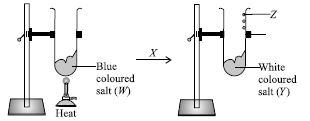
(a) W: CuSO4.5H2O; X: Physical change; Y: CuSO4; Z: H2O vapours
(b) W: MgSO4.7H2O; X: Physical change; Y: MgSO4; Z: H2O vapours
(c) W: FeSO4.7H2O; X: Chemical change; Y: FeSO4; Z: H2O droplets
(d) W: CuSO4.5H2O; X: Chemical change; Y: CuSO4; Z: H2O droplets
Show Answer & Explanation
Answer: (d) W: CuSO4.5H2O; X: Chemical change; Y: CuSO4; Z: H2O droplets
Explanation:
- The blue salt is hydrated copper sulphate, CuSO4.5H2O.
- Heating removes its water of crystallisation and leaves white CuSO4, which is a chemical change.
- The water given out cools on the upper cooler part and forms droplets.
- So the answer is (d).
I : Glass plate and steel plate
II : Iron nail and wooden rod
III : Glass marble and flower petals
IV : Chalk powder and sugar
Which of the following represents the properties best suitable to distinguish between the substances of each pair?
(a) I: Conductivity; II: Elasticity; III: Shape; IV: Physical state
(b) I: Transparency; II: Magnetic nature; III: Relative density; IV: Solubility in water
(c) I: Brittleness; II: Colour; III: Miscibility; IV: Taste
(d) I: Transparency; II: Conductivity; III: Elasticity; IV: Solubility in water
Show Answer & Explanation
Answer: (b) I: Transparency; II: Magnetic nature; III: Relative density; IV: Solubility in water
Explanation:
- Glass is transparent but steel is not.
- An iron nail is attracted by a magnet but a wooden rod is not.
- A glass marble sinks in water but flower petals float, and sugar dissolves in water but chalk powder does not.
- So the answer is (b).
(i) Freezing (ii) Evaporation (iii) Melting
(iv) Sublimation (v) Condensation (vi) Vaporisation
She asked students to match the keywords with the common changes which are listed as :
P : When we put a lid on a vessel containing hot milk, the inside of the lid gets wet.
Q : When we breathe onto a cold mirror it turns foggy.
R : When we spread hard butter on a warm toast, it becomes soft.
S : Solid piece of an air freshener kept on the bathroom shelf disappears in a few days.
T : When we put ice cubes in water, they disappear after some time.
U : Milk left in the freezer becomes ice cream.
The correct match is
(a) P - (ii); Q - (vi); R, S - (iii); T, U - (i)
(b) P, Q - (ii); R - (iii); S - (iv); T, U - (i)
(c) P, Q - (v); R, T - (iii); S - (iv); U - (i)
(d) P - (i); Q, R - (v) ; S, T - (iii); U - (iv)
Show Answer & Explanation
Answer: (c) P, Q - (v); R, T - (iii); S - (iv); U - (i)
Explanation:
- P and Q: vapour turns to liquid on a cold surface, which is condensation (v).
- R and T: a solid turns to liquid, which is melting (iii).
- S: a solid turns directly to gas, which is sublimation (iv). U: a liquid turns to solid, which is freezing (i).
- So the answer is (c).

I. Large volume of acid should be added to a small volume of water slowly.
II. The figure represents the process of concentrating dilute H2SO4.
III. The process involves release of a large amount of heat.
IV. Water should not be stirred.
(a) I and IV only
(b) II and III only
(c) I, II and IV only
(d) II only
Show Answer & Explanation
Answer: (c) I, II and IV only
Explanation:
- The figure shows concentrated acid being added slowly to water while stirring with a glass rod.
- Statement I is wrong: a small amount of acid is added to a large volume of water.
- Statement II is wrong: the process is dilution, not concentrating. Statement IV is wrong: the water is stirred, and III is correct.
- So the answer is (c) I, II and IV only.
| S. No. | Periodic change | Non-periodic change |
| I | Occurrence of new moon | Volcanic eruption |
| II | Growth of plants | Heartbeat |
| III | Occurrence of a rainbow | Low and high tides |
| IV | Sunrise and sunset | Falling of trees |
| V | Opening of Morning glory flower | Earthquake |
(a) I, IV and V only
(b) I, II and IV only
(c) I and V only
(d) I, II, III, IV and V
Show Answer & Explanation
Answer: (a) I, IV and V only
Explanation:
- Periodic changes repeat after a fixed time, like new moon, sunrise and sunset, and opening of morning glory.
- Volcanic eruption, falling of trees and earthquake are non-periodic.
- Rows II and III are placed the wrong way round, because heartbeat and tides are periodic while growth of plants and a rainbow are not.
- So the answer is (a) I, IV and V only.
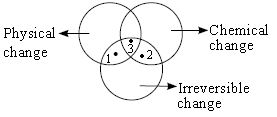
(a) 1: Melting of ice; 2: Boiling of rice; 3: Burning of a candle
(b) 1: Burning of paper; 2: Rusting of iron; 3: Cutting of fruits
(c) 1: Breaking of a glass; 2: Baking a cake; 3: Burning of LPG in kitchen
(d) 1: Tearing of paper; 2: Evaporation of water; 3: Making lemonade
Show Answer & Explanation
Answer: (c) 1: Breaking of a glass; 2: Baking a cake; 3: Burning of LPG in kitchen
Explanation:
- Breaking of a glass is a physical change that cannot be undone.
- Baking a cake is a chemical change that cannot be undone.
- Burning of LPG is a chemical change that cannot be undone and also gives out heat and light.
- So the answer is (c).
Group I : Nepenthes, Rafflesia, Drosera
Group II : Cuscuta, Hydnora, Utricularia
Group III : Hibiscus, Petunia, Dionaea
(a) Drosera in group I should be interchanged with Hydnora in group II.
(b) Utricularia in group II should be interchanged with Petunia in group III.
(c) Rafflesia in group I should be interchanged with Hibiscus in group III.
(d) Utricularia in group II should be interchanged with Rafflesia in group I whereas Dionaea in group III should be replaced with Ocimum.
Show Answer & Explanation
Answer: (d) Utricularia in group II should be interchanged with Rafflesia in group I whereas Dionaea in group III should be replaced with Ocimum.
Explanation:
- Nepenthes, Drosera, Utricularia and Dionaea are insectivorous plants.
- Rafflesia, Cuscuta and Hydnora are parasites, and Hibiscus, Petunia and Ocimum are ordinary green plants.
- So Utricularia and Rafflesia must swap, and Dionaea must be replaced by Ocimum.
- So the answer is (d).

What conclusion may be derived from the graph?
(a) High level of oxygen in the air causes breathing rate to drop, regardless of carbon dioxide level.
(b) Increase in carbon dioxide level in air causes breathing rate to increase upto a limit.
(c) Breathing rate is controlled only by oxygen content of air and is independent of carbon dioxide concentration.
(d) None of these
Show Answer & Explanation
Answer: (b) Increase in carbon dioxide level in air causes breathing rate to increase upto a limit.
Explanation:
- With 91% oxygen and 9% carbon dioxide the breathing rate goes up.
- With 100% oxygen (no carbon dioxide) the breathing rate goes down.
- So more carbon dioxide makes breathing faster, and the rise levels off.
- So the answer is (b).

(a) X: Aloe; Y: Mint
(b) X: Coriander; Y: Maize
(c) X: Basil; Y: Mustard
(d) X: Palm; Y: Bamboo
Show Answer & Explanation
Answer: (b) X: Coriander; Y: Maize
Explanation:
- X is a herb with reticulate venation, so it is a dicot herb such as coriander.
- Y is a herb with parallel venation, so it is a monocot herb such as maize.
- So the answer is (b).
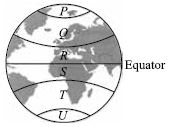
(a) Labelled parts P and U are the torrid zones.
(b) Labelled parts Q and T are temperate zones.
(c) Labelled parts R and S are frigid zones.
(d) None of these
Show Answer & Explanation
Answer: (b) Labelled parts Q and T are temperate zones.
Explanation:
- The zones on both sides of the equator (R and S) are the torrid zones.
- P and U near the poles are the frigid zones.
- Q and T between them are the temperate zones.
- So the answer is (b).
I. (a) It is a vitamin deficiency disease. – Go to II
(b) It is a mineral deficiency disease. – Go to III
II. (a) It is characterised by bleeding gums and aching joints. – P
(b) It is characterised by red rashes, scaly lesions on skin, diarrhoea, dementia, etc. – Q
III. (a) It affects haemoglobin formation in blood. – R
(b) It affects many metabolic processes of the body and is often characterised by prominent swelling in neck region. – S
(a) P is caused by vitamin C deficiency whereas Q is caused by vitamin E deficiency.
(b) P is scurvy, Q is pellagra, R is anaemia and S is goitre.
(c) Person suffering from R should take iodised salt and more of citrus fruits.
(d) Diseases P and Q occur in children only whereas diseases R and S occur only in adults.
Show Answer & Explanation
Answer: (b) P is scurvy, Q is pellagra, R is anaemia and S is goitre.
Explanation:
- Bleeding gums and aching joints are signs of scurvy, caused by lack of vitamin C.
- Rashes, diarrhoea and dementia are signs of pellagra, caused by lack of niacin.
- Lack of iron affects haemoglobin and causes anaemia, and lack of iodine causes goitre.
- So the answer is (b).

Select the correct option regarding constituents X and Y.
(a) X is formed by weathering of parent rock.
(b) Y contains nutrients required by the plants for their proper growth.
(c) X is composed of gravel, sand, silt or clay.
(d) All of these
Show Answer & Explanation
Answer: (d) All of these
Explanation:
- The mineral part of soil is formed by weathering of rocks.
- It is made of gravel, sand, silt or clay.
- The humus part holds nutrients that plants need for growth.
- So all the three statements are correct and the answer is (d) all of these.

Study the graph and select the correct statements regarding organisms P, Q and R.
(i) Q could be a heterotroph whereas P and R could be autotrophs.
(ii) Q is a herbivore that feeds exclusively on P.
(iii) If population of R is removed from this community, then population of P will decrease whereas that of Q will increase.
(iv) P is a carnivore, Q is a herbivore whereas R is an omnivore that feeds on both P and Q.
(v) R is the predator of P which in turn is the predator of Q.
(a) (ii) and (v) only
(b) (i), (iii) and (iv) only
(c) (i) and (ii) only
(d) (iii), (iv) and (v) only
Show Answer & Explanation
Answer: (c) (i) and (ii) only
Explanation:
- The population of R keeps rising whatever happens to P and Q, so R is not affected by them.
- Q falls after P is gone, so Q depends on P for food, which makes Q a herbivore feeding on P.
- So statements (i) and (ii) fit the graph, and the others do not.
- So the answer is (c) (i) and (ii) only.

Identify them and select the incorrect option regarding them.
(a) X always carries oxygen rich blood away from the heart whereas Y always carries carbon dioxide rich blood towards the heart.
(b) Y is provided with valves to prevent the back flow of blood whereas valves are absent in X.
(c) X is usually deep seated whereas Y is superficially placed.
(d) Pressure of blood is much higher in X as compared to Y.
Show Answer & Explanation
Answer: (a) X always carries oxygen rich blood away from the heart whereas Y always carries carbon dioxide rich blood towards the heart.
Explanation:
- X has the thick wall of an artery and Y has the thin wall of a vein.
- The pulmonary artery carries carbon dioxide rich blood away from the heart.
- The pulmonary vein carries oxygen rich blood towards the heart.
- So the word 'always' makes statement (a) incorrect, and the answer is (a).

(a) P may have mammary glands and may respire through lungs whereas Q may have jointed appendages and may respire through tracheae.
(b) Q could be a fish with 2 chambered heart or a reptile with 3 chambered heart.
(c) R may have unsegmented body with distinct head, muscular foot and visceral hump.
(d) S could be a detritivore which respires through its moist skin and is often called as farmer's friend.
Show Answer & Explanation
Answer: (b) Q could be a fish with 2 chambered heart or a reptile with 3 chambered heart.
Explanation:
- P has an endoskeleton, Q has a chitinous exoskeleton, R has a shell and S has no skeleton.
- Animals with a chitinous exoskeleton are arthropods, so Q cannot be a fish or a reptile.
- So statement (b) is incorrect.
- So the answer is (b).

Which of the following can be inferred from the graph?
(a) More water passes through the trunk than the branches.
(b) The greatest increase in the rate of water movement first occurs in branches.
(c) The increase in the rate of water movement first begins in the trunk.
(d) None of these
Show Answer & Explanation
Answer: (b) The greatest increase in the rate of water movement first occurs in branches.
Explanation:
- The branches curve reaches a higher peak than the trunk curve.
- The branches curve also rises and peaks earlier than the trunk curve.
- So the greatest increase first occurs in the branches.
- So the answer is (b).
(a) Some aquatic animals possess gills for breathing and have streamlined bodies.
(b) Forelimbs of birds are modified into wings and they have hollow air filled bones.
(c) People living in plains suffer from altitude sickness when they visit mountainous regions but soon recover and adjust to the changes.
(d) Animals inhabiting polar regions have thick furs and thick layers of subcutaneous fat.
Show Answer & Explanation
Answer: (c) People living in plains suffer from altitude sickness when they visit mountainous regions but soon recover and adjust to the changes.
Explanation:
- An adaptation is a feature that an organism has over many generations to suit its habitat.
- Gills, wings and thick fur are such features.
- Adjusting to a mountain within a few days is acclimatisation, not an adaptation.
- So the answer is (c).
(i) Add salt into the water
(ii) Add some goldfish into the pond
(iii) Spray a film of oil on the surface of the pond
(a) (i) only
(b) (ii) only
(c) (iii) only
(d) (i), (ii) and (iii)
Show Answer & Explanation
Answer: (b) (ii) only
Explanation:
- Salt in the water would harm the freshwater plants.
- An oil film on the surface would cut off air and light to the plants.
- Goldfish eat mosquito larvae and do not harm the plants.
- So the answer is (b) (ii) only.

(a) Decreased level of mineral nutrients in water.
(b) Decreased level of carbon dioxide in water due to photosynthesis performed by water plants.
(c) Increased level of carbon dioxide in water due to respiration performed by water plants and animals.
(d) None of these
Show Answer & Explanation
Answer: (b) Decreased level of carbon dioxide in water due to photosynthesis performed by water plants.
Explanation:
- Dissolved carbon dioxide makes water slightly acidic.
- In daylight water plants use up carbon dioxide for photosynthesis.
- Less carbon dioxide makes the water less acidic, so the pH rises.
- So the answer is (b).

Which of the following is the incorrect statement regarding it?
(a) X is an important component of fertilisers and proteins present in our body.
(b) Y is necessary for humans to get energy from food.
(c) During the process of burning X is used up and Z is given out.
(d) Both B and C
Show Answer & Explanation
Answer: (c) During the process of burning X is used up and Z is given out.
Explanation:
- X is the largest part of air, which is nitrogen, and Y is oxygen.
- Nitrogen is needed for fertilisers and proteins, and oxygen is needed to get energy from food.
- In burning it is oxygen that is used up, not nitrogen.
- So statement (c) is incorrect and the answer is (c).

(a) R secretes digestive enzymes viz. amylase, lipase, pepsin, trypsin, etc.
(b) P secretes bile juice whereas T secretes hydrochloric acid.
(c) S is longer in herbivores as compared to carnivores to aid the digestion of cellulose rich food.
(d) Q is the largest digestive gland which secretes different enzymes for digestion of fats, proteins and carbohydrates.
Show Answer & Explanation
Answer: (c) S is longer in herbivores as compared to carnivores to aid the digestion of cellulose rich food.
Explanation:
- Herbivores eat cellulose rich food, which takes a long time to digest.
- So the small intestine of a herbivore is longer than that of a carnivore.
- The other statements mix up the organs and what they secrete.
- So the answer is (c).
Jute is a rainy season crop and grows best in (i) climate. It grows well in (ii) soil receiving silt from annual floods, as in the Sunderban delta in (iii) and (iv).
(a) (i) Warm and humid, (ii) Alluvial, (iii) India, (iv) Bangladesh
(b) (i) Cold and dry, (ii) Black, (iii) India, (iv) Bangladesh
(c) (i) Warm and humid, (ii) Sandy, (iii) India, (iv) Nepal
(d) (i) Cold and dry, (ii) Alluvial, (iii) Bangladesh, (iv) Nepal
Show Answer & Explanation
Answer: (a) (i) Warm and humid, (ii) Alluvial, (iii) India, (iv) Bangladesh
Explanation:
- Jute needs a warm and humid climate.
- Soil that gets silt from yearly floods is alluvial soil.
- The Sunderban delta lies in India and Bangladesh.
- So the answer is (a).
(a) Platelets are smaller in size than both RBCs and WBCs.
(b) Platelet count decreases during certain infections.
(c) Platelets prevent blood loss in case of any injury.
(d) None of these
Show Answer & Explanation
Answer: (d) None of these
Explanation:
- Platelets are the smallest blood cells.
- Their count falls in some infections such as dengue.
- They help blood to clot and stop bleeding.
- So all three statements are correct, and the answer is (d) none of these.

(a) (ii) and (iv) only
(b) (iii) and (v) only
(c) (iv) only
(d) (i) only
Show Answer & Explanation
Answer: (d) (i) only
Explanation:
- Speed has only one value at a given time.
- Graph (i) has a vertical part at t = 0, which gives many speeds at one time.
- The other graphs each show one speed at every time, so they can be v – t graphs.
- So the answer is (d) (i) only.
| Solution | Indicators | ||
| Methyl orange | Phenolphthalein | China rose | |
| (i) | Orange | Colourless | Pink |
| Lime water | Yellow | Pink | (ii) |
| (iii) | Red | Colourless | (iv) |
| (v) | Yellow | Pink | Green |
(a) (i) Vinegar; (ii) Red; (iii) Spinach juice; (iv) Yellow; (v) Sugar solution
(b) (i) Sugar solution; (ii) Yellow; (iii) Salt solution; (iv) Pink; (v) Lime water
(c) (i) Common salt; (ii) Green; (iii) Tomato juice; (iv) Magenta; (v) Caustic soda
(d) (i) Lime juice; (ii) Green; (iii) Salt solution; (iv) Yellow; (v) Aerated drink
Show Answer & Explanation
Answer: (c) (i) Common salt; (ii) Green; (iii) Tomato juice; (iv) Magenta; (v) Caustic soda
Explanation:
- Lime water is a base, so China rose turns green in it, and (ii) is green.
- Methyl orange red and China rose magenta show an acid, so (iii) is an acid like tomato juice and (iv) is magenta.
- Yellow, pink and green show a base, so (v) is a base like caustic soda. A neutral substance like common salt leaves the indicators in their own colours, which suits (i).
- So the answer is (c).
Wool is obtained from fleece of certain animals. Angora wool is obtained from Angora goat. It is much warmer and softer than other wools. Mohair wool is obtained from Angora rabbit. Cashmere is obtained from yak and is common in Kashmir. Llama, Alpaca and Vicuna are members of camel family that yield extremely fine and expensive wool.
Select the correct option regarding this.
(a) Softer should be replaced with harder whereas Vicuna should be replaced with Lohi.
(b) The positions of goat and rabbit should be interchanged.
(c) Yak should not be replaced as it is correctly mentioned whereas Kashmir should be replaced with Kota.
(d) Camel should be replaced with sheep whereas Llama should not be replaced as it is correctly mentioned.
Show Answer & Explanation
Answer: (b) The positions of goat and rabbit should be interchanged.
Explanation:
- Angora wool comes from the Angora rabbit and mohair comes from the Angora goat.
- So goat and rabbit are placed the wrong way round in the paragraph.
- Llama, alpaca and vicuna are correctly said to belong to the camel family.
- So the answer is (b).
I. (a) Plant shows natural vegetative propagation. – Go to II
(b) Plant reproduces through asexual spores. – Go to III
II. (a) Plant propagates through stem. – P
(b) Plant propagates through leaves. – Q
III. (a) Leaves of plants called fronds contain spores. – R
(b) Short plants that grow only in moist habitats and bear spores in spore case or capsule. – S
(a) P could be Chrysanthemum or strawberry whereas R could be mushroom or mould.
(b) Q could be Bryophyllum or Begonia whereas S could be fern or moss.
(c) P and Q may produce flowers and seeds whereas both these structures are absent in R and S.
(d) P could be garlic that propagates through bulbs or turmeric that propagates through tuber whereas Q could be Petunia or Begonia.
Show Answer & Explanation
Answer: (c) P and Q may produce flowers and seeds whereas both these structures are absent in R and S.
Explanation:
- P and Q are flowering plants that propagate vegetatively, so they can produce flowers and seeds.
- R is a fern (fronds) and S is a moss, and neither has flowers or seeds.
- R cannot be mushroom or mould, S cannot be a fern, and Petunia does not propagate by leaves, so (a), (b) and (d) are wrong.
- So the answer is (c).
Question. Select a figure from the options which will continue the same series as established by the Problem Figures.
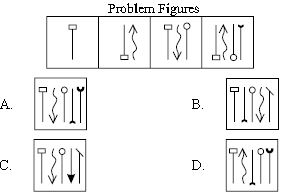
Show Answer
Answer: (a)
- Look at how the problem figures change one after another.
- The figure in option (a) carries on the same change.
- So the answer is (a).
Question. Select the correct water image of Fig. (X).
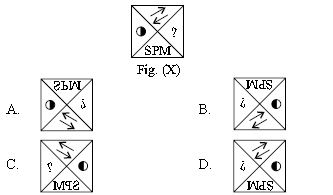
Show Answer
Answer: (a)
- A water image is the reflection seen when the figure is flipped top to bottom.
- So the top and bottom parts swap places and turn upside down, while left and right stay on the same sides.
- Option (a) shows the figure this way.
- So the answer is (a).
Question. The given question consists of a set of three figures X, Y and Z showing a sequence of folding of a piece of paper. Fig. (Z) shows the manner in which the folded paper has been cut. Select a figure from the options which would most closely resemble the unfolded form of Fig. (Z).

Show Answer
Answer: (a)
- Unfold the paper one fold at a time, in the reverse order of folding.
- Each cut in the folded paper repeats on the other side of every fold line.
- Option (a) shows the unfolded paper with the cuts in these places.
- So the answer is (a).
Question. Refer to the given food web operating in a community. Large amount of insecticides was sprayed in this community.

Which of the following graphs correctly depicts the changes in numbers of mice, caterpillars and sparrowhawks over time?

Show Answer
Answer: (d)
- The insecticide kills caterpillars quickly, so their number falls steeply.
- Sparrows lose food, and sparrowhawks that feed on sparrows decline slowly after that.
- The graph in option (d) shows a steep fall in caterpillars and a slower fall in sparrowhawks.
- So the answer is (d).
Free study material for Science Olympiad NSO
Practice MCQs for Class 7 Science NSO Olympiad
About NSO Olympiad MCQs for Class 7 Science
Review structured objective questions for Class 7 Science NSO Olympiad. Built according to official CBSE guidelines, these MCQ sets support daily revision and core concept reinforcement.
How to Verify Your MCQ Answers
Cross-reference your completed choices with comprehensive NCERT solutions for Class 7 Science to ensure absolute clarity across all sub-topics in this chapter.
Enhance Speed with Online MCQ Tests
Follow up your worksheet practice by attempting the interactive online Science MCQ test for this chapter to evaluate your execution speed. All platform resources are free to access.
FAQs
You can get most exhaustive CBSE Class 7 Science NSO Olympiad MCQs with Answers Set 08 for free on StudiesToday.com. These MCQs for Class 7 Science are updated for the 2026-27 academic session as per CBSE examination standards.
Yes, our CBSE Class 7 Science NSO Olympiad MCQs with Answers Set 08 include the latest type of questions, such as Assertion-Reasoning and Case-based MCQs. 50% of the CBSE paper is now competency-based.
By solving our CBSE Class 7 Science NSO Olympiad MCQs with Answers Set 08, Class 7 students can improve their accuracy and speed which is important as objective questions provide a chance to secure 100% marks in the Science.
Yes, Science MCQs for Class 7 have answer key and brief explanations to help students understand logic behind the correct option as its important for 2026 competency-focused CBSE exams.
Yes, you can also access online interactive tests for CBSE Class 7 Science NSO Olympiad MCQs with Answers Set 08 on StudiesToday.com as they provide instant answers and score to help you track your progress in Science.