

Science Objective Questions and Answers: Chapter 14 Water
Access targeted multiple-choice questions for Chapter 14 Water designed to align with the latest CBSE academic syllabus for Class 6 Science. These objective practice sets help students evaluate their conceptual understanding and improve exam readiness.
Download Chapter 14 Water MCQs with Answers
View or download the dedicated Chapter 14 Water MCQ resource below. Practicing these 50 objective questions regularly builds familiarity with standard exam patterns and helps secure higher marks in final Science evaluations.
Question. For which of these diseases is NO vaccination available?
a. Polio
b. Tetanus
c. Measles
d. Diarrhoea
Answer : D
Question. Sahil poured EQUAL AMOUNTS of water into three containers as shown in the figure and kept them all out in the hot sun for an entire day. At the end of the day he measured the amount of water left in each container. What CAN Sahil test with this information?

a. whether evaporation depends on the volume of water taken
b. whether evaporation depends on the temperature of the surroundings
c. whether evaporation depends on the material of the container
d. whether evaporation depends on the exposed area of the water
Answer : D
Question. If diarrhoea spreads rapidly through your town, which of these precautions should you start taking immediately?
a. cover your nose while going out
b. drink only clean, boiled water
c. cover open buckets of water
d. spray insecticides in the garden
Answer : B
Question. See the water-cycle shown alongside. What is the difference between the water vapour that evaporates from rivers (P) and the water that evaporates from the sea (Q)?
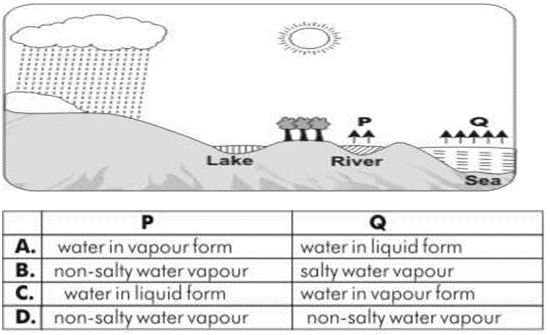
a. A
b. B
c. C
d. D
Answer : D
Question. The apparatus used for purifying water using a method called 'distillation' is shown below.
Impure water is boiled and the steam formed is passed through a chamber. Why is cold water also passed through this chamber?
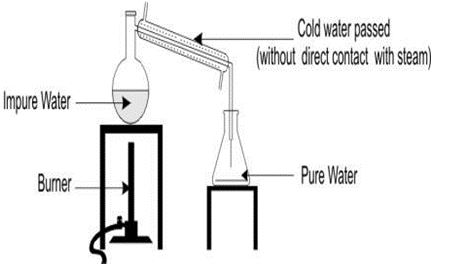
a. The cold water removes the impurities.
b. The cold water helps the steam condense.
c. The cold water helps the water evaporate.
d. The cold water dissolves the steam.
Answer : B
Question. Which of these options contains processes involving change of state from LIQUID to GAS?
a. evaporation and sublimation
b. evaporation and respiration
c. respiration and transpiration
d. evaporation and transpiration
Answer : D
Question. Sprinkling a little salt on ice helps to melt the ice. Shakun has three glasses of water with him. Glasses A and C have pure water and Glass B has salt water. He puts glasses A and B into the freezer and leaves C outside. Which of these will take the least time to freeze?
a. Glass A
b. Glass B
c. Both glasses A and C will freeze at the same time.
d. Glass C
Answer : A
Question. The annual rainfall of many leading Indian cities is given in the map below:
Which of these cities is likely to have the heaviest rainfall?
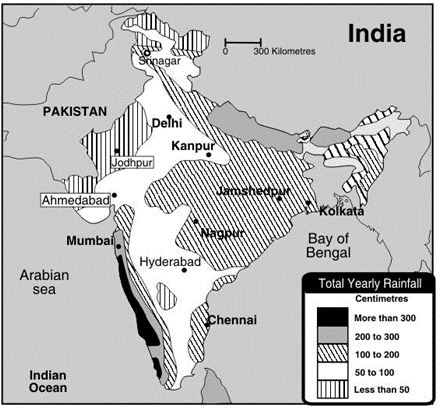
a. Mumbai
b. Kolkata
c. Delhi
d. Chennai
Answer : A
Question. In a certain locality, flooding occurs if the total rainfall over a three-day period exceeds 40 mm. How many times would flooding have occurred in the locality during the entire week?
a. Never
b. Once
c. Twice
d. Thrice
Answer : B
Question. What is the total approximate rainfall for the week?
a. 50 mm
b. 60 mm
c. 70 mm
d. 80 mm
Answer : D
Question. In water, where do fish get the oxygen they need to breathe?
a. Fish do not need to breathe oxygen.
b. Each water molecule (H2O) consists of an oxygen atom which fish breathe.
c. Fish come up to the surface of the water from time to time to breathe.
d. There is oxygen gas dissolved in the water which fish breathe.
Answer : D
Question. Shyam is running in the rain. In which way should he hold the umbrella so that he does not get wet?

Answer : B
Question. Observe this figure carefully. From which of the positions shown below will a person see a rainbow?
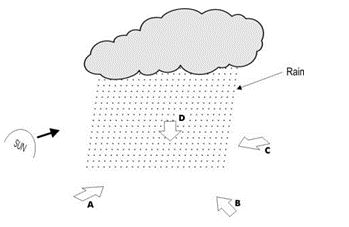
a. A
b. B
c. C
d. D
Answer : A
Question. When placed in salt water, an egg gets completely immersed but does not sink to the bottom (see figure).
Now three tablespoons of salt are added and the water is gently stirred. Which of these may be the NEW position of the egg?
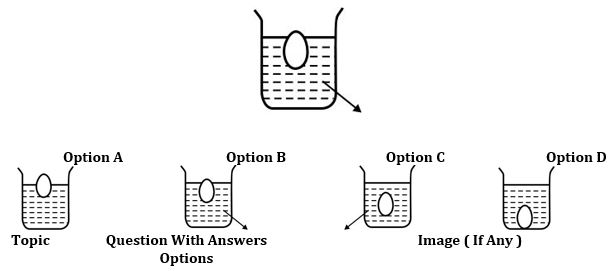
Answer : A
Question. Four people use four different methods to heat water for bathing. Who among the four uses a non-conventional energy source?
| Visu | Solar water heater |
| Sheel | Electric water heater |
| Nithai | Cooking gas |
| Mohan | Fire wood |
a. Vishu
b. Sheel
c. Nithai
d. Mohan
Answer : A
Question. Most of the rain water goes into
a. Lakes and ponds
b. Transpiration and evaporation
c. The ground water
d. Rivers and sea
Answer : C
Question. The circulation of water between ocean and land is a continuous process known as _____
a. Transpiration
b. Evaporation
c. Raining
d. Water cycle
Answer : D
Question. Rise in water level of rivers leads to
a. Flood
b. Drought
c. Water scarcity
d. Dry lands
Answer : A
Question. One way of increasing the availability of water is to collect rainwater and store it for later use. This is called ___________
a. Rain water catching
b. Rain water harvesting
c. Catching water
d. Water collection in catchment areas
Answer : B
Question. Fog appearing on a cold winter morning and Blackboard dries up after wiping it is due to:
a. Evaporation and condensation respectively
b. Condensation and evaporation respectively
c. Neither Evaporation nor condensation
d. both Evaporation and condensation
Answer : B
Question. Water vapour condenses to form tiny droplets of water in the upper layers of air where it is cooler. These droplets fall down as:
a. Rain
b. Storm
c. Cyclone
d. Drought
Answer : A
Question. Which of the following is not a source by which water in rivers, lakes, ponds, wells and soil is replenished:
a. Rain
b. Hail
c. Snow
d. Evaporation
Answer : D
Question. Water from the wet clothes disappears due to ________
a. Condensation
b. Evaporation
c. Moisture
d. Sun
Answer : B
Question. Which of the following is not a source of potable water:
a. Well
b. River
c. Lake
d. Sea
Answer : D
Question. A glass containing ice has water droplets around it. What conclusion can be drawn from this
a. The water from the ice has settled outside the glass
b. There is water in the air which has got condensed around the glass
c. The glass is sweating
d. The glass of ice is not so strong hence water goes through the glass and settles outside.
Answer : B
Answer Key

Attempt Mock Tests on this topic
Free study material for Science
Download Chapter MCQs: Class 6 Science Chapter 14 Water
About Chapter 14 Water MCQs for Class 6 Science
Explore reliable practice questions for Chapter 14 Water tailored for Class 6 Science learners. Use these multiple-choice formats to evaluate preparedness and strengthen problem-solving skills.
How to Verify Your MCQ Answers
Built using the official NCERT book for Class 6, these Science objective sets provide reliable academic guidance. Pair your practice with our recommended NCERT solutions to master optimal problem-solving approaches.
Enhance Speed with Online MCQ Tests
Explore our broader library of printable assignments, chapter notes, and mock tests designed to support continuous revision and secure higher marks in CBSE assessments.
FAQs
You can get most exhaustive CBSE Class 6 Science Water MCQs for free on StudiesToday.com. These MCQs for Class 6 Science are updated for the 2026-27 academic session as per CBSE examination standards.
Yes, our CBSE Class 6 Science Water MCQs include the latest type of questions, such as Assertion-Reasoning and Case-based MCQs. 50% of the CBSE paper is now competency-based.
By solving our CBSE Class 6 Science Water MCQs, Class 6 students can improve their accuracy and speed which is important as objective questions provide a chance to secure 100% marks in the Science.
Yes, Science MCQs for Class 6 have answer key and brief explanations to help students understand logic behind the correct option as its important for 2026 competency-focused CBSE exams.
Yes, you can also access online interactive tests for CBSE Class 6 Science Water MCQs on StudiesToday.com as they provide instant answers and score to help you track your progress in Science.