

Science Objective Questions and Answers: Chapter 03 Fibre to Fabric
Review structured MCQ sets for Class 6 Science Chapter 03 Fibre to Fabric. Built according to official CBSE guidelines, these downloadable questions support daily revision and core concept reinforcement.
Download Chapter 03 Fibre to Fabric MCQs with Answers
Navigate directly to the 50 objective questions for Chapter 03 Fibre to Fabric using the digital viewer below. Each practice set includes verified answer keys, allowing students to instantly cross-check their work and identify areas requiring further revision.
Fibre to Fabric
Question. Which of the following fibers are obtained from the fleece of animals?
a. Jute
b. Cotton
c. Nylon
d. Wool
Answer: D
Question. The pod of cotton containing fibres and seeds is called a cotton ____
a. Flower
b. Fruit
c. Boll
d. bloom
Answer: C
Question. A fabric is made of __________
a. Yarn
b. Thread
c. Hair
d. Coir
Answer: A
Question. The thin strands of yarn that we see, are made up of still thinner strands called ___________
a. Coir
b. Thread
c. Hair
d. Fibre
Answer: D
Question. The fibres of some fabrics such as cotton, jute, silk and wool are obtained from plants and animals. These are called
a. Natural fibres
b. Artificial fibres
c. Rayon fibre
d. Nylon fibre
Answer: A
Question. Cotton is usually picked by hand. Fibres are then separated from the seeds by combing. This process is called ____________ of cotton.
a. Machining
b. Ginning
c. Raining
d. Spinning
Answer: B
Question. Jute fibre is obtained from the _______ of the jute plant.
a. Stem
b. Leaves
c. Flower
d. Fruit
Answer: A
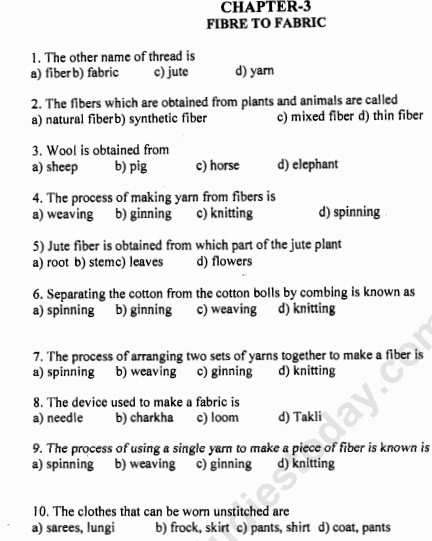
Question. The process of making yarn from fibres is called__________.
a. Weaving
b. Spinning
c. Knitting
d. Looming
Answer: B
Question. The process of arranging two sets of yarns together to make a fabric is called___________.
a. Spinning
b. Knitting
c. Looming
d. weaving
Answer: D
Question. In ___________, a single yarn is used to make a piece of fabric.
a. Spinning
b. Knitting
c. Weaving
d. looming
Answer: B
Question. Weaving of fabric is done on__________.
a. Looms
b. Fabric
c. Paper
d. Needles
Answer: A
Question. Which of the following is not a natural fabric?
a. Silk
b. Nylon
c. Cotton
d. Wool
Answer: B
Question: What happens if wool yarn is burnt
a) It shrinks and burns but does not melt
b) Its does not shrink and melt
c) It has odour of charred meat
d) It has odour of burning paper
Answer: It shrinks and burns but does not melt
Question: What happens if cotton yarn is burnt
a) It does not shrink or melt
b) It shrinks but does not melt
c) It has odour of charred meat
d) Odour of burning hair
Answer: It does not shrink or melt
Question: Fabrics are made of multiple threads called as
a) Yarns
b) Cotton
c) Silk
d) Cloth
Answer: Yarns
Question: Weaving of fabric is done on which device
a) Looms
b) Dooms3
c) Cloth
d) Table
Answer: Looms
Question: Hand operated device to make cotton yarns popularised by Mahatma Gandhi is
a) Charkha
b) Takli
c) Hand spindle
d) Weaving
Answer: Charkha
Question: Jute is cultivated in which season
a) Rainy
b) Summer
c) Winter
d) Spring
Answer: Rainy
Question: Cotton is which part of the plant
a) Fruit
b) Stem
c) Roots
d) Trunk
Answer: Fruit
Question: Silk fibre is drawn from
a) Cocoon of silkworm
b) Cocoon of sheep
c) Cocoon of animals
d) Cocoon of cow
Answer: Cocoon of silkworm
Question: Which of the following are obtained from plant
a) Cotton and Jute
b) Wool and Silk
c) Polyester and nylon
d) Acrylic
Answer: Cotton and Jute
Question: What are mufflers made of
a) Wool
b) Silk
c) Jute
d) Cotton
Answer: Wool
Question: Cotton is grown in which of the following state
a) Karnataka
b) Bihar
c) Jammu and Kashmir
d) Maharashtra
Answer: Karnataka
Question: What happens if silk yarn is burnt
a) Shrinks away burns but does not melt
b) it does not shrink or melt
c) It has odour of burning paper
d) it has odour of burning plastics
Answer: Shrinks away burns but does not melt
Question: Yarns are made up of fibres obtained from
a) Natural and chemical process
b) Plants
c) Animals
d) Wool
Answer: Natural and chemical process
Question: To make a sweater how many yarns are required
a) Single Yarn
b) Multiple yarns
c) Two yarns
d) Five yarns
Answer: Single Yarn
Question: Two main processes of making fabrics from yarns are
a) Weaving and knitting
b) Weaving and spinning
c) Spinning and Ginning
d) Knitting and Ginning
Answer: Weaving and knitting
Question: Jute is grown in which of the following state
a) Bihar
b) Maharashtra
c) Sikkim
d) Karnataka
Answer: Bihar
Question: The process of separating cotton from seeds is called
a) Ginning
b) Mining
c) Spinning
d) Separation
Answer: Ginning
Question: Mattresses, pillows, quilts etc. are filled with which kind of fibre?
a) Cotton
b) Wool
c) Silk
d) Polyester
Answer: Cotton
Question: Which animal gives wool?
a) Sheep
b) Cow
c) Dear
d) Lion
Answer: Sheep
Question: Pull out yarns from a cotton cloth and scratch it from one end, What can u see?
a) Thin strands of thread called as fibres
b) Thin layers of cloth coming out
c) Yarns come out easily from cloth
d) Threads come out
Answer: Thin strands of thread called as fibres
Question: Socks are made with which process
a) Knitting
b) Weaving
c) Spinning
d) Ginning
Answer: Knitting
Question: What happens if synthetic yarn is burnt
a) It shrinks and melts
b) It does not shrink or melt
c) It give odour of charred meat
d) Odour of burning paper
Answer: It shrinks and melts
Question: Nylon and polyester are which type of fibres
a) Synthetic fibres
b) Natural fibres
c) Artificial fibres
d) Chemical fibres
Answer: Synthetic fibres
Question: In ancient times people made clothes of
a) Animal skin and leaves
b) Silk and cotton
c) Cotton and wool
d) Wool and silk
Answer: Animal skin and leaves
Question: Process of arranging 2 sets of yarn to make a fabric is called
a) Weaving
b) Knitting
c) Spinning
d) Ginning
Answer: Weaving
Question: Process of making yarn from fibres is called
a) Spinning
b) Mining
c) Ginning
d) Separating
Answer: Spinning
Question: Jute fibre is which part of the plant
a) Stem
b) Roots
c) Fruit
d) Leaves
Answer: Stem
Question: Cotton plants are grown at places with
a) Black soil and warm climate
b) White soil and dry climate
c) Black soil and humid climate
d) White soil and warm climate
Answer: Black soil and warm climate
Question: Synthetic fibres are
a) Obtained from chemical process
b) Obtained from animal
c) Obtained from plants
d) Obtained from yak and camel
Answer: Obtained from chemical process
Question: Fibres obtained to make wool and silk are?
a) Natural fibres
b) Artificial Fibres
c) Synthetic fibres
d) Chemical fibres
Answer: Natural fibres
Answer Key

Free study material for Science
Practice MCQs for Class 6 Science Chapter 03 Fibre to Fabric
Download Multiple Choice Questions: Chapter 03 Fibre to Fabric (Class 6 Science)
Explore reliable practice questions for Chapter 03 Fibre to Fabric tailored for Class 6 Science learners. Use these multiple-choice formats to evaluate preparedness and strengthen problem-solving skills.
Concept Clarification for Chapter 03 Fibre to Fabric
Built using the official NCERT book for Class 6, these Science objective sets provide reliable academic guidance. Pair your practice with our recommended NCERT solutions to master optimal problem-solving approaches.
Additional Study Resources for Class 6 Science
Follow up your worksheet practice by attempting the interactive online Science MCQ test for this chapter to evaluate your execution speed. All platform resources are free to access.
FAQs
You can get most exhaustive CBSE Class 6 Science Fibre to Fabric MCQs for free on StudiesToday.com. These MCQs for Class 6 Science are updated for the 2026-27 academic session as per CBSE examination standards.
Yes, our CBSE Class 6 Science Fibre to Fabric MCQs include the latest type of questions, such as Assertion-Reasoning and Case-based MCQs. 50% of the CBSE paper is now competency-based.
By solving our CBSE Class 6 Science Fibre to Fabric MCQs, Class 6 students can improve their accuracy and speed which is important as objective questions provide a chance to secure 100% marks in the Science.
Yes, Science MCQs for Class 6 have answer key and brief explanations to help students understand logic behind the correct option as its important for 2026 competency-focused CBSE exams.
Yes, you can also access online interactive tests for CBSE Class 6 Science Fibre to Fabric MCQs on StudiesToday.com as they provide instant answers and score to help you track your progress in Science.