

Multiple Choice Questions (MCQs) for Class 6 Science: Chapter 15 Air Around Us
Explore reliable objective questions for Chapter 15 Air Around Us tailored for Class 6 learners. Utilizing these Science multiple-choice formats ensures thorough preparation and strengthens problem-solving speed for upcoming school assessments.
Practice Chapter 15 Air Around Us MCQs for Class 6 Science
Access the complete set of multiple-choice questions for Chapter 15 Air Around Us below. This focused format allows students to isolate specific topics for thorough review and uninterrupted practice alongside official CBSE textbooks.
Question: Air is a/an
a) mixture
b) element
c) compound
d) None of these
Answer: mixture
Question: Which of the following component of air cannot be taken directly by plants?
a) Nitrogen
b) None of these
c) Oxygen
d) Carbon dioxide
Answer: Nitrogen
Question: Wind mill is used
a) All of these
b) to draw water from tubewells
c) to generate electricity
d) to run flour mills
Answer: All of these
Question: In which of the following cities would there be maximum water vapour in the air on a sunny day in December?
a) Mumbai
b) Delhi
c) Srinagar
d) Bhopal
Answer: Mumbai
Question: If burning splinter is taken close to the gas jar filled with oxygen, taken gas formed is
a) carbon dioxide
b) sulphur dioxide
c) nitrogen dioxide
d) carbon monoxide
Answer: carbon dioxide
Question: Photosynthesis by plant releases
a) O2
b) CO2
c) CO
Answer: O2
Question: Oxygen is consumed from atmosphere in the following process
a) combustion of fuel
b) absorbed by green plants during photosynthesis
c) biological fixation by symbiotic bacteria
d) cultivation of land
Answer: combustion of fuel
Question: The percentage composition of oxygen in air is
a) 1/5 of the volume
b) 1/6 of the above volume
c) 1/4th of the volume
d) None of these
Answer: 1/5 of the volume
Question: Nitrogen is used
a) in preserving tinned foods
b) all are correct
c) as a refrigerant
d) in electric bulbs
Answer: in preserving tinned foods
Question: Which gas makes up major part of the air?
a) Nitrogen
b) Helium
c) Krypton
d) Argon
Answer: Nitrogen
Question: The constituent of air that supports combustion is
a) oxygen
b) nitrogen
c) carbon dioxide
d) No0ne of these
Answer: oxygen
Question: Which of the following represents correct order of abundance of various gases in air?
a) Nitrogen> Oxygen> Carbon dioxide> Argon
b) Nitrogen> Oxygen> Argon> Carbon dioxide
c) Oxygen > Nitrogen> Carbon dioxide> Argon
d) Carbon dioxide> Nitrogen> Oxygen > Argon
Answer: Nitrogen> Oxygen> Carbon dioxide> Argon
Question: Which of the following is a variable component of air ?
a) Water vapour
b) Nitrogen
c) Oxygen
d) Carbon dioxide
Answer: Water vapour
Question: The atmospheric layer nearest the earth's surface is the
a) troposphere
b) stratosphere
c) ionosphere
d) mesosphere
Answer: troposphere
Question: Which of the following is second layer of atmosphere?
a) Stratosphere
b) Thermosphere
c) Troposphere
d) Mesosphere
Answer: Stratosphere
1. Which of the following is second layer of atmosphere?
(A) Troposphere (B) Stratosphere
(C) Mesosphere (D) Thermosphere
2. Which of the following is a variable component of air ?
(A) Nitrogen (B) Oxygen
(C) Water vapour (D) Carbon dioxide
3. The atmospheric layer nearest the earth's surface is the
(A) stratosphere (B) ionosphere
(C) troposphere (D) mesosphere
4. Which of the following represents correct order of abundance of various gases in air?
(A) Nitrogen> Oxygen> Carbon dioxide> Argon
(B) Nitrogen> Oxygen> Argon> Carbon dioxide
(C) Oxygen > Nitrogen> Carbon dioxide> Argon
(D) Carbon dioxide> Nitrogen> Oxygen > Argon
5. The constituent of air that supports combustion is
(A) oxygen (B) nitrogen
(C) carbon dioxide (D) (A) and (B) both
6. Which gas makes up major part of the air?
(A) Nitrogen (B) Argon
(C) Helium (D) Krypton
7. Nitrogen is used
(A) in electric bulbs.
(B) as a refrigerant.
(C) in preserving tinned foods.
(D) all are correct.
8. The percentage composition of oxygen in air is
(A) 1/4 th of the volume
(B) 1/6 of the above volume
(C) 1/5 of the volume
(D) 1/3 rd of the volume
9. Oxygen is consumed from atmosphere in the following process
(A) combustion of fuel.
(B) absorbed by green plants during photosynthesis.
(C) biological fixation by symbiotic bacteria.
(D) cultivation of land.
1.
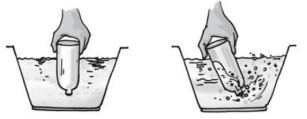
Take an empty glass bottle. Turn it, upside down. Now, dip the open mouth of the bottle into the bucket filled with water. Now tilt the bottle slightly. You can see bubbles coming out of the bottle or hear any bubbly sound. Which of the following cannot be inferred from this activity?
a. Air is everywhere. It is present even in the empty bottle.
b. Air does not have any colour and it is transparent
c. Air has weight
d. Air occupies space
Answer: C
2. Fix two small candles of the same size in the middle of two shallow containers. Now, fill the containers with some water. Light the candles and then cover each one of them with an inverted glass (one much taller than the other) Observe carefully what happens to the burning candles and the water level. What do you not infer from this experiment:
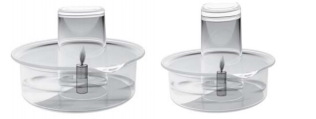
a. There is a component of air that is required for burning
b. As that component has been consumed during burning the candles went off.
c. The height of the water in the inverted glasses is 1/5th the height of the glass. It means that component is 1/5th of the air
d. The remaining air is nitrogen
Answer: D
3. Mountaineers carry oxygen cylinder with them because:
a. The air is very cold up the mountain
b. There is less air on the top of the mountain
c. They feel happy carrying the oxygen cylinders
d. Oxygen is required for burning
Answer: B
4. Plants and animals consume oxygen for respiration and produce carbon dioxide. How is this carbon dioxide consumed to balance the carbon dioxide—oxygen balance.
a. People stop breathing for some time
b. Plants can be burnt to release oxygen
c. Plants take in carbon dioxide and exhale oxygen during photosynthesis
d. Oxygen comes into the earth’s atmosphere from outside.
Answer: C
5. We should breathe through the nose and not by the mouth, because ____
a. it is a bad habit
b. the air is moisturized when we breathe through mouth
c. the hair and mucus in our nostrils trap soot and dust particles present in the air
d. it is natural phenomenon
Answer: C
6. Take some water in a glass vessel or beaker. Heat it slowly on a tripod stand. Well before the water begins to boil, look carefully at the inner surface of the vessel. From where do these bubbles come?
a. These bubbles are due to the heating of water closer to the vessel
b. These bubbles are due to extremely cold temperature of the water
c. The dissolved air comes out of the water
d. The bubbles are due to formation of fog
Answer: C
7. Earth worms come out of the soil during rainy seasons because:
a. The rain goes into the soil and reaches the water table. The earthworms come out to be relieved of the wet weather.
b. The rain fills up the space between soil particles. The air comes out; Hence earthworms come out for breathing
c. The earthworms come out to move around in the sun
d. None of the above
Answer: B
8.
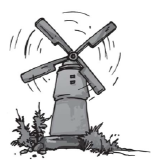
This is a wind mill. It uses air for:
a. Making it move and thus it is able to generate electricity
b. Making it move to show the direction of the wind
c. Making it move to show signals
d. Making it move to slow down vehicles
Answer: A
9. Air plays an important role in water cycle. How?
a. Air moves over the oceans
b. Air moves over the land
c. Air moves to evaporate water which then condenses on cooler layers
d. Air is everywhere.
Answer: C
10. Plants depend on animals and animals depend on plants. How?
a. Plants cannot get water without animals
b. Plants use carbon dioxide for preparing food and animals give out carbon dioxide during respiration. Thus a balance is maintained in the oxygen –carbon dioxide level.
c. Plants and animals cannot live without food and shelter.
d. None of the above.
Answer: B
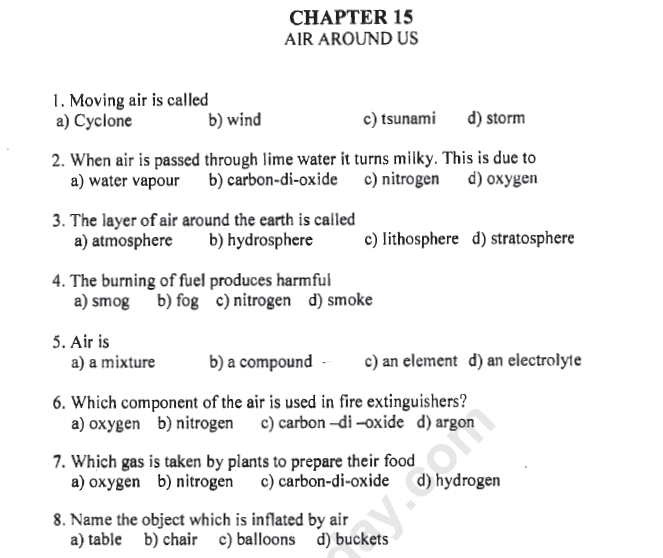
Answer Key

Free study material for Science
Practice MCQs for Class 6 Science Chapter 15 Air Around Us
About Chapter 15 Air Around Us MCQs for Class 6 Science
Test your conceptual understanding of Chapter 15 Air Around Us with these targeted multiple-choice questions. Designed in alignment with the latest CBSE curriculum for Class 6 Science, these problem sets build accuracy and prepare students for objective exams.
How to Verify Your MCQ Answers
Each question includes structured solution keys mapped directly to standard CBSE textbooks, helping students evaluate their reasoning and correct mistakes early in their revision.
Enhance Speed with Online MCQ Tests
Explore our broader library of printable assignments, chapter notes, and mock tests designed to support continuous revision and secure higher marks in CBSE assessments.
FAQs
You can get most exhaustive CBSE Class 6 Science Air Around Us MCQs for free on StudiesToday.com. These MCQs for Class 6 Science are updated for the 2026-27 academic session as per CBSE examination standards.
Yes, our CBSE Class 6 Science Air Around Us MCQs include the latest type of questions, such as Assertion-Reasoning and Case-based MCQs. 50% of the CBSE paper is now competency-based.
By solving our CBSE Class 6 Science Air Around Us MCQs, Class 6 students can improve their accuracy and speed which is important as objective questions provide a chance to secure 100% marks in the Science.
Yes, Science MCQs for Class 6 have answer key and brief explanations to help students understand logic behind the correct option as its important for 2026 competency-focused CBSE exams.
Yes, you can also access online interactive tests for CBSE Class 6 Science Air Around Us MCQs on StudiesToday.com as they provide instant answers and score to help you track your progress in Science.