

Download CBSE MCQs for Class 6 Science: Chapter 08 Body Movements
Review structured MCQ sets for Class 6 Science Chapter 08 Body Movements. Built according to official CBSE guidelines, these downloadable questions support daily revision and core concept reinforcement.
Chapter-wise Objective Questions: Chapter 08 Body Movements
View or download the dedicated Chapter 08 Body Movements MCQ resource below. Practicing these 50 objective questions regularly builds familiarity with standard exam patterns and helps secure higher marks in final Science evaluations.
Body Movements
Question. The bones in our body also form a frame work to give shape to our body. This frame work is called ____.
a. Spine
b. Skeleton
c. Pelvic girdle
d. Sternum
Answer : B
Question. The ribs join the chest bone and the back bone to form a box called the ________
a. Rib cage
b. Cervical region
c. Backbone
d. Knee
Answer : A
Question. The body part used by the snake to move and its movement is called:
a. Legs, walk
b. Wings, fly
c. Whole body, slither
d. Fins, swim
Answer : C
Question. The body part used by the bird to move and its movement is called:
a. Legs, walk
b. Wings, fly
c. Whole body, slither
d. Fins, swim
Answer : B
Question. The body part used by the fish to move and its movement is called:
a. Legs, walk
b. Wings, fly
c. Whole body, slither
d. Fins, swim
Answer : D
Question. The movement of upper arm is _______
a. In two directions
b. Rotates completely
c. Does not move at all
d. Bends in one direction only
Answer : B
Question. The movement of head is _______
a. In one direction
b. Rotates completely
c. Rotates partly
d. Bends in one direction only
Answer : C
Question. The movement of the elbow is _______
a. In two direction
b. Rotates completely
c. Does not move at all
d. Bends in one direction only
Answer : D
Question. We are able to bend or rotate our body in places where two parts of our body seem to be joined together These places are called_____________
a. Bones
b. Blood
c. Nerves
d. Joints
Answer : D
Question. The rounded end of one bone fits into the cavity (hollow space) of the other bone. Such a joint allows movements in all directions. Such a joint is called_____________.
a. Ball and socket joint
b. Pivotal joint
c. Hinge joint
d. Fixed joint
Answer : A
Question. The joint where our neck joins the head is a _______ joint. In this joint a cylindrical bone rotates in a ring.
a. Ball and socket joint
b. Pivotal joint
c. Hinge joint
d. Fixed joint
Answer : B
Question. Joint that allows only a back and forth movement is called____________.
a. Ball and socket joint
b. Pivotal joint
c. Hinge joint
d. Fixed joint
Answer : C
Question. There are some bones in our body that are joined together and cannot move. Such joints are called_________.
a. Ball and socket joint
b. Pivotal joint
c. Hinge joint
d. Fixed joint
Answer : D
Question. The skeleton is made of bones and _______.
a. Muscles
b. Cartilages
c. Skin
d. Blood
Answer : B
Question. Movement in humans is due to Bones and __________
a. Blood
b. Skin
c. Legs
d. Muscles
Answer : D
Question. Most animals can move from one place to another. This type of movement is called ____.
a. Movement
b. Transportation
c. Conduction
d. locomotion
Answer : D
Question. The head and tail of the fish are smaller than the middle portion of the body – the body tapers at both ends. This body shape is called streamlined. It helps the fish to
a. Swim
b. Cut through water
c. To attack its enemy
d. To take care of its young ones
Answer : B
Question. Most animals can move from one place to another. This type of movement is called ____.
a. Movement
b. Transportation
c. Conduction
d. locomotion
Answer : D
Question. Earthworm fixes part of its body during movement to the soil using
a. Muscles which help to extend and shorten the body
b. Skin which is slimy to touch
c. Tiny bristles projecting out which are connected to the muscles
d. None of the above
Answer : A
Question. The bones are held together at the joint by tough structures called –
a) Tendons
b) ligaments
c) nerves
d) muscles
Answer : B
Question. At birth our body is made up of ----------- bones.
a) 206
b) 305
c) 200
d) 300
Answer : D
Question. A Skeletal System consists of ------------------
a) Bones and muscles
b)muscles and nerves
c)bones and nerves
d) Bones and cartilages
Answer : D
Question. There are ---------------joints in our body.
a) 40
b) 35
c) 22
d) 25
Answer : C
Question. Muscles are attached to the bones by -----------------
a) nerves
b) joints
c) tendons
d) cartilages
Answer : C
Question. There are more than ---------------- muscles in our body.
a) 350
b) 300
c) 360
d) 325
Answer : A
Question. The number of bones in an adult skeleton are -----------
a) 200
b) 225
c) 300
d) 206
Answer : D
Question. The number of bones in the neck of a giraffe is -----------
a) 70
b) 50
c) 7
d) 10
Answer : C
Question. The aquatic animal whose skeleton is made entirely by cartilages is the -------------
a) whale
b) dolphin
c) shark
d) seahorse
Answer : C
Question. The streamlined body is found in a ----------
a) snail
b) earthworm
c) fish
d) jellyfish
Answer : B
Question. A cockroach has -------------- pair of legs.
a) Two
b) three
c) four
d) one
Answer : D
Question. Which of the following animal has its body covered by a hard shell?
a) Snake
b) earthworm
c) fish
d) snail
Answer : C
Question. Fish moves with the help of its ------------------
a) Flagella
b) fins
c) hindlimbs
d) circular and longitudinal muscles
Answer : B
Question. Which of the following is made up of the vertebrae ?
a) Cartilage
b) backbone
c) skull
d) rib cage
Answer : B
Question. The joint which allows the maximum movement is the -----------
a) Slightly moveable joint
b)ball and socket joint
c)hinge joint
d)pivot joint
Answer : B
Question. This joint helps the bowler in the game of cricket ---------
a) Hinge joint
b) pivot joint
c) ball and socket joint
d) slightly movable joint
Answer : C
Question. Synovial fluid is found in the ---------------
a) Muscles
b) freely movable joints
c) slightly movable joints
d) immovable joints
Answer : B
Question.Dhoni tried to bend his elbow backward like how he could with his shoulder . He found he could not . This is because the elbow joint is made up of –
a) pivot joint
b) hinge joint
c) ball and socket joint
d) fixed joint
Answer : B
Question. Sachin has fractured one of his bones in his rib cage . Which of the organs could be affected in the accident?
a) kidneys
b) lungs
c) lungs and heart
d) heart alone
Answer : C
Question. The muscles that support the beating of the heart are the –
a) Voluntary muscles
b) cardiac muscles
c) involuntary muscles
d) biceps and triceps
Answer : C
Question. The joints between the gum and teeth are –
a) Fixed joints
b) synovial joints
c) cartilaginous joints
d) perfect joints
Answer : A
Question. An exoskeleton is found in animals like –
a) Cockroach
b) fish
c) earthworm
d) snake
Answer : A
Question. The bones of the skull are interlocked with each other by their senated margins called –
a) Synovial membrane
b) cartilages
c) sutures
d) tendons
Answer : C
Question. A fluid forming an incompressible skeleton is found in –
a) frog
b)fish
c) snail
d) earthworm
Answer : D
Question. ______________offers least resistance to forward movement through the water by a fish
a) Strong muscles
b) tail and fins
c) bones
d) streamlined body shape.
Answer : D
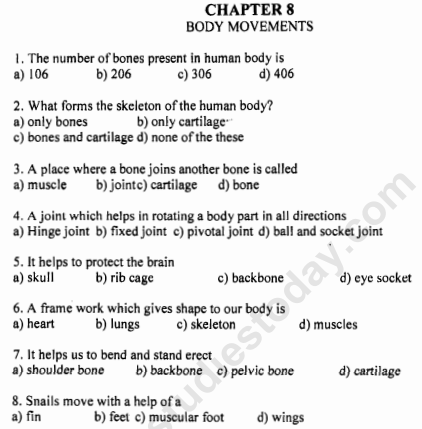

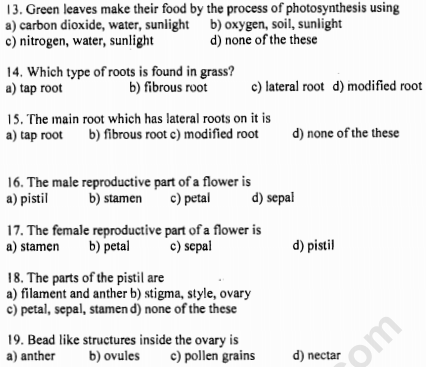
ANSWER KEY

Free study material for Science
Practice MCQs for Class 6 Science Chapter 08 Body Movements
Download Multiple Choice Questions: Chapter 08 Body Movements (Class 6 Science)
Review structured objective questions for Class 6 Science Chapter 08 Body Movements. Built according to official CBSE guidelines, these MCQ sets support daily revision and core concept reinforcement.
Concept Clarification for Chapter 08 Body Movements
Cross-reference your completed choices with comprehensive NCERT solutions for Class 6 Science to ensure absolute clarity across all sub-topics in this chapter.
Additional Study Resources for Class 6 Science
Explore our broader library of printable assignments, chapter notes, and mock tests designed to support continuous revision and secure higher marks in CBSE assessments.
FAQs
You can get most exhaustive CBSE Class 6 Science Body Movements MCQs for free on StudiesToday.com. These MCQs for Class 6 Science are updated for the 2026-27 academic session as per CBSE examination standards.
Yes, our CBSE Class 6 Science Body Movements MCQs include the latest type of questions, such as Assertion-Reasoning and Case-based MCQs. 50% of the CBSE paper is now competency-based.
By solving our CBSE Class 6 Science Body Movements MCQs, Class 6 students can improve their accuracy and speed which is important as objective questions provide a chance to secure 100% marks in the Science.
Yes, Science MCQs for Class 6 have answer key and brief explanations to help students understand logic behind the correct option as its important for 2026 competency-focused CBSE exams.
Yes, you can also access online interactive tests for CBSE Class 6 Science Body Movements MCQs on StudiesToday.com as they provide instant answers and score to help you track your progress in Science.