

Download CBSE Class 12 Accountancy Assignments
Access comprehensive school assignments for Part 1 Chapter 01 Accounting For Not For Profit Organisation using the CBSE Class 12 Accountancy Accounting for Not for Profit Organisation Assignment. Designed to align with the 2026-27 CBSE academic guidelines, these practice sets help Class 12 Accountancy students reinforce core concepts and improve their problem-solving accuracy.
Access CBSE School Assignments and Answers
Access the complete assignment PDF for Class 12 Accountancy below. Regular practice with these targeted academic tasks builds familiarity with standard question patterns and helps secure higher marks in final school evaluations.
Question. Which of the following is main source of income of non-profit organisation?
a) Sale of old books
b) Sale of old furniture
c) Received subscription
d) Business
Answer : C
Question. For the year ending 31st March, 2022, the following entries appeared related to subscription received
Amt (Rs)
2020-21 5,000
2021-22 96,000
2022-23 10,400
The club has 300 members, paying annual subscription of Rs 400 each. Subscription outstanding on 31st March, 2021 was Rs 8,000. Calculate the amount of subscription to be shown in the income and expenditure account?
a) Rs 96,000
b) Rs 1,11,400
c) Rs 1,20,000
d) Rs 91,000
Answer : C
Question. Which of the following will be recorded in credit side of receipts and payments account?
a) Rs 300 received from entrance fees
b) Cash purchases of books Rs 700
c) Donation received Rs 800
d) Outstanding Rs 300 for repair
Answer : B
Question. Donation can be
a) general donation
b) specific donation
c) Both (a) and (b)
d) None of these
Answer : C
Question. Item that should be debited in the income and expenditure account of a college is
a) tuition fees received from students
b) equipment purchased for science laboratory
c) amount of reward
d) fines collected from students
Answer : B
Question. Consider the following information
Sports fund investment Rs 70,000
Donation for sports fund Rs 15,000
Sports prizes awarded Rs 10,000
Expenses on sports events Rs 8,000
Income from sports fund investment Rs 5,000
Calculate amount of sport fund that will be shown in liability side of balance sheet.
a) Rs 40,000
b) Rs 38,000
c) Rs 45,000
d) Rs 72,000
Answer : D
Question. Consider the following statements
I. Income and expenditure records both capital and revenue items.
II. Receipt and payment account records only revenue items during the year.
Choose the correct option
a) Both are incorrect
b) Both are correct
c) Only (i) is correct
d) Only (ii) is correct
Answer : A
Question. Which of the following cannot be recorded in the receipt and payment account of a club?
a) Payment made to workers
b) Sale of old newspaper
c) Loss on sale of fixed asset
d) All of the above
Answer : C
Question. Capital fund in non-profit organisation will be
a) Total Assets − Total Liabilities
b) Total Assets − External Liabilities
c) Total Assets − Internal Liabilities
d) Total Fund − Total External Liabilities
Answer : A
Question. In the final account of non-profit organisation, closing balance of cash will be recorded in
a) receipt and payment account only
b) balance sheet only
c) income and expenditure account
d) receipt and payment account and balance sheet both
Answer : D
Question. Find the cost of medicines consumed, if Opening stock of medicines Rs 30,000 Purchases during the year Rs 50,000 Closing stock Rs 20,000
a) Rs 80,000
b) Rs 60,000
c) Rs 50,000
d) Rs 40,000
Answer : B
Question. What amount of rent will be transferred to debit side of income and expenditure account, if rent paid during the year was Rs 70,000, rent outstanding at the end of the year Rs 6,000 and rent outstanding at the beginning of the year Rs 8,000?
a) Rs 60,000
b) Rs 68,000
c) Rs 70,000
d) Rs 72,000
Answer : B
Question. A non-profit organisation normally prepares …… before preparing balance sheet.
a) income and expenditure account
b) real account
c) trading account
d) None of the above
Answer : A
Question. Receipt and payment account generally shows
a) a debit balance
b) a credit balance
c) surplus and deficit
d) capital fund
Answer : A
Question. On 15th April, 2021, assets of Ashish club was as follows
Assets : Land and building Rs 1,00,000, Cash in hand Rs 30,000, Furniture Rs 65,000, Subscription receivable Rs 30,000.
Liabilities: Bank overdraft Rs 1,25,000, Outstanding salaries Rs 15,000. Capital fund as on 1st April, 2021 will be
a) Rs 85,000
b) Rs 75,000
c) Rs 1,10,000
d) Rs 8,000
Answer : A
Question. Calculate the amount of locker rent to be transferred to income and expenditure account.
Particulars 31st March, 2021 (Rs) 31st March, 2022 (Rs)
Outstanding Locker Rent 9,200 12,600
Advance Locker Rent 6,000 8,000
Locker rent received during the year 2021-22,
Rs 64,000.
a) Rs 65,400
b) Rs 66,500
c) Rs 66,000
d) Rs 73,000
Answer : A
Question. Opening balance of prize fund was Rs 16,400. During the year, donations received towards this fund amounted to Rs 7,700, while amount spent on prizes was Rs 6,150 and interest received on prize fund investment was Rs 2,000. The closing balanceof prize fund will be
a) Rs 28,250
b) Rs 32,250
c) Rs 19,950
d) Rs 15,950
Answer : C
Question. Receipt and payment account shows
a) income and expenditure
b) profit and loss
c) saving and deficit
d) cash receipts and payments
Answer : D
Question. Receipt and payment account is the summary of
a) bank balance
b) capital account
c) cash book
d) income and expenditure account
Answer : C
Question. What is an accounting treatment of cash received for life membership fees?
a) Debit in income and expenditure account
b) Credit in income and expenditure account
c) To be shown in liabilities column of balance sheet
d) To be shown in assets column of balance sheet
Answer : C
Question. The amount of subscriptions received in advance is shown in
a) liabilities side
b) assets side of balance sheet
c) payments side of receipts and payments account
d) None of the above
Answer : A
Question. Pass the journal entry for Royal Dance Club, whose deficit is calculated Rs 91,000 during 2019-20.
a) Income and Expenditure A/c Dr 91,000 To Deficit A/c 91,000
b) Deficit A/c Dr 91,000 To Income and Expenditure A/c 91,000
c) Cash A/c Dr 91,000 To Income and Expenditure A/c 91,000
d) None of the above
Answer : B
Question. Funds raised by non-profit organisation for its operation are credited to
a) Capital Fund of NPO
b) General fund of NPO
c) Reserve Fund of Bank
d) Both (a) and (b)
Answer : D
Question. There are 500 members in Diamond Club, paying an annual subscription of Rs 50 each. Subscription received during the year Rs 20,000 including Rs 2,000 for next year. Calculate amount to be shown as outstanding subscription.
a) Rs 7,000
b) Rs 5,000
c) Rs 25,000
d) Rs 18,000
Answer : A
Question. Uttam Charitable gets surplus from his income and expenditure account of Rs 65,000 in 2018-19. It will be recorded in debit side of the ……… account.
a) receipts and payments
b) income and expenditure
c) Both (a) and (b)
d) None of these
Answer : B
Question. Pass journal entry for subscription recorded in the income and expenditure account.
a) Income and Expenditure A/c Dr —
To Subscription A/c —
b) Subscription A/c Dr —
To Income and Expenditure A/c —
c) Bank A/c Dr —
To Income and Expenditure A/c —
d) None of the above
Answer : B
Question. A non-profit organisation normally prepares …… before preparing balance sheet.
a) income and expenditure account
b) real account
c) trading account
d) None of the above
Answer : A
Question. In the absence of any specific information, entrance fees may be treated as
a) revenue receipt
b) capital receipt
c) non-cash receipt
d) deferred receipt
Answer : A
Question. Profit or loss on sale of any fixed asset is treated as ……… in concern of NPOs.
a) capital income or loss
b) revenue income or loss
c) not considered while preparing account
d) None of the above
Answer : B
Question. Debit balance in receipts and payments account was shown as Rs 80,000, subscription received amounted to Rs 9,600 out of which Rs 3,000 is related to next year. According to you, what amount will be shown in receipts and payments account?
a) Rs 80,000
b) Rs 89,600
c) Rs 9,600
d) Rs 86,600
Answer : B
Question. Which of the following is/are account(s) in NPO where outstanding expenses, prepaid expenses, etc. are not recorded?
a) Income and expenditure account
b) Balance sheet
c) Receipts and payments account
d) All of the above
Answer : C
Question. How would you account for ‘subscription received in advance’ in the current year in the books of a non trading organisation?
Answer : Subscription received in advance is subtracted from subscription received during the year in Income and Expenditure A/C and shown as a liability in the closing Balance sheet.
Question. Show the following information in the Balance Sheet of the Cosmos club as on 31st March 2007:-
Additional Information:-
Interest accrued on Tournament Fund Investment Rs. 6000.
Answer : Balance sheet of Cosmos Ltd.
As on 31st March, 2007
Question. How would you account for ‘subscription due to be received’ in the current year in the books of a non trading organisation?
Answer : Subscription due to be received is added with subscription received during the year in Income and Expenditure A/C and shown as an asset in the closing balance sheet.
Question. From the following extracts of Receipts and Payments Account and the additional information given below, compute the amount of income from subscriptions and show us how they would appear in the Income and Expenditure Account for the year ending March 31, 2007and the Balance sheet on that date:-
Receipts and Payments A/C
For the year ending March 31, 2007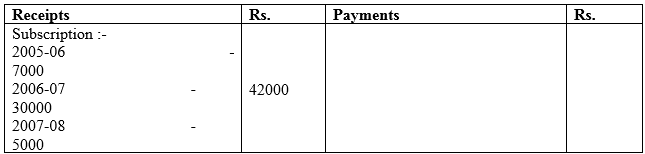
Additional information:-
(i) Subscription outstanding on March 31, 2006 Rs. 8500.
(ii) Total subscriptions outstanding on March 31, 2007 Rs. 18,500.
(iii) Subscriptions received in advance as on March 31, 2006 Rs. 4000.
Answer : Income and Expenditure A/C
For the year ending March 31, 2007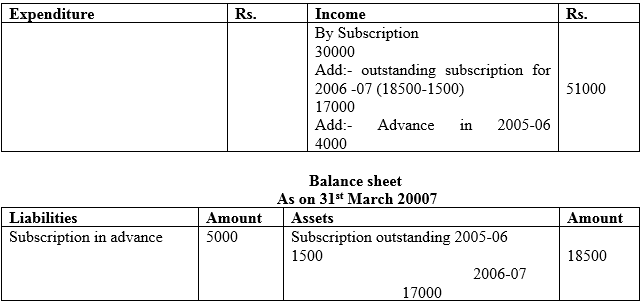
Question. Tournament fund appears in the books Rs. 15,000 and expenses on tournament during the year were Rs. 18000. How will you show this in format while preparing financial statement of a not-for-profit organisation?
Answer : Income and Expenditure A/C
For the year ended ………
Question. Calculate the amount medicines to be debited in the Income and Expenditure Account of a Hospital on the basis of the following information:-
Amount paid for medicines during the year was Rs. 6,79000.
Answer : Amount paid for medicine during the year 6,79000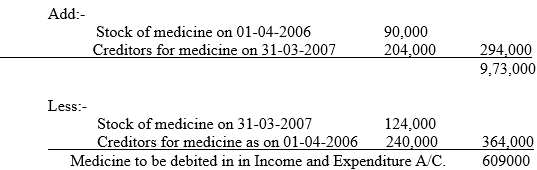
Question. What is meant by fund based accounting?
Answer : Fund based accounting is a book peeping technique where by separate self-balancing sets of assets, liability, income, expenses and fund balance accounts are maintained for each contribution for a specific purpose.
Question. State any two characteristics of Receipt and Payment Account.
Answer : (i) Receipts and Payments Account is a summary of Cash Book.
(ii) Non- cash expenses such as depreciation and outstanding expenses are not shown in Receipts and Payments Account.
Question. From the following particulars of a club, calculate the amount of salaries to be shown in Income and expenditure account for the year ended 31 March, 2008:-
Total salaries paid during the year 2007-08 Rs. 87,000
Outstanding salaries on 01-04-2007 Rs. 17,000
Prepaid salaries on 01-04-2007 Rs. 19,000
Outstanding salaries on 31-03-2008 Rs. 32,000
Prepaid salaries on 31-03-2008 Rs 20,000
Answer :Calculation of salaries to be shown in Income and Expenditure A/C for the year ended March 31, 2008:-
Question. Distinguish between Receipts and Payments A/C and Income and expenditure A/C.
Answer : Difference between Receipts and Payments and Income and Expenditure.

Question. As per Receipt and Payments account for the year ended on March 31, 2008, the subscription received were Rs. 2,50,000. Addition information given is as follows:-
(i) Subscriptions outstanding on 01-04-2007 Rs. 50,000.
(ii) Subscription outstanding on 31-03-2008 Rs. 35,000.
(iii)Subscription Received in advance as on 31-03-2008 Rs. 30000.
Ascertain the amount of income from subscription for the year 2007-08.
Answer : Calculation of current year subscription to be shown in Income and Expenditure A/C for the year ended March 31, 2008 :-
Total subscription received during the year 250000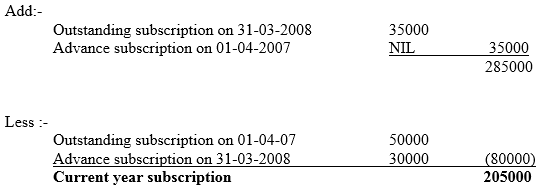
Question. Give to main sources of income of a ‘Not for profit organisation’.
Answer : (i) Subscription
(ii) Donation.
Question. Calculate the amount to be debited to Income and Expenditure account under the heading sports items for the year 2006-07 in respect of the Osmosis club:-
Stock of sports items on 01-04-2006 Rs. 44,700
Stock of sports items on 31-03-2007 Rs. 24,500
Paid for sports items during the year Rs. 97,900
Creditors for supplies of sports items 31-03-2007 Rs. 26,500.
Answer : 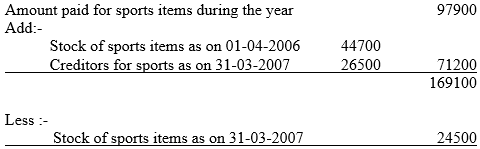
Sports items to be debited in the Income and expenditure A/C 144600
Question. Bilochpur Ltd. has an outstanding balance of Rs. 4,00,000, 8% Debentures of Rs. 100 each. The Board of Directors decided to purchase 1, 00,000 debentures at a price of Rs. 96 for investment purposes but after few months they took a decision to sell them @ Rs. 99 in the market. Record necessary entries to show above transactions.
Answer:
Note: The question states debentures of face value Rs. 1,00,000 (i.e., 1,000 debentures of Rs. 100 each).
Journal of Bilochpur Ltd.
1. On purchase of own debentures as investment:
Own Debentures A/c Dr. Rs. 96,000
To Bank A/c Rs. 96,000
(Being 1,000 own debentures of Rs. 100 each purchased @ Rs. 96 each for investment)
2. On sale of own debentures in the open market:
Bank A/c (1,000 \( \times \) Rs. 99) Dr. Rs. 99,000
To Own Debentures A/c (1,000 \( \times \) Rs. 96) Rs. 96,000
To Profit on Sale of Own Debentures / Investment A/c Rs. 3,000
(Being 1,000 own debentures sold @ Rs. 99 each)
3. On transfer of profit on sale:
Profit on Sale of Own Debentures A/c Dr. Rs. 3,000
To Statement of Profit and Loss / Capital Reserve A/c Rs. 3,000
(Being profit on sale of own debentures transferred)
(Note: If taken literally as 1,00,000 debentures, the purchase amount would be Rs. 96,00,000, sale amount Rs. 99,00,000, and profit Rs. 3,00,000.)
Question. (a) (i) Z Ltd. purchased a building for Rs. 2,20,000. Half of the payment was made in cash and the balance by issue of 12% debentures at premium of 10% Pass the necessary journal entries in the books of Z Ltd.
(ii) A Ltd. issued Rs. 2,00,000. 12%. Debentures as collateral security. Pass necessary journal entries in the books of A Ltd.
(b) A company had issued 10% Rs. 100 debentures amounting to Rs. 80,000 redeemable at the option of the company by drawing at par or by purchase in the open market. The company decides to redeem Rs. 20,000 debentures by the purchase of Rs. 16,000 debentures in the open market at Rs. 98 each and draw Rs. 4,000 debentures.
Assuming that company had sufficient balance in the Debenture Redemption Reserve before the purchase of own debentures, pass the necessary journal entries in the books of the company.
Answer:
(a) (i) In the books of Z Ltd.
1. Building A/c Dr. Rs. 2,20,000
To Vendor A/c Rs. 2,20,000
(Being building purchased from vendor)
2. Vendor A/c Dr. Rs. 1,10,000
To Cash / Bank A/c Rs. 1,10,000
(Being half payment made in cash)
3. Vendor A/c Dr. Rs. 1,10,000
To 12% Debentures A/c (1,000 \( \times \) Rs. 100) Rs. 1,00,000
To Securities Premium Reserve A/c (1,000 \( \times \) Rs. 10) Rs. 10,000
(Being 1,000, 12% debentures of Rs. 100 each issued at a premium of 10% to settle balance of Rs. 1,10,000; Number of debentures = \( \frac{\text{Rs. } 1,10,000}{\text{Rs. } 110} = 1,000 \))
(a) (ii) In the books of A Ltd.
Method: When journal entry is passed:
Debenture Suspense A/c Dr. Rs. 2,00,000
To 12% Debentures A/c Rs. 2,00,000
(Being Rs. 2,00,000, 12% debentures issued as collateral security against loan)
(Note: If no entry is passed, only a disclosure note is given in the Balance Sheet under Long-term Borrowings.)
(b) In the books of the Company
1. Purchase of own debentures for cancellation:
Own Debentures A/c (160 \( \times \) Rs. 98) Dr. Rs. 15,680
To Bank A/c Rs. 15,680
(Being 160 own debentures of nominal value Rs. 16,000 purchased @ Rs. 98 each)
2. Cancellation of purchased debentures:
10% Debentures A/c Dr. Rs. 16,000
To Own Debentures A/c Rs. 15,680
To Profit on Redemption / Cancellation of Debentures A/c Rs. 320
(Being own debentures cancelled and profit on redemption recognized)
3. Transfer of profit on redemption to Capital Reserve:
Profit on Redemption of Debentures A/c Dr. Rs. 320
To Capital Reserve A/c Rs. 320
(Being profit on cancellation transferred to Capital Reserve)
4. Redemption of debentures by draw of lots:
10% Debentures A/c Dr. Rs. 4,000
To Debentureholders A/c Rs. 4,000
(Being amount due on redemption of 40 debentures drawn at par)
5. Payment to debentureholders:
Debentureholders A/c Dr. Rs. 4,000
To Bank A/c Rs. 4,000
(Being payment made to debentureholders)
6. Transfer from DRR to General Reserve on redemption:
Debenture Redemption Reserve A/c Dr. Rs. 20,000
To General Reserve A/c Rs. 20,000
(Being proportionate amount transferred from DRR to General Reserve on redemption of debentures of Rs. 20,000)
Question. X Ltd. invited applications for 2,00,000 equity shares of Rs. 10 each at a premium of Rs. 2 per share payable as to Rs. 2 on application, Rs. 5 on allotment including premium, Rs. 2 first call & Rs. 3 on final call.
Applications were received for 3,00,000 shares. Applications for 60,000 shares were rejected and pro-rata allotment was made to the remaining applicants. Ram, who applied for 9,600 shares, failed to pay allotment and two calls and Shyam the holder of 12,000 shares, failed to pay two calls. These shares were forfeited. Subsequently, all these shares were reissued at Rs.8 per share as fully paid up. Pass necessary journal entries in the books of X Ltd.
Answer:
Working Notes:
1. Total applications = 3,00,000 shares. Rejected = 60,000 shares. Remaining = 2,40,000 shares allotted 2,00,000 shares (ratio 6 : 5).
Excess application money = \( 40,000 \times \text{Rs. } 2 = \text{Rs. } 80,000 \) (adjusted on allotment).
2. Ram's Account:
- Shares applied = 9,600; Shares allotted = \( 9,600 \times \frac{5}{6} = 8,000 \) shares.
- Application money paid = \( 9,600 \times \text{Rs. } 2 = \text{Rs. } 19,200 \).
- Application money required = \( 8,000 \times \text{Rs. } 2 = \text{Rs. } 16,000 \).
- Excess application money = \( \text{Rs. } 19,200 - \text{Rs. } 16,000 = \text{Rs. } 3,200 \).
- Allotment money due = \( 8,000 \times \text{Rs. } 5 = \text{Rs. } 40,000 \) (Share Capital Rs. 24,000 + Premium Rs. 16,000).
- Unpaid on Allotment = \( \text{Rs. } 40,000 - \text{Rs. } 3,200 = \text{Rs. } 36,800 \) (Entire premium of Rs. 16,000 is unpaid).
- Unpaid on First Call = \( 8,000 \times \text{Rs. } 2 = \text{Rs. } 16,000 \).
- Unpaid on Final Call = \( 8,000 \times \text{Rs. } 3 = \text{Rs. } 24,000 \).
3. Shyam's Account:
- Shares allotted = 12,000 shares.
- Unpaid on First Call = \( 12,000 \times \text{Rs. } 2 = \text{Rs. } 24,000 \).
- Unpaid on Final Call = \( 12,000 \times \text{Rs. } 3 = \text{Rs. } 36,000 \).
Journal of X Ltd.
1. Bank A/c (3,00,000 \( \times \) Rs. 2) Dr. Rs. 6,00,000
To Equity Share Application A/c Rs. 6,00,000
(Being application money received on 3,00,000 shares)
2. Equity Share Application A/c Dr. Rs. 6,00,000
To Equity Share Capital A/c (2,00,000 \( \times \) Rs. 2) Rs. 4,00,000
To Equity Share Allotment A/c Rs. 80,000
To Bank A/c (60,000 \( \times \) Rs. 2) Rs. 1,20,000
(Being application money transferred to Share Capital, excess adjusted on allotment and balance refunded)
3. Equity Share Allotment A/c (2,00,000 \( \times \) Rs. 5) Dr. Rs. 10,00,000
To Equity Share Capital A/c (2,00,000 \( \times \) Rs. 3) Rs. 6,00,000
To Securities Premium Reserve A/c (2,00,000 \( \times \) Rs. 2) Rs. 4,00,000
(Being allotment money due including premium)
4. Bank A/c Dr. Rs. 8,83,200
Calls-in-Arrears A/c Dr. Rs. 36,800
To Equity Share Allotment A/c Rs. 9,20,000
(Being allotment money received except from Ram on 8,000 shares)
5. Equity Share First Call A/c (2,00,000 \( \times \) Rs. 2) Dr. Rs. 4,00,000
To Equity Share Capital A/c Rs. 4,00,000
(Being first call money due)
6. Bank A/c Dr. Rs. 3,60,000
Calls-in-Arrears A/c (20,000 \( \times \) Rs. 2) Dr. Rs. 40,000
To Equity Share First Call A/c Rs. 4,00,000
(Being first call received except on 8,000 shares of Ram and 12,000 shares of Shyam)
7. Equity Share Final Call A/c (2,00,000 \( \times \) Rs. 3) Dr. Rs. 6,00,000
To Equity Share Capital A/c Rs. 6,00,000
(Being final call money due)
8. Bank A/c Dr. Rs. 5,40,000
Calls-in-Arrears A/c (20,000 \( \times \) Rs. 3) Dr. Rs. 60,000
To Equity Share Final Call A/c Rs. 6,00,000
(Being final call received except on 20,000 shares)
9. Equity Share Capital A/c (20,000 \( \times \) Rs. 10) Dr. Rs. 2,00,000
Securities Premium Reserve A/c (8,000 \( \times \) Rs. 2) Dr. Rs. 16,000
To Calls-in-Arrears A/c (Rs. 36,800 + Rs. 40,000 + Rs. 60,000) Rs. 1,36,800
To Share Forfeiture A/c (Rs. 19,200 + Rs. 60,000) Rs. 79,200
(Being 8,000 shares of Ram and 12,000 shares of Shyam forfeited for non-payment of dues)
10. Bank A/c (20,000 \( \times \) Rs. 8) Dr. Rs. 1,60,000
Share Forfeiture A/c (20,000 \( \times \) Rs. 2) Dr. Rs. 40,000
To Equity Share Capital A/c (20,000 \( \times \) Rs. 10) Rs. 2,00,000
(Being 20,000 forfeited shares reissued @ Rs. 8 per share as fully paid up)
11. Share Forfeiture A/c (Rs. 79,200 \( - \) Rs. 40,000) Dr. Rs. 39,200
To Capital Reserve A/c Rs. 39,200
(Being net gain on reissue of forfeited shares transferred to Capital Reserve)
Question. Beriwal Ltd. at present is having an equity share capital of Rs. 1, 00,000. The face value of one equity share is Rs. 10.It intends to make further issue of equity as follows:
(I) General public-10,000 equity shares at a discount of Re. 1 per share. Terms of issue:
Application Rs.2, Allotment Rs.2, First and Final Call Rs.5
The shares issued to the public were oversubscribed by 1,000 shares. The directors have refunded the entire excess application money. Jatin holding 200 shares failed to pay the final call and these shares have been forfeited after having notices of forfeited etc. Later these shares were issued to Bobby of maximum discount.
(II) The company acquired assets worth Rs. 9,00,000, the payment was settled by the issue of sufficient number of equity shares at a discount of Re. 1 per share. You are required to
(a) Give journal entrees to record the above Share Capital transactions including forfeiture and reissue.
(b) Give journal entries in respect of purchase of assets.
Answer:
(a) Journal entries for Share Capital transactions:
1. Bank A/c (11,000 \( \times \) Rs. 2) Dr. Rs. 22,000
To Equity Share Application A/c Rs. 22,000
(Being application money received on 11,000 shares)
2. Equity Share Application A/c Dr. Rs. 22,000
To Equity Share Capital A/c (10,000 \( \times \) Rs. 2) Rs. 20,000
To Bank A/c (1,000 \( \times \) Rs. 2) Rs. 2,000
(Being application money transferred to Share Capital and excess refunded)
3. Equity Share Allotment A/c (10,000 \( \times \) Rs. 2) Dr. Rs. 20,000
Discount on Issue of Shares A/c (10,000 \( \times \) Re. 1) Dr. Rs. 10,000
To Equity Share Capital A/c (10,000 \( \times \) Rs. 3) Rs. 30,000
(Being allotment money due and discount on issue recorded)
4. Bank A/c Dr. Rs. 20,000
To Equity Share Allotment A/c Rs. 20,000
(Being allotment money received)
5. Equity Share First and Final Call A/c (10,000 \( \times \) Rs. 5) Dr. Rs. 50,000
To Equity Share Capital A/c Rs. 50,000
(Being first and final call due on 10,000 shares)
6. Bank A/c (9,800 \( \times \) Rs. 5) Dr. Rs. 49,000
Calls-in-Arrears A/c (200 \( \times \) Rs. 5) Dr. Rs. 1,000
To Equity Share First and Final Call A/c Rs. 50,000
(Being call money received except on 200 shares)
7. Equity Share Capital A/c (200 \( \times \) Rs. 10) Dr. Rs. 2,000
To Discount on Issue of Shares A/c (200 \( \times \) Re. 1) Rs. 200
To Calls-in-Arrears A/c Rs. 1,000
To Share Forfeiture A/c (200 \( \times \) Rs. 4) Rs. 800
(Being 200 shares of Jatin forfeited for non-payment of final call)
8. Bank A/c (200 \( \times \) Rs. 5) Dr. Rs. 1,000
Share Forfeiture A/c (Maximum permissible discount = Rs. 4 per share) Dr. Rs. 800
Discount on Issue of Shares A/c (200 \( \times \) Re. 1) Dr. Rs. 200
To Equity Share Capital A/c (200 \( \times \) Rs. 10) Rs. 2,000
(Being 200 shares reissued to Bobby at maximum discount)
(Note: Since the entire forfeited amount of Rs. 800 is utilized as discount on reissue, the transfer to Capital Reserve is Nil.)
(b) Journal entries in respect of purchase of assets:
1. Sundry Assets A/c Dr. Rs. 9,00,000
To Vendor A/c Rs. 9,00,000
(Being assets acquired from vendor)
2. Vendor A/c Dr. Rs. 9,00,000
Discount on Issue of Shares A/c (1,00,000 \( \times \) Re. 1) Dr. Rs. 1,00,000
To Equity Share Capital A/c (1,00,000 \( \times \) Rs. 10) Rs. 10,00,000
(Being 1,00,000 equity shares of Rs. 10 each issued at a discount of Re. 1 per share to settle vendor's claim; Number of shares = \( \frac{\text{Rs. } 9,00,000}{\text{Rs. } 9} = 1,00,000 \))
Question. Goodwill Trading Co. Ltd. had issued share capital of Rs. 1,40,000 in equity shares of Rs. 10 each, on which Rs. 7.50 per share was called and paid. When the final call of Rs. 2.50 per share was made, all the shareholders paid their money in full excepting two shareholders, one holding 200 shares and the other 100 shares. These shares were forfeited in due course and were reissued to a new shareholder who paid Rs. 5 for each share.
You are to give the Journal entries recording the above transactions in the books of the company.
Answer:
Journal of Goodwill Trading Co. Ltd.
1. On making the final call:
Equity Share Final Call A/c (14,000 \( \times \) Rs. 2.50) Dr. Rs. 35,000
To Equity Share Capital A/c Rs. 35,000
(Being final call of Rs. 2.50 per share made on 14,000 shares)
2. On receipt of final call money:
Bank A/c (13,700 \( \times \) Rs. 2.50) Dr. Rs. 34,250
Calls-in-Arrears A/c (300 \( \times \) Rs. 2.50) Dr. Rs. 750
To Equity Share Final Call A/c Rs. 35,000
(Being final call money received on 13,700 shares; 300 shares failed to pay)
3. On forfeiture of 300 shares:
Equity Share Capital A/c (300 \( \times \) Rs. 10) Dr. Rs. 3,000
To Calls-in-Arrears A/c Rs. 750
To Share Forfeiture A/c (300 \( \times \) Rs. 7.50) Rs. 2,250
(Being 300 shares forfeited for non-payment of final call)
4. On reissue of 300 forfeited shares:
Bank A/c (300 \( \times \) Rs. 5) Dr. Rs. 1,500
Share Forfeiture A/c (300 \( \times \) Rs. 5) Dr. Rs. 1,500
To Equity Share Capital A/c (300 \( \times \) Rs. 10) Rs. 3,000
(Being 300 shares reissued as fully paid-up @ Rs. 5 per share)
5. On transfer of profit on reissue to Capital Reserve:
Share Forfeiture A/c (Rs. 2,250 \( - \) Rs. 1,500) Dr. Rs. 750
To Capital Reserve A/c Rs. 750
(Being balance of share forfeiture account transferred to Capital Reserve)
Question. A company issued 20,000 shares of Rs. 100 each payable Rs. 25 per share on application, Rs. 25 per share on allotment and the balance in two calls of Rs. 25 each. The company did not make the final call of Rs. 25 per share. All the money was duly received with the exception of the amount due on the first call on 400 shares held by Mr. Modi. The Board of Directors forfeited these shares and subsequently reissued them as Rs. 75 per share paid-up as for a sum of Rs. 28,000. Journalise the above transactions and prepare the Share Capital Account.
Answer:
Journal Entries
1. Bank A/c (20,000 \( \times \) Rs. 25) Dr. Rs. 5,00,000
To Share Application A/c Rs. 5,00,000
(Being application money received on 20,000 shares)
2. Share Application A/c Dr. Rs. 5,00,000
To Share Capital A/c Rs. 5,00,000
(Being application money transferred to Share Capital Account)
3. Share Allotment A/c (20,000 \( \times \) Rs. 25) Dr. Rs. 5,00,000
To Share Capital A/c Rs. 5,00,000
(Being allotment money due on 20,000 shares)
4. Bank A/c Dr. Rs. 5,00,000
To Share Allotment A/c Rs. 5,00,000
(Being allotment money received)
5. Share First Call A/c (20,000 \( \times \) Rs. 25) Dr. Rs. 5,00,000
To Share Capital A/c Rs. 5,00,000
(Being first call money due on 20,000 shares @ Rs. 25 each)
6. Bank A/c (19,600 \( \times \) Rs. 25) Dr. Rs. 4,90,000
Calls-in-Arrears A/c (400 \( \times \) Rs. 25) Dr. Rs. 10,000
To Share First Call A/c Rs. 5,00,000
(Being first call money received except on 400 shares of Mr. Modi)
7. Share Capital A/c (400 \( \times \) Rs. 75 called-up) Dr. Rs. 30,000
To Calls-in-Arrears A/c Rs. 10,00,0? Rs. 10,000
To Share Forfeiture A/c (400 \( \times \) Rs. 50 paid-up) Rs. 20,000
(Being 400 shares forfeited for non-payment of first call)
8. Bank A/c Dr. Rs. 28,000
Share Forfeiture A/c (400 \( \times \) Rs. 5) Dr. Rs. 2,000
To Share Capital A/c (400 \( \times \) Rs. 75) Rs. 30,000
(Being 400 forfeited shares reissued as Rs. 75 paid-up for Rs. 28,000)
9. Share Forfeiture A/c (Rs. 20,000 \( - \) Rs. 2,000) Dr. Rs. 18,000
To Capital Reserve A/c Rs. 18,000
(Being gain on reissue transferred to Capital Reserve)
Share Capital Account
Dr. Cr.
To Share Forfeiture A/c Rs. 20,000 | By Share Application A/c Rs. 5,00,000
To Calls-in-Arrears A/c Rs. 10,000 | By Share Allotment A/c Rs. 5,00,000
To Balance c/d (20,000 shares @ Rs. 75) Rs. 15,00,000 | By Share First Call A/c Rs. 5,00,000
| By Bank A/c (Reissue) Rs. 28,000
| By Share Forfeiture A/c Rs. 2,000
Total: Rs. 15,30,000 | Total: Rs. 15,30,000
Free study material for Accountancy
Part 1 Chapter 01 Accounting For Not For Profit Organisation Printable Assignments & Solutions for Class 12 Accountancy
Revision Assignment: Part 1 Chapter 01 Accounting For Not For Profit Organisation (CBSE)
Access structured practice assignments for Part 1 Chapter 01 Accounting For Not For Profit Organisation designed in alignment with the latest CBSE curriculum for Class 12 Accountancy. These printable sets cover objective and descriptive problem types to support thorough revision.
Why Practice Class 12 Accountancy Assignments?
- Exam Alignment: Questions strictly follow contemporary CBSE sample papers and grading schemes.
- Comprehensive Coverage: Features objective drills, case studies, and structured descriptive problems for Part 1 Chapter 01 Accounting For Not For Profit Organisation.
- Pacing & Precision: Regular problem-solving builds critical calculation speed and test-taking accuracy.
Effective Strategy for Class 12 Accountancy Assignments
- Initial Reading: Begin by reading the NCERT book for Class 12 Accountancy to build a baseline understanding.
- Independent Testing: Attempt assignment questions unassisted, then verify work using provided answer keys.
- Supplementary Aids: Leverage revision notes and worksheets whenever you encounter difficult topics.
FAQs
You can download free PDF assignments for Class 12 Accountancy Part 1 Chapter 01 Accounting For Not For Profit Organisation from StudiesToday.com. These practice sheets have been updated for the 2026-27 session covering all concepts from latest NCERT textbook.
Yes, our teachers have given solutions for all questions in the Class 12 Accountancy Part 1 Chapter 01 Accounting For Not For Profit Organisation assignments. This will help you to understand step-by-step methodology to get full marks in school tests and exams.
Yes. These assignments are designed as per the latest CBSE syllabus for 2026. We have included huge variety of question formats such as MCQs, Case-study based questions and important diagram-based problems found in Part 1 Chapter 01 Accounting For Not For Profit Organisation.
Practicing topicw wise assignments will help Class 12 students understand every sub-topic of Part 1 Chapter 01 Accounting For Not For Profit Organisation. Daily practice will improve speed, accuracy and answering competency-based questions.
Yes, all printable assignments for Class 12 Accountancy Part 1 Chapter 01 Accounting For Not For Profit Organisation are available for free download in mobile-friendly PDF format.