

Class 12 Accountancy Practice Assignments: CBSE Class 12 Accountancy Reconstitution Of Partnership Assignment Part A
Review targeted academic assignments with the CBSE Class 12 Accountancy Reconstitution Of Partnership Assignment Part A. Built according to official CBSE standards for the 2026-27 term, these downloadable Class 12 Accountancy worksheets support effective daily practice for Part 1 Chapter 02 Reconstitution Of A Partnership Firm Admission Of A Partner.
Download Part 1 Chapter 02 Reconstitution Of A Partnership Firm Admission Of A Partner Assignment PDF with Solutions
Navigate directly to the solved Accountancy assignments using the digital viewer below. Each practice set includes detailed step-by-step solutions, allowing students to instantly cross-check their work and identify areas requiring further revision.
MCQ Questions for NCERT Class 12 AccountancyReconstitution of Partnership Firm – Admission of a Partner
Question: As per _________ , only purchased goodwill can be shown in the Balance Sheet.
(a) AS 37
(b) AS 26
(c) Section 37
(d) AS 37
Answer: B
Question: A, and B are partners sharing profits in the ratio of 2:3. Their balance sheet shows machinery at Rs.2,00,000; stock Rs.80,000, and debtors at Rs.1,60,000. C is admitted and the new profit sharing ratio is 6:9:5. Machinery is revalued at Rs.1,40,000 and a provision is made for doubtful debts @5%. A’s share in loss on revaluation amount to Rs.20,000. Revalued value of stock will be:
(a) Rs.62,000
(b) Rs.1,00,000
(c) Rs.60,000
(d) Rs.98,000
Answer: C
Question: Heena and Sudha share Profit & Loss equally. Their capitals were Rs.1,20,000 and Rs.80,000 respectively. There was also a balance of Rs.60,000 in General reserve and revaluation gain amounted to Rs.15,000. They admit friend Teena with 1/5 share. Teena brings Rs.90,000 as capital. Calculate the amount of goodwill of the firm.
(a) Rs..85,000
(b) Rs.1,00,000
(c) Rs..20,000
(d) None of the above
Answer: A
Question: If at the time of admission if there is some unrecorded liability, it will be -------------to -- ------------ Account.
(a) Debited, Revaluation
(b) Credited, Revaluation
(c) Debited, Goodwill
(d) Credited, Partners’ Capital
Answer: A
Question: Match the following:

(a) i- B, ii-C, iii-A, iv-D
(b) i- D, ii-B, iii-A, iv-C
(c) i- D, ii-C, iii-A, iv-B
(d) i- D, ii-C, iii-B, iv-A
Answer: C
Question: Sacrificing ratio is calculated because:
(a) Profit shown by Revaluation Account can be credited to sacrificing partners
(b) Goodwill brought in by the incoming partner can be credited to the new partner
(c) Goodwill brought in by the incoming partner can be credited to the sacrificing partners
(d) Both a and
Answer: C
Question: Match the following with respect to journal entries for treatment of goodwill.
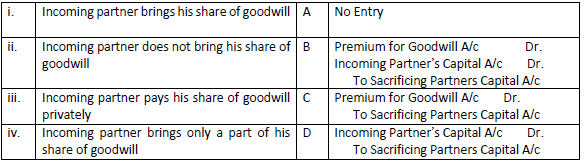
(a) i- B, ii-C, iii-A, iv-D
(b) i- C, ii-D, iii-A, iv-B
(c) i- D, ii-C, iii-A, iv-B
(d) i- D, ii-C, iii-B, iv-A
Answer: B
Question: Share of goodwill brought by the new partner in cash is shared by old partners in:
(a) ratio of sacrifice
(b) old profit sharing ratio
(c) new profit sharing ratio
(d) none of the above
Answer: A
Question: A and B are partners sharing profits in the ratio of 3:1. C is admitted to partnership firm for 1/4th share. The sacrificing ratio of A and B will be:
(a) Equal
(b) 2:1
(c) 3:2
(d) 3:1
Answer: D
Question: A and B are partners sharing profits and losses in the ratio of 3:2. A’s capital is Rs.1,20,000 and B’s capital is Rs.60,000. they admit C for 1/5th share of profits. C should bring as his capital:
(a) Rs.36,000
(b) Rs.48,000
(c) Rs.58,000
(d) Rs.45,000
Answer: D
Question: At the time of admission of a partner, Employees Provident Fund is:
(a) Distributed to partners in the old profit sharing ratio
(b) Distributed to partners in the new profit sharing ratio
(c) Adjusted through gaining ratio
(d) None of the above
Answer: D
Question: If at the of admission, some balance of profit and loss account appears in the books, it will be transferred to :
(a) Profit and loss adjustment account
(b) All partners’ capital account
(c) Old partners’ capital account
(d) Revaluation account
Answer: C
Question: A and B are partners in a firm sharing profits in 4:1. They admit Pal as a new partner for ¼ share in the profits, which he acquired wholly from A. New profit sharing ratio of the partners is:
(a) 4:1:1
(b) Equally
(c) 11:4:5
(d) none of the above
Answer: C
Question: When new partner does not bring his share of goodwill in cash, the amount is debited to:
(a) Current account of the new partner
(b) Premium account
(c) Capital account of the old partners
(d) Cash account
Answer: C
Question: A, B, C, and D are partners. A and B share 2/3rd of profits equally and C and D share remaining profits in the ratio of 3:2. Find the profit sharing ratio of A, B, C and D.
(a) 5:5:3:2
(b) 7:7:6:4
(c) 2.5:2.5:8:6
(d) 3:9:8:3
Answer: A
True/ False:
Question: Reserve and accumulated profits are distributed in old profit sharing ratio at the time of admission of a partner.
Answer: True
Question: Claim of workmen compensation if more than workmen compensation reserve, is debited to revaluation account.
Answer: True
Question: New partner brings goodwill in the firm to get share in the past profits.
Answer: False
Question: Hidden goodwill arises when total capital is computed based on the new partner’s capital is less than total capitals of remaining partners after all adjustments.
Answer: False
Question: At the time of admission, reserves may be carried forwarded by the partners.
Answer: True
Fill in the blanks
Question: If, at the time of admission of a new partner, provision for doubtful debts is to be reduced, it shall be …………to profit and loss adjustment account.
Answer: credited capital accounts
Question: At the time of admission, the assets are revalued and liabilities are reassessed. The increase or decrease in the values is debited or credited in ……………..
Answer: Revaluation account
Question: In the case of downward revaluation of an asset, revaluation account is ………………
Answer: Debited
Question: If the revaluation account finally shows a debit balance then it indicates ………….., which will be transferred to …………
Answer: Net loss, debit side of old partners’ capital accounts
Question: Revaluation account shows ………….in the values of assets and liabilities.
Answer: Increase or decrease
Question: In case of upward revaluation of a liability, revaluation account is …………….
Answer: Debited
Unit 2: Reconstitution of Partnership - Admission of a Partner
Q.1 On what occasions does the need for valuation of goodwill arise?
Answer: The need for valuation of goodwill arises on several occasions such as:
1. Change in the profit-sharing ratio among existing partners.
2. Admission of a new partner.
3. Retirement or death of a partner.
4. Dissolution of a partnership firm.
5. Amalgamation of two or more partnership firms or sale of the business.
In simple words: Goodwill must be valued whenever the profit-sharing arrangement of the partners changes or ownership is transferred.
Exam Tip: Memorize at least four clear circumstances to score full marks in theoretical questions.
Q.2 Why is it necessary to revalue assets and liabilities at the time of admission of a new partner?
Answer: At the time of admission of a new partner, assets and liabilities are revalued so that any increase or decrease in their values up to the date of admission belongs exclusively to the old partners in their old profit-sharing ratio. If this is not done, the new partner would gain or suffer from past revaluations that occurred before they joined.
In simple words: Revaluation ensures old partners get the profit or bear the loss of asset value changes that happened before the new partner arrived.
Exam Tip: Always state that revaluation prevents unfair gains or losses to incoming partners regarding past asset appreciation or depreciation.
Q.3 What is meant by sacrificing ratio?
Answer: Sacrificing ratio is the ratio in which the old partners agree to surrender or sacrifice a portion of their share of profits in favour of an incoming (new) partner. It is calculated as:
\(\text{Sacrificing Ratio} = \text{Old Profit-Sharing Ratio} - \text{New Profit-Sharing Ratio}\)
In simple words: It measures how much share of profit old partners give up for the new partner.
Exam Tip: Remember the formula: Old Ratio minus New Ratio. A positive result denotes sacrifice.
Q.4 State two occasions when sacrificing ratio may be applied.
Answer: Two occasions when sacrificing ratio is applied are:
1. At the time of admission of a new partner, to distribute the premium for goodwill brought in by the new partner among the sacrificing partners.
2. When there is a change in the profit-sharing ratio among existing partners resulting in a sacrifice by one or more partners who need to be compensated by the gaining partners.
In simple words: Used for sharing goodwill compensation when partners lose a part of their profit share.
Exam Tip: Associate sacrificing ratio primarily with the distribution of goodwill brought by an incoming partner.
Q.5 A business has earned average profit of Rs. 60,000 during the last few years. The assets of the business are Rs. 5,40,000 and its external liabilities are Rs. 80,000. The normal rate of return is 10%. Calculate the value of goodwill on the basis of capitalisation of super profits.
Answer:
Total Assets = Rs. 5,40,000
External Liabilities = Rs. 80,000
Capital Employed = Total Assets - External Liabilities
Capital Employed = 5,40,000 - 80,000 = Rs. 4,60,000
Normal Profit = Capital Employed \(\times\) (Normal Rate of Return / 100)
Normal Profit = 4,60,000 \(\times\) \(\frac{10}{100}\) = Rs. 46,000
Average Profit = Rs. 60,000
Super Profit = Average Profit - Normal Profit
Super Profit = 60,000 - 46,000 = Rs. 14,000
Goodwill = Super Profit \(\times\) \(\frac{100}{\text{Normal Rate of Return}}\)
Goodwill = 14,000 \(\times\) \(\frac{100}{10}\) = Rs. 1,40,000
In simple words: First find capital employed, normal profit, and super profit, then capitalize the super profit at the normal rate of return to find goodwill.
Exam Tip: Capitalization of super profit yields the exact same goodwill valuation as capitalization of average profit minus capital employed.
Q.6 The capital of a firm of Arpit and Prajwal is Rs. 10,00,000. The market rate of return is 15% and the goodwill of the firm has been valued Rs. 1,80,000 at two years purchase of super profits. Find the average profits of the firm.
Answer:
Capital Employed = Rs. 10,00,000
Normal Rate of Return = 15%
Normal Profit = Capital Employed \(\times\) (Normal Rate of Return / 100)
Normal Profit = 10,00,000 \(\times\) \(\frac{15}{100}\) = Rs. 1,50,000
Goodwill = Super Profit \(\times\) Number of Years' Purchase
1,80,000 = Super Profit \(\times\) 2
Super Profit = \(\frac{1,80,000}{2}\) = Rs. 90,000
Super Profit = Average Profit - Normal Profit
90,000 = Average Profit - 1,50,000
Average Profit = 90,000 + 1,50,000 = Rs. 2,40,000
In simple words: Work backwards from goodwill to find super profit, add normal profit to super profit to determine the average profit.
Exam Tip: Be comfortable reversing formulas when given goodwill and asked to find average or super profit.
Q.7 The average profits for last 5 years of a firm are Rs. 20,000 and goodwill has been worked out Rs. 24,000 calculated at 3 years purchase of super profits. Calculate the amount of capital employed assuming the normal rate of interest is 8 %.
Answer:
Average Profit = Rs. 20,000
Goodwill = Rs. 24,000
Number of Years' Purchase = 3
Goodwill = Super Profit \(\times\) Number of Years' Purchase
24,000 = Super Profit \(\times\) 3
Super Profit = \(\frac{24,000}{3}\) = Rs. 8,000
Super Profit = Average Profit - Normal Profit
8,000 = 20,000 - Normal Profit
Normal Profit = 20,000 - 8,000 = Rs. 12,000
Normal Profit = Capital Employed \(\times\) (Normal Rate of Return / 100)
12,000 = Capital Employed \(\times\) \(\frac{8}{100}\)
Capital Employed = \(\frac{12,000 \times 100}{8}\) = Rs. 1,50,000
In simple words: Find super profit from goodwill, deduct it from average profit to get normal profit, then divide normal profit by the interest rate percentage to get capital employed.
Exam Tip: Keep track of percentage divisions carefully: multiplying by 100 and dividing by 8 gives the total capital base.
Q.8 Rahul and Sahil are partners sharing profits together in the ratio of 4:3. They admit Kamal as a new partner. Rahul surrenders 1/4th of his share and Sahil surrenders 1/3rd of his share in favour of Kamal. Calculate the new profit sharing ratio.
Answer:
Old Ratio of Rahul and Sahil = 4:3 (Rahul = \(\frac{4}{7}\), Sahil = \(\frac{3}{7}\))
Rahul surrenders in favour of Kamal = \(\frac{1}{4}\) of his share = \(\frac{4}{7} \times \frac{1}{4} = \frac{1}{7}\)
Rahul's new share = Old Share - Sacrificed Share = \(\frac{4}{7} - \frac{1}{7} = \frac{3}{7}\)
Sahil surrenders in favour of Kamal = \(\frac{1}{3}\) of his share = \(\frac{3}{7} \times \frac{1}{3} = \frac{1}{7}\)
Sahil's new share = Old Share - Sacrificed Share = \(\frac{3}{7} - \frac{1}{7} = \frac{2}{7}\)
Kamal's share = Rahul's sacrifice + Sahil's sacrifice = \(\frac{1}{7} + \frac{1}{7} = \frac{2}{7}\)
New profit sharing ratio of Rahul, Sahil, and Kamal = \(\frac{3}{7} : \frac{2}{7} : \frac{2}{7}\) = 3:2:2
In simple words: Deduct each partner's surrendered portion from their old share, and add both surrendered amounts together to get the new partner's share.
Exam Tip: Notice the phrasing "surrenders 1/4th of his share" means multiply old share by 1/4th before subtracting.
Q.9 Ajay and Naveen are partners sharing profits in the ratio of 5:3. Surinder is admitted in to the firm for 1/4th share in the profit which he acquires from Ajay and Naveen in the ratio of 2:1. Calculate the new profit sharing ratio.
Answer:
Old Ratio of Ajay and Naveen = 5:3 (Ajay = \(\frac{5}{8}\), Naveen = \(\frac{3}{8}\))
Surinder's share = \(\frac{1}{4}\)
Surinder acquires his share from Ajay and Naveen in the ratio of 2:1.
Ajay's sacrifice = \(\frac{1}{4} \times \frac{2}{3} = \frac{2}{12} = \frac{1}{6}\)
Naveen's sacrifice = \(\frac{1}{4} \times \frac{1}{3} = \frac{1}{12}\)
Ajay's new share = \(\frac{5}{8} - \frac{1}{6} = \frac{15 - 4}{24} = \frac{11}{24}\)
Naveen's new share = \(\frac{3}{8} - \frac{1}{12} = \frac{9 - 2}{24} = \frac{7}{24}\)
Surinder's share = \(\frac{1}{4} = \frac{6}{24}\)
New profit sharing ratio of Ajay, Naveen, and Surinder = \(\frac{11}{24} : \frac{7}{24} : \frac{6}{24}\) = 11:7:6
In simple words: Distribute the new partner's total share between old partners in the given acquisition ratio, then subtract from their old shares.
Exam Tip: "Acquires from in the ratio 2:1" means multiply the incoming partner's total share directly by 2/3 and 1/3.
Q.10 A and B were partners sharing profits in the ratio of 3:2. A surrenders 1/6th of his share and B surrenders 1/4th of his share in favour of C, a new partner. What is the new ratio and the sacrificing ratio.
Answer:
Old Ratio of A and B = 3:2 (A = \(\frac{3}{5}\), B = \(\frac{2}{5}\))
A surrenders = \(\frac{1}{6}\) of his share = \(\frac{3}{5} \times \frac{1}{6} = \frac{3}{30} = \frac{1}{10}\)
B surrenders = \(\frac{1}{4}\) of his share = \(\frac{2}{5} \times \frac{1}{4} = \frac{2}{20} = \frac{1}{10}\)
Sacrificing ratio of A and B = \(\frac{3}{30} : \frac{2}{30}\) = 3:2 (or \(\frac{1}{10} : \frac{1}{10}\) = 1:1)
A's new share = \(\frac{3}{5} - \frac{1}{10} = \frac{6 - 1}{10} = \frac{5}{10}\)
B's new share = \(\frac{2}{5} - \frac{1}{10} = \frac{4 - 1}{10} = \frac{3}{10}\)
C's share = A's sacrifice + B's sacrifice = \(\frac{1}{10} + \frac{1}{10} = \frac{2}{10}\)
New Profit Sharing Ratio of A, B, and C = \(\frac{5}{10} : \frac{3}{10} : \frac{2}{10}\) = 5:3:2
In simple words: Calculate individual sacrifices first to find the sacrificing ratio, subtract from old shares to get new shares, and combine sacrifices for the new partner.
Exam Tip: The sacrificing ratio is the ratio of amounts actually sacrificed by the partners (\(\frac{3}{30} : \frac{2}{30} = 3:2\)).
Q.11 Aarti and Bharti are partners sharing profits in the ratio of 5:3. They admit Shital for 1/4th share and agree to share between them in the ratio of 2:1 in future. Calculate new and sacrificing ratio.
Answer:
Old Ratio of Aarti and Bharti = 5:3 (Aarti = \(\frac{5}{8}\), Bharti = \(\frac{3}{8}\))
Shital's share = \(\frac{1}{4}\)
Remaining share after Shital's admission = \(1 - \frac{1}{4} = \frac{3}{4}\)
This remaining share (\(\frac{3}{4}\)) is shared by Aarti and Bharti in the ratio of 2:1.
Aarti's new share = \(\frac{3}{4} \times \frac{2}{3} = \frac{6}{12} = \frac{1}{2} = \frac{4}{8}\)
Bharti's new share = \(\frac{3}{4} \times \frac{1}{3} = \frac{3}{12} = \frac{1}{4} = \frac{2}{8}\)
Shital's share = \(\frac{1}{4} = \frac{2}{8}\)
New Profit Sharing Ratio of Aarti, Bharti, and Shital = \(\frac{4}{8} : \frac{2}{8} : \frac{2}{8}\) = 4:2:2 = 2:1:1
Sacrificing Ratio = Old Ratio - New Ratio
Aarti's sacrifice = \(\frac{5}{8} - \frac{4}{8} = \frac{1}{8}\)
Bharti's sacrifice = \(\frac{3}{8} - \frac{2}{8} = \frac{1}{8}\)
Sacrificing ratio of Aarti and Bharti = \(\frac{1}{8} : \frac{1}{8}\) = 1:1
In simple words: Subtract the new partner's share from 1, distribute the balance to old partners in their new agreement ratio, then find the sacrifice by comparing old and new shares.
Exam Tip: When remaining share is distributed in a given ratio, always multiply that ratio with the remaining fraction.
Q.12 X and Y divide profits and losses in the ratio of 3:2. Z is admitted in the firm as a new partner with 1/6th share, which he acquires from X and Y in the ratio of 1:1. Calculate the new profit sharing ratio of all partners.
Answer:
Old Ratio of X and Y = 3:2 (X = \(\frac{3}{5}\), Y = \(\frac{2}{5}\))
Z's share = \(\frac{1}{6}\)
Z acquires his share from X and Y in the ratio of 1:1.
X's sacrifice = \(\frac{1}{6} \times \frac{1}{2} = \frac{1}{12}\)
Y's sacrifice = \(\frac{1}{6} \times \frac{1}{2} = \frac{1}{12}\)
X's new share = \(\frac{3}{5} - \frac{1}{12} = \frac{36 - 5}{60} = \frac{31}{60}\)
Y's new share = \(\frac{2}{5} - \frac{1}{12} = \frac{24 - 5}{60} = \frac{19}{60}\)
Z's share = \(\frac{1}{6} = \frac{10}{60}\)
New Profit Sharing Ratio of X, Y, and Z = \(\frac{31}{60} : \frac{19}{60} : \frac{10}{60}\) = 31:19:10
In simple words: Split Z's share equally between X and Y, subtract from their old shares, and equate denominators to form the new ratio.
Exam Tip: Ensure all fractions share a common denominator before writing out the final ratio.
Q.13 Rakhi and Parul are partners sharing profits in the ratio of 3:1. Neha is admitted as a partner. The new profit sharing ratio among Rakhi, Parul and Neha is 2:3:2. Find out the sacrificing ratio.
Answer:
Old Ratio of Rakhi and Parul = 3:1 (Rakhi = \(\frac{3}{4}\), Parul = \(\frac{1}{4}\))
New Ratio of Rakhi, Parul, and Neha = 2:3:2 (Rakhi = \(\frac{2}{7}\), Parul = \(\frac{3}{7}\), Neha = \(\frac{2}{7}\))
Sacrificing Ratio = Old Ratio - New Ratio
Rakhi's sacrifice = \(\frac{3}{4} - \frac{2}{7} = \frac{21 - 8}{28} = \frac{13}{28}\)
Parul's sacrifice = \(\frac{1}{4} - \frac{3}{7} = \frac{7 - 12}{28} = -\frac{5}{28}\) (Parul gains \(\frac{5}{28}\))
Sacrificing Ratio = Rakhi alone sacrifices \(\frac{13}{28}\) while Parul gains. Thus, only Rakhi sacrifices.
In simple words: Subtract new shares from old shares; a negative result means the partner gained instead of sacrificing.
Exam Tip: If a partner's old share minus new share is negative, that partner is actually gaining from the reconstitution.
Q.14 X and Y are partners sharing profits in the ratio of 5:4. They admit Z in the firm for 1/3rd profit, which he takes 2/9th from X and 1/9th from Y and brings Rs. 1500 as premium. Pass the necessary Journal entries on Z's admission.
Answer:
Sacrificing Ratio between X and Y = \(\frac{2}{9} : \frac{1}{9}\) = 2:1
Journal Entries:
1. Bank A/c Dr. Rs. 1,500
To Premium for Goodwill A/c Rs. 1,500
(Being premium for goodwill brought in cash by Z)
2. Premium for Goodwill A/c Dr. Rs. 1,500
To X's Capital A/c Rs. 1,000
To Y's Capital A/c Rs. 500
(Being premium for goodwill distributed among X and Y in their sacrificing ratio of 2:1)
In simple words: Record cash received for goodwill, then transfer it to old partners' capital accounts in the ratio they sacrificed their shares.
Exam Tip: Always write complete narration texts underneath journal entries in examinations.
Q.15 Ranzeet and Priya are two partners sharing profits in the ratio of 3:2. They admit Nilu as a partner, who pays Rs. 60,000 as capital. The new ratio is fixed as 3:1:1. The value of goodwill of the firm was valued at Rs. 50,000. Show journal entries if Nilu brings goodwill for her share in cash.
Answer:
Old Ratio of Ranzeet and Priya = 3:2 (Ranzeet = \(\frac{3}{5}\), Priya = \(\frac{2}{5}\))
New Ratio of Ranzeet, Priya, and Nilu = 3:1:1 (Ranzeet = \(\frac{3}{5}\), Priya = \(\frac{1}{5}\), Nilu = \(\frac{1}{5}\))
Sacrificing Ratio = Old Ratio - New Ratio
Ranzeet's sacrifice = \(\frac{3}{5} - \frac{3}{5} = 0\)
Priya's sacrifice = \(\frac{2}{5} - \frac{1}{5} = \frac{1}{5}\)
Thus, Priya sacrifices her entire share of \(\frac{1}{5}\) alone.
Nilu's share = \(\frac{1}{5}\)
Nilu's share of goodwill = Total Goodwill \(\times\) Nilu's Share = \(50,000 \times \frac{1}{5} = \text{Rs. } 10,000\)
Journal Entries:
1. Bank A/c Dr. Rs. 70,000
To Nilu's Capital A/c Rs. 60,000
To Premium for Goodwill A/c Rs. 10,000
(Being capital and goodwill brought in cash by Nilu)
2. Premium for Goodwill A/c Dr. Rs. 10,000
To Priya's Capital A/c Rs. 10,000
(Being premium for goodwill credited entirely to Priya as she is the sole sacrificing partner)
In simple words: Since only Priya sacrificed, the entire goodwill brought by Nilu is credited to Priya's capital account.
Exam Tip: Calculate individual partner sacrifices carefully; never assume both old partners always sacrifice equally.
Q.16 A and B are partners sharing profits equally. They admit C into partnership, C paying only Rs. 1000 for premium out of his share of premium of Rs. 1800 for 1/4th share of profit. Goodwill account appears in the books at Rs. 6000. All the partners have decided that goodwill should not appear in the new firms books.
Answer:
Old Ratio of A and B = 1:1
Existing Goodwill written off in old ratio (1:1):
A's Capital A/c Dr. Rs. 3,000
B's Capital A/c Dr. Rs. 3,000
To Goodwill A/c Rs. 6,000
(Being existing goodwill written off among old partners in old ratio)
Recording C's premium and shortage:
Bank A/c Dr. Rs. 1,000
C's Current A/c Dr. Rs. 800
To Premium for Goodwill A/c Rs. 1,800
(Being premium brought in part in cash, and remaining debited to C's current account)
Distributing Premium for Goodwill to A and B (equally, as old ratio equals sacrificing ratio):
Premium for Goodwill A/c Dr. Rs. 1,800
To A's Capital A/c Rs. 900
To B's Capital A/c Rs. 900
(Being premium transferred to sacrificing partners' capital accounts)
In simple words: Write off existing goodwill first, record cash and current account amounts for incomplete premium, then credit sacrificing partners.
Exam Tip: Unpaid premium for goodwill is debited to the incoming partner's Current Account, not Capital Account.
Q.17 A and B are partners sharing profits in the ratio of 3:2. Their books showed goodwill at Rs. 2000. C is admitted with 1/4th share of profits and brings Rs. 10,000 as his capital but is not able to bring in cash goodwill Rs. 3000. Give necessary Journal entries.
Answer:
Journal Entries:
1. A's Capital A/c Dr. Rs. 1,200
B's Capital A/c Dr. Rs. 800
To Goodwill A/c Rs. 2,000
(Being existing goodwill written off in old ratio of 3:2)
2. Bank A/c Dr. Rs. 10,000
To C's Capital A/c Rs. 10,000
(Being capital brought in cash by C)
3. C's Current A/c Dr. Rs. 3,000
To A's Capital A/c Rs. 1,800
To B's Capital A/c Rs. 1,200
(Being C's share of goodwill adjusted through his current account in sacrificing ratio of 3:2)
In simple words: Existing goodwill is written off among old partners, capital is recorded, and unbrought goodwill is charged to the new partner's current account.
Exam Tip: When a new partner fails to bring goodwill in cash, use their Current Account to debit their share.
Q.18 Piyush and Deepika are partners sharing in the ratio of 7:3. they admit Seema as a new partner. The new ratio being 5:3:2. Pass journal entries.
Answer:
Old Ratio of Piyush and Deepika = 7:3
New Ratio of Piyush, Deepika, and Seema = 5:3:2
Since no specific information regarding goodwill amount or capital is given, no entry for goodwill or capital can be passed except noting the change in profit-sharing ratio.
In simple words: Without monetary values for goodwill or capital, no financial journal entry can be passed.
Exam Tip: State clearly if insufficient information prevents passing numerical journal entries.
Q.19 A and B are partners with capital of Rs. 26,000 and Rs. 22,000 respectively. They admit C as partner with 1/4th share in the profits of the firm. C brings Rs. 26,000 as his share of capital. Give journal entry to record goodwill on C's admission.
Answer:
C's capital for \(\frac{1}{4}\) share = Rs. 26,000
Total capital of the firm on the basis of C's capital = \(26,000 \times \frac{4}{1}\) = Rs. 1,04,000
Combined capital of A and B = Rs. 26,000 + Rs. 22,000 = Rs. 48,000
Capital of C = Rs. 26,000
Total adjusted capital of the firm = 48,000 + 26,000 = Rs. 74,000
Hidden Goodwill of the firm = Total Capital based on C's share - Total Adjusted Capital
Hidden Goodwill = 1,04,000 - 74,000 = Rs. 30,000
C's share of goodwill = \(30,000 \times \frac{1}{4}\) = Rs. 7,500
Journal Entry:
C's Current A/c Dr. Rs. 7,500
To A's Capital A/c (sacrifice) Rs. 3,750
To B's Capital A/c (sacrifice) Rs. 3,750
(Being C's share of hidden goodwill adjusted through his current account)
In simple words: Calculate total firm capital from the new partner's capital, subtract combined actual capital to find hidden goodwill, and adjust the new partner's share.
Exam Tip: This is a classic "Hidden Goodwill" problem where goodwill is calculated by capitalizing the new partner's capital contribution.
Q.20 A and B are partners sharing profits in the ratio of 3:2. They admit C into partnership for 1/4th share. C is unable to bring his share of goodwill in cash. The goodwill of the firm is valued at Rs. 21,000. give journal entry for the treatment of goodwill on C's admission.
Answer:
Total Goodwill of the firm = Rs. 21,000
C's share of goodwill = \(21,000 \times \frac{1}{4}\) = Rs. 5,250
Old ratio = 3:2 (which is also the sacrificing ratio since no other information is given)
Journal Entry:
C's Current A/c Dr. Rs. 5,250
To A's Capital A/c Rs. 3,150 (\(5,250 \times \frac{3}{5}\))
To B's Capital A/c Rs. 2,100 (\(5,250 \times \frac{2}{5}\))
(Being C's share of goodwill adjusted through his current account in sacrificing ratio)
In simple words: Multiply total firm goodwill by the new partner's share and debit their current account, crediting old partners in their old ratio.
Exam Tip: When no new ratio is mentioned, the old profit-sharing ratio is automatically treated as the sacrificing ratio.
Q.21 A and B are partners with capitals of Rs. 13,000 and Rs. 9,000 respectively. They admit C as a partner with 1/5th share in the profits of the firm. C brings Rs. 8,000 as his capital. Give journal entries to record goodwill.
Answer:
C's capital for \(\frac{1}{5}\) share = Rs. 8,000
Total capital of the firm based on C's share = \(8,000 \times \frac{5}{1}\) = Rs. 40,000
Combined capital of A, B, and C = \(13,000 + 9,000 + 8,000\) = Rs. 30,000
Hidden Goodwill of the firm = Total Capital - Combined Capital = \(40,000 - 30,000\) = Rs. 10,000
C's share of goodwill = \(10,000 \times \frac{1}{5}\) = Rs. 2,000
Journal Entry:
C's Current A/c Dr. Rs. 2,000
To A's Capital A/c Rs. 1,000
To B's Capital A/c Rs. 1,000
(Assuming equal sacrifice, being C's share of hidden goodwill adjusted through his current account)
In simple words: Calculate total capital via the new partner's contribution, subtract actual capital to find hidden goodwill, and distribute the new partner's share.
Exam Tip: If no sacrificing ratio is specified, distribute hidden goodwill among old partners in their old profit-sharing ratio.
Q.22 A, B and C were partners in the ratio of 5:4:1. On 31st Dec. 2006 their balance sheet showed a reserve fund of Rs. 65,000, P&L A/C (Loss) of Rs. 45,000. On 1st January, 2007, the partners decided to change their profit sharing ratio to 9:6:5. For this purpose goodwill was valued at Rs. 1,50,000.
The partners do not want to distribute reserves and losses and also do not want to record goodwill.
You are required to pass single journal entry for the above.
Answer:
Net value of accumulated profits / reserves = Reserve Fund - P&L Loss + Goodwill
Net amount = \(65,000 - 45,000 + 1,50,000\) = Rs. 1,70,000
Old Ratio = 5:4:1
New Ratio = 9:6:5
Sacrificing / Gaining Ratio = Old Ratio - New Ratio:
A's share = \(\frac{5}{10} - \frac{9}{20} = \frac{10 - 9}{20} = +\frac{1}{20}\) (Sacrifice)
B's share = \(\frac{4}{10} - \frac{6}{20} = \frac{8 - 6}{20} = +\frac{2}{20}\) (Sacrifice)
C's share = \(\frac{1}{10} - \frac{5}{20} = \frac{2 - 5}{20} = -\frac{3}{20}\) (Gain)
Adjustment amount for C = \(1,70,000 \times \frac{3}{20}\) = Rs. 25,500
Adjustment amount for A = \(1,70,000 \times \frac{1}{20}\) = Rs. 8,500
Adjustment amount for B = \(1,70,000 \times \frac{2}{20}\) = Rs. 17,000
Journal Entry:
C's Capital A/c Dr. Rs. 25,500
To A's Capital A/c Rs. 8,500
To B's Capital A/c Rs. 17,000
(Being single adjusting entry passed for reserves, accumulated losses, and goodwill without altering book figures)
In simple words: Combine all reserves, losses, and goodwill into a single net pool, then debit gaining partners and credit sacrificing partners based on their net shares.
Exam Tip: When book figures are not to be disturbed, calculate the net adjustment amount and pass a single entry through capital accounts.
Q.23 A and B were partners in the ratio of 3:2. They admit C for 3/13th share. New profit ratio after C's admission will be 5:5:3. C brought some assets in the form of his capital and for the share of his goodwill.
Following were the assets:
Assets Rs.
Stock 2,44,000
Building 2,40,000
Plant and Machinery 1,40,000
At the time of admission of C goodwill of the firm was valued at Rs. 12,48,000.
Pass necessary journal entries.
Answer:
Total Assets brought by C = \(2,44,000 + 2,40,000 + 1,40,000\) = Rs. 6,24,000
C's share of goodwill = Total Goodwill \(\times\) C's Share = \(12,48,000 \times \frac{3}{13}\) = Rs. 2,88,000
C's Capital = Total Assets - C's Share of Goodwill = \(6,24,000 - 2,88,000\) = Rs. 3,36,000
Old Ratio = 3:2
New Ratio = 5:5:3
Sacrificing Ratio = Old Ratio - New Ratio:
A's sacrifice = \(\frac{3}{5} - \frac{5}{13} = \frac{39 - 25}{65} = \frac{14}{65}\)
B's sacrifice = \(\frac{2}{5} - \frac{5}{13} = \frac{26 - 25}{65} = \frac{1}{65}\)
Sacrificing Ratio of A and B = 14:1
Journal Entries:
1. Stock A/c Dr. Rs. 2,44,000
Building A/c Dr. Rs. 2,40,000
Plant and Machinery A/c Dr. Rs. 1,40,000
To C's Capital A/c Rs. 3,36,000
To Premium for Goodwill A/c Rs. 2,88,000
(Being assets brought in by C for capital and premium for goodwill)
2. Premium for Goodwill A/c Dr. Rs. 2,88,000
To A's Capital A/c Rs. 2,68,800 (\(2,88,000 \times \frac{14}{15}\))
To B's Capital A/c Rs. 19,200 (\(2,88,000 \times \frac{1}{15}\))
(Being premium for goodwill distributed between A and B in their sacrificing ratio of 14:1)
In simple words: Split the total assets brought by C into capital and goodwill premium, then distribute the premium to old partners based on their exact sacrificing ratio.
Exam Tip: Capital brought via assets equals total assets brought minus the partner's share of goodwill.
Q.24 X, Y and Z are sharing profits and losses in the ratio of 5:3:2. They decide to share future profits and losses in the ratio of 2:3:5 with effect from 1st April, 2002. They also decide to record the effect of the reserves without affecting their book figures, by passing a single adjusting entry.
Book Figure
General Reserve Rs. 40,000
Profit & loss A/C Rs. 10,000
Advertisement Suspense A/C Rs. 20,000
Pass the necessary single adjusting entry.
Answer:
Net Reserve / Profit = General Reserve + Profit & Loss (Profit) - Advertisement Suspense (Loss)
Net Amount = \(40,000 + 10,000 - 20,000\) = Rs. 30,000
Old Ratio = 5:3:2
New Ratio = 2:3:5
Sacrificing / Gaining Ratio = Old Ratio - New Ratio:
X's share = \(\frac{5}{10} - \frac{2}{10} = +\frac{3}{10}\) (Sacrifice)
Y's share = \(\frac{3}{10} - \frac{3}{10} = 0\) (Neither sacrifice nor gain)
Z's share = \(\frac{2}{10} - \frac{5}{10} = -\frac{3}{10}\) (Gain)
Adjustment amount = \(30,000 \times \frac{3}{10}\) = Rs. 9,000
Journal Entry:
Z's Capital A/c Dr. Rs. 9,000
To X's Capital A/c Rs. 9,000
(Being single adjusting entry passed for reserves and fictitious assets without altering their book values)
In simple words: Calculate net reserves by adding profits/reserves and subtracting losses/suspense accounts, then debit the gaining partner and credit the sacrificing partner.
Exam Tip: Fictitious assets like Advertisement Suspense represent accumulated losses and must be subtracted when calculating net reserves.
Retirement / Death of a Partner
Q.1 Distinguish between Sacrificing Ratio and Gaining Ratio.
Answer:
1. Meaning: Sacrificing ratio is the ratio in which old partners surrender a part of their profit share in favour of a new partner. Gaining ratio is the ratio in which remaining partners acquire the outgoing partner's share.
2. Time of Calculation: Calculated at the time of admission of a new partner (Sacrificing) versus retirement or death of a partner (Gaining).
3. Formula: Sacrificing Ratio = Old Ratio - New Ratio; Gaining Ratio = New Ratio - Old Ratio.
In simple words: Sacrificing ratio shows shares given up on admission, while gaining ratio shows extra shares acquired on retirement.
Exam Tip: Present distinctions in a structured tabular format or clear bullet points for maximum scoring potential.
Q.2 Kamal, Kishore and Kunal are partners in a firm sharing profits equally. Kishore retires from the firm. Kamal and Kunal decide to share the profits in future in the ratio 4:3. Calculate the Gaining Ratio.
Answer:
Old Ratio of Kamal, Kishore, and Kunal = 1:1:1 (Kamal = \(\frac{1}{3}\), Kunal = \(\frac{1}{3}\))
New Ratio of Kamal and Kunal = 4:3 (Kamal = \(\frac{4}{7}\), Kunal = \(\frac{3}{7}\))
Gaining Ratio = New Ratio - Old Ratio
Kamal's gain = \(\frac{4}{7} - \frac{1}{3} = \frac{12 - 7}{21} = \frac{5}{21}\)
Kunal's gain = \(\frac{3}{7} - \frac{1}{3} = \frac{9 - 7}{21} = \frac{2}{21}\)
Gaining Ratio of Kamal and Kunal = 5:2
In simple words: Subtract each remaining partner's old share from their new share to find the gaining ratio.
Exam Tip: Remember the gaining ratio formula is New Ratio minus Old Ratio.
Q.3 P, Q and R are partners sharing profits in the ratio of 7:2:1. P retires and the new profit sharing ratio between Q and R is 2:1. State the Gaining Ratio.
Answer:
Old Ratio of P, Q, and R = 7:2:1 (Q = \(\frac{2}{10}\), R = \(\frac{1}{10}\))
New Ratio of Q and R = 2:1 (Q = \(\frac{2}{3}\), R = \(\frac{1}{3}\))
Gaining Ratio = New Ratio - Old Ratio
Q's gain = \(\frac{2}{3} - \frac{2}{10} = \frac{20 - 6}{30} = \frac{14}{30}\)
R's gain = \(\frac{1}{3} - \frac{1}{10} = \frac{10 - 3}{30} = \frac{7}{30}\)
Gaining Ratio of Q and R = \(\frac{14}{30} : \frac{7}{30}\) = 14:7 = 2:1
In simple words: Compare the new shares of remaining partners with their old shares to arrive at their gaining ratio.
Q.4 A, B and C are partners in a firm sharing profits in the ration of 2:2:1. B retires and his share is acquired by A and C equally. Calculate new profit sharing ratio of A and C.
Answer:
Old Ratio of A, B, and C = 2:2:1 (A = \(\frac{2}{5}\), B = \(\frac{2}{5}\), C = \(\frac{1}{5}\))
B's share = \(\frac{2}{5}\)
B's share is acquired by A and C equally (i.e., in the ratio of 1:1).
Share acquired by A from B = \(\frac{2}{5} \times \frac{1}{2} = \frac{2}{10} = \frac{1}{5}\)
Share acquired by C from B = \(\frac{2}{5} \times \frac{1}{2} = \frac{2}{10} = \frac{1}{5}\)
A's new share = Old Share + Acquired Share = \(\frac{2}{5} + \frac{1}{5} = \frac{3}{5}\)
C's new share = Old Share + Acquired Share = \(\frac{1}{5} + \frac{1}{5} = \frac{2}{5}\)
New Profit Sharing Ratio of A and C = 3:2
In simple words: Divide the retiring partner's share equally and add it to the remaining partners' old shares to find the new ratio.
Exam Tip: Adding acquired shares directly to old shares provides the quickest path to the new profit-sharing ratio.
Q.5 X, Y and Z are partners sharing profits in the ratio of 4/9, 1/3 and 2/9. X retires and surrenders 2/3rd of his share in favour of Y and remaining in favour of Z. Calculate new profit sharing ratio and gaining ratio.
Answer:
Old Ratio of X, Y, and Z = \(\frac{4}{9} : \frac{1}{3} : \frac{2}{9}\) = \(\frac{4}{9} : \frac{3}{9} : \frac{2}{9}\) (X = \(\frac{4}{9}\), Y = \(\frac{3}{9}\), Z = \(\frac{2}{9}\))
X retires and surrenders \(\frac{2}{3}\) of his share to Y:
Share acquired by Y = \(\frac{4}{9} \times \frac{2}{3} = \frac{8}{27}\)
Remaining share surrendered to Z = \(\frac{4}{9} \times \frac{1}{3} = \frac{4}{27}\)
Y's new share = Old Share + Acquired Share = \(\frac{3}{9} + \frac{8}{27} = \frac{9 + 8}{27} = \frac{17}{27}\)
Z's new share = Old Share + Acquired Share = \(\frac{2}{9} + \frac{4}{27} = \frac{6 + 4}{27} = \frac{10}{27}\)
New Profit Sharing Ratio of Y and Z = 17:10
Gaining Ratio of Y and Z = Share acquired by them = \(\frac{8}{27} : \frac{4}{27}\) = 8:4 = 2:1
In simple words: Calculate what portions of the retiring partner's share go to each remaining partner, add them to their old shares for the new ratio, and use those portions as the gaining ratio.
Exam Tip: The proportions in which the retiring partner's share is acquired directly constitute the gaining ratio.
Q.6 X, Y and Z have been sharing profits and losses in the ratio of 3:2:1. Z retires. His share is taken over by X and Y in the ratio of 2:1. Calculate the new profit sharing ratio.
Answer:
Old Ratio of X, Y, and Z = 3:2:1 (X = \(\frac{3}{6}\), Y = \(\frac{2}{6}\), Z = \(\frac{1}{6}\))
Z's share = \(\frac{1}{6}\)
Z's share is taken over by X and Y in the ratio of 2:1.
Share acquired by X = \(\frac{1}{6} \times \frac{2}{3} = \frac{2}{18} = \frac{1}{9}\)
Share acquired by Y = \(\frac{1}{6} \times \frac{1}{3} = \frac{1}{18}\)
X's new share = \(\frac{3}{6} + \frac{1}{9} = \frac{9 + 2}{18} = \frac{11}{18}\)
Y's new share = \(\frac{2}{6} + \frac{1}{18} = \frac{6 + 1}{18} = \frac{7}{18}\)
New Profit Sharing Ratio of X and Y = 11:7
In simple words: Multiply the retiring partner's share by the takeover ratio and add the resulting fractions to the remaining partners' old shares.
Q.7 P, Q and R were partners in a firm sharing profits in 4:5:6 ratio. On 28-02-2008 Q retired and his share of profits was taken over by P and R in 1:2 ratio. Calculate the new profit sharing ratio of P and R.
Answer:
Old Ratio of P, Q, and R = 4:5:6 (P = \(\frac{4}{15}\), Q = \(\frac{5}{15}\), R = \(\frac{6}{15}\))
Q's share = \(\frac{5}{15}\)
Q's share is taken over by P and R in the ratio of 1:2.
Share acquired by P = \(\frac{5}{15} \times \frac{1}{3} = \frac{5}{45} = \frac{1}{9}\)
Share acquired by R = \(\frac{5}{15} \times \frac{2}{3} = \frac{10}{45} = \frac{2}{9}\)
P's new share = \(\frac{4}{15} + \frac{1}{9} = \frac{12 + 5}{45} = \frac{17}{45}\)
R's new share = \(\frac{6}{15} + \frac{2}{9} = \frac{18 + 10}{45} = \frac{28}{45}\)
New Profit Sharing Ratio of P and R = 17:28
In simple words: Distribute Q's share according to the takeover ratio (1:2), then add the portions to P and R's respective old shares.
Exam Tip: Simplify fractions where possible before adding them to keep calculations clean and manageable.
Q.8 Mayank, Harshit and Rohit were partners in a firm sharing profits in the ratio of 5:3:2. Harshit retired and goodwill is valued at Rs 60000. Mayank and Rohit decided to share future profits in the ratio 2:3. Pass necessary journal entry for treatment of goodwill.
Answer:
Old Ratio of Mayank, Harshit, and Rohit = 5:3:2
New Ratio of Mayank and Rohit = 2:3
Harshit's share = \(\frac{3}{10}\)
Harshit's share of goodwill = \(60,000 \times \frac{3}{10}\) = Rs. 18,000
Gaining Ratio = New Ratio - Old Ratio:
Mayank's gain = \(\frac{2}{5} - \frac{5}{10} = \frac{4 - 5}{10} = -\frac{1}{10}\) (Mayank sacrifices \(\frac{1}{10}\))
Rohit's gain = \(\frac{3}{5} - \frac{2}{10} = \frac{6 - 2}{10} = +\frac{4}{10}\) (Rohit gains \(\frac{4}{10}\))
Since Mayank is also sacrificing along with Harshit, Mayank's capital account will also be credited.
Mayank's share of compensation = \(60,000 \times \frac{1}{10}\) = Rs. 6,000
Harshit's share of goodwill = Rs. 18,000
Total amount debited to Rohit's capital account = \(18,000 + 6,000\) = Rs. 24,000
Journal Entry:
Rohit's Capital A/c Dr. Rs. 24,000
To Harshit's Capital A/c Rs. 18,000
To Mayank's Capital A/c Rs. 6,000
(Being goodwill adjusted on Harshit's retirement, taking into account Mayank's sacrifice)
In simple words: When an old partner also loses profit share upon another partner's retirement, their capital account is credited along with the retiring partner.
Exam Tip: Always check remaining partners' new shares; if an old partner's share decreases, they must be compensated with goodwill.
Q.9 Ramesh, Naresh and Suresh were partners in a firm sharing profits in the ratio of 5:3:2. Naresh retired and the new profit sharing ratio between Ramesh and Suresh was 2:3. On Naresh retirement the goodwill of the firm was valued at Rs. 120000. Pass necessary journal entry for the treat.
Answer:
Old Ratio of Ramesh, Naresh, and Suresh = 5:3:2
New Ratio of Ramesh and Suresh = 2:3
Naresh's share = \(\frac{3}{10}\)
Naresh's share of goodwill = \(1,20,000 \times \frac{3}{10}\) = Rs. 36,000
Gaining Ratio = New Ratio - Old Ratio:
Ramesh's gain = \(\frac{2}{5} - \frac{5}{10} = \frac{4 - 5}{10} = -\frac{1}{10}\) (Ramesh sacrifices \(\frac{1}{10}\))
Suresh's gain = \(\frac{3}{5} - \frac{2}{10} = \frac{6 - 2}{10} = +\frac{4}{10}\) (Suresh gains \(\frac{4}{10}\))
Compensation to Ramesh = \(1,20,000 \times \frac{1}{10}\) = Rs. 12,000
Compensation to Naresh = Rs. 36,000
Total debited to Suresh's capital account = \(36,000 + 12,000\) = Rs. 48,000
Journal Entry:
Suresh's Capital A/c Dr. Rs. 48,000
To Naresh's Capital A/c Rs. 36,000
To Ramesh's Capital A/c Rs. 12,000
(Being goodwill adjusted on Naresh's retirement and Ramesh's sacrifice)
In simple words: The gaining partner compensates both the retiring partner and any other partner who suffered a sacrifice due to the ratio change.
Exam Tip: Calculate individual gains and losses carefully using New Ratio minus Old Ratio.
Q.10 L, M and O were partners in a firm sharing profits in the ratio of 1:3:2. L retired and the new profit sharing ratio between M and O was 1:2. On L's retirement the goodwill of the firm was valued Rs. 120000. Pass necessary journal entry for the treatment of goodwill.
Answer:
Old Ratio of L, M, and O = 1:3:2 (L = \(\frac{1}{6}\), M = \(\frac{3}{6}\), O = \(\frac{2}{6}\))
New Ratio of M and O = 1:2 (M = \(\frac{1}{3}\), O = \(\frac{2}{3}\))
L's share of goodwill = \(1,20,000 \times \frac{1}{6}\) = Rs. 20,000
Gaining Ratio = New Ratio - Old Ratio:
M's gain = \(\frac{1}{3} - \frac{3}{6} = \frac{2 - 3}{6} = -\frac{1}{6}\) (M sacrifices \(\frac{1}{6}\))
O's gain = \(\frac{2}{3} - \frac{2}{6} = \frac{4 - 2}{6} = +\frac{2}{6}\) (O gains \(\frac{2}{6}\))
Since M sacrifices instead of gaining, M must be compensated for his sacrifice.
Compensation to M = \(1,20,000 \times \frac{1}{6}\) = Rs. 20,000
Compensation to L = Rs. 20,000
Total amount debited to O's capital account = \(20,000 + 20,000\) = Rs. 40,000
Journal Entry:
O's Capital A/c Dr. Rs. 40,000
To L's Capital A/c Rs. 20,000
To M's Capital A/c Rs. 20,000
(Being goodwill adjusted on L's retirement and M's sacrifice)
In simple words: O gains from both L's retirement and M's loss of share, so O's account is debited to pay off both L and M.
Exam Tip: Whenever an existing partner loses share upon retirement, they are treated as sacrificing and must receive goodwill compensation.
Q.11 State the journal entry for treatment of deceased partners share of profit for his life period in the year of death.
Answer:
If profits are calculated up to the date of death: Profit & Loss Suspense A/c Dr.
To Deceased Partner's Capital A/c
(Being deceased partner's share of profit up to date of death transferred to their capital account)
In simple words: Debit Profit & Loss Suspense Account and credit the deceased partner's capital account for their interim profit share.
Exam Tip: Remember to use Profit & Loss Suspense Account if interim profit is estimated based on time or turnover.
Q.12 X, Y and Z were partners in a firm sharing profits and losses in the ratio of 3:2:1. The profit of the firm for the year ended 31st March, 2007 was Rs. 3,00,000. Y dies on 1st July 2007. Calculate Y's share of profit up to date of death assuming that profits in the year 2007- 2008 have been accured on the same scale as in the year 2006-07 and pass necessary journal entry.
Answer:
Total annual profit = Rs. 3,00,000
Y's profit share ratio = \(\frac{2}{6} = \frac{1}{3}\)
Period from 1st April 2007 to 1st July 2007 = 3 months (April, May, June)
Y's share of profit = \(3,00,000 \times \frac{2}{6} \times \frac{3}{12}\) = \(3,00,000 \times \frac{1}{3} \times \frac{1}{4}\) = Rs. 25,000
Journal Entry:
Profit & Loss Suspense A/c Dr. Rs. 25,000
To Y's Capital A/c Rs. 25,000
(Being Y's share of profit up to the date of death credited to his capital account)
In simple words: Multiply total annual profit by the deceased partner's profit share fraction and the fraction of the year lived before death.
Exam Tip: Count the exact number of months from the beginning of the financial year up to the date of death.
Q.13 A, B and C were partners in a firm sharing profits in 3:2:1 ratio. The firm closes its books on 31st March every year. B died on 12-06-2007. On B's death the goodwill of the firm was valued at Rs. 60000. On B's death his share in the profit of the firm till the time of his death was to be calculated on the basis of previous years which was Rs. 150,000. Calculate B's share in the profit of the firm. Pass necessary journal entries for the treatment of goodwill and B's share of profit at the time of his death.
Answer:
B's profit share ratio = \(\frac{2}{6} = \frac{1}{3}\)
Previous year profit = Rs. 1,50,000
Period from 1st April 2007 to 12th June 2007 = 73 days (or approx 2.4 months; taking 73 days / 365 days = \(\frac{1}{5}\) of a year):
April = 30 days, May = 31 days, June = 12 days; Total = 73 days.
B's share of profit = \(1,50,000 \times \frac{2}{6} \times \frac{73}{365}\) = \(50,000 \times \frac{1}{5}\) = Rs. 10,000
B's share of goodwill = \(60,000 \times \frac{2}{6}\) = Rs. 20,000
New Ratio between A and C is assumed to be 3:1 (remaining old ratio proportion). Gaining ratio = 3:1.
Journal Entries:
1. A's Capital A/c Dr. Rs. 15,000
C's Capital A/c Dr. Rs. 5,000
To B's Capital A/c Rs. 20,000
(Being B's share of goodwill adjusted among remaining partners in their gaining ratio of 3:1)
2. Profit & Loss Suspense A/c Dr. Rs. 10,000
To B's Capital A/c Rs. 10,000
(Being B's share of interim profit up to date of death credited to his capital account)
In simple words: Calculate goodwill share and adjust via remaining partners' capital accounts; calculate interim profit share based on days elapsed and credit via P&L Suspense.
Exam Tip: When days are given instead of months (like 73 days), calculate time fraction as \(\frac{\text{Days}}{365}\).
Q.14 A, B and C were partners in a firm sharing profits in the ratio of 2:2:1. C dies on 31st July, 2007. Sales during the previous year upto 31st march, 2007 were Rs. 6,00,000 and profits were Rs. 150000. Sales for the current year upto 31st July were Rs. 250000. Calculate C's share of profits upto the date of his death and pass necessary journal entry.
Answer:
Profit percentage on sales for previous year = \(\frac{\text{Previous Year Profit}}{\text{Previous Year Sales}} \times 100\)
Profit percentage = \(\frac{1,50,000}{6,00,000} \times 100\) = 25%
Sales for current year up to date of death (31st July 2007) = Rs. 2,50,000
Estimated profit for current year up to date of death = \(2,50,000 \times \frac{25}{100}\) = Rs. 62,500
C's share ratio = \(\frac{1}{5}\)
C's share of profit = \(62,500 \times \frac{1}{5}\) = Rs. 12,500
Journal Entry:
Profit & Loss Suspense A/c Dr. Rs. 12,500
To C's Capital A/c Rs. 12,500
(Being C's share of profit up to date of death based on sales turnover estimated and credited)
In simple words: Determine the profit-to-sales ratio from the previous year, apply it to current sales up to the date of death, and take the deceased partner's share.
Exam Tip: When sales figures are provided, calculate profit based on the previous year's profit-to-sales percentage.
Dissolution of Partnership Firm
Q.1 Distinguish between dissolution of partnership and dissolution of partnership firm on the basis of continuation of business.
Answer:
1. Dissolution of Partnership: It only involves reconstitution of the firm due to admission, retirement, or change in profit-sharing ratio. The business does not discontinue; it continues under a new agreement.
2. Dissolution of Partnership Firm: It involves the complete closure of the business. All assets are sold, liabilities are paid off, and the business discontinues permanently.
In simple words: Partnership dissolution changes the relationship between partners while business continues, whereas firm dissolution shuts down the entire business.
Q.2 Why is Realisation Account prepared on dissolution of partnership firm?
Answer: A Realisation Account is prepared to close all asset and liability accounts, determine the profit or loss arising from the sale of assets and settlement of liabilities, and ascertain the final financial outcome upon the closure of the firm.
In simple words: It is a nominal account opened to calculate profit or loss on realizing assets and paying off liabilities during firm closure.
Q.3 State any one point of difference between Realisation Account and Revaluation Account.
Answer:
1. Objective: Realisation Account is prepared on the dissolution of a partnership firm to close books and sell assets/pay liabilities, whereas Revaluation Account is prepared on the reconstitution (admission/retirement) of a partnership to record changes in asset and liability values while the firm continues.
In simple words: Realisation is for shutting down a firm permanently, while Revaluation is for updating values when partners change.
Exam Tip: Tie the primary distinction to whether the firm is dissolving or simply being reconstituted.
Q.4 All partners wish to dissolve the firm. Yastin, a partner wants that her loan of Rs. 2,00,000 must be paid off before the payment of capitals to the partners. But, Amart, another partner wants that the capital must be paid before the payment of Yastin's loan. You are required to settle the conflict giving reasons.
Answer: Yastin's contention is legally correct. According to the Indian Partnership Act, partner's loans are external liabilities / dues payable by the firm before returning any partner's capital contributions. Capitals are paid only after all outside debts and partner loans have been fully settled.
In simple words: Partner loans rank higher than partner capitals during firm dissolution settlements.
Exam Tip: Cite the priority order of payments on dissolution: outside debts first, partner loans second, partner capitals last.
Q.5 On a firms dissolution debtors as shown in the Balance sheet were Rs. 17000 out of these Rs. 2000 became bad. One debtor of Rs. 6000 became insolvent and 40% could be recovered from him. Full recovery was made from the balance debtors. Calculate the amount received from debtors and pass necessary journal entry.
Answer:
Total Debtors = Rs. 17,000
Bad debts = Rs. 2,000
Insolvent debtor amount = Rs. 6,000 (Amount recovered = 40% of \(6,000 = 2,400\))
Balance debtors = \(17,000 - 2,000 - 6,000 = \text{Rs. } 9,000\) (Full recovery = Rs. 9,000)
Total amount received from debtors = \(2,400 + 9,000\) = Rs. 11,400
Journal Entry:
Bank A/c Dr. Rs. 11,400
To Realisation A/c Rs. 11,400
(Being cash realized from debtors upon dissolution)
In simple words: Deduct bad debts, calculate recovery percentage for insolvent debtors, add full recovery from remaining debtors, and record the total cash received.
Exam Tip: Realization entries for asset collections are always routed through the Realisation Account and Bank Account.
Q.6 On dissolution of a firm, Kamal's capital account shows a debit balance of Rs. 16000. His share of profit on realization is Rs. 11000. He has taken over firms creditors at Rs. 9000. Calculate the final payment due to /from him and pass journal entry.
Answer:
Kamal's capital account opening debit balance = Rs. 16,000
Add: Creditors taken over (liability assumed increases his credit/payment) = Rs. 9,000
Less: Realization profit credited to him = Rs. 11,000
Net balance calculation: Kamal owes Rs. 16,000 and is credited by Rs. 9,000 (liability) and Rs. 11,000 (profit) = Total credits Rs. 20,000.
Net amount payable to Kamal = \(20,000 - 16,000\) = Rs. 4,000
Journal Entry:
Realisation A/c Dr. Rs. 9,000
To Kamal's Capital A/c Rs. 9,000
(Being creditors taken over by Kamal)
Kamal's Capital A/c Dr. Rs. 4,000
To Bank A/c Rs. 4,000
(Being final payment made to Kamal on dissolution)
In simple words: Combine all capital account debits and credits to determine whether the partner brings in cash or receives a final settlement.
Q.7 A and B were partners in a firm sharing profits and losses equally. Their firm was dissolved on 15th March, 2004, which resulted in a loss of Rs. 30,000. On that date the capital A/C of A showed a credit balance of Rs. 20,000 and that of B a credit balance of Rs. 30000. The cash account has a balance of Rs. 20000. You are required to pass the necessary journal entries for the (i) Transfer of loss to the capital accounts and (ii) making final payment to the partners.
Answer:
Journal Entries:
1. A's Capital A/c Dr. Rs. 15,000
B's Capital A/c Dr. Rs. 15,000
To Realisation A/c (Loss) Rs. 30,000
(Being realization loss transferred to partners' capital accounts in equal ratio)
2. A's Capital A/c Dr. Rs. 5,000 (\(20,000 - 15,000\))
B's Capital A/c Dr. Rs. 15,000 (\(30,000 - 15,000\))
To Bank A/c Rs. 20,000
(Being final payment made to partners upon firm dissolution)
In simple words: Transfer realization loss to capital accounts first, then settle remaining capital balances with available bank cash.
Exam Tip: Always verify that total partner final payments equal the cash account balance available.
Q.8 What journal entries would be passed in the books of A and B who are partners in a firm, sharing profits in the ratio of 5:2, for the following transactions on the dissolution of the firm after various assets (other than cash) and third party liabilities have been transferred to Realisation Account?
(a) Bank loan Rs. 16,000 is paid.
(b) Stock worth Rs. 6000 is taken over by B.
(c) Loss on Realisation Rs. 14,000.
(d) Realisation expenses amounted to Rs. 2,000, B has to bear these expenses.
(e) Deferred Revenue Advertising Expenditure appeared at Rs. 28,000.
(f) A typewriter completely written off in the books of the firm was sold for Rs. 200.
Answer:
Journal Entries:
(a) Realisation A/c Dr. Rs. 16,000
To Bank A/c Rs. 16,000
(Being bank loan paid off)
(b) B's Capital A/c Dr. Rs. 6,000
To Realisation A/c Rs. 6,000
(Being stock taken over by partner B)
(c) A's Capital A/c Dr. Rs. 10,000
B's Capital A/c Dr. Rs. 4,000
To Realisation A/c Rs. 14,000
(Being realization loss transferred to partners in 5:2 ratio)
(d) No entry in the firm's books since realization expenses are borne and paid by partner B personally.
(e) A's Capital A/c Dr. Rs. 20,000
B's Capital A/c Dr. Rs. 8,000
To Deferred Revenue Advertising Expenditure A/c Rs. 28,000
(Being fictitious asset written off among partners in 5:2 ratio)
(f) Bank A/c Dr. Rs. 200
To Realisation A/c Rs. 200
(Being unrecorded asset realized in cash)
In simple words: Record each dissolution transaction systematically: liability payments and asset sales go through Realisation Account, partner takeovers debit capital accounts, and expenses borne personally require no firm entry.
Exam Tip: Expenses borne and paid by an individual partner personally require no entry in the primary books of the firm.
Free study material for Accountancy
Part 1 Chapter 02 Reconstitution Of A Partnership Firm Admission Of A Partner Printable Assignments & Solutions for Class 12 Accountancy
Download Assignment: Part 1 Chapter 02 Reconstitution Of A Partnership Firm Admission Of A Partner (Class 12 Accountancy)
Explore reliable practice questions for Part 1 Chapter 02 Reconstitution Of A Partnership Firm Admission Of A Partner tailored for Class 12 learners. Use these structured worksheets to evaluate preparedness and strengthen core problem-solving skills.
Why Practice Class 12 Accountancy Assignments?
- Exam Alignment: Questions strictly follow contemporary CBSE sample papers and grading schemes.
- Comprehensive Coverage: Features objective drills, case studies, and structured descriptive problems for Part 1 Chapter 02 Reconstitution Of A Partnership Firm Admission Of A Partner.
- Pacing & Precision: Regular problem-solving builds critical calculation speed and test-taking accuracy.
How to Approach Accountancy Part 1 Chapter 02 Reconstitution Of A Partnership Firm Admission Of A Partner Assignments
- Initial Reading: Begin by reading the NCERT book for Class 12 Accountancy to build a baseline understanding.
- Independent Testing: Attempt assignment questions unassisted, then verify work using provided answer keys.
- Supplementary Aids: Leverage revision notes and worksheets whenever you encounter difficult topics.
FAQs
You can download free PDF assignments for Class 12 Accountancy Part 1 Chapter 02 Reconstitution Of A Partnership Firm Admission Of A Partner from StudiesToday.com. These practice sheets have been updated for the 2026-27 session covering all concepts from latest NCERT textbook.
Yes, our teachers have given solutions for all questions in the Class 12 Accountancy Part 1 Chapter 02 Reconstitution Of A Partnership Firm Admission Of A Partner assignments. This will help you to understand step-by-step methodology to get full marks in school tests and exams.
Yes. These assignments are designed as per the latest CBSE syllabus for 2026. We have included huge variety of question formats such as MCQs, Case-study based questions and important diagram-based problems found in Part 1 Chapter 02 Reconstitution Of A Partnership Firm Admission Of A Partner.
Practicing topicw wise assignments will help Class 12 students understand every sub-topic of Part 1 Chapter 02 Reconstitution Of A Partnership Firm Admission Of A Partner. Daily practice will improve speed, accuracy and answering competency-based questions.
Yes, all printable assignments for Class 12 Accountancy Part 1 Chapter 02 Reconstitution Of A Partnership Firm Admission Of A Partner are available for free download in mobile-friendly PDF format.