

School Assignments for Class 12 Accountancy: Part 2 Chapter 06 Cash Flow Statement
Review targeted academic assignments with the CBSE Class 12 Accountancy Cash Flow Statement Set 01. Built according to official CBSE standards for the 2026-27 term, these downloadable Class 12 Accountancy worksheets support effective daily practice for Part 2 Chapter 06 Cash Flow Statement.
Practice Class 12 Accountancy Assignments: Part 2 Chapter 06 Cash Flow Statement
View or download the dedicated CBSE Class 12 Accountancy Cash Flow Statement Set 01 resource below. Engaging with these assignments under focused study conditions ensures continuous academic progress and mastery of the 2026-27 curriculum.
OBJECTIVE QUESTIONS
Question. Which of the following is not an investing cash flow?
(A) Purchase of marketable securities for Rs 25,000 cash
(B) Sales of land for Rs 28,000 cash
(C) Sale of 2,500 shares (held as investment) for Rs 15 each
(D) Purchase of equipment for Rs 500 cash
Answer. Option (A) is correct.
Question. Which of the following transactions will result into ‘Inflow of Cash’ ?
(A) Deposited Rs 10,000 into bank
(B) Withdrew cash from bank Rs 14,500
(C) Sale of machinery of the book value of Rs 74,000 at a loss of Rs 9,000
(D) Converted Rs 2,00,000 9% debentures into equity shares
Answer. Option (C) is correct.
Question. Which of the following transactions will not result into flow of cash?
(A) Issue of equity shares of Rs 1,00,000
(B) Purchase of machinery of Rs 1,75,000
(C) Redemption of 9% debentures Rs 3,50,000
(D) Cash deposited into bank Rs 15,000
Answer. Option (D) is correct.
Question. Cash Flow Statement is based upon :
(A) Accrual basis of accounting
(B) Cash basis of accounting
(C) Accounting equatio
(D) None of the above
Answer. Option (B) is correct
Question. Payment of income tax is classified under :
(A) Operating activity
(B) Financing activity
(C) Investing activity
(D) None of the above
Answer. Option (A) is correct.
Question. Dividend received by other than financial enterprise is shown in cash flow statement under :
(A) Operating activity
(B) Financing activity
(C) Investing activity
(D) None of the above
Answer. Option (C) is correct.
Question. Dividend received by financial enterprise is shown in cash flow statement under :
(A) Operating activity
(B) Financing activity
(C) Investing activity
(D) None of these
Answer. Option (A) is correct.
Question. Pick the odd one out :
(A) Issue of shares in cash
(B) Issue of debentures in cash
(C) Proceeds from long-term loans
(D) Cash received as royalty
Answer. Option (D) is correct.
Question. Pick the odd one out :
(A) Cash in hand
(B) Cash at bank
(C) Marketable Securities
(D) Non-current Investments
Answer. Option (D) is correct.
Assertion and Reason Based MCQs
Directions: In the following questions, a statement of Assertion (A) is followed by a statement of Reason (R).
Mark the correct choice as:
(A) Both (A) and (R) are true, and (R) is the correct explanation of (A).
(B) Both (A) and (R) are true, but (R) is not the correct explanation of (A).
(C) (A) is true, but (R) is false.
(D) (A) is false, but (R) is true.
Question. Assertion (A): Depreciation is added to net profit before tax.
Reason (R): Depreciation is a non-cash item which is an expense.
Answer. Option (A) is correct.
Question. Assertion (A): Buy-back of equity shares comes under financing activities.
Reason (R): Financing activities are the activities which result in change in size and composition of owner’s capital and borrowing of the enterprise from other sources.
Answer. Option (A) is correct.
Question. Assertion (A): Sale of fixed asset is shown under the investing activities.
Reason (R): Sale of fixed asset leads to inflow of cash.
Answer. Option (B) is correct.
Question. Assertion (A): Proceeds from issue of shares and debentures are recorded in financing activity.
Reason (R): Issue of shares and debentures are the cash inflow or outflow made to finance the company.
Answer. Option (A) is correct.
Case-based MCQs
I. Read the following information and answer the given questions:
Krishika an alumni of IIM Ahemdabad initiated her startup Krishika Ltd. in 2018.
The profits of Krishika Ltd. in the year 2019- 20 after all appropriations was Rs 31,25,000.
This profit was arrived after taking into consideration the following items: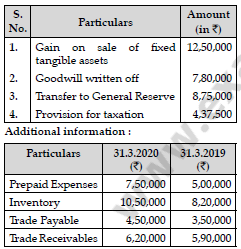
Question. Operating profit before working capital changes will be Rs _______ .
(A) 52,17,500
(B) 64,67,500
(C) 39,67,500
(D) 39,69,500
Answer. Option (C) is correct.
Question. Cash from operating activities before tax will be Rs__________.
(A) 35,57,500
(B) 40,67,500
(C) 37,87,500
(D) 35,67,300
Answer. Option (A) is correct.
Question. Cash flow from Operating Activities will be Rs ___________.
(A) 39,95,000
(B) 31,20,000
(C) 40,67,500
(D) 31,00,000
Answer. Option (B) is correct
II. Read the following information and answer the given questions:
X Ltd. made a profit of Rs 5,00,000 after consideration of the following items :
Rs
(i) Goodwill written off 5,000
(ii) Depreciation on Fixed Tangible Assets 50,000
(iii) Loss on Sale of Fixed Tangible 20,000
Assets (Machinery)
(iv) Provision for Doubtful Debts 10,000
(v) Gain on Sale of Fixed Tangible 7,500
Assets (Land)
Additional information :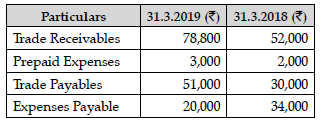
Question. How will goodwill written off be adjusted in the cash flow statement?
(A) Added to the Net Profit Before Tax
(B) Subtracted the Net Profit before Tax
(C) Not recorded in the Cash Flow
(D) None of these
Answer. Option (A) is correct.
Question. What will be the amount of Trade payables added to get the Cash flow from operations?
(A) Rs51,000
(B) Rs30,000
(C) Rs21,000
(D) Rs 31,000
Answer. Option (C) is correct.
Question. What amount of Trade Receivables will be subtracted from the Cash flow statement to get Cash flow from operations?
(A) Rs78,800
(B) Rs52,000
(C) Rs3,000
(D) Rs26,800
Answer. Option (D) is correct.
Question. Which of the following items will be adjusted to Net Profit before Tax?
(A) Trade Receivables
(B) Prepaid Expenses
(C) Loss on sale of Fixed Asset
(D) Expenses Payable
Answer. Option (C) is correct.
III. Read the following information and answer the questions that follow:
Following are the opening and closing balances of Jayesh Ltd.: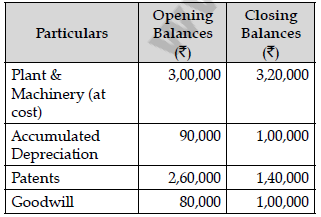
Additional information:
During the year :
(a) Depreciation charged on Plant and Machinery was Rs 36,000.
(b) A machine having a book value of Rs 20,000 was sold for Rs 16,000.
(c) Patents having a book value of Rs 80,000 were sold for Rs 1,10,000
Question. What amount of sales proceeds of Plant and Machinery will be added/subtracted?
(A) Rs20,000 added
(B) Rs20,000 subtracted
(C) Rs16,000 added
(D) Rs16,000 subtracted
Answer. Option (C) is correct.
Question. What amount of machinery was purchased?
(A) Rs 70,000
(B) Rs 76,000
(C) Rs 3,20,000
(D) Rs 20,000
Answer. Option (B) is correct.
Question. What amount of patents will be added/subtracted to get the cash flow from investing activities?
(A) Rs1,50,000 added
(B) Rs1,50,000 subtracted
(C) Rs1,20,000 added
(D) Rs1,20,000 subtracted
Answer. Option (A) is correct.
Question. What is the cash flow from investing activities?
(A) Rs70,000
(B) Rs72,000
(C) Rs73,000
(D) Rs80,000
Answer. Option (A) is correct
Short Answer Type Questions-I
Question. From the following information, calculate the amount of cash flow from investing activities:
Acquired machinery for Rs 10,00,000, paying 10% immediately in cash and accepting a draft for the balance in favour of the vendor, payable after three months.
Answer. Cash outflow from investing activity Rs 1,00,000
Question. X Limited redeemed Rs 1,00,000, 9% debentures at 10% premium. What will be the amount of ‘Cash Flow from Financing Activities’ ?
Answer. Rs 1,10,000
Question. Under which type of activity will you classify ‘Cash advances and loans made to third party’ while preparing Cash Flow Statement ?
Answer. Investing Activity
Question. While preparing cash flow statement, ‘Receipt of interest and divided’ will be classified under which type of activity in case of a nonfinancial enterprise?
Answer. Investing Activity
Question. ‘Loans and advances granted’ by a company will be considered as which type of activity while preparing Cash Flow Statement ?
Answer. Investing Activity
Question. Give any one example of an activity which is an investing activity for every type of enterprise.
Answer. Purchase of Goodwill
Question. ‘An enterprise may hold securities and loans for dealing or trading purpose in which case they are similar to inventory acquired specifically for resale’. Cash Flows from such activities will be classified under which type of activity while preparing Cash Flow Statement ?
Answer. Operating Activities
Question. ‘Payment of bonus to the employees’ by an insurance company is which type of activity ?
Answer. Operating Activity
Question. Kaveri Ltd. a financing company obtained loans and advances of Rs 5,00,000 during the year @ 12% p.a. It will be included in which of the activities while preparing the cash flow
statement?
Answer. Operating Activities
Question. ‘Koval Ltd.’ is a financing company. Under which activity will the amount of interest paid on a loan settled in the current year be shown ?
Answer. Operating Activity
Question. ‘G Ltd.’ is carrying on a paper manufacturing business. In the current year, it purchased machinery for Rs 30,00,000; it paid salaries of Rs 60,000 to its employees; it required funds for expansion and therefore, issued shares of Rs 20,00,000. It earned a profit of Rs 9,00,000 for the current year.
Find out cash flow from operating activities.
Answer. Rs 9,00,000
Question. If the net profits earned during the year is Rs 50,000 and the amount of debtors in the beginning and at the end of the year are Rs 10,000 and Rs 20,000 respectively, compute cash flow from operating activities.
Answer. Rs 40,000
Question. If the net profits made during the year are Rs 50,000 and the bills receivables have decreased by Rs 10,000 during the year. Compute cash flow from operating activities.
Answer. Rs 60,000
Question 1. X Ltd. made a profit of Rs.4,75,000 after considering the following items: Provision for tax made during the year 44,000, Preliminary expenses written off 5,000, Depreciation on fixed assets 50,000, Loss on sale of machinery 16,000, Provision for Doubtful debts 10,000, Gain on sale of Land 7,500. ADDITIONAL INFORMATION: Deferred Tax Liability (Net) 2013: Rs.10,000, 2012: Rs.25,000. Trade Receivables 2013: Rs.78,000, 2012: Rs.52,000. Prepaid Expenses 2013: Rs.3,000, 2012: Rs.2,000. Trade Payables 2013: Rs.51,000, 2012: Rs.40,000. Expenses Payable 2013: Rs.20,000, 2012: Rs.34,000. Tax paid during the year was Rs.50,000. Calculate cash from Operating Activities.
Answer:
Net Profit before tax and extraordinary items = Net Profit after tax + Provision for tax made during the year
Net Profit before tax and extraordinary items = \(4,75,000 + 44,000 = 5,19,000\)
Calculation of Cash Flow from Operating Activities:
Net Profit before Tax: Rs.5,19,000
Add: Non-cash and non-operating expenses:
Preliminary expenses written off: Rs.5,000
Depreciation on fixed assets: Rs.50,000
Loss on sale of machinery: Rs.16,000
Provision for Doubtful debts: Rs.10,000
Less: Non-operating incomes:
Gain on sale of Land: \((7,500)\)
Operating Profit before Working Capital Changes = \(5,19,000 + 5,000 + 50,000 + 16,000 + 10,000 - 7,500 = 5,92,500\)
Add: Increase in Trade Payables = \(51,000 - 40,000 = 11,000\)
Less: Decrease in Expenses Payable = \(34,000 - 20,000 = 14,000\)
Less: Decrease in Deferred Tax Liability = \(25,000 - 10,000 = 15,000\)
Less: Increase in Trade Receivables = \(78,000 - 52,000 = 26,000\)
Less: Increase in Prepaid Expenses = \(3,000 - 2,000 = 1,000\)
Cash Generated from Operations = \(5,92,500 + 11,000 - 14,000 - 15,000 - 26,000 - 1,000 = 5,47,500\)
Less: Income Tax Paid = \((50,000)\)
Net Cash Flow from Operating Activities = Rs.4,97,500
In simple words: Cash flow from operating activities is computed by adjusting net profit for non-cash items, non-operating gains/losses, and changes in working capital components.
Exam Tip: Remember to add back the provision for tax made during the current year to find profit before tax, and subtract the actual tax paid at the very end.
Question 2. From the following information, calculate net cash from operations: Operating profit after Provision for tax of Rs.1,53,000: Rs.6,28,000; Insurance proceeds from the famine settlement: Rs.1,00,000; Proposed Dividend for the current year: Rs.72,000; Depreciation: Rs.1,40,000; Loss on sale of machinery: Rs.30,000; Profit on sale of investments: Rs.20,000; Dividend received on investments: Rs.6,000; Decrease in current assets (other than cash and cash equivalents): Rs.10,000; Increase in current liabilities: Rs.1,51,000; Increase in current assets (other than cash and cash equivalents): Rs.6,00,000; Decrease in current liabilities: Rs.64,000; Income tax paid: Rs.1,18,000; Refund of income tax received: Rs.3,000.
Answer:
Calculation of Net Profit Before Tax and Extraordinary Items:
Operating profit after provision for tax: Rs.6,28,000
Add: Provision for tax: Rs.1,53,000
Add: Proposed Dividend for current year: Rs.72,000
Net Profit Before Tax and Extraordinary Items = \(6,28,000 + 1,53,000 + 72,000 = 8,53,000\)
Calculation of Cash Flow from Operating Activities:
Net Profit Before Tax and Extraordinary Items: Rs.8,53,000
Less: Insurance proceeds from famine settlement (extraordinary income): \((1,00,000)\)
Adjusted Profit before Tax: Rs.7,53,000
Add: Non-cash and non-operating expenses:
Depreciation: Rs.1,40,000
Loss on sale of machinery: Rs.30,000
Less: Non-operating incomes:
Profit on sale of investments: \((20,000)\)
Dividend received on investments: \((6,000)\)
Operating Profit before Working Capital Changes = \(7,53,000 + 1,40,000 + 30,000 - 20,000 - 6,000 = 8,97,000\)
Add: Decrease in current assets: Rs.10,000
Add: Increase in current liabilities: Rs.1,51,000
Less: Increase in current assets: \((6,00,000)\)
Less: Decrease in current liabilities: \((64,000)\)
Cash Generated from Operations before Extraordinary Items = \(8,97,000 + 10,000 + 1,51,000 - 6,00,000 - 64,000 = 3,94,000\)
Add: Insurance proceeds from famine settlement: Rs.1,00,000
Cash Generated from Operations = Rs.4,94,000
Less: Income tax paid: \((1,18,000)\)
Add: Refund of income tax received: Rs.3,000
Net Cash Flow from Operating Activities = Rs.3,79,000
In simple words: Start with operating profit, add back provisions and proposed dividends to get profit before tax, adjust for non-cash items and working capital changes, and finally account for taxes and extraordinary items.
Exam Tip: Proposed dividend of the current year is added to calculate profit before tax, and extraordinary items like insurance proceeds must be adjusted at their respective stages.
Question 3. From the following particulars of R Ltd., calculate Cash Flows from Financing Activities: Equity Share Capital (2006: 6,00,000, 2007: 10,000,000), 18% Preference Share Capital (2006: 4,00,000, 2007: 3,00,000), Securities Premium (2006: 1,00,000, 2007: 2,60,000), 14% Debentures (2006: 2,00,000, 2007: 2,50,000), Discount on debentures (2006: 5,000, 2007: 6,000), Underwriting commission on issue of shares (2006: ----, 2007: 20,000). Additional Information: 1. Dividend on preference shares and an interim dividend at 15% were paid on equity shares on March 31, 2007. 2. Preference shares were redeemed on March 31, 2007 at a premium of 5%. Such premium has been provided out of profit. 3. New shares and debentures were issued on March 31, 2007.
Answer:
Calculation of Cash Flows from Financing Activities:
Proceeds from issue of Equity Shares (including securities premium on new shares):
Increase in Equity Share Capital = \(10,00,000 - 6,00,000 = 4,00,000\)
Increase in Securities Premium = \(2,60,000 - 1,00,000 = 1,60,000\)
Total proceeds from issue of Equity Shares = \(4,00,000 + 1,60,000 = 5,60,000\)
Redemption of Preference Shares = \((1,00,000)\)
Premium on redemption of Preference shares (\(5\%\) of \(1,00,000\)) = \((5,000)\)
Proceeds from issue of \(14\%\) Debentures = \(2,50,000 - 2,00,000 = 50,000\)
Payment of Dividend on Preference Shares (\(18\%\) of opening balance of Rs.4,00,000) = \((72,000)\)
Payment of Interim Dividend on Equity Shares (\(15\%\) of opening capital of Rs.6,00,000) = \((90,000)\)
Net Cash Flow from Financing Activities = \(5,60,000 - 1,00,000 - 5,000 + 50,000 - 72,000 - 90,000 = Rs.3,43,000\)
In simple words: Financing activities show cash flows from issuing or redeeming shares and debentures, plus the payment of dividends and interest.
Exam Tip: Dividend is always calculated on the opening balance of share capital unless specified otherwise.
Question 4. From the following particulars of Bharat Gas Ltd., calculate Cash Flows from Investing Activities. Also show the workings clearly by preparing the ledger accounts. Assets: Goodwill (2006: 1,00,000, 2007: 3,00,000), Patents (2006: 2,80,000, 2007: 1,60,000), Machinery (2006: 10,20,000, 2007: 12,40,000), 10% Long Term Investments (2006: 60,000, 2007: 1,60,000), Investment in Land (2006: 1,00,000, 2007: 1,00,000), Shares of Amartax Ltd. (2006: 1,00,000, 2007: 1,00,000). Additional Information: 1. Patents are written off to the extent of Rs.40,000 and some patents were sold at a profit of Rs.20,000. 2. A machine costing Rs.1,40,000 (depreciation provided thereon Rs.60,000) was sold for Rs.50,000. Depreciation charged during the year was Rs.1,40,000. 3. On March 31, 2007, 10% investments were purchased for Rs.1,80,000 and some investments were sold at a profit of Rs.20,000. Interest on investment was received on March 31, 2007. 4. Amartax Ltd. paid dividend @10% on its shares. 5. A plot of land was purchased out of surplus funds for investment purposes and let out for commercial use and rent received Rs.30,000.
Answer:
Calculation of Cash Flows from Investing Activities:
1. Sale of Patents: Opening Patents (2,80,000) - Written off (40,000) - Closing Patents (1,60,000) = Sale of Patents = Rs.80,000. Add profit of Rs.20,000 = Cash inflow from sale of patents = Rs.1,00,000.
2. Purchase of Machinery (balancing figure from Machinery Account): Purchase = Rs.4,00,000 (Cash outflow: \((4,00,000)\)). Sale of Machinery = Rs.50,000 (Cash inflow: Rs.50,000).
3. Purchase of 10% Long Term Investments: \((1,80,000)\). Sale of investments: Rs.80,000 (Cash inflow).
4. Interest received on 10% Investments = \(10\%\) on opening balance plus new purchases = Rs.16,000.
5. Dividend received on shares of Amartax Ltd. (\(10\%\) of Rs.1,00,000) = Rs.10,000.
6. Rent received on Investment in Land = Rs.30,000.
Total Cash Flow from Investing Activities = \(1,00,000 - 4,00,000 + 50,000 - 1,80,000 + 80,000 + 16,000 + 10,000 + 30,000 = \text{Rs. } (1,94,000)\)
In simple words: Investing activities include cash flows from the purchase and sale of long-term assets and investments, as well as investment income like interest, dividends, and rent received.
Exam Tip: Always prepare ledger accounts for fixed assets and accumulated depreciation to correctly determine purchases and sales figures.
Question 5. From the following Balance Sheet of surya Ltd., as on 31st March, 2012 and 2011, prepare a statement of cash flow... [Balance Sheet and Additional Information provided in PDF].
Answer:
A. Cash Flow from Operating Activities:
Net Profit before Tax and Extraordinary Items = Rs.1,18,000
Operating Profit before Working Capital Changes = Rs.2,46,000
Cash Generated from Operations = Rs.1,83,000
Net Cash from Operating Activities = Rs.1,47,000
B. Cash Flow from Investing Activities:
Purchase of Fixed Assets = \((3,30,000)\)
Sale of Fixed Assets = Rs.17,000
Purchase of Investments = \((5,000)\)
Sale of Investments = Rs.14,000
Net Cash used in Investing Activities = \((3,04,000)\)
C. Cash Flow from Financing Activities:
Issue of Share Capital and Securities Premium = Rs.1,35,000
Proceeds from Long Term Borrowings (\(15\%\) Debentures) = Rs.50,000
Dividend paid = \((36,000)\)
Interest on Debentures paid = \((34,000)\)
Net Cash from Financing Activities = Rs.1,15,000
Net Increase in Cash and Cash Equivalents = \(1,47,000 - 3,04,000 + 1,15,000 = \text{Rs. } (42,000)\)
Opening Cash and Cash Equivalents = Rs.98,000
Closing Cash and Cash Equivalents = Rs.56,000
In simple words: A full cash flow statement systematically categorizes all cash inflows and outflows into operating, investing, and financing activities.
Exam Tip: Ensure that the net increase or decrease in cash and cash equivalents matches the difference between opening and closing cash balances.
Question 6. Following are the balance sheets of Sewak Ltd. as on 31.3.2012 and 31.3.2011... Prepare a Cash Flow Statement.
Answer:
Net Cash Flow from Operating Activities = Rs.1,12,000
Net Cash used in Investing Activities = \((2,03,000)\)
Net Cash from Financing Activities = Rs.96,000
Net Increase in Cash and Cash Equivalents = \(1,12,000 - 2,03,000 + 96,000 = \text{Rs. } 5,000\)
Opening Cash and Cash Equivalents (Cash Rs.20,000) = Rs.20,000
Closing Cash and Cash Equivalents (Cash Rs.25,000 + Other Current Assets Rs.3,000) = Rs.28,000
In simple words: Combine operating, investing, and financing net cash flows to reconcile opening and closing cash balances.
Exam Tip: Double-check non-current asset and liability notes to account for all hidden adjustments like share discounts and accumulated depreciation.
Question 7. Prepare a Cash Flow Statement from the following: STATEMENT OF PROFIT AND LOSS (for the year ended 31st March, 2012)... [Financial Statements provided in PDF].
Answer:
Calculation of Operating Profit before Working Capital Changes:
Net Profit Before Tax = Rs.2,54,000
Add: Non-cash and non-operating expenses:
Finance Costs (Interest on Debentures): Rs.20,000
Depreciation and Amortization Expenses: Rs.54,000
Goodwill written off: Rs.16,000
Operating Profit before Working Capital Changes = \(2,54,000 + 20,000 + 54,000 + 16,000 = 3,44,000\)
Net Cash Flow from Operating Activities = Rs.3,44,000
Net Cash used in Investing Activities = Rs.0 (assuming no asset changes given)
Net Cash used in Financing Activities (Interest paid) = \((20,000)\)
Net Increase in Cash = \(3,44,000 - 20,000 = 3,24,000\)
In simple words: Extract profit before tax from the statement of profit and loss, add back non-cash expenses like depreciation and goodwill written off, and adjust for financing costs.
Exam Tip: Finance costs added back in operating activities must be shown as cash outflows under financing activities if paid in cash.
Free study material for Accountancy
Chapter Assignment & Practice Material for Class 12 Accountancy Part 2 Chapter 06 Cash Flow Statement
Chapter Practice Questions for Class 12 Accountancy
Explore reliable practice questions for Part 2 Chapter 06 Cash Flow Statement tailored for Class 12 learners. Use these structured worksheets to evaluate preparedness and strengthen core problem-solving skills.
Why Practice Class 12 Accountancy Assignments?
- Curriculum Standards: Assignments match modern CBSE sample formats to ensure relevant preparation.
- Thorough Revision: Detailed problem sets reinforce core concepts and eliminate conceptual weak spots.
- Execution Speed: Timed practice with assignment sets sharpens overall response timing.
How to Approach Accountancy Part 2 Chapter 06 Cash Flow Statement Assignments
- Concept Foundation: Review the NCERT book for Class 12 Accountancy thoroughly before diving into assignment tasks.
- Self-Evaluation: Solve exercises independently before inspecting professional answer guides.
- Progress Monitoring: Note down complex formulas or concepts, clearing them up using available online practice aids.
FAQs
You can download free PDF assignments for Class 12 Accountancy Part 2 Chapter 06 Cash Flow Statement from StudiesToday.com. These practice sheets have been updated for the 2026-27 session covering all concepts from latest NCERT textbook.
Yes, our teachers have given solutions for all questions in the Class 12 Accountancy Part 2 Chapter 06 Cash Flow Statement assignments. This will help you to understand step-by-step methodology to get full marks in school tests and exams.
Yes. These assignments are designed as per the latest CBSE syllabus for 2026. We have included huge variety of question formats such as MCQs, Case-study based questions and important diagram-based problems found in Part 2 Chapter 06 Cash Flow Statement.
Practicing topicw wise assignments will help Class 12 students understand every sub-topic of Part 2 Chapter 06 Cash Flow Statement. Daily practice will improve speed, accuracy and answering competency-based questions.
Yes, all printable assignments for Class 12 Accountancy Part 2 Chapter 06 Cash Flow Statement are available for free download in mobile-friendly PDF format.