

School Assignments for Class 12 Accountancy: Part 2 Chapter 03 Financial Statements Of A Company
Explore structured practice materials through the CBSE Class 12 Accountancy Financial Statements of a Company Assignment. Tailored for Class 12 learners, utilizing these Accountancy assignments ensures thorough preparation and strengthens foundational knowledge before final CBSE evaluations.
Practice Class 12 Accountancy Assignments: Part 2 Chapter 03 Financial Statements Of A Company
Access the complete assignment PDF for Class 12 Accountancy below. Regular practice with these targeted academic tasks builds familiarity with standard question patterns and helps secure higher marks in final school evaluations.
OBJECTIVE QUESTIONS
Question. Which of the following is not a tool of financial analysis :
(A) Comparative Income Statement
(B) Comparative Position Statement
(C) Statement of Profit and Loss
(D) Cash Flow Statement
Answer. Option (C) is correct.
Question. Which of the following is a limitation of financial analysis :
(A) It is just a study of reports of the company.
(B) It judges the ability of the firm to repay its debts.
(C) It identifies the reasons for change in financial position.
(D) It ascertains the relative importance of different components of the financial position of the firm.
Answer. Option (A) is correct.
Question. Which of the following is not a limitation of analysis of financial statements :
(A) Window dressing
(B) Price level changes ignored
(C) Subjectivity
(D) Intra firm comparison possible
Answer. Option (D) is correct.
Question. The most commonly used tools for financial analysis are :
(A) Horizontal analysis
(B) Vertical analysis
(C) Ratio analysis
(D) All of the above
Answer. Option (D) is correct.
Question. Pick the odd one out :
(A) Horizontal Analysis
(B) Comparative Statement of Profit and Loss
(C) Comparative Balance Sheet
(D) Common-Size Balance Sheet
Answer. Option (D) is correct.
Question. Consider the following statements given below:
(i) In Common-size Balance Sheet, each item is converted into the percentage of share capital.
(ii) In Common-size Statement of Profit and Loss, each item is converted into the percentage of total expenses.
(iii) In Comparative Statement of Profit and Loss, absolute and percentage change in the items during two periods of time are calculated.
Choose the correct option :
(A) Only (i) is correct
(B) Only (ii) is correct
(C) Only (iii) is correct
(D) All are correct
Answer. Option (C) is correct.
Question. Financial Statements Analysis helps in assessing future trends and thus, helps in forecasting and preparation of _________.
(A) Accounts
(B) Budgets
(C) Reports
(D) Statements
Answer. Option (B) is correct.
Question. Which of the following points out the nature of financial statements?
(i) Financial statements are prepared on the basis of recorded facts.
(ii) Certain accounting conventions are followed while preparing financial statements.
(iii) Financial statements are prepared on certain basic assumptions (pre-requisites) known as postulates.
(iv) Facts and figures presented through financial statements are based on personal opinion, estimates and judgements.
(A) Only (i)
(B) (i) and (ii)
(C) (i), (ii) and (iii)
(D) (i), (ii), (iiii) and (iv)
Answer : D
Question. 10% debentures are included in
(A) current liability
(B) fixed assets
(C) current assets
(D) None of these
Answer : D
Question. Which of the following are the objectives of financial statements?
(i) To provide information about economic resources and obligations of a business.
(ii) To provide information about the earning capacity of the business.
(iii) To provide information about cash f lows.
(iv) To judge effectiveness of management.
(A) (i) and (ii)
(B) Only (ii)
(C) (i), (ii) and (iv)
(D) (i), (ii), (iii) and (iv)
Answer : D
Question. Under which of the following head/ sub-head is ‘forfeited shares’ presented in the balance sheet of a company?
(A) Reserves and surplus
(B) Share capital
(C) Other long-term liabilities
(D) Other current liabilities
Answer : B
Question. Staff welfare expenses are included in
(A) cost of material consumed
(B) revenue from operation
(C) employees benefit expense
(D) None of the above
Answer : C
Question. Which of the following is not included under the head shareholders’ fund?
(A) Share capital
(B) Reserves and surplus
(C) Money received against share warrants
(D) Long-term provisions
Answer : D
Question. Public deposits appear under which of the following head in a company’s balance sheet?
(A) Current liabilities
(B) Non-current liabilities
(C) Reserves and surplus
(D) Shareholders’ funds
Answer : B
Question. External users of financial statements are
(A) banks
(B) suppliers
(C) Both ((A) and ((B)
(D) director of company
Answer : C
Question. Which of the following is not presented under ‘current liabilities’ in the balance sheet of a company?
(A) Short-term borrowings
(B) Deferred tax liabilities
(C) Short-term provisions
(D) Trade payables
Answer : B
Question. In a trading firm, if stock of finished goods held for a month and credit period is 2 months, then operating cycle will be for ....... month(s).
(A) one
(B) two
(C) three
(D) four
Answer : C
Question. Preliminary expenses are those expenses which are paid before incorporation of a company. A company paid its preliminary expenses to its promoters. Accountant of company is in view that this is an expense, so it will be fully written-off in statement of profit and loss account. How this should have been shown?
(A) Statement of profit and loss account by full amount
(B) Current asset
(C) Deduct from reserve and surplus
(D) None of the above
Answer : C
Question. A company got its mining right recently. You are required to show this right in financial statements of the company as
(A) expense
(B) tangible asset
(C) current asset
(D) intangible asset
Answer : D
Question. A company issued shares calling application, allotment and first and final call. A holder of shares not paid allotment and first call. His shares are forfeited but not re-issued. As on balance sheet date, you are required to show these forfeited shares in the balance sheet of company under the head
(A) current liability
(B) shareholders’ fund
(C) current assets
(D) None of these
Answer : B
Question. You are required to find heading and sub-heading under which sundry debtors can be shown?
(A) Fixed assets, trade receivables
(B) Current assets, trade receivables
(C) Fixed assets, trade payables
(D) Current assets, trade payables
Answer : B
Question. Which of the following item(s) can be presented on the assets side of the balance sheet of company?
(A) Sundry debtors
(B) Public deposits
(C) Livestock
(D) Both (A) and (C)
Answer : D
Question. Financial statements include balance sheet, statement of profit and loss, cash f low statement, etc. Besides these statements, a special statement is also included in financial statements if applicable on company. Name that special statement.
(A) Statement of changes in equity
(B) Statement of assets and liabilities
(C) Statement of cash inflow and outflow
(D) Statement of incomes and expenses
Answer : A
Question. Which of the following is not an item of sub-head other current liabilities in balance sheet?
(A) Creditors
(B) Outstanding expenses
(C) Advance income
(D) Both (B) and (C)
Answer : A
Question. From following information, calculate other incomes. Sales of product = Rs 54,000; Sale of services = Rs 60,000; Commission received = Rs 1,20,000; Excise duty paid = Rs 3,00,000; Dividend from investment = Rs 20,000
(A) Rs 1,40,000
(B) Rs 2,54,000
(C) Rs (46,000) loss
(D) None of these
Answer : A
Question. A company issued capital. A shareholder paid all money on allotment while first call is not called by company. So you are required to show this advance in balance sheet of company as
(A) current liability
(B) long-term liability
(C) current assets
(D) None of these
Answer : A
Question. Format and Contents of a company’s balance sheet must be in accordance with ………, Part 1 of Companies Act, 2013.
(A) Schedule I
(B) Schedule II
(C) Schedule III
(D) Schedule IV
Answer : C
Question. From the following information, you are required to compute profit after tax.
I. Revenue from operation = Rs 80,00,000
II. Cost of material consumed = Rs 10,00,000
III. Purchase of stock-in-trade = Rs 30,00,000
IV. Employees salary = Rs 4,00,000
V. Tax rate = 50%
(A) Rs 20,00,000
(B) Rs 24,00,000
(C) Rs 15,00,000
(D) Rs 18,00,000
Answer : D
Question. What is the total under equity and liabilities side of the balance sheet when the following information is given?
Shareholders’ Funds = Rs 10,00,000; Non-current Liabilities = Rs 5,00,000; Current Liabilities = Rs 3,00,000
(A) Rs 10,00,000
(B) Rs 15,00,000
(C) Rs 18,00,000
(D) Rs 13,00,000
Answer : C
Question. A company purchased a business of a firm. When accountant was tallying all assets and liabilities, he found that the company has paid more amount than the worth of it’s assets. You are required to find what this difference be called and where it will be shown?
(A) Capital reserve, reserve and surplus
(B) Goodwill, intangible assets
(C) Accountants totalling is wrong, assets and liabilities always tally without adjustment
(D) None of the above
Answer : B
Question. Livestock is a item of ……… assets under sub-head fixed assets and the major head non-current assets.
(A) intangible
(B) inventories
(C) trade receivables
(D) tangible
Answer : D
Question. What will be the amount shown under the head current liabilities when the following data is given? Short-term borrowings = Rs 3,00,000; Trade Payables = Rs 2,00,000; Other Current Liabilities = Rs 1,00,000; Short-term Provisions = Rs1,00,000
(A) Rs 5,00,000
(B) Rs 6,00,000
(C) Rs 4,00,000
(D) Rs 7,00,000
Answer : D
Question. In balance sheet, ‘Trade receivables’ is the sub-head under ……… .
(A) non-current assets
(B) current assets
(C) non-current liabilities
(D) current liabilities
Answer : B
Question. Securities premium reserve is shown on the liabilities side in the balance sheet under the head
(A) reserves and surplus
(B) general reserve
(C) share capital
(D) current liabilities
Answer : A
Question. Compute cost of materials consumed from the following information. Opening inventory of materials Rs 5,00,000, materials purchased Rs 40,00,000 and closing inventory of materials Rs 6,00,000.
(A) Rs 40,00,000
(B) Rs 51,00,000
(C) Rs 27,00,000
(D) Rs 39,00,000
Answer : D
Question. What will be the amount shown under the head current assets when the following data is given? Inventories = Rs 2,30,000; Trade Receivables = Rs 70,000; Cash and Cash Equivalents = Rs 50, Current Investments = Rs 50,000
(A) Rs 3,00,000
(B) Rs 3,50,000
(C) Rs 2,80,000
(D) Rs 4,00,000
Answer : D
Question. What is the total under assets side of the balance sheet when the following information is given? Non-current Assets = Rs 5,00,000; Current Assets = Rs 2,00,000; Current Liabilities = Rs 3,00,000
(A) Rs 7,00,000
(B) Rs 10,00,000
(C) Rs 5,00,000
(D) None of these
Answer : A
Assertion and Reason Based MCQs
Directions: In the following questions, a statement of Assertion (A) is followed by a statement of Reason (R).
Mark the correct choice as:
(A) Both (A) and (R) are true, and (R) is the correct explanation of (A).
(B) Both (A) and (R) are true, but (R) is not the correct explanation of (A).
(C) (A) is true, but (R) is false.
(D) (A) is false, but (R) is true.
Question. Assertion (A): Financial statements analysis helps in drawing out meaningful conclusions.
Reason (R): Financial Statements Analysis presents financial data in a simplified and understandable form.
Answer. Option (A) is correct.
Question. Assertion (A): The analysis of financial statements does not disclose the current worth of the business.
Reason (R): Financial statements are prepared on cost principles.
Answer. Option (A) is correct.
Question. Assertion (A): Comparative statements help in deriving meaningful conclusions regarding the changes in financial position and operating results.
Reason (R): Comparative statements compare financial data of two points of time.
Answer. Option (A) is correct.
Question. Assertion (A): Comparative Balance Sheet provides information regarding progress of the business firm.
Reason (R): The Comparative Balance Sheet shows increase and decrease in absolute terms as well as in percentage in various assets, liabilities and capital.
Answer. Option (A) is correct.
Case-based MCQs
I. Read the following information and answer the given questions:
Following is the data given of Lalit Ltd.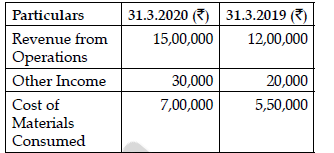
Question. What is the percentage change in the Revenue from Operations?
(A) 50%
(B) 25%
(C) 30%
(D) 20%
Answer. Option (B) is correct.
Question. What is the percentage change in the Total Revenue earned?
(A) 20.41%
(B) 27.27%
(C) 23.88%
(D) 25.41%
Answer. Option (D) is correct.
Question. What is the change in the profit before tax?
(A) Rs 1,50,000
(B) Rs 1,60,000
(C) Rs 3,10,000
(D) Rs 10,000
Answer. Option (B) is correct.
Question. What is the percentage change in the Total Expenses?
(A) 25%
(B) 24.41%
(C) 27.27%
(D) 23.88%
Answer. Option (C) is correct.
II. Read the following information and answer the given questions:
The following data is available of Pitambar Ltd.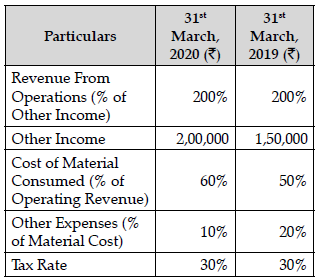
Question. What is the revenue from operations on 31st March, 2020?
(A) Rs 2,00,000
(B) Rs 4,00,000
(C) Rs 3,00,000
(D) None of these
Answer. Option (B) is correct.
Question. What percentage of total revenue is of revenue from operations for 2019?
(A) 100%
(B) 50%
(C) 66%
(D) 150%
Answer. Option (D) is correct.
Question. What is the value of the tax paid by the firm in 2019?
(A) Rs 1,00,800
(B) Rs 81,000
(C) Rs 2,35,000
(D) Cannot be determined from the given data.
Answer. Option (B) is correct.
Question. What is the Net Profit after Tax in March 2020?
(A) Rs 2,35,200
(B) Rs 1,89,000
(C) Rs 2,70,000
(D) Rs 3,36,000
Answer. Option (A) is correct.
III. Read the following information and answer the given questions:
Following information are taken from the books of Agarwal Pvt Ltd.: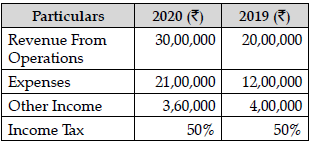
Question. What is the value of absolute change in the Total Revenue?
(A) Rs 10,00,000
(B) Rs 40,000
(C) Rs 9,60,000
(D) Rs 9,00,000
Answer. Option (C) is correct.
Question. What is the percentage change in the tax paid?
(A) 5%
(B) 6%
(C) 8%
(D) 7%
Answer. Option (A) is correct.
Question. The absolute change in the Expenses is:
(A) Rs 9,00,000
(B) Rs 60,000
(C) Rs 10,00,000
(D) Rs 12,00,000
Answer. Option (A) is correct.
Question. What is the percentage change in the profit earned after tax?
(A) 40%
(B) 7%
(C) 10%
(D) 5%
Answer. Option (D) is correct.
Very Short Answer Type Questions
Question. Name the statement in which the figure of net sales is assumed to be equal to 100 and all other figures are expressed as percentage of net sales.
Answer. Common-size Income Statement
Question. Mr. Navratan wants to know the progress of the business firm by considering the change in assets, liabilities and capital on different dates.Suggest him to choose the financial statement analysis tool which will be helpful for him for the above study.
Answer. Comparative Balance Sheet
Question. Identity the tool of financial statement analysis stated below :
It is prepared in such a form so as to reflect the operating activities of the business for two or more accounting periods.
Answer. Comparative Income Statement
Question 1. The following balances were extracted from the books of Perfect Sports Ltd. as on 31st March, 2017: Plant and Machinery Rs.2,00,000, Shares in RXL Ltd. Rs.1,00,000, Stock-in-Trade Rs.80,000, Bills Receivable Rs.10,000, Preapid Expenses Rs.10,000, Share capital Rs.2,00,000, Capital Redemption Reserve Rs.1,20,000, 10% Debentures Rs.60,000, Short-term loan from Bank Rs.10,000 and provision for taxation Rs.10,000. Prepare Balance Sheet of the company as per Schedule III Part I of the Companies Act, 2013.
Answer: Balance Sheet of Perfect Sports Ltd. as at 31st March, 2017
| Particulars | Note No. | 31st March, 2017 (Rs) | 31st March, 2016 (Rs) |
|---|---|---|---|
| I. EQUITY AND LIABILITIES | |||
| 1. Shareholders' Funds: | |||
| (a) Share Capital | 1 | 2,00,000 | |
| (b) Reserves and Surplus | 2 | 1,20,000 | |
| 2. Non-current Liabilities | |||
| (a) Long-term Borrowings | 3 | 60,000 | |
| 3. Current Liabilities | |||
| (a) Short-term Borrowings | 4 | 10,000 | |
| (b) Short-term Provisions | 5 | 10,000 | |
| Total | 4,00,000 | ||
| II. ASSETS | |||
| 1. Non-current Assets | |||
| (a) Fixed Assets (Tangible) | 6 | 2,00,000 | |
| (b) Non-Current Investments | 7 | 1,00,000 | |
| 2. Current Assets | |||
| (a) Inventories | 8 | 80,000 | |
| (b) Trade Receivables | 9 | 10,000 | |
| (c) Other Current Assets | 10 | 10,000 | |
| Total | 4,00,000 | ||
Notes to Accounts:
| Particulars | (Rs) |
|---|---|
| 1. Share Capital: | |
| Subscribed and Paid-up Share Capital | 2,00,000 |
| 2. Reserves and Surplus: | |
| Capital Redemption Reserve | 1,20,000 |
| 3. Long-term Borrowings: | |
| 10% Debentures | 60,000 |
| 4. Short-term Borrowings: | |
| Short-term Loan from Bank | 10,000 |
| 5. Short-term Provisions: | |
| Provision for Taxation | 10,000 |
| 6. Fixed Assets (Tangible): | |
| Plant and Machinery | 2,00,000 |
| 7. Non-current Investments: | |
| Shares in RXL Ltd. | 1,00,000 |
| 8. Inventories: | |
| Stock-in-Trade | 80,000 |
| 9. Trade Receivables: | |
| Bills Receivable | 10,000 |
| 10. Other Current Assets: | |
| Preapid Expenses | 10,000 |
In simple words: The Balance Sheet lists what the company owns (assets) on the right side and what it owes (liabilities) and what belongs to owners (equity) on the left side. Both sides must be equal. Assets are split into long-term and short-term, and liabilities into the same categories.
Exam Tip: When preparing a Balance Sheet, always ensure that the total of Equity and Liabilities equals the total of Assets. Classify items carefully as current (short-term) or non-current (long-term) based on when they will be paid or realized.
Question 2. X Ltd. has an authorised capital of Rs.15,00,000 divided into 1,00,000 Equity shares of Rs.10 each and 50,000, 9% preference shares of Rs.10 each. The whole of preference shares were subscribed, called and paid. However the company issued only 90,000 equity shares. 85,000 equity shares were subscribed for. During the first year Rs.8 per share were called. Ram holding 1,000 shares did not pay first call of Rs.2. Also Shyam holding 2,000 shares did not pay first call of Rs.2. Only Shyam's shares were forfeited after the first call and later on 1,500 of the forfeited shares were reissued at Rs.6 per share, Rs.8 called up.
(a) Show capital in Balance Sheet as per Schedule III of Companies Act, 2013 as at 31st March, 2017.
(b) Prepare relevant 'Notes to Accounts'. [Question from CBSE Guiding Notes]
Answer: Let us work through the capital structure step by step. First, compute the shares subscribed, called, and paid, accounting for forfeitures and reissues.
Equity Shares Calculation:
Shares subscribed for: 85,000
Shares called at Rs.8 first call: Rs.8,00,000
Ram's 1,000 shares - call defaulted but not forfeited
Shyam's 2,000 shares - forfeited; 1,500 reissued at Rs.6, Rs.8 called up
Paid-up Capital:
From 85,000 subscribed shares, 81,000 paid for first call of Rs.2 each = 81,000 shares × Rs.2 = Rs.1,62,000
From 1,500 reissued shares at Rs.6 called up, all paid = 1,500 × Rs.6 = Rs.9,000
Total from reissued: Rs.9,000
Preference Shares: 50,000 × Rs.10 = Rs.5,00,000 (fully subscribed, called and paid)
Balance Sheet - Share Capital Section
| Particulars | Note No. | 31st March, 2017 (Rs) |
|---|---|---|
| Share Capital | ||
| Equity Share Capital | 1 | 1,71,000 |
| Preference Share Capital | 2 | 5,00,000 |
| Total Share Capital | 6,71,000 | |
Notes to Accounts:
| Particulars | (Rs) |
|---|---|
| 1. Equity Share Capital | |
| Subscribed and Paid-up: | |
| 81,000 Equity Shares fully paid at Rs.10 each | 8,10,000 |
| 1,500 Forfeited Shares Reissued at Rs.6, Rs.8 called, fully paid | 9,000 |
| Less: Forfeited Shares Account (1,000 shares × Rs.2 uncalled) | (48,000) |
| Total Equity Share Capital | 1,71,000 |
| 2. Preference Share Capital | |
| 50,000 Preference Shares of Rs.10 each, fully paid | 5,00,000 |
In simple words: Share capital shows the money invested by shareholders. It includes equity shares and preference shares. Some shares were not fully paid, and some were forfeited then reissued. The Balance Sheet shows the net paid-up capital after accounting for all these changes.
Exam Tip: When dealing with forfeited and reissued shares, track each holder's position separately. Deduct calls-in-arrears from the paid-up capital, and show the forfeited shares account separately. Ensure the final balance reflects only the capital actually received.
Question 1. List the major heads under which the 'equity and liabilities' are presented in the Balance Sheet of a company as per Schedule III, Part I of the Companies Act, 2013.
Answer: The major heads under which equity and liabilities are shown in the Balance Sheet as per Schedule III, Part I of the Companies Act, 2013 are:
(i) Shareholders' Funds
(ii) Non-current Liabilities
(iii) Current Liabilities
In simple words: The Balance Sheet divides all money owed by the company and money owned by shareholders into three main groups: shareholder ownership, long-term debts, and short-term debts.
Exam Tip: Remember that Shareholders' Funds comes first, followed by liabilities in order of how long the company has to pay them back.
Question 2. Name the sub-heads under the head 'Non-current Assets' in the Balance Sheet under Schedule III of the Companies Act, 2013.
Answer: The sub-heads under 'Non-current Assets' are:
(i) Property, Plant and Equipment
(ii) Capital Work-in-Progress
(iii) Intangible Assets
(iv) Intangible Assets under Development
(v) Financial Assets
(vi) Investments
(vii) Trade Receivables
(viii) Loans
(ix) Other Financial Assets
(x) Deferred Tax Assets
(xi) Other Non-current Assets
In simple words: Non-current assets are things the company owns for more than one year, like buildings, machines, and money lent to others that won't be paid back soon.
Exam Tip: Non-current assets are those the company will keep for a long time - more than 12 months from the Balance Sheet date.
Question 3. Name the sub-heads under the head 'Non-current Liabilities' in the equity and liabilities part of the Balance Sheet under Schedule III, Part I of the Companies Act, 2013.
Answer: The sub-heads under 'Non-current Liabilities' are:
(i) Financial Liabilities
(ii) Borrowings
(iii) Trade Payables
(iv) Other Financial Liabilities
(v) Provisions
(vi) Deferred Tax Liabilities
(vii) Other Non-current Liabilities
In simple words: Non-current liabilities are debts the company must pay back after more than one year, like long-term loans and future employee benefits.
Exam Tip: These are obligations that the company will settle beyond the next 12 months, making them different from current liabilities.
Question 4. Name any two items that are shown under the head 'Other Current Liabilities' and any two items that are shown under the head 'Other Current Assets' in the Balance Sheet of a company as per Schedule III of the Companies Act, 2013.
Answer: Other Current Liabilities may include:
(i) Income received in advance
(ii) Accrued expenses
Other Current Assets may include:
(i) Short-term loans to others
(ii) Accrued income
In simple words: Current liabilities and assets are things that will turn into cash or need to be paid within one year. They include money the company received early and money it will get soon.
Exam Tip: Always check if the item will be settled or converted within 12 months to decide if it belongs in the "Current" category.
Question 5. (a) Give the meaning of 'Long-term Provisions'.
Answer: Long-term Provisions are sums set aside by the company to meet future obligations that are likely to happen but whose exact amount or timing is uncertain, and which will be settled after more than one year. Examples include provisions for employee pension schemes and warranty claims payable in the future.
In simple words: Long-term provisions are money the company saves now for future costs it knows will come, but doesn't know exactly when or how much - like setting aside funds for workers' pensions.
Exam Tip: The key difference from liabilities is that provisions deal with uncertain future amounts, while current liabilities are definite amounts due soon.
Question 5. (b) List any four items other than 'stock-in-trade' that are presented under the sub-head 'inventories' as per Schedule III of the Companies Act, 2013.
Answer: Four items under 'Inventories' other than stock-in-trade are:
(i) Raw materials
(ii) Work-in-progress
(iii) Finished goods
(iv) Stores and spares
In simple words: Inventories include all materials and goods the company owns for business - from raw materials waiting to be used, items being made, to completed goods ready to sell.
Exam Tip: Remember that inventories represent goods owned by the company, not yet sold, so they appear as current assets.
Question 6. Under which major heads, the following items will be placed in the Balance Sheet of a company as per Schedule III, Part I of the Companies Act, 2013?
(i) Securities Premium Reserve
(ii) Balances with banks
(iii) Term loans from bank
(iv) Goods-in-transit
(v) Loans repayable on demand
(vi) Computer software
(vii) Unpaid dividends
(viii) Vehicles
Answer:
(i) Securities Premium Reserve - Shareholders' Funds
(ii) Balances with banks - Current Assets
(iii) Term loans from bank - Non-current Liabilities
(iv) Goods-in-transit - Current Assets
(v) Loans repayable on demand - Current Liabilities
(vi) Computer software - Non-current Assets
(vii) Unpaid dividends - Current Liabilities
(viii) Vehicles - Non-current Assets
In simple words: Each item goes to the part of the Balance Sheet that shows what it is - reserves go with shareholder funds, bank money goes with current assets, loans go with liabilities, and equipment goes with fixed assets.
Exam Tip: Ask yourself: Is this money owed? Is it owned by shareholders? Will it be settled within a year? These questions help you place items correctly.
Question 7. Under which heads, the following items will be placed in the Balance Sheet of a company as per Schedule III Part I of the Companies Act, 2013?
(i) Cash in hand
(ii) Mining Rights
(iii) Short-term deposits
(iv) Debenture Redemption Reserve
(v) Income received in advance
(vi) Balance of the Statement of Profit and Loss
(vii) Office Equipments
(viii) Work-in-progress
Answer:
(i) Cash in hand - Current Assets
(ii) Mining Rights - Non-current Assets
(iii) Short-term deposits - Current Assets
(iv) Debenture Redemption Reserve - Shareholders' Funds
(v) Income received in advance - Current Liabilities
(vi) Balance of the Statement of Profit and Loss - Shareholders' Funds
(vii) Office Equipments - Non-current Assets
(viii) Work-in-progress - Current Assets
In simple words: Cash and things turning to cash soon go in current assets. Reserves and profits kept in the business are shareholder funds. Rights to mine go in long-term assets. Money received early is a liability, and unfinished work goes in current assets as inventory.
Exam Tip: When classifying, remember the time rule: if it will be converted to cash or paid within 12 months, it's current; otherwise it's non-current.
Question 8. Name the Major heads under which the following items will be shown in the Balance sheet of a company as per Schedule III of the Companies Act, 2013:
(i) Work-in-Progress
(ii) Calls-in-Advance
(iii) Mining Rights
(iv) Trade Receivables
(v) Provision for Tax
(vi) Goodwill
(vii) Loose Tools
(viii) Accrued Income
Answer:
(i) Work-in-Progress - Current Assets
(ii) Calls-in-Advance - Current Assets
(iii) Mining Rights - Non-current Assets
(iv) Trade Receivables - Current Assets
(v) Provision for Tax - Current Liabilities
(vi) Goodwill - Non-current Assets
(vii) Loose Tools - Current Assets
(viii) Accrued Income - Current Assets
In simple words: Items that will turn to cash within a year go in current assets. Mining rights and goodwill stay with the company for many years, so they go in non-current assets. Tax provisions are debts to be paid soon, so they are current liabilities.
Exam Tip: Goodwill and mining rights are intangible non-current assets - they have no physical form but have value for many years.
Question 9. Under which sub-headings will the following items be shown in the Balance Sheet of a company as per Schedule III Part I of the Companies Act, 2013?
(i) Long-term Loans
(ii) Capital Redemption Reserve
(iii) Short-term Provisions
(iv) Goodwill
(v) Provisions for Warranties
(vi) Brand/Trademarks
Answer:
(i) Long-term Loans - Non-current Liabilities, under Borrowings
(ii) Capital Redemption Reserve - Shareholders' Funds, under Reserves and Surplus
(iii) Short-term Provisions - Current Liabilities, under Provisions
(iv) Goodwill - Non-current Assets, under Intangible Assets
(v) Provisions for Warranties - Non-current Liabilities, under Provisions
(vi) Brand/Trademarks - Non-current Assets, under Intangible Assets
In simple words: Reserves come under shareholder funds because they're profits kept in the business. Loans due after one year go under non-current liabilities. Goodwill and brands are intangible assets that last many years. Warranty provisions are non-current because they apply to future service periods.
Exam Tip: Always pair each item with its correct major head first, then find the right sub-heading - this two-step approach prevents mistakes.
Question 10. Under what heads and sub-heads the following items will appear in the Balance Sheet of a company as per Schedule III, Part I of the Companies Act, 2013?
(i) Mining Rights
(ii) Encashment of employees earned leave payable on retirement
(iii) Vehicles
Answer:
(i) Mining Rights - Non-current Assets, under Intangible Assets
(ii) Encashment of employees earned leave payable on retirement - Non-current Liabilities, under Provisions
(iii) Vehicles - Non-current Assets, under Property, Plant and Equipment
In simple words: Mining rights are intangible assets the company owns for many years. Employee leave liability is a future payment obligation that takes more than a year, so it's a non-current provision. Vehicles are tangible fixed assets used for business operations.
Exam Tip: Intangible assets like mining rights have no physical form but provide value to the company - don't confuse them with tangible assets like vehicles.
Question 11. JW Ltd. was a company manufacturing geysers. As a part of its long term goal for expansion, the company decided to identify the opportunity in rural areas. Initial plan was rolled out for Bhiwani village in Haryana. Since the village did not have regular supply of electricity, the company decided to manufacture solar geysers. The core team consisting of the Regional Manager, Accountant and the Marketing Manager was taken from the Head Office and the remaining employees were selected from the village and the neighbourhood areas.
At the time of preparation of financial statements, the accountant of the company fell sick and the company deputed a junior accountant temporarily from the village for two months.
The Balance Sheet prepared by the junior accountant showed the following items against the Major Heads and Sub-heads mentioned which were not as per Schedule III of the Companies Act, 2013:
Items
(i) Loose Tools - Trade Receivables
(ii) Cheques in Hand - Current Investments
(iii) Term Loan from Bank - Other Long-term Liabilities
(iv) Computer Software - Tangible Fixed Assets
Present the above items under the correct major heads and sub-heads as per Schedule III of the Companies Act, 2013.
Answer:
(i) Loose Tools - Current Assets, under Inventories
(ii) Cheques in Hand - Current Assets, under Cash and Cash Equivalents
(iii) Term Loan from Bank - Non-current Liabilities, under Borrowings
(iv) Computer Software - Non-current Assets, under Intangible Assets
In simple words: Loose tools are items held for sale or use, so they go with inventory. Cheques are cash waiting to be deposited, not investments. Bank loans taken for the long term go under borrowings as liabilities. Computer software is intangible because you cannot touch it, even though it is valuable to the company.
Exam Tip: Focus on the nature of the asset - is it tangible (can you touch it) or intangible (software, rights)? This determines whether it goes under Fixed Assets or Intangible Assets.
Question 12. Give the major headings under which the following items will be shown in a company's Balance Sheet as per Schedule III, Part I of the Companies Act, 2013:
(i) Sundry Creditors
(ii) Provision for Tax
(iii) Preliminary Expenses
(iv) Loose Tools
(v) Interest accrued on investments
(vi) Goodwill
Answer:
(i) Sundry Creditors - Current Liabilities
(ii) Provision for Tax - Current Liabilities
(iii) Preliminary Expenses - Non-current Assets
(iv) Loose Tools - Current Assets
(v) Interest accrued on investments - Current Assets
(vi) Goodwill - Non-current Assets
In simple words: Creditors and tax provisions are amounts owed and due soon, so they're current liabilities. Preliminary expenses and goodwill benefit the company for many years, so they're non-current assets. Loose tools and accrued interest will be realized within a year, making them current assets.
Exam Tip: Current items are settled within 12 months; non-current items extend beyond 12 months - use this timing rule to classify every item correctly.
Question 13. Give the major headings under which the following items will be shown in a Company's Balance Sheet as per Schedule III, Part I of the Companies Act, 2013:
(i) Long-term Loans
(ii) Loose Tools
(iii) Trade Marks
(iv) Drafts in Hand
(v) Bank Overdraft
(vi) Stores and Spares
(vii) Bonds
(viii) Capital Reserve
Answer:
(i) Long-term Loans - Non-current Liabilities
(ii) Loose Tools - Current Assets
(iii) Trade Marks - Non-current Assets
(iv) Drafts in Hand - Current Assets
(v) Bank Overdraft - Current Liabilities
(vi) Stores and Spares - Current Assets
(vii) Bonds - Non-current Liabilities
(viii) Capital Reserve - Shareholders' Funds
In simple words: Loans and bonds are borrowed money lasting several years, so they're non-current liabilities. Loose tools, drafts, and spares will be used up or spent within a year, so they're current assets. Trade marks are valuable company property lasting many years, making them non-current assets. Capital reserve is profit kept by owners, belonging to shareholder funds.
Exam Tip: Remember that reserves and capital are ownership amounts shown under Shareholders' Funds, never under assets or liabilities.
Question 14. Under which major headings and sub-headings, will the following items be presented in the Balance Sheet of a company as per Schedule III, Part I of the Companies Act, 2013?
(i) Balance of the Statement of Profit and Loss
(ii) Interest accrued on investments
(iii) Livestock
(iv) Licenses and Franchise
(v) Securities Premium Reserve
(vi) Trade Marks
(vii) Work in Progress
(viii) 9% Debentures repayable during the current year
Answer:
(i) Balance of the Statement of Profit and Loss - Shareholders' Funds, under Reserves and Surplus
(ii) Interest accrued on investments - Current Assets, under Other Current Assets
(iii) Livestock - Current Assets, under Inventories
(iv) Licenses and Franchise - Non-current Assets, under Intangible Assets
(v) Securities Premium Reserve - Shareholders' Funds, under Reserves and Surplus
(vi) Trade Marks - Non-current Assets, under Intangible Assets
(vii) Work in Progress - Current Assets, under Inventories
(viii) 9% Debentures repayable during the current year - Current Liabilities, under Borrowings
In simple words: The profit balance and reserves are ownership funds kept in the business. Interest and other receivables coming soon are current assets. Livestock and unfinished goods are inventory. Licenses and trademarks are intangible assets the company owns for years. Debentures due this year are current liabilities because they must be paid back within 12 months.
Exam Tip: When debentures or bonds are due within the current year, they move from non-current to current liabilities - always check the payment timing.
Question 15. Financial statements are prepared following the consistent accounting concepts, principles, procedures and also the legal environment in which the business organisations operate. These statements are the sources of information on the basis of which conclusions are drawn about the profitability and financial position of a company so that their users can easily understand and use them in their economic decisions in a meaningful way.
From the above statement, identify any two values that a company should observe while preparing its financial statements. Also, state under which major heads and sub-headings the following items will be presented in the Balance Sheet of a company as per Schedule III of the Companies Act, 2013:
(i) Capital Reserve
(ii) Calls-in-Advance
(iii) Loose Tools
(iv) Bank Overdraft
Answer: Two key values a company should observe while preparing financial statements are:
(1) Consistency - The company should use the same accounting methods and principles year after year so that financial statements can be compared over time.
(2) Transparency - The company should clearly disclose all material facts so that users of financial statements can make informed economic decisions.
Presentation under Schedule III:
(i) Capital Reserve - Shareholders' Funds, under Reserves and Surplus
(ii) Calls-in-Advance - Current Assets, under Inventories
(iii) Loose Tools - Current Assets, under Inventories
(iv) Bank Overdraft - Current Liabilities, under Short-term Borrowings
In simple words: Companies must be honest and steady - using the same methods each year and showing everything clearly so people can trust the numbers and make good decisions. Capital reserves show what the owners have put back into the business. Calls-in-advance and loose tools are inventory items. Bank overdraft is money the company has borrowed and must repay soon.
Exam Tip: The two core values to remember are consistency (same methods every year) and transparency (full disclosure of facts) - these build user confidence in financial statements.
Question 16. On 1st April, 2016, Ashok Ltd. was formed with an authorised capital of Rs.1,00,00,000 divided into 2,00,000 equity shares of Rs.50 each. The company issued prospectus inviting applications for 1,50,000 shares. The issue price was payable as under:
On application: Rs.15
On allotment: Rs.20
On call: Balance
The issue was fully subscribed and the company allotted shares to all the applicants. The company did not make the call during the year.
The company also issued 5,000 shares of Rs.50 each fully paid up to the vendor for purchase of office premises.
Show the:
(a) Share capital in the Balance Sheet of the company as per Schedule III.
(b) Also prepare 'Notes to Accounts'
Answer:
(a) The Share Capital would show in the Balance Sheet as follows:
Issued Capital: Rs.1,50,000 shares × Rs.50 = Rs.75,00,000
Add: Vendor shares: 5,000 shares × Rs.50 = Rs.2,50,000
Total Issued Capital = Rs.77,50,000
Subscribed Capital = Rs.77,50,000
Less: Amount due on calls = Rs.75,00,000 × (Rs.50 - Rs.35) = Rs.11,25,000
Share Capital (paid-up) = Rs.66,25,000
(b) Notes to Accounts would show the details of share capital including the breakdown of shares issued on application, allotment, and those issued to the vendor.
In simple words: The company issued shares in three instalments - application, allotment, and call. The Balance Sheet shows the paid-up portion of share capital after deducting the amount still due on calls. The Notes give detailed information about how many shares were issued and at what price.
Exam Tip: Always remember that Share Capital in the Balance Sheet shows only the amount actually received or due, not the authorised capital. Include vendor shares as issued capital if fully paid.
Question 17. From the following information extracted from the books of XY Ltd., prepare a Balance Sheet of the company as at 31st March, 2019 as per Schedule III of the Indian Companies Act, 2013:
| Particulars | Rs. (in '000) |
|---|---|
| Long-term Borrowings | 500 |
| Trade Payables | 30 |
| Share Capital | 400 |
| Reserves and Surplus | 90 |
| Fixed assets (tangible) | 800 |
| Inventories | 20 |
| Trade receivables | 80 |
| Cash and cash equivalents | 120 |
Answer:
BALANCE SHEET OF XY LTD. AS AT 31ST MARCH, 2019
| Particulars | Rs. (in '000) |
|---|---|
| Equity and Liabilities | |
| Share Capital | 400 |
| Reserves and Surplus | 90 |
| Long-term Borrowings | 500 |
| Trade Payables | 30 |
| Total Equity and Liabilities | 1,020 |
| Assets | |
| Fixed assets (tangible) | 800 |
| Inventories | 20 |
| Trade receivables | 80 |
| Cash and cash equivalents | 120 |
| Total Assets | 1,020 |
In simple words: The Balance Sheet shows what the company owns (assets) on one side and who gave the money (equity and liabilities) on the other side. Both sides must equal. Assets include fixed items, inventory, money owed by customers, and cash. Liabilities include money borrowed, amounts owed to suppliers, and shareholder funds.
Exam Tip: Always arrange items under proper headings - Equity and Liabilities on one side (with Share Capital, Reserves, and Borrowings clearly marked), and Assets on the other. Ensure both sides total to the same amount.
Question 1. Name the item out of the following which appears as Short term provision:
(a) Provision for tax
(b) Interest scrued but not due
(c) Employee's Provident Fund
(d) None of these
Answer: (a) Provision for tax
In simple words: A short-term provision is money set aside for expenses expected within the next 12 months. Tax provision is kept for income tax that must be paid soon. Employee Provident Fund is a long-term liability because it will be paid in the future when the worker retires.
Exam Tip: Short-term provisions are made for costs due within one year. Tax provisions always appear as short-term unless specifically stated as deferred tax.
Question 2. Out of the following, identify the item that is not shown in the Notes to Accounts on Finance costs:
(a) Interest paid on term loan
(b) Bank charges
(c) Interest paid on Bank overdraft
(d) Discount on Issue of Debentures written off
Answer: (d) Discount on Issue of Debentures written off
In simple words: Finance costs include all interest and bank charges paid during the year. However, discount on debentures is not a finance cost - it is written off as part of the debenture issue and shown separately in the financial statements.
Exam Tip: Remember that only actual interest and fees paid to banks and lenders count as finance costs. Discounts and adjustments related to securities are shown differently in the accounts.
Question 3. Mining Rights are:
(a) Tangible Fixed Assets
(b) Intangible Fixed Assets
(c) Intangible Assets under Development
(d) Capital work-in-progress
Answer: (b) Intangible Fixed Assets
In simple words: Mining rights are legal permissions to extract minerals from the earth. You cannot touch or hold them, so they are intangible. Since they help the business earn income for many years, they count as fixed assets, not current assets.
Exam Tip: Intangible assets like mining rights, patents, and copyrights have no physical form but give legal ownership or exclusive use rights. Always classify them as intangible fixed assets.
Question 4. As per Section 2 (8) of the Companies Act, 2013, the Capital which is registered by the memorandum of a company is known as _________.
Answer: Authorised Capital
In simple words: The memorandum of association shows the maximum amount of capital that a company can issue. This maximum limit is called the authorised capital, and the company cannot go beyond it without changing the memorandum.
Exam Tip: Authorised capital is the upper limit set in the memorandum. The company may not issue all of it immediately - what it actually issues is called issued capital.
Question 5. When a reserve is represented by investments, it is termed as _________.
Answer: Investment Reserve
In simple words: When a company keeps aside profits and buys shares or securities with that money, the reserve created is called an investment reserve because it is backed by investments rather than cash.
Exam Tip: Reserves can be shown as cash, investments, or other assets. When specifically backed by investments like stocks or bonds, they are named investment reserves.
Question 6. 'Provision for Doubtful Debts' are shown as _________ under _________.
Answer: Deduction; Current Assets
In simple words: When a customer may not pay back the money owed, the company reduces the value of trade receivables by setting aside a provision. This provision lowers the trade receivable figure shown under current assets on the balance sheet.
Exam Tip: The provision reduces the gross amount of receivables to show the net amount the company expects to actually collect. It appears as a deduction in the Balance Sheet.
Question 7. What do you mean by 'Securities Premium Reserve'?
Answer: Securities Premium Reserve is the profit or surplus that arises when shares or debentures are issued at a price higher than their face value. When a company issues shares at Rs.100 but the face value is Rs.50, the extra Rs.50 per share is credited to the Securities Premium Reserve. This reserve shows the premium received over the par value of the security and is used for specific purposes like issuing bonus shares or writing off debenture discounts as per the Companies Act rules.
Exam Tip: Securities Premium Reserve can only be used for specific lawful purposes like bonus share issue, debenture discount write-off, and share issue expenses - it cannot be distributed as dividend to shareholders.
Question 8. Explain the nature of financial statements.
Answer: Financial statements are formal records that show the financial position and performance of a company. They include:
1. Balance Sheet - This statement displays what a company owns (assets), what it owes (liabilities), and the shareholders' stake (equity) on a specific date. It gives a snapshot of financial health at a particular moment in time.
2. Statement of Profit and Loss - This document shows the company's revenues, costs, and profits or losses over a period (usually one year). It explains how much money came in, how much was spent, and what remained as profit.
3. Cash Flow Statement - This statement tracks the movement of cash into and out of the business from operating, investing, and financing activities. It helps understand actual cash available to the company.
4. Notes to Accounts - These provide detailed explanations and breakdowns of figures shown in the main statements. They give context and support to the numbers.
Financial statements follow standard accounting principles and rules so that all companies report information in the same way. They help owners, investors, lenders, and the government understand how the business is doing and make informed decisions about it.
In simple words: Financial statements are official reports showing how much money the company has, how much profit it made, and where its cash went. They use standard rules so everyone can understand and compare them fairly.
Exam Tip: Always mention the four main components - Balance Sheet, Profit and Loss Statement, Cash Flow Statement, and Notes to Accounts. Stress that they follow accounting standards and help stakeholders make decisions.
Question 9. Give three examples of Current Assets and Current Liabilities.
Answer:
Current Assets - These are resources owned by the company that can be converted into cash within 12 months:
(1) Cash and cash equivalents - Money held in bank accounts and on hand
(2) Trade receivables - Money owed by customers for goods or services sold
(3) Inventories - Stock of raw materials, goods in progress, and finished goods ready for sale
Current Liabilities - These are obligations the company must pay within 12 months:
(1) Trade payables - Money owed to suppliers for goods or services bought
(2) Short-term borrowings - Loans due to be repaid within the next 12 months
(3) Accrued expenses - Costs incurred but not yet paid, such as wages due or utilities payable
In simple words: Current assets are things the company owns that turn into cash quickly. Current liabilities are debts that must be paid back soon. Both happen within one year, which makes them "current".
Exam Tip: Remember the 12-month rule - if an asset will convert to cash or a liability will be paid within 12 months, it is current. Provide clear, distinct examples for each.
Question 10. List any four items of 'reserves' that are shown under the heading 'Reserve and Surplus' in the Balance Sheet of a company as per Schedule III, Part I of the Companies Act, 2013.
Answer: Four items of reserves that appear under 'Reserve and Surplus' are:
(1) Capital Reserve - This is a reserve created from gains or surpluses of a capital nature, such as profits on the sale of fixed assets or contributions made by the owner. It cannot normally be distributed as dividends.
(2) Securities Premium Reserve - This arises when shares or debentures are issued at a price above their face value. The difference between the issue price and face value is credited to this reserve.
(3) General Reserve - This is built up by transferring a portion of profits each year as a reserve for future contingencies, expansion, and strengthening of the financial position. It provides financial flexibility.
(4) Retained Earnings or Surplus - This represents the accumulated profits of the company that have not been distributed as dividends. It shows the retained profits available for reinvestment or future use.
In simple words: Reserves are parts of the company's profits kept aside for different reasons - to meet emergencies, strengthen finances, or follow legal rules. Each reserve has its own purpose and cannot always be used freely.
Exam Tip: Be clear on the source of each reserve - capital gains, premium on securities, annual profit transfers, or retained profits. Mention whether they can be distributed as dividends or not.
Question 11. Under which major headings and sub-headings will the following items be presented in the Balance Sheet of a company as per Schedule III, Part I of the Companies Act, 2013?
(i) Interest accrued and due on debentures
(ii) Loose tools
(iii) Accrued interest on calls-in-advance
(iv) Interest due on calls-in-arrears
(v) Trademarks
(vi) Premium on redemption of debentures
(vii) Plant and Machinery
(viii) Patents
Answer:
(i) Interest accrued and due on debentures - Current Liabilities; Short-term Borrowings
(ii) Loose tools - Non-Current Assets; Property, Plant and Equipment
(iii) Accrued interest on calls-in-advance - Current Liabilities; Other Current Liabilities
(iv) Interest due on calls-in-arrears - Current Assets; Other Current Assets
(v) Trademarks - Non-Current Assets; Intangible Assets
(vi) Premium on redemption of debentures - Non-Current Liabilities; Long-term Borrowings
(vii) Plant and Machinery - Non-Current Assets; Property, Plant and Equipment
(viii) Patents - Non-Current Assets; Intangible Assets
In simple words: Items are grouped based on whether they will be converted to cash or paid off within a year (current) or take longer (non-current). Tangible items like machinery go under property and plant, while intangible items like patents go under intangible assets.
Exam Tip: Apply the test - will this item move or settle within 12 months? If yes, it is current; if no, it is non-current. Separate tangible assets from intangible ones carefully.
Question 12. Under which major headings will the following items will be presented in the Balance Sheet of a company as per Schedule III Part I of the Companies Act, 2013?
(i) Loans provided repayable on demand
(ii) Goodwill
(iii) Copyrights
(iv) Loose tools
(v) Cheques
(vi) General Reserve
(vii) Stock of finished goods, and
(viii) 9% Debentures repayable after three years
Answer:
(i) Loans provided repayable on demand - Current Assets; Loans and Advances
(ii) Goodwill - Non-Current Assets; Intangible Assets
(iii) Copyrights - Non-Current Assets; Intangible Assets
(iv) Loose tools - Non-Current Assets; Property, Plant and Equipment
(v) Cheques - Current Assets; Cash and Cash Equivalents
(vi) General Reserve - Non-Current Liabilities; Reserves and Surplus
(vii) Stock of finished goods - Current Assets; Inventories
(viii) 9% Debentures repayable after three years - Non-Current Liabilities; Long-term Borrowings
In simple words: Each item goes under its proper heading based on type (asset or liability), duration (current or non-current), and nature (tangible, intangible, cash, inventory, or debt). Goodwill and copyrights are intangible and long-lasting. Cheques and finished goods are current and will be used quickly.
Exam Tip: Classify by asking three questions: (1) Is it an asset or liability? (2) Will it settle within 12 months (current) or beyond (non-current)? (3) What is its nature - cash, inventory, property, or intangible? This systematic approach prevents errors.
Question 13. Amarpali Paperworks Ltd. has an authorised capital of Rs.15,00,000 divided into equity shares of Rs.10 each. The company invited applications for 75,000 shares. Applications for 67,500 shares were received. All calls were made and duly received except the final call of Rs.2 per share on 1,500 shares. 600 of the shares on which the final call was not received were forfeited. Show how share capital will appear in the Balance Sheet of the company. Also prepare Notes to Accounts.
Answer:
Calculation of Share Capital Position:
Authorised Capital: Rs.15,00,000 (divided into 1,50,000 shares of Rs.10 each)
Applications received for: 67,500 shares
Applications allotted: 67,500 shares
Shares forfeited: 600 shares
Shares in issue (after forfeiture): 67,500 - 600 = 66,900 shares
Amount received on shares:
67,500 shares × Rs.10 = Rs.6,75,000 (if fully paid)
Less: Final call not received on 1,500 shares = 1,500 × Rs.2 = Rs.3,000
Less: Forfeited shares (600) × Rs.10 = Rs.6,000
Amount to be adjusted for final call not received: Rs.3,000 - (600 × Rs.2) = Rs.1,200
Balance Sheet Presentation:
Share Capital:
Issued Capital: 67,500 shares × Rs.10 = Rs.6,75,000
Less: Forfeited shares: 600 × Rs.10 = (Rs.6,000)
Allotted Capital: Rs.6,69,000
Less: Amount due on calls (1,500 - 600 = 900 shares × Rs.2) = (Rs.1,800)
Subscribed and Paid-up Capital = Rs.6,67,200
Notes to Accounts would give a detailed breakdown of:
- Authorized, Issued, Subscribed, and Paid-up Capital
- Number of shares issued, allotted, and forfeited
- Breakdown of amounts due on calls
- Details of calls made and received
In simple words: When shares are forfeited (taken back because the shareholder did not pay), they reduce the issued capital. The final call not received on some shares shows as a liability until those calls are collected or the shares are forfeited. The balance sheet must show the paid-up amount only.
Exam Tip: Track shares carefully - issued shares minus forfeited shares equals shares actually held by shareholders. Always deduct amounts not yet received from the total subscribed capital. Use notes to clarify the reconciliation.
Question 14. From the following information of Ratna Ltd., prepare a Statement of Profit and Loss for the year ended 31st March, 2019: Revenue from operations Rs.1,72,500, Commission Received Rs.52,500, Cost of Material Consumed Rs.18,750, Purchases of stock-in-trade Rs.7,500, Changes in Inventories Rs.33,750, Employees Benefit Expenses Rs.15,000, Finance Cost Rs.9,000, Depreciation Rs.3,750, Advertising Expenses Rs.12,750.
Answer:
STATEMENT OF PROFIT AND LOSS OF RATNA LTD. FOR THE YEAR ENDED 31ST MARCH, 2019
| Revenue from operations | Rs.1,72,500 |
| Other income (Commission Received) | Rs.52,500 |
| Total Income | Rs.2,25,000 |
| Less: Cost of Material Consumed | Rs.18,750 |
| Purchases of stock-in-trade | Rs.7,500 |
| Changes in Inventories | Rs.33,750 |
| Cost of Goods Sold | Rs.60,000 |
| Gross Profit | Rs.1,65,000 |
| Less: Operating Expenses | |
| Employee Benefit Expenses | Rs.15,000 |
| Depreciation | Rs.3,750 |
| Advertising Expenses | Rs.12,750 |
| Total Operating Expenses | Rs.31,500 |
| Profit Before Finance Cost | Rs.1,33,500 |
| Less: Finance Cost | Rs.9,000 |
| Profit Before Tax | Rs.1,24,500 |
In simple words: Start with all income sources. Subtract the cost of materials and inventory changes to get gross profit. Then deduct operating expenses like wages and depreciation. Finally, subtract interest costs to get the profit before tax. This shows how much the company earned from operations.
Exam Tip: Arrange income and expenses in the proper order - revenue first, then cost of goods sold, then operating expenses, then finance costs. Show subtotals for each section to make the statement easy to follow and understand.
Free study material for Accountancy
Part 2 Chapter 03 Financial Statements Of A Company Printable Assignments & Solutions for Class 12 Accountancy
Class 12 Accountancy Part 2 Chapter 03 Financial Statements Of A Company Printable Assignments
Review targeted chapter assignments for Class 12 Accountancy Part 2 Chapter 03 Financial Statements Of A Company. Built according to official CBSE guidelines, these downloadable problem sets help students build accuracy and prepare effectively for school tests.
Key Advantages of Solving Part 2 Chapter 03 Financial Statements Of A Company Assignments
- Syllabus Compliance: Sets reflect current CBSE evaluation criteria and official marking frameworks.
- Multi-Format Practice: Includes varied problem types designed to deepen comprehension across all sub-topics.
- Time Management: Routine practice optimizes pacing to finish school examinations comfortably within schedule.
Effective Strategy for Class 12 Accountancy Assignments
- Textbook Review: Always study the core NCERT book for Class 12 Accountancy prior to beginning the assignment.
- Independent Attempt: Solve Part 2 Chapter 03 Financial Statements Of A Company questions on your own initially before cross-checking with expert solutions.
- Error Tracking: Record challenging concepts in a dedicated notebook and practice online MCQ tests for revision.
FAQs
You can download free PDF assignments for Class 12 Accountancy Part 2 Chapter 03 Financial Statements Of A Company from StudiesToday.com. These practice sheets have been updated for the 2026-27 session covering all concepts from latest NCERT textbook.
Yes, our teachers have given solutions for all questions in the Class 12 Accountancy Part 2 Chapter 03 Financial Statements Of A Company assignments. This will help you to understand step-by-step methodology to get full marks in school tests and exams.
Yes. These assignments are designed as per the latest CBSE syllabus for 2026. We have included huge variety of question formats such as MCQs, Case-study based questions and important diagram-based problems found in Part 2 Chapter 03 Financial Statements Of A Company.
Practicing topicw wise assignments will help Class 12 students understand every sub-topic of Part 2 Chapter 03 Financial Statements Of A Company. Daily practice will improve speed, accuracy and answering competency-based questions.
Yes, all printable assignments for Class 12 Accountancy Part 2 Chapter 03 Financial Statements Of A Company are available for free download in mobile-friendly PDF format.