

Official CBSE VBQs for Class 9 Mathematics
Explore authentic value-based practice materials through the CBSE Class 9 Mathematics Circles VBQs. Tailored for Class 9 learners, utilizing these Mathematics VBQs ensures thorough preparation and strengthens moral reasoning skills before final CBSE evaluations.
Competency-Based Practice for Mathematics
View or download the dedicated CBSE Class 9 Mathematics Circles VBQs resource below. Engaging with these value-based scenarios ensures continuous academic progress and mastery of the 2026-27 exam format.
Question. The collection of all points in a plane which are at a fixed distance from a given point of the plane is called
(a) Centre
(b) Circumference
(c) Circle
(d) Radius
Answer : C
Question. AB, BC, CD and DA are four chords of a circle with centre O. If ∠AOB = 50°, ∠BOC = 150° and ∠COD = 85°, then the longest among the four chords is
(a) BC
(b) AB
(c) DA
(d) CD
Answer : A
Question. If the length of a chord of a circle is 16 cm and is at a distance of 15 cm from the centre of the circle, then the radius of the circle is
(a) 15 cm
(b) 17 cm
(c) 16 cm
(d) 34 cm
Answer : B
Question. End points of chord lie
(a) Outside the circle
(b) Inside the circle
(c) On the circle
(d) None of these
Answer : C
Question. The points lying in which of the following don’t belong to the circular region of a circle
(a) Exterior of circle
(b) On the circle
(c) Interior of circle
(d) Both (a) and (c)
Answer : A
Question. The degree measure of circle is
(a) 180°
(b) 360°
(c) 90°
(d) 270°
Answer : B
Question. The two parts of the circle formed by a chord whose mid-point coincides with the centre are called
(a) Quadrants
(b) Semicircles
(c) Segments
(d) Sectors
Answer : B
Question. The length of the perpendicular from the centre of a circle of radius 13 cm on a chord of length 24 cm is
(a) 6 cm
(b) 5 cm
(c) 4 cm
(d) 3 cm
Answer : B
Question. AD is a diameter of a circle and AB is a chord.
If AD = 36 cm and AB = 26 cm, the distance of AB from the centre of the circle is
(a) 17.35 cm
(b) 15.45 cm
(c) 12.45 cm
(d) 8.35 cm
Answer : C
Question. AD is a diameter of a circle and AB is a chord. If AD = 34 cm, AB = 30 cm, the distance of AB from the centre of the circle is
(a) 17 cm
(b) 15 cm
(c) 4 cm
(d) 8 cm
Answer : D
Question. The angle in a semi circle measures
(a) 45°
(b) 60°
(c) 90°
(d) 36°
Answer : C
Question. Given a circle with centre O and smaller chord AB of length 5 cm and the longest chord CD of the circle of length 12 cm. The radius of the circle is
(a) 15 cm
(b) 6 cm
(c) 5 cm
(d) 3.5 cm
Answer : B
Question. Which of the following is the angle type in the major sector of a circle?
(a) acute angle
(b) obtuse angle
(c) reflex angle
(d) none of these
Answer : C
Question. The minute hand of a clock is at 12 and the hour hand is at 4. The angle between the hands of the clock is
(a) 120°
(b) 20°
(c) 30°
(d) 60°
Answer : A
Question. In the given figure, O is the centre of the circle. COD is an equilateral triangle. CD = AB, then ∠AOB =
(a) 30°
(b) 45°
(c) 60°
(d) 90°
Answer : C
Question. Equal chords of a circle are equidistant from
(a) the centre
(b) an extremity of a diameter
(c) any point on the circumference
(d) any point on the diameter
Answer : A
Question. ABCD is a cyclic quadrilateral. If ∠A = (2x + 4)°, ∠B = (y + 10)°, ∠C = (4x – 4)° and ∠D = (5y + 20)°, then ∠A, ∠B, ∠C and ∠D respectively are
(a) 70°, 122°, 110°, 58°
(b) 60°, 105°, 120°, 75°
(c) 84°, 50°, 96°, 130°
(d) 64°, 35°, 116°, 145°
Answer : D
Question. The centre of the circle passing through the vertices of a right angled triangle lies
(a) inside the triangle
(b) outside the triangle
(c) on the hypotenuse
(d) none of these
Answer : C
Question. ABCD is a cyclic quadrilateral. If ∠A = 4x, ∠B = 3y, ∠C = 2x and ∠D = 15y, then x and y are equal to
(a) x = 25°, y = 20°
(b) x = 30°, y = 10°
(c) x = 20°, y = 18°
(d) x = 10°, y = 25°
Answer : B
Question. Number of circles that can be drawn passing through two points are
(a) one
(b) two
(c) infinite
(d) no circle can be drawn
Answer : C
Question. The line drawn through the centre of a circle to bisect a chord is ______ to the chord.
(a) Perpendicular
(b) Parallel
(c) Both (a) and (b)
(d) Can’t say
Answer : A
Case Based MCQs
Case I : Read the following passage and answer the questions from 1 to 5.
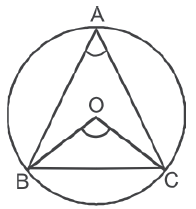
Three friends Amit, Mayank and Richa were playing with ball by standing on a circle at A, B and C point respectively. Richa throws a ball to Amit, Amit to Mayank and Mayank to Richa.
They all are equidistant from each other as shown in the figure.
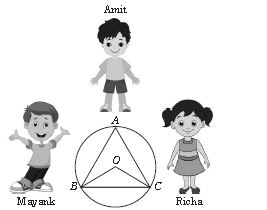
Considering O as the centre of the circle, answer the following questions.
1. Which type of ΔABC is given in figure?
(a) Right angled triangle
(b) Equilateral triangle
(c) Isosceles triangle
(d) Scalene triangle
Answer : B
2. Measure of ∠ABC is
(a) 45°
(b) 60°
(c) 30°
(d) 90°
Answer : B
3. If AB = 6 cm, then BC + CA is equal to
(a) 12 cm
(b) 14 cm
(c) 15 cm
(d) 18 cm
Answer : A
4. Measure of ∠BOC is
(a) 90°
(b) 100°
(c) 120°
(d) 150°
Answer : C
5. Value of ∠OBC + ∠OCB is
(a) 30°
(b) 45°
(c) 90°
(d) 60°
Answer : A
Short Answer Type Questions
Answer: (a) 92.4 cm2 (b) co-operatio
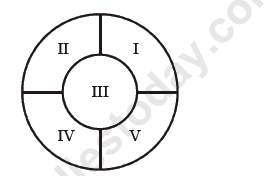
Answer: (a) Group III, 8662.5 sq. cm (b) Environmental protection, beauty
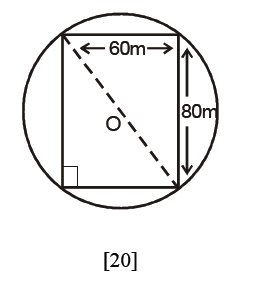
Answer: (a) 50 m (b) Helpfulness, co-operation
(c) This money is utilized for welfare of orphans.
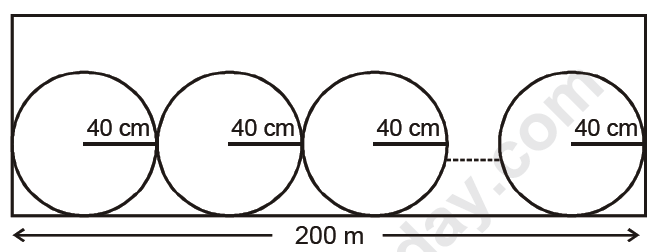
Answer: (a) 250 (b) Beauty
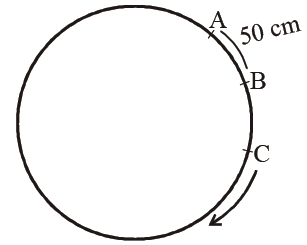
Answer: (a) 5.25 m (b) Co-operation, happiness
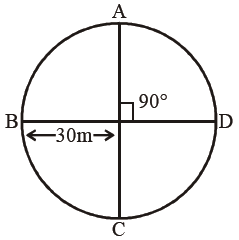
Answer: (a) 30√ 2 m (b) Yes, for the inmates of old age home, orphanages, handicapped children etc.
Answer: (a) 50050 sq. cm (b) Helpfulness
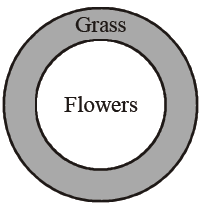
Answer: (a) 120° (b) Yes
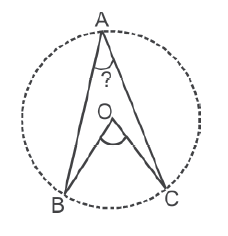
Answer: (a) Yes (b) 55° (c) T r u t h ,scientific temper
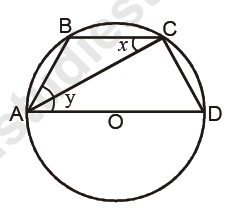
(a) Social value (b) Freedom
(c) Truth value (d) Gender equality Justify your answer.
Answer: angle ACD = 90°
Free study material for Mathematics
VBQs with Answers for Class 9 Mathematics Chapter 09 Circles
Moral Practice Exercises: Class 9 Mathematics Chapter 09 Circles
Access targeted moral and value-driven questions for Class 9 Mathematics Chapter 09 Circles. Designed to align with official CBSE guidelines, these problem sets test deep comprehension beyond standard textbook answers.
NCERT-Aligned VBQ Solutions
Built using the official NCERT book for Class 9 Mathematics, these solved problem sets provide reliable guidance. Cross-reference your answers with our expert-verified keys for complete conceptual clarity.
Complete Your Chapter Revision
Explore our wider library of free chapter notes, worksheets, and online mock tests to support your ongoing revision and secure top-tier academic results.
FAQs
The latest collection of Value Based Questions for Class 9 Mathematics Chapter 09 Circles is available for free on StudiesToday.com. These questions are as per 2026 academic session to help students develop analytical and ethical reasoning skills.
Yes, all our Mathematics VBQs for Chapter 09 Circles come with detailed model answers which help students to integrate factual knowledge with value-based insights to get high marks.
VBQs are important as they test student's ability to relate Mathematics concepts to real-life situations. For Chapter 09 Circles these questions are as per the latest competency-based education goals.
In the current CBSE pattern for Class 9 Mathematics, Chapter 09 Circles Value Based or Case-Based questions typically carry 3 to 5 marks.
Yes, you can download Class 9 Mathematics Chapter 09 Circles VBQs in a mobile-friendly PDF format for free.