

Class 9 Mathematics Competency-Based Questions: CBSE Class 9 Mathematics Number System VBQs
Access comprehensive Value Based Questions (VBQs) for Chapter 01 Number System using the CBSE Class 9 Mathematics Number System VBQs. Designed to align with the 2026-27 CBSE academic guidelines, these competency-based resources help Class 9 Mathematics students apply theoretical knowledge to real-world scenarios.
Download Chapter 01 Number System VBQ PDF with Solutions
View or download the dedicated CBSE Class 9 Mathematics Number System VBQs resource below. Engaging with these value-based scenarios ensures continuous academic progress and mastery of the 2026-27 exam format.
Question. Shalini is making triangles with matchsticks from a box. What is the MINIMUM number of matchsticks that she will need to make a triangle with no sides equal?
(Each matchstick should form a part of any side of the triangle and no matchstick should be bent or broken)
A. 5
B. 6
C. 9
D. 11
Answer : C
Question. Read the information given below to answer the question. Suppose, for all rational numbers x, y and z,
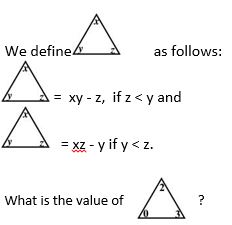
A. -3
B. -2
C. 0
D. 6
Answer : D
Question. Of the following, which will have the same value as?
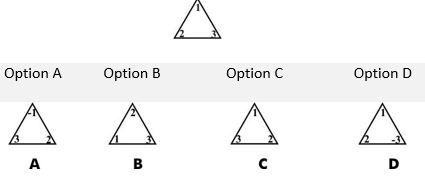
Answer : C
Question. Answer the question based on the given information.
Ramesh works in a factory control room, where he operates three electronic devices which run on ordinary batteries.
Each device requires 1 battery, which lasts for 8-12 days depending on the battery quality.
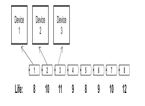
Ramesh has a stock of 8 new batteries. The number of days each will last (though this is not known to Ramesh) is shown below.
Ramesh puts new batteries in all three devices in the order shown. After this, as batteries run out, Ramesh replaces the old batteries from his stock IN THE SAME ORDER. Which battery will replace battery number 2 in device 2?
A. 4
B. 5
C. 7
D. 8
Answer : B
Question. On which day will Ramesh have to buy a new battery?
A. Day 16
B. Day 21
C. Day 27
D. Day 25
Answer : B
Question. One of the numbers below can be written as 2.828427125...... (The pattern of digits does NOT repeat). Which one is it?
A. 20/7
B. 8
C. 2 + 9/11
D. 56
Answer : B
Question. Which of the following is the best approximation for the value of 541 ÷ (0.098)2 ?
(Hint: You need not actually calculate.)
A. 50
B. 5
C. 5500
D. 55000
Answer : D
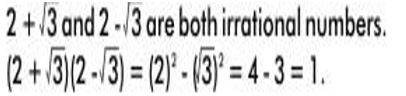
Question. What can be said WITH CERTAINTY about the product of two irrational numbers from the above example? The product of two irrational numbers is
A. always a rational number.
B. always an irrational number.
C. always 1.
D. not necessarily an irrational number.
Answer : D
Question. I start with 1000 and start writing a series of numbers - subtracting 6 every time to get the next number.
The series looks like this: 1000, 994, 988, 982, ....and so on.
If the series is continued, which will be the first negative number to appear in it?
A. -6
B. -4
C. -2
D. -1
Answer : C
Question. What number does the pointer show?
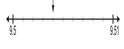
A. 9. 4
B. -9. 54
C. 9. 504
D. 9. 514
Answer : C
Question. 8 + 271/3 is equal to
A. 5
B. 81/3
C. 11
D. 17
Answer : C
Question. If 160 × 1. 362 = 217. 92
What is the value of 21. 792 ÷ 1. 6?
A. 0. 01362
B. 0. 1362
C. 1. 362
D. 13. 62
Answer : D
Question. q is a number such that -q > -2. Which of the following statements will also be true?
A. q = 2
B. q < 2
C. q > 5
D. q > 2
Answer : B
Question. If a number is divisible by 6 and 10, it must also be divisible by ______
A. 4
B. 16
C. 30
D. 60
Answer : C
Question. On which number line is the position of √6 shown correctly?
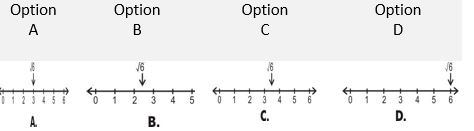
Answer : B
Question. If 2x – 3 ·32x – 8 = 36, then the value of x is ______.
(A) 2
(B) 5
(C) 3
(D) 1
Answer : B
Question. The rationalising factor of 5√a2b3c4 is _____.
(A) 5√a3b2c
(B) 4√a3b2c
(C) 3√a3b2c
(D) √a3b2c
Answer : A
Question. Rational number -18/5 lies between consecutive integers ______.
(A) –2 and –3
(B) –3 and –4
(C) –4 and –5
(D) –5 and –6
Answer : B
Question. If x = (7+4√3), then (x + 1/x) = ______.
(A) 8 3
(B) 14
(C) 49
(D) 48
Answer : B
Question. 7√3/(√10+√3) - 2√5(√6/√5) - 3√2/(15+3√2) = ______.
(A) 1
(B) 2
(C) 1/2
(D) 3
Answer : A
Question. The denominator of

(A) a2
(B) b2
(C) a2 – b2
(D) 4a2 – 2b2/b2
Answer : B
Question. Which of the following numbers has the terminating decimal representation?
(A) 5/12
(B) 8/35
(C) 7/24
(D) 13/80
Answer : D
Question. The value of 1/3 of 1527 is ______.
(A) 527
(B) 159
(C) 5 × 1526
(D) 5 × 39
Answer : C
Question. If x = 2 − √3 , then the value of x2 + 1/x2 and x2 - 1/x2 respectively, are ______.
(A) 14, 8√3
(B) −14, − 8√3
(C) 14, − 8√3
(D) −14, 8√3
Answer : C
Question. An irrational number between 1/7 and 2/7 is _____.
(A) 1/2 (1/7 + 2/7)
(B) (1/7 x 2/7)
(C) √1/7 x 2/7
(D) None of these
Answer : C
Question. If
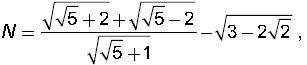
then N equals ______.
(A) 1
(B) 2√2 -1
(C) √5/2
(D) 2/√√5 +1
Answer : A
Question. Express the mixed recurring decimal 4.32 in the form p/q.
(A) 389/90
(B) 329/90
(C) 29/90
(D) 233/990
Answer : A
Question. The ascending order of the surds 3√2, 6√3, 9√4 is ______.
(A) 9√4, 6√3, 3√2
(B) 9√4, 3√2, 6√3
(C) 3√2, 6√3, 9√4
(D) 6√3, 9√4, 3√2
Answer : A
Question. The greater number among √17 − √12 and √11 −√ 6 is ______.
(A) √17 − √12
(B) √11 − √6
(C) Both are equal
(D) Can’t be compared
Answer : B
Question. The value of x, if 5x – 3 · 32x – 8 = 225 is ______.
(A) 3
(B) 4
(C) 2
(D) 5
Answer : D
Question. Fill in the blanks.
(i) The decimal form of an irrational number is neither P nor Q .
(ii) There are R rational numbers between any two consecutive integers.
(iii) Every rational number is S .
| P | Q | R | S | |
| (A) | nonrepeating | terminating | zero | real |
| (B) | repeating | terminating | inifinite | real |
| (C) | nonrepeating | nonterminating | zero | integer |
| (D) | repeating | terminating | inifinite | integer |
Answer : B
Question. Read the statements carefully.
Statement-1 : Every point on the number line represent a unique real number.
Statement-2 : Irrational numbers cannot be represented on a number line. Which of the following options hold?
(A) Both Statement-1 and Statement-2 are true.
(B) Statement-1 is true but Statement-2 is false.
(C) Statement-1 is false but Statement-2 is true.
(D) Both Statement-1 and Statement-2 are false.
Answer : B
Question. Match the following.
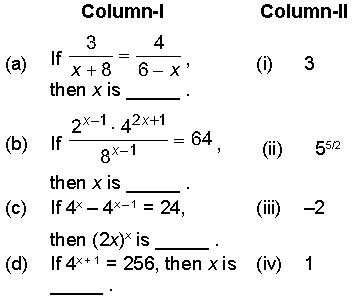
(A) (a)→(i); (b)→(ii); (c)→(iii); (d)→(iv)
(B) (a)→(iii); (b)→(iv); (c)→(i); (d)→(ii)
(C) (a)→(i); (b)→(iv); (c)→(ii); (d)→(iii)
(D) (a)→(iii); (b)→(iv); (c)→(ii); (d)→(i)
Answer : D
Question. If x and y are positive real numbers, then which of the following is CORRECT?
(A) x > y ⇒ –x > –y
(B) x > y ⇒ –x < –y
(C) x > y ⇒ 1/x > 1/y
(D) x > y ⇒ 1/x < -1/y
Answer : B
Question. If x = 1− √2 , then find the value of (x − 1/x)
(A) 2
(B) 3
(C) 4
(D) 5
Answer : C
Question. The value of

is ______.
(A) 0
(B) 1
(C) 2
(D) 4
Answer : C
Question. If (√3−1)/(√3+1) = (a−b√3), find the values of a and b.
(A) a = 1, b = 2
(B) a = 2, b = 1
(C) a = 2, b = 3
(D) a = 3, b = 2
Answer : B
Question. Which of the following statements is INCORRECT ?
(A) Every integer is a rational number.
(B) Every natural number is an integer.
(C) Every natural number is a real number.
(D) Every real number is a rational number.
Answer : D
Question. The number x = 1.242424....... can be expressed in the form x p/q = , where p and q are positive integers having no common factors. Then p + q equals ______.
(A) 72
(B) 74
(C) 41
(D) 53
Answer : B
Question. Which of the following statements is INCORRECT?
(A) If ‘a’ is a rational number and ‘b’ is irrational, then a + b is irrational.
(B) The product of a non-zero rational number with an irrational number is always irrational.
(C) Addition of any two irrational numbers can be rational.
(D) Division of any two integers is an integer.
Answer : D
Free study material for Mathematics
VBQs with Answers for Class 9 Mathematics Chapter 01 Number System
Download VBQs for Class 9 Mathematics Chapter 01 Number System
Explore curated Value-Based Questions (VBQs) for Chapter 01 Number System, structured according to the latest CBSE curriculum for Class 9 Mathematics. These problems focus on ethical and real-world themes to strengthen analytical reasoning.
Expert Guidance for Chapter 01 Number System VBQs
Built using the official NCERT book for Class 9 Mathematics, these solved problem sets provide reliable guidance. Cross-reference your answers with our expert-verified keys for complete conceptual clarity.
Enhance Analytical Depth for Class 9 Mathematics
Practicing value-based problems regularly connects abstract concepts to everyday experiences, ensuring stronger performance across school examinations and board assessments.
FAQs
The latest collection of Value Based Questions for Class 9 Mathematics Chapter 01 Number System is available for free on StudiesToday.com. These questions are as per 2026 academic session to help students develop analytical and ethical reasoning skills.
Yes, all our Mathematics VBQs for Chapter 01 Number System come with detailed model answers which help students to integrate factual knowledge with value-based insights to get high marks.
VBQs are important as they test student's ability to relate Mathematics concepts to real-life situations. For Chapter 01 Number System these questions are as per the latest competency-based education goals.
In the current CBSE pattern for Class 9 Mathematics, Chapter 01 Number System Value Based or Case-Based questions typically carry 3 to 5 marks.
Yes, you can download Class 9 Mathematics Chapter 01 Number System VBQs in a mobile-friendly PDF format for free.