

Class 9 Mathematics Competency-Based Questions: CBSE Class 9 Mathematics Surface Areas And Volume VBQs
Review targeted competency-based resources with the CBSE Class 9 Mathematics Surface Areas And Volume VBQs. Built according to official CBSE standards for the 2026-27 academic year, these downloadable Class 9 Mathematics VBQs support holistic learning and critical reasoning for Chapter 11 Surface Areas and Volumes.
Download Chapter 11 Surface Areas and Volumes VBQ PDF with Solutions
Navigate directly to the solved Mathematics Value Based Questions using the digital viewer below. Each practice set includes detailed solutions, allowing students to instantly cross-check their work and understand the ethical dimensions of the topic.
Question. If the height of a cylinder is doubled, by what number must the radius of the base be multiplied so that the resulting cylinder has the same volume as the original cylinder?
(A) 4
(B) 1/2
(C) 2
(D) 1/2
Answer : B
Question. A hemispherical bowl is filled to the brim with a beverage. The contents of the bowl are transferred into a cylindrical vessel whose radius is 50% more than its height. If the diameter is same for both the bowl and the cylinder, then the amount of the beverage that can be poured from the bowl into the cylindrical vessel is ______.
(A) 66(2/3)%
(B) 78(1/2)%
(C) 100%
(D) None of these
Answer : C
Question. The edge of a cube is 20 cm. How many small cubes of edge 5 cm can be formed from this cube?
(A) 4
(B) 32
(C) 64
(D) 100
Answer : C
Question. The length of the longest rod that can be kept in a cuboidal room of dimensions 10 m × 10 m × 5 m is _____.
(A) 16 m
(B) 10 m
(C) 15 m
(D) 12 m
Answer : C
Question. A covered wooden box has the inner measures as 115 cm, 75 cm, 35 cm and the thickness of wood is 2.5 cm. Then the volume of the wood is ______.
(A) 80000 cu. cm
(B) 82125 cu. cm
(C) 84000 cu. cm
(D) 85000 cu. cm
Answer : B
Question. If the length of diagonal of a cube is √12cm, then the volume of the cube is
(A) 8√12 cm3
(B) 8 cm3
(C) 16√2 cm3
(D) 16 cm3
Answer : B
Question. A metal sheet 27 cm long, 8 cm broad and 1 cm thick is melted into a cube. Find the difference between surface areas of two solids.
(A) 280 cm2
(B) 284 cm2
(C) 296 cm2
(D) 286 cm2
Answer : D
Question. The height of a cone is equal to its base diameter. Then slant height of the cone is
(A) √r2+h2
(B) r√5
(C) h√5
(D) rh√5
Answer : B
Question. The volume of a cylinder of radius r is 1/4 of the volume of a rectangular box with a square base of side length x. If the cylinder and the box have equal heights, what is the value of r in terms of x?
(A) x2/2π
(B) x/2√π
(C) √2x/π
(D) x/√π
Answer : B
Question. A spherical ball of lead, 3 cm in radius is melted and recast into three spherical balls. The radius of two of these are 1.5 cm and 2 cm respectively. The radius of the third ball is ______.
(A) 2.66 cm
(B) 2.5 cm
(C) 3 cm
(D) 3.5 cm
Answer : B
Question. How many bricks, each measuring 25 cm × 11.25 cm × 6 cm, will be needed to build a wall 8 m × 6 m × 22.5 cm?
(A) 5600
(B) 6000
(C) 6400
(D) 7200
Answer : C
Question. The volume of two spheres are in the ratio 64 : 27. The difference of their surface areas, if the sum of their radii is 7 units, is _____.
(A) 28p sq. units
(B) 88 sq. units
(C) 88p sq. units
(D) 4p sq. units
Answer : A
Question. How many metres of cloth, 5 m wide, will be required to make a conical tent, the radius of whose base is 7 m and height is 24 m?
(A) 550 m
(B) 168 m
(C) 110 m
(D) 33.6 m
Answer : C
Question. A solid wooden toy is in the shape of a right circular cone mounted on a hemisphere. If the radius of the hemisphere is 4.2 cm and the total height of the toy is 10.2 cm, find the volume of the wooden toy.
(A) 266.11 cm3
(B) 301.12 cm3
(C) 242.36 cm3
(D) 278.34 cm3
Answer : A
Question. A small village, having a population of 5000, requires 75 litres of water per head per day. The village has got an overhead tank of measurement 40 m × 25 m × 15 m.
For how many days will the water of this tank last?
(A) 30 days
(B) 32 days
(C) 40 days
(D) 45 days
Answer : C
Question. Match the following.
| Column-I | Column-II |
| (P) A cylinder of radius 3 cm is inscribed in a sphere of radius 5 cm, then volume of cylinder is _____. | (1) 38.5 cm3 |
| (Q) A conical pit of top diameter 3.5 cm is 12 cm deep, the capacity of pit is _____. | (2) 512 cm3 |
| (R) The length of a diagonal of a cube is 8 3cm, then volume of cube is ____ | (3) 72p cm3 |
| (S) The capacity of a conical vessel with height 12 cm and slant height 13 cm is _____. | (4) 100p cm3 |
(A) (P)→(2) ; (Q)→(3) ; (R)→(4) ; (S)→(1)
(B) (P)→(1) ; (Q)→(3) ; (R)→(2) ; (S)→(4)
(C) (P)→(3) ; (Q)→(1) ; (R)→(2) ; (S)→(4)
(D) (P)→(4) ; (Q)→(1) ; (R)→(3) ; (S)→(2)
Answer : C
Question. Water flows in a tank 150 m × 100 m at the base, through a pipe whose cross-section is 2 dm by 1.5 dm at the speed of 15 km per hour. In what time, will the water be 3 metres deep?
(A) 50 hours
(B) 150 hours
(C) 100 hours
(D) 200 hours
Answer : C
Question. The radii of two cylinders are in the ratio 2 : 3 and their heights are in the ratio of 5 : 3. The ratio of their volumes is _____.
(A) 10 : 17
(B) 20 : 27
(C) 17 : 27
(D) 20 : 37
Answer : B
Question. A circus tent is cylindrical to a height of 3 metres and conical above it. if its diameter is 105 m and the slant height of the conical portion is 53 m, calculate the length of the canvas 5 m wide to make the required tent.
(A) 1996 m
(B) 2096 m
(C) 1947 m
(D) 1800 m
Answer : C
Question. A teak wood log is first cut in the form of a cuboid of length 2.3 m, width 0.75 m and of a certain thickness. Its volume is 1.104 m3. How many rectangular planks of size 2.3 m × 0.75 m × 0.04 m can be cut from the cuboid?
(A) 16
(B) 64
(C) 68
(D) 4
Answer : A
Question. A school provides milk to the students daily in a cylindrical glasses of diameter 7 cm. If the glass is filled with milk upto an height of 12 cm, then how many litres of milk is needed to serve 1600 students?
(A) 739.2 litres
(B) 538 litres
(C) 740 litres
(D) 400 litres
Answer : A
Question. Read the statement carefully and write ‘T’ for true and ‘F’ for false.
(i) Volume of a cylinder is three times the volume of a cone on the same base and of same height.
(ii) Volume of biggest sphere in cube of edge 6 cm is 36p cm3.
(iii) Cuboids and cubes are special forms of right prisms.
(i) (ii) (iii)
(A) T F T
(B) T T T
(C) F T F
(D) F T T
Answer : B
Question. The internal and external radii of a hollow hemispherical bowl are 15 cm and 16 cm respectively, find the cost of painting the bowl at the rate of 35 paise per cm2, if
(i) the area of the edge of the bowl is ignored.
(ii) the area of the edge of the bowl is taken into account.
(i) (ii)
(A) ₹ 1058.20 ₹ 1092.30
(B) ₹ 1020.50 ₹ 1045
(C) ₹ 1092.50 ₹ 1058.20
(D) ₹ 1086.20 ₹ 1095.2
Answer : A
Question. A cylindrical tub of radius 12 cm contains water to a depth of 20 cm. A spherical iron ball is dropped into the tub and thus the level of the water is raised by 6.75 cm.
What is the radius of the sphere?
(A) 9 cm
(B) 13 cm
(C) 11 cm
(D) 15 cm
Answer : A
Question. Study the statements carefully.
Statement-I : If diameter of a sphere is decreased by 25%, then its curved surface area is decreased by 43.75%.
Statement-II : Curved surface area is increased when diameter decreases.
Which of the following options hold?
(A) Both Statement-I and Statement-II are true.
(B) Statement-I is true but Statement-II is false.
(C) Statement-I is false but Statement-II is true.
(D) Both Statement-I and Statement-II are false.
Answer : B
Question. By stating the formula for the volume of cone as v= 1/3πl2h-1/3πh3 the following value is depicted.
(a) Truth value (b) Social value
(c) Respect for other views (d) Equality
Question. 50 students of class X planned a visit to an old age home and to spend the whole day with its inmates. Each one prepared a cylindrical flower vase using cardboard to gift the inmates. The radius of cylinder is 4.2 cm and the height is 11.2 cm.
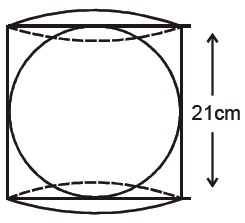
Answer: (a) r = 10.5 cm
Free study material for Mathematics
Value-Based Questions (VBQs) for Class 9 Mathematics Chapter 11 Surface Areas and Volumes
Moral Practice Exercises: Class 9 Mathematics Chapter 11 Surface Areas and Volumes
Access targeted moral and value-driven questions for Class 9 Mathematics Chapter 11 Surface Areas and Volumes. Designed to align with official CBSE guidelines, these problem sets test deep comprehension beyond standard textbook answers.
NCERT-Aligned VBQ Solutions
Pair your practice with our comprehensive NCERT solutions for Class 9 Mathematics to review detailed responses and master the underlying themes of this chapter.
Complete Your Chapter Revision
Explore our wider library of free chapter notes, worksheets, and online mock tests to support your ongoing revision and secure top-tier academic results.
FAQs
The latest collection of Value Based Questions for Class 9 Mathematics Chapter 11 Surface Areas and Volumes is available for free on StudiesToday.com. These questions are as per 2026 academic session to help students develop analytical and ethical reasoning skills.
Yes, all our Mathematics VBQs for Chapter 11 Surface Areas and Volumes come with detailed model answers which help students to integrate factual knowledge with value-based insights to get high marks.
VBQs are important as they test student's ability to relate Mathematics concepts to real-life situations. For Chapter 11 Surface Areas and Volumes these questions are as per the latest competency-based education goals.
In the current CBSE pattern for Class 9 Mathematics, Chapter 11 Surface Areas and Volumes Value Based or Case-Based questions typically carry 3 to 5 marks.
Yes, you can download Class 9 Mathematics Chapter 11 Surface Areas and Volumes VBQs in a mobile-friendly PDF format for free.