

Value Based Questions (VBQs) for Class 9 Mathematics
Explore authentic value-based practice materials through the CBSE Class 9 Mathematics Coordinate Geometry VBQs. Tailored for Class 9 learners, utilizing these Mathematics VBQs ensures thorough preparation and strengthens moral reasoning skills before final CBSE evaluations.
Practice Class 9 Mathematics VBQs: Chapter 03 Coordinate Geometry
View or download the dedicated CBSE Class 9 Mathematics Coordinate Geometry VBQs resource below. Engaging with these value-based scenarios ensures continuous academic progress and mastery of the 2026-27 exam format.
Question. The linear equation y = 2x + 3 cuts the y-axis at ______.
(A) (0, 3)
(B) (0, 2)
(C) (3/2, 0)
(D) (2/3, 0)
Answer : A
Question. (2, 1) is a point, which belongs to the line ______.
(A) x = y
(B) y = x + 1
(C) 2y = x
(D) xy = 1
Answer : C
Question. One set of ordered pair which belongs to a straight line represented by an equation y = 2x – 1 is ______ .
(A) (1, 1)
(B) (2, 1)
(C) (1, 2)
(D) (3, 1)
Answer : A
Question. The axis on which the point (0, – 4) lie, is______.
(A) Positive x-axis
(B) Negative x-axis
(C) Positive y-axis
(D) Negative y-axis
Answer : D
Question. The coordinate axes divide the plane into ______.
(A) One part
(B) Two parts
(C) Three parts
(D) Four parts
Answer : D
Question. If (x + 3, 5) = (2, 2 – y) then the values of the x and y respectively are
(A) 5, 3
(B) –1, –3
(C) 0, –3
(D) 1, 3
Answer : B
Question. The value of ‘x’ in the ordered pair (x, – 8) if the ordinate of the pair is 4 more than the abscissa is _____.
(A) – 4
(B) – 8
(C) – 12
(D) 4
Answer : C
Question. The point (–5, 6) lies in
(A) Ist quadrant
(B) IInd quadrant
(C) IIIrd quadrant
(D) IVth quadrant
Answer : B
Question. The point at which the two coordinate axes meet is called ______.
(A) Abscissa
(B) Ordinate
(C) Origin
(D) Quadrant
Answer : C
Question. The coordinates of two points are A(3, 4) and B(–2, 5), then (abscissa of A) – (abscissa of B) is______.
(A) 1
(B) –1
(C) 5
(D) –5
Answer : C
Question. The signs of abscissa and ordinate of a point in quadrant II are respectively ______.
(A) (+, –)
(B) (–, +)
(C) (–, –)
(D) (+, +)
Answer : B
Question. Two points having same abscissa but different ordinates lie on ______.
(A) x-axis
(B) y-axis
(C) A line parallel to y-axis
(D) A line parallel to x-axis
Answer : C
DIRECTION (a - c): Study the graph and answer the following questions.
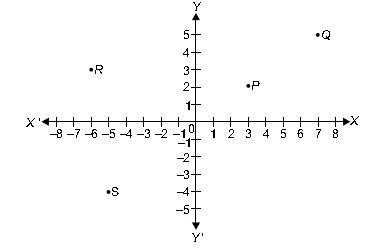
Question a. The coordinate of point S are ______.
(A) (4, 5)
(B) (–5, –4)
(C) (–4, –5)
(D) (5, 4)
Answer : B
Question b. Sum of abscissae of point P and R is ______.
(A) 5
(B) 6
(C) 9
(D) –3
Answer : D
Question c. The point whose abscissae is 2 more than the ordinate is ______.
(A) P
(B) R
(C) Q
(D) S
Answer : C
Question. The difference between ordinates of R and Q is ______.
(A) 8
(B) 3
(C) 2
(D) 14
Answer : C
Question. The area of the triangle formed by the points P (0, 1), Q (0, 5) and R (3, 4) is ______.
(A) 16 sq. units
(B) 8 sq. units
(C) 4 sq. units
(D) 6 sq. units
Answer : D
Question. The perpendicular distance of the point (–7, 8) from the x-axis is ______.
(A) 7
(B) 8
(C) –7
(D) 1
Answer : C
Question. The point (3, 0) lies ______.
(A) On x-axis
(B) On y-axis
(C) In I quadrant
(D) None of these
Answer : A
Question. The signs of the abscissa and ordinate of a point in the fourth quadrant respectively are_____.
(A) +, +
(B) –, –
(C) +, –
(D) –, +
Answer : C
Question. State ‘T’ for true and ‘F’ for false.
(i) Origin is the only point which lies on both the axes.
(ii) The point (2, –2) and point (–2, 2) lies in the same quadrant.
(iii) A point lies on y-axis at a distance 2 units from x-axis then it’s coordinates are (2, 0).
(iv) Abscissa of a point is positive in I quadrant and also in II quadrant.
(i) (ii) (iii) (iv)
(A) F T F T
(B) T F F F
(C) F T T F
(D) T F T F
Answer : B
Question. Fill in the blanks.
(i) Point B is 3 spaces right and one space above from the point A(–1, –2). So point B lies in quadrant P.
(ii) Point B is 40 spaces left and 0.02 spaces above from the point A(20, 0.18). So point B lies in quadrant Q.
(iii) Point B is 15 spaces right and 15 spaces below from the point A (–15, 0). So, coordinate of point B are R.
(iv) A man moves 30 metres towards North and then moves 50 metres towards South and finally 10 metres towards East. Considering his initial position
at origin, the coordinate of his final destination are S
P Q R S
(A) II I (0, 15) (–10, 20)
(B) IV II (0, – 15) (10, – 20)
(C) II IV (10, – 20) (0, – 15)
(D) I II (0, 15) (10, 20)
Answer : B
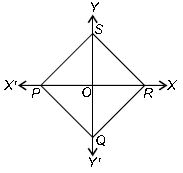
Question. In the given figure, PQRS is a rhombus whose diagonal PR and QS are along coordinate axis and PR = 12 units and QS = 6 units. Now, if T is a point which is 5 spaces right and 2 spaces above S. Find :
(i) sum of abscissae of P and T.
(ii) sum of ordinates of Q, R and T.
(i) (ii)
(A) –1 2
(B) 1 –2
(C) 1 2
(D) –1 –2
Answer : A
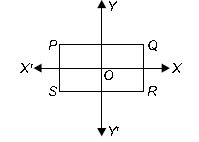
Question. In the given figure, PQRS is a rectangle with its centre at origin and length PQ = 2a units and breadth QR = 2b units.
Find coordinates of all of its vertices
(A) P(a, – b), Q(a, b), R(–a, b), S(–a, –b)
(B) P(a, – b), Q(a, b), R(a, – b), S(–a, –b)
(C) P(–a, b), Q(a, b), R(a, – b), S(–a, – b)
(D) P(–a, b), Q(a, b), R(a, – b), S(–a, b)
Answer : C
Question. Match the following.
| Column-I | Column-II |
| (P) The area of ΔOAB with O (0, 0), A (4, 0) and B (0, 8) is | (i) 14 sq. units |
| (Q) The area of DABC with A (2, 0), B (6, 0) and C (4, 6) is | (ii) 16 sq. units |
| (R) The area of DOAB with O (0, 0), A (7, 0) and B (0, 4) is | (iii) 12 sq. units |
(A) (P) → (ii), (Q) → (i), (R) → (iii)
(B) (P) → (iii), (Q) → (i), (R) → (ii)
(C) (P) → (iii), (Q) → (ii), (R) → (i)
(D) (P) → (ii), (Q) → (iii), (R) → (i)
Answer : D
Free study material for Mathematics
CBSE Value-Based Study Material for Class 9 Mathematics
Chapter VBQs with Solutions (CBSE)
Explore curated Value-Based Questions (VBQs) for Chapter 03 Coordinate Geometry, structured according to the latest CBSE curriculum for Class 9 Mathematics. These problems focus on ethical and real-world themes to strengthen analytical reasoning.
Verified Answers for Class 9 Mathematics Chapter 03 Coordinate Geometry
Each question includes structured solution guides mapped directly to standard CBSE textbooks, helping students evaluate their reasoning and correct mistakes early.
More Study Resources for Chapter 03 Coordinate Geometry
Wrap up your preparation by testing your critical thinking against standard Mathematics question formats. All resources on our platform are free to access.
FAQs
The latest collection of Value Based Questions for Class 9 Mathematics Chapter 03 Coordinate Geometry is available for free on StudiesToday.com. These questions are as per 2026 academic session to help students develop analytical and ethical reasoning skills.
Yes, all our Mathematics VBQs for Chapter 03 Coordinate Geometry come with detailed model answers which help students to integrate factual knowledge with value-based insights to get high marks.
VBQs are important as they test student's ability to relate Mathematics concepts to real-life situations. For Chapter 03 Coordinate Geometry these questions are as per the latest competency-based education goals.
In the current CBSE pattern for Class 9 Mathematics, Chapter 03 Coordinate Geometry Value Based or Case-Based questions typically carry 3 to 5 marks.
Yes, you can download Class 9 Mathematics Chapter 03 Coordinate Geometry VBQs in a mobile-friendly PDF format for free.