

Download CBSE Class 10 Mathematics Useful Resources
Explore structured advanced study materials through the CBSE Class 10 Probability Important Formulas and concepts for exams. Tailored for Class 10 learners, utilizing these Mathematics resources ensures thorough preparation and strengthens foundational knowledge before final CBSE evaluations.
Access CBSE Study Guides and Summaries
Navigate directly to the advanced Mathematics study materials using the digital viewer below. Each resource pack includes detailed conceptual summaries and solved practice questions, allowing students to instantly reinforce their learning.
CBSE Class 10 Probability Important Formulas and concepts for exams. There are many more useful educational material which the students can download in pdf format and use them for studies. Study material like concept maps, important and sure shot question banks, quick to learn flash cards, flow charts, mind maps, teacher notes, important formulas, past examinations question bank, important concepts taught by teachers. Students can download these useful educational material free and use them to get better marks in examinations. Also refer to other worksheets for the same chapter and other subjects too. Use them for better understanding of the subjects.
CLASS X : CHAPTER - 15
PROBABILITY
IMPORTANT FORMULAS & CONCEPTS
PROBABILITY
Experimental or empirical probability P(E) of an event E is defined as:
P(E) = \(\frac{\text{Number of trials in which the event happened}}{\text{Total number of trials}\)
The theoretical probability (also called classical probability) of an event A, written as P(A), is defined as:
P(A) = \(\frac{\text{Number of outcomes favourable to A}}{\text{Number of all possible outcomes of the experiment}}\)
Two or more events of an experiment, where occurrence of an event prevents occurrences of all other events, are called Mutually Exclusive Events.


Answer:
1. Understand the difference between empirical and theoretical probability.
2. Empirical probability is based on actual experiments and observations.
3. Theoretical probability is based on equally likely outcomes without actually performing the experiment.
Teacher's Note:
a) Core concepts include fundamental definitions of probability.
b) Students often confuse experimental trials with theoretical sample space outcomes.
c) Remember that experimental probability approaches theoretical probability as the number of trials increases.
COMPLIMENTARY EVENTS AND PROBABILITY
We denote the event 'not E' by Ē. This is called the complement event of event E.
So, P(E) + P(not E) = 1
i.e., P(E) + P(Ē) = 1, which gives us P(Ē) = 1 - P(E).
In general, it is true that for an event E, P(Ē) = 1 - P(E).
- The probability of an event which is impossible to occur is 0. Such an event is called an impossible event.
- The probability of an event which is sure (or certain) to occur is 1. Such an event is called a sure event or a certain event.
- The probability of an event E is a number P(E) such that 0 ≤ P(E) ≤ 1.
- An event having only one outcome is called an elementary event. The sum of the probabilities of all the elementary events of an experiment is 1.

Answer:
1. Complementary events cover all remaining possibilities of an event not occurring.
2. The sum of probabilities of an event and its complement is always equal to 1.
3. Probability values always lie strictly between 0 and 1 inclusive.
Teacher's Note:
a) Master the formula P(E) + P(not E) = 1 for quick problem solving.
b) Never write a probability value greater than 1 or less than 0.
c) Elementary events sum up to exactly 1 in any given random experiment.
DECK OF CARDS AND PROBABILITY
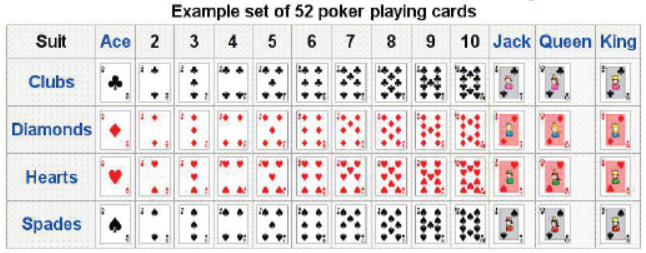
A deck of playing cards consists of 52 cards which are divided into 4 suits of 13 cards each.
They are black spades (♠), red hearts (♥), red diamonds (♦) and black clubs (♣).
The cards in each suit are Ace, King, Queen, Jack, 10, 9, 8, 7, 6, 5, 4, 3 and 2. Kings, Queens and Jacks are called face cards.
Answer:
1. Total number of cards in a standard deck is 52.
2. There are 26 red cards and 26 black cards in total.
3. There are 12 face cards in total, with 3 face cards in each of the 4 suits.
Teacher's Note:
a) Memorize the breakdown of suits, colors, and face cards to solve card-based probability problems efficiently.
b) Do not count Aces as face cards; face cards are strictly Kings, Queens, and Jacks.
c) Each suit contains exactly 13 cards comprising numbers 2 to 10 and 4 honor cards (Ace, Jack, Queen, King).
1. Define equally likely events. [1 Mark]
Answer:
1. Two or more events are said to be equally likely if each one of them has an equal chance of occurrence.
2. Example includes tossing a fair coin, where heads and tails have equal chances.
Teacher's Note:
a) This is a fundamental definition in classical probability.
b) It assumes symmetry and fairness in the random experiment.
2. Define mutually exclusive events. [1 Mark]
Answer:
1. Two or more events are mutually exclusive if the occurrence of each event prevents the every other event.
2. In such cases, no two events can occur simultaneously.
Teacher's Note:
a) Mutually exclusive events have an intersection of empty sets.
b) The probability of the union of mutually exclusive events is the sum of their individual probabilities.
3. Define complementary events. [1 Mark]
Answer:
1. Consider an event has few outcomes.
2. Event of all other outcomes in the sample survey which are not in the favourable event is called Complementary event.
Teacher's Note:
a) The sum of the probability of an event and its complement is always equal to 1.
b) Written mathematically as P(E) + P(not E) = 1.
4. Define exhaustive events. [1 Mark]
Answer:
1. All the events are exhaustive events if their union is the sample space.
2. This means that the set of events covers all possible outcomes of the experiment.
Teacher's Note:
a) Exhaustive events ensure that no potential outcome is left out.
b) Every sample space has at least one set of exhaustive events.
5. Define sure events. [1 Mark]
Answer:
1. The sample space of a random experiment is called sure or certain event.
2. Any one of its elements will surely occur in any trial of the experiment.
Teacher's Note:
a) The probability of a sure event is always exactly equal to 1.
b) It represents certainty in the context of probability theory.
6. Define impossible event. [1 Mark]
Answer:
1. An event which will occur on any account is called an impossible event.
2. Such an event contains no outcomes from the sample space (empty set).
Teacher's Note:
a) The probability of an impossible event is always equal to 0.
b) Note the phrasing in the original text indicating events that cannot happen under any circumstances.
Free study material for Mathematics
Mathematics Class 10 Exam Resources: Chapter 14 Probability
Comprehensive Study Resources for Chapter 14 Probability
Review targeted study resources for Chapter 14 Probability tailored for Class 10 learners. Utilizing these structured notes and quick-revision tools ensures complete alignment with current CBSE evaluation standards.
Understanding Marking Schemes
Each resource draws directly from authorized textbooks to maintain academic accuracy. Evaluating solved examples allows Class 10 students to master the formal presentation and answer-writing standards expected in upcoming school exams.
Complete Revision for Mathematics
Wrap up your chapter revision by testing your knowledge against standard objective question formats. Explore our full library of free, up-to-date sample papers and online assessments to secure top grades in your CBSE examinations.
FAQs
Our advanced study package for Chapter 14 Probability includes detailed concepts, diagrams, Mind Maps, and explanation of complex topics to ensure Class 10 students learn as per syllabus for 2026 exams.
The Mind Maps provided for Chapter 14 Probability act as visual anchors which will help faster recall during high-pressure exams.
Yes, teachers use our Class 10 Mathematics resources for lesson planning as they are in simple language and have lot of solved examples.
Yes, You can download the complete, mobile-friendly PDF of the Mathematics Chapter 14 Probability advanced resources for free.
Yes, our subject matter experts have updated the Chapter 14 Probability material to align with the rationalized NCERT textbooks and have removed deleted topics and added new competency-based questions.