

Download CBSE Class 10 Mathematics Useful Resources
Explore structured advanced study materials through the CBSE Class 10 Circles Important Formulas and concepts for exams. Tailored for Class 10 learners, utilizing these Mathematics resources ensures thorough preparation and strengthens foundational knowledge before final CBSE evaluations.
Access CBSE Study Guides and Summaries
Access the complete useful resource PDF for Class 10 Mathematics below. Regular practice with these targeted academic notes builds familiarity with complex topics and helps secure higher marks in final school evaluations.
CBSE Class 10 Circles Important Formulas and concepts for exams. There are many more useful educational material which the students can download in pdf format and use them for studies. Study material like concept maps, important and sure shot question banks, quick to learn flash cards, flow charts, mind maps, teacher notes, important formulas, past examinations question bank, important concepts taught by teachers. Students can download these useful educational material free and use them to get better marks in examinations. Also refer to other worksheets for the same chapter and other subjects too. Use them for better understanding of the subjects.
Circles is Chapter 10 of the CBSE Class 10 Maths syllabus. This page gives the important formulas and concepts of circles, covering the definition of a circle, radius, chord, diameter, arc, segment and sector, the key theorems on equal chords, arcs and angles, cyclic quadrilaterals, secants and tangents, common tangents to two circles, and the properties of tangents.
CIRCLE
The collection of all the points in a plane, which are at a fixed distance from a fixed point in the plane, is called a circle.
The fixed point is called the centre of the circle and the fixed distance is called the radius of the circle. In the below figure, O is the centre and the length OP is the radius of the circle.
The line segment joining the centre and any point on the circle is also called a radius of the circle.
A circle divides the plane on which it lies into three parts. They are: (i) inside the circle, which is also called the interior of the circle; (ii) the circle; and (iii) outside the circle, which is also called the exterior of the circle. The circle and its interior make up the circular region.
The chord is the line segment having its two end points lying on the circumference of the circle.
The chord, which passes through the centre of the circle, is called a diameter of the circle.
A diameter is the longest chord and all diameters have the same length, which is equal to two times the radius.
A piece of a circle between two points is called an arc.
The longer one is called the major arc PQ and the shorter one is called the minor arc PQ.
The length of the complete circle is called its circumference.
The region between a chord and either of its arcs is called a segment of the circular region or simply a segment of the circle. There are two types of segments also, which are the major segment and the minor segment.
The region between an arc and the two radii, joining the centre to the end points of the arc is called a sector. The minor arc corresponds to the minor sector and the major arc corresponds to the major sector.
In the below figure, the region OPQ is the minor sector and the remaining part of the circular region is the major sector. When two arcs are equal, that is, each is a semicircle, then both segments and both sectors become the same and each is known as a semicircular region.
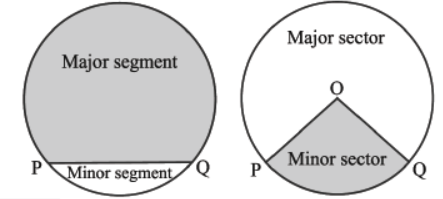
[Figure: Two circles side by side. Left circle labelled "Major segment" (shaded grey) above a chord PQ, with the region between the chord and the minor arc labelled "Minor segment" at the bottom, end points P and Q. Right circle with centre O, a shaded minor sector OPQ labelled "Minor sector" and the rest of the circle labelled "Major sector".]
POINTS TO REMEMBER
A circle is a collection of all the points in a plane, which are equidistant from a fixed point in the plane.
Equal chords of a circle (or of congruent circles) subtend equal angles at the centre.
If the angles subtended by two chords of a circle (or of congruent circles) at the centre (corresponding centre) are equal, the chords are equal.
The perpendicular from the centre of a circle to a chord bisects the chord.
The line drawn through the centre of a circle to bisect a chord is perpendicular to the chord.
There is one and only one circle passing through three non-collinear points.
Equal chords of a circle (or of congruent circles) are equidistant from the centre (or corresponding centres).
Chords equidistant from the centre (or corresponding centres) of a circle (or of congruent circles) are equal.
If two arcs of a circle are congruent, then their corresponding chords are equal and conversely, if two chords of a circle are equal, then their corresponding arcs (minor, major) are congruent.
Congruent arcs of a circle subtend equal angles at the centre.
The angle subtended by an arc at the centre is double the angle subtended by it at any point on the remaining part of the circle.
Angles in the same segment of a circle are equal.
Angle in a semicircle is a right angle.
If a line segment joining two points subtends equal angles at two other points lying on the same side of the line containing the line segment, the four points lie on a circle.
The sum of either pair of opposite angles of a cyclic quadrilateral is 180°.
If the sum of a pair of opposite angles of a quadrilateral is 180°, then the quadrilateral is cyclic.
SECANT TO A CIRCLE
A secant to a circle is a line that intersects the circle at exactly two points.
TANGENT TO A CIRCLE
A tangent to a circle is a line that intersects the circle at only one point.
COMMON TANGENTS TO TWO CIRCLES
Given two circles, there are lines that are tangents to both of them at the same time.
If the circles are separate (do not intersect), there are four possible common tangents.

[Figure: Two diagrams. Left: a larger circle and a smaller circle placed apart, with two outer common tangents touching the top and bottom of both circles. Right: the same two separate circles with two crossing common tangents (direct and transverse) forming an X between them.]
If the two circles touch at just one point, there are three possible tangent lines that are common to both.
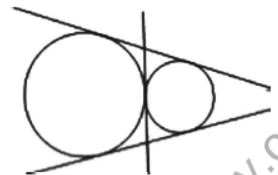
[Figure: Two circles touching externally at one point. Three common tangents: two outer tangents touching the top and bottom of both circles, and one vertical tangent at the point of contact.]
If the two circles touch at just one point, with one inside the other, there is just one line that is a tangent to both.
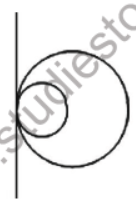
[Figure: A small circle inside a larger circle, touching it internally at one point on the left. One vertical straight line touches both circles at that point of contact.]
If the circles overlap, that is, intersect at two points, there are two tangents that are common to both.
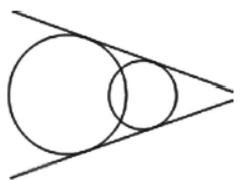
[Figure: Two overlapping circles of different sizes. Two outer common tangents touch both circles, one above and one below.]
If the circles lie one inside the other, there are no tangents that are common to both. A tangent to the inner circle would be a secant of the outer circle.
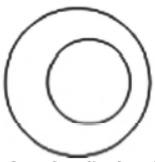
[Figure: Two concentric circles, one inside the other, with no common tangent drawn.]
PROPERTIES OF TANGENTS
The tangent to a circle is perpendicular to the radius through the point of contact.
The lengths of tangents drawn from an external point to a circle are equal.
The centre lies on the bisector of the angle between the two tangents.
If a line in the plane of a circle is perpendicular to the radius at its end point on the circle, then the line is tangent to the circle.
Free study material for Mathematics
CBSE Class 10 Mathematics Study Material: Chapter 10 Circles
Essential Notes for Class 10 Mathematics
Access comprehensive study material for Chapter 10 Circles, including revision notes, concept maps, and high-probability questions. These resources are designed in alignment with the latest 2026 CBSE syllabus for Class 10 Mathematics to support effective exam preparation.
Verified Solutions for Class 10 Mathematics
Designed around the official curriculum, these study guides guarantee standard compliance. Reviewing step-by-step solutions clarifies complex sub-topics within Chapter 10 Circles and demystifies standard marking schemes for Mathematics evaluations.
Enhance Accuracy with Online Tests
Maximize your grade potential by utilizing Class 10 Mathematics practice papers in tandem with these structured notes. All printable assignments and interactive mock tests on our platform are updated for the 2026 session and available free of charge.
FAQs
Our advanced study package for Chapter 10 Circles includes detailed concepts, diagrams, Mind Maps, and explanation of complex topics to ensure Class 10 students learn as per syllabus for 2026 exams.
The Mind Maps provided for Chapter 10 Circles act as visual anchors which will help faster recall during high-pressure exams.
Yes, teachers use our Class 10 Mathematics resources for lesson planning as they are in simple language and have lot of solved examples.
Yes, You can download the complete, mobile-friendly PDF of the Mathematics Chapter 10 Circles advanced resources for free.
Yes, our subject matter experts have updated the Chapter 10 Circles material to align with the rationalized NCERT textbooks and have removed deleted topics and added new competency-based questions.