

Class 10 Mathematics Study Guide: CBSE Class 10 Quadratic Equations Sure Shot Questions Set 01
Explore structured advanced study materials through the CBSE Class 10 Quadratic Equations Sure Shot Questions Set 01. Tailored for Class 10 learners, utilizing these Mathematics resources ensures thorough preparation and strengthens foundational knowledge before final CBSE evaluations.
Download Chapter 04 Quadratic Equations Study Material PDF
View or download the dedicated CBSE Class 10 Quadratic Equations Sure Shot Questions Set 01 resource below. Engaging with these advanced study guides under focused conditions ensures continuous academic progress and mastery of the 2026-27 curriculum for Chapter 04 Quadratic Equations.
CBSE Class 10 Quadratic Equations Sure Shot Questions Set A. There are many more useful educational material which the students can download in pdf format and use them for studies. Study material like concept maps, important and sure shot question banks, quick to learn flash cards, flow charts, mind maps, teacher notes, important formulas, past examinations question bank, important concepts taught by teachers. Students can download these useful educational material free and use them to get better marks in examinations. Also refer to other worksheets for the same chapter and other subjects too. Use them for better understanding of the subjects.
Solve the following quadratic equations:
1. x2 + 11x + 30 = 0
2. x2+ 18x + 32 = 0
3. x2+ 7x – 18 = 0
4. x2 + 5x – 6 = 0
5. y2– 4y + 3 = 0
6. x2 – 21x + 108 = 0
7. x2 – 11x – 80 = 0
8. x2 – x – 156 = 0
9. z2– 32z – 105 = 0
10. 40 + 3x – x2= 0
11. 6 – x – x2= 0
12. 7x2+ 49x + 84 = 0
13. m2+ 17mn – 84n2= 0
14. 5x2+ 16x + 3 = 0
15. 6x2+ 17x +12 = 0
16. 9x2 + 18x + 8 = 0
17. 14x2+ 9x + 1 = 0
18. 2x2 + 3x – 90 = 0
19. 2x2+ 11x – 21 = 0
20. 3x2 – 14x + 8 = 0
21. 18x2+ 3x – 10 = 0
22. 15x2+ 2x – 8 = 0
23. 6x2+ 11x – 10 = 0
24. 30x2+ 7x – 15 = 0
25. 24x2– 41x + 12 = 0
26. 2x2– 7x – 15 = 0
27. 6x2+ 11x – 10 = 0
28. 10x2– 9x – 7 =0
29. 5x2– 16x – 21 = 0
30. 2x2– x – 21 = 0
31. 15x2– x – 28 = 0
32. 8a2– 27ab + 9b2= 0
33. 5x2+ 33xy – 14y2= 0
34. 3x3 – x2– 10x = 0
35. x2 + 9x + 18 = 0
36. x2+ 5x – 24 = 0
37. x2 – 4x – 21 = 0
38. 6x2+ 7x – 3 = 0
39. 2x2– 7x – 39 = 0
40. 9x2– 22x + 8 = 0
41. 6x2+40=31x
42. 36x2-12ax+(a2-b2)=0
43. 8x2-22x-21=0
44. 2x2-x+1/8=0
45. 4√3x2+5x-2√3=0

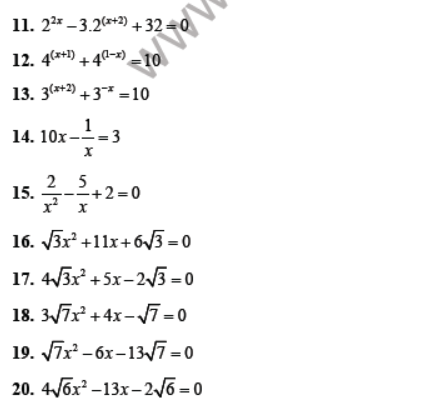
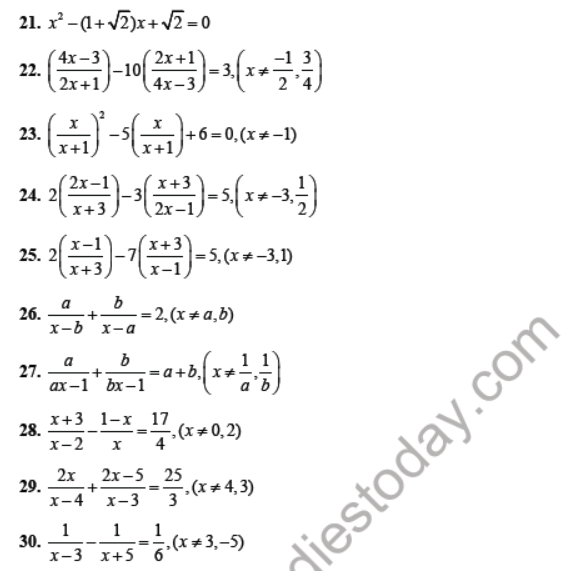
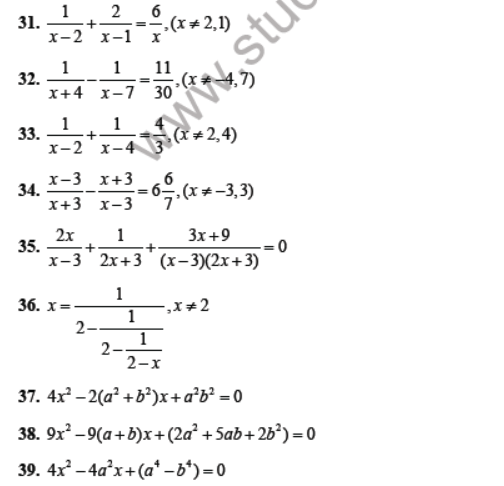
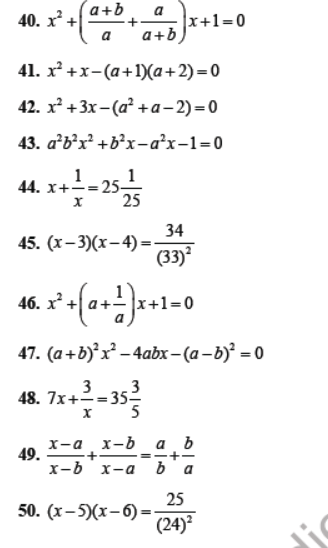
Facts that Matter
- Quadratic Equations: An equation of the form \( ax^2 + bx + c = 0 \), where \( a, b, c \) are real numbers, and \( a \neq 0 \), is called a quadratic equation in the variable \( x \).
- Examples: \( x^2 - 3x + 4 = 0 \), \( \sqrt{2}y^2 + \frac{3}{\sqrt{2}}y - 2 = 0 \), \( 2x^2 - 149 = 0 \).
- Roots of a Quadratic Equation:
- A value \( x = \alpha \) is said to be a root of \( ax^2 + bx + c = 0 \) if it satisfies the equation.
- Example: 2 is a root of \( 3x^2 - x - 10 = 0 \) because \( 3(2)^2 - 2 - 10 = 0 \).
- A quadratic equation has at most two roots (zeroes). Either it has no zero, or two zeroes.
- We can solve a quadratic equation by factorisation.
Example: Solve \( 6x^2 - x - 2 = 0 \)
\( \Rightarrow 6x^2 + 3x - 4x - 2 = 0 \)
\( \Rightarrow 3x(2x + 1) - 2(2x + 1) = 0 \)
\( \Rightarrow (3x - 2)(2x + 1) = 0 \)
\( \Rightarrow 3x - 2 = 0 \) or \( 2x + 1 = 0 \)
\( \Rightarrow x = \frac{2}{3} \) or \( x = \frac{-1}{2} \)
These are the two roots of the equation.
EXERCISE 4.1
Question. Check whether the following are quadratic equations: \( (x + 1)^2 = 2(x - 3) \)
Answer: We have:
\( (x + 1)^2 = 2(x - 3) \)
\( \Rightarrow x^2 + 2x + 1 = 2x - 6 \)
\( \Rightarrow x^2 + 2x + 1 - 2x + 6 = 0 \)
\( \Rightarrow x^2 + 7 = 0 \)
Since \( x^2 + 7 \) is a quadratic polynomial
\( \therefore (x + 1)^2 = 2(x - 3) \) is a quadratic equation.
Question. Check whether the following are quadratic equations: \( x^2 - 2x = (-2)(3 - x) \)
Answer: We have:
\( x^2 - 2x = (-2)(3 - x) \)
\( \Rightarrow x^2 - 2x = -6 + 2x \)
\( \Rightarrow x^2 - 2x - 2x + 6 = 0 \)
\( \Rightarrow x^2 - 4x + 6 = 0 \)
Since \( x^2 - 4x + 6 \) is a quadratic polynomial
\( \therefore x^2 - 2x = (-2)(3 - x) \) is a quadratic equation.
Question. Check whether the following are quadratic equations: \( (x - 2)(x + 1) = (x - 1)(x + 3) \)
Answer: We have:
\( (x - 2)(x + 1) = (x - 1)(x + 3) \)
\( \Rightarrow x^2 - x - 2 = x^2 + 2x - 3 \)
\( \Rightarrow x^2 - x - 2 - x^2 - 2x + 3 = 0 \)
\( \Rightarrow -3x + 1 = 0 \)
Since \( -3x + 1 \) is a linear polynomial
\( \therefore (x - 2)(x + 1) = (x - 1)(x + 3) \) is not quadratic equation.
Question. Check whether the following are quadratic equations: \( (x - 3)(2x + 1) = x(x + 5) \)
Answer: We have:
\( (x - 3)(2x + 1) = x(x + 5) \)
\( \Rightarrow 2x^2 + x - 6x - 3 = x^2 + 5x \)
\( \Rightarrow 2x^2 - 5x - 3 - x^2 - 5x = 0 \)
\( \Rightarrow x^2 - 10x - 3 = 0 \)
Since \( x^2 - 10x - 3 \) is a quadratic polynomial
\( \therefore (x - 3)(2x + 1) = x(x + 5) \) is a quadratic equation.
Question. Check whether the following are quadratic equations: \( (2x - 1)(x - 3) = (x + 5)(x - 1) \)
Answer: We have:
\( (2x - 1)(x - 3) = (x + 5)(x - 1) \)
\( \Rightarrow 2x^2 - 6x - x + 3 = x^2 - x + 5x - 5 \)
\( \Rightarrow 2x^2 - x^2 - 6x - x + x - 5x + 3 + 5 = 0 \)
\( \Rightarrow x^2 - 11x + 8 = 0 \)
Since \( x^2 - 11x + 8 \) is a quadratic polynomial
\( \therefore (2x - 1)(x - 3) = (x + 5)(x - 1) \) is a quadratic equation.
Question. Check whether the following are quadratic equations: \( x^2 + 3x + 1 = (x - 2)^2 \)
Answer: We have:
\( x^2 + 3x + 1 = (x - 2)^2 \)
\( \Rightarrow x^2 + 3x + 1 = x^2 - 4x + 4 \)
\( \Rightarrow x^2 + 3x + 1 - x^2 + 4x - 4 = 0 \)
\( \Rightarrow 7x - 3 = 0 \)
Since \( 7x - 3 \) is a linear polynomial.
\( \therefore x^2 + 3x + 1 = (x - 2)^2 \) is not a quadratic equation.
Question. Check whether the following are quadratic equations: \( (x + 2)^3 = 2x(x^2 - 1) \)
Answer: We have:
\( (x + 2)^3 = 2x(x^2 - 1) \)
\( \Rightarrow x^3 + 3x^2(2) + 3x(2)^2 + (2)^3 = 2x^3 - 2x \)
\( \Rightarrow x^3 + 6x^2 + 12x + 8 = 2x^3 - 2x \)
\( \Rightarrow x^3 + 6x^2 + 12x + 8 - 2x^3 + 2x = 0 \)
\( \Rightarrow -x^3 + 6x^2 + 14x + 8 = 0 \)
Since \( -x^3 + 6x^2 + 14x + 8 \) is a polynomial of degree 3
\( \therefore (x + 2)^3 = 2x(x^2 - 1) \) is not a quadratic equation.
Question. Check whether the following are quadratic equations: \( x^3 - 4x^2 - x + 1 = (x - 2)^3 \)
Answer: We have:
\( x^3 - 4x^2 - x + 1 = (x - 2)^3 \)
\( \Rightarrow x^3 - 4x^2 - x + 1 = x^3 + 3x^2(-2) + 3x(-2)^2 + (-2)^3 \)
\( \Rightarrow x^3 - 4x^2 - x + 1 = x^3 - 6x^2 + 12x - 8 \)
\( \Rightarrow x^3 - 4x^2 - x + 1 - x^3 + 6x^2 - 12x + 8 = 0 \)
\( \Rightarrow 2x^2 - 13x + 9 = 0 \)
Since \( 2x^2 - 13x + 9 \) is a quadratic polynomial
\( \therefore x^3 - 4x^2 - x + 1 = (x - 2)^3 \) is a quadratic equation.
Question. Represent the following situation in the form of quadratic equations: The area of a rectangular plot is 528 m². The length of the plot (in metres) is one more than twice its breadth. We need to find the length and breadth of the plot.
Answer: Let the breadth = \( x \) metres
\( \therefore \) Length = \( 2(\text{Breadth}) + 1 = 2x + 1 \) metres
Since Length \( \times \) Breadth = Area
\( \therefore (2x + 1) \times x = 528 \)
\( \Rightarrow 2x^2 + x = 528 \)
\( \Rightarrow 2x^2 + x - 528 = 0 \)
Thus, the required quadratic equation is \( 2x^2 + x - 528 = 0 \).
Question. Represent the following situation in the form of quadratic equations: The product of two consecutive positive integers is 306. We need to find the integers.
Answer: Let the two consecutive numbers be \( x \) and \( (x + 1) \).
Given product of the numbers = 306
\( \therefore x(x + 1) = 306 \)
\( \Rightarrow x^2 + x = 306 \)
\( \Rightarrow x^2 + x - 306 = 0 \)
Thus, the required quadratic equation is \( x^2 + x - 306 = 0 \).
Question. Represent the following situation in the form of quadratic equations: Rohan’s mother is 26 years older than him. The product of their ages (in years) 3 years from now will be 360. We would like to find Rohan’s present age.
Answer: Let the present age = \( x \)
\( \therefore \) Mother’s age = \( (x + 26) \) years
After 3 years:
Rohan's age = \( (x + 3) \) years
Mother’s age = \( [(x + 26) + 3] = (x + 29) \) years
According to the condition,
\( (x + 3) \times (x + 29) = 360 \)
\( \Rightarrow x^2 + 29x + 3x + 87 = 360 \)
\( \Rightarrow x^2 + 32x + 87 - 360 = 0 \)
\( \Rightarrow x^2 + 32x - 273 = 0 \)
Thus, the required quadratic equation is \( x^2 + 32x - 273 = 0 \).
Question. Represent the following situation in the form of quadratic equations: A train travels a distance of 480 km at a uniform speed. If the speed had been 8 km/h less, then it would have taken 3 hours more to cover the same distance. We need to find the speed of the train.
Answer: Let the speed of the train = \( u \) km/hr
Distance covered = 480 km
Time taken = Distance \( \div \) Speed = \( \frac{480}{u} \) hours
In second case, Speed = \( (u - 8) \) km/hour
\( \therefore \) Time taken = \( \frac{480}{u - 8} \) hours
According to the condition, \( \frac{480}{u - 8} - \frac{480}{u} = 3 \)
\( \Rightarrow 480u - 480(u - 8) = 3u(u - 8) \)
\( \Rightarrow 480u - 480u + 3840 = 3u^2 - 24u \)
\( \Rightarrow 3u^2 - 24u - 3840 = 0 \)
\( \Rightarrow u^2 - 8u - 1280 = 0 \)
Thus, the required quadratic equation is \( u^2 - 8u - 1280 = 0 \).
Question. Find the roots of the following quadratic equation by factorisation: \( x^2 - 3x - 10 = 0 \)
Answer: We have:
\( x^2 - 3x - 10 = 0 \)
\( \Rightarrow x^2 - 5x + 2x - 10 = 0 \)
\( \Rightarrow x(x - 5) + 2(x - 5) = 0 \)
\( \Rightarrow (x - 5)(x + 2) = 0 \)
Either \( x - 5 = 0 \Rightarrow x = 5 \)
or \( x + 2 = 0 \Rightarrow x = -2 \)
Thus, the required roots are \( x = 5 \) and \( x = -2 \).
Question. Find the roots of the following quadratic equation by factorisation: \( 2x^2 + x - 6 = 0 \)
Answer: We have:
\( 2x^2 + x - 6 = 0 \)
\( \Rightarrow 2x^2 + 4x - 3x - 6 = 0 \)
\( \Rightarrow 2x(x + 2) - 3(x + 2) = 0 \)
\( \Rightarrow (x + 2)(2x - 3) = 0 \)
Either \( x + 2 = 0 \Rightarrow x = -2 \)
or \( 2x - 3 = 0 \Rightarrow x = \frac{3}{2} \)
Thus, the required roots are \( x = -2 \) and \( x = \frac{3}{2} \).
Question. Find the roots of the following quadratic equation by factorisation: \( \sqrt{2}x^2 + 7x + 5\sqrt{2} = 0 \)
Answer: We have:
\( \sqrt{2}x^2 + 7x + 5\sqrt{2} = 0 \)
\( \Rightarrow \sqrt{2}x^2 + 2x + 5x + 5\sqrt{2} = 0 \)
\( \Rightarrow \sqrt{2}x^2 + (\sqrt{2} \cdot \sqrt{2})x + 5x + 5\sqrt{2} = 0 \)
\( \Rightarrow \sqrt{2}x[x + \sqrt{2}] + 5[x + \sqrt{2}] = 0 \)
\( \Rightarrow (x + \sqrt{2})(\sqrt{2}x + 5) = 0 \)
Either \( x + \sqrt{2} = 0 \Rightarrow x = -\sqrt{2} \)
or \( \sqrt{2}x + 5 = 0 \Rightarrow x = \frac{-5}{\sqrt{2}} \)
Thus, the required roots are \( x = -\sqrt{2} \) and \( x = \frac{-5}{\sqrt{2}} \).
Question. Find the roots of the following quadratic equation by factorisation: \( 2x^2 - x + \frac{1}{8} = 0 \)
Answer: We have:
\( 2x^2 - x + \frac{1}{8} = 0 \)
\( \Rightarrow 16x^2 - 8x + 1 = 0 \)
\( \Rightarrow 16x^2 - 4x - 4x + 1 = 0 \)
\( \Rightarrow 4x(4x - 1) - 1(4x - 1) = 0 \)
\( \Rightarrow (4x - 1)(4x - 1) = 0 \)
\( \Rightarrow x = \frac{1}{4} \) and \( x = \frac{1}{4} \)
Thus, the required roots are \( x = \frac{1}{4} \) and \( x = \frac{1}{4} \).
Question. Find the roots of the following quadratic equation by factorisation: \( 100x^2 - 20x + 1 = 0 \)
Answer: We have:
\( 100x^2 - 20x + 1 = 0 \)
\( \Rightarrow 100x^2 - 10x - 10x + 1 = 0 \)
\( \Rightarrow 10x(10x - 1) - 1(10x - 1) = 0 \)
\( \Rightarrow (10x - 1)(10x - 1) = 0 \)
\( \Rightarrow x = \frac{1}{10} \) and \( x = \frac{1}{10} \)
Thus, the required roots are \( x = \frac{1}{10} \) and \( x = \frac{1}{10} \).
Question. Solve the problem: \( x^2 - 45x + 324 = 0 \)
Answer: We have:
\( x^2 - 45x + 324 = 0 \)
\( \Rightarrow x^2 - 9x - 36x + 324 = 0 \) [Since \( (-9) \times (-36) = 324 \) and \( (-9) + (-36) = -45 \)]
\( \Rightarrow x(x - 9) - 36(x - 9) = 0 \)
\( \Rightarrow (x - 9)(x - 36) = 0 \)
Either \( x - 9 = 0 \Rightarrow x = 9 \)
or \( x - 36 = 0 \Rightarrow x = 36 \)
Thus, \( x = 9 \) and \( x = 36 \).
Question. Solve the problem: \( x^2 - 55x + 750 = 0 \)
Answer: We have:
\( x^2 - 55x + 750 = 0 \)
\( \Rightarrow x^2 - 30x - 25x + 750 = 0 \) [Since \( (-30) \times (-25) = 750 \) and \( (-30) + (-25) = -55 \)]
\( \Rightarrow x(x - 30) - 25(x - 30) = 0 \)
\( \Rightarrow (x - 30)(x - 25) = 0 \)
Either \( x - 30 = 0 \Rightarrow x = 30 \)
or \( x - 25 = 0 \Rightarrow x = 25 \)
Thus, \( x = 30 \) and \( x = 25 \).
Question. Find two numbers whose sum is 27 and product is 182.
Answer: Here, sum of the numbers is 27.
Let one of the numbers be \( x \).
\( \therefore \) Other number = \( 27 - x \)
According to the condition,
Product of the numbers = 182
\( \Rightarrow x(27 - x) = 182 \)
\( \Rightarrow 27x - x^2 = 182 \)
\( \Rightarrow -x^2 + 27x - 182 = 0 \)
\( \Rightarrow x^2 - 27x + 182 = 0 \)
\( \Rightarrow x^2 - 13x - 14x + 182 = 0 \) [Since \( -27 = (-13) + (-14) \) and \( (-13) \times (-14) = 182 \)]
\( \Rightarrow x(x - 13) - 14(x - 13) = 0 \)
\( \Rightarrow (x - 13)(x - 14) = 0 \)
Either \( x - 13 = 0 \Rightarrow x = 13 \)
or \( x - 14 = 0 \Rightarrow x = 14 \)
Thus, the required numbers are 13 and 14.
Question. Find two consecutive positive integers, sum of whose squares is 365.
Answer: Let the two consecutive positive integers be \( x \) and \( (x + 1) \).
Since the sum of the squares of the numbers = 365
\( \therefore x^2 + (x + 1)^2 = 365 \)
\( \Rightarrow x^2 + [x^2 + 2x + 1] = 365 \)
\( \Rightarrow 2x^2 + 2x + 1 - 365 = 0 \)
\( \Rightarrow 2x^2 + 2x - 364 = 0 \)
\( \Rightarrow x^2 + x - 182 = 0 \)
\( \Rightarrow x^2 + 14x - 13x - 182 = 0 \) [Since \( +14 - 13 = 1 \) and \( 14 \times (-13) = -182 \)]
\( \Rightarrow x(x + 14) - 13(x + 14) = 0 \)
\( \Rightarrow (x + 14)(x - 13) = 0 \)
Either \( x + 14 = 0 \Rightarrow x = -14 \)
or \( x - 13 = 0 \Rightarrow x = 13 \)
Since \( x \) has to be a positive integer
\( \therefore x = 13 \)
\( \Rightarrow x + 1 = 13 + 1 = 14 \)
Thus, the required consecutive positive integers are 13 and 14.
Question. The altitude of a right triangle is 7 cm less than its base. If the hypotenuse is 13 cm, find the other two sides.
Answer: Let the base of the given right triangle be ‘\( x \)’ cm.
\( \therefore \) Its height = \( (x - 7) \) cm
Given Hypotenuse \( = 13 \) cm
By Pythagoras Theorem: \( \text{Base}^2 + \text{Height}^2 = \text{Hypotenuse}^2 \)
\( \therefore x^2 + (x - 7)^2 = 13^2 \)
\( \Rightarrow x^2 + x^2 - 14x + 49 = 169 \)
\( \Rightarrow 2x^2 - 14x + 49 - 169 = 0 \)
\( \Rightarrow 2x^2 - 14x - 120 = 0 \)
\( \Rightarrow x^2 - 7x - 60 = 0 \) [Since \( (-12) \times 5 = -60 \) and \( (-12) + 5 = -7 \)]
\( \Rightarrow x^2 - 12x + 5x - 60 = 0 \)
\( \Rightarrow x(x - 12) + 5(x - 12) = 0 \)
\( \Rightarrow (x - 12)(x + 5) = 0 \)
Either \( x - 12 = 0 \Rightarrow x = 12 \)
or \( x + 5 = 0 \Rightarrow x = -5 \)
But the side of triangle can never be negative,
\( \Rightarrow x = 12 \)
\( \therefore \) Length of the base = 12 cm
\( \Rightarrow \) Length of the height = \( (12 - 7) \) cm = 5 cm
Thus, the required base = 12 cm and height = 5 cm.
Question. A cottage industry produces a certain number of pottery articles in a day. It was observed on a particular day that the cost of production of each article (in rupees) was 3 more than twice the number of articles produced on that day. If the total cost of production on that day was Rs 90, find the number of articles produced and the cost of each article.
Answer: Let the number of articles produced in a day = \( x \)
\( \therefore \) Cost of production of each article = \( Rs (2x + 3) \)
According to the condition,
Total cost = 90
\( \Rightarrow x \times (2x + 3) = 90 \)
\( \Rightarrow 2x^2 + 3x = 90 \)
\( \Rightarrow 2x^2 + 3x - 90 = 0 \)
\( \Rightarrow 2x^2 - 12x + 15x - 90 = 0 \)
\( \Rightarrow 2x(x - 6) + 15(x - 6) = 0 \)
\( \Rightarrow (x - 6)(2x + 15) = 0 \)
Either \( x - 6 = 0 \Rightarrow x = 6 \)
or \( 2x + 15 = 0 \Rightarrow x = \frac{-15}{2} \)
But the number of articles cannot be negative.
\( \therefore x = \frac{-15}{2} \) is not required
\( \Rightarrow x = 6 \)
\( \therefore \) Cost of each article = \( Rs (2 \times 6 + 3) = Rs 15 \)
Thus, the required number of articles produced is 6 and the cost of each article is Rs 15.
Solving a quadratic equation by completing the square:
Example: Solve \( x^2 + 4x - 5 = 0 \).
\( x^2 + 4x - 5 = 0 \)
\( \Rightarrow x^2 + (2)(2)(1)x - 5 = 0 \)
\( \Rightarrow x^2 + (2)(2)(1)x + (2)^2 - (2)^2 - 5 = 0 \)
\( \Rightarrow (x + 2)^2 - 9 = 0 \)
\( \Rightarrow (x + 2)^2 = 9 \)
\( \Rightarrow x + 2 = \pm 3 \)
\( \Rightarrow x = 3 - 2 \) or \( x = -3 - 2 \)
\( \Rightarrow x = 1 \) or \( x = -5 \)
Steps involved in solving \( ax^2 + bx + c = 0 \):
- Divide the equation by \( a \): \( x^2 + \frac{b}{a}x + \frac{c}{a} = 0 \)
- Write \( \frac{b}{a} \) as \( 2\left(\frac{b}{2a}\right)(1) \), and \( \frac{c}{a} \) as \( -\left(\frac{b}{2a}\right)^2 + \left(\frac{b}{2a}\right)^2 + \frac{c}{a} \).
- Therefore, the equation becomes: \( x^2 + 2\left(\frac{b}{2a}\right)(1) + \left(\frac{b}{2a}\right)^2 - \left(\frac{b}{2a}\right)^2 + \frac{c}{a} = 0 \)
Here, the first three terms are a perfect square.
\( \Rightarrow \left(x + \frac{b}{2a}\right)^2 - \left[\left(\frac{b}{2a}\right)^2 - \frac{c}{a}\right] = 0 \) - Now this can be solved easily to first find the value of \( x + \frac{b}{2a} \) and then \( x \).
Quadratic Formula:
The roots of \( ax^2 + bx + c = 0 \) are also given simply by the quadratic formula:
\( x = \frac{-b \pm \sqrt{b^2 - 4ac}}{2a} \)
i.e., \( x = \frac{-b + \sqrt{b^2 - 4ac}}{2a} \) or \( x = \frac{-b - \sqrt{b^2 - 4ac}}{2a} \)
The term \( b^2 - 4ac \) is said to be the discriminant \( D \).
(i) If \( D > 0 \), roots exist and they are distinct.
(ii) If \( D = 0 \), the two roots are equal and real.
(iii) If \( D < 0 \), \( \sqrt{b^2 - 4ac} \) does not exist, so there are no real roots.
Question. Find the roots of the following quadratic equation, if they exist, by the method of completing the square: \( 2x^2 - 7x + 3 = 0 \)
Answer: Sol. \( 2x^2 - 7x + 3 = 0 \)
Dividing throughout by the co-efficient of \( x^2 \), we get
\( x^2 - \frac{7}{2}x + \frac{3}{2} = 0 \)
\( \Rightarrow \left\{ x - \frac{1}{2} \left( \frac{7}{2} \right) \right\}^2 - \left( \frac{7}{4} \right)^2 + \frac{3}{2} = 0 \)
\( \Rightarrow \left( x - \frac{7}{4} \right)^2 - \frac{49}{16} + \frac{3}{2} = 0 \)
\( \Rightarrow \left( x - \frac{7}{4} \right)^2 - \frac{49}{16} + \frac{24}{16} = 0 \)
\( \Rightarrow \left( x - \frac{7}{4} \right)^2 - \frac{25}{16} = 0 \)
\( \Rightarrow \left( x - \frac{7}{4} \right)^2 = \frac{25}{16} = \left( \frac{5}{4} \right)^2 \)
\( \Rightarrow x - \frac{7}{4} = \pm \frac{5}{4} \)
Case I:
When \( \frac{5}{4} \) is \( +ve \), then
\( x - \frac{7}{4} = \frac{5}{4} \Rightarrow x = \frac{5}{4} + \frac{7}{4} \)
\( \Rightarrow x = \frac{12}{4} = 3 \)
Case II:
When \( \frac{5}{4} \) is \( -ve \), then
\( x - \frac{7}{4} = -\frac{5}{4} \Rightarrow x = -\frac{5}{4} + \frac{7}{4} \)
\( \Rightarrow x = \frac{2}{4} = \frac{1}{2} \)
Thus, required roots are \( x = 3 \) and \( x = \frac{1}{2} \).
Question. Find the roots of the following quadratic equation, if they exist, by the method of completing the square: \( 2x^2 + x - 4 = 0 \)
Answer: Sol. We have:
\( 2x^2 + x - 4 = 0 \)
Dividing throughout by 2,
\( x^2 + \frac{x}{2} - 2 = 0 \)
\( \Rightarrow \left\{ x + \frac{1}{2} \cdot \frac{1}{2} \right\}^2 - \left( \frac{1}{4} \right)^2 - 2 = 0 \)
\( \Rightarrow \left( x + \frac{1}{4} \right)^2 - \frac{1}{16} - 2 = 0 \)
\( \Rightarrow \left( x + \frac{1}{4} \right)^2 - \frac{33}{16} = 0 \)
\( \Rightarrow \left( x + \frac{1}{4} \right)^2 = \frac{33}{16} = \left( \frac{\sqrt{33}}{4} \right)^2 \)
\( \Rightarrow x + \frac{1}{4} = \pm \frac{\sqrt{33}}{4} \)
Case I:
When \( \frac{\sqrt{33}}{4} \) is positive, then
\( x + \frac{1}{4} = \frac{\sqrt{33}}{4} \Rightarrow x = \frac{\sqrt{33}}{4} - \frac{1}{4} \Rightarrow x = \frac{\sqrt{33} - 1}{4} \)
Case II:
When \( \frac{\sqrt{33}}{4} \) is negative, then
\( x + \frac{1}{4} = -\frac{\sqrt{33}}{4} \Rightarrow x = -\frac{\sqrt{33}}{4} - \frac{1}{4} \Rightarrow x = \frac{-\sqrt{33} - 1}{4} \)
Thus, the required roots are \( x = \frac{\sqrt{33} - 1}{4} \) and \( x = \frac{-\sqrt{33} - 1}{4} \).
Question. Find the roots of the following quadratic equation, if they exist, by the method of completing the square: \( 4x^2 + 4\sqrt{3}x + 3 = 0 \)
Answer: Sol. Dividing throughout by 4, we have:
\( x^2 + \sqrt{3}x + \frac{3}{4} = 0 \)
\( \Rightarrow \left[ x + \left( \frac{1}{2} \cdot \sqrt{3} \right) \right]^2 - \left( \frac{\sqrt{3}}{2} \right)^2 + \frac{3}{4} = 0 \)
\( \Rightarrow \left[ x + \frac{\sqrt{3}}{2} \right]^2 - \frac{3}{4} + \frac{3}{4} = 0 \)
\( \Rightarrow \left[ x + \frac{\sqrt{3}}{2} \right]^2 = 0 \)
\( \Rightarrow \left( x + \frac{\sqrt{3}}{2} \right) \left( x + \frac{\sqrt{3}}{2} \right) = 0 \)
\( \Rightarrow x = -\frac{\sqrt{3}}{2} \) and \( x = -\frac{\sqrt{3}}{2} \).
Question. Find the roots of the following quadratic equation, if they exist, by the method of completing the square: \( 2x^2 + x + 4 = 0 \)
Answer: Sol. Dividing throughout by 2, we have:
\( x^2 + \frac{x}{2} + 2 = 0 \)
\( \Rightarrow \left[ x + \frac{1}{4} \right]^2 - \left( \frac{1}{4} \right)^2 + 2 = 0 \)
\( \Rightarrow \left[ x + \frac{1}{4} \right]^2 - \frac{1}{16} + 2 = 0 \)
\( \Rightarrow \left[ x + \frac{1}{4} \right]^2 + \frac{31}{16} = 0 \)
\( \Rightarrow \left[ x + \frac{1}{4} \right]^2 = -\frac{31}{16} \)
But the square of a number cannot be negative.
\( \therefore \left[ x + \frac{1}{4} \right]^2 \) cannot be a real value.
So, no real roots exist.
\( \Rightarrow \) There is no real value of \( x \) satisfying the given equation.
Question. Find the roots of the following quadratic equations, using the quadratic formula: \( 2x^2 - 7x + 3 = 0 \)
Answer: Sol. Comparing the given equation with \( ax^2 + bx + c = 0 \), we have:
\( a = 2, b = -7, c = 3 \)
\( \therefore b^2 - 4ac = (-7)^2 - 4(2)(3) = 49 - 24 = 25 \geq 0 \)
Since \( b^2 - 4ac > 0 \), the given equation has real roots. The roots are given by
\( x = \frac{-b \pm \sqrt{b^2 - 4ac}}{2a} \)
\( \Rightarrow x = \frac{-(-7) \pm \sqrt{25}}{2(2)} = \frac{7 \pm 5}{4} \)
Taking \( +ve \) sign, \( x = \frac{7 + 5}{4} = \frac{12}{4} = 3 \)
Taking \( -ve \) sign, \( x = \frac{7 - 5}{4} = \frac{2}{4} = \frac{1}{2} \)
Thus, the roots of the given equation are \( x = 3 \) and \( x = \frac{1}{2} \).
Question. Find the roots of the following quadratic equations, using the quadratic formula: \( 2x^2 + x - 4 = 0 \)
Answer: Sol. Comparing the given equation with \( ax^2 + bx + c = 0 \), we have:
\( a = 2, b = 1, c = -4 \)
\( \therefore b^2 - 4ac = (1)^2 - 4(2)(-4) = 1 + 32 = 33 > 0 \)
Since \( b^2 - 4ac > 0 \), the given equation has real roots. The roots are given by
\( x = \frac{-b \pm \sqrt{b^2 - 4ac}}{2a} = \frac{-1 \pm \sqrt{33}}{2(2)} = \frac{-1 \pm \sqrt{33}}{4} \)
Taking \( +ve \) sign, \( x = \frac{-1 + \sqrt{33}}{4} \)
Taking \( -ve \) sign, \( x = \frac{-1 - \sqrt{33}}{4} \)
Thus, the required roots are \( x = \frac{-1 + \sqrt{33}}{4} \) and \( x = \frac{-1 - \sqrt{33}}{4} \).
Question. Find the roots of the following quadratic equations, using the quadratic formula: \( 4x^2 + 4\sqrt{3}x + 3 = 0 \)
Answer: Sol. Comparing the given equation with \( ax^2 + bx + c = 0 \), we have:
\( a = 4, b = 4\sqrt{3}, c = 3 \)
\( \therefore b^2 - 4ac = (4\sqrt{3})^2 - 4(4)(3) = [16 \times 3] - 48 = 48 - 48 = 0 \)
Since \( b^2 - 4ac = 0 \), the given equation has real roots, which are given by:
\( x = \frac{-b \pm \sqrt{b^2 - 4ac}}{2a} = \frac{-4\sqrt{3} \pm \sqrt{0}}{2(4)} = \frac{-4\sqrt{3} \pm 0}{8} = \frac{-\sqrt{3} \pm 0}{2} \)
\( \therefore x = -\frac{\sqrt{3}}{2} \) and \( x = -\frac{\sqrt{3}}{2} \).
Question. Find the roots of the following quadratic equations, using the quadratic formula: \( 2x^2 + x + 4 = 0 \)
Answer: Sol. Comparing the given equation with \( ax^2 + bx + c = 0 \), we have:
\( a = 2, b = 1, c = 4 \)
\( \therefore b^2 - 4ac = (1)^2 - 4(2)(4) = 1 - 32 = -31 < 0 \)
Since \( b^2 - 4ac \) is less than 0, therefore the given equation does not have real roots.
Question. Find the roots of the following equation: \( x - \frac{1}{x} = 3, x \neq 0 \)
Answer: Sol. Here, we have:
\( x - \frac{1}{x} = 3 \Rightarrow x^2 - 1 = 3x \Rightarrow x^2 - 3x - 1 = 0 \) ...(1)
Comparing (1) with \( ax^2 + bx + c = 0 \), we have:
\( a = 1, b = -3, c = -1 \)
\( \therefore b^2 - 4ac = (-3)^2 - 4(1)(-1) = 9 + 4 = 13 > 0 \)
\( \therefore x = \frac{-b \pm \sqrt{b^2 - 4ac}}{2a} = \frac{-(-3) \pm \sqrt{13}}{2(1)} = \frac{3 \pm \sqrt{13}}{2} \)
Now, taking \( +ve \) sign, \( x = \frac{3 + \sqrt{13}}{2} \)
Taking \( -ve \) sign, \( x = \frac{3 - \sqrt{13}}{2} \)
Thus, the required roots of the given equation are \( x = \frac{3 + \sqrt{13}}{2} \) and \( x = \frac{3 - \sqrt{13}}{2} \).
Question. Find the roots of the following equation: \( \frac{1}{x + 4} - \frac{1}{x - 7} = \frac{11}{30}; x \neq -4, 7 \)
Answer: Sol. We have:
\( \frac{1}{x + 4} - \frac{1}{x - 7} = \frac{11}{30} \)
\( \Rightarrow \frac{(x - 7) - (x + 4)}{(x + 4)(x - 7)} = \frac{11}{30} \)
\( \Rightarrow \frac{x - 7 - x - 4}{x^2 - 3x - 28} = \frac{11}{30} \)
\( \Rightarrow -11 \times 30 = 11(x^2 - 3x - 28) \)
\( \Rightarrow -30 = x^2 - 3x - 28 \)
\( \Rightarrow x^2 - 3x - 28 + 30 = 0 \)
\( \Rightarrow x^2 - 3x + 2 = 0 \) ...(1)
Comparing (1) with \( ax^2 + bx + c = 0 \), we have:
\( a = 1, b = -3, c = 2 \)
\( \therefore b^2 - 4ac = (-3)^2 - 4(1)(2) = 9 - 8 = 1 > 0 \)
The quadratic equation (1) has real roots, which are given by:
\( x = \frac{-b \pm \sqrt{b^2 - 4ac}}{2a} = \frac{-(-3) \pm \sqrt{1}}{2(1)} = \frac{3 \pm 1}{2} \)
Taking \( +ve \) sign, \( x = \frac{3 + 1}{2} = \frac{4}{2} = 2 \)
Taking \( -ve \) sign, \( x = \frac{3 - 1}{2} = \frac{2}{2} = 1 \)
Thus, the roots of the given equation are \( x = 2 \) and \( x = 1 \).
Question. The sum of the reciprocals of Rehman’s ages, (in years) 3 years ago and 5 years from now is \( \frac{1}{3} \). Find his present age.
Answer: Sol. Let the present age of Rehman = \( x \)
\( \therefore \) 3 years ago Rehman’s age = \( (x - 3) \) years
5 years later Rehman’s age = \( (x + 5) \) years
Now, according to the condition,
\( \frac{1}{x - 3} + \frac{1}{x + 5} = \frac{1}{3} \)
\( \Rightarrow \frac{(x + 5) + (x - 3)}{(x - 3)(x + 5)} = \frac{1}{3} \)
\( \Rightarrow 3[x + 5 + x - 3] = (x - 3)(x + 5) \)
\( \Rightarrow 3[2x + 2] = x^2 + 2x - 15 \)
\( \Rightarrow 6x + 6 = x^2 + 2x - 15 \)
\( \Rightarrow x^2 + 2x - 6x - 15 - 6 = 0 \)
\( \Rightarrow x^2 - 4x - 21 = 0 \) ...(1)
Comparing (1) with \( ax^2 + bx + c = 0 \), we have:
\( a = 1, b = -4, c = -21 \)
\( \therefore b^2 - 4ac = (-4)^2 - 4(1)(-21) = 16 + 84 = 100 \)
\( x = \frac{-b \pm \sqrt{b^2 - 4ac}}{2a} = \frac{-(-4) \pm \sqrt{100}}{2(1)} = \frac{4 \pm 10}{2} \)
Taking positive sign, \( x = \frac{4 + 10}{2} = \frac{14}{2} = 7 \)
Taking negative sign, \( x = \frac{4 - 10}{2} = -\frac{6}{2} = -3 \)
Since age cannot be negative, \( \therefore x \neq -3 \Rightarrow x = 7 \)
So, the present age of Rehman = 7 years.
Question. In a class test, the sum of Shefali’s marks in Mathematics and English is 30. Had she got 2 marks more in Mathematics and 3 marks less in English, the product of their marks would have been 210? Find her marks in the two subjects.
Answer: Sol. Let, Shefali’s marks in Mathematics = \( x \)
\( \therefore \) Marks in English = \( (30 - x) \)
Now, according to the condition,
\( (x + 2) \times [(30 - x) - 3] = 210 \)
\( \Rightarrow (x + 2) \times (30 - x - 3) = 210 \)
\( \Rightarrow (x + 2)(-x + 27) = 210 \)
\( \Rightarrow -x^2 + 27x - 2x + 54 = 210 \)
\( \Rightarrow -x^2 + 25x + 54 - 210 = 0 \)
\( \Rightarrow -x^2 + 25x - 156 = 0 \)
\( \Rightarrow x^2 - 25x + 156 = 0 \) ...(1)
Comparing (1) with \( ax^2 + bx + c = 0 \): \( a = 1, b = -25, c = 156 \)
\( \therefore b^2 - 4ac = (-25)^2 - 4(1)(156) = 625 - 624 = 1 \)
\( x = \frac{-b \pm \sqrt{b^2 - 4ac}}{2a} = \frac{-(-25) \pm \sqrt{1}}{2(1)} = \frac{25 \pm 1}{2} \)
Taking \( +ve \) sign, \( x = \frac{25 + 1}{2} = \frac{26}{2} = 13 \)
Taking \( -ve \) sign, \( x = \frac{25 - 1}{2} = \frac{24}{2} = 12 \)
When \( x = 13 \), then English marks = \( 30 - 13 = 17 \)
When \( x = 12 \), then English marks = \( 30 - 12 = 18 \)
Thus, marks in Maths = 13, marks in English = 17 or marks in Maths = 12, marks in English = 18.
Question. The diagonal of a rectangular field is 60 metres more than the shorter side. If the longer side is 30 metres more than the shorter side, find the sides of the field.
Answer: Sol. Let the shorter side (i.e., breadth) = \( x \) metres.
\( \therefore \) The longer side (length) = \( (x + 30) \) metres.
In a rectangle, \( diagonal = \sqrt{(breadth)^2 + (length)^2} \)
\( \Rightarrow x + 60 = \sqrt{x^2 + (x + 30)^2} \)
\( \Rightarrow (x + 60)^2 = x^2 + x^2 + 60x + 900 \)
\( \Rightarrow x^2 + 120x + 3600 = 2x^2 + 60x + 900 \)
\( \Rightarrow 2x^2 - x^2 + 60x - 120x + 900 - 3600 = 0 \)
\( \Rightarrow x^2 - 60x - 2700 = 0 \) ...(1)
Comparing (1) with \( ax^2 + bx + c = 0 \): \( a = 1, b = -60, c = -2700 \)
\( \therefore b^2 - 4ac = (-60)^2 - 4(1)(-2700) = 3600 + 10800 = 14400 \)
\( x = \frac{-b \pm \sqrt{b^2 - 4ac}}{2a} = \frac{-(-60) \pm \sqrt{14400}}{2(1)} = \frac{60 \pm 120}{2} \)
Taking \( +ve \) sign, \( x = \frac{60 + 120}{2} = \frac{180}{2} = 90 \)
Taking \( -ve \) sign, \( x = \frac{60 - 120}{2} = -\frac{60}{2} = -30 \)
Since breadth cannot be negative, \( \therefore x \neq -30 \Rightarrow x = 90 \)
\( \therefore x + 30 = 90 + 30 = 120 \)
Thus, the shorter side = 90 m and the longer side = 120 m.
Question. The difference of squares of two numbers is 180. The square of the smaller number is 8 times the larger number. Find the two numbers.
Answer: Sol. Let the larger number be \( x \).
Since, \( (smaller number)^2 = 8(larger number) = 8x \)
Now, according to the condition,
\( x^2 - (smaller number)^2 = 180 \)
\( \Rightarrow x^2 - 8x = 180 \Rightarrow x^2 - 8x - 180 = 0 \) ...(1)
Comparing (1) with \( ax^2 + bx + c = 0 \): \( a = 1, b = -8, c = -180 \)
\( \therefore b^2 - 4ac = (-8)^2 - 4(1)(-180) = 64 + 720 = 784 \)
\( x = \frac{-b \pm \sqrt{b^2 - 4ac}}{2a} = \frac{-(-8) \pm \sqrt{784}}{2(1)} = \frac{8 \pm 28}{2} \)
Taking \( +ve \) sign, \( x = \frac{8 + 28}{2} = \frac{36}{2} = 18 \)
Taking \( -ve \) sign, \( x = \frac{8 - 28}{2} = -\frac{20}{2} = -10 \)
But \( x = -10 \) is not admissible because square of smaller number \( 8 \times (-10) = -80 \) is not possible.
\( \therefore \) The larger number = 18
\( \therefore \) Square of smaller number = \( 8 \times 18 = 144 \Rightarrow \) smaller number = \( \sqrt{144} = \pm 12 \)
Thus, the two numbers are: 18 and 12 or 18 and -12.
Question. A train travels 360 km at a uniform speed. If the speed had been 5 km/h more, it would have taken 1 hour less for the same journey. Find the speed of the train.
Answer: Sol. Let the uniform speed of the train be \( x \) km/hr.
Time taken = \( \frac{Distance}{Speed} = \frac{360}{x} \) hr
When speed is 5 km/hr more, then time is 1 hour less.
\( \Rightarrow \frac{360}{x + 5} = \frac{360}{x} - 1 \)
\( \Rightarrow \frac{360}{x} - \frac{360}{x + 5} = 1 \)
\( \Rightarrow 360 \left[ \frac{1}{x} - \frac{1}{x + 5} \right] = 1 \)
\( \Rightarrow \frac{(x + 5) - x}{x(x + 5)} = \frac{1}{360} \)
\( \Rightarrow 5 \times 360 = x^2 + 5x \)
\( \Rightarrow x^2 + 5x - 1800 = 0 \) ...(1)
Comparing (1) with \( ax^2 + bx + c = 0 \): \( a = 1, b = 5, c = -1800 \)
\( \therefore b^2 - 4ac = (5)^2 - 4(1)(-1800) = 25 + 7200 = 7225 \)
\( x = \frac{-b \pm \sqrt{b^2 - 4ac}}{2a} = \frac{-5 \pm \sqrt{7225}}{2(1)} = \frac{-5 \pm 85}{2} \)
Taking \( +ve \) sign, \( x = \frac{-5 + 85}{2} = \frac{80}{2} = 40 \)
Taking \( -ve \) sign, \( x = \frac{-5 - 85}{2} = -45 \)
Since, speed cannot be negative, \( x = 40 \).
Thus, speed of the train = 40 km/hr.
Question. Two water taps together can fill a tank in \( 9\frac{3}{8} \) hours. The tap of larger diameter takes 10 hours less than the smaller one to fill the tank separately. Find the time in which each tap can separately fill the tank.
Answer: Sol. Let the smaller tap fills the tank in \( x \) hours. \( \therefore \) The larger tap fills the tank in \( (x - 10) \) hours.
Time taken together in 1 hour = \( \frac{1}{x} + \frac{1}{x - 10} = \frac{x - 10 + x}{x(x - 10)} = \frac{2x - 10}{x^2 - 10x} \)
According to the condition, \( \frac{75}{8} \left( \frac{2x - 10}{x^2 - 10x} \right) = 1 \)
\( \Rightarrow \frac{150x - 750}{8x^2 - 80x} = 1 \Rightarrow 8x^2 - 80x = 150x - 750 \)
\( \Rightarrow 8x^2 - 230x + 750 = 0 \) ...(1)
Comparing (1) with \( ax^2 + bx + c = 0 \): \( a = 8, b = -230, c = 750 \)
\( \therefore b^2 - 4ac = (-230)^2 - 4(8)(750) = 52900 - 24000 = 28900 \)
\( x = \frac{-b \pm \sqrt{b^2 - 4ac}}{2a} = \frac{230 \pm \sqrt{28900}}{16} = \frac{230 \pm 170}{16} \)
Taking \( +ve \) sign, \( x = \frac{400}{16} = 25 \)
Taking \( -ve \) sign, \( x = \frac{60}{16} = \frac{15}{4} \)
For \( x = \frac{15}{4} \), \( x - 10 = \frac{15}{4} - 10 = -\frac{25}{4} \), which is impossible as time cannot be negative.
\( \therefore x = 25 \Rightarrow x - 10 = 15 \)
Thus, smaller tap fills in 25 hours and larger tap in 15 hours.
Question. An express train takes 1 hour less than a passenger train to travel 132 km between Mysore and Bangalore (without taking into consideration the time they stop at intermediate stations). If the average speed of the express train is 11 km/h more than that of the passenger train, find the average speed of the two trains.
Answer: Sol. Let the average speed of the passenger train be \( x \) km/hr.
\( \therefore \) Average speed of the express train = \( (x + 11) \) km/hr.
According to the condition, \( \frac{132}{x} - \frac{132}{x + 11} = 1 \)
\( \Rightarrow 132 \left[ \frac{(x + 11) - x}{x(x + 11)} \right] = 1 \)
\( \Rightarrow 132 \times 11 = x^2 + 11x \Rightarrow x^2 + 11x - 1452 = 0 \) ...(1)
Comparing (1) with \( ax^2 + bx + c = 0 \): \( a = 1, b = 11, c = -1452 \)
\( \therefore b^2 - 4ac = (11)^2 - 4(1)(-1452) = 121 + 5808 = 5929 \)
\( x = \frac{-11 \pm \sqrt{5929}}{2} = \frac{-11 \pm 77}{2} \)
Taking \( +ve \) sign, \( x = \frac{66}{2} = 33 \)
Taking \( -ve \) sign, \( x = -\frac{88}{2} = -44 \)
Since speed cannot be negative, \( x = 33 \).
Passenger train speed = 33 km/hr, Express train speed = \( 33 + 11 = 44 \) km/hr.
Question. Sum of the areas of two squares is 468 m². If the difference of their perimeters is 24 m, find the sides of the two squares.
Answer: Sol. Let the side of smaller square be \( x \) m. Perimeter = \( 4x \) m.
Perimeter of larger square = \( (4x + 24) \) m. Side of larger square = \( \frac{4x + 24}{4} = (x + 6) \) m.
According to condition, \( x^2 + (x + 6)^2 = 468 \)
\( \Rightarrow x^2 + x^2 + 12x + 36 = 468 \Rightarrow 2x^2 + 12x - 432 = 0 \)
\( \Rightarrow x^2 + 6x - 216 = 0 \) ...(1)
Comparing (1) with \( ax^2 + bx + c = 0 \): \( a = 1, b = 6, c = -216 \)
\( \therefore b^2 - 4ac = (6)^2 - 4(1)(-216) = 36 + 864 = 900 \)
\( x = \frac{-6 \pm \sqrt{900}}{2} = \frac{-6 \pm 30}{2} \)
Taking \( +ve \) sign, \( x = \frac{24}{2} = 12 \)
Taking \( -ve \) sign, \( x = -\frac{36}{2} = -18 \)
Length cannot be negative, \( \therefore x = 12 \).
Smaller square side = 12 m, larger square side = \( 12 + 6 = 18 \) m.
Please click the link below to download CBSE Class 10 Quadratic Equations Sure Shot Questions Set A.
Free study material for Mathematics
Mathematics Class 10 Exam Resources: Chapter 04 Quadratic Equations
Essential Notes for Class 10 Mathematics
Explore essential learning tools for Class 10 Mathematics Chapter 04 Quadratic Equations. This curated collection features in-depth notes and targeted practice questions built around the active 2026 curriculum to streamline your daily revision.
Verified Solutions for Class 10 Mathematics
Built using official NCERT guidelines for Class 10 Mathematics, these materials provide reliable academic support. Integrating past examination questions and step-by-step solutions helps students understand official CBSE grading criteria.
Enhance Accuracy with Online Tests
For peak performance in upcoming evaluations, integrate official Mathematics sample papers directly into your study schedule. Follow up your revision by attempting online MCQ tests for Chapter 04 Quadratic Equations to refine calculation speed and precision.
FAQs
Our advanced study package for Chapter 04 Quadratic Equations includes detailed concepts, diagrams, Mind Maps, and explanation of complex topics to ensure Class 10 students learn as per syllabus for 2026 exams.
The Mind Maps provided for Chapter 04 Quadratic Equations act as visual anchors which will help faster recall during high-pressure exams.
Yes, teachers use our Class 10 Mathematics resources for lesson planning as they are in simple language and have lot of solved examples.
Yes, You can download the complete, mobile-friendly PDF of the Mathematics Chapter 04 Quadratic Equations advanced resources for free.
Yes, our subject matter experts have updated the Chapter 04 Quadratic Equations material to align with the rationalized NCERT textbooks and have removed deleted topics and added new competency-based questions.