

Advanced Study Material for Class 10 Mathematics: Chapter 14 Probability
Review targeted academic resources with the CBSE Class 10 Probability Sure Shot Questions Set 06. Built according to official CBSE standards for the 2026-27 term, these downloadable Class 10 Mathematics study materials support effective daily practice and deeper conceptual understanding for Chapter 14 Probability.
Practice Class 10 Mathematics Resources: Chapter 14 Probability
Access the complete useful resource PDF for Class 10 Mathematics below. Regular practice with these targeted academic notes builds familiarity with complex topics and helps secure higher marks in final school evaluations.
CBSE Class 10 Probability Sure Shot Questions Set F. There are many more useful educational material which the students can download in pdf format and use them for studies. Study material like concept maps, important and sure shot question banks, quick to learn flash cards, flow charts, mind maps, teacher notes, important formulas, past examinations question bank, important concepts taught by teachers. Students can download these useful educational material free and use them to get better marks in examinations. Also refer to other worksheets for the same chapter and other subjects too. Use them for better understanding of the subjects.
1. Why is tossing a coin considered to be a fair way of deciding which team should get the ball at the beginning of a football game?
2. The probability that it will rain today is 0.84. What is the probability that it will not rain today?
3. What is the probability that an ordinary year has 53 Sundays?
4. Find the probability of getting 53 Fridays in a leap year.
5. Find the probability of getting 53 Fridays or 53 Saturdays in a leap year.
6. Find the probability of getting 53 Mondays or 53 Tuesday in an ordinary year.
7. Out of 400 bulbs in a box, 15 bulbs are defective. One bulb is taken out at random from the box. Find the probability that the drawn bulb is not defective.
8. In a lottery there are 10 prizes and 25 blanks. What is the probability of getting a prize?
9. 250 lottery tickets were sold and there are 5 prizes on these tickets. If Mahesh purchased one lottery ticket, what is the probability that he wins a prize?
10. The record of a weather station shows that out of the past 250 consecutive days, its weather forecasts were correct 175 times. (i) What is the probability that on a given day it was correct? (ii) What is the probability that it was not correct on a given day?
11. A lot consists of 144 ball pens of which 20 are defective and the others are good. Nuri will buy a pen if it is good, but will not buy if it is defective. The shopkeeper draws one pen at random and gives it to her. What is the probability that (i) She will buy it ? (ii) She will not buy it ?
12. A box contains 5 red marbles, 8 white marbles and 4 green marbles. One marble is taken out of the box at random. What is the probability that the marble taken out will be (i) red ? (ii) white ? (iii) not green?
13. Savita and Hamida are friends. What is the probability that both will have (i) different birthdays? (ii) the same birthday? (ignoring a leap year).
14. 12 defective pens are accidentally mixed with 132 good ones. It is not possible to just look at a pen and tell whether or not it is defective. One pen is taken out at random from this lot. Determine the probability that the pen taken out is a good one.
15. A piggy bank contains hundred 50p coins, fifty Re 1 coins, twenty Rs 2 coins and ten Rs 5 coins. If it is equally likely that one of the coins will fall out when the bank is turned upside down, what is the probability that the coin (i) will be a 50 p coin ? (ii) will not be a Rs 5 coin?
16. Gopi buys a fish from a shop for his aquarium. The shopkeeper takes out one fish at random from a tank containing 5 male fish and 8 female fish. What is the probability that the fish taken out is a male fish?
17. A number x is selected from the numbers 1, 2, 3 and then a second number y is randomly selected from the number 1, 4, 9. What is the probability that the product xy of the two numbers will be less than 9?
18. A missing helicopter is reported to have crashed somewhere in the rectangular region shown in Fig. What is the probability that it crashed inside the lake shown in the figure?
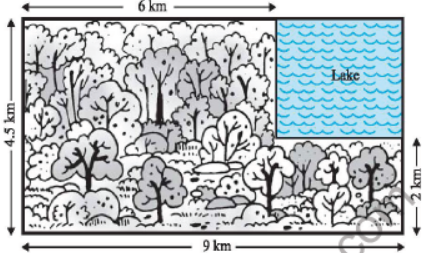
19. There are 40 students in Class X of a school of whom 25 are girls and 15 are boys. The class teacher has to select one student as a class representative. She writes the name of each student on a separate card, the cards being identical. Then she puts cards in a bag and stirs them thoroughly.
She then draws one card from the bag. What is the probability that the name written on the card is the name of (i) a girl? (ii) a boy?
20. A carton consists of 100 shirts of which 88 are good, 8 have minor defects and 4 have major defects. Jimmy, a trader, will only accept the shirts which are good, but Sujatha, another trader, will only reject the shirts which have major defects. One shirt is drawn at random from the carton. What is the probability that (i) it is acceptable to Jimmy? (ii) it is acceptable to Sujatha?
21. Two customers Shyam and Ekta are visiting a particular shop in the same week (Tuesday to Saturday). Each is equally likely to visit the shop on any day as on another day. What is the probability that both will visit the shop on (i) the same day? (ii) consecutive days? (iii) different days?
22. Two customers are visiting a particular shop in the same week (Monday to Saturday). Each is equally likely to visit the shop on any day as on another day. What is the probability that both will visit the shop on (i) the same day? (ii) consecutive days? (iii) different days?
23. A bag contains 5 red balls and some blue balls. If the probability of drawing a blue ball is double that of a red ball, determine the number of blue balls in the bag.
24. A box contains 12 balls out of which x are black. If one ball is drawn at random from the box, what is the probability that it will be a black ball? If 6 more black balls are put in the box, the probability of drawing a black ball is now double of what it was before. Find x.
25. A jar contains 24 marbles, some are green and others are blue. If a marble is drawn at random from the jar, the probability that it is green is 2/3 . Find the number of blue marbles in the jar.
26. A lot consists of 144 ball pens of which 20 are defective and the others are good. Nuri will buy a pen if it is good, but will not buy if it is defective. The shopkeeper draws one pen at random and gives it to her. What is the probability that (i) She will buy it ? (ii) She will not buy it ?
27. A jar contains 54 marbles, each of which is blue, green or white. If a marble is drawn at random from the jar, the probability that it is green is 1/3 and that of getting a blue marble is 4/9. Find the number of white marbles in the jar.
28. A letter is chosen at random from the letters of the word ‘ASSASSINATION’. Find the probability that the letter chosen is a (i) vowel (ii) consonant (iii) A (iv) S (v) N.
29. A letter is chosen at random from the letters of the word ‘INDEPENDENCE’. Find the probability that the letter chosen is a (i) vowel (ii) consonant (iii) E (iv) N (v) D.
30. A letter is chosen at random from the letters of the word ‘MATHEMATICS’. Find the probability that the letter chosen is a (i) vowel (ii) consonant (iii) A (iv) T (v) M.
31. A letter of English alphabets is chosen at random. Determine the probability that the letter is a consonant.
32. There are 1000 sealed envelopes in a box, 10 of them contain a cash prize of Rs 100 each, 100 of them contain a cash prize of Rs 50 each and 200 of them contain a cash prize of Rs 10 each and rest do not contain any cash prize. If they are well shuffled and an envelope is picked up out, what is the probability that it contains no cash prize?
33. Box A contains 25 slips of which 19 are marked Re 1 and other are marked Rs 5 each. Box B contains 50 slips of which 45 are marked Re 1 each and others are marked Rs 13 each. Slips of both boxes are poured into a third box and reshuffled. A slip is drawn at random. What is the probability that it is marked other than Re 1?
34. A carton of 24 bulbs contain 6 defective bulbs. One bulbs is drawn at random. What is the probability that the bulb is not defective? If the bulb selected is defective and it is not replaced and a second bulb is selected at random from the rest, what is the probability that the second bulb is defective?
35. A child’s game has 8 triangles of which 3 are blue and rest are red, and 10 squares of which 6 are blue and rest are red. One piece is lost at random. Find the probability that it is a (i) triangle (ii) square (iii) square of blue colour (iv) triangle of red colour.
36. In a game, the entry fee is Rs 5. The game consists of a tossing a coin 3 times. If one or two heads show, Sweta gets her entry fee back. If she throws 3 heads, she receives double the entry fees. Otherwise she will lose. For tossing a coin three times, find the probability that she (i) loses the entry fee. (ii) gets double entry fee. (iii) just gets her entry fee.
37. A die has its six faces marked 0, 1, 1, 1, 6, 6. Two such dice are thrown together and the total score is recorded. (i) How many different scores are possible? (ii) What is the probability of getting a total of 7?
38. A lot consists of 48 mobile phones of which 42 are good, 3 have only minor defects and 3 have major defects. Varnika will buy a phone if it is good but the trader will only buy a mobile if it has no major defect. One phone is selected at random from the lot. What is the probability that it is (i) a good phone (ii) a bad phone
39. (i) A lot of 20 bulbs contain 4 defective ones. One bulb is drawn at random from the lot. What is the probability that this bulb is defective?
(ii) Suppose the bulb drawn in (i) is not defective and is not replaced. Now one bulb is drawn at random from the rest. What is the probability that this bulb is not defective ?
40. A game of chance consists of spinning an arrow which comes to rest pointing at one of the numbers 1, 2, 3, 4, 5, 6, 7, 8 (see Fig.), and these are equally likely outcomes. What is the probability that it will point at (i) 8 ? (ii) an odd number? (iii) a number greater than 2? (iv) a number less than 9?
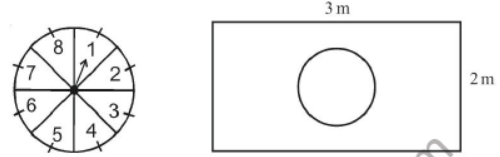
41. Suppose you drop a die at random on the rectangular region shown in above right-sided figure. What is the probability that it will land inside the circle with diameter 1m?
42. A child has a die whose six faces show the letters as given below:

The die is thrown once. What is the probability of getting (i) A? (ii) D?
43. A game consists of tossing a one rupee coin 3 times and noting its outcome each time. Hanif wins if all the tosses give the same result i.e., three heads or three tails, and loses otherwise. Calculate the probability that Hanif will lose the game.
Question. Cards bearing numbers 1, 3, 5, ..., 35 are kept in a bag. A card is drawn at random from the bag. Find the probability of getting a card bearing:
(i) a prime number less than 15.
(ii) a number divisible by 3 and 5.
Answer: (i) \( \frac{1}{3} \), (ii) \( \frac{1}{9} \)
Question. Red kings, queens and jacks are removed from a deck of 52 playing cards and then well-shuffled. A card is drawn from the remaining cards. Find the probability of getting (i) King (ii) a red card (iii) a spade.
Answer: (i) \( \frac{1}{23} \), (ii) \( \frac{10}{23} \), (iii) \( \frac{13}{46} \)
Question. One card is drawn from a well-shuffled deck of 52 cards. Find the probability of getting:
(i) A king of red suit.
(ii) A queen of black suit.
(iii) A jack hearts.
(iv) A red face card.
Answer: (i) \( \frac{1}{26} \), (ii) \( \frac{1}{26} \), (iii) \( \frac{1}{52} \), (iv) \( \frac{3}{26} \)
Question. A bag contains 5 red balls and some blue balls. If the probability of drawing a blue ball from the bag is thrice that of a red ball, find the number of blue balls in the bag.
Hint: Let number of blue balls = \( x \)
∴ Total number of balls = \( (5 + x) \)
\( P_{\text{(blue ball)}} = 3 \times P_{\text{(red ball)}} \Rightarrow \frac{x}{x+5} = 3 \left[ \frac{5}{x+5} \right] \)
Answer: 15
Question. In a throw of a coin, find the probability of getting a head.
Answer: \( \frac{1}{2} \)
Question. Two coins are tossed together find the probability of getting:
(i) at least one tail.
(ii) one head
Answer: (i) \( \frac{3}{4} \), (ii) \( \frac{1}{2} \)
Question. An unbiased die is thrown once, find the probability of getting:
(i) a number greater than 4.
(ii) a multiple of 3.
Answer: (i) \( \frac{1}{3} \), (ii) \( \frac{1}{3} \)
Question. Two dice are thrown at the same time. Find the probability of getting different numbers on both the dice.
Hint: \( P_{\text{(different numbers on both dice)}} = 1 – P_{\text{(same number on both dice)}} \)
Answer: \( \frac{5}{6} \)
Question. Two dice are thrown at the same time. Find the probability of getting same number on both the dice.
Answer: \( \frac{1}{6} \)
Question. A pair of dice is thrown once. Find the probability of getting an odd number on each die.
Answer: \( \frac{1}{4} \)
Question. A lot consists of 48 mobile phones of which 42 are good, 3 have only minor defects and 3 have major defects. Varnika will buy a phone if it is good but the trader will only buy a mobile if it has no major defect. One phone is selected at random from the lot. What is the probability that it is:
(i) acceptable to Varnika?
(ii) acceptable to the trader?
Answer: (i) \( \frac{7}{8} \), (ii) \( \frac{15}{16} \)
Question. Find the probability that a number selected at random from the numbers 1, 2, 3, ..., 35 is a:
(i) prime number
(ii) multiple of 7
(iii) a prime number less than 15.
Answer: (i) \( \frac{11}{35} \), (ii) \( \frac{1}{7} \), (iii) \( \frac{6}{35} \)
Question. A bag contains 5 red marbles, 8 white marbles and 4 green marbles. What is the probability that if one marble is taken out of the bag at random it will not be a green marble?
Answer: \( \frac{13}{17} \)
Question. One card is drawn from a well shuffled deck of 52 cards. Find the probability of getting:
(i) the queen of diamond
(ii) an ace of hearts
(iii) a spade.
Hint: (i) There is only one queen of diamond.
(ii) There is only one ace of hearts.
(iii) There are 13 spade cards.
Answer: (i) \( \frac{1}{52} \), (ii) \( \frac{1}{52} \), (iii) \( \frac{1}{4} \)
Question. Find the probability of getting 53 Sundays in a leap year.
Hint: Number of days in a normal year = 365
Number of days in a leap year = 366
Number of weeks, in a normal year = 52, means 52 Sundays
\( [366 – (52 \times 7)] = 2 \) extra days in a leap year.
These two extra days may have sample-space as:
(Monday – Tuesday), (Tuesday – Wednesday), (Wednesday – Thursday), (Thursday – Friday), (Friday – Saturday), (Saturday – Sunday), (Sunday – Monday).
i.e. out of 7 sample spaces, only two are favourable.
\( \Rightarrow P_{\text{(53 Sundays in a leap year)}} = \frac{2}{7} \)
Answer: \( \frac{2}{7} \)
Question. One letter is chosen at random amongst letters of the word Mathematics. Find the probability that the letter chosen is a:
(i) vowel
(ii) consonant
Answer: (i) \( \frac{4}{11} \), (ii) \( \frac{7}{11} \)
Question. Two coins are tossed simultaneously. Find the probability of getting:
(i) two Heads
(ii) at least one Head
(iii) no Head.
Hint: In a throw of two coins simultaneously the four possible outcomes are
HH, HT, TH, TT
Answer: (i) \( \frac{1}{4} \), (ii) \( \frac{3}{4} \), (iii) \( \frac{1}{4} \)
Question. A die is thrown once. What is the probability of getting a number greater than 4?
Answer: \( \frac{1}{3} \)
Question. What is the probability that a number selected at random from the numbers 3, 4, 5, ..., 9 is a multiple of 4?
Answer: \( \frac{2}{7} \)
Question. From a well suffled pack of playing cards, black jacks, black kings and black aces are removed. A card is then drawn from the pack. Find the probability of getting:
(i) a red card
(ii) not a diamond card.
Answer: (i) \( \frac{13}{23} \), (ii) \( \frac{33}{46} \)
Question. A bag contains cards which are numbered from 2 to 90. A card is drawn at random from the bag. Find the probability that it bears.
(i) a two-digit number
(ii) a number which is a perfect square.
Answer: (i) \( \frac{81}{89} \), (ii) \( \frac{8}{89} \)
Question. Cards numbered 1 to 30 are put in a bag. A card is drawn at random from this bag. Find the probability that the number on the drawn card is :
(i) not divisible by 3.
(ii) a prime number greater than 7.
(iii) not a perfect square number.
Hint: Total possible outcomes = 30
(i) Numbers not divisible by 3 [1 to 30] are :
1, 2, 4, 5, 7, 8, 10, 11, 13, 14, 16, 17, 19, 20, 22, 23, 25, 26, 28, 29,
∴ Number of favourable outcomes = 20
\( \Rightarrow \text{Required Probability} = \frac{20}{30} = \frac{2}{3} \)
(ii) Prime numbers greater than 7 are : 11, 13, 17, 19, 23, 29
∴ Required probability = \( \frac{6}{30} = \frac{1}{5} \)
(iii) Perfect squares are 1, 4, 9, 16, 25 \( \Rightarrow \) Total No. = 5
∴ Required pribability = \( \frac{30 - 5}{30} = \frac{25}{30} = \frac{5}{6} \)
Answer: (i) \( \frac{2}{3} \), (ii) \( \frac{1}{5} \), (iii) \( \frac{5}{6} \)
Question. Two different dice are tossed together. Find the probability :
(i) That the numbers on either die is even.
(ii) That the sum of numbers appearing on the two dice is 5.
Hint: Total possible outcomes = 36
(i) Numbers of favourable outcomes = 9
[ \( \because \) (2, 2), (2, 4), (2, 6), (4, 2), (4, 4), (4, 6), (6, 2), (6, 4) and (6, 6) are desired outcomes.
Required Probability = \( \frac{9}{36} = \frac{1}{4} \)
(ii) Desired (favourable) outcomes are : (1, 4), (2, 3), (3, 2), (4, 1)
Required Probability = \( \frac{4}{36} = \frac{1}{9} \)
Answer: (i) \( \frac{1}{4} \), (ii) \( \frac{1}{9} \)
Question. Red queens and black jacks are removed from a pack of 52 playing cards. A card is drawn at random from the remaining cards, after reshuffling them. Find the probability that the card drawn is :
(i) a king
(ii) of red colour
(iii) a face-card
(iv) a queen
Hint: A pack of playing cards consists of 52 cards. 2 red queens and 2 black jacks are removed.
Therefore, remaining number of cards = 52 - 4 = 48.
(i) Numbers of kings = 4 \( \Rightarrow \) Required P = \( \frac{4}{48} = \frac{1}{12} \)
(ii) Remaining red cards = 26 – 2 = 24 \( \Rightarrow \) Required P = \( \frac{24}{48} = \frac{1}{2} \)
(iii) Remaining face-cards = 12 – 4 = 8 \( \Rightarrow \) Required P = \( \frac{8}{48} = \frac{1}{6} \)
(iv) Remaining queens = 4 – 2 = 2 \( \Rightarrow \) Required P = \( \frac{2}{48} = \frac{1}{24} \)
Answer: (i) \( \frac{1}{12} \), (ii) \( \frac{1}{2} \), (iii) \( \frac{1}{6} \), (iv) \( \frac{1}{24} \)
Question. Rahim tosses two different coins simultaneously. Find the probability of getting at least one tail.
Hint: Total outcomes = 4 (HH, HT, TH, TT)
Fovourable outcomes = 3 (HT, TH, TT)
\( \Rightarrow \text{Required P} = \frac{3}{4} \)
Answer: \( \frac{3}{4} \)
Question. A bag contains cards numbered from 1 to 49. A card is drawn from the bag at random, after mixing the cards thoroughly. Find the probability that the number on the drawn card is :
(i) an odd number
(ii) a multiple of 5
(iii) a perfect square
(iv) an even prime number
Hint: Possible outcomes = 49
(i) Odd numbers are : 1, 3, 5, 7, 9, 11, 13, 15, 17, 19, 21, 23, 25, 27, 29, 31, 33, 35, 37, 39, 41, 43, 45, 47, 49 \( \Rightarrow \) Favourable outcomes = 25
\( \Rightarrow \text{Required P} = \frac{25}{49} \)
(ii) Multiples of 5 are = 5, 10, 15, 20, 25, 30, 35, 40, 45 \( \Rightarrow P = \frac{9}{49} \)
(iii) Perfect squares are : 1, 4, 9, 16, 25, 36, 49 \( \Rightarrow P = \frac{7}{49} = \frac{1}{7} \)
(iv) Even Primes are : only 2. \( \Rightarrow P = \frac{1}{49} \)
Answer: (i) \( \frac{25}{49} \), (ii) \( \frac{9}{49} \), (iii) \( \frac{1}{7} \), (iv) \( \frac{1}{49} \)
Please click the link below to download CBSE Class 10 Probability Sure Shot Questions Set F.
Free study material for Mathematics
Free CBSE Study Guides: Class 10 Mathematics Chapter 14 Probability
Essential Notes for Class 10 Mathematics
Review targeted study resources for Chapter 14 Probability tailored for Class 10 learners. Utilizing these structured notes and quick-revision tools ensures complete alignment with current CBSE evaluation standards.
Verified Solutions for Class 10 Mathematics
Designed around the official curriculum, these study guides guarantee standard compliance. Reviewing step-by-step solutions clarifies complex sub-topics within Chapter 14 Probability and demystifies standard marking schemes for Mathematics evaluations.
Enhance Accuracy with Online Tests
Wrap up your chapter revision by testing your knowledge against standard objective question formats. Explore our full library of free, up-to-date sample papers and online assessments to secure top grades in your CBSE examinations.
FAQs
Our advanced study package for Chapter 14 Probability includes detailed concepts, diagrams, Mind Maps, and explanation of complex topics to ensure Class 10 students learn as per syllabus for 2026 exams.
The Mind Maps provided for Chapter 14 Probability act as visual anchors which will help faster recall during high-pressure exams.
Yes, teachers use our Class 10 Mathematics resources for lesson planning as they are in simple language and have lot of solved examples.
Yes, You can download the complete, mobile-friendly PDF of the Mathematics Chapter 14 Probability advanced resources for free.
Yes, our subject matter experts have updated the Chapter 14 Probability material to align with the rationalized NCERT textbooks and have removed deleted topics and added new competency-based questions.