

Official CBSE Study Materials for Class 10 Mathematics
Explore structured advanced study materials through the CBSE Class 10 Surface Areas and Volumes Sure Shot Questions Set 01. Tailored for Class 10 learners, utilizing these Mathematics resources ensures thorough preparation and strengthens foundational knowledge before final CBSE evaluations.
Advanced Resources for Mathematics
View or download the dedicated CBSE Class 10 Surface Areas and Volumes Sure Shot Questions Set 01 resource below. Engaging with these advanced study guides under focused conditions ensures continuous academic progress and mastery of the 2026-27 curriculum for Chapter 12 Surface Area and Volume.
CBSE Class 10 Surface Areas and Volumes Sure Shot Questions Set A. There are many more useful educational material which the students can download in pdf format and use them for studies. Study material like concept maps, important and sure shot question banks, quick to learn flash cards, flow charts, mind maps, teacher notes, important formulas, past examinations question bank, important concepts taught by teachers. Students can download these useful educational material free and use them to get better marks in examinations. Also refer to other worksheets for the same chapter and other subjects too. Use them for better understanding of the subjects.
- A cone of maximum size is carved out from a cube of edge 14 cm. Find the surface area of the cone and of the remaining solid left out after the cone carved out.
- A solid metallic sphere of radius 10.5 cm is melted and recast into a number of smaller cones, each of radius 3.5 cm and height 3 cm. Find the number of cones so formed.
- A canal is 300 cm wide and 120 cm deep. The water in the canal is flowing with a speed of 20 km/h. How much area will it irrigate in 20 minutes if 8 cm of standing water is desired?
- A cone of radius 4 cm is divided into two parts by drawing a plane through the mid point of its axis and parallel to its base. Compare the volumes of the two parts.
- Three cubes of a metal whose edges are in the ratio 3:4:5 are melted and converted into a single cube whose diagonal is 12 √3 cm. Find the edges of the three cubes.
- Three metallic solid cubes whose edges are 3 cm, 4 cm and 5 cm are melted and formed into a single cube. Find the edge of the cube so formed.
- How many shots each having diameter 3 cm can be made from a cuboidal lead solid of dimensions 9cm × 11cm × 12cm?
- A bucket is in the form of a frustum of a cone and holds 28.490 litres of water. The radii of the top and bottom are 28 cm and 21 cm, respectively. Find the height of the bucket.
- A cone of radius 8 cm and height 12 cm is divided into two parts by a plane through the midpoint of its axis parallel to its base. Find the ratio of the volumes of two parts.
- Two identical cubes each of volume 64 cm3 are joined together end to end. What is the surface area of the resulting cuboid?
- From a solid cube of side 7 cm, a conical cavity of height 7 cm and radius 3 cm is hollowed out. Find the volume of the remaining solid.
- Two cones with same base radius 8 cm and height 15 cm are joined together along their bases. Find the surface area of the shape so formed.
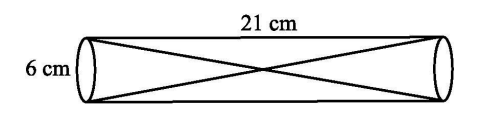
- Two solid cones A and B are placed in a cylindrical tube as shown in the below figure. The ratio of their capacities is 2:1. Find the heights and capacities of cones. Also, find the volume of the remaining portion of the cylinder
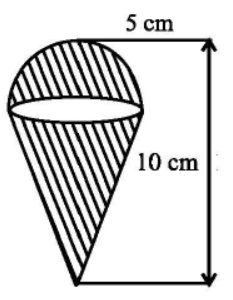
- An ice cream cone full of ice cream having radius 5 cm and height 10 cm as shown in the below figure. Calculate the volume of ice cream, provided that its 1/6 part is left unfilled with ice cream.
- Marbles of diameter 1.4 cm are dropped into a cylindrical beaker of diameter 7 cm containing some water. Find the number of marbles that should be dropped into the beaker so that the water level rises by 5.6 cm.
- How many spherical lead shots each of diameter 4.2 cm can be obtained from a solid rectangular lead piece with dimensions 66 cm, 42 cm and 21 cm.
- How many spherical lead shots of diameter 4 cm can be made out of a solid cube of lead whose edge measures 44 cm.
- A wall 24 m long, 0.4 m thick and 6 m high is constructed with the bricks each of dimensions 25 cm × 16 cm × 10 cm. If the mortar occupies 1/10 th of the volume of the wall, then find the number of bricks used in constructing the wall.
- Find the number of metallic circular disc with 1.5 cm base diameter and of height 0.2 cm to be melted to form a right circular cylinder of height 10 cm and diameter 4.5 cm.
- A bucket is in the form of a frustum of a cone of height 30 cm with radii of its lower and upper ends as 10 cm and 20 cm, respectively. Find the capacity and surface area of the bucket. Also, find the cost of milk which can completely fill the container, at the rate of Rs 25 per litre ( use Π = 3.14).
- A solid toy is in the form of a hemisphere surmounted by a right circular cone. The height of the cone is 4 cm and the diameter of the base is 8 cm. Determine the volume of the toy. If a cube circumscribes the toy, then find the difference of the volumes of cube and the toy. Also, find the total surface area of the toy.
- A solid metallic hemisphere of radius 8 cm is melted and recasted into a right circular cone of base radius 6 cm. Determine the height of the cone.
- A rectangular water tank of base 11 m × 6 m contains water upto a height of 5 m. If the water in the tank is transferred to a cylindrical tank of radius 3.5 m, find the height of the water level in the tank.
- A building is in the form of a cylinder surmounted by a hemispherical dome. The base diameter of the dome is equal to 2 of the total height of the building. Find the height of the building, if it 3 contains 671/21 m3 of air.
- How many cubic centimetres of iron is required to construct an open box whose external dimensions are 36 cm, 25 cm and 16.5 cm provided the thickness of the iron is 1.5 cm. If one cubic cm of iron weighs 7.5 g, find the weight of the box.
- The barrel of a fountain pen, cylindrical in shape, is 7 cm long and 5 mm in diameter. A full barrel of ink in the pen is used up on writing 3300 words on an average. How many words can be written in a bottle of ink containing one fifth of a litre?
- Water flows at the rate of 10m/minute through a cylindrical pipe 5 mm in diameter. How long would it take to fill a conical vessel whose diameter at the base is 40 cm and depth 24 cm?
- A heap of rice is in the form of a cone of diameter 9 m and height 3.5 m. Find the volume of the rice. How much canvas cloth is required to just cover the heap?
- A factory manufactures 120000 pencils daily. The pencils are cylindrical in shape each of length 25 cm and circumference of base as 1.5 cm. Determine the cost of colouring the curved surfaces of the pencils manufactured in one day at Rs 0.05 per dm2.
- Water is flowing at the rate of 15 km/h through a pipe of diameter 14 cm into a cuboidal pond which is 50 m long and 44 m wide. In what time will the level of water in pond rise by 21 cm?
- A solid iron cuboidal block of dimensions 4.4 m × 2.6 m × 1m is recast into a hollow cylindrical pipe of internal radius 30 cm and thickness 5 cm. Find the length of the pipe.
- 500 persons are taking a dip into a cuboidal pond which is 80 m long and 50 m broad. What is the rise of water level in the pond, if the average displacement of the water by a person is 0.04m3?
- 16 glass spheres each of radius 2 cm are packed into a cuboidal box of internal dimensions 16 cm × 8 cm × 8 cm and then the box is filled with water. Find the volume of water filled in the box.
- A milk container of height 16 cm is made of metal sheet in the form of a frustum of a cone with radii of its lower and upper ends as 8 cm and 20 cm respectively. Find the cost of milk at the rate of Rs. 22 per litre which the container can hold.
- A cylindrical bucket of height 32 cm and base radius 18 cm is filled with sand. This bucket is emptied on the ground and a conical heap of sand is formed. If the height of the conical heap is 24 cm, find the radius and slant height of the heap.
- A rocket is in the form of a right circular cylinder closed at the lower end and surmounted by a cone with the same radius as that of the cylinder. The diameter and height of the cylinder are 6 cm and 12 cm, respectively. If the slant height of the conical portion is 5 cm, find the total surface area and volume of the rocket [Use Π = 3.14].
- A building is in the form a cylinder surmounted by a hemispherical vaulted dome and contains 4119/21m3 of air. If the internal diameter of dome is equal to its total height above the floor, find the height of the building?
- A hemispherical bowl of internal radius 9 cm is full of liquid. The liquid is to be filled into cylindrical shaped bottles each of radius 1.5 cm and height 4 cm. How many bottles are needed to empty the bowl?
- A solid right circular cone of height 120 cm and radius 60 cm is placed in a right circular cylinder full of water of height 180 cm such that it touches the bottom. Find the volume of water left in the cylinder, if the radius of the cylinder is equal to the radius of the cone.
- Water flows through a cylindrical pipe, whose inner radius is 1 cm, at the rate of 80 cm/sec in an empty cylindrical tank, the radius of whose base is 40 cm. What is the rise of water level in tank in half an hour?
- The rain water from a roof of dimensions 22 m 20 m drains into a cylindrical vessel having diameter of base 2 m and height 3.5 m. If the rain water collected from the roof just fill the cylindrical vessel, then find the rainfall in cm.
- A pen stand made of wood is in the shape of a cuboid with four conical depressions and a cubical depression to hold the pens and pins, respectively. The dimension of the cuboid are 10 cm, 5 cm and 4 cm. The radius of each of the conical depressions is 0.5 cm and the depth is 2.1 cm. The edge of the cubical depression is 3 cm. Find the volume of the wood in the entire stand.
- A cone of radius 10cm is divided into two parts by drawing a plane through the midpoint of its axis, parallel to its base. Compare the volume of the two parts.
- A hollow cone is cut by a plane parallel to the base and the upper portion is removed. If the curved surface of the remainder is 8/9 of the curved surface of the whole cone. Find the ratio of the line segments into which the cone’s altitude is divided by the plane.
- From a solid cylinder of height 24cm and diameter 10cm, two conical cavities of same radius as that of the cylinder are hollowed out. If the height of each conical activity is half the height of cylinder, find the total surface area of the remaining cylinder.
- A farmer connects a pipe of internal diameter 20cm from a canal into a cylindrical tank to her field, which is 10m in diameter and 2m deep. If water flows through the pipe at the rate of 3km/hr, in how much time will the tank be filled?
- A toy is in the form of a cone on a hemi-sphere of diameter 7 cm. The toal height of the top is 14.5cm. Find the volume and total surface area of the toy.
- A vessel in the form of hemi-spherical is mounted by a hollow cylinder. The diameter of the bowl is 14cm and the total height of the vessel is 13 cm. Find the capacity of the vessel.
- A cylindrical with radius and height is 4cm and 8cm is filled with Ice-cream and ice-cream is distributed to 10 Children in equal can having hemi-spherical tops. If the height of the conical portion is 4 times the radius of its base, find the radius of the ice-cream cone.
- A tent has cylindrical surmounted by a conical roof. The radius of the cylindrical base is 20m. The total height of tent is 6.3m and height of cylindrical portion is 4.2m, find the volume and surface area of tent.
- Rasheed got a playing top (lattu) as his birthday present, which surprisingly had no colour on it. He wanted to colour it with his crayons. The top is shaped like a cone surmounted by a hemisphere. The entire top is 5 cm in height and the diameter of the top is 3.5 cm. Find the area he has to colour. (Take Π = 22/7)
- A wooden toy rocket is in the shape of a cone mounted on a cylinder. The height of the entire rocket is 26 cm, while the height of the conical part is 6 cm. The base of the conical portion has a diameter of 5 cm, while the base diameter of the cylindrical portion is 3 cm. If the conical portion is to be painted orange and the cylindrical portion yellow, find the area of the rocket painted with each of these colours. (Take Π = 3.14)
- A toy is in the form of a cone of radius 3.5 cm mounted on a hemisphere of same radius. The total height of the toy is 15.5 cm. Find the total surface area of the toy.
- A tent is in the shape of a cylinder surmounted by a conical top. If the height and diameter of the cylindrical part are 2.1 m and 4 m respectively, and the slant height of the top is 2.8 m, find the area of the canvas used for making the tent. Also, find the cost of the canvas of the tent at the rate of Rs 500 per m2
- From a solid cylinder whose height is 2.4 cm and diameter 1.4 cm, a conical cavity of the same height and same diameter is hollowed out. Find the total surface area of the remaining solid to the nearest cm2.
- A juice seller was serving his customers using glasses. The inner diameter of the cylindrical glass was 5 cm, but the bottom of the glass had a hemispherical raised portion which reduced the capacity of the glass. If the height of a glass was 10 cm, find the apparent capacity of the glass and its actual capacity. (Take Π = 3.14)
- A solid toy is in the form of a hemisphere surmounted by a right circular cone. The height of the cone is 2 cm and the diameter of the base is 4 cm. Determine the volume of the toy. If a right circular cylinder circumscribes the toy, find the difference of the volumes of the cylinder and the toy. (Take p = 3.14)
- A gulab jamun, contains sugar syrup up to about 30% of its volume. Find approximately how much syrup would be found in 45 gulab jamuns, each shaped like a cylinder with two hemispherical ends with length 5 cm and diameter 2.8 cm.
- A pen stand made of wood is in the shape of a cuboid with four conical depressions to hold pens.The dimensions of the cuboid are 15 cm by 10 cm by 3.5 cm. The radius of each of the depressions is 0.5 cm and the depth is 1.4 cm. Find the volume of wood in the entire stand.
- A vessel is in the form of an inverted cone. Its height is 8 cm and the radius of its top, which is open, is 5 cm. It is filled with water up to the brim. When lead shots, each of which is a sphere of radius 0.5 cm are dropped into the vessel, one-fourth of the water flows out. Find the number of lead shots dropped in the vessel.
- A solid iron pole consists of a cylinder of height 220 cm and base diameter 24 cm, which is surmounted by another cylinder of height 60 cm and radius 8 cm. Find the mass of the pole, given that 1 cm3 of iron has approximately 8g mass. (Use p = 3.14)
- A solid consisting of a right circular cone of height 120 cm and radius 60 cm standing on a hemisphere of radius 60 cm is placed upright in a right circular cylinder full of water such that it touches the bottom. Find the volume of water left in the cylinder, if the radius of the cylinder is 60 cm and its height is 180 cm.
- A spherical glass vessel has a cylindrical neck 8 cm long, 2 cm in diameter; the diameter of the spherical part is 8.5 cm. By measuring the amount of water it holds, a child finds its volume to be 345 cm3. Check whether she is correct, taking the above as the inside measurements, and Π = 3.14.
- A cone of height 24 cm and radius of base 6 cm is made up of modeling clay. A child reshapes it in the form of a sphere. Find the radius of the sphere.
- Selvi’s house has an overhead tank in the shape of a cylinder. This is filled by pumping water from a sump (an underground tank) which is in the shape of a cuboid. The sump has dimensions 1.57 m × 1.44 m × 95cm. The overhead tank has its radius 60 cm and height 95 cm. Find the height of the water left in the sump after the overhead tank has been completely filled with water from the sump which had been full. Compare the capacity of the tank with that of the sump. (Use p = 3.14)
- A copper rod of diameter 1 cm and length 8 cm is drawn into a wire of length 18 m of uniform thickness. Find the thickness of the wire.
- A hemispherical tank full of water is emptied by a pipe at the rate of 3 4/7 litres per second. How much time will it take to empty half the tank, if it is 3m in diameter? (Take Π = 22/7)
- A 20 m deep well with diameter 7 m is dug and the earth from digging is evenly spread out to form a platform 22 m by 14 m. Find the height of the platform.
- A well of diameter 3 m is dug 14 m deep. The earth taken out of it has been spread evenly all around it in the shape of a circular ring of width 4 m to form an embankment. Find the height of the embankment.
- A container shaped like a right circular cylinder having diameter 12 cm and height 15 cm is full of ice cream. The ice cream is to be filled into cones of height 12 cm and diameter 6 cm, having a hemispherical shape on the top. Find the number of such cones which can be filled with ice cream.
- How many silver coins, 1.75 cm in diameter and of thickness 2 mm, must be melted to form a cuboid of dimensions 5.5 cm × 10 cm × 3.5 cm?
- A cylindrical bucket, 32 cm high and with radius of base 18 cm, is filled with sand. This bucket is emptied on the ground and a conical heap of sand is formed. If the height of the conical heap is 24 cm, find the radius and slant height of the heap.
- Water in a canal, 6 m wide and 1.5 m deep, is flowing with a speed of 10 km/h. How much area will it irrigate in 30 minutes, if 8 cm of standing water is needed?
- A farmer connects a pipe of internal diameter 20 cm from a canal into a cylindrical tank in her field, which is 10 m in diameter and 2 m deep. If water flows through the pipe at the rate of 3 km/h, in how much time will the tank be filled?
- Hanumappa and his wife Gangamma are busy making jaggery out of sugarcane juice. They have processed the sugarcane juice to make the molasses, which is poured into moulds in the shape of a frustum of a cone having the diameters of its two circular faces as 30 cm and 35 cm and the vertical height of the mould is 14 cm. If each cm3 of molasses has mass about 1.2 g, find the mass of the molasses that can be poured into each mould. (Take p = 22/7)
- An open metal bucket is in the shape of a frustum of a cone, mounted on a hollow cylindrical base made of the same metallic sheet. The diameters of the two circular ends of the bucket are 45 cm and 25 cm, the total vertical height of the bucket is 40 cm and that of the cylindrical base is 6 cm. Find the area of the metallic sheet used to make the bucket, where we do not take into account the handle of the bucket. Also, find the volume of water the bucket can hold.
- A container, opened from the top and made up of a metal sheet, is in the form of a frustum of a cone of height 16 cm with radii of its lower and upper ends as 8 cm and 20 cm, respectively. Find the cost of the milk which can completely fill the container, at the rate of Rs 20 per litre. Also find the cost of metal sheet used to make the container, if it costs Rs 8 per 100 cm2. (Take p = 3.14)
- A metallic right circular cone 20 cm high and whose vertical angle is 60° is cut into two parts at the middle of its height by a plane parallel to its base. If the frustum so obtained be drawn into a wire of diameter 1/16 cm, find the length of the wire.
- A right triangle, whose sides are 3 cm and 4 cm (other than hypotenuse) is made to revolve about its hypotenuse. Find the volume and surface area of the double cone so formed.
- The decorative block shown in Fig. is made of two solids - a cube and a hemisphere. The base of the block is a cube with edge 5 cm, and the hemisphere fixed on the top has a diameter of 4.2 cm. Find the total surface area of the block. (Take p = 22/7).
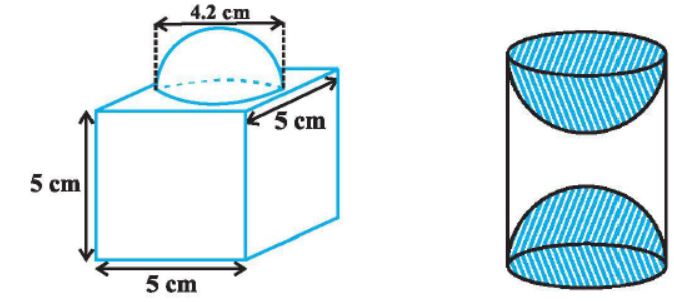
- A wooden article was made by scooping out a hemisphere from each end of a solid cylinder, as shown in above Fig.. If the height of the cylinder is 10 cm, and its base is of radius 3.5 cm, find the total surface area of the article.
- A sphere of diameter 12 cm, is dropped in a right circular cylindrical vessel, partly filled with water. If the sphere is completely submerged in water level in the cylindrical vessel rises by 3 5/9 cm. find the diameter of the cylindrical vessel.
- An iron pillar has lower part in the form of a right circular cylinder and the upper part is in the form of a right circular cone. The radius of the base of the cone and cylinder is 8cm. The cylindrical part is 240cm high and the conical part is 36cm high. Find the weight of the pillar if 1 cm3 of iron weighs 7.5 grams.
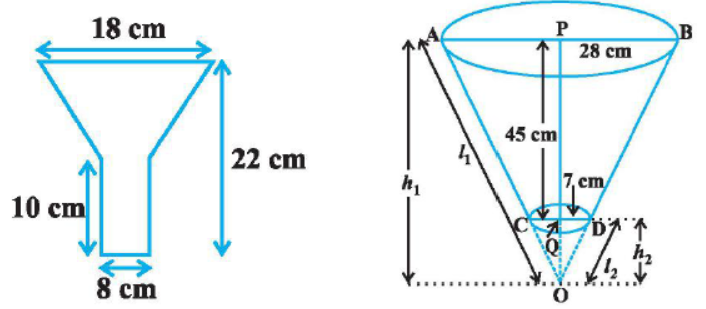
- An oil funnel made of tin sheet consists of a 10 cm long cylindrical portion attached to a frustum of a cone. If the total height is 22 cm, diameter of the cylindrical portion is 8 cm and the diameter of the top of the funnel is 18 cm, find the area of the tin sheet required to make the funnel (see below figure)
- The radii of the ends of a frustum of a cone 45 cm high are 28 cm and 7 cm (see above sided Fig). Find its volume, the curved surface area and the total surface area. (Take Π = 22/7)
[Take \( \pi = \frac{22}{7} \), (Unless stated otherwise)]
Question. A metallic sphere of radius \( 4.2 \text{ cm} \) is melted and recast into the shape of a cylinder of radius \( 6 \text{ cm} \). Find the height of the cylinder.
Answer: Radius of the sphere \( (r_1) = 4.2 \text{ cm} \)
∴ Volume of the sphere \( \left( \frac{4}{3} \pi r_1^3 \right) = \frac{4}{3} \times \frac{22}{7} \times \frac{42}{10} \times \frac{42}{10} \times \frac{42}{10} \text{ cm}^3 \)
Radius of the cylinder \( (r_2) = 6 \text{ cm} \)
Let ‘h’ be the height of the cylinder
∴ Volume of the cylinder \( = \pi r_2^2 h = \frac{22}{7} \times 6 \times 6 \times h \text{ cm}^3 \)
Since, Volume of the metallic sphere = Volume of the cylinder.
\( \Rightarrow \frac{4}{3} \times \frac{22}{7} \times \frac{42}{10} \times \frac{42}{10} \times \frac{42}{10} = \frac{22}{7} \times 6 \times 6 \times h \)
\( \Rightarrow h = \frac{4}{3} \times \frac{22}{7} \times \frac{42}{10} \times \frac{42}{10} \times \frac{42}{10} \times \frac{7}{22} \times \frac{1}{6} \times \frac{1}{6} \text{ cm} \)
\( = \frac{4 \times 7 \times 7 \times 4}{10 \times 10 \times 10} \text{ cm} = \frac{2744}{1000} \text{ cm} = 2.744 \text{ cm} \).
Question. Metallic spheres of radii \( 6 \text{ cm} \), \( 8 \text{ cm} \) and \( 10 \text{ cm} \), respectively, are melted to form a single solid sphere. Find the radius of the resulting sphere.
Answer: Radii of the given spheres are:
\( r_1 = 6 \text{ cm} \)
\( r_2 = 8 \text{ cm} \)
\( r_3 = 10 \text{ cm} \)
⇒ Volume of the given spheres are:
\( V_1 = \frac{4}{3} \pi r_1^3 \), \( V_2 = \frac{4}{3} \pi r_2^3 \) and \( V_3 = \frac{4}{3} \pi r_3^3 \)
∴ Total volume of the given spheres
\( = V_1 + V_2 + V_3 \)
\( = \frac{4}{3} \pi r_1^3 + \frac{4}{3} \pi r_2^3 + \frac{4}{3} \pi r_3^3 = \frac{4}{3} \pi [r_1^3 + r_2^3 + r_3^3] \)
\( = \frac{4}{3} \times \frac{22}{7} \times [6^3 + 8^3 + 10^3] \text{ cm}^3 \)
\( = \frac{4}{3} \times \frac{22}{7} \times [216 + 512 + 1000] \text{ cm}^3 = \frac{4}{3} \times \frac{22}{7} \times 1728 \text{ cm}^3 \)
Let the radius of the new big sphere be R.
∴ Volume of the new sphere
\( = \frac{4}{3} \times \pi \times R^3 = \frac{4}{3} \times \frac{22}{7} \times R^3 \)
Since, the two volume must be equal.
∴ \( \frac{4}{3} \times \frac{22}{7} \times R^3 = \frac{4}{3} \times \frac{22}{7} \times 1728 \text{ cm}^3 \)
\( \Rightarrow R^3 = 1728 \)
\( \Rightarrow R^3 = 2^3 \times 2^3 \times 3^3 \)
\( \Rightarrow R^3 = (2 \times 2 \times 3)^3 \)
\( \Rightarrow R = 2 \times 2 \times 3 \)
\( \Rightarrow R = 12 \text{ cm} \)
Thus, the required radius of the resulting sphere \( = 12 \text{ cm} \).
Question. A \( 20 \text{ m} \) deep well with diameter \( 7 \text{ m} \) is dug and the earth from digging is evenly spread out to form a platform \( 22 \text{ m} \) by \( 14 \text{ m} \). Find the height of the platform.
Answer: Diameter of the cylindrical well \( = 7 \text{ m} \)
\( \Rightarrow \) Radius of the cylinder \( (r) = \frac{7}{2} \text{ m} \)
Depth of the well \( (h) = 20 \text{ m} \)
∴ Volume \( = \pi r^2 h = \frac{22}{7} \times \frac{7}{2} \times \frac{7}{2} \times 20 \text{ m}^3 = 22 \times 7 \times 5 \text{ m}^3 \)
⇒ Volume of the earth taken out \( = 22 \times 7 \times 5 \text{ m}^3 \)
Now this earth is spread out to form a cuboidal platform having
length \( = 22 \text{ m} \)
breadth \( = 14 \text{ m} \)
Let ‘h’ be the height of the platform.
∴ Volume of the platform \( = 22 \times 14 \times h \text{ m}^3 \)
∴ \( 22 \times 14 \times h = 22 \times 7 \times 5 \)
\( \Rightarrow h = \frac{22 \times 7 \times 5}{22 \times 14} = \frac{5}{2} \text{ m} = 2.5 \text{ m} \).
Thus, the required height of the platform is \( 2.5 \text{ m} \).
Question. A well of diameter \( 3 \text{ m} \) is dug \( 14 \text{ m} \) deep. The earth taken out of it has been spread evenly all around it in shape of a circular ring of width \( 4 \text{ m} \) to form an embankment. Find the height of the embankment.
Answer: Diameter of cylindrical well \( (d) = 3 \text{ m} \)
\( \Rightarrow \) Radius of the cylindrical well \( (r) = \frac{3}{2} \text{ m} = 1.5 \text{ m} \)
Depth of the well \( (h) = 14 \text{ m} \)
∴ Volume \( = \pi r^2 h = \frac{22}{7} \times \left( \frac{15}{10} \right)^2 \times 14 \text{ m}^3 \)
\( = \frac{22 \times 15 \times 15 \times 14}{7 \times 10 \times 10} \text{ m}^3 = 11 \times 3 \times 3 \text{ m}^3 = 99 \text{ m}^3 \)
Let the height of the embankment \( = \text{‘H’ metre} \).
Internal radius of the embankment \( (r) = 1.5 \text{ m} \).
External radius of the embankment \( R = (4 + 1.5) \text{ m} = 5.5 \text{ m} \).
∴ Volume of the embankment
\( = \pi R^2 H - \pi r^2 H = \pi H [R^2 - r^2] = \pi H (R + r) (R - r) \)
\( = \frac{22}{7} \times H (5.5 + 1.5) (5.5 - 1.5) = \frac{22}{7} \times H \times 7 \times 4 \text{ m}^3 \)
Since, Volume of the embankment = Volume of the cylindrical well
∴ \( \frac{22}{7} \times H \times 7 \times 4 = 99 \)
\( \Rightarrow H = \frac{99 \times 7}{22 \times 7 \times 4} = \frac{9}{8} \text{ m} = 1.125 \text{ m} \)
Thus, the required height of the embankment \( = 1.125 \text{ m} \).
Question. A container shaped like a right circular cylinder having diameter \( 12 \text{ cm} \) and height \( 15 \text{ cm} \) is full of ice cream. The ice cream is to be filled into cones of height \( 12 \text{ cm} \) and diameter \( 6 \text{ cm} \), having a hemispherical shape on the top. Find the number of such cones which can be filled with ice cream.
Answer: For the circular cylinder:
Diameter \( = 12 \text{ cm} \Rightarrow \) Radius \( = \frac{12}{2} = 6 \text{ cm} \)
Height \( (h) = 15 \text{ cm} \)
∴ Volume \( = \pi r^2 h \)
⇒ Volume of total ice cream \( = \frac{22}{7} \times 6 \times 6 \times 15 \text{ cm}^3 \)
For conical + hemispherical ice-cream cone:
Diameter \( = 6 \text{ cm} \Rightarrow \) radius \( (R) = 3 \text{ cm} \)
Height of cone \( (H) = 12 \text{ cm} \)
Volume = (Volume of the conical part) + (Volume of the hemispherical part)
\( = \frac{1}{3} \pi R^2 H + \frac{2}{3} \pi R^3 = \frac{1}{3} \pi R^2 [H + 2R] \)
\( = \frac{1}{3} \times \frac{22}{7} \times 3 \times 3 [12 + 2 \times 3] \text{ cm}^3 = \frac{22 \times 3 \times 18}{7} \text{ cm}^3 \)
Let number of ice-cream cones required to fill the total ice cream \( = n \).
∴ \( n \left[ \frac{22 \times 3 \times 18}{7} \right] = \frac{22}{7} \times 6 \times 6 \times 15 \)
\( \Rightarrow n = \frac{22}{7} \times 6 \times 6 \times 15 \times \frac{7}{22} \times \frac{1}{3} \times \frac{1}{18} \)
\( \Rightarrow n = 2 \times 5 = 10 \)
Thus, the required number of cones is \( 10 \).
Question. How many silver coins, \( 1.75 \text{ cm} \) in diameter and of thickness \( 2 \text{ mm} \), must be melted to form a cuboid of dimensions \( 5.5 \text{ cm} \times 10 \text{ cm} \times 3.5 \text{ cm} \)?
Answer: For a circular coin:
Diameter \( = 1.75 \text{ cm} \)
\( \Rightarrow \) Radius \( (r) = \frac{175}{200} \text{ cm} \)
Thickness \( (h) = 2 \text{ mm} = \frac{2}{10} \text{ cm} \)
∴ Volume \( = \pi r^2 h = \frac{22}{7} \times \left( \frac{175}{200} \right)^2 \times \frac{2}{10} \text{ cm}^3 \) [∵ A coin is like a cylinder]
For a cuboid:
Length \( (l) = 10 \text{ cm} \), Breadth \( (b) = 5.5 \text{ cm} \)
and Height \( (h) = 3.5 \text{ cm} \)
∴ Volume \( = 10 \times \frac{55}{10} \times \frac{35}{10} \text{ cm}^3 \)
Number of coins
Let the number of coins need to melt be ‘n’
∴ \( n = \left( 10 \times \frac{55}{10} \times \frac{35}{10} \right) \div \left( \frac{22}{7} \times \frac{175}{200} \times \frac{175}{200} \times \frac{2}{10} \right) \)
\( = \left( 10 \times \frac{55}{10} \times \frac{35}{10} \right) \times \frac{7}{22} \times \frac{200}{175} \times \frac{200}{175} \times \frac{10}{2} = 16 \times 25 = 400 \)
Thus, the required number of coins \( = 400 \).
Question. A cylindrical bucket, \( 32 \text{ cm} \) high and with radius of base \( 18 \text{ cm} \), is filled with sand. This bucket is emptied on the ground and a conical heap of sand is formed. If the height of the conical heap is \( 24 \text{ cm} \), find the radius and slant height of the heap.
Answer: For the cylindrical bucket:
Radius \( (r) = 18 \text{ cm} \)
Height \( (h) = 32 \text{ cm} \)
Volume \( = \pi r^2 h = \frac{22}{7} \times (18)^2 \times 32 \text{ cm}^3 \)
\( \Rightarrow \) Volume of the sand \( = \frac{22}{7} \times 18 \times 18 \times 32 \text{ cm}^3 \)
For the conical heap:
Height \( (H) = 24 \text{ cm} \)
Let radius of the base be \( (R) \).
∴ Volume of conical heap \( = \frac{1}{3} \pi R^2 H = \frac{1}{3} \times \frac{22}{7} \times R^2 \times 24 \text{ cm}^3 \)
Radius of the conical heap of sand:
∵ Volume of the conical heap of sand = Volume of the sand
∴ \( \frac{1}{3} \times \frac{22}{7} \times R^2 \times 24 = \frac{22}{7} \times 18 \times 18 \times 32 \)
\( \Rightarrow R^2 = \frac{22}{7} \times 18 \times 18 \times 32 \times \frac{3 \times 7}{22 \times 24} = 18 \times 18 \times 4 = 18^2 \times 2^2 \)
\( \Rightarrow R = 18 \times 2 \text{ cm} = 36 \text{ cm} \)
Slant Height
Let ‘l’ be the slant height of the conical heap of the sand.
∴ \( l^2 = R^2 + H^2 \)
\( \Rightarrow l^2 = 36^2 + 24^2 \)
\( \Rightarrow l^2 = (12 \times 3)^2 + (12 \times 2)^2 \)
\( \Rightarrow l^2 = 12^2 [3^2 + 2^2] = 12^2 \times 13 \)
\( \Rightarrow l = \sqrt{12^2 \times 13} = 12\sqrt{13} \text{ cm} \)
Thus, the required radius \( = 36 \text{ cm} \) and slant height \( = 12\sqrt{13} \text{ cm} \).
Question. Water in a canal, \( 6 \text{ m} \) wide and \( 1.5 \text{ m} \) deep, is flowing with a speed of \( 10 \text{ km/h} \). How much area will it irrigate in \( 30 \text{ minutes} \), if \( 8 \text{ cm} \) of standing water is needed?
Answer: Width of the canal \( = 6 \text{ m} \)
Depth of the canal \( = 1.5 \text{ m} \)
Length of the water column in \( 1 \text{ hr} = 10 \text{ km} \)
∴ Length of the water column in \( 30 \text{ minutes} \) (i.e., \( \frac{1}{2} \text{ hr} \)) \( = \frac{10}{2} \text{ km} = 5000 \text{ m} \)
∴ Volume of water flown in \( \frac{1}{2} \text{ hr} \)
\( = 6 \times 1.5 \times 5000 \text{ m}^3 = 6 \times \frac{15}{10} \times 5000 \text{ m}^3 = 45000 \text{ m}^3 \)
Since the above amount (volume) of water is spread in the form of a cuboid of height as \( 8 \text{ cm} = \frac{8}{100} \text{ m} \).
Let the area of the cuboid \( = a \)
∴ Volume of the cuboid = Area \( \times \) Height \( = a \times \frac{8}{100} \text{ m}^3 \)
Thus, \( a \times \frac{8}{100} = 45000 \)
\( \Rightarrow a = \frac{45000 \times 100}{8} = \frac{4500000}{8} \text{ m}^2 \)
\( \Rightarrow a = 562500 \text{ m}^2 = \frac{562500}{10000} \text{ hectares} = 56.25 \text{ hectares} \)
Thus, the required area \( = 56.25 \text{ hectares} \).
Question. A farmer connects a pipe of internal diameter \( 20 \text{ cm} \) from a canal into a cylindrical tank in her field, which is \( 10 \text{ m} \) in diameter and \( 2 \text{ m} \) deep. If water flows through the pipe at the rate of \( 3 \text{ km/h} \), in how much time will the tank be filled?
Answer: Diameter of the pipe \( = 20 \text{ cm} \)
\( \Rightarrow \) Radius of the pipe \( (r) = \frac{20}{2} \text{ cm} = 10 \text{ cm} \)
Since, the water flows through the pipe at \( 3 \text{ km/hr} \).
∴ Length of water column per hour \( (h) = 3 \text{ km} = 3 \times 1000 \text{ m} = 3000 \times 100 \text{ cm} = 300000 \text{ cm} \).
∴ Volume of water per hour \( = \pi r^2 h = \pi \times 10^2 \times 300000 \text{ cm}^3 = \pi \times 30000000 \text{ cm}^3 \)
Now, for the cylindrical tank,
Diameter \( = 10 \text{ m} \Rightarrow \) Radius \( (R) = \frac{10}{2} \text{ m} = 5 \times 100 \text{ cm} = 500 \text{ cm} \)
Height \( (H) = 2 \text{ m} = 2 \times 100 \text{ cm} = 200 \text{ cm} \)
∴ Volume of the cylindrical tank \( = \pi R^2 H = \pi \times (500)^2 \times 200 \text{ cm}^3 \)
Now, time required to fill the tank
\( = \frac{\text{Volume of the tank}}{\text{Volume of water flown in 1 hour}} = \frac{\pi \times 500 \times 500 \times 200}{\pi \times 30000000} \text{ hrs} \)
\( = \frac{5 \times 5 \times 2}{30} \text{ hrs} = \frac{5}{3} \text{ hrs} = \frac{5}{3} \times 60 \text{ minutes} = 100 \text{ minutes} \).
Question. A copper wire, 3 mm in diameter, is wound about a cylinder whose length is 12 cm, and diameter 10 cm, so as to cover the curved surface of the cylinder. Find the length and mass of the wire, assuming the density of copper to be 8.88 g per \( \text{cm}^3 \).
Answer: Since, diameter of the cylinder = 10 cm
\(\therefore\) Radius of the cylinder \((r) = \frac{10}{2} \text{ cm} = 5 \text{ cm}\)
\(\Rightarrow\) Length of wire in completely one round
\(2\pi r = 2 \times 3.14 \times 5 \text{ cm} = 31.4 \text{ cm}\)
\(\because\) Diameter of wire = 3 mm = \( \frac{3}{10} \text{ cm} \)
\(\therefore\) The thickness of cylinder covered in one round = \( \frac{3}{10} \text{ cm} \)
\(\Rightarrow\) Number of rounds (turns) of the wire to cover 12 cm
\( = \frac{12}{3/10} = 12 \times \frac{10}{3} = 40 \)
\(\therefore\) Length of wire required to cover the whole surface = Length of wire required to complete 40 rounds
\( = 40 \times 31.4 \text{ cm} = 1256 \text{ cm} \)
Now, radius of the wire = \( \frac{3}{2} \text{ mm} = \frac{3}{20} \text{ cm} \)
\(\therefore\) Volume of wire = \( \pi r^2 l \)
\( = \frac{22}{7} \times \frac{3}{20} \times \frac{3}{20} \times 1256 \text{ cm}^3 \)
\(\because\) Density of wire = 8.88 \( \text{gm/cm}^3 \)
\(\therefore\) Weight of the wire = [Volume of the wire] \(\times\) Density
\( = \left[ \frac{22}{7} \times \frac{3}{20} \times \frac{3}{20} \times 1256 \right] \times 8.88 \text{ gm} = \frac{22}{7} \times \frac{3}{20} \times \frac{3}{20} \times 1256 \times \frac{888}{100} \text{ gm} \)
\( = 788 \text{ g (approx.)} \)
Question. A cistern, internally measuring 150 cm \(\times\) 120 cm \(\times\) 110 cm, has 129600 \( \text{cm}^3 \) of water in it. Porous bricks are placed in the water until the cistern is full to the brim. Each brick absorbs one-seventeenth of its own volume of water. How many bricks can be put in without overflowing the water, each being 22.5 cm \(\times\) 7.5 cm \(\times\) 6.5 cm?
Answer: \(\because\) Dimensions of the cistern are 150 cm, 120 cm and 110 cm.
\(\therefore\) Volume of the cistern = \( 150 \times 120 \times 110 \text{ cm}^3 = 1980000 \text{ cm}^3 \)
Volume of water contained in the cistern = 129600 \( \text{cm}^3 \)
\(\therefore\) Free space (volume) which is not filled with water
\( = 1980000 - 129600 \text{ cm}^3 = 1850400 \text{ cm}^3 \)
Now, Volume of one brick = \( 22.5 \times 7.5 \times 6.5 \text{ cm}^3 \)
\( = \frac{225}{10} \times \frac{75}{10} \times \frac{65}{10} \text{ cm}^3 = 1096.875 \text{ cm}^3 \)
\(\therefore\) Volume of water absorbed by one brick = \( \frac{1}{17} (1096.875) \text{ cm}^3 \)
Let ‘n’ bricks can be put in the cistern.
\(\therefore\) Volume of water absorbed by ‘n’ bricks = \( \frac{n}{17} (1096.875) \)
\(\therefore\) [Volume occupied by ‘n’ bricks] = [(free space in the cistern) + (volume of water absorbed by n-bricks)]
\( \Rightarrow [n \times (1096.875)] = [1850400 + \frac{n}{17} (1096.875)] \)
\( \Rightarrow 1096.875 n - \frac{n}{17} (1096.875) = 1850400 \)
\( \Rightarrow n \left( 1 - \frac{1}{17} \right) \times 1096.875 = 1850400 \)
\( \Rightarrow \frac{16}{17} n = \frac{1850400}{1096.875} \)
\( \Rightarrow n = \frac{1850400 \times 1000}{1096875} \times \frac{17}{16} = 1792.4102 \approx 1792 \)
Thus, 1792 bricks can be put in the cistern.
Question. In one fortnight of a given month, there was a rainfall of 10 cm in a river valley. If the area of the valley is \( 97280 \text{ km}^2 \), show that the total rainfall was approximately equivalent to the addition to the normal water of three rivers each 1072 km long, 75 m wide and 3 m deep.
Answer: Volume of three rivers = \( 3 \{(Surface area of a river) \times Depth\} \)
\( = 3 \left\{ (1072 \text{ km} \times \frac{75}{1000} \text{ km}) \times \frac{3}{1000} \text{ km} \right\} = 3 \left\{ \frac{241200}{1000000} \text{ km}^3 \right\} \)
\( = \frac{723600}{1000000} \text{ km}^3 = 0.7236 \text{ km}^3 \)
Volume of rainfall = (surface area) \(\times\) (height of rainfall)
\( = 97280 \times \frac{10}{100 \times 1000} \text{ km}^3 \) [\(\because 10 \text{ cm} = \frac{10}{100 \times 1000} \text{ km}\)]
\( = \frac{9728}{1000} \text{ km}^3 = 9.728 \text{ km}^3 \)
Since, \( 0.7236 \text{ km}^3 \neq 9.728 \text{ km}^3 \)
\(\therefore\) The additional water in the three rivers is not equivalent to the rainfall.
VERY SHORT ANSWER TYPE QUESTIONS
Question. A cylinder, a cone and a hemisphere have the same values for r and h. Find the ratio of their volumes.
Answer: Let radius be ‘r’ and height ‘h’.
\(\therefore r = h\)
[Volume of a cylinder] : [Volume of a cone] : [Volume of a hemisphere]
\( \Rightarrow \pi r^2 h : \frac{1}{3} \pi r^2 h : \frac{2}{3} \pi r^3 \)
\( \Rightarrow h : \frac{1}{3} h : \frac{2}{3} r \) [Dividing by \(\pi r^2\)]
\( \Rightarrow h : \frac{1}{3} h : \frac{2}{3} h \) [\(\because r = h\)]
\( \Rightarrow 1 : \frac{1}{3} : \frac{2}{3} \) [Dividing by \(h\)]
\( \Rightarrow 3 : 1 : 2 \) [multiplying by 3]
\(\therefore\) The required ratio = 3 : 1 : 2
Question. If two identical solid cubes of side ‘x’ are joined end to end, then the total surface area of the resulting cuboid is \( 12x^2 \). Is it true?
Answer: \(\because\) The total surface area of a cube of side x is \( 6x^2 \)
When they are joined end to end, the length becomes 2x
\(\therefore\) Total surface area = \( 2[lh + bh + hl] = 2 [(2x \cdot x) + (x \cdot x) + (2x \cdot x)] \)
\( = 2 [2x^2 + x^2 + 2x^2] = 2 [5x^2] = 10x^2 \neq 12x^2 \)
\(\therefore\) False
Question. A spherical ball is melted to make eight new identical balls. Then the radius of each new ball is \( \frac{1}{8} \) th of the radius of the original ball. Is it true?
Answer: \(\because\) Radius ‘R’ of original ball \( \Rightarrow \) volume = \( \frac{4}{3} \pi R^3 \)
And Radius ‘r’ of the new ball \( \Rightarrow \) volume = \( \frac{4}{3} \pi r^3 \)
\(\therefore \frac{4}{3} \pi R^3 = 8 \left[ \frac{4}{3} \pi r^3 \right] \)
\( \Rightarrow R^3 = (2r)^3 \Rightarrow R = 2r \) or \( r = \frac{1}{2} R \)
\( \Rightarrow \) Radius of the new ball = Half the radius of original ball.
\(\therefore\) False
Question. If a solid cone of base radius ‘r’ and height ‘h’ is placed over a solid cylinder having same base radius ‘r’ and height - ‘h’ as that of the cone, then the curved surface area of the shape is \( \pi r (\sqrt{h^2 + r^2} + 2h) \). Is it true?
Answer: \(\because\) Curved surface area of a cone = \(\pi rl = \pi r \sqrt{h^2 + r^2} \) [\(\because l = \sqrt{h^2 + r^2}\)]
And curved surface area of the cylinder = \( 2\pi rh \)
\(\therefore\) The curved surface area of the combination = \( \pi r \sqrt{h^2 + r^2} + 2\pi rh \)
\(\therefore\) True.
Question. A cylinder and a cone are of the same base radius and same height. Find the ratio of the volumes of the cylinder of that of the cone.
Answer: Let the base radius = r and height = h
\(\therefore \frac{\text{Volume of cylinder}}{\text{Volume of cone}} = \frac{\pi r^2 h}{\frac{1}{3} \pi r^2 h} = \frac{1}{1/3} = 1 \times \frac{3}{1} = \frac{3}{1} \)
\(\Rightarrow\) The required ratio = 3 : 1
SHORT ANSWER TYPE QUESTIONS
Question. A metallic sphere of radius 4.2 cm is melted and recast into the shape of a cylinder of radius 6 cm. Find the height of the cylinder.
Answer: Here, radius (r) = 4.2 cm
\(\therefore\) Volume of the sphere = \( \frac{4}{3} \pi r^3 = \frac{4}{3} \pi \left( \frac{42}{10} \right)^3 \text{ cm}^3 \)
Let the height of the cylinder = h
\(\because\) Radius of the cylinder (R) = 6 cm
\(\therefore\) Volume of the cylinder = \( \pi R^2 h = \pi \times (6)^2 \times h \)
Since, [Volume of the cylinder] = [Volume of the sphere]
\(\therefore \pi \times 6^2 \times h = \frac{4}{3} \pi \times \frac{42}{10} \times \frac{42}{10} \times \frac{42}{10} \)
\( \Rightarrow h = \frac{4}{3} \times \frac{42 \times 42 \times 42}{1000} \times \frac{1}{36} = \frac{2744}{1000} \text{ cm} = 2.744 \text{ cm} \)
Question. A toy is in the form of a cone mounted on a hemisphere of common base radius 7 cm. The total height of the toy is 31 cm. Find the total surface area of the toy. [Use \(\pi = \frac{22}{7} \)]
Answer: Height of the cone, h = 31 \(-\) 7 = 24 cm
Radius of the cone = Radius of the hemisphere
r = 7 cm.
Now, Slant height, \( l = \sqrt{r^2 + h^2} = \sqrt{7^2 + 24^2} = \sqrt{49 + 576} \text{ cm} = \sqrt{625} \text{ cm} = 25 \text{ cm} \)
\(\therefore\) Total surface area of the toy
\( = 2\pi r^2 + \pi rl = \pi r [2r + l] \)
\( = \frac{22}{7} \times 7 [2 \times 7 + 25] \text{ cm}^2 = 22 \times [14 + 25] \text{ cm}^2 \)
\( = 22 \times 39 \text{ cm}^2 = 858 \text{ cm}^2 \)
LONG ANSWER TYPE QUESTIONS
Question. A bucket is in the form of a frustum of a cone. Its depth is 15 cm and the diameters of the top and the bottom are 56 cm and 42 cm respectively. Find how much water can the bucket hold? [use \( \pi = \frac{22}{7} \)]
Answer: Here \( r_1 = \frac{56}{2} = 28 \text{ cm} \)
\( r_2 = \frac{42}{2} = 21 \text{ cm} \)
Height \( h = 15 \text{ cm} \)
Since the volume of a frustum of a cone = \( \frac{1}{3} \pi h (r_1^2 + r_2^2 + r_1r_2) \)
\(\therefore\) Volume of the bucket
\( = \frac{1}{3} \times \frac{22}{7} \times 15 [28^2 + 21^2 + 28 \times 21] \text{ cm}^3 \)
\( = \frac{110}{7} [784 + 441 + 588] \text{ cm}^3 = \frac{110}{7} \times 1813 \text{ cm}^3 \)
\( = 110 \times 259 \text{ cm}^3 = 28490 \text{ cm}^3 \)
\( = \frac{28490}{1000} \text{ litres} = 28.49 \text{ litres} \)
Question. The height of a cone is 30 cm. A small cone is cut off at the top by a plane parallel to the base. If its volume be \( \frac{1}{27} \text{th} \) of the volume of the given cone, at what height above the base is the section made?
Answer: In the figure, we have
\(\Delta ABC \sim \Delta ADE\) [By AA similarity]
\(\Rightarrow \frac{BC}{DE} = \frac{AB}{AD}\)
[\(\because\) corresponding sides of similar \(\Delta\)s are proportional.]
\(\Rightarrow \frac{r}{R} = \frac{h}{30}\) ...(1)
Here, volume of the small cone = \( \frac{1}{3} \pi r^2 h \)
Volume of the given cone = \( \frac{1}{3} \pi R^2 H \)
Since, [Volume of the small cone] = \( \frac{1}{27} \) [Volume of the given cone]
\(\Rightarrow \frac{1}{3} \pi r^2 h = \frac{1}{27} \left( \frac{1}{3} \pi R^2 H \right) \)
\(\Rightarrow \frac{r^2}{R^2} \times \frac{h}{H} = \frac{1}{27} \)
\(\Rightarrow \left( \frac{h}{30} \right)^2 \times \frac{h}{30} = \frac{1}{27} \)
\(\Rightarrow \left( \frac{h}{30} \right)^3 = \frac{1}{27} = \left( \frac{1}{3} \right)^3 \)
\(\Rightarrow \frac{h}{30} = \frac{1}{3} \Rightarrow h = 10 \text{ cm} \)
\(\therefore\) The required height \( BD = AD - AB = (30 - 10) \text{ cm} = 20 \text{ cm} \)
Question. A circus tent is cylindrical to a height of 3 m and conical above it. If its base radius is 52.5 m and slant height of the conical portion is 53 m, find the area of the canvas needed to make the tent. [Use \( \pi = \frac{22}{7} \)].
Answer: For cylindrical part:
We have, radius (\(r\)) = 52.5 m
Height (\(h\)) = 3 m
Curved surface area = \( 2\pi rh \)
For the conical part
Slant height (\(l\)) = 53 m
Radius (\(r\)) = 52.5 m
\(\therefore\) Curved surface area = \(\pi rl\)
Area of the canvas = \( 2\pi rh + \pi rl \)
\( = \pi r (2h + l) \)
\( = \frac{22}{7} \times 52.5 \times (2 \times 3 + 53) \text{ m}^2 = \frac{22}{7} \times \frac{525}{10} \times 59 \text{ m}^2 \)
\( = \frac{22 \times 75 \times 59}{10} \text{ m}^2 = 11 \times 15 \times 59 \text{ m}^2 = 9735 \text{ m}^2 \)
Question. An iron pillar has some part in the form of a right circular cylinder and remaining in the form of a right circular cone. The radius of the base of each of cone and cylinder is 8 cm. The cylindrical part is 240 cm high and the conical part in 36 cm high. Find the weight of the pillar if one cu. cm of iron weighs 7.8 grams.
Answer: Here, height of the cylindrical part \( h = 240 \text{ cm} \)
Height of the conical part, \( H = 36 \text{ cm} \)
Radius \( r = 8 \text{ cm} \)
Now, the total volume of the pillar
= [volume of the cylindrical part] + [volume of the conical part]
\( = [\pi r^2 h] + \left[ \frac{1}{3} \pi r^2 H \right] = \pi r^2 \left( h + \frac{1}{3} H \right) \)
\( = \frac{22}{7} \times 8^2 \left( 240 + \frac{1}{3} \times 36 \right) \text{ cm}^3 = \frac{22 \times 64}{7} [240 + 12] \text{ cm}^3 \)
\( = \frac{22 \times 64}{7} \times 252 \text{ cm}^3 = 22 \times 64 \times 36 \text{ cm}^3 = 50688 \text{ cm}^3 \)
Weight of the pillar \( = 7.8 \times 50688 \text{ g} = \frac{78}{10} \times \frac{50688}{1000} \text{ kg} \)
\( = \frac{3953664}{10000} \text{ kg} = 395.3664 \text{ kg} \approx 395.36 \text{ kg} \)
Question. A solid toy is in the form of a hemisphere surmounted by a right circular cone. The height of the cone is 4 cm and diameter of the base is 8 cm. Determine the volume of the toy. If the cube circumscribes the toy, then find the difference of the volumes of the cube and the toy. Also, find the total surface area of the toy.
Answer: Let the radius of the hemisphere = \( r = 4 \text{ cm} \)
And height of the cone = \( h = 4 \text{ cm} \)
Now, Volume of the toy = Volume of the cone + Volume of the hemisphere
\( = \frac{1}{3} \pi r^2 h + \frac{2}{3} \pi r^3 = \frac{1}{3} \pi r^2 (h + 2r) \)
\( = \frac{1}{3} \times \frac{22}{7} \times 4^2 (4 + 2 \times 4) \text{ cm}^3 = \frac{1}{3} \times \frac{22}{7} \times 16 \times 12 \text{ cm}^3 \)
\( = \frac{22 \times 64}{7} \text{ cm}^3 = \frac{1408}{7} \text{ cm}^3 \)
Since, the cube circumscribing the solid must have its edge as \( 4 + 4 = 8 \text{ cm} \),
\(\therefore\) Volume of the cube = \( (8)^3 = 512 \text{ cm}^3 \)
Now, difference in volumes = \( 512 - \frac{1408}{7} = \frac{3584 - 1408}{7} = \frac{2176}{7} \text{ cm}^3 = 310.86 \text{ cm}^3 \)
Also, total surface area of the toy = curved surface area of conical part + curved surface area of the hemispherical part
\( = \pi rl + 2\pi r^2 = \pi r (\sqrt{h^2 + r^2} + 2r) \)
\( = \frac{22}{7} \times 4 \times (\sqrt{4^2 + 4^2} + 2 \times 4) \text{ cm}^2 = \frac{22 \times 4}{7} (4\sqrt{2} + 8) \text{ cm}^2 \)
\( = \frac{352}{7} (\sqrt{2} + 2) \text{ cm}^2 \approx 171.68 \text{ cm}^2 \)
Question. The diameter of a sphere is 28 cm. Find the cost of painting it all around at ₹ 0.10 per square cm.
Answer: ₹ 246.40
Question. The perimeter of one face of a wooden cube is 20 cm. Find its weight if 1 cm³ of wood weighs 8.25 g.
Answer: 1031.25 g
Question. The radii of two cylinders are in the ratio of \( 1 : \sqrt{3} \). If the volumes of two cylinders be same, find the ratio of their respective heights.
Answer: 3 : 1
Question. If the radius of the base of a cone is doubled keeping the height same. What is the ratio of the volume of the larger cone to the smaller cone?
Answer: 4 : 1
Question. If the length, breadth and height of a solid cube are in the ratio 4 : 3 : 2 and total surface area is 832 cm². Find its volume.
Answer: 1536 cm³
Question. Three cubes of a metal whose edges are in the ratio 3 : 4 : 5 are melted and converted into a single cube whose diagonal is \( 12\sqrt{3} \) cm. Find the edges of the three cubes.
Answer: Hint: Let the edges of the given cubes be \( 3x, 4x \) and \( 5x \).
\(\therefore\) Sum of volumes of the given cubes \( = (3x)^3 + (4x)^3 + (5x)^3 = 216x^3 \)
Let edge of the new cube be ‘\( a \)’.
\(\therefore\) Diagonal of the new cube \( = \sqrt{a^2 + a^2 + a^2} = \sqrt{3a^2} = a\sqrt{3} \)
\(\Rightarrow a\sqrt{3} = 12\sqrt{3} \) or \( a = 12 \)
Also, volume of the new cube \( = a^3 = 216x^3 \)
\(\Rightarrow 12^3 = 216x^3 \Rightarrow x = 2 \)
\(\therefore 3x = 6, 4x = 8 \) and \( 5x = 10 \).
Final Answer: 6 cm, 8 cm, 10 cm
Question. A toy is in the form of a cone mounted on a hemisphere of common base of diameter 7 cm. If the height of the toy is 15.5 cm, find the total surface area of the toy. [Take \( \pi = \frac{22}{7} \)]
Answer: 214.5 cm²
Question. A circular tent is cylindrical up to a height of 3 m and conical above it. If the diameter of the base of the cone and cylinder is 105 m and the slant height of the conical part is 53 m, find the total canvas used in making the tent.
Answer: 9735 m²
Question. A solid composed of a cylinder with hemispherical ends. If the whole length of the solid is 108 cm and the diameter of the hemispherical end is 36 cm, find the cost of polishing its surface at the rate of 70 paise per square cm.
Answer: ₹ 8553.60
Question. A 5 m wide cloth is used to make a conical tent of base diameter 14 m and height 24 m. Find the cost of cloth used at the rate of ₹ 25 per metre [Use \( \pi = \frac{22}{7} \)]
Answer: Hint: Slant height \( = \sqrt{h^2 + r^2} = \sqrt{24^2 + 7^2} = 25 \text{ m} \)
\(\therefore\) Curved S.A \( = \pi rl = \frac{22}{7} \times 25 \times 7 \text{ m}^2 = 550 \text{ m}^2 \)
Area of the cloth required = length \(\times\) breadth
\( = l \times 5 = 550 \Rightarrow l = \frac{550}{5} = 110 \text{ m} \)
Cost of the cloth \( = Rs 25 \times 110 = Rs 2750 \text{ per metre} \).
Question. A girl empties a cylindrical bucket, full of sand, of base radius 18 cm and height 32 cm, on the floor to form a conical heap of sand. If the height of this conical heap is 24 cm, then find its slant height correct up to one place of decimal.
Answer: Hint: Let radius and height of cylindrical bucket = \( R \) and \( H \) respectively
Let \( r \) and ‘\( h \)’ be radius and height of conical heap.
\(\therefore \pi R^2 H = \frac{1}{3} \pi r^2 h \Rightarrow r = \sqrt{\frac{3 \times H \times R^2}{h}} = \sqrt{\frac{3 \times 18 \times 18 \times 32}{24}} = 36 \)
\(\therefore l = \sqrt{r^2 + h^2} = \sqrt{36^2 + 24^2} = \sqrt{1296 + 576} = \sqrt{1872} = 43.3 \text{ cm} \).
Question. The largest possible sphere is carved out of a wooden solid cube of side 7 cm. Find the volume of the wood left. [Use \( \pi = \frac{22}{7} \)]
Answer: Hint: Volume of the wooden cube \( = 7 \times 7 \times 7 \text{ cm}^3 = 343 \text{ cm}^3 \)
Radius of the sphere \( = \frac{1}{2} \text{ side of the cube} = \frac{1}{2} (7 \text{ cm}) = 3.5 \text{ cm} \)
\(\therefore\) Volume of the sphere \( = \frac{4}{3} \pi r^3 = \frac{4}{3} \times \frac{22}{7} \times \left( \frac{7}{2} \right)^3 \text{ cm}^3 = 179.66 \text{ cm}^3 \)
\(\Rightarrow\) Volume of the wood left \( = [ \text{volume of cube} ] - [ \text{volume of sphere} ] = (343 - 179.66) \text{ cm}^3 = 163.34 \text{ cm}^3 \).
Question. 150 spherical marbles, each of radius 1.4 cm, are dropped in a cylindrical vessel of radius 7 cm containing some water, which are completely immersed in water. Find the rise in the level of water in the vessel.
Answer: Hint: Volume of 150 spherical marbles \( = 150 \times \text{[volume of a spherical marble]} \)
\( = 150 \times \frac{4}{3} \times \frac{22}{7} \times (1.4)^3 = 548.8 \text{ cm}^3 \)
\(\therefore\) Let the level of water rises \( h \) cm.
\(\therefore\) Volume of ‘\( h \)’ high water in the vessel \( = \pi r^2 h \text{ cm}^3 = \frac{22}{7} \times 7 \times 7 \times h = 154 h \text{ cm}^3 \)
\(\Rightarrow 154 h = 548.8 \Rightarrow h = \frac{5488}{10} \times \frac{1}{154} = 3.56 \text{ cm} \).
Please click the link below to download CBSE Class 10 Surface Areas and Volumes Sure Shot Questions Set A.
Free study material for Mathematics
Free CBSE Study Guides: Class 10 Mathematics Chapter 12 Surface Area and Volume
Core Study Kit: Class 10 Mathematics Chapter 12 Surface Area and Volume
Explore essential learning tools for Class 10 Mathematics Chapter 12 Surface Area and Volume. This curated collection features in-depth notes and targeted practice questions built around the active 2026 curriculum to streamline your daily revision.
NCERT-Aligned Solutions for Chapter 12 Surface Area and Volume
Designed around the official curriculum, these study guides guarantee standard compliance. Reviewing step-by-step solutions clarifies complex sub-topics within Chapter 12 Surface Area and Volume and demystifies standard marking schemes for Mathematics evaluations.
Next Steps in Your Exam Preparation
For peak performance in upcoming evaluations, integrate official Mathematics sample papers directly into your study schedule. Follow up your revision by attempting online MCQ tests for Chapter 12 Surface Area and Volume to refine calculation speed and precision.
FAQs
Our advanced study package for Chapter 12 Surface Area and Volume includes detailed concepts, diagrams, Mind Maps, and explanation of complex topics to ensure Class 10 students learn as per syllabus for 2026 exams.
The Mind Maps provided for Chapter 12 Surface Area and Volume act as visual anchors which will help faster recall during high-pressure exams.
Yes, teachers use our Class 10 Mathematics resources for lesson planning as they are in simple language and have lot of solved examples.
Yes, You can download the complete, mobile-friendly PDF of the Mathematics Chapter 12 Surface Area and Volume advanced resources for free.
Yes, our subject matter experts have updated the Chapter 12 Surface Area and Volume material to align with the rationalized NCERT textbooks and have removed deleted topics and added new competency-based questions.