

Class 10 Mathematics Study Guide: CBSE Class 10 Circles Sure Shot Questions Set 01
Explore structured advanced study materials through the CBSE Class 10 Circles Sure Shot Questions Set 01. Tailored for Class 10 learners, utilizing these Mathematics resources ensures thorough preparation and strengthens foundational knowledge before final CBSE evaluations.
Download Chapter 10 Circles Study Material PDF
Access the complete useful resource PDF for Class 10 Mathematics below. Regular practice with these targeted academic notes builds familiarity with complex topics and helps secure higher marks in final school evaluations.
CBSE Class 10 Circles Sure Shot Questions. There are many more useful educational material which the students can download in pdf format and use them for studies. Study material like concept maps, important and sure shot question banks, quick to learn flash cards, flow charts, mind maps, teacher notes, important formulas, past examinations question bank, important concepts taught by teachers. Students can download these useful educational material free and use them to get better marks in examinations. Also refer to other worksheets for the same chapter and other subjects too. Use them for better understanding of the subjects.
1. Prove that “The tangent at any point of a circle is perpendicular to the radius through the point of contact”.
2. Prove that “The lengths of tangents drawn from an external point to a circle are equal.”
3. Prove that “The centre lies on the bisector of the angle between the two tangents drawn from an external point to a circle.”
4. Find the length of the tangent drawn to a circle of radius 3 cm, from a point distant 5 cm from the centre.
5. A point P is at a distance 13 cm from the centre C of a circle and PT is a tangent to the given circle. If PT = 12 cm, find the radius of the circle.
6. From appoint Q, the length of the tangent to a circle is 24 cm and the distance of Q from the centre of the circle is 25 cm. Find the radius of the circle.
7. The tangent to a circle of radius 6 cm from an external point P, is of length 8 cm. Calculate the distance of P from the nearest point of the circle.
8. Prove that in two concentric circles, the chord of the bigger circle, which touches the smaller circle is bisected at the point of contact.
9. ΔPQR circumscribes a circle of radius r such that angle Q = 900 , PQ = 3 cm and QR = 4 cm. Find r.
10. Prove that the parallelogram circumscribing a circle is a rhombus.
OR
If all the sides of a parallelogram touch the circle, show that the parallelogram is a rhombus.
11. ABC is an isosceles triangle in which AB = AC, circumscribed about a circle. Show that BC is bisected at the point of contact.
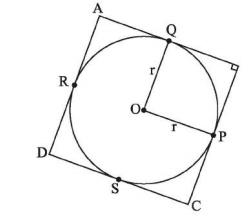
12. In Fig., a circle is inscribed in a quadrilateral ABCD in which <B=900 . If AD = 23 cm, AB = 29 cm and DS = 5 cm, find the radius (r) of the circle.
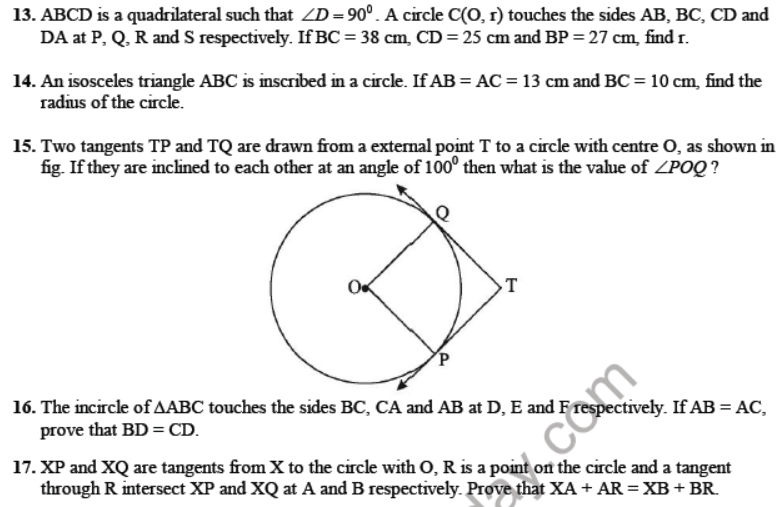
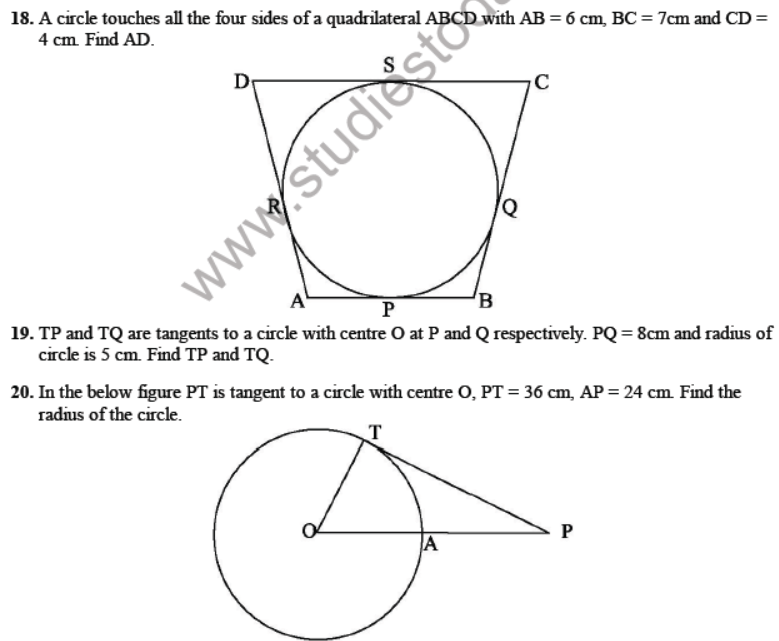
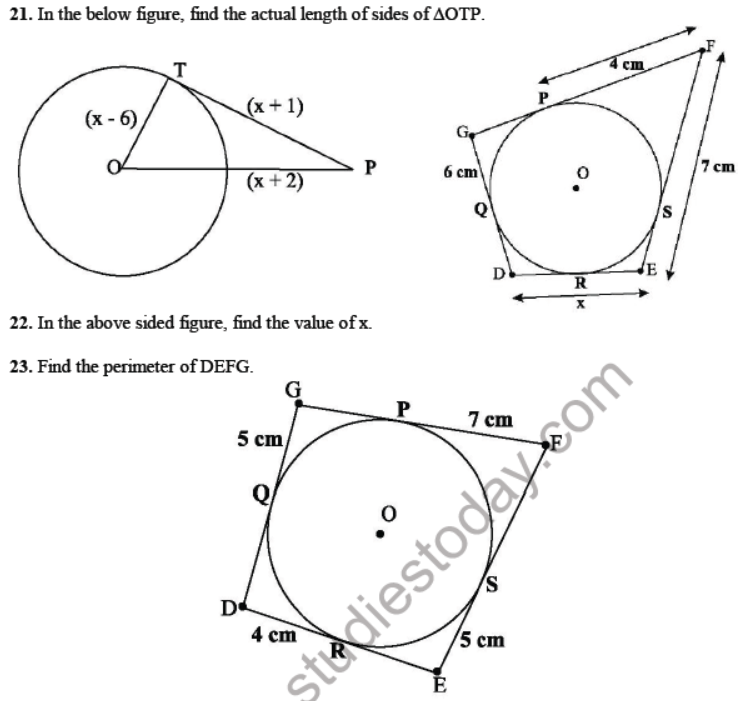
24. Two tangents TP and TQ are drawn to a circle with centre O from an external point T. Prove that ∠PTQ = 2∠OPQ.
25. PQ is a chord of length 8 cm of a circle of radius 5 cm. The tangents at P and Q intersect at a point T. Find the length TP.
26. Prove that the perpendicular at the point of contact to the tangent to a circle passes through the centre.
27. The length of a tangent from a point A at distance 5 cm from the centre of the circle is 4 cm. Find the radius of the circle.
28. Two concentric circles are of radii 5 cm and 3 cm. Find the length of the chord of the larger circle which touches the smaller circle.
29. A quadrilateral ABCD is drawn to circumscribe a circle. Prove that AB + CD = AD + BC
30. Prove that the angle between the two tangents drawn from an external point to a circle is supplementary to the angle subtended by the line-segment joining the points of contact at the centre.
31. Prove that opposite sides of a quadrilateral circumscribing a circle subtend supplementary angles at the centre of the circle.
OR
A circle touches all the four sides a quadrilateral ABCD. Prove that the angles subtended at the centre of the circle by the opposite sides are supplementary.
32. PA and PB are the two tangents to a circle with centre O in which OP is equal to the diameter of the circle. Prove that APB is an equilateral triangle.
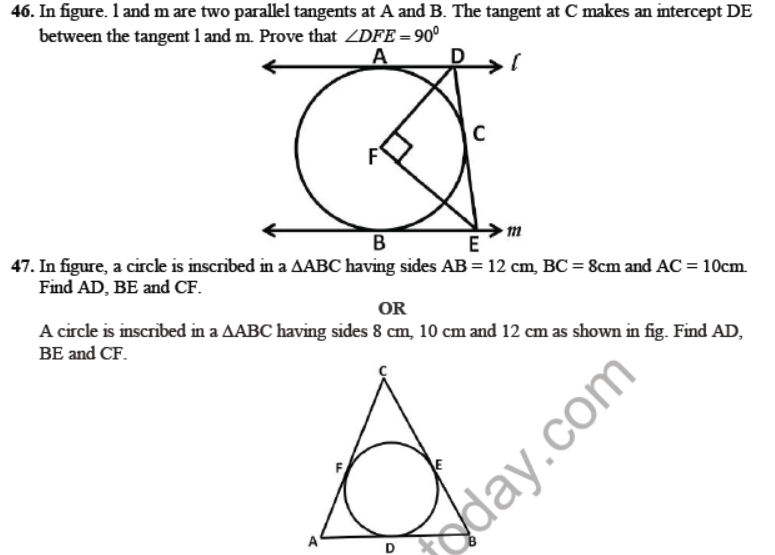
33. Prove that the intercept of a tangent between two parallel tangents to a circle subtends a right angle at the center of the circle.
34. If PQ and RS are two parallel tangents to a circle with centre O and another tangent X, with point of contact C intersects PQ at A and RS at B. Prove that ∠AOB = 90o.
35. The incircle of ΔABC touches the sides BC, CA and AB at D, E and F respectively. If AB = AC, prove that BD = DC.
36. Two tangents PA and PB are drawn to the circle with center O, such that ΔAPB = 1200. Prove that OP = 2AP.
37. A circle is touching the side BC of ΔABC at P and is touching AB and AC when produced at Q and R respectively. Prove that AQ = ½ (Perimeter of Δ ABC).
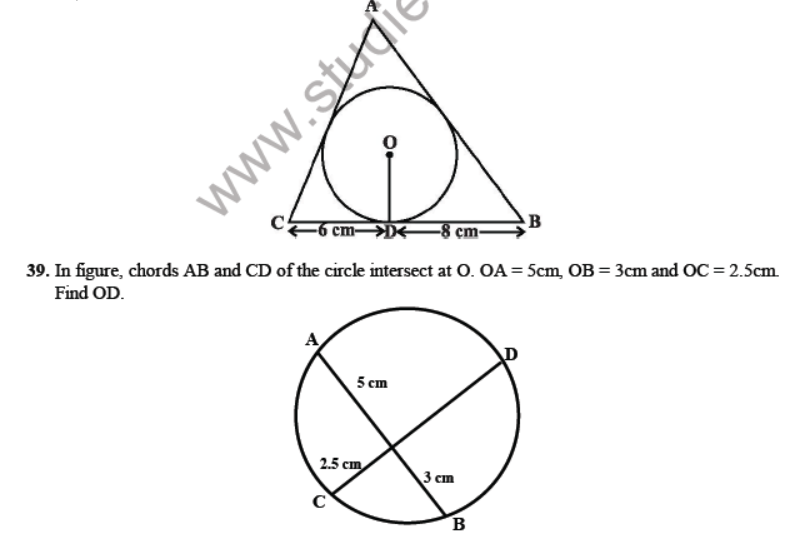
38. A triangle ABC is drawn to circumscribe a circle of radius 4 cm such that the segments BD and DC into which BC is divided by the point of contact D are of lengths 8 cm and 6 cm
respectively. Find the sides AB and AC.

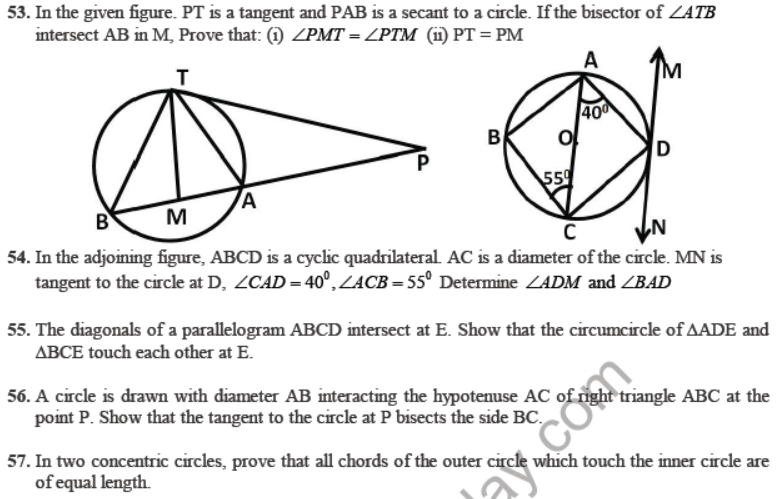
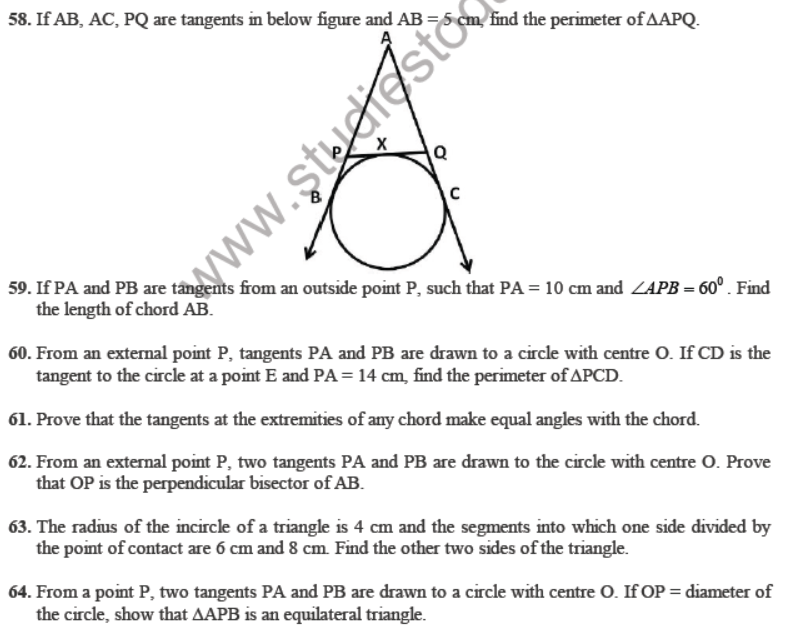
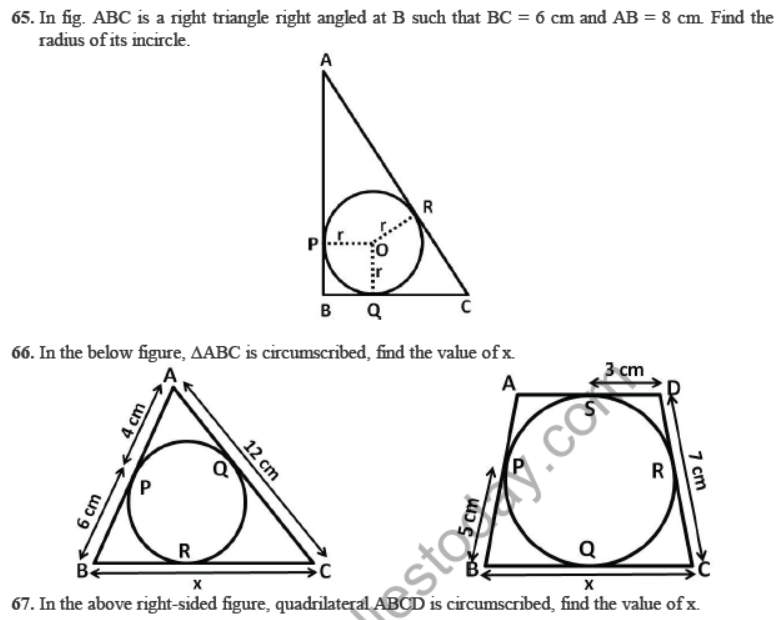
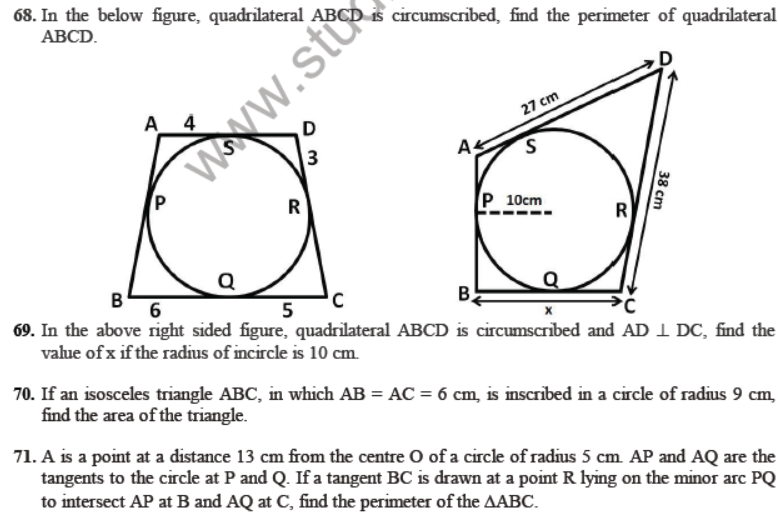
Question. In the above question (no. 3) what is the ratio of AM : BM?
(a) 5 : 6
(b) 3 : 2
(c) 1 : 1
(d) can't be determined
Answer: (c) 1 : 1
Question. If the diagonals of a cyclic quadrilateral are equal, then the quadrilateral is
(a) rhombus
(b) square
(c) rectangle
(d) none of the options
Answer: (c) rectangle
Question. The quadrilateral formed by angle bisectors of a cyclic quadrilateral is a:
(a) rectangle
(b) square
(c) parallelogram
(d) cyclic quadrilateral
Answer: (d) cyclic quadrilateral
Question. Three circles touch each other externally. The distance between their centre is 5 cm, 6 cm and 7 cm. Find the radii of the circles :
(a) 2 cm, 3 cm, 4 cm
(b) 3 cm, 4 cm, 1 cm
(c) 1 cm, 2.5 cm, 3.5 cm
(d) 1 cm, 2 cm, 4 cm
Answer: (a) 2 cm, 3 cm, 4 cm
Question. O and O' are the centres of two circles which touch each other externally at P. AB is a common tangent. Find \( \angle APO \):
(a) 90°
(b) 120°
(c) 60°
(d) data insufficient
Answer: (a) 90°
Question. If AB is a chord of a circle, P and Q are two points on the circle different from A and B, then:
(a) the angle subtended by AB at P and Q are either equal or supplementary.
(b) the sum of the angles subtended by AB at P and Q is always equal two right angles.
(c) the angles subtended at P and Q by AB are always equal.
(d) the sum of the angles subtended at P and Q is equal to four right angles.
Answer: (a) the angle subtended by AB at P and Q are either equal or supplementary.
Question. In a circle of radius 5 cm, AB and AC are the two chords such that AB = AC = 6 cm. Find the length of the chord BC.
(a) 4.8 cm
(b) 10.8 cm
(c) 9.6 cm
(d) none of the options
Answer: (c) 9.6 cm
Question. In a circle of radius 17 cm, two parallel chords are drawn on opposite sides of a diameter. The distance between the chords is 23 cm. If the length of one chord is 16 cm, then the length of the other is :
(a) 23 cm
(b) 30 cm
(c) 15 cm
(d) none of the options
Answer: (b) 30 cm
Question. A circle has two parallel chords of lengths 6 cm and 8 cm. If the chords are 1 cm apart and the centre is on the same side of the chords, then a diameter of the circle is of length:
(a) 5 cm
(b) 6 cm
(c) 8 cm
(d) 10 cm
Answer: (d) 10 cm
Question. Three equal circles of unit radius touch each other. Then, the area of the circle circumscribing the three circles is :
(a) \( 6\pi (2 + \sqrt{3})^2 \)
(b) \( \frac{\pi}{6}(2 + \sqrt{3})^2 \)
(c) \( \frac{\pi}{3}(2 + \sqrt{3})^2 \)
(d) \( 3\pi (2 + \sqrt{3})^2 \)
Answer: (c) \( \frac{\pi}{3}(2 + \sqrt{3})^2 \)
Question. Through any given set of four points P,Q, R, S it is possible to draw :
(a) atmost one circle
(b) exactly one circle
(c) exactly two circles
(d) exactly three circles
Answer: (a) atmost one circle
Question. The number of common tangents that can be drawn to two given circles is at the most :
(a) 1
(b) 2
(c) 3
(d) 4
Answer: (d) 4
Question. In the diagram, PQ and QR are tangents to the circle centre O, at P and R respectively. Find the value of x.
(a) 25
(b) 35
(c) 45
(d) 55
Answer: (d) 55
Question. AB and CD are two parallel of a circle such that AB=10 cm and CD = 24 cm. The chords are on opposite sides of the centre and the distance between them is 17 cm. Find the radius of the circle
(a) 11 cm
(b) 12 cm
(c) 13 cm
(d) 14 cm
Answer: (c) 13 cm
Question. An equilateral triangle has side \( 2\sqrt{3} \) cm. The radius of its circumcircle will be
(a) 2 cm
(b) \( \sqrt{3} \) cm
(c) 3 cm
(d) 4 cm
Answer: (a) 2 cm
Question. Find the distance of a perpendicular from the centre of a circle to the chord if the diameter of the circle is 30 cm and its chord is 24 cm.
(a) 6 cm
(b) 7 cm
(c) 9 cm
(d) 10 cm
Answer: (c) 9 cm
Please click the link below to download CBSE Class 10 Circles Sure Shot Questions.
Free study material for Mathematics
Mathematics Class 10 Exam Resources: Chapter 10 Circles
Essential Notes for Class 10 Mathematics
Access comprehensive study material for Chapter 10 Circles, including revision notes, concept maps, and high-probability questions. These resources are designed in alignment with the latest 2026 CBSE syllabus for Class 10 Mathematics to support effective exam preparation.
Verified Solutions for Class 10 Mathematics
Designed around the official curriculum, these study guides guarantee standard compliance. Reviewing step-by-step solutions clarifies complex sub-topics within Chapter 10 Circles and demystifies standard marking schemes for Mathematics evaluations.
Enhance Accuracy with Online Tests
Wrap up your chapter revision by testing your knowledge against standard objective question formats. Explore our full library of free, up-to-date sample papers and online assessments to secure top grades in your CBSE examinations.
FAQs
Our advanced study package for Chapter 10 Circles includes detailed concepts, diagrams, Mind Maps, and explanation of complex topics to ensure Class 10 students learn as per syllabus for 2026 exams.
The Mind Maps provided for Chapter 10 Circles act as visual anchors which will help faster recall during high-pressure exams.
Yes, teachers use our Class 10 Mathematics resources for lesson planning as they are in simple language and have lot of solved examples.
Yes, You can download the complete, mobile-friendly PDF of the Mathematics Chapter 10 Circles advanced resources for free.
Yes, our subject matter experts have updated the Chapter 10 Circles material to align with the rationalized NCERT textbooks and have removed deleted topics and added new competency-based questions.