

Advanced Study Material for Class 10 Mathematics: Chapter 01 Real Numbers
Review targeted academic resources with the CBSE Class 10 Real Numbers Sure Shot Questions Set 01. Built according to official CBSE standards for the 2026-27 term, these downloadable Class 10 Mathematics study materials support effective daily practice and deeper conceptual understanding for Chapter 01 Real Numbers.
Practice Class 10 Mathematics Resources: Chapter 01 Real Numbers
Navigate directly to the advanced Mathematics study materials using the digital viewer below. Each resource pack includes detailed conceptual summaries and solved practice questions, allowing students to instantly reinforce their learning.
CBSE Class 10 Real Numbers Sure Shot Questions. There are many more useful educational material which the students can download in pdf format and use them for studies. Study material like concept maps, important and sure shot question banks, quick to learn flash cards, flow charts, mind maps, teacher notes, important formulas, past examinations question bank, important concepts taught by teachers. Students can download these useful educational material free and use them to get better marks in examinations. Also refer to other worksheets for the same chapter and other subjects too. Use them for better understanding of the subjects.
PRACTICE QUESTIONS
CLASS X : CHAPTER - 1
REAL NUMBERS
1. Write whether every positive integer can be of the form 4q + 2, where q is an integer. Justify your answer.
Answer:
1. Numbers of the form 4q + 2 = 2(2q + 1) are even.
2. The number 1 is a positive integer but it is odd, so it cannot be written as 4q + 2.
3. Hence, every positive integer cannot be of the form 4q + 2.
Teacher's Note:
a) Every number of the form 4q + 2 is even, because it is 2 times an odd number.
b) One counter-example is enough to disprove the statement.
2. "The product of two consecutive positive integers is divisible by 2". Is this statement true or false? Give reasons.
Answer:
1. Let the two consecutive positive integers be n and n + 1.
2. Out of two consecutive integers, one is always even.
3. So n(n + 1) is always divisible by 2. The statement is true.
Teacher's Note:
a) Any two consecutive integers have one even number among them.
b) A product containing an even factor is always even.
3. "The product of three consecutive positive integers is divisible by 6". Is this statement true or false"? Justify your answer.
Answer:
1. Let the three consecutive positive integers be n, n + 1 and n + 2.
2. Among them, one is even, so the product is divisible by 2.
3. Among any three consecutive integers, one is divisible by 3, so the product is divisible by 3.
4. Since the product is divisible by both 2 and 3, it is divisible by 6. The statement is true.
Teacher's Note:
a) Divisibility by 2 and by 3 together gives divisibility by 6.
b) Check with 2 × 3 × 4 = 24, which is divisible by 6.
4. Write whether the square of any positive integer can be of the form 3m + 2, where m is a natural number. Justify your answer.
Answer:
1. Let a positive integer be n = 3q + r, where r = 0, 1 or 2.
2. n² = 9q² + 6qr + r² = 3(3q² + 2qr) + r².
3. For r = 0, r² = 0; for r = 1, r² = 1; for r = 2, r² = 4 = 3 + 1.
4. So n² is of the form 3m or 3m + 1 and never of the form 3m + 2. Hence, the answer is no.
Teacher's Note:
a) Squares of integers leave a remainder of 0 or 1 when divided by 3.
b) This method of writing n = 3q + r is the standard approach for such proofs.
c) The answer is no, since no square can leave remainder 2 on division by 3.
5. A positive integer is of the form 3q + 1, q being a natural number. Can you write its square in any form other than 3m + 1, i.e., 3m or 3m + 2 for some integer m? Justify your answer.
Answer:
1. Let the positive integer be 3q + 1.
2. Its square is (3q + 1)² = 9q² + 6q + 1 = 3(3q² + 2q) + 1.
3. Taking m = 3q² + 2q, the square is 3m + 1 only.
4. Hence, it cannot be written in the form 3m or 3m + 2. The answer is no.
Teacher's Note:
a) Expanding the square and grouping the terms gives the required form.
b) The value of m is always an integer, because q is a natural number.
6. Show that the square of an odd positive integer is of the form 8m + 1, for some whole number m.
Answer:
1. Let the odd positive integer be 2q + 1.
2. Its square is (2q + 1)² = 4q² + 4q + 1 = 4q(q + 1) + 1.
3. The product q(q + 1) of two consecutive integers is even, so q(q + 1) = 2k for some integer k.
4. Hence, the square = 4(2k) + 1 = 8k + 1, which is of the form 8m + 1 with m = k.
Teacher's Note:
a) Consecutive integers always contain an even number, so q(q + 1) is even.
b) Try n = 3: 9 = 8 × 1 + 1, which confirms the result.
7. Show that the square of any positive integer is either of the form 4q or 4q + 1 for some integer q.
Answer:
1. Let the positive integer be n = 2k or n = 2k + 1.
2. If n = 2k, then n² = 4k² = 4q with q = k².
3. If n = 2k + 1, then n² = 4k² + 4k + 1 = 4(k² + k) + 1 = 4q + 1 with q = k² + k.
4. Hence, the square of any positive integer is of the form 4q or 4q + 1.
Teacher's Note:
a) Every integer is either even or odd, and the two cases are checked separately.
b) The value of q in each case is an integer.
8. Show that cube of any positive integer is of the form 4m, 4m + 1 or 4m + 3, for some integer m.
Answer:
1. Let the positive integer be n = 4q + r, where r = 0, 1, 2 or 3.
2. If r = 0, then n³ = 64q³ = 4(16q³), which is of the form 4m.
3. If r = 2, then n³ = 8(2q + 1)³ = 4 × 2(2q + 1)³, which is of the form 4m.
4. If r = 1, then n³ = (4q + 1)³ = 64q³ + 48q² + 12q + 1 = 4(16q³ + 12q² + 3q) + 1, which is of the form 4m + 1.
5. If r = 3, then n³ = (4q + 3)³ = 64q³ + 144q² + 108q + 27 = 4(16q³ + 36q² + 27q + 6) + 3, which is of the form 4m + 3.
6. Hence, the cube of any positive integer is of the form 4m, 4m + 1 or 4m + 3.
Teacher's Note:
a) Check the remainders: 0³, 1³, 2³ and 3³ leave remainders 0, 1, 0 and 3 on division by 4.
b) The cube of 4q + 3 is the only case that needs the full expansion.
9. Show that the square of any positive integer cannot be of the form 5q + 2 or 5q + 3 for any integer q.
Answer:
1. Let the positive integer be n = 5q + r, where r = 0, 1, 2, 3 or 4.
2. The squares give remainders when divided by 5: 0² = 0, 1² = 1, 2² = 4, 3² = 9 = 5 + 4, and 4² = 16 = 15 + 1.
3. So the square of any positive integer is of the form 5m, 5m + 1 or 5m + 4.
4. Hence, the square can never be of the form 5q + 2 or 5q + 3.
Teacher's Note:
a) Only the remainders 0, 1 and 4 occur for squares modulo 5.
b) Testing 2 and 3 separately is a common student mistake, so use all five remainders.
10. Show that the square of any positive integer cannot be of the form 6m + 2 or 6m + 5 for any integer m.
Answer:
1. Let the positive integer be n = 6q + r, where r = 0, 1, 2, 3, 4 or 5.
2. The squares give remainders when divided by 6: 0² = 0, 1² = 1, 2² = 4, 3² = 9 = 6 + 3, 4² = 16 = 12 + 4 and 5² = 25 = 24 + 1.
3. So the square is of the form 6m, 6m + 1, 6m + 3 or 6m + 4.
4. Hence, the square can never be of the form 6m + 2 or 6m + 5.
Teacher's Note:
a) The remainders 2 and 5 never appear for a square when divided by 6.
b) The same method works for any divisor, by listing the squares of the remainders.
11. Show that the square of any odd integer is of the form 4q + 1, for some integer q.
Answer:
1. Let the odd integer be 2k + 1.
2. Its square is (2k + 1)² = 4k² + 4k + 1.
3. So the square = 4(k² + k) + 1 = 4q + 1, where q = k² + k is an integer.
Teacher's Note:
a) The value q = k² + k is always an integer.
b) Try 5: 25 = 4 × 6 + 1, which agrees with the result.
12. If n is an odd integer, then show that n² - 1 is divisible by 8.
Answer:
1. Let n = 2q + 1.
2. Then n² - 1 = (2q + 1)² - 1 = 4q² + 4q = 4q(q + 1).
3. Since q(q + 1) is the product of two consecutive integers, it is even, say 2k.
4. So n² - 1 = 4 × 2k = 8k, which is divisible by 8.
Teacher's Note:
a) Factorising n² - 1 as (n - 1)(n + 1) gives two consecutive even numbers, whose product is a multiple of 8.
b) Try n = 3: 9 - 1 = 8, which is divisible by 8.
13. Prove that if x and y are both odd positive integers, then x² + y² is even but not divisible by 4.
Answer:
1. Let x = 2a + 1 and y = 2b + 1.
2. Then x² + y² = (4a² + 4a + 1) + (4b² + 4b + 1) = 4(a² + a + b² + b) + 2.
3. This number is of the form 2 × (an integer), so it is even.
4. It leaves remainder 2 when divided by 4, so it is not divisible by 4.
Teacher's Note:
a) The sum of two odd squares always leaves remainder 2 on division by 4.
b) Try x = 1 and y = 3: 1 + 9 = 10, which is even but not divisible by 4.
14. Show that the square of an odd positive integer can be of the form 6q + 1 or 6q + 3 for some integer q.
Answer:
1. An odd integer has the form 6q + r with r = 1, 3 or 5.
2. (6q + 1)² = 36q² + 12q + 1 = 6(6q² + 2q) + 1, which is of the form 6m + 1.
3. (6q + 3)² = 36q² + 36q + 9 = 6(6q² + 6q + 1) + 3, which is of the form 6m + 3.
4. (6q + 5)² = 36q² + 60q + 25 = 6(6q² + 10q + 4) + 1, which is again of the form 6m + 1.
5. Hence, the square of an odd positive integer is of the form 6q + 1 or 6q + 3.
Teacher's Note:
a) The case 6q + 5 gives the same form as 6q + 1.
b) Odd squares never leave remainder 5 on division by 6.
15. Show that the cube of a positive integer of the form 6q + r, q is an integer and r = 0, 1, 2, 3, 4, 5 is also of the form 6m + r.
Answer:
1. (6q + r)³ = 216q³ + 108q²r + 18qr² + r³ = 6(36q³ + 18q²r + 3qr²) + r³.
2. Check the cubes of r: 0³ = 0 = 6 × 0 + 0; 1³ = 1 = 6 × 0 + 1; 2³ = 8 = 6 + 2; 3³ = 27 = 24 + 3; 4³ = 64 = 60 + 4; 5³ = 125 = 120 + 5.
3. So r³ = 6k + r for some integer k.
4. Therefore (6q + r)³ = 6(36q³ + 18q²r + 3qr² + k) + r = 6m + r.
Teacher's Note:
a) The key step is that r³ leaves the same remainder as r when divided by 6.
b) Work through each value of r separately, as the table in step 2 shows.
16. Prove that one and only one out of n, n + 2 and n + 4 is divisible by 3, where n is any positive integer.
Answer:
1. Any positive integer n leaves remainder 0, 1 or 2 on division by 3.
2. If n = 3k, then n is divisible by 3; n + 2 leaves remainder 2 and n + 4 leaves remainder 1, so only n is divisible by 3.
3. If n = 3k + 1, then n + 2 = 3(k + 1) is divisible by 3; n leaves remainder 1 and n + 4 leaves remainder 2.
4. If n = 3k + 2, then n + 4 = 3(k + 2) is divisible by 3; n and n + 2 leave remainders 2 and 1.
5. Hence, exactly one of n, n + 2 and n + 4 is divisible by 3.
Teacher's Note:
a) The three numbers leave three different remainders on division by 3.
b) "One and only one" needs both the existence and the uniqueness of the multiple of 3.
17. Prove that one of any three consecutive positive integers must be divisible by 3.
Answer:
1. Let the three consecutive positive integers be n, n + 1 and n + 2.
2. Their remainders on division by 3 are r, r + 1 and r + 2 (mod 3), which cover 0, 1 and 2 in some order.
3. So one of the three numbers leaves remainder 0, that is, it is divisible by 3.
Teacher's Note:
a) Three consecutive integers always cover all three remainders modulo 3.
b) This is the reason every third number on the number line is a multiple of 3.
18. For any positive integer n, prove that n³ - n is divisible by 6.
Answer:
1. n³ - n = n(n² - 1) = (n - 1)n(n + 1).
2. This is the product of three consecutive integers, so it is divisible by 2.
3. Among three consecutive integers, one is divisible by 3, so the product is divisible by 3.
4. Since it is divisible by 2 and 3, it is divisible by 6.
Teacher's Note:
a) Factorising n³ - n into three consecutive integers is the key idea.
b) Check n = 2: 8 - 2 = 6, which is divisible by 6.
19. Show that one and only one out of n, n + 4, n + 8, n + 12 and n + 16 is divisible by 5, where n is any positive integer.
Answer:
1. Modulo 5, the five numbers have remainders: n, n + 4 ≡ n - 1, n + 8 ≡ n - 2, n + 12 ≡ n - 3 and n + 16 ≡ n - 4.
2. These five remainders are all different, and together they cover the remainders 0, 1, 2, 3 and 4 modulo 5.
3. So exactly one of the five numbers has remainder 0, that is, exactly one is divisible by 5.
Teacher's Note:
a) Adding 4 to a number changes its remainder mod 5 in the same way as subtracting 1.
b) Five numbers spaced 4 apart cover all remainders once each.
20. Show that the product of three consecutive natural numbers is divisble by 6.
Answer:
1. Let the three consecutive natural numbers be n, n + 1 and n + 2.
2. Their product is always divisible by 2, because one of them is even.
3. Their product is always divisible by 3, because one of them is a multiple of 3.
4. Hence, the product is divisible by 6.
Teacher's Note:
a) This is the same idea as Question 3 and Question 18.
b) Check: 4 × 5 × 6 = 120, which is divisible by 6.
21. Show that any positive odd integer is of the form 6q + 1 or 6q + 3 or 6q + 5 where q ∈ Z.
Answer:
1. By the division algorithm, a positive integer n = 6q + r, where 0 ≤ r < 6.
2. Since n is odd, r must be odd, because 6q is even.
3. So r = 1, 3 or 5, and n is of the form 6q + 1, 6q + 3 or 6q + 5.
Teacher's Note:
a) The divisor 6 is even, so the parity of n depends only on r.
b) The values 1, 3 and 5 are the only odd remainders less than 6.
22. Show that any positive even integer is of the form 6q or 6q + 2 or 6q + 4 where q ∈ Z.
Answer:
1. By the division algorithm, a positive integer n = 6q + r, where 0 ≤ r < 6.
2. Since n is even, r must be even, because 6q is even.
3. So r = 0, 2 or 4, and n is of the form 6q, 6q + 2 or 6q + 4.
Teacher's Note:
a) This is the even-number counterpart of Question 21.
b) The forms 6q + 3 and 6q + 5 are odd, so they are excluded here.
23. If a and b are two odd positive integers such that a > b, then prove that one of the two numbers (a + b)/2 and (a - b)/2 is odd and the other is even.
Answer:
1. Let a = 2p + 1 and b = 2q + 1, where p and q are integers.
2. Then (a + b)/2 = p + q + 1 and (a - b)/2 = p - q, and both are integers because a > b.
3. Their sum is (a + b)/2 + (a - b)/2 = a = 2p + 1, which is odd.
4. An odd sum means one number is odd and the other is even. Hence, one of the two numbers is odd and the other is even.
Teacher's Note:
a) Two integers whose sum is odd must have different parity.
b) Try a = 7 and b = 3: (7 + 3)/2 = 5 is odd and (7 - 3)/2 = 2 is even.
24. Use Euclid's division lemma to show that the cube of any positive integer is of the form 9m, 9m + 1 or 9m + 8.
Answer:
1. Let the positive integer be n = 3q + r, where r = 0, 1 or 2, by Euclid's division lemma.
2. n³ = 27q³ + 27q²r + 9qr² + r³ = 9(3q³ + 3q²r + qr²) + r³.
3. For r = 0, r³ = 0; for r = 1, r³ = 1; for r = 2, r³ = 8.
4. So n³ = 9m, 9m + 1 or 9m + 8, where m = 3q³ + 3q²r + qr².
Teacher's Note:
a) Euclid's division lemma gives the remainder r as 0, 1 or 2 for divisor 3.
b) Check: 2³ = 8 = 9 × 0 + 8, which is of the form 9m + 8.
25. Using Euclid's division algorithm to show that any positive odd integer is of the form 4q + 1 or 4q + 3, where q is some integer.
Answer:
1. By Euclid's division algorithm, a positive integer a = 4q + r, where 0 ≤ r < 4.
2. Since a is odd and 4q is even, r must be odd, so r = 1 or r = 3.
3. Hence, a is of the form 4q + 1 or 4q + 3.
Teacher's Note:
a) The even remainders 0 and 2 give even numbers, so they are not possible here.
b) Try 11 = 4 × 2 + 3, which is of the form 4q + 3.
26. Use Euclid's division algorithm to find the HCF of 441, 567, 693.
Answer:
1. 567 = 1 × 441 + 126
2. 441 = 3 × 126 + 63
3. 126 = 2 × 63 + 0
4. HCF (441, 567) = 63.
5. 693 = 11 × 63 + 0, so 63 divides 693.
6. Hence, HCF (441, 567, 693) = 63.
Teacher's Note:
a) Apply the algorithm to two numbers first, then to the result and the third number.
b) A zero remainder means the last divisor is the HCF.
27. Using Euclid's division algorithm, find the largest number that divides 1251, 9377 and 15628 leaving remainders 1, 2 and 3, respectively.
Answer:
1. The numbers 1251 - 1 = 1250, 9377 - 2 = 9375 and 15628 - 3 = 15625 must be exactly divisible by the required number.
2. 9375 = 7 × 1250 + 625 and 1250 = 2 × 625 + 0, so HCF (1250, 9375) = 625.
3. 15625 = 25 × 625, so 625 divides 15625.
4. Hence, the largest number is 625.
Teacher's Note:
a) Subtract each remainder first, then find the HCF of the results.
b) The answer must be larger than every remainder, which 625 is.
28. Using Euclid's division algorithm, find which of the following pairs of numbers are co-prime: (i) 231, 396 (ii) 847, 2160
Answer:
1. (i) 396 = 1 × 231 + 165, 231 = 1 × 165 + 66, 165 = 2 × 66 + 33, 66 = 2 × 33 + 0.
2. HCF (231, 396) = 33, so the pair is not co-prime.
3. (ii) 2160 = 2 × 847 + 466, 847 = 1 × 466 + 381, 466 = 1 × 381 + 85, 381 = 4 × 85 + 41, 85 = 2 × 41 + 3, 41 = 13 × 3 + 2, 3 = 1 × 2 + 1, 2 = 2 × 1 + 0.
4. HCF (847, 2160) = 1, so the pair is co-prime.
Teacher's Note:
a) Co-prime numbers have HCF 1, but the numbers themselves need not be prime.
b) 231 = 3 × 7 × 11 and 396 = 2² × 3² × 11 share the factors 3 and 11.
29. Show that 12n cannot end with the digit 0 or 5 for any natural number n.
Answer:
1. 12n = (2² × 3)n = 22n × 3n.
2. The prime factorisation of 12n has only the primes 2 and 3.
3. A number ending in 0 or 5 is divisible by 5, which needs 5 as a prime factor. Since 5 is not a factor of 12n, it cannot end with 0 or 5.
Teacher's Note:
a) By the fundamental theorem of arithmetic, the prime factors of 12n are unique.
b) Ending in 0 needs both 2 and 5, and 5 is missing here.
30. In a morning walk, three persons step off together and their steps measure 40 cm, 42 cm and 45 cm, respectively. What is the minimum distance each should walk so that each can cover the same distance in complete steps?
Answer:
1. The required distance must be a common multiple of 40, 42 and 45.
2. Prime factorisation: 40 = 2³ × 5, 42 = 2 × 3 × 7, 45 = 3² × 5.
3. LCM (40, 42, 45) = 2³ × 3² × 5 × 7 = 2520.
4. Hence, the minimum distance is 2520 cm, that is, 25.2 m.
Teacher's Note:
a) The minimum distance is the least common multiple, not the HCF.
b) Give the answer in the unit asked for, so convert 2520 cm into metres if needed.
31. If LCM (480, 672) = 3360, find HCF (480,672).
Answer:
1. HCF × LCM = product of the two numbers.
2. HCF (480, 672) = (480 × 672) / 3360 = 322560 / 3360 = 96.
3. Hence, HCF (480, 672) = 96.
Teacher's Note:
a) Use this relation only for two numbers, not for three.
b) Check: 480 = 96 × 5 and 672 = 96 × 7, so 96 is a common divisor.
32. Express 0.69 as a rational number in p/q form.
Answer:
1. 0.69 = 69/100.
2. HCF (69, 100) = 1, since 69 = 3 × 23 and 100 = 2² × 5².
3. Hence, 0.69 = 69/100 in the form p/q, with p = 69 and q = 100.
Teacher's Note:
a) Two decimal places mean the denominator is 100.
b) Always check that p and q have no common factor.
33. Show that the number of the form 7n, n ∈ N cannot have unit digit zero.
Answer:
1. 7n = 7 × 7 × ... × 7 (n times), so its only prime factor is 7.
2. A number with unit digit zero is divisible by 10, which means it is divisible by 2 and by 5.
3. The number 7n is not divisible by 2 or by 5, so it cannot have unit digit zero.
Teacher's Note:
a) The unit digits of powers of 7 are 7, 9, 3, 1 and then repeat, which never includes 0.
b) The fundamental theorem of arithmetic explains why 7 is the only prime factor.
34. Using Euclid's Division Algorithm find the HCF of 9828 and 14742.
Answer:
1. 14742 = 1 × 9828 + 4914
2. 9828 = 2 × 4914 + 0
3. The last non-zero remainder is 4914.
4. Hence, HCF (9828, 14742) = 4914.
Teacher's Note:
a) Here the first division leaves the remainder that is exactly half the first number.
b) The HCF is the divisor at the step where the remainder becomes zero.
35. The numbers 525 and 3000 are both divisible only by 3, 5, 15, 25 and 75. What is HCF (525, 3000)? Justify your answer.
Answer:
1. 525 = 3 × 5² × 7 and 3000 = 2³ × 3 × 5³.
2. Common prime factors with the lowest powers: 3 and 5².
3. HCF (525, 3000) = 3 × 5² = 75.
Teacher's Note:
a) The statement that 525 is divisible only by 3, 5, 15, 25 and 75 is not correct, since 525 is also divisible by 7, 21 and 35. The HCF is still 75.
b) The prime factorisation method gives the HCF directly, without a list of divisors.
36. Explain why 3 × 5 × 7 + 7 is a composite number.
Answer:
1. 3 × 5 × 7 + 7 = 7 × (3 × 5 + 1) = 7 × 16 = 112.
2. 112 has factors other than 1 and itself, such as 7 and 16.
3. Hence, 112 is a composite number.
Teacher's Note:
a) Take 7 common from both terms, and the expression becomes a product.
b) A number is composite if it has a factor other than 1 and itself.
37. Can two numbers have 18 as their HCF and 380 as their LCM? Give reasons.
Answer:
1. The HCF of two numbers always divides their LCM.
2. 380 = 2² × 5 × 19, and 18 = 2 × 3².
3. 18 does not divide 380, because 380 has no factor 3.
4. Hence, two numbers cannot have 18 as HCF and 380 as LCM.
Teacher's Note:
a) Any common factor of the two numbers must also divide their LCM.
b) The exponent of 3 in the HCF cannot exceed its exponent in the LCM.
38. Without actual division find whether the rational number 1323/(6³ × 35²) has a terminating or a non-terminating decimal.
Answer:
1. 6³ × 35² = (2³ × 3³) × (5² × 7²) = 2³ × 3³ × 5² × 7².
2. 1323 = 3³ × 7², so the fraction becomes 1323 / (2³ × 3³ × 5² × 7²) = 1 / (2³ × 5²).
3. The denominator 2³ × 5² has only the prime factors 2 and 5.
4. Hence, the decimal expansion is terminating (1/200 = 0.005).
Teacher's Note:
a) Cancel the common factors first, and then check the denominator.
b) A fraction terminates when its reduced denominator has only 2 and 5 as prime factors.
39. Without actually performing the long division, find if 987/10500 will have terminating or non-terminating (repeating) decimal expansion. Give reasons for your answer.
Answer:
1. 987 = 3 × 7 × 47 and 10500 = 2² × 3 × 5³ × 7.
2. Cancelling the common factor 21 gives 987/10500 = 47/500.
3. 500 = 2² × 5³ has only the prime factors 2 and 5.
4. Hence, 987/10500 has a terminating decimal expansion (0.094).
Teacher's Note:
a) Find the HCF of the numerator and denominator before judging the expansion.
b) Only the reduced denominator matters, so the factor 3 in 10500 does not cause a repeating decimal.
40. A rational number in its decimal expansion is 327.7081. What can you say about the prime factors of q, when this number is expressed in the form p/q? Give reasons.
Answer:
1. Since the decimal 327.7081 has four digits after the decimal point, 327.7081 = 3277081 / 10000.
2. The number 3277081 is not divisible by 2 or 5, so the fraction is already in lowest terms.
3. So q = 10000 = 2⁴ × 5⁴.
4. Hence, the prime factors of q are only 2 and 5.
Teacher's Note:
a) A decimal that terminates always has a denominator made of 2 and 5 only.
b) Check that the numerator does not end in 0 or 5, or it could cancel the 2s or 5s.
41. Find the HCF of 81 and 237 and express it as a linear combination of 81 and 237.
Answer:
1. 237 = 2 × 81 + 75
2. 81 = 1 × 75 + 6
3. 75 = 12 × 6 + 3
4. 6 = 2 × 3 + 0, so HCF (81, 237) = 3.
5. 3 = 75 - 12 × 6 = 75 - 12 (81 - 75) = 13 × 75 - 12 × 81 = 13 (237 - 2 × 81) - 12 × 81 = 13 × 237 - 38 × 81.
6. Hence, 3 = 81 × (-38) + 237 × 13.
Teacher's Note:
a) Work the division steps backwards to write the HCF as a combination.
b) Check: 81 × (-38) = -3078 and 237 × 13 = 3081, and their sum is 3.
42. Find the HCF of 65 and 117 and express it in the form 65m + 117n.
Answer:
1. 117 = 1 × 65 + 52
2. 65 = 1 × 52 + 13
3. 52 = 4 × 13 + 0, so HCF (65, 117) = 13.
4. 13 = 65 - 52 = 65 - (117 - 65) = 2 × 65 - 117.
5. Hence, 13 = 65 × 2 + 117 × (-1), so m = 2 and n = -1.
Teacher's Note:
a) Substitute 52 = 117 - 65 to get the form 65m + 117n.
b) Many values of m and n are possible, so one pair is enough.
43. If the HCF of 210 and 55 is expressible in the form of 210x5 + 55y, find y.
Answer:
1. HCF (210, 55) = 5.
2. The given form is 210 × 5 + 55y = 5.
3. 1050 + 55y = 5, so 55y = -1045.
4. y = -1045 / 55 = -19.
Teacher's Note:
a) The "x5" in the question means 210 multiplied by 5.
b) Check: 1050 - 1045 = 5, which is the HCF.
44. If d is the HCF of 56 and 72, find x, y satisfying d = 56x + 72y. Also show that x and y are not unique.
Answer:
1. 72 = 1 × 56 + 16
2. 56 = 3 × 16 + 8
3. 16 = 2 × 8 + 0, so d = 8.
4. 8 = 56 - 3 × 16 = 56 - 3 (72 - 56) = 4 × 56 - 3 × 72.
5. So x = 4 and y = -3 satisfy 8 = 56x + 72y.
6. Another pair: x = 13 and y = -10, since 56 × 13 + 72 × (-10) = 728 - 720 = 8.
7. Hence, x and y are not unique.
Teacher's Note:
a) Adding 9 to x and subtracting 7 from y keeps the sum at 8, since 56 × 9 = 72 × 7.
b) Any pair (4 + 9t, -3 - 7t) with an integer t is also a solution.
45. Express the HCF of 468 and 222 as 468x + 222y where x, y are integers in two different ways.
Answer:
1. 468 = 2 × 222 + 24
2. 222 = 9 × 24 + 6
3. 24 = 4 × 6 + 0, so HCF = 6.
4. 6 = 222 - 9 × 24 = 222 - 9 (468 - 2 × 222) = 19 × 222 - 9 × 468.
5. First way: x = -9 and y = 19, so 6 = 468 × (-9) + 222 × 19.
6. Second way: x = 28 and y = -59, so 6 = 468 × 28 + 222 × (-59) = 13104 - 13098 = 6.
Teacher's Note:
a) The second pair is obtained by adding 37 to x and subtracting 78 from y, because 222 ÷ 6 = 37 and 468 ÷ 6 = 78.
b) Each pair must be checked by multiplying and adding.
46. Express the HCF of 210 and 55 as 210x + 55y where x, y are integers in two different ways.
Answer:
1. 210 = 3 × 55 + 45
2. 55 = 1 × 45 + 10
3. 45 = 4 × 10 + 5, so HCF = 5.
4. 5 = 45 - 4 × 10 = 45 - 4 (55 - 45) = 5 × 45 - 4 × 55 = 5 (210 - 3 × 55) - 4 × 55 = 5 × 210 - 19 × 55.
5. First way: x = 5 and y = -19.
6. Second way: x = 16 and y = -61, since 210 × 16 + 55 × (-61) = 3360 - 3355 = 5.
Teacher's Note:
a) Adding 11 to x and subtracting 42 from y gives another solution.
b) The HCF is 5, which is the last non-zero remainder.
47. If the HCF of 408 and 1032 is expressible in the form of 1032m - 408 × 5, find m.
Answer:
1. 1032 = 2 × 408 + 216
2. 408 = 1 × 216 + 192
3. 216 = 1 × 192 + 24
4. 192 = 8 × 24 + 0, so HCF (408, 1032) = 24.
5. 24 = 1032m - 2040.
6. 1032m = 2064, so m = 2.
Teacher's Note:
a) Find the HCF first, then substitute it into the given form.
b) Check: 1032 × 2 - 2040 = 2064 - 2040 = 24.
48. If the HCF of 657 and 963 is expressible in the form of 657n + 963 × (-15), find n.
Answer:
1. 963 = 1 × 657 + 306
2. 657 = 2 × 306 + 45
3. 306 = 6 × 45 + 36
4. 45 = 1 × 36 + 9
5. 36 = 4 × 9 + 0, so HCF (657, 963) = 9.
6. 9 = 657n + 963 × (-15) = 657n - 14445.
7. 657n = 14454, so n = 22.
Teacher's Note:
a) The product 963 × 15 is 14445, which is easy to get wrong, so check it.
b) Check: 657 × 22 = 14454.
49. A sweet seller has 420 kaju burfis and 130 badam burfis she wants to stack them in such a way that each stack has the same number, and they take up the least area of the tray. What is the number of burfis that can be placed in each stack for this purpose?
Answer:
1. Each stack must contain a number that divides both 420 and 130 exactly.
2. To take up the least area, the stacks should be as large as possible, so the number is the HCF of 420 and 130.
3. 420 = 2² × 3 × 5 × 7 and 130 = 2 × 5 × 13, so HCF (420, 130) = 10.
4. Hence, 10 burfis can be placed in each stack.
Teacher's Note:
a) This gives 42 stacks of kaju burfis and 13 stacks of badam burfis.
b) Larger equal stacks mean fewer stacks, so the area of the tray is least.
50. Find the largest number which divides 245 and 1029 leaving remainder 5 in each case.
Answer:
1. The required number divides 245 - 5 = 240 and 1029 - 5 = 1024 exactly.
2. 1024 = 4 × 240 + 64
3. 240 = 3 × 64 + 48
4. 64 = 1 × 48 + 16
5. 48 = 3 × 16 + 0, so HCF (240, 1024) = 16.
6. Hence, the largest number is 16.
Teacher's Note:
a) Subtract the remainder from each number before finding the HCF.
b) The answer must be greater than the remainder 5, which 16 is.
51. Find the largest number which divides 2053 and 967 and leaves a remainder of 5 and 7 respectively.
Answer:
1. The required number divides 2053 - 5 = 2048 and 967 - 7 = 960 exactly.
2. 2048 = 2 × 960 + 128
3. 960 = 7 × 128 + 64
4. 128 = 2 × 64 + 0, so HCF (2048, 960) = 64.
5. Hence, the largest number is 64.
Teacher's Note:
a) The remainders are different, so subtract 5 from 2053 and 7 from 967.
b) Check: 2048 = 64 × 32 and 960 = 64 × 15.
52. Two tankers contain 850 litres and 680 litres of kerosene oil respectively. Find the maximum capacity of a container which can measure the kerosene oil of both the tankers when used an exact number of times.
Answer:
1. The capacity must divide both 850 and 680 exactly.
2. 850 = 1 × 680 + 170
3. 680 = 4 × 170 + 0, so HCF (850, 680) = 170.
4. Hence, the maximum capacity of the container is 170 litres.
Teacher's Note:
a) The largest possible container is the HCF, because the capacity must divide both quantities.
b) With 170 litres, the first tanker is measured in 5 steps and the second in 4 steps.
53. In a morning walk, three persons step off together. Their steps measure 80 cm, 85 cm and 90 cm respectively. What is the minimum distance each should walk so that all can cover the same distance in complete steps?
Answer:
1. The required distance must be a common multiple of 80, 85 and 90.
2. 80 = 2⁴ × 5, 85 = 5 × 17, 90 = 2 × 3² × 5.
3. LCM (80, 85, 90) = 2⁴ × 3² × 5 × 17 = 12240.
4. Hence, the minimum distance is 12240 cm, that is, 122.4 m.
Teacher's Note:
a) Use the LCM, because each person must complete a whole number of steps.
b) Check: 12240 ÷ 80 = 153, 12240 ÷ 85 = 144 and 12240 ÷ 90 = 136.
54. Find the least number which when divided by 12, 16, 24 and 36 leaves a remainder 7 in each case.
Answer:
1. 12 = 2² × 3, 16 = 2⁴, 24 = 2³ × 3, 36 = 2² × 3².
2. LCM (12, 16, 24, 36) = 2⁴ × 3² = 144.
3. The required number = 144 + 7 = 151.
Teacher's Note:
a) Find the LCM first, then add the remainder.
b) Check: 151 = 144 + 7, which leaves remainder 7 on each division.
55. The length, breadth and height of a room are 825 cm, 675 cm and 450 cm respectively. Find the longest tape which can measure the three dimensions of the room exactly.
Answer:
1. The length of the tape must divide 825, 675 and 450 exactly.
2. 825 = 3 × 5² × 11, 675 = 3³ × 5², 450 = 2 × 3² × 5².
3. HCF (825, 675, 450) = 3 × 5² = 75.
4. Hence, the longest tape is 75 cm long.
Teacher's Note:
a) The longest tape is the HCF of the three dimensions.
b) Check: 825 ÷ 75 = 11, 675 ÷ 75 = 9 and 450 ÷ 75 = 6.
56. Determine the smallest 3-digit number which is exactly divisible by 6, 8 and 12.
Answer:
1. LCM (6, 8, 12) = 24.
2. The smallest 3-digit number is 100, and the multiples of 24 are 96, 120, ...
3. The smallest multiple of 24 that is 3-digit is 120.
4. Hence, the required number is 120.
Teacher's Note:
a) 96 is a multiple of 24 but has only two digits, so it is not accepted.
b) Check: 120 ÷ 6 = 20, 120 ÷ 8 = 15 and 120 ÷ 12 = 10.
57. Determine the greatest 3-digit number exactly divisible by 8, 10 and 12.
Answer:
1. LCM (8, 10, 12) = 120.
2. The greatest 3-digit number is 999. Multiples of 120 are 960, 1080, ...
3. 1080 is a 4-digit number, so the greatest 3-digit multiple of 120 is 960.
4. Hence, the required number is 960.
Teacher's Note:
a) Divide 999 by 120 to find the largest whole number of multiples, which is 8.
b) Check: 960 = 120 × 8.
58. The traffic lights at three different road crossings change after every 48 seconds, 72 seconds and 108 seconds respectively. If they change simultaneously at 7 a.m., at what time will they change simultaneously again?
Answer:
1. The lights change together again after a time which is a common multiple of 48, 72 and 108 seconds.
2. 48 = 2⁴ × 3, 72 = 2³ × 3², 108 = 2² × 3³.
3. LCM (48, 72, 108) = 2⁴ × 3³ = 432 seconds = 7 minutes 12 seconds.
4. So they change together again at 7 : 07 : 12 a.m.
Teacher's Note:
a) Convert the LCM from seconds to minutes and seconds before adding it to the time.
b) Check: 432 ÷ 48 = 9, 432 ÷ 72 = 6 and 432 ÷ 108 = 4.
59. Three tankers contain 403 litres, 434 litres and 465 litres of diesel respectively. Find the maximum capacity of a container that can measure the diesel of the three containers exact number of times.
Answer:
1. The capacity must divide 403, 434 and 465 exactly.
2. 403 = 13 × 31, 434 = 2 × 7 × 31, 465 = 3 × 5 × 31.
3. HCF (403, 434, 465) = 31.
4. Hence, the maximum capacity of the container is 31 litres.
Teacher's Note:
a) The common factor 31 appears in all three numbers, so it is the HCF.
b) Check: 403 ÷ 31 = 13, 434 ÷ 31 = 14 and 465 ÷ 31 = 15.
60. Find the least number which when divided by 6, 15 and 18 leave remainder 5 in each case.
Answer:
1. 6 = 2 × 3, 15 = 3 × 5, 18 = 2 × 3².
2. LCM (6, 15, 18) = 2 × 3² × 5 = 90.
3. The required number = 90 + 5 = 95.
Teacher's Note:
a) The number must be 5 more than a multiple of the LCM.
b) Check: 95 ÷ 6 = 15 remainder 5, 95 ÷ 15 = 6 remainder 5 and 95 ÷ 18 = 5 remainder 5.
61. Find the smallest 4-digit number which is divisible by 18, 24 and 32.
Answer:
1. 18 = 2 × 3², 24 = 2³ × 3, 32 = 2⁵.
2. LCM (18, 24, 32) = 2⁵ × 3² = 288.
3. The smallest 4-digit number is 1000. The multiples of 288 are 864 and 1152.
4. Hence, the required number is 1152.
Teacher's Note:
a) 864 is a 3-digit number, so the next multiple, 1152, is the answer.
b) Check: 1152 = 288 × 4.
62. Renu purchases two bags of fertiliser of weights 75 kg and 69 kg. Find the maximum value of weight which can measure the weight of the fertiliser exact number of times.
Answer:
1. The required weight must divide 75 and 69 exactly.
2. 75 = 3 × 5², 69 = 3 × 23.
3. HCF (75, 69) = 3.
4. Hence, the maximum weight is 3 kg.
Teacher's Note:
a) The HCF gives the largest weight that measures both bags exactly.
b) Check: 75 ÷ 3 = 25 and 69 ÷ 3 = 23.
63. In a seminar, the number, the number of participants in Hindi, English and Mathematics are 60, 84 and 108, respectively. Find the minimum number of rooms required if in each room the same number of participants are to be seated and all of them being in the same subject.
Answer:
1. The number of participants in each room must divide 60, 84 and 108 exactly, so it is their HCF.
2. 60 = 2² × 3 × 5, 84 = 2² × 3 × 7, 108 = 2² × 3³, so HCF (60, 84, 108) = 12.
3. Rooms needed for Hindi = 60 ÷ 12 = 5, for English = 84 ÷ 12 = 7, and for Mathematics = 108 ÷ 12 = 9.
4. Total minimum number of rooms = 5 + 7 + 9 = 21.
Teacher's Note:
a) The room size must be the largest common size, which gives the fewest rooms.
b) Each subject needs its own rooms, so the three counts are added.
64. 144 cartons of Coke cans and 90 cartons of Pepsi cans are to be stacked in a canteen. If each stack is of the same height and is to contain cartons of the same drink, what would be the greatest number of cartons each stack would have?
Answer:
1. Each stack must contain the same number of cartons, and this number must divide both 144 and 90.
2. 144 = 2⁴ × 3², 90 = 2 × 3² × 5.
3. HCF (144, 90) = 2 × 3² = 18.
4. Hence, the greatest number of cartons in each stack is 18.
Teacher's Note:
a) Stacks of Coke and Pepsi are separate, so the number per stack must divide both totals.
b) Check: 144 ÷ 18 = 8 stacks and 90 ÷ 18 = 5 stacks.
65. A merchant has 120 litres of oil of one kind, 180 litres of another kind and 240 litres of third kind. He wants to sell the oil by filling the three kinds of oil in tins of equal capacity. What would be the greatest capacity of such a tin?
Answer:
1. The capacity of each tin must divide 120, 180 and 240 exactly.
2. 120 = 2³ × 3 × 5, 180 = 2² × 3² × 5, 240 = 2⁴ × 3 × 5.
3. HCF (120, 180, 240) = 2² × 3 × 5 = 60.
4. Hence, the greatest capacity of a tin is 60 litres.
Teacher's Note:
a) Each kind of oil fills a whole number of tins, so the HCF is the answer.
b) Check: 120 ÷ 60 = 2, 180 ÷ 60 = 3 and 240 ÷ 60 = 4 tins.
66. Express each of the following positive integers as the product of its prime factors: (i) 3825 (ii) 5005 (iii) 7429
Answer:
1. (i) 3825 = 3 × 3 × 5 × 5 × 17 = 3² × 5² × 17.
2. (ii) 5005 = 5 × 7 × 11 × 13.
3. (iii) 7429 = 17 × 19 × 23.
Teacher's Note:
a) Divide by the smallest prime first, and keep dividing until the quotient is prime.
b) Check: 17 × 19 = 323 and 323 × 23 = 7429.
67. Express each of the following positive integers as the product of its prime factors: (i) 140 (ii) 156 (iii) 234
Answer:
1. (i) 140 = 2 × 2 × 5 × 7 = 2² × 5 × 7.
2. (ii) 156 = 2 × 2 × 3 × 13 = 2² × 3 × 13.
3. (iii) 234 = 2 × 3 × 3 × 13 = 2 × 3² × 13.
Teacher's Note:
a) Start with the prime 2, since all three numbers are even.
b) Check: 2 × 3² × 13 = 2 × 9 × 13 = 234.
68. There is circular path around a sports field. Priya takes 18 minutes to drive one round of the field, while Ravish takes 12 minutes for the same. Suppose they both start at the same point and at the same time and go in the same direction. After how many minutes will they meet again at the starting point?
Answer:
1. They meet at the starting point when each has completed a whole number of rounds.
2. This happens at a time which is a common multiple of 18 and 12 minutes.
3. LCM (18, 12) = 36.
4. Hence, they will meet again at the starting point after 36 minutes.
Teacher's Note:
a) Priya completes 2 rounds and Ravish completes 3 rounds in 36 minutes.
b) Use the LCM because the question asks for the first time they meet again.
69. In a morning walk, three persons step off together and their steps measure 80 cm, 85 cm and 90 cm, respectively. What is the minimum distance each should walk so that each can cover the same distance in complete steps?
Answer:
1. This is the same as Question 53, so the required distance is the LCM of 80, 85 and 90.
2. LCM (80, 85, 90) = 2⁴ × 3² × 5 × 17 = 12240.
3. Hence, the minimum distance is 12240 cm, that is, 122.4 m.
Teacher's Note:
a) The answer is the same as Question 53, because the data are identical.
b) Each person completes a whole number of steps over this distance.
70. A circular field has a circumference of 360 km. Three cyclists start together and can cycle 48, 60 and 72 km a day, round the field. When will they meet again?
Answer:
1. The cyclists meet again at the start when each has covered a whole number of rounds, that is, a multiple of 360 km.
2. For 48 km a day: 48T must be a multiple of 360, so T must be a multiple of 360 ÷ 24 = 15.
3. For 60 km a day: T must be a multiple of 360 ÷ 60 = 6.
4. For 72 km a day: T must be a multiple of 360 ÷ 72 = 5.
5. LCM (15, 6, 5) = 30, so T = 30 days.
6. Hence, they meet again after 30 days.
Teacher's Note:
a) After 30 days, the cyclists have covered 1440 km, 1800 km and 2160 km, which are 4, 5 and 6 rounds.
b) This method uses the rounds directly, which is simpler than finding the LCM of 48, 60 and 72.
71. Find the smallest number which leaves remainders 8 and 12 when divided by 28 and 32 respectively.
Answer:
1. The difference between each divisor and its remainder is 28 - 8 = 20 and 32 - 12 = 20.
2. So the required number + 20 is divisible by both 28 and 32.
3. LCM (28, 32) = 224.
4. The required number + 20 = 224, so the number = 224 - 20 = 204.
5. Hence, the smallest number is 204.
Teacher's Note:
a) The same gap of 20 in both cases makes this problem simple.
b) Check: 204 = 28 × 7 + 8 and 204 = 32 × 6 + 12.
72. Find the smallest number which when increased by 17 is exactly divisible by 520 and 468.
Answer:
1. The number + 17 must be a common multiple of 520 and 468.
2. 520 = 2³ × 5 × 13, 468 = 2² × 3² × 13.
3. LCM (520, 468) = 2³ × 3² × 5 × 13 = 4680.
4. So the number + 17 = 4680, which gives the number = 4680 - 17 = 4663.
Teacher's Note:
a) Subtract 17 from the LCM, not from the HCF.
b) Check: 4663 + 17 = 4680, which is divisible by both 520 and 468.
73. Find the greatest numbers that will divide 445, 572 and 699 leaving remainders 4, 5 and 6 respectively.
Answer:
1. Subtract the remainders: 445 - 4 = 441, 572 - 5 = 567 and 699 - 6 = 693.
2. The required number is the HCF of 441, 567 and 693.
3. 441 = 3² × 7², 567 = 3⁴ × 7, 693 = 3² × 7 × 11.
4. HCF (441, 567, 693) = 3² × 7 = 63.
5. Hence, the greatest number is 63.
Teacher's Note:
a) The answer must be larger than each remainder, and 63 is larger than 6.
b) This is the same HCF as Question 26.
74. Find the greatest number which divides 2011 and 2423 leaving remainders 9 and 5 respectively.
Answer:
1. 2011 - 9 = 2002 and 2423 - 5 = 2418.
2. 2418 = 1 × 2002 + 416
3. 2002 = 4 × 416 + 338
4. 416 = 1 × 338 + 78
5. 338 = 4 × 78 + 26
6. 78 = 3 × 26 + 0, so HCF (2002, 2418) = 26.
7. Hence, the greatest number is 26.
Teacher's Note:
a) Subtracting the remainders gives the numbers whose HCF is needed.
b) Check: 2002 = 26 × 77 and 2418 = 26 × 93.
75. Find the greatest number which divides 615 and 963 leaving remainder 6 in each case.
Answer:
1. 615 - 6 = 609 and 963 - 6 = 957.
2. 957 = 1 × 609 + 348
3. 609 = 1 × 348 + 261
4. 348 = 1 × 261 + 87
5. 261 = 3 × 87 + 0, so HCF (609, 957) = 87.
6. Hence, the greatest number is 87.
Teacher's Note:
a) The remainder is the same in both cases, so subtract 6 from both numbers.
b) Check: 609 = 3 × 7 × 29 and 957 = 3 × 11 × 29, which share 3 × 29 = 87.
76. Find the greatest number which divides 285 and 1249 leaving remainders 9 and 7 respectively.
Answer:
1. 285 - 9 = 276 and 1249 - 7 = 1242.
2. 1242 = 4 × 276 + 138
3. 276 = 2 × 138 + 0, so HCF (276, 1242) = 138.
4. Hence, the greatest number is 138.
Teacher's Note:
a) The remainders are different, so each one must be subtracted from its own number.
b) Check: 276 = 138 × 2 and 1242 = 138 × 9.
77. Find the largest possible positive integer that will divide 398, 436, and 542 leaving remainder 7, 11, 15 respectively.
Answer:
1. 398 - 7 = 391, 436 - 11 = 425 and 542 - 15 = 527.
2. 391 = 17 × 23, 425 = 5² × 17, 527 = 17 × 31.
3. HCF (391, 425, 527) = 17.
4. Hence, the largest possible integer is 17.
Teacher's Note:
a) Each remainder is smaller than 17, so the remainders are valid.
b) Check: 391 = 17 × 23, which is exactly divisible by 17.
78. If d is the HCF of 30, 72, find the value of x & y satisfying d = 30x + 72y.
Answer:
1. 72 = 2 × 30 + 12
2. 30 = 2 × 12 + 6
3. 12 = 2 × 6 + 0, so d = 6.
4. 6 = 30 - 2 × 12 = 30 - 2 (72 - 2 × 30) = 5 × 30 - 2 × 72.
5. Hence, x = 5 and y = -2, since 30 × 5 + 72 × (-2) = 150 - 144 = 6.
Teacher's Note:
a) Other solutions also exist, such as x = 17 and y = -7.
b) The HCF is 6, because 6 divides both 30 and 72.
79. State Euclid's Division Lemma.
Answer:
1. Given two positive integers a and b, there exist unique integers q and r such that a = bq + r.
2. The remainder r satisfies 0 ≤ r < b.
Teacher's Note:
a) The lemma is the basis of Euclid's division algorithm for finding the HCF.
b) The remainder can be 0, but it can never be equal to or greater than b.
80. State the Fundamental theorem of Arithmetic.
Answer:
1. Every composite number can be expressed as a product of primes in one and only one way, apart from the order of the prime factors.
2. Hence, the prime factorisation of a composite number is unique.
Teacher's Note:
a) The theorem also applies to numbers such as 12, which can be written as 2 × 2 × 3 in only one way.
b) Uniqueness is used in proofs such as Question 29.
81. Given that HCF (306, 657) = 9, find the LCM(306, 657).
Answer:
1. HCF × LCM = 306 × 657.
2. LCM (306, 657) = (306 × 657) / 9 = 306 × 73 = 22338.
3. Hence, LCM (306, 657) = 22338.
Teacher's Note:
a) Divide 657 by 9 first to get 73, which makes the multiplication easier.
b) Check: 22338 ÷ 306 = 73 and 22338 ÷ 657 = 34.
82. Why the number 4n, where n is a natural number, cannot end with 0?
Answer:
1. 4n = (2²)n = 22n, so its only prime factor is 2.
2. A number ending with 0 is divisible by 5, so it must have 5 as a prime factor.
3. Since 5 is not a factor of 4n, it cannot end with 0.
Teacher's Note:
a) A number ending with 0 needs both 2 and 5 as prime factors.
b) Powers of 4 end with 4 or 6, which never give 0.
83. Why is 5 x 7 x 11 + 7 is a composite number?
Answer:
1. 5 × 7 × 11 + 7 = 7 × (5 × 11 + 1) = 7 × 56 = 392.
2. Since 392 has factors 7 and 56 other than 1 and itself, it is a composite number.
Teacher's Note:
a) Take 7 common from both terms to see the composite structure.
b) Check: 392 = 7 × 56 = 7 × 7 × 8.
84. Explain why 7 x 11 + 13 + 13 and 7 x 6 x 5 x 4 x 3 x 2 x 1 + 5 are composite numbers.
Answer:
1. The expression as printed, 7 × 11 + 13 + 13 = 77 + 26 = 103, is a prime number. So the intended expression is 7 × 11 × 13 + 13.
2. 7 × 11 × 13 + 13 = 13 × (7 × 11 + 1) = 13 × 78 = 1014, which is composite, since it has factors 13 and 78.
3. 7 × 6 × 5 × 4 × 3 × 2 × 1 + 5 = 5040 + 5 = 5 × (1008 + 1) = 5 × 1009 = 5045, which is composite, since it has factors 5 and 1009.
Teacher's Note:
a) The printed term 7 × 11 + 13 + 13 has a missing multiplication sign, and the correct form is 7 × 11 × 13 + 13.
b) The method is to take the common factor out of both terms, as in Question 83.
c) The number 5045 ends in 5, so it is divisible by 5 straight away.
85. In a school there are two sections - section A and section B of class X. There are 32 students in section A and 36 students in section B. Determine the minimum number of books required for their class library so that they can be distributed equally among students of section A or section B.
Answer:
1. The number of books must be divisible by 32 (for section A) and by 36 (for section B).
2. 32 = 2⁵ and 36 = 2² × 3².
3. LCM (32, 36) = 2⁵ × 3² = 288.
4. Hence, the minimum number of books required is 288.
Teacher's Note:
a) The books must be shared equally within each section, so the LCM is needed.
b) Check: 288 ÷ 32 = 9 books each and 288 ÷ 36 = 8 books each.
86. Determine the number nearest 110000 but greater than 100000 which is exactly divisible by each of 8, 15 and 21.
Answer:
1. LCM (8, 15, 21) = 2³ × 3 × 5 × 7 = 840.
2. The multiples of 840 near 110000 are 109200 (= 840 × 130) and 110040 (= 840 × 131).
3. The distance of 109200 from 110000 is 800, while the distance of 110040 is 40.
4. Hence, the required number is 110040.
Teacher's Note:
a) Both candidates are greater than 100000, so the nearest one to 110000 is chosen.
b) Check: 110040 ÷ 840 = 131 exactly.
87. Three sets of English, Hindi and Mathematics books have to be stacked in such a way that all the books are stored topic wise and the height of each stack is the same. The number of English books is 96, the number of Hindi books is 240 and the number of Mathematics books is 336. Assuming that the books are of the same thickness, determine the number of stacks of English, Hindi and Mathematics books.
Answer:
1. The books in each stack must be the same in number for the stacks to have the same height, and this number must divide 96, 240 and 336.
2. For the fewest stacks, the number of books per stack is the HCF of 96, 240 and 336.
3. 96 = 2⁵ × 3, 240 = 2⁴ × 3 × 5, 336 = 2⁴ × 3 × 7, so HCF = 2⁴ × 3 = 48.
4. Number of English stacks = 96 ÷ 48 = 2; Hindi stacks = 240 ÷ 48 = 5; Mathematics stacks = 336 ÷ 48 = 7.
5. Hence, there are 2 stacks of English books, 5 stacks of Hindi books and 7 stacks of Mathematics books.
Teacher's Note:
a) Each stack holds 48 books, so all the stacks have the same height.
b) Check: 2 × 48 = 96, 5 × 48 = 240 and 7 × 48 = 336.
88. Using Euclid's division algorithm, find the HCF of 2160 and 3520.
Answer:
1. 3520 = 1 × 2160 + 1360
2. 2160 = 1 × 1360 + 800
3. 1360 = 1 × 800 + 560
4. 800 = 1 × 560 + 240
5. 560 = 2 × 240 + 80
6. 240 = 3 × 80 + 0, so HCF (2160, 3520) = 80.
Teacher's Note:
a) Keep dividing the larger number by the smaller until the remainder is 0.
b) Check: 2160 = 80 × 27 and 3520 = 80 × 44.
89. Find the HCF and LCM of 144, 180 and 192 by using prime factorization method.
Answer:
1. 144 = 2⁴ × 3², 180 = 2² × 3² × 5, 192 = 2⁶ × 3.
2. HCF = product of the common prime factors with the lowest powers = 2² × 3 = 12.
3. LCM = product of all prime factors with the highest powers = 2⁶ × 3² × 5 = 2880.
4. Hence, HCF = 12 and LCM = 2880.
Teacher's Note:
a) For the HCF use the lowest powers, and for the LCM use the highest powers.
b) Check: 2880 is divisible by 144, 180 and 192.
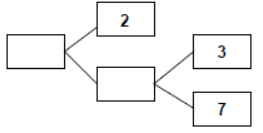
90. Find the missing numbers in the following factorization:
[Figure: Factor tree. The top box contains 2. Below it, a box on the left is empty and a box in the middle is empty. The empty middle box has two branches, one to a box containing 3 and one to a box containing 7.]
Answer:
1. The empty middle box has the factors 3 and 7, so it is 3 × 7 = 21.
2. The empty left box has the factors 2 and 21, so it is 2 × 21 = 42.
3. Hence, the missing numbers are 42 (left box) and 21 (middle box).
Teacher's Note:
a) Work from the bottom of the tree upwards.
b) Check: 42 = 2 × 3 × 7.
91. Find the HCF and LCM of 17, 23 and 37 by using prime factorization method.
Answer:
1. 17, 23 and 37 are all prime numbers.
2. They have no common prime factor, so HCF (17, 23, 37) = 1.
3. LCM = 17 × 23 × 37 = 391 × 37 = 14467.
4. Hence, HCF = 1 and LCM = 14467.
Teacher's Note:
a) Distinct primes are always co-prime, so their HCF is 1.
b) When numbers are prime, their LCM is simply their product.
92. If HCF(6, a) = 2 and LCM(6, a) = 60 then find the value of a.
Answer:
1. HCF × LCM = product of the two numbers, so 2 × 60 = 6 × a.
2. 120 = 6a, so a = 20.
3. Check: HCF (6, 20) = 2 and LCM (6, 20) = 60.
4. Hence, a = 20.
Teacher's Note:
a) The relation HCF × LCM = product works for two numbers only.
b) Always check the given HCF and LCM after finding a value.
93. If remainder of (5m + 1)(5m + 3)(5m + 4) / 5 is a natural number then find it.
Answer:
1. Modulo 5, (5m + 1)(5m + 3)(5m + 4) ≡ 1 × 3 × 4 = 12.
2. 12 = 2 × 5 + 2, so the remainder is 2.
3. Hence, the remainder is 2 for every integer m, and it is a natural number.
Teacher's Note:
a) Only the constant terms matter when dividing by 5, since 5m is divisible by 5.
b) Check with m = 1: 6 × 8 × 9 = 432 and 432 = 5 × 86 + 2.
94. A rational number p/q has a non-terminating repeating decimal expansion. What can you say about q?
Answer:
1. A rational number p/q (in lowest terms) has a non-terminating repeating decimal expansion when q has a prime factor other than 2 or 5.
2. Hence, q is not of the form 2m × 5n, that is, q has at least one prime factor other than 2 and 5.
Teacher's Note:
a) The condition applies to p/q in lowest terms, so cancel any common factor first.
b) Example: 1/3 = 0.333..., and 3 is not of the form 2m × 5n.
95. If 278 / (2m × m) has a terminating decimal expansion and m is a positive integer such that 2 < m < 9, then find the value of m.
Answer:
1. Check each value of m from 3 to 8. The fraction 278 / (2m × m) reduces to a fraction with denominator built from 2 and 5 only when every prime factor of m other than 2 and 5 cancels with 139, which is not possible.
2. m = 3: 278 / 24 = 139 / 12, which is non-terminating, since 12 has the factor 3.
3. m = 4: 278 / 64 = 139 / 32, which is terminating.
4. m = 5: 278 / 160 = 139 / 80, which is terminating, since 80 = 2⁴ × 5.
5. m = 6: 278 / 384 = 139 / 192, which is non-terminating, since 192 has the factor 3.
6. m = 7: 278 / 896 = 139 / 448, which is non-terminating, since 448 has the factor 7.
7. m = 8: 278 / 2048 = 139 / 1024, which is terminating.
8. Hence, the values of m are 4, 5 and 8, all of which give a terminating decimal.
Teacher's Note:
a) The question has more than one answer, and all three values satisfying the condition are given.
b) The only prime factors allowed in the denominator are 2 and 5, so check the factor of m in each case.
96. Write the condition to be satisfied by q so that a rational number p/q has a terminating expression.
Answer:
1. For p/q in lowest terms, the decimal expansion is terminating if and only if q has no prime factors other than 2 and 5.
2. Hence, q must be of the form 2n × 5m, where n and m are non-negative integers.
Teacher's Note:
a) The fraction must be reduced to lowest terms before this condition is applied.
b) Examples: 7/8 terminates since 8 = 2³, and 7/20 terminates since 20 = 2² × 5.
97. If a and b are positive integers. Show that √2 always lies between a/b and (a² - 2b²)/(b(a + b)).
Answer:
1. The second number as printed does not work. For a = b = 1 it gives (1 - 2) / (1 × 2) = -1/2, and √2 does not lie between 1 and -1/2.
2. The correct statement is that √2 always lies between a/b and 2b/a.
3. Let x = a/b, so 2b/a = 2/x and the product of the two numbers is x × (2/x) = 2.
4. a/b cannot equal √2, because √2 is irrational and a/b is rational. So x is not equal to √2.
5. If x < √2, then 2/x > √2; if x > √2, then 2/x < √2. In both cases √2 lies strictly between x and 2/x.
Teacher's Note:
a) The printed expression is wrong for a = b = 1, so the correction matters when a student checks the statement.
b) The argument uses the fact that the two numbers have product 2, so one must be less than √2 and the other greater.
98. Find two rational number and two irrational number between √2 and √3.
Answer:
1. √2 ≈ 1.414 and √3 ≈ 1.732.
2. Two rational numbers: 3/2 = 1.5 and 8/5 = 1.6, both of which lie between 1.414 and 1.732.
3. Two irrational numbers: √(5/2) = √10 / 2 ≈ 1.581 and √(27/10) ≈ 1.643, since 5/2 and 27/10 are not squares of rational numbers.
4. Hence, 3/2 and 8/5 are rational, and √(5/2) and √(27/10) are irrational numbers between √2 and √3.
Teacher's Note:
a) Any rational number between the two limits works, so 3/2 and 8/5 are only examples.
b) A square root of a non-square number is irrational, which is why √(5/2) works.
99. Prove that 5 - 2√3 is an irrational number.
Answer:
1. Suppose 5 - 2√3 = r, where r is rational.
2. Then 2√3 = 5 - r, so √3 = (5 - r) / 2.
3. The right side is rational, so √3 would be rational, which is a contradiction because √3 is irrational.
4. Hence, 5 - 2√3 is irrational.
Teacher's Note:
a) The irrationality of √3 is proved in the same way as for √2 in Question 108.
b) An irrational number plus or minus a rational number is always irrational.
100. Prove that 15 + 17√3 is an irrational number.
Answer:
1. Suppose 15 + 17√3 = r, where r is rational.
2. Then √3 = (r - 15) / 17, which is rational.
3. This contradicts the fact that √3 is irrational.
4. Hence, 15 + 17√3 is irrational.
Teacher's Note:
a) Isolate the square root first, then check whether the rest is rational.
b) The same method works for any number of the form a + b√c, where b is non-zero.
101. Prove that 2√3 / 5 is an irrational number.
Answer:
1. Suppose 2√3 / 5 = r, where r is rational.
2. Then √3 = 5r / 2, which is rational.
3. This contradicts the fact that √3 is irrational.
4. Hence, 2√3 / 5 is irrational.
Teacher's Note:
a) Dividing or multiplying an irrational number by a non-zero rational number keeps it irrational.
b) Multiply both sides by 5 and divide by 2 to isolate √3.
102. Prove that 7 + 3√2 is an irrational number.
Answer:
1. Suppose 7 + 3√2 = r, where r is rational.
2. Then √2 = (r - 7) / 3, which is rational.
3. This contradicts the fact that √2 is irrational.
4. Hence, 7 + 3√2 is irrational.
Teacher's Note:
a) The number 3 is rational and non-zero, which is needed for the contradiction.
b) Irrationality of √2 is proved in Question 108.
103. Prove that 2 + 3√5 is an irrational number.
Answer:
1. Suppose 2 + 3√5 = r, where r is rational.
2. Then √5 = (r - 2) / 3, which is rational.
3. This contradicts the fact that √5 is irrational.
4. Hence, 2 + 3√5 is irrational.
Teacher's Note:
a) √5 is irrational, since 5 is not a perfect square; the proof is like that for √2.
b) This method is the same as in Questions 100 and 102.
104. Prove that √2 + √3 is an irrational number.
Answer:
1. Suppose √2 + √3 = r, where r is rational.
2. Squaring gives 2 + 2√6 + 3 = r², so 2√6 = r² - 5.
3. Hence, √6 = (r² - 5) / 2, which is rational.
4. This contradicts the fact that √6 is irrational, since 6 is not a perfect square.
5. Hence, √2 + √3 is irrational.
Teacher's Note:
a) Squaring removes the square roots from the sum, which makes the contradiction possible.
b) √6 is irrational by the same argument as √2.
105. Prove that √3 + √5 is an irrational number.
Answer:
1. Suppose √3 + √5 = r, where r is rational.
2. Squaring gives 3 + 2√15 + 5 = r², so 2√15 = r² - 8.
3. Hence, √15 = (r² - 8) / 2, which is rational.
4. This contradicts the fact that √15 is irrational, since 15 is not a perfect square.
5. Hence, √3 + √5 is irrational.
Teacher's Note:
a) The product of √3 and √5 gives √15, which must be irrational.
b) This is the same squaring method as Question 104.
106. Prove that 7 - 2√3 is an irrational number.
Answer:
1. Suppose 7 - 2√3 = r, where r is rational.
2. Then 2√3 = 7 - r, so √3 = (7 - r) / 2, which is rational.
3. This contradicts the fact that √3 is irrational.
4. Hence, 7 - 2√3 is irrational.
Teacher's Note:
a) Subtracting an irrational number from a rational one gives an irrational result.
b) This is the same method as Question 99.
107. Prove that 3 - √5 is an irrational number.
Answer:
1. Suppose 3 - √5 = r, where r is rational.
2. Then √5 = 3 - r, which is rational.
3. This contradicts the fact that √5 is irrational.
4. Hence, 3 - √5 is irrational.
Teacher's Note:
a) The subtraction of a rational number from 3 keeps the result rational only if √5 is rational.
b) The result is the same as Question 109.
108. Prove that √2 is an irrational number.
Answer:
1. Suppose √2 = p/q, where p and q are co-prime integers and q ≠ 0.
2. Squaring gives 2 = p² / q², so p² = 2q².
3. Hence p² is even, so p is even. Let p = 2k.
4. Substituting gives 4k² = 2q², so q² = 2k², and q is even.
5. Now both p and q are even, so 2 is a common factor. This contradicts the fact that p and q are co-prime.
6. Hence, √2 is irrational.
Teacher's Note:
a) The key step is that the square of an odd number is odd, so p must be even.
b) The same argument proves that √3, √5 and other square roots of primes are irrational.
109. Prove that 7 - √5 is an irrational number
Answer:
1. Suppose 7 - √5 = r, where r is rational.
2. Then √5 = 7 - r, which is rational.
3. This contradicts the fact that √5 is irrational.
4. Hence, 7 - √5 is irrational.
Teacher's Note:
a) This is the same method as Question 107.
b) Irrationality of √5 is proved as in Question 108.
110. Show that there is no positive integer 'n' for which √(n - 1) + √(n + 1) is rational.
Answer:
1. Case n = 1: √0 + √2 = √2, which is irrational. So n = 1 does not work.
2. Case n ≥ 2: suppose √(n - 1) + √(n + 1) = r, where r is rational.
3. Squaring gives (n - 1) + (n + 1) + 2√(n² - 1) = r², so √(n² - 1) = (r² - 2n) / 2 is rational.
4. The square root of an integer is rational only if the integer is a perfect square. So n² - 1 must be a perfect square.
5. But (n - 1)² = n² - 2n + 1 < n² - 1 < n² for n ≥ 2, so n² - 1 lies strictly between two consecutive squares and is not a perfect square.
6. This is a contradiction. Hence, there is no positive integer n for which the expression is rational.
Teacher's Note:
a) Squaring the sum and isolating the square root is the key step, as in Questions 104 and 105.
b) For n = 1 the expression equals √2, which is irrational, so it must be treated as a separate case.
Multiple Choice Questions
Question. The decimal form of \( \frac{129}{2^2 \times 5^7 \times 7^5} \) is
(a) terminating
(b) non-terminating repeating
(c) non-terminating non-repeating
(d) none of the above
Answer: (b) non-terminating repeating
Question. HCF of 8, 9, 25 is
(a) 8
(b) 9
(c) 25
(d) 1
Answer: (d) 1
Question. Which of the following is not irrational?
(a) \( (2 - \sqrt{3})^2 \)
(b) \( (\sqrt{2} + \sqrt{3})^2 \)
(c) \( (\sqrt{2} - \sqrt{3})(\sqrt{2} + \sqrt{3}) \)
(d) \( \frac{2\sqrt{7}}{7} \)
Answer: (c) \( (\sqrt{2} - \sqrt{3})(\sqrt{2} + \sqrt{3}) \)
Question. The product of a rational and irrational number is
(a) rational
(b) irrational
(c) both of above
(d) none of above
Answer: (b) irrational
Question. The sum of a rational and irrational number is
(a) rational
(b) irrational
(c) both of above
(d) none of above
Answer: (b) irrational
Question. The product of two different irrational numbers is always
(a) rational
(b) irrational
(c) rational or irrational
(d) none of above
Answer: (c) rational or irrational
Question. The sum of two irrational numbers is always
(a) irrational
(b) rational
(c) rational or irrational
(d) one
Answer: (a) irrational
Question. If \( b = 3 \), then any integer can be expressed as \( a = \)
(a) \( 3q, 3q + 1, 3q + 2 \)
(b) \( 3q \)
(c) none of the above
(d) \( 3q + 1 \)
Answer: (a) \( 3q, 3q + 1, 3q + 2 \)
Question. The set \( A = \{0, 1, 2, 3, 4, ...\} \) represents the set of
(a) whole numbers
(b) integers
(c) natural numbers
(d) even numbers
Answer: (a) whole numbers
Question. Which number is divisible by 11?
(a) 1516
(b) 1452
(c) 1011
(d) 1121
Answer: (b) 1452
Question. LCM of the given number ‘x’ and ‘y’ where y is a multiple of ‘x’ is given by
(a) \( x \)
(b) \( y \)
(c) \( xy \)
(d) \( \frac{x}{y} \)
Answer: (b) \( y \)
Question. There are 312, 260 and 156 students in class X, XI and XII respectively. Buses are to be hired to take these students to a picnic. Find the maximum number of students who can sit in a bus if each bus takes equal number of students
(a) 52
(b) 56
(c) 48
(d) 63
Answer: (a) 52
Explanation: HCF of 312, 260, 156 = 52
Question. Express 98 as a product of its primes
(a) \( 2^2 \times 7 \)
(b) \( 2^2 \times 7^2 \)
(c) \( 2 \times 7^2 \)
(d) \( 2^3 \times 7 \)
Answer: (c) \( 2 \times 7^2 \)
Question. Three farmers have 490 kg, 588 kg and 882 kg of wheat respectively. Find the maximum capacity of a bag so that the wheat can be packed in exact number of bags.
(a) 98 kg
(b) 290 kg
(c) 200 kg
(d) 350 kg
Answer: (a) 98 kg
Explanation: HCF of 490, 588, 882 = 98 kg
Question. \( m^2 – 1 \) is divisible by 8, if m is
(a) an even integer
(b) an odd integer
(c) a natural number
(d) a whole number
Answer: (b) an odd integer
Question. If two positive integers A and B can be expressed as \( A = xy^3 \) and \( B = x^4y^2z \); x, y being prime numbers, the LCM (A, B) is
(a) \( xy^2 \)
(b) \( x^4y^2z \)
(c) \( x^4y^3 \)
(d) \( x^4y^3z \)
Answer: (d) \( x^4y^3z \)
Question. The product of a non-zero rational and an irrational number is
(a) always rational
(b) rational or irrational
(c) always irrational
(d) zero
Answer: (c) always irrational
Question. If two positive integers A and B can be expressed as \( A = xy^3 \) and \( B = x^4y^2z \); x, y being prime numbers then HCF (A, B) is
(a) \( xy^2 \)
(b) \( x^4y^2z \)
(c) \( x^4y^3 \)
(d) \( x^4y^3z \)
Answer: (a) \( xy^2 \)
Question. The largest number which divides 60 and 75, leaving remainders 8 and 10 respectively, is
(a) 260
(b) 75
(c) 65
(d) 13
Answer: (d) 13
Question. The least number that is divisible by all the numbers from 1 to 5 (both inclusive) is
(a) 5
(b) 60
(c) 20
(d) 100
Answer: (b) 60
Explanation: LCM of 2, 3, 4, 5 = 60
Question. The least number that is divisible by all the numbers from 1 to 8 (both inclusive) is
(a) 840
(b) 2520
(c) 8
(d) 420
Answer: (a) 840
Question. The decimal expansion of the rational number \( \frac{14587}{250} \) will terminate after:
(a) one decimal place
(b) two decimal places
(c) three decimal places
(d) four decimal places
Answer: (c) three decimal places
Question. The decimal expansion of the rational number \( \frac{97}{2 \times 5^4} \) will terminate after:
(a) one decimal place
(b) two decimal places
(c) three decimal places
(d) four decimal places
Answer: (d) four decimal places
Question. The product of two consecutive natural numbers is always:
(a) prime number
(b) even number
(c) odd number
(d) even or odd
Answer: (b) even number
Question. If the HCF of 408 and 1032 is expressible in the form \( 1032 \times 2 + 408 \times p \), then the value of p is
(a) 5
(b) –5
(c) 4
(d) –4
Answer: (b) –5
Explanation: HCF of 408 and 1032 is 24, \( \therefore 1032 \times 2 + 408 \times (–5) \)
Question. The number in the form of \( 4p + 3 \), where p is a whole number, will always be
(a) even
(b) odd
(c) even or odd
(d) multiple of 3
Answer: (b) odd
Question. When a number is divided by 7, its remainder is always:
(a) greater than 7
(b) at least 7
(c) less than 7
(d) at most 7
Answer: (c) less than 7
Question. \( (6 + 5\sqrt{3}) – (4 – 3\sqrt{3}) \) is
(a) a rational number
(b) an irrational number
(c) a natural number
(d) an integer
Answer: (b) an irrational number
Question. If HCF (16, y) = 8 and LCM (16, y) = 48, then the value of y is
(a) 24
(b) 16
(c) 8
(d) 48
Answer: (a) 24
Question. According to the fundamental theorem of arithmetic, if T (a prime number) divides \( b^2 \), b > 0, then
(a) T divides b
(b) b divides T
(c) \( T^2 \) divides \( b^2 \)
(d) \( b^2 \) divides \( T^2 \)
Answer: (a) T divides b
Question. The number ‘\( \pi \)’ is
(a) natural number
(b) rational number
(c) irrational number
(d) rational or irrational
Answer: (c) irrational number
Question. If LCM (77, 99) = 693, then HCF (77, 99) is
(a) 11
(b) 7
(c) 9
(d) 22
Answer: (a) 11
Free study material for Mathematics
Mathematics Class 10 Exam Resources: Chapter 01 Real Numbers
Comprehensive Study Resources for Chapter 01 Real Numbers
Explore essential learning tools for Class 10 Mathematics Chapter 01 Real Numbers. This curated collection features in-depth notes and targeted practice questions built around the active 2026 curriculum to streamline your daily revision.
Understanding Marking Schemes
Built using official NCERT guidelines for Class 10 Mathematics, these materials provide reliable academic support. Integrating past examination questions and step-by-step solutions helps students understand official CBSE grading criteria.
Complete Revision for Mathematics
Wrap up your chapter revision by testing your knowledge against standard objective question formats. Explore our full library of free, up-to-date sample papers and online assessments to secure top grades in your CBSE examinations.
FAQs
Our advanced study package for Chapter 01 Real Numbers includes detailed concepts, diagrams, Mind Maps, and explanation of complex topics to ensure Class 10 students learn as per syllabus for 2026 exams.
The Mind Maps provided for Chapter 01 Real Numbers act as visual anchors which will help faster recall during high-pressure exams.
Yes, teachers use our Class 10 Mathematics resources for lesson planning as they are in simple language and have lot of solved examples.
Yes, You can download the complete, mobile-friendly PDF of the Mathematics Chapter 01 Real Numbers advanced resources for free.
Yes, our subject matter experts have updated the Chapter 01 Real Numbers material to align with the rationalized NCERT textbooks and have removed deleted topics and added new competency-based questions.