

Class 10 Mathematics Study Guide: CBSE Class 10 Application of Trigonometry Important Formulas and concepts for exams
Access comprehensive study materials and useful resources for Chapter 08 Introduction to Trigonometry using the CBSE Class 10 Application of Trigonometry Important Formulas and concepts for exams. Designed to align with the 2026-27 CBSE academic guidelines, these advanced resources help Class 10 Mathematics students reinforce core concepts beyond standard textbooks.
Download Chapter 08 Introduction to Trigonometry Study Material PDF
View or download the dedicated CBSE Class 10 Application of Trigonometry Important Formulas and concepts for exams resource below. Engaging with these advanced study guides under focused conditions ensures continuous academic progress and mastery of the 2026-27 curriculum for Chapter 08 Introduction to Trigonometry.
CBSE Class 10 Application of Trigonometry Important Formulas and concepts for exams. There are many more useful educational material which the students can download in pdf format and use them for studies. Study material like concept maps, important and sure shot question banks, quick to learn flash cards, flow charts, mind maps, teacher notes, important formulas, past examinations question bank, important concepts taught by teachers. Students can download these useful educational material free and use them to get better marks in examinations. Also refer to other worksheets for the same chapter and other subjects too. Use them for better understanding of the subjects.
Class 10 Maths Chapter 9 Some Applications to Trigonometry important formulas and concepts for CBSE exams. This page covers the angle of elevation and angle of depression, the trigonometric ratios of an acute angle in a right triangle, reciprocal and quotient relations, complementary angle identities and the table of trigonometric ratios for 0°, 30°, 45°, 60° and 90°.
ANGLE OF ELEVATION
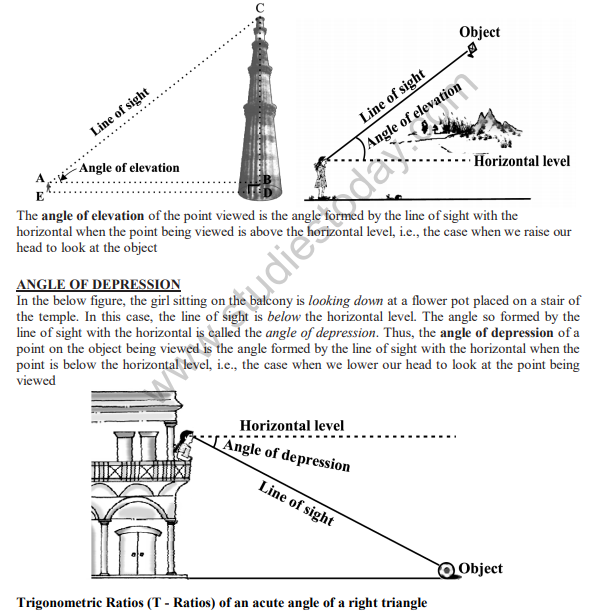
In the figure, the line AC drawn from the eye of the student to the top of the minar is called the line of sight. The student is looking at the top of the minar. The angle BAC, so formed by the line of sight with the horizontal, is called the angle of elevation of the top of the minar from the eye of the student. Thus, the line of sight is the line drawn from the eye of an observer to the point in the object viewed by the observer.
[Figure: Left diagram shows a tall minar with its top marked C, the eye of the student at point A on the ground, the line of sight drawn from A to C (labelled Line of sight), the horizontal line AE, and the point B at the base of the minar with point D below it. The angle at A between the line of sight and the horizontal is marked Angle of elevation. Right diagram shows a person looking up at an object with the Line of sight, the Angle of elevation and the Horizontal level labelled.]
The angle of elevation of the point viewed is the angle formed by the line of sight with the horizontal when the point being viewed is above the horizontal level, i.e., the case when we raise our head to look at the object.
ANGLE OF DEPRESSION
In the figure, the girl sitting on the balcony is looking down at a flower pot placed on a stair of the temple. In this case, the line of sight is below the horizontal level. The angle so formed by the line of sight with the horizontal is called the angle of depression. Thus, the angle of depression of a point on the object being viewed is the angle formed by the line of sight with the horizontal when the point is below the horizontal level, i.e., the case when we lower our head to look at the point being viewed.
[Figure: A girl on a balcony looks down at an object on the ground. The horizontal level is a dashed line from the girl's eye. The angle between the horizontal level and the line of sight is marked Angle of depression. The line of sight runs from the girl's eye down to the object, which is labelled Object.]
Trigonometric Ratios (T - Ratios) of an acute angle of a right triangle
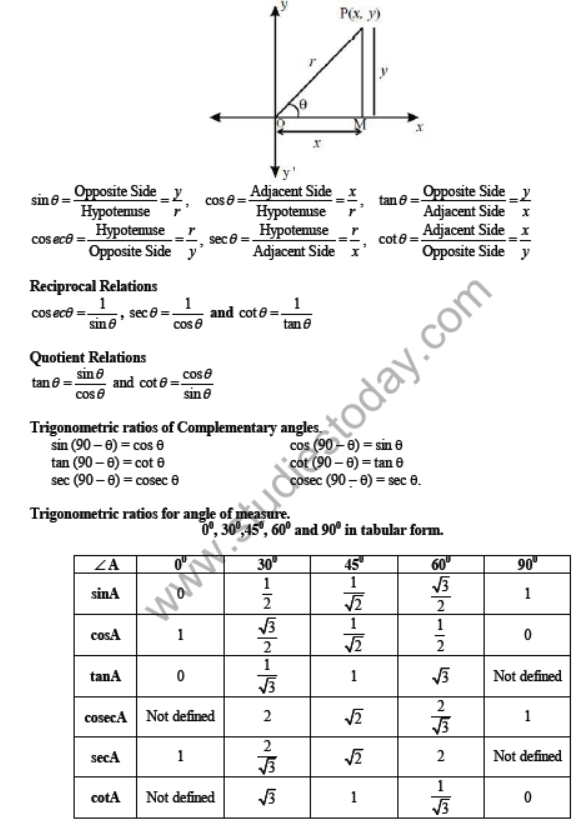
In XOY-plane, let a revolving line OP starting from OX trace out angle XOP = θ. From P (x, y), draw PM ⊥ OX.
In right angled triangle OMP, OM = x (Adjacent side); PM = y (Opposite side); OP = r (Hypotenuse).
[Figure: Coordinate axes with x and x' on the horizontal line and y and y' on the vertical line. The point P(x, y) is in the first quadrant. The segment OP is the hypotenuse marked r, the angle at O is marked θ, the perpendicular PM is marked y, and the base OM is marked x.]
sin θ = Opposite Side / Hypotenuse = y / r
cos θ = Adjacent Side / Hypotenuse = x / r
tan θ = Opposite Side / Adjacent Side = y / x
cosec θ = Hypotenuse / Opposite Side = r / y
sec θ = Hypotenuse / Adjacent Side = r / x
cot θ = Adjacent Side / Opposite Side = x / y
Reciprocal Relations
cosec θ = 1 / sin θ, sec θ = 1 / cos θ and cot θ = 1 / tan θ
Quotient Relations
tan θ = sin θ / cos θ and cot θ = cos θ / sin θ
Trigonometric ratios of Complementary angles
sin (90 - θ) = cos θ
tan (90 - θ) = cot θ
sec (90 - θ) = cosec θ
cos (90 - θ) = sin θ
cot (90 - θ) = tan θ
cosec (90 - θ) = sec θ
Trigonometric ratios for angles of measure 0°, 30°, 45°, 60° and 90° in tabular form
| ∠A | 0° | 30° | 45° | 60° | 90° |
|---|---|---|---|---|---|
| sin A | 0 | \( \frac{1}{2} \) | \( \frac{1}{\sqrt{2}} \) | \( \frac{\sqrt{3}}{2} \) | 1 |
| cos A | 1 | \( \frac{\sqrt{3}}{2} \) | \( \frac{1}{\sqrt{2}} \) | \( \frac{1}{2} \) | 0 |
| tan A | 0 | \( \frac{1}{\sqrt{3}} \) | 1 | √3 | Not defined |
| cosec A | Not defined | 2 | √2 | \( \frac{2}{\sqrt{3}} \) | 1 |
| sec A | 1 | \( \frac{2}{\sqrt{3}} \) | √2 | 2 | Not defined |
| cot A | Not defined | √3 | 1 | \( \frac{1}{\sqrt{3}} \) | 0 |
Free study material for Mathematics
Mathematics Class 10 Exam Resources: Chapter 08 Introduction to Trigonometry
Core Study Kit: Class 10 Mathematics Chapter 08 Introduction to Trigonometry
Explore essential learning tools for Class 10 Mathematics Chapter 08 Introduction to Trigonometry. This curated collection features in-depth notes and targeted practice questions built around the active 2026 curriculum to streamline your daily revision.
NCERT-Aligned Solutions for Chapter 08 Introduction to Trigonometry
Designed around the official curriculum, these study guides guarantee standard compliance. Reviewing step-by-step solutions clarifies complex sub-topics within Chapter 08 Introduction to Trigonometry and demystifies standard marking schemes for Mathematics evaluations.
Next Steps in Your Exam Preparation
For peak performance in upcoming evaluations, integrate official Mathematics sample papers directly into your study schedule. Follow up your revision by attempting online MCQ tests for Chapter 08 Introduction to Trigonometry to refine calculation speed and precision.
FAQs
Our advanced study package for Chapter 08 Introduction to Trigonometry includes detailed concepts, diagrams, Mind Maps, and explanation of complex topics to ensure Class 10 students learn as per syllabus for 2026 exams.
The Mind Maps provided for Chapter 08 Introduction to Trigonometry act as visual anchors which will help faster recall during high-pressure exams.
Yes, teachers use our Class 10 Mathematics resources for lesson planning as they are in simple language and have lot of solved examples.
Yes, You can download the complete, mobile-friendly PDF of the Mathematics Chapter 08 Introduction to Trigonometry advanced resources for free.
Yes, our subject matter experts have updated the Chapter 08 Introduction to Trigonometry material to align with the rationalized NCERT textbooks and have removed deleted topics and added new competency-based questions.