

Advanced Study Material for Class 9 Mathematics: Chapter 12 Herons Formula
Review targeted academic resources with the CBSE Class 9 Herons Formula Sure Shot Questions. Built according to official CBSE standards for the 2026-27 term, these downloadable Class 9 Mathematics study materials support effective daily practice and deeper conceptual understanding for Chapter 12 Herons Formula.
Practice Class 9 Mathematics Resources: Chapter 12 Herons Formula
Access the complete useful resource PDF for Class 9 Mathematics below. Regular practice with these targeted academic notes builds familiarity with complex topics and helps secure higher marks in final school evaluations.
CBSE Class 9 Herons Formula Sure Shot Questions. There are many more useful educational material which the students can download in pdf format and use them for studies. Study material like concept maps, important and sure shot question banks, quick to learn flash cards, flow charts, mind maps, teacher notes, important formulas, past examinations question bank, important concepts taught by teachers. Students can download these useful educational material free and use them to get better marks in examinations. Also refer to other worksheets for the same chapter and other subjects too. Use them for better understanding of the subjects.
PRACTICE QUESTIONS
CLASS IX: CHAPTER - 12
HERON'S FORMULA
1. Find the area of a triangle whose sides are 35 cm, 45 cm and 50 cm.
Answer:
1. Semi-perimeter s = (35 + 45 + 50) ÷ 2 = 65 cm.
2. s - a = 30, s - b = 20, s - c = 15.
3. Area = \( \sqrt{s(s - a)(s - b)(s - c)} \) = \( \sqrt{65 \times 30 \times 20 \times 15} \) = \( \sqrt{585000} \).
4. Area = 150√26 ≈ 764.85 cm².
5. Hence, the area of the triangle is 150√26 cm², that is, about 764.85 cm².
Teacher's Note:
a) Find s first; then each of s - a, s - b and s - c.
b) Simplify the root by taking out perfect squares: 585000 = 22500 × 26.
2. An isosceles triangle has perimeter 30 cm and each of its equal sides is 12 cm. Find its area. (use √15 = 3.88)
Answer:
1. Base = 30 - 12 - 12 = 6 cm.
2. Semi-perimeter s = 30 ÷ 2 = 15 cm.
3. s - a = 3, s - b = 3, s - c = 9.
4. Area = \( \sqrt{15 \times 3 \times 3 \times 9} \) = \( \sqrt{1215} \) = 9√15.
5. Area = 9 × 3.88 = 34.92 cm².
6. Hence, the area of the triangle is 34.92 cm².
Teacher's Note:
a) Subtract the two equal sides from the perimeter to get the base.
b) Substitute the given value √15 = 3.88 only at the last step.
3. The measure of one side of a right triangular field is 4.2 m. If the difference of the lengths of hypotenuse and the other is 14m, find the sides of the triangle and its area.
Answer:
1. Let the other side be b m and the hypotenuse c m, with c - b = 14, so c = b + 14.
2. With a side of 4.2 m, Pythagoras theorem gives (b + 14)² = (4.2)² + b², so 28b + 196 = 17.64 and b is negative. So no such triangle exists with 4.2 m.
3. The intended side is 42 m. Then (b + 14)² = 42² + b².
4. b² + 28b + 196 = 1764 + b², so 28b = 1568 and b = 56 m.
5. Hypotenuse c = 56 + 14 = 70 m.
6. Check: 42² + 56² = 1764 + 3136 = 4900 = 70².
7. Area = \( \frac{1}{2} \) × 42 × 56 = 1176 m².
8. Hence, the sides are 42 m, 56 m and 70 m, and the area is 1176 m².
Teacher's Note:
a) The printed value 4.2 m gives no real triangle; the correct data is 42 m, so the answer is worked for 42 m.
b) Always test a result with Pythagoras theorem: 42, 56, 70 is the 3, 4, 5 triple multiplied by 14.
c) The area of a right triangle is half the product of the sides about the right angle.
4. Find the area of the quadrilateral ABCD given in the below figure
Answer:
1. Join AC. From the figure, AC = 9 cm, AB = 7 cm, BC = 15 cm, CD = 12 cm and DA = 6 cm.
2. For △ABC, s = (7 + 15 + 9) ÷ 2 = 15.5 cm.
3. Area of △ABC = \( \sqrt{15.5 \times 8.5 \times 0.5 \times 6.5} \) = \( \frac{\sqrt{6851}}{4} \) ≈ 20.69 cm².
4. For △ACD, s = (6 + 9 + 12) ÷ 2 = 13.5 cm.
5. Area of △ACD = \( \sqrt{13.5 \times 7.5 \times 4.5 \times 1.5} \) = \( \frac{27\sqrt{15}}{4} \) ≈ 26.14 cm².
6. Area of ABCD = 20.69 + 26.14 = 46.83 cm².
7. Hence, the area of the quadrilateral ABCD is about 46.83 cm².
Teacher's Note:
a) The diagonal AC splits the quadrilateral into two triangles whose three sides are known.
b) Keep four decimal places in the middle steps and round only at the end.
5. The perimeter of a rhombus is 40cm. If one of its diagonal is 16cm, find the area of the rhombus.
Answer:
1. Side of the rhombus = 40 ÷ 4 = 10 cm.
2. Half of the given diagonal = 16 ÷ 2 = 8 cm.
3. The diagonals of a rhombus bisect each other at right angles, so half of the other diagonal = √(10² - 8²) = √36 = 6 cm.
4. Other diagonal = 2 × 6 = 12 cm.
5. Area = \( \frac{1}{2} \) × 16 × 12 = 96 cm².
6. Hence, the area of the rhombus is 96 cm².
Teacher's Note:
a) The diagonals of a rhombus cut each other at 90° and make four congruent right triangles.
b) Area of a rhombus = half the product of its diagonals.
6. Two parallel sides of a trapezium are 60cm and 77cm and the other sides are 25cm and 26cm. Find the area of the trapezium.
Answer:
1. Draw a line through one end of the shorter parallel side parallel to the slant side of 25 cm. This makes a parallelogram and a triangle.
2. The triangle has sides 25 cm, 26 cm and 77 - 60 = 17 cm.
3. s = (25 + 26 + 17) ÷ 2 = 34 cm.
4. Area of the triangle = \( \sqrt{34 \times 9 \times 8 \times 17} \) = \( \sqrt{41616} \) = 204 cm².
5. Height of the trapezium = (2 × 204) ÷ 17 = 24 cm.
6. Area of the trapezium = \( \frac{1}{2} \) × (60 + 77) × 24 = 1644 cm².
7. Hence, the area of the trapezium is 1644 cm².
Teacher's Note:
a) The triangle formed by the two slant sides and the difference of the parallel sides gives the height.
b) Area of a trapezium = half the sum of the parallel sides times the height.
7. Find the area of quadrilateral ABCD in which AD = 24cm, ∠BAD = 90° and B, C and D form an equilateral triangle of side 26cm. (use √3 = 1.73)
Answer:
1. In right △BAD, BD = 26 cm and AD = 24 cm.
2. AB = √(26² - 24²) = √(676 - 576) = √100 = 10 cm.
3. Area of △BAD = \( \frac{1}{2} \) × 10 × 24 = 120 cm².
4. Area of equilateral △BCD = \( \frac{\sqrt{3}}{4} \) × 26² = 169√3 = 169 × 1.73 = 292.37 cm².
5. Area of ABCD = 120 + 292.37 = 412.37 cm².
6. Hence, the area of the quadrilateral ABCD is 412.37 cm².
Teacher's Note:
a) BD is the common side; it is the hypotenuse of the right triangle and a side of the equilateral triangle.
b) Area of an equilateral triangle = \( \frac{\sqrt{3}}{4} \) × (side)².
c) Round only at the end, after substituting √3 = 1.73.
8. The height of an equilateral triangle measures 9cm. Find its area, correct to two places of decimals (use √3 = 1.73)
Answer:
1. Let the side be a cm. Height = \( \frac{\sqrt{3}}{2} \) a = 9, so a = \( \frac{18}{\sqrt{3}} \) = 6√3 cm.
2. Area = \( \frac{\sqrt{3}}{4} \) a² = \( \frac{\sqrt{3}}{4} \) × 108 = 27√3 cm².
3. Area = 27 × 1.73 = 46.71 cm².
4. Hence, the area of the triangle is 46.71 cm².
Teacher's Note:
a) Find the side from the height first; the height of an equilateral triangle is \( \frac{\sqrt{3}}{2} \) times the side.
b) Check with area = \( \frac{1}{2} \) × base × height = \( \frac{1}{2} \) × 6√3 × 9 = 27√3.
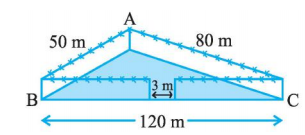
9. A triangular park ABC has sides 120m, 80m and. A gardener Dhania has to put a fence all around it and also plant grass inside. How much area does she need to plant? Find the cost of fencing it with barbed wire at the rate of Rs 20 per metre leaving a space 3m wide for a gate on one side.
Answer:
1. From the figure, the third side is 50 m, so the sides are 120 m, 80 m and 50 m.
2. Perimeter = 120 + 80 + 50 = 250 m and s = 125 m.
3. Area = \( \sqrt{125 \times 5 \times 45 \times 75} \) = \( \sqrt{2109375} \) = 375√15 m².
4. Area to be planted = 375 × 3.873 ≈ 1452.4 m².
5. Length to be fenced = 250 - 3 = 247 m.
6. Cost of fencing = 247 × 20 = Rs. 4,940.
7. Hence, the area to be planted is 375√15 m² (about 1452.4 m²) and the cost of fencing is Rs. 4,940.
Teacher's Note:
a) The question leaves out the third side; the figure shows it as 50 m.
b) The 3 m gate is not fenced, so subtract it from the perimeter before multiplying by the rate.
10. A traffic signal board, indicating ‘SCHOOL AHEAD’, is an equilateral triangle with side ‘a’. Find the area of the signal board, using Heron’s formula. If its perimeter is 180 cm, what will be the area of the signal board?
Answer:
1. Sides are a, a and a, so s = \( \frac{3a}{2} \).
2. Area = \( \sqrt{\frac{3a}{2} \times \frac{a}{2} \times \frac{a}{2} \times \frac{a}{2}} \) = \( \sqrt{\frac{3a^4}{16}} \) = \( \frac{\sqrt{3}}{4} \) a².
3. Perimeter = 180 cm, so 3a = 180 and a = 60 cm.
4. Area = \( \frac{\sqrt{3}}{4} \) × 60² = 900√3 cm².
5. Taking √3 = 1.73, area = 900 × 1.73 = 1557 cm².
6. Hence, the area is \( \frac{\sqrt{3}}{4} \) a², and for a perimeter of 180 cm it is 900√3 cm², about 1557 cm².
Teacher's Note:
a) All three factors s - a, s - b, s - c equal \( \frac{a}{2} \) for an equilateral triangle.
b) Learn the result \( \frac{\sqrt{3}}{4} \) a²; it saves time in every equilateral triangle problem.
c) The value changes slightly with the approximation of √3 used: 1.732 gives 1558.8 cm².
11. A park, in the shape of a quadrilateral ABCD, has ∠C = 90°, AB = 9 m, BC = 12 m, CD = 5 m and AD = 8 m. How much area does it occupy?
Answer:
1. Join BD. In right △BCD, BD = √(12² + 5²) = √169 = 13 m.
2. Area of △BCD = \( \frac{1}{2} \) × 12 × 5 = 30 m².
3. For △ABD, sides are 9 m, 8 m and 13 m, so s = (9 + 8 + 13) ÷ 2 = 15 m.
4. Area of △ABD = \( \sqrt{15 \times 6 \times 7 \times 2} \) = \( \sqrt{1260} \) = 6√35 ≈ 35.50 m².
5. Area of the park = 30 + 35.50 = 65.50 m².
6. Hence, the park occupies about 65.50 m².
Teacher's Note:
a) Use Pythagoras theorem to get the diagonal BD from the right triangle.
b) The right triangle needs no Heron's formula; use half base times height.
12. Find the area of a quadrilateral ABCD in which AB = 3 cm, BC = 4 cm, CD = 4 cm, DA = 5 cm and AC = 5 cm.
Answer:
1. In △ABC, AB² + BC² = 9 + 16 = 25 = AC², so ∠B = 90°.
2. Area of △ABC = \( \frac{1}{2} \) × 3 × 4 = 6 cm².
3. In △ACD, the sides are 5 cm, 4 cm and 5 cm, so s = 14 ÷ 2 = 7 cm.
4. Area of △ACD = \( \sqrt{7 \times 2 \times 3 \times 2} \) = \( \sqrt{84} \) = 2√21 ≈ 9.17 cm².
5. Area of ABCD = 6 + 9.17 = 15.17 cm².
6. Hence, the area of the quadrilateral is about 15.17 cm².
Teacher's Note:
a) Check for a right angle first; it avoids Heron's formula for △ABC.
b) The diagonal AC is the common side of the two triangles.
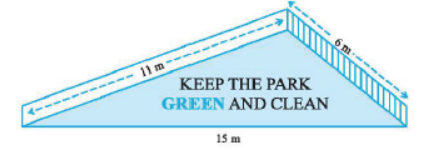
13. There is a slide in a park. One of its side walls has been painted in some colour with a message “KEEP THE PARK GREEN AND CLEAN”. If the sides of the wall are 15 m, 11 m and 6 m, find the area painted in colour.
Answer:
1. s = (15 + 11 + 6) ÷ 2 = 16 m.
2. s - a = 1, s - b = 5, s - c = 10.
3. Area = \( \sqrt{16 \times 1 \times 5 \times 10} \) = \( \sqrt{800} \) = 20√2 m².
4. Area ≈ 20 × 1.414 = 28.28 m².
5. Hence, the area painted in colour is about 28.28 m².
Teacher's Note:
a) The wall is a triangle, so apply Heron's formula directly.
b) 800 = 400 × 2, so the root simplifies to 20√2.
14. Students of a school staged a rally for cleanliness campaign. They walked through the lanes in two groups. One group walked through the lanes AB, BC and CA; while the other through AC, CD and DA. Then they cleaned the area enclosed within their lanes. If AB = 9 m, BC = 40 m, CD = 15 m, DA = 28 m and ∠B = 90°, which group cleaned more area and by how much? Find the total area cleaned by the students (neglecting the width of the lanes).
Answer:
1. In right △ABC, AC = √(9² + 40²) = √1681 = 41 m.
2. Area of △ABC = \( \frac{1}{2} \) × 9 × 40 = 180 m².
3. For △ACD, the sides are 41 m, 15 m and 28 m, so s = (41 + 15 + 28) ÷ 2 = 42 m.
4. Area of △ACD = \( \sqrt{42 \times 1 \times 27 \times 14} \) = \( \sqrt{15876} \) = 126 m².
5. The first group (lanes AB, BC, CA) cleaned 180 m² and the second group (lanes AC, CD, DA) cleaned 126 m².
6. Difference = 180 - 126 = 54 m².
7. Total area cleaned = 180 + 126 = 306 m².
8. Hence, the first group cleaned 54 m² more, and the total area cleaned is 306 m².
Teacher's Note:
a) Find the diagonal AC with Pythagoras theorem; it is the common lane of both groups.
b) Answer all three parts: which group, by how much, and the total.
15. Sanya has a piece of land which is in the shape of a rhombus. She wants her one daughter and one son to work on the land and produce different crops. She divided the land in two equal parts. If the perimeter of the land is 400 m and one of the diagonals is 160 m, how much area each of them will get for their crops?
Answer:
1. Side of the rhombus = 400 ÷ 4 = 100 m.
2. Half of the given diagonal = 160 ÷ 2 = 80 m.
3. Half of the other diagonal = √(100² - 80²) = √3600 = 60 m, so the other diagonal = 120 m.
4. Area of the land = \( \frac{1}{2} \) × 160 × 120 = 9600 m².
5. Area for each of them = 9600 ÷ 2 = 4800 m².
6. Hence, each of them will get 4800 m².
Teacher's Note:
a) The diagonals of a rhombus are perpendicular bisectors of each other.
b) Remember to divide the total area by 2 at the end.
16. Find the area of a triangle, two sides of which are 8 cm and 11 cm and the perimeter is 32 cm.
Answer:
1. Third side = 32 - 8 - 11 = 13 cm.
2. Semi-perimeter s = (8 + 11 + 13) ÷ 2 = 16 cm.
3. s - a = 8, s - b = 5, s - c = 3.
4. Area = \( \sqrt{s(s - a)(s - b)(s - c)} \) = \( \sqrt{16 \times 8 \times 5 \times 3} \) = \( \sqrt{1920} \).
5. Area = 8√30 ≈ 43.82 cm².
6. Hence, the area of the triangle is 8√30 cm², about 43.82 cm².
Teacher's Note:
a) Subtract the two given sides from the perimeter to get the third side.
b) 1920 = 64 × 30, so the root simplifies to 8√30.
17. A triangle has sides 35 cm, 54 cm and 61 cm long. Find its area. Also find smallest of its altitudes.
Answer:
1. s = (35 + 54 + 61) ÷ 2 = 75 cm.
2. s - a = 40, s - b = 21, s - c = 14.
3. Area = \( \sqrt{75 \times 40 \times 21 \times 14} \) = \( \sqrt{882000} \) = 420√5 cm² ≈ 939.15 cm².
4. The smallest altitude falls on the longest side, which is 61 cm.
5. Area = \( \frac{1}{2} \) × 61 × h, so h = \( \frac{2 \times 420\sqrt{5}}{61} \) = \( \frac{840\sqrt{5}}{61} \) ≈ 30.79 cm.
6. Hence, the area is 420√5 cm² (about 939.15 cm²) and the smallest altitude is about 30.79 cm.
Teacher's Note:
a) For a fixed area, the altitude is smallest on the longest base.
b) Use the exact value 420√5 in the second part to avoid rounding errors.
18. The sides of a triangular plot are in the ratio 3 : 5 : 7 and its perimeter is 300 m. Find its area.
Answer:
1. Let the sides be 3x, 5x and 7x. Then 15x = 300, so x = 20.
2. The sides are 60 m, 100 m and 140 m and s = 150 m.
3. s - a = 90, s - b = 50, s - c = 10.
4. Area = \( \sqrt{150 \times 90 \times 50 \times 10} \) = \( \sqrt{6750000} \) = 1500√3 m².
5. Area ≈ 1500 × 1.732 = 2598 m².
6. Hence, the area of the plot is 1500√3 m², about 2598 m².
Teacher's Note:
a) Convert the ratio into actual sides using the perimeter.
b) 6750000 = 2250000 × 3, and 2250000 = 1500².
19. A triangle and a parallelogram have the same base and the same area. If the sides of the triangle are 26 cm, 28 cm and 30 cm, and the parallelogram stands on the base 28 cm, find the height of the parallelogram.
Answer:
1. For the triangle, s = (26 + 28 + 30) ÷ 2 = 42 cm.
2. Area = \( \sqrt{42 \times 16 \times 14 \times 12} \) = \( \sqrt{112896} \) = 336 cm².
3. The parallelogram has the same area, 336 cm², and base 28 cm.
4. Height = area ÷ base = 336 ÷ 28 = 12 cm.
5. Hence, the height of the parallelogram is 12 cm.
Teacher's Note:
a) Area of a parallelogram = base × height.
b) The triangle and the parallelogram share the base 28 cm, so use that base.
20. A rhombus shaped field has green grass for 18 cows to graze. If each side of the rhombus is 30 m and its longer diagonal is 48 m, how much area of grass field will each cow be getting?
Answer:
1. Half of the longer diagonal = 48 ÷ 2 = 24 m.
2. Half of the shorter diagonal = √(30² - 24²) = √324 = 18 m, so the shorter diagonal = 36 m.
3. Area of the field = \( \frac{1}{2} \) × 48 × 36 = 864 m².
4. Area for each cow = 864 ÷ 18 = 48 m².
5. Hence, each cow gets 48 m².
Teacher's Note:
a) Use the right triangle formed by half-diagonals and the side.
b) Divide the total area by the number of cows, 18.
21. Sides of a triangle are in the ratio of 12 : 17 : 25 and its perimeter is 540cm. Find its area.
Answer:
1. Let the sides be 12x, 17x and 25x. Then 54x = 540, so x = 10.
2. The sides are 120 cm, 170 cm and 250 cm and s = 270 cm.
3. s - a = 150, s - b = 100, s - c = 20.
4. Area = \( \sqrt{270 \times 150 \times 100 \times 20} \) = \( \sqrt{81000000} \) = 9000 cm².
5. Hence, the area of the triangle is 9000 cm².
Teacher's Note:
a) Add the ratio terms: 12 + 17 + 25 = 54.
b) The product under the root is a perfect square: 9000² = 81000000.
22. The base of an isosceles triangle is 10 cm and one of its equal sides is 13 cm. Find its area.
Answer:
1. The sides are 13 cm, 13 cm and 10 cm, so s = 36 ÷ 2 = 18 cm.
2. s - a = 5, s - b = 5, s - c = 8.
3. Area = \( \sqrt{18 \times 5 \times 5 \times 8} \) = \( \sqrt{3600} \) = 60 cm².
4. Hence, the area of the triangle is 60 cm².
Teacher's Note:
a) Check: the height is √(13² - 5²) = 12 cm and half base times height = 5 × 12 = 60 cm².
23. Find the area of a right triangle in which the sides containing the right angle measure 20 cm and 15 cm.
Answer:
1. The sides containing the right angle are the base and the height.
2. Area = \( \frac{1}{2} \) × 20 × 15 = 150 cm².
3. Hence, the area of the triangle is 150 cm².
Teacher's Note:
a) For a right triangle there is no need for Heron's formula.
b) Check: the hypotenuse is 25 cm and Heron's formula also gives 150 cm².
24. An umbrella is made by stitching 10 triangular pieces of cloth of two different colours each piece measuring 20 cm, 50 cm and 50 cm. How much cloth of each colour is required for the umbrella?
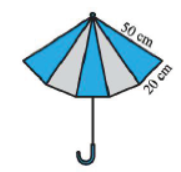
[Figure: An open umbrella seen from above, made of 10 triangular pieces of cloth in two alternating colours (blue and grey). The sides of each piece are labelled 50 cm along the rib and 20 cm along the rim]
Answer:
1. The 10 pieces are in two colours alternately, so there are 5 pieces of each colour.
2. For one piece, s = (20 + 50 + 50) ÷ 2 = 60 cm.
3. s - a = 40, s - b = 10, s - c = 10.
4. Area of one piece = \( \sqrt{60 \times 40 \times 10 \times 10} \) = \( \sqrt{240000} \) = 200√6 cm² ≈ 489.9 cm².
5. Cloth of each colour = 5 × 200√6 = 1000√6 cm² ≈ 2449.5 cm².
6. Hence, about 2449.5 cm² of cloth of each colour is required.
Teacher's Note:
a) Two colours used alternately means half of the pieces for each colour.
b) Multiply the area of one piece by 5, not by 10.
25. A kite in the shape of a square with a diagonal 32 cm and an isosceles triangle of base 8 cm and sides 6 cm each is to be made of three different shades as shown in Fig.. How much paper of each shade has been used in it?

[Figure: A kite in the shape of a square standing on one corner, with its two diagonals drawn. The upper triangular part is shaded and marked I, the lower part is marked II, and a small isosceles triangle marked III is attached below the bottom corner with its base labelled 8 cm]
Answer:
1. The square has diagonal 32 cm, so its area = \( \frac{1}{2} \) × 32 × 32 = 512 cm².
2. The diagonals divide the square into two equal parts, shades I and II, so area of shade I = area of shade II = 512 ÷ 2 = 256 cm².
3. For the isosceles triangle (shade III), the sides are 6 cm, 6 cm and 8 cm, so s = 10 cm.
4. Area of shade III = \( \sqrt{10 \times 4 \times 4 \times 2} \) = \( \sqrt{320} \) = 8√5 ≈ 17.89 cm².
5. Hence, 256 cm² of shade I, 256 cm² of shade II and about 17.89 cm² of shade III have been used.
Teacher's Note:
a) The area of a square can be found from its diagonal d as \( \frac{1}{2} \)d².
b) Shade III needs Heron's formula because its height is not given.
26. A floral design on a floor is made up of 16 tiles which are triangular, the sides of the triangle being 9 cm, 28 cm and 35 cm. Find the cost of polishing the tiles at the rate of 50p per cm².
[Figure: A floral design made of 16 triangular tiles arranged like petals around a common centre. Each tile has sides labelled 28 cm, 35 cm and 9 cm, and alternate tiles are shaded blue]
Answer:
1. For one tile, s = (9 + 28 + 35) ÷ 2 = 36 cm.
2. s - a = 27, s - b = 8, s - c = 1.
3. Area of one tile = \( \sqrt{36 \times 27 \times 8 \times 1} \) = \( \sqrt{7776} \) = 36√6 cm² ≈ 88.18 cm².
4. Area of 16 tiles = 16 × 36√6 = 576√6 ≈ 1410.9 cm².
5. Rate = 50p = Rs. 0.50 per cm².
6. Cost of polishing = 1410.9 × 0.50 ≈ Rs. 705.45.
7. Hence, the cost of polishing the tiles is about Rs. 705.45.
Teacher's Note:
a) 50 paise is half a rupee; convert before multiplying.
b) Using √6 = 2.449 gives the cost as about Rs. 705.4, so small differences are due to rounding.
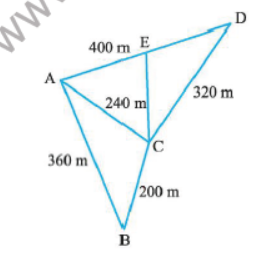
27. Kamla has a triangular field with sides 240 m, 200 m, 360 m, where she grew wheat. In another triangular field with sides 240 m, 320 m, 400 m adjacent to the previous field, she wanted to grow potatoes and onions. She divided the field in two parts by joining the mid-point of the longest side to the opposite vertex and grew patatoes in one part and onions in the other part. How much area (in hectares) has been used for wheat, potatoes and onions? (1 hectare = 10000 m²).
Answer:
1. Wheat field: sides 240 m, 200 m and 360 m, so s = 400 m.
2. Area = \( \sqrt{400 \times 160 \times 200 \times 40} \) = \( \sqrt{512000000} \) = 16000√2 m² ≈ 22627.4 m² ≈ 2.26 hectares.
3. Second field: sides 240 m, 320 m and 400 m. Since 240² + 320² = 57600 + 102400 = 160000 = 400², it is a right triangle.
4. Area = \( \frac{1}{2} \) × 240 × 320 = 38400 m².
5. The median to the longest side divides the triangle into two parts of equal area, so potatoes = onions = 38400 ÷ 2 = 19200 m².
6. 19200 m² = 1.92 hectares.
7. Hence, wheat is grown on about 2.26 hectares, potatoes on 1.92 hectares and onions on 1.92 hectares.
Teacher's Note:
a) A median divides a triangle into two parts of equal area.
b) Convert square metres to hectares by dividing by 10000.
c) Spot the right triangle 240, 320, 400 (the 3, 4, 5 triple times 80) to avoid Heron's formula.
28. A field is in the shape of a trapezium whose parallel sides are 25 m and 10 m. The non-parallel sides are 14 m and 13 m. Find the area of the field.
Answer:
1. Draw a line parallel to the 13 m side through the end of the 10 m side. This forms a parallelogram and a triangle with sides 14 m, 13 m and 25 - 10 = 15 m.
2. s = (14 + 13 + 15) ÷ 2 = 21 m.
3. Area of the triangle = \( \sqrt{21 \times 7 \times 8 \times 6} \) = \( \sqrt{7056} \) = 84 m².
4. Height = (2 × 84) ÷ 15 = 11.2 m.
5. Area of the trapezium = \( \frac{1}{2} \) × (25 + 10) × 11.2 = 196 m².
6. Hence, the area of the field is 196 m².
Teacher's Note:
a) The side of the triangle on the longer base is the difference of the parallel sides.
b) The height of the triangle is the height of the trapezium.
29. An isosceles triangle has perimeter 30 cm and each of the equal sides is 12 cm. Find the area of the triangle.
Answer:
1. Base = 30 - 12 - 12 = 6 cm and s = 15 cm.
2. s - a = 3, s - b = 3, s - c = 9.
3. Area = \( \sqrt{15 \times 3 \times 3 \times 9} \) = \( \sqrt{1215} \) = 9√15 cm².
4. Taking √15 = 3.873, area ≈ 34.86 cm².
5. Hence, the area of the triangle is 9√15 cm², about 34.86 cm².
Teacher's Note:
a) This is the same triangle as question 2; the earlier question used √15 = 3.88 and gave 34.92 cm².
b) Both values are correct for the approximation used.
30. Find the area of a triangle two sides of which are 18cm and 10cm and the perimeter is 42cm.
Answer:
1. Third side = 42 - 18 - 10 = 14 cm and s = 21 cm.
2. s - a = 3, s - b = 11, s - c = 7.
3. Area = \( \sqrt{21 \times 3 \times 11 \times 7} \) = \( \sqrt{4851} \) = 21√11 cm².
4. Area ≈ 21 × 3.317 = 69.65 cm².
5. Hence, the area of the triangle is 21√11 cm², about 69.65 cm².
Teacher's Note:
a) 4851 = 441 × 11, so the root simplifies to 21√11.
31. The sides of a triangular field are 41 m, 40 m and 9 m. Find the number of rose beds that can be prepared in the field, if each rose bed, on an average needs 900 cm² space.
Answer:
1. Since 9² + 40² = 81 + 1600 = 1681 = 41², the triangle is right-angled.
2. Area of the field = \( \frac{1}{2} \) × 9 × 40 = 180 m².
3. 180 m² = 180 × 10000 cm² = 1800000 cm².
4. Number of rose beds = 1800000 ÷ 900 = 2000.
5. Hence, 2000 rose beds can be prepared.
Teacher's Note:
a) Convert the units: 1 m² = 10000 cm².
b) Recognising the right triangle (9, 40, 41) saves the Heron calculation.
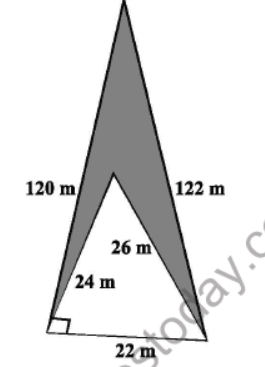
32. Calculate the area of the shaded region in
Answer:
1. The outer triangle has sides 120 m, 122 m and 22 m. Since 22² + 120² = 484 + 14400 = 14884 = 122², it is right-angled.
2. Area of the outer triangle = \( \frac{1}{2} \) × 22 × 120 = 1320 m².
3. The inner (unshaded) triangle has sides 24 m, 26 m and 22 m, so s = 36 m.
4. Area of the inner triangle = \( \sqrt{36 \times 12 \times 10 \times 14} \) = \( \sqrt{60480} \) = 24√105 m² ≈ 245.9 m².
5. Area of the shaded region = 1320 - 245.9 = 1074.1 m².
6. Hence, the area of the shaded region is about 1074.1 m².
Teacher's Note:
a) Shaded area = area of the outer triangle minus area of the inner triangle.
b) In the figure the inner triangle stands on the same 22 m base as the outer triangle.
33. Find the cost of laying grass in a triangular field of sides 50 m, 65 m and 65 m at the rate of Rs 7 per m².
Answer:
1. s = (50 + 65 + 65) ÷ 2 = 90 m.
2. s - a = 40, s - b = 25, s - c = 25.
3. Area = \( \sqrt{90 \times 40 \times 25 \times 25} \) = \( \sqrt{2250000} \) = 1500 m².
4. Cost = 1500 × 7 = Rs. 10,500.
5. Hence, the cost of laying grass is Rs. 10,500.
Teacher's Note:
a) 2250000 is the perfect square 1500², so no decimals are needed.
b) Cost = area × rate per square metre.
34. The triangular side walls of a flyover have been used for advertisements. The sides of the walls are 13 m, 14 m and 15 m. The advertisements yield an earning of Rs 2000 per m² a year. A company hired one of its walls for 6 months. How much rent did it pay?
Answer:
1. s = (13 + 14 + 15) ÷ 2 = 21 m.
2. Area of one wall = \( \sqrt{21 \times 8 \times 7 \times 6} \) = \( \sqrt{7056} \) = 84 m².
3. Rent for one year = 84 × 2000 = Rs. 1,68,000.
4. Rent for 6 months = 1,68,000 ÷ 2 = Rs. 84,000.
5. Hence, the company paid Rs. 84,000.
Teacher's Note:
a) The rate is per year, so halve the amount for 6 months.
b) 13, 14, 15 is a common triangle with area 84.
35. From a point in the interior of an equilateral triangle, perpendiculars are drawn on the three sides. The lengths of the perpendiculars are 14 cm, 10 cm and 6 cm. Find the area of the triangle.
Answer:
1. Let the side of the equilateral triangle be a cm and the interior point be P.
2. Area of the triangle = sum of the areas of the three triangles formed by P with the sides.
3. Area = \( \frac{1}{2} \) × a × 14 + \( \frac{1}{2} \) × a × 10 + \( \frac{1}{2} \) × a × 6 = \( \frac{1}{2} \) × a × 30 = 15a.
4. Also, area = \( \frac{\sqrt{3}}{4} \) a².
5. So 15a = \( \frac{\sqrt{3}}{4} \) a², hence a = \( \frac{60}{\sqrt{3}} \) = 20√3 cm.
6. Area = 15 × 20√3 = 300√3 cm².
7. Taking √3 = 1.732, area ≈ 519.6 cm².
8. Hence, the area of the triangle is 300√3 cm², about 519.6 cm².
Teacher's Note:
a) The sum of the perpendiculars from an interior point to the sides of an equilateral triangle equals its height, here 30 cm.
b) Divide the triangle into three smaller triangles with the common vertex P.
c) Equate the two area expressions to find the side.
36. The perimeter of an isosceles triangle is 32 cm. The ratio of the equal side to its base is 3 : 2. Find the area of the triangle.
Answer:
1. Let the equal sides be 3x each and the base 2x. Then 3x + 3x + 2x = 32, so x = 4.
2. The sides are 12 cm, 12 cm and 8 cm and s = 16 cm.
3. s - a = 4, s - b = 4, s - c = 8.
4. Area = \( \sqrt{16 \times 4 \times 4 \times 8} \) = \( \sqrt{2048} \) = 32√2 cm².
5. Area ≈ 32 × 1.414 = 45.25 cm².
6. Hence, the area of the triangle is 32√2 cm², about 45.25 cm².
Teacher's Note:
a) Take the ratio as 3 : 3 : 2 for the three sides.
b) 2048 = 1024 × 2, so the root is 32√2.
37. A field in the form of a parallelogram has sides 60 m and 40 m and one of its diagonals is 80 m long. Find the area of the parallelogram.
Answer:
1. The diagonal divides the parallelogram into two congruent triangles with sides 60 m, 40 m and 80 m.
2. s = (60 + 40 + 80) ÷ 2 = 90 m.
3. Area of one triangle = \( \sqrt{90 \times 30 \times 50 \times 10} \) = \( \sqrt{1350000} \) = 300√15 m².
4. Area of the parallelogram = 2 × 300√15 = 600√15 m².
5. Taking √15 = 3.873, area ≈ 2323.8 m².
6. Hence, the area of the parallelogram is 600√15 m², about 2323.8 m².
Teacher's Note:
a) A diagonal cuts a parallelogram into two triangles of equal area.
b) Do not forget to double the area of one triangle.
38. The perimeter of a triangular field is 420 m and its sides are in the ratio 6 : 7 : 8. Find the area of the triangular field.
Answer:
1. Let the sides be 6x, 7x and 8x. Then 21x = 420, so x = 20.
2. The sides are 120 m, 140 m and 160 m and s = 210 m.
3. s - a = 90, s - b = 70, s - c = 50.
4. Area = \( \sqrt{210 \times 90 \times 70 \times 50} \) = \( \sqrt{66150000} \) = 2100√15 m².
5. Taking √15 = 3.873, area ≈ 8133.3 m².
6. Hence, the area of the field is 2100√15 m², about 8133.3 m².
Teacher's Note:
a) Write 66150000 as 4410000 × 15; and 4410000 = 2100².
b) Take x = 20 from the perimeter before using Heron's formula.
39. The sides of a quadrilateral ABCD are 6 cm, 8 cm, 12 cm and 14 cm (taken in order) respectively, and the angle between the first two sides is a right angle. Find its area.
Answer:
1. AB = 6 cm, BC = 8 cm, CD = 12 cm, DA = 14 cm and ∠ABC = 90°.
2. Join AC. AC = √(6² + 8²) = 10 cm.
3. Area of △ABC = \( \frac{1}{2} \) × 6 × 8 = 24 cm².
4. For △ACD, sides are 10 cm, 12 cm and 14 cm, so s = 18 cm.
5. Area of △ACD = \( \sqrt{18 \times 8 \times 6 \times 4} \) = \( \sqrt{3456} \) = 24√6 ≈ 58.79 cm².
6. Area of ABCD = 24 + 58.79 = 82.79 cm².
7. Hence, the area of the quadrilateral is about 82.79 cm².
Teacher's Note:
a) The right angle gives the diagonal AC from the 6, 8, 10 triple.
b) 3456 = 576 × 6, so the root is 24√6.
40. A rhombus shaped sheet with perimeter 40 cm and one diagonal 12 cm, is painted on both sides at the rate of Rs 5 per m². Find the cost of painting.
Answer:
1. Side of the rhombus = 40 ÷ 4 = 10 cm and half of the given diagonal = 6 cm.
2. Half of the other diagonal = √(10² - 6²) = √64 = 8 cm, so the other diagonal = 16 cm.
3. Area of one face = \( \frac{1}{2} \) × 12 × 16 = 96 cm².
4. Area of both sides = 2 × 96 = 192 cm² = \( \frac{192}{10000} \) m² = 0.0192 m².
5. Cost = 0.0192 × 5 = Rs. 0.096.
6. Hence, the cost of painting is Rs. 0.096, that is, about 10 paise.
Teacher's Note:
a) The rate is per m², so convert cm² to m² by dividing by 10000.
b) The sheet is painted on both sides, so double the area.
41. Find the area of a parallelogram given in the below Figure. Also find the length of the altitude from vertex A on the side DC.
Answer:
1. The diagonal BD divides the parallelogram into two triangles of equal area. In △BCD, the sides are 12 cm, 17 cm and 25 cm.
2. s = (12 + 17 + 25) ÷ 2 = 27 cm.
3. Area of △BCD = \( \sqrt{27 \times 15 \times 10 \times 2} \) = \( \sqrt{8100} \) = 90 cm².
4. Area of the parallelogram = 2 × 90 = 180 cm².
5. Altitude from A on DC = area ÷ DC = 180 ÷ 12 = 15 cm.
6. Hence, the area is 180 cm² and the altitude from A on DC is 15 cm.
Teacher's Note:
a) Use the diagonal to turn the parallelogram into two triangles.
b) The altitude is found from area = base × height with base DC = 12 cm.
42. Find the area of the trapezium PQRS with height PQ given in the below Figure
Answer:
1. PQ is the height. Draw RT ⊥ PS with T on PS. Then PT = QR = 7 m and TS = 12 - 7 = 5 m.
2. In right △RTS, RT = √(13² - 5²) = √144 = 12 m, so PQ = RT = 12 m.
3. Area = \( \frac{1}{2} \) × (PS + QR) × PQ = \( \frac{1}{2} \) × (12 + 7) × 12 = 114 m².
4. Hence, the area of the trapezium PQRS is 114 m².
Teacher's Note:
a) The height PQ is not given, so find it with Pythagoras theorem in the right triangle.
b) The two parallel sides are PS = 12 m and QR = 7 m.
43. If each side of a triangle is doubled, then find the ratio of area of the new triangle thus formed and the given triangle.
Answer:
1. Let the sides of the given triangle be a, b, c and s = \( \frac{a + b + c}{2} \).
2. Area of the given triangle = \( \sqrt{s(s - a)(s - b)(s - c)} \).
3. The new sides are 2a, 2b, 2c, so the new semi-perimeter is 2s.
4. Area of the new triangle = \( \sqrt{2s(2s - 2a)(2s - 2b)(2s - 2c)} \) = \( \sqrt{16s(s - a)(s - b)(s - c)} \) = 4\( \sqrt{s(s - a)(s - b)(s - c)} \).
5. Ratio = 4 : 1.
6. Hence, the ratio of the area of the new triangle to the area of the given triangle is 4 : 1.
Teacher's Note:
a) Doubling every side multiplies the area by 2², that is, 4.
b) The factor 16 comes from four factors each doubled.
44. The perimeter of a triangle is 50 cm. One side of a triangle is 4 cm longer than the smaller side and the third side is 6 cm less than twice the smaller side. Find the area of the triangle.
Answer:
1. Let the smaller side be x cm. The other sides are (x + 4) cm and (2x - 6) cm.
2. x + (x + 4) + (2x - 6) = 50, so 4x - 2 = 50 and x = 13.
3. The sides are 13 cm, 17 cm and 20 cm and s = 25 cm.
4. s - a = 12, s - b = 8, s - c = 5.
5. Area = \( \sqrt{25 \times 12 \times 8 \times 5} \) = \( \sqrt{12000} \) = 20√30 cm².
6. Area ≈ 20 × 5.477 = 109.54 cm².
7. Hence, the area of the triangle is 20√30 cm², about 109.54 cm².
Teacher's Note:
a) Check that 13 is really the smallest side: 13 is less than 17 and 20.
b) 12000 = 400 × 30, so the root is 20√30.
45. The area of a trapezium is 475 cm² and the height is 19 cm. Find the lengths of its two parallel sides if one side is 4 cm greater than the other.
Answer:
1. Let the shorter parallel side be x cm. Then the longer one is (x + 4) cm.
2. Area = \( \frac{1}{2} \) × (x + x + 4) × 19 = 475.
3. (2x + 4) × 19 = 950, so 2x + 4 = 50 and x = 23.
4. The parallel sides are 23 cm and 27 cm.
5. Check: \( \frac{1}{2} \) × (23 + 27) × 19 = 475 cm².
6. Hence, the parallel sides are 23 cm and 27 cm.
Teacher's Note:
a) Form the equation from the area formula of a trapezium.
b) Always verify the answer by substituting back.
46. A rectangular plot is given for constructing a house, having a measurement of 40 m long and 15 m in the front. According to the laws, a minimum of 3 m, wide space should be left in the front and back each and 2 m wide space on each of other sides. Find the largest area where house can be constructed.
Answer:
1. Length of the plot = 40 m. Space of 3 m is left at the front and at the back, so the length available = 40 - 3 - 3 = 34 m.
2. Width of the plot = 15 m. Space of 2 m is left on each of the other two sides, so the width available = 15 - 2 - 2 = 11 m.
3. Largest area for the house = 34 × 11 = 374 m².
4. Hence, the house can be constructed on an area of at most 374 m².
Teacher's Note:
a) Subtract the open space from both ends of each dimension.
b) The area for the house is a rectangle inside the plot.
47. A field is in the shape of a trapezium having parallel sides 90 m and 30 m. These sides meet the third side at right angles. The length of the fourth side is 100 m. If it costs Rs 4 to plough 1m² of the field, find the total cost of ploughing the field.
Answer:
1. The third side is perpendicular to both parallel sides, so it is the height h of the trapezium.
2. Draw a line from the end of the shorter side perpendicular to the longer side. The remaining part of the longer side = 90 - 30 = 60 m.
3. In the right triangle with hypotenuse 100 m, h = √(100² - 60²) = √6400 = 80 m.
4. Area of the field = \( \frac{1}{2} \) × (90 + 30) × 80 = 4800 m².
5. Cost of ploughing = 4800 × 4 = Rs. 19,200.
6. Hence, the total cost of ploughing the field is Rs. 19,200.
Teacher's Note:
a) The slanting side of 100 m is the hypotenuse of a right triangle with legs h and 60 m.
b) The 60, 80, 100 triple is 20 times the 3, 4, 5 triple.
48. The sides of a triangle are 35 cm, 54 cm and 61 cm, respectively. Find the length of its longest altitude.
Answer:
1. s = (35 + 54 + 61) ÷ 2 = 75 cm.
2. Area = \( \sqrt{75 \times 40 \times 21 \times 14} \) = \( \sqrt{882000} \) = 420√5 cm².
3. The longest altitude falls on the shortest side, 35 cm.
4. Area = \( \frac{1}{2} \) × 35 × h, so h = \( \frac{2 \times 420\sqrt{5}}{35} \) = 24√5 cm.
5. Altitude ≈ 24 × 2.236 = 53.67 cm.
6. Hence, the longest altitude is 24√5 cm, about 53.67 cm.
Teacher's Note:
a) For a fixed area, the altitude is longest on the shortest base.
b) The same area was found in question 17.
49. In the below Fig, △ABC has sides AB = 7.5 cm, AC = 6.5 cm and BC = 7 cm. On base BC a parallelogram DBCE of same area as that of △ABC is constructed. Find the height DF of the parallelogram.
Answer:
1. For △ABC, s = (7.5 + 6.5 + 7) ÷ 2 = 10.5 cm.
2. s - a = 3, s - b = 4, s - c = 3.5.
3. Area of △ABC = \( \sqrt{10.5 \times 3 \times 4 \times 3.5} \) = \( \sqrt{441} \) = 21 cm².
4. Area of the parallelogram DBCE = area of △ABC = 21 cm².
5. Base BC = 7 cm, so height DF = 21 ÷ 7 = 3 cm.
6. Hence, the height DF of the parallelogram is 3 cm.
Teacher's Note:
a) The parallelogram has the same area as the triangle, so use area = base × height.
b) The height DF is the perpendicular distance between DE and BC.
50. A design is made on a rectangular tile of dimensions 50 cm × 70 cm as shown in below Figure. The design shows 8 triangles, each of sides 26 cm, 17 cm and 25 cm. Find the total area of the design and the remaining area of the tile.
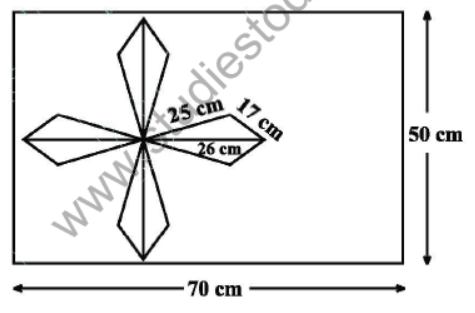
[Figure: A rectangular tile 70 cm long and 50 cm wide with a cross-shaped design at the centre made of 8 triangles, two pointing up, two down, two to the left and two to the right. Each triangle has sides labelled 26 cm, 17 cm and 25 cm]
Answer:
1. For one triangle, s = (26 + 17 + 25) ÷ 2 = 34 cm.
2. s - a = 8, s - b = 17, s - c = 9.
3. Area of one triangle = \( \sqrt{34 \times 8 \times 17 \times 9} \) = \( \sqrt{41616} \) = 204 cm².
4. Total area of the design = 8 × 204 = 1632 cm².
5. Area of the tile = 50 × 70 = 3500 cm².
6. Remaining area of the tile = 3500 - 1632 = 1868 cm².
7. Hence, the area of the design is 1632 cm² and the remaining area of the tile is 1868 cm².
Teacher's Note:
a) There are 8 identical triangles, so multiply the area of one by 8.
b) Remaining area = area of the rectangle minus area of the design.
Free study material for Mathematics
Mathematics Class 9 Exam Resources: Chapter 12 Herons Formula
Comprehensive Study Resources for Chapter 12 Herons Formula
Access comprehensive study material for Chapter 12 Herons Formula, including revision notes, concept maps, and high-probability questions. These resources are designed in alignment with the latest 2026 CBSE syllabus for Class 9 Mathematics to support effective exam preparation.
Understanding Marking Schemes
Designed around the official curriculum, these study guides guarantee standard compliance. Reviewing step-by-step solutions clarifies complex sub-topics within Chapter 12 Herons Formula and demystifies standard marking schemes for Mathematics evaluations.
Complete Revision for Mathematics
Maximize your grade potential by utilizing Class 9 Mathematics practice papers in tandem with these structured notes. All printable assignments and interactive mock tests on our platform are updated for the 2026 session and available free of charge.
FAQs
Our advanced study package for Chapter 12 Herons Formula includes detailed concepts, diagrams, Mind Maps, and explanation of complex topics to ensure Class 9 students learn as per syllabus for 2026 exams.
The Mind Maps provided for Chapter 12 Herons Formula act as visual anchors which will help faster recall during high-pressure exams.
Yes, teachers use our Class 9 Mathematics resources for lesson planning as they are in simple language and have lot of solved examples.
Yes, You can download the complete, mobile-friendly PDF of the Mathematics Chapter 12 Herons Formula advanced resources for free.
Yes, our subject matter experts have updated the Chapter 12 Herons Formula material to align with the rationalized NCERT textbooks and have removed deleted topics and added new competency-based questions.