

Download CBSE Class 9 Mathematics Useful Resources
Review targeted academic resources with the CBSE Class 9 Introduction to Euclids Geometry Sure Shot Questions. Built according to official CBSE standards for the 2026-27 term, these downloadable Class 9 Mathematics study materials support effective daily practice and deeper conceptual understanding for Chapter 05 Introduction to Euclids Geometry.
Access CBSE Study Guides and Summaries
Navigate directly to the advanced Mathematics study materials using the digital viewer below. Each resource pack includes detailed conceptual summaries and solved practice questions, allowing students to instantly reinforce their learning.
CBSE Class 9 Introduction to Euclids Geometry Sure Shot Questions. There are many more useful educational material which the students can download in pdf format and use them for studies. Study material like concept maps, important and sure shot question banks, quick to learn flash cards, flow charts, mind maps, teacher notes, important formulas, past examinations question bank, important concepts taught by teachers. Students can download these useful educational material free and use them to get better marks in examinations. Also refer to other worksheets for the same chapter and other subjects too. Use them for better understanding of the subjects.
PRACTICE QUESTIONS
CLASS IX: CHAPTER - 5
INTRODUCTION TO EUCLID'S GEOMETRY
1. What was name of the famous book of Euclid? How many chapters it had? [1 Mark]
Answer:
1. The famous book of Euclid was named 'Elements'.
2. It was divided into thirteen chapters, called books.
Teacher's Note:
a) Euclid's Elements is one of the most successful textbooks in the history of mathematics.
b) The book laid the foundation of modern axiomatic geometry.
2. It is known that x + y = 10. Is it true to say that x + y + p = 10 + p ? [1 Mark]
Answer:
1. Yes, it is true.
2. This is because according to Euclid's third axiom, if equals be added to equals, the wholes are equal.
Teacher's Note:
a) Applying Euclid's axiom ensures logical consistency in algebraic operations.
b) Here, the equal quantities are x + y and 10, and p is added to both sides.
3. If AB = CD, can you say that AC = BD? Give reasons for your answer. [2 Marks]
Answer:
1. Yes, AC = BD.
2. Given that AB = CD.
3. Adding BC to both sides, we get AB + BC = CD + BC, which gives AC = BD by Euclid's third axiom (if equals be added to equals, the wholes are equal).
Teacher's Note:
a) Visualizing line segments helps in understanding segment addition properties.
b) Overlapping segments share a common part, which is added to equal parts.
c) Always mention the specific Euclid axiom used for justification.
4. If ∠1 = ∠2, ∠3 = ∠4 and ∠2 = ∠4, what is the relation between ∠1 and ∠2. Give reasons for your answer. [2 Marks]
Answer:
1. The question contains a slight typo in asking the relation between ∠1 and ∠2, but based on the given conditions, ∠1 = ∠4.
2. Given that ∠1 = ∠2 and ∠2 = ∠4.
3. According to Euclid's first axiom, things which are equal to the same thing are equal to one another, hence ∠1 = ∠4.
Teacher's Note:
a) Transitive property of equality is derived directly from Euclid's first axiom.
b) Check the given conditions carefully to establish correct angle relations.
c) ∠3 = ∠4 is extra information not required to find the relation between ∠1 and ∠4.
5. If AB = 4 cm, CD = 8 cm and PQ = 2 times AB. Are CD and PQ equal? Which axiom is used for proving this? [2 Marks]
Answer:
1. Yes, CD and PQ are equal.
2. Given AB = 4 cm, so PQ = 2 × 4 cm = 8 cm.
3. Since CD = 8 cm as well, CD = PQ.
4. According to Euclid's first axiom, things which are equal to the same thing are equal to one another.
Teacher's Note:
a) Substitute the given numerical values to find the length of PQ.
b) Compare the calculated value with CD to establish equality.
c) State Euclid's axiom clearly as the reason for final equality.
6. AB = AC and AP = AQ. Can you say that BP = CQ? Which axioms are you using for this? [3 Marks]
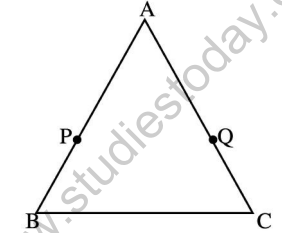
Answer:
1. Yes, BP = CQ.
2. Given that AB = AC and AP = AQ.
3. According to Euclid's third axiom, if equals be subtracted from equals, the remainders are equal.
4. Subtracting AP from AB and AQ from AC gives AB - AP = AC - AQ, which results in BP = CQ.
Teacher's Note:
a) Identify the whole lengths and the parts to be subtracted.
b) Apply Euclid's subtraction axiom correctly to line segments.
c) Verify the geometrical configuration from the accompanying triangle figure.
7. l = 3 cm long and lengths of lines m and n are three-fourth the length of l. Are m and n equal? [2 Marks]
Answer:
1. Yes, m and n are equal.
2. Given that length of l = 3 cm.
3. Length of m = \(\frac{3}{4}\) × 3 cm = \(\frac{9}{4}\) cm, and length of n = \(\frac{3}{4}\) × 3 cm = \(\frac{9}{4}\) cm.
4. Since both m and n are equal to the same value (\(\frac{9}{4}\) cm), by Euclid's first axiom, m and n are equal.
Teacher's Note:
a) Calculate fractional lengths carefully using basic multiplication.
b) Use Euclid's first axiom to show equality of two quantities equal to a third quantity.
c) Units must be written clearly in the final comparison.
8. How would you rewrite Euclid's fifth postulate so that it would be easier to understand? [2 Marks]
Answer:
1. Euclid's fifth postulate can be stated as Playfair's axiom.
2. It can be rewritten as: For every line l and for every point P not lying on l, there exists a unique line m passing through P and parallel to l.
Teacher's Note:
a) Playfair's axiom is an equivalent version of Euclid's fifth postulate.
b) This version is much simpler and widely used in modern geometry.
9. Does Euclid's fifth postulate imply the existence of parallel lines? Explain. [2 Marks]
Answer:
1. Yes, Euclid's fifth postulate implies the existence of parallel lines.
2. If the sum of interior angles on one side of a transversal intersecting two lines is less than 180°, the lines will eventually intersect on that side when produced indefinitely.
3. If the sum is exactly 180°, the lines never intersect on either side and are defined as parallel lines.
Teacher's Note:
a) Connect the concept of non-intersecting lines directly to the angle sum condition.
b) Explain how the 180° threshold separates intersecting lines from parallel lines.
10. Consider the following statement : There exists a pair of straight lines that are everywhere equidistant from one another. Is this statement a direct consequence of Euclid's fifth postulate? Explain. [3 Marks]
Answer:
1. Yes, this statement is a direct consequence of Euclid's fifth postulate.
2. Lines that are everywhere equidistant are parallel lines.
3. According to Playfair's axiom (which is equivalent to Euclid's fifth postulate), parallel lines maintain a constant perpendicular distance between them everywhere.
Teacher's Note:
a) Equidistant straight lines refer geometrically to parallel lines.
b) Link this property to Playfair's equivalent form of the fifth postulate.
c) Emphasize that constant distance ensures non-intersection at any point.
11. If A, B and C are three points on a line, and B lies between A and C, then prove that AB + BC = AC. [3 Marks]
Answer:
1. Given three points A, B, C on a line such that B lies between A and C.
2. The point B coincides with one of the division points when line segment AC is divided into parts.
3. By Euclid's axiom, the whole is equal to the sum of its parts.
4. Therefore, the total length of segment AC is equal to the sum of segments AB and BC, hence AB + BC = AC.
Teacher's Note:
a) Use the segment addition postulate derived from Euclid's axioms.
b) Point location 'betweenness' is a fundamental concept in linear geometry.
c) Ensure proper notation for line segments in the proof steps.
12. Prove that an equilateral triangle can be constructed on any given line segment. [3 Marks]
Answer:
1. Let AB be the given line segment.
2. With center A and radius AB, draw a circle. With center B and radius BA, draw another circle.
3. Let the two circles intersect at point C.
4. Join AC and BC, so that AB = AC (radii of the same circle) and AB = BC (radii of the same circle), making △ABC an equilateral triangle.
Teacher's Note:
a) This is Proposition 1 from Euclid's Elements, Book I.
b) Use circle radii properties to prove all three sides are equal.
c) Mention compass and straightedge construction logic clearly.
13. If a point C lies between two points A and B such that AC = BC, then prove that AC = \(\frac{1}{2}\) AB. Explain by drawing the figure. [3 Marks]
Answer:
1. Given that point C lies between A and B, so AC + BC = AB.
2. We are given that AC = BC.
3. Substituting AC for BC in the first equation gives AC + AC = AB, which means 2 AC = AB.
4. Dividing both sides by 2 gives AC = \(\frac{1}{2}\) AB.
Teacher's Note:
a) Combine segment addition with algebraic substitution.
b) Draw a neat line segment showing C as the midpoint.
c) State the final relation clearly as required by the question.
14. In adjoining figure, if AC = BD, then prove that AB = CD. [3 Marks]
Answer:
1. From the figure, we have AC = AB + BC and BD = BC + CD.
2. Given that AC = BD, so AB + BC = BC + CD.
3. According to Euclid's third axiom, if equals be subtracted from equals, the remainders are equal.
4. Subtracting segment BC from both sides gives AB = CD.
Teacher's Note:
a) Break down overlapping segments into smaller contiguous parts.
b) Apply Euclid's subtraction axiom to eliminate the common segment BC.
c) Check that points are in order A-B-C-D on the straight line.
15. If a point C is called a mid-point of line segment AB. Prove that every line segment has one and only one mid-point. [3 Marks]
Answer:
1. Let AB be a given line segment.
2. Assume, if possible, that C and C' are two midpoints of AB.
3. Since C is a midpoint of AB, AC = CB and AC = \(\frac{1}{2}\) AB.
4. Since C' is a midpoint of AB, AC' = C'B and AC' = \(\frac{1}{2}\) AB.
5. From the above, AC = AC', which means points C and C' coincide.
6. Hence, every line segment has one and only one midpoint.
Teacher's Note:
a) Uses the definition of a midpoint and Euclid's axiom that things which coincide with one another are equal to one another.
b) A common student mistake is assuming uniqueness without proof by contradiction.
c) This uniqueness theorem is foundational for the construction of geometric figures.
16. Ram and Ravi have the same weight. If they each gain weight by 2 kg, how will their new weights be compared? [2 Marks]
Answer:
1. Let Ram's weight be x and Ravi's weight be y. Given that x = y.
2. When each gains 2 kg, their new weights are x + 2 and y + 2.
3. By Euclid's axiom, if equals are added to equals, the wholes are equal.
4. Therefore, their new weights will still be equal.
Teacher's Note:
a) Directly applies Euclid's second axiom.
b) Remember to explicitly state the axiom used to get full marks.
17. Solve the equation a - 15 = 25 and state which axiom do you use here. [2 Marks]
Answer:
1. Given equation is a - 15 = 25.
2. Adding 15 to both sides gives a - 15 + 15 = 25 + 15, which simplifies to a = 40.
3. The axiom used is: If equals are added to equals, the wholes are equal (Euclid's second axiom).
Teacher's Note:
a) Both finding the numerical value and naming the correct axiom are required.
b) Ensure clarity in stating the algebraic operation corresponding to the axiom.
18. In the Fig., if ∠1 = ∠3, ∠2 = ∠4 and ∠3 = ∠4, write the relation between ∠1 and ∠2, using an Euclid's axiom. [3 Marks]
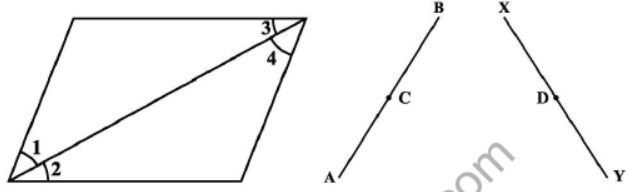

Answer:
1. Given that ∠1 = ∠3 and ∠2 = ∠4.
2. Also given that ∠3 = ∠4.
3. By Euclid's axiom, things which are equal to the same thing are equal to one another.
4. Therefore, ∠1 = ∠2.
Teacher's Note:
a) This question tests the application of Euclid's first axiom to angles.
b) Pay close attention to substitution of equal quantities using intermediate variables like ∠3 and ∠4.
19. In the above right sided Figure, we have : AC = XD, C is the mid-point of AB and D is the mid-point of XY. Using an Euclid's axiom, show that AB = XY. [3 Marks]
Answer:
1. Given C is the midpoint of AB, so AB = 2AC.
2. Given D is the midpoint of XY, so XY = 2XD.
3. Also given that AC = XD.
4. By Euclid's axiom, if equals are multiplied by equals, the wholes are equal, hence 2AC = 2XD, which means AB = XY.
Teacher's Note:
a) Relates line segment lengths to midpoint definitions and multiplication axioms.
b) Clearly state each deduction step before applying the final axiom.
20. Solve using appropriate Euclid's axiom: "Two salesmen make equal sales during the month of August. In September, each salesman doubles his sale of the month of August. Compare their sales in September." [2 Marks]
Answer:
1. Let the sales of the two salesmen in August be x and y respectively, where x = y.
2. In September, their sales become 2x and 2y.
3. By Euclid's axiom, if equals are multiplied by equals, the wholes are equal.
4. Therefore, their sales in September are equal (2x = 2y).
Teacher's Note:
a) Directly applies Euclid's axiom regarding multiplication of equals.
b) Express the word problem mathematically before citing the axiom.
21. Solve using appropriate Euclid's axiom: It is known that x + y = 10 and that x = z. Show that z + y = 10? [2 Marks]
Answer:
1. We are given x + y = 10 and x = z.
2. Substituting z in place of x in the first equation gives z + y = 10.
3. This is based on Euclid's axiom: Things which are equal to the same thing are equal to one another (or substituting equals for equals).
Teacher's Note:
a) Demonstrates substitution of equal quantities.
b) Ensure equations are properly referenced in sequence.
22. Solve using appropriate Euclid's axiom: Look at the below Figure. Show that length AH > sum of lengths of AB + BC + CD. [3 Marks]
Answer:
1. From the figure, the whole length AH can be written as the sum of parts: AH = AB + BC + CD + DE + EF + FG + GH.
2. Since lengths DE, EF, FG, and GH are positive magnitudes, AH is greater than the sum of any of its parts.
3. Therefore, by Euclid's axiom that the whole is greater than the part, AH > AB + BC + CD.
Teacher's Note:
a) Uses Euclid's fifth axiom (The whole is greater than the part).
b) Visually break down the line segment into its constituent parts to explain the inequality clearly.
23. Solve using appropriate Euclid's axiom : In the below Figure, we have AB = BC, BX = BY. Show that AX = CY. [3 Marks]
Answer:
1. Given that AB = BC and BX = BY.
2. By Euclid's axiom, if equals are subtracted from equals, the remainders are equal.
3. Subtracting BX from AB and BY from BC gives AB - BX = BC - BY.
4. Therefore, AX = CY.
Teacher's Note:
a) Applies Euclid's third axiom regarding subtraction of equals.
b) Verify segment addition and subtraction postulates carefully from the figure.
24. Solve using appropriate Euclid's axiom : In the above right sided Figure, we have X and Y are the mid-points of AC and BC and AX = CY. Show that AC = BC. [3 Marks]
Answer:
1. Since X is the midpoint of AC, AC = 2AX.
2. Since Y is the midpoint of BC, BC = 2CY.
3. Given that AX = CY.
4. By Euclid's axiom, if equals are multiplied by equals, the wholes are equal, hence 2AX = 2CY, which gives AC = BC.
Teacher's Note:
a) Combines midpoint definitions with the multiplication axiom.
b) This problem is the converse of working with halves of equals.
Free study material for Mathematics
Mathematics Class 9 Exam Resources: Chapter 05 Introduction to Euclids Geometry
Essential Notes for Class 9 Mathematics
Access comprehensive study material for Chapter 05 Introduction to Euclids Geometry, including revision notes, concept maps, and high-probability questions. These resources are designed in alignment with the latest 2026 CBSE syllabus for Class 9 Mathematics to support effective exam preparation.
Verified Solutions for Class 9 Mathematics
Designed around the official curriculum, these study guides guarantee standard compliance. Reviewing step-by-step solutions clarifies complex sub-topics within Chapter 05 Introduction to Euclids Geometry and demystifies standard marking schemes for Mathematics evaluations.
Enhance Accuracy with Online Tests
For peak performance in upcoming evaluations, integrate official Mathematics sample papers directly into your study schedule. Follow up your revision by attempting online MCQ tests for Chapter 05 Introduction to Euclids Geometry to refine calculation speed and precision.
FAQs
Our advanced study package for Chapter 05 Introduction to Euclids Geometry includes detailed concepts, diagrams, Mind Maps, and explanation of complex topics to ensure Class 9 students learn as per syllabus for 2026 exams.
The Mind Maps provided for Chapter 05 Introduction to Euclids Geometry act as visual anchors which will help faster recall during high-pressure exams.
Yes, teachers use our Class 9 Mathematics resources for lesson planning as they are in simple language and have lot of solved examples.
Yes, You can download the complete, mobile-friendly PDF of the Mathematics Chapter 05 Introduction to Euclids Geometry advanced resources for free.
Yes, our subject matter experts have updated the Chapter 05 Introduction to Euclids Geometry material to align with the rationalized NCERT textbooks and have removed deleted topics and added new competency-based questions.