

Class 9 Mathematics Study Guide: CBSE Class 9 Linear Equations in Two Variables Sure Shot Questions
Review targeted academic resources with the CBSE Class 9 Linear Equations in Two Variables Sure Shot Questions. Built according to official CBSE standards for the 2026-27 term, these downloadable Class 9 Mathematics study materials support effective daily practice and deeper conceptual understanding for Chapter 04 Linear Equations In Two Variables.
Download Chapter 04 Linear Equations In Two Variables Study Material PDF
Navigate directly to the advanced Mathematics study materials using the digital viewer below. Each resource pack includes detailed conceptual summaries and solved practice questions, allowing students to instantly reinforce their learning.
CBSE Class 9 Linear Equations in Two Variables Sure Shot Questions. There are many more useful educational material which the students can download in pdf format and use them for studies. Study material like concept maps, important and sure shot question banks, quick to learn flash cards, flow charts, mind maps, teacher notes, important formulas, past examinations question bank, important concepts taught by teachers. Students can download these useful educational material free and use them to get better marks in examinations. Also refer to other worksheets for the same chapter and other subjects too. Use them for better understanding of the subjects.
PRACTICE QUESTIONS
CLASS IX: CHAPTER - 4
LINEAR EQUATION IN TWO VARIABLES
1. Find the value of k, if x = 2, y = 1 is a solution of the equation 2x + 3y = k. [1 Mark]
Answer:
1. Given equation is 2x + 3y = k.
2. Substitute x = 2 and y = 1 into the equation.
3. 2(2) + 3(1) = k
4. 4 + 3 = k
5. k = 7
Teacher's Note:
a) A solution of a linear equation satisfies the equation when the coordinate values are substituted.
b) Always substitute values carefully in the correct positions of variables.
2. Find the points where the graph of the equation 3x + 4y = 12 cuts the x-axis and the y-axis. [2 Marks]
Answer:
1. To find where the graph cuts the x-axis, put y = 0.
2. 3x + 4(0) = 12, which gives 3x = 12, so x = 4. The point is (4, 0).
3. To find where the graph cuts the y-axis, put x = 0.
4. 3(0) + 4y = 12, which gives 4y = 12, so y = 3. The point is (0, 3).
Teacher's Note:
a) The graph of an equation cuts the x-axis at y = 0 and the y-axis at x = 0.
b) State both intersection points clearly as coordinates.
3. At what point does the graph of the linear equation x + y = 5 meet a line which is parallel to the y-axis, at a distance 2 units from the origin and in the positive direction of x-axis. [2 Marks]
Answer:
1. A line parallel to the y-axis at a distance of 2 units in the positive direction of the x-axis has the equation x = 2.
2. Substitute x = 2 into the equation x + y = 5.
3. 2 + y = 5, which gives y = 3.
4. Hence, the required point is (2, 3).
Teacher's Note:
a) Equations of lines parallel to axes have constant coordinates.
b) Solve simultaneous conditions by substitution.
4. Determine the point on the graph of the equation 2x + 5y = 20 whose x-coordinate is \(\frac{5}{2}\) times its ordinate. [3 Marks]
Answer:
1. Let the ordinate (y-coordinate) be y.
2. Then the x-coordinate is x = \(\frac{5}{2}\)y.
3. Substitute x = \(\frac{5}{2}\)y into the equation 2x + 5y = 20.
4. 2(\(\frac{5}{2}\)y) + 5y = 20
5. 5y + 5y = 20, which means 10y = 20, so y = 2.
6. Therefore, x = \(\frac{5}{2}\)(2) = 5.
7. Hence, the required point is (5, 2).
Teacher's Note:
a) Abscissa represents the x-coordinate and ordinate represents the y-coordinate.
b) Form a linear equation in one variable by substitution and solve for the ordinate first.
c) Check the final point by substituting it back into the original equation.
5. Draw the graph of the equation represented by the straight line which is parallel to the x-axis and is 4 units above it. [2 Marks]
Answer:
1. A straight line parallel to the x-axis and 4 units above it is represented by the equation y = 4.
2. For any value of x, the value of y remains 4.
3. The graph is a horizontal straight line passing through the points (0, 4), (1, 4), (-1, 4), etc.
Teacher's Note:
a) Any line parallel to the x-axis has the general form y = a.
b) Plot points with a constant y-coordinate to draw the graph.
6. Draw the graphs of linear equations y = x and y = -x on the same cartesian plane. What do you observe? [3 Marks]
Answer:
1. For y = x, points are (0, 0), (1, 1), (-1, -1), forming a line passing through the origin at 45° to the axes.
2. For y = -x, points are (0, 0), (1, -1), (-1, 1), forming a line passing through the origin at 135° to the axes.
3. Observation: Both lines pass through the origin (0, 0) and are perpendicular to each other, making angles of 45° and 135° with the positive x-axis.
Teacher's Note:
a) Lines of the form y = mx pass through the origin.
b) The product of slopes is 1 × (-1) = -1, which shows perpendicularity.
c) Symmetry about the coordinate axes is a key geometric property here.
7. Determine the point on the graph of the linear equation 2x + 5y = 19, whose ordinate is \(1\frac{1}{2}\) times its abscissa. [3 Marks]
Answer:
1. Let the abscissa (x-coordinate) be x.
2. The ordinate (y-coordinate) is y = \(1\frac{1}{2}\)x = \(\frac{3}{2}\)x.
3. Substitute y = \(\frac{3}{2}\)x into the equation 2x + 5y = 19.
4. 2x + 5(\(\frac{3}{2}\)x) = 19
5. 2x + \(\frac{15}{2}\)x = 19
6. \(\frac{4x + 15x}{2}\) = 19, which means 19x = 38, so x = 2.
7. Therefore, y = \(\frac{3}{2}\)(2) = 3.
8. Hence, the required point is (2, 3).
Teacher's Note:
a) Convert mixed fractions into improper fractions before algebraic manipulation.
b) Set up the relationship clearly between x and y.
c) Verify the solution by substituting coordinates into 2x + 5y = 19.
8. Draw the graph of the equation represented by a straight line which is parallel to the x-axis and at a distance 3 units below it. [2 Marks]
Answer:
1. A straight line parallel to the x-axis and 3 units below it is represented by the equation y = -3.
2. For any value of x, the value of y is always -3.
3. The graph is a horizontal straight line passing through points such as (0, -3), (2, -3), and (-2, -3).
Teacher's Note:
a) Lines below the x-axis have negative y-intercepts.
b) The equation takes the form y = -c where c is positive.
9. Draw the graph of the linear equation whose solutions are represented by the points having the sum of the coordinates as 10 units. [3 Marks]
Answer:
1. Let the coordinates be x and y.
2. According to the question, x + y = 10.
3. Find solutions: when x = 0, y = 10; when x = 5, y = 5; when x = 10, y = 0.
4. Plot the points (0, 10), (5, 5), and (10, 0) on a Cartesian plane and join them with a straight line.
Teacher's Note:
a) Translate statement conditions directly into an algebraic equation.
b) Find at least three points to ensure correct plotting.
c) Extend the line in both directions with arrows.
10. Write the linear equation such that each point on its graph has an ordinate 3 times its abscissa. [1 Mark]
Answer:
1. Let abscissa be x and ordinate be y.
2. Given condition is ordinate = 3 × abscissa, which means y = 3x.
3. The linear equation is 3x - y = 0 (or y = 3x).
Teacher's Note:
a) Abscissa is x and ordinate is y.
b) Write the equation in standard form if required.
11. If the point (3, 4) lies on the graph of 3y = ax + 7, then find the value of a. [2 Marks]
Answer:
1. Given equation is 3y = ax + 7.
2. Since the point (3, 4) lies on the graph, substitute x = 3 and y = 4 into the equation.
3. 3(4) = a(3) + 7
4. 12 = 3a + 7
5. 3a = 12 - 7 = 5, so a = \(\frac{5}{3}\).
Teacher's Note:
a) Any point on a graph satisfies its equation.
b) Solve the resulting linear equation in one variable for the unknown parameter.
12. How many solution(s) of the equation 2x + 1 = x - 3 are there on the : (i) Number line (ii) Cartesian plane [2 Marks]
Answer:
1. Simplify the equation: 2x - x = -3 - 1, which gives x = -4.
2. (i) On the number line, a linear equation in one variable has a unique (one) solution.
3. (ii) On the Cartesian plane, the equation x = -4 represents a line parallel to the y-axis, which consists of infinitely many points, so there are infinitely many solutions.
Teacher's Note:
a) The dimension of the space changes the number of solutions.
b) A single variable equation in a plane represents a line, hence infinite solutions.
13. Find the solution of the linear equation x + 2y = 8 which represents a point on (i) x-axis (ii) y-axis [2 Marks]
Answer:
1. (i) For a point on the x-axis, y = 0.
2. Substitute y = 0 in x + 2y = 8: x + 2(0) = 8, so x = 8. The solution is (8, 0).
3. (ii) For a point on the y-axis, x = 0.
4. Substitute x = 0 in x + 2y = 8: 0 + 2y = 8, so y = 4. The solution is (0, 4).
Teacher's Note:
a) Axis intercepts are found by setting the opposite coordinate to zero.
b) Express the final answers as coordinate pairs.
14. For what value of c, the linear equation 2x + cy = 8 has equal values of x and y for its solution. [2 Marks]
Answer:
1. Given that x = y for the solution.
2. Substitute x = y in the equation 2x + cy = 8 to get 2x + cx = 8.
3. Also substitute y = x in 2x + cy = 8 directly with x = y: 2y + cy = 8.
4. Using x = y, substitute both as k: 2k + ck = 8, so k(2 + c) = 8.
5. Alternatively, let x = y = k, then 2k + ck = 8. Without loss of generality, taking a simple point like x = 2, y = 2:
6. 2(2) + c(2) = 8 ⇒ 4 + 2c = 8 ⇒ 2c = 4 ⇒ c = 2.
Teacher's Note:
a) Assume equal variables as a common value to solve for the parameter.
b) Verify by substituting c back into the equation.
15. Let y varies directly as x. If y = 12 when x = 4, then write a linear equation. What is the value of y when x = 5? [3 Marks]
Answer:
1. Since y varies directly as x, y = kx for some constant k.
2. Given y = 12 when x = 4: 12 = k(4), which gives k = 3.
3. The linear equation is y = 3x.
4. To find y when x = 5, substitute x = 5 into the equation.
5. y = 3(5) = 15.
Teacher's Note:
a) Direct variation is always expressed as y = kx.
b) Find the constant of proportionality first using given conditions.
c) Use the derived equation to calculate new values.
16. Draw the graph of the linear equation 2x + 3y = 12. At what points, the graph of the equation cuts the x-axis and the y-axis? [3 Marks]
Answer:
1. Given equation is 2x + 3y = 12.
2. To find the x-intercept, put y = 0: 2x = 12, so x = 6. Point is (6, 0).
3. To find the y-intercept, put x = 0: 3y = 12, so y = 4. Point is (0, 4).
4. Take a third point for verification: if x = 3, 2(3) + 3y = 12 ⇒ 3y = 6 ⇒ y = 2, giving (3, 2).
5. Plot (6, 0), (0, 4), and (3, 2) and join them to get the straight line graph, which cuts the x-axis at (6, 0) and the y-axis at (0, 4).
Teacher's Note:
a) Intercepts provide the easiest points to plot for drawing a linear graph.
b) Always calculate at least three points to ensure accuracy.
c) Label the axes and intercept points clearly on the graph.
17. Show that the points A (1, 2), B (-1, -16) and C (0, -7) lie on the graph of the linear equation y = 9x - 7. [3 Marks]
Answer:
1. Given equation is y = 9x - 7.
2. For point A (1, 2): LHS = 2, RHS = 9(1) - 7 = 9 - 7 = 2. Since LHS = RHS, point A lies on the graph.
3. For point B (-1, -16): LHS = -16, RHS = 9(-1) - 7 = -9 - 7 = -16. Since LHS = RHS, point B lies on the graph.
4. For point C (0, -7): LHS = -7, RHS = 9(0) - 7 = 0 - 7 = -7. Since LHS = RHS, point C lies on the graph.
Teacher's Note:
a) A point lies on the graph of an equation if its coordinates satisfy the equation.
b) Test each point independently by substituting x and y values.
c) Conclude clearly after verifying that all points satisfy the equation.
18. The following values of x and y are thought to satisfy a linear equation : [3 Marks]

| x | 1 | 2 |
|---|---|---|
| y | 1 | 3 |
Draw the graph, using the values of x, y as given in the above table. At what point the graph of the linear equation (i) cuts the x-axis. (ii) cuts the y-axis.
Answer:
1. Let the linear equation be y = mx + c.
2. Substituting (1, 1), we get 1 = m + c, and substituting (2, 3), we get 3 = 2m + c.
3. Solving these equations gives m = 2 and c = -1, so the linear equation is 2x - y = 1.
4. (i) To find where it cuts the x-axis, put y = 0, giving 2x - 0 = 1, so x = \(\frac{1}{2}\); point is (\(\frac{1}{2}\), 0).
5. (ii) To find where it cuts the y-axis, put x = 0, giving 2(0) - y = 1, so y = -1; point is (0, -1).
Teacher's Note:
a) Two points are sufficient to plot the straight line representing a linear equation in two variables.
b) The x-intercept is found by setting y to zero, and the y-intercept is found by setting x to zero.
c) Always label the axes and the plotted line clearly on the graph.
19. The Autorikshaw fare in a city is charged Rs 10 for the first kilometer and @ Rs 4 per kilometer for subsequent distance covered. Write the linear equation to express the above statement. Draw the graph of the linear equation. [4 Marks]
Answer:
1. Let the total distance covered be x km and the total fare be Rs y.
2. Fare for the first kilometer = Rs 10.
3. Fare for the remaining distance (x - 1) km = Rs 4(x - 1).
4. Total fare y = 10 + 4(x - 1) = 10 + 4x - 4 = 4x + 6.
5. Linear equation: 4x - y + 6 = 0 or y = 4x + 6.
6. Plotting points: when x = 0, y = 6; when x = 1, y = 10; when x = 2, y = 14.
Teacher's Note:
a) Word problems require careful translation of statements into algebraic linear equations.
b) Distance and fare cannot be negative in this physical context, though the mathematical line extends further.
c) Check your equation by substituting test values like x = 1 giving y = 10.
d) Drawing the graph requires at least three coordinate points to ensure accuracy.
20. The work done by a body on application of a constant force is the product of the constant force and the distance travelled by the body in the direction of force. Express this in the form of a linear equation in two variables and draw its graph by taking the constant force as 3 units. What is the work done when the distance travelled is 2 units. Verify it by plotting the graph. [4 Marks]
Answer:
1. Let work done be y units and distance travelled be x units.
2. Given constant force = 3 units.
3. Equation: Work done = Force × Distance, so y = 3x.
4. When distance travelled x = 2 units, work done y = 3(2) = 6 units.
5. To draw graph, points are (0, 0), (1, 3), and (2, 6).
6. Verification from graph: locate x = 2 on the x-axis and observe the corresponding y-value on the line y = 3x, which is 6.
Teacher's Note:
a) Direct proportionality between variables creates a linear equation passing through the origin.
b) Always substitute the given value into the derived equation to compute the numerical answer.
c) Graphical verification confirms consistency between algebraic and geometric representations.
d) Ensure proper scaling on both axes when plotting equations with larger slopes.
21. The following values of x and y are thought to satisfy a linear equation, Write the linear equation. [3 Marks]
| x | 6 | -6 |
|---|---|---|
| y | -6 | 6 |
Draw the graph, using the values of x, y as given in the above table. At what point the graph of the linear equation (i) cuts the x-axis. (ii) cuts the y-axis.
Answer:
1. Given points are (6, -6) and (-6, 6).
2. Let the linear equation be y = mx + c.
3. Substituting (6, -6) gives -6 = 6m + c, and substituting (-6, 6) gives 6 = -6m + c.
4. Adding both equations gives 2c = 0, so c = 0, and then m = -1, yielding x + y = 0.
5. (i) Cutting the x-axis: put y = 0, giving x + 0 = 0, so x = 0; point is (0, 0).
6. (ii) Cutting the y-axis: put x = 0, giving 0 + y = 0, so y = 0; point is (0, 0).
Teacher's Note:
a) When coordinates are negatives of each other, the line passes through the origin.
b) Both intercepts coincide at the origin (0, 0) for this specific equation.
c) Double-check sign conventions while solving simultaneous equations for slope and intercept.
22. Draw the graph of the linear equation 3x + 4y = 6. At what points, the graph cuts the x-axis and the y-axis. [3 Marks]
Answer:
1. Equation is 3x + 4y = 6.
2. To find x-intercept, put y = 0: 3x = 6, so x = 2; point is (2, 0).
3. To find y-intercept, put x = 0: 4y = 6, so y = \(\frac{3}{2}\); point is (0, \(\frac{3}{2}\)).
4. Choosing another point: if x = -2, 3(-2) + 4y = 6 ⇒ 4y = 12 ⇒ y = 3, point is (-2, 3).
5. Plot these points and join them to get the required line.
Teacher's Note:
a) Intercept form makes finding axis-cutting points very quick and efficient.
b) Fractional coordinates like \(\frac{3}{2}\) should be plotted carefully as 1.5.
c) Always write down coordinates of intersection points explicitly as asked in the question.
23. The force exerted to pull a cart is directly proportional to the acceleration produced in the body. Express the statement as a linear equation of two variables and draw the graph of the same by taking the constant mass equal to 6 kg. Read from the graph, the force required when the acceleration produced is (i) 5 m/sec2, (ii) 6 m/sec2. [4 Marks]
Answer:
1. Let force be y units and acceleration be x units.
2. Given constant mass = 6 kg.
3. Equation: Force = Mass × Acceleration, so y = 6x.
4. (i) When acceleration x = 5 m/sec2, force y = 6(5) = 30 units.
5. (ii) When acceleration x = 6 m/sec2, force y = 6(6) = 36 units.
6. The graph is a straight line passing through the origin with a slope of 6.
Teacher's Note:
a) Newton's second law \(F = ma\) forms the basis of this linear relationship.
b) Directly proportional quantities always yield equations of the form \(y = kx\).
c) Reading values from graphs requires tracing perpendiculars from the given axis to the line.
d) Units must be correctly interpreted and stated in the final answers.
24. If the temperature of a liquid can be measured in Kelvin units as x°K or in Fahrenheit units as y°F, the relation between the two systems of measurement of temperature is given by the linear equation y = \(\frac{9}{5}\)(x - 273) + 32
(i) Find the temperature of the liquid in Fahrenheit if the temperature of the liquid is 313°K.
(ii) If the temperature is 158°F, then find the temperature in Kelvin. [4 Marks]
Answer:
1. Equation given is y = \(\frac{9}{5}\)(x - 273) + 32.
2. (i) Given x = 313°K: y = \(\frac{9}{5}\)(313 - 273) + 32 = \(\frac{9}{5}\)(40) + 32 = 9(8) + 32 = 72 + 32 = 104°F.
3. (ii) Given y = 158°F: 158 = \(\frac{9}{5}\)(x - 273) + 32.
4. 158 - 32 = \(\frac{9}{5}\)(x - 273) ⇒ 126 = \(\frac{9}{5}\)(x - 273).
5. x - 273 = 126 × \(\frac{5}{9}\) = 14 × 5 = 70.
6. x = 70 + 273 = 343°K.
Teacher's Note:
a) Substitute the given variable directly into the formula and follow BODMAS order of operations.
b) Transposition method is essential when solving for the independent variable from a given dependent value.
c) Check calculations by reversing the substitution step.
d) Temperature conversion formulas are practical applications of linear equations in two variables.
25. The linear equation that converts Fahrenheit (F) to Celsius (C) is given by the relation C = \(\frac{5F - 160}{9}\)
(i) If the temperature is 86°F, what is the temperature in Celsius?
(ii) If the temperature is 35°C, what is the temperature in Fahrenheit?
(iii) If the temperature is 0°C what is the temperature in Fahrenheit and if the temperature is 0°F, what is the temperature in Celsius?
(iv) What is the numerical value of the temperature which is same in both the scales? [6 Marks]
Answer:
1. (i) For F = 86: C = \(\frac{5(86) - 160}{9}\) = \(\frac{430 - 160}{9}\) = \(\frac{270}{9}\) = 30°C.
2. (ii) For C = 35: 35 = \(\frac{5F - 160}{9}\) ⇒ 315 = 5F - 160 ⇒ 5F = 475 ⇒ F = 95°F.
3. (iii) For C = 0: 0 = \(\frac{5F - 160}{9}\) ⇒ 5F = 160 ⇒ F = 32°F. For F = 0: C = \(\frac{5(0) - 160}{9}\) = \(\frac{-160}{9}\) = -17.78°C.
4. (iv) Let the same temperature be x in both scales, so C = F = x.
5. x = \(\frac{5x - 160}{9}\) ⇒ 9x = 5x - 160 ⇒ 4x = -160 ⇒ x = -40.
6. Hence, -40° is the temperature which is the same on both Celsius and Fahrenheit scales.
Teacher's Note:
a) This standard multi-part question tests both forward and backward calculations using a linear formula.
b) Finding the common temperature requires equating C and F to a single variable x.
c) Pay attention to negative signs during fraction arithmetic.
d) The result -40 is a famous invariant point between Celsius and Fahrenheit scales.
26. Draw the graph of x + y = 7 and x - y = 2 on the same graph. [3 Marks]
Answer:
1. For equation x + y = 7: points are (0, 7), (7, 0), and (3, 4).
2. For equation x - y = 2: points are (0, -2), (2, 0), and (4, 2).
3. Plot both lines on the same cartesian plane.
4. The two lines intersect at the point (4.5, 2.5) or solving simultaneously: 2x = 9 ⇒ x = 4.5, y = 2.5.
Teacher's Note:
a) Drawing multiple graphs on the same plane helps visualize simultaneous linear equations.
b) Clearly distinguish each line using labels or different styles.
c) The point of intersection represents the unique solution to the pair of linear equations.
27. If the point (3, 4) lies on the graph of the equation 3y = ax + 7, find the value of a. [2 Marks]
Answer:
1. Given equation is 3y = ax + 7.
2. Since the point (3, 4) lies on the graph, it must satisfy the equation.
3. Substitute x = 3 and y = 4 into the equation: 3(4) = a(3) + 7.
4. 12 = 3a + 7 ⇒ 3a = 12 - 7 = 5 ⇒ a = \(\frac{5}{3}\).
Teacher's Note:
a) Any point lying on a graph satisfies its corresponding algebraic equation.
b) Substitute x and y coordinates directly to solve for unknown parameters.
28. The taxi fare in a city is as follows: For the first kilometre, the fare is Rs 8 and for the subsequent distance it is Rs 5 per km. Taking the distance covered as x km and total fare as Rs y, write a linear equation for this information, and draw its graph. [4 Marks]

Answer:
1. Let total distance be x km and total fare be Rs y.
2. Fare for the first kilometer = Rs 8.
3. Fare for the remaining distance (x - 1) km = Rs 5(x - 1).
4. Total fare y = 8 + 5(x - 1) = 8 + 5x - 5 = 5x + 3.
5. Linear equation: 5x - y + 3 = 0 or y = 5x + 3.
6. Points for graph: (0, 3), (1, 8), and (2, 13).
Teacher's Note:
a) Split the total distance into the first unit rate and subsequent unit rates.
b) Formulate the linear equation by adding fixed base fare to variable distance fare.
c) Plot coordinate points accurately to represent the real-world taxi fare structure.
d) Ensure proper labeling of axes representing independent and dependent variables.
29. Solve the equation 2x + 1 = x - 3, and represent the solution(s) on
(i) the number line,
(ii) the Cartesian plane. [3 Marks]
Answer:
1. Given equation: 2x + 1 = x - 3
2. Simplifying: 2x - x = -3 - 1
3. x = -4
4. (i) On the number line, the solution x = -4 is represented as a unique point at -4 on the number line.
5. (ii) On the Cartesian plane, the linear equation x + 4 = 0 is represented by a line parallel to the y-axis passing through the point (-4, y) for all values of y.
Teacher's Note:
a) Transpose terms with x to one side and constants to the other.
b) Representing a single variable equation in two variables requires writing it as \(1x + 0y + 4 = 0\).
c) A linear equation in one variable has a unique solution on the number line but infinitely many solutions on the Cartesian plane.
30. Give the geometric representations of y = 3 as an equation
(i) in one variable (ii) in two variables [2 Marks]
Answer:
1. (i) In one variable, y = 3 is represented as a point on the number line at coordinate 3.
2. (ii) In two variables, the equation can be written as \(0x + 1y = 3\), which is represented geometrically as a straight line parallel to the x-axis at a distance of 3 units above it.
Teacher's Note:
a) An equation in one variable has a point as its geometric representation on a number line.
b) An equation in two variables represents a straight line on the Cartesian plane.
31. Give the geometric representations of 2x + 9 = 0 as an equation
(i) in one variable (ii) in two variables [2 Marks]
Answer:
1. Given equation: 2x + 9 = 0, which means x = \(-\frac{9}{2}\) = -4.5.
2. (i) In one variable, it is represented as a unique point at -4.5 on the number line.
3. (ii) In two variables, the equation is written as \(2x + 0y + 9 = 0\), representing a straight line parallel to the y-axis at x = -4.5.
Teacher's Note:
a) Always simplify the linear equation to find the exact coordinate value before plotting.
b) Lines parallel to the y-axis have equations of the form x = a.
32. The force applied on a body is directly proportional to the acceleration produced in the body. Write an equation to express this situation and plot the graph of the equation. [3 Marks]
Answer:
1. Let the force applied be F and the acceleration produced be a.
2. According to the given condition, F \(\propto\) a, hence F = ka, where k is a constant (mass of the body).
3. Let the constant mass k = 5 units, so the linear equation is F = 5a.
4. When a = 0, F = 0; when a = 1, F = 5; when a = 2, F = 10.
5. Plotting points (0, 0), (1, 5), and (2, 10) on a Cartesian plane gives a straight line passing through the origin.
Teacher's Note:
a) Assume a suitable non-zero constant for the proportionality to draw the graph easily.
b) Direct proportionality between two variables always results in a linear graph passing through the origin.
c) Label both axes clearly with the physical quantities represented.
33. Draw the graphs of the equations x - y + 1 = 0 and 3x + 2y - 12 = 0. Determine the coordinates of the vertices of the triangle formed by these lines and the x-axis, and shade the triangular region. [4 Marks]
Answer:
1. For equation x - y + 1 = 0: when x = 0, y = 1; when x = 2, y = 3. Points are (0, 1) and (2, 3).
2. For equation 3x + 2y - 12 = 0: when x = 0, y = 6; when x = 4, y = 0. Points are (0, 6) and (4, 0).
3. Solving the two equations simultaneously: x - y = -1 and 3x + 2y = 12 gives the point of intersection as (2, 3).
4. The line x - y + 1 = 0 intersects the x-axis at (-1, 0), and the line 3x + 2y - 12 = 0 intersects the x-axis at (4, 0).
5. The vertices of the triangle formed by the two lines and the x-axis are (-1, 0), (4, 0), and (2, 3).
Teacher's Note:
a) Find the x-intercepts by setting y = 0 for both equations to locate the base vertices on the x-axis.
b) Solve the simultaneous linear equations to find the third vertex where the two lines intersect.
c) Shade the region carefully bounded by the two lines and the x-axis.
d) Use a scale of 1 cm = 1 unit on both axes for accurate graph plotting.
34. Draw the graphs of the equations y = x and y = -x in the same graph paper. Find the coordinates of the point where two lines intersect. [3 Marks]
Answer:
1. For equation y = x: points are (0, 0), (1, 1), and (-1, -1).
2. For equation y = -x: points are (0, 0), (1, -1), and (-1, 1).
3. Both equations represent straight lines passing through the origin.
4. Solving the equations simultaneously by substituting y = x into y = -x gives x = 0 and y = 0.
5. The coordinates of the point of intersection are (0, 0).
Teacher's Note:
a) Equations of the form y = mx always pass through the origin (0, 0).
b) Verify the intersection point algebraically by setting the expressions for y equal to each other.
c) Both lines are symmetric with respect to the coordinate axes.
35. Draw the graphs of the equations 3x - 2y = 4 and x + y - 3 = 0 in the same graph paper. Find the coordinates of the point where two lines intersect. [4 Marks]
Answer:
1. For equation 3x - 2y = 4: when x = 2, y = 1; when x = 4, y = 4. Points are (2, 1) and (4, 4).
2. For equation x + y - 3 = 0: when x = 0, y = 3; when x = 3, y = 0. Points are (0, 3) and (3, 0).
3. From equation x + y - 3 = 0, substitute y = 3 - x into 3x - 2(3 - x) = 4.
4. 3x - 6 + 2x = 4 implies 5x = 10, so x = 2, and y = 3 - 2 = 1.
5. The coordinates of the point of intersection are (2, 1).
Teacher's Note:
a) Choose integer coordinates for easy plotting on graph paper.
b) Use substitution or elimination method to find the exact algebraic point of intersection.
c) Check the intersection coordinates in both equations to ensure accuracy.
d) Draw clear axes and label the lines with their respective equations.
36. Draw the graphs of the equations 3x - 2y + 6 = 0 and x + 2y - 6 = 0 in the same graph paper. Find the area of triangle formed by the two lines and x - axis. [4 Marks]
Answer:
1. For 3x - 2y + 6 = 0: when x = 0, y = 3; when x = -2, y = 0. Points are (0, 3) and (-2, 0).
2. For x + 2y - 6 = 0: when x = 0, y = 3; when x = 6, y = 0. Points are (0, 3) and (6, 0).
3. Solving the equations simultaneously: adding both gives 4x = 0, so x = 0 and y = 3. The intersection point is (0, 3).
4. The base of the triangle lies on the x-axis between x = -2 and x = 6, so length of base = 6 - (-2) = 8 units.
5. The height of the triangle is the y-coordinate of the intersection point (0, 3), which is 3 units.
6. Area of the triangle = \(\frac{1}{2}\) × base × height = \(\frac{1}{2}\) × 8 × 3 = 12 square units.
Teacher's Note:
a) Identify the base along the x-axis by finding the x-intercepts of both lines.
b) The height is the perpendicular distance from the intersection point to the x-axis.
c) Use the standard triangle area formula \(\frac{1}{2}bh\).
d) Ensure proper scaling and clear shading of the triangular region.
37. If the number of hours for which a labourer works is x and y are his wages (in rupees) and y = 2x - 1, draw the graph of work - wages equation. From the graph, find the wages of the labourer if he works for 6 hours. [3 Marks]
Answer:
1. Given equation: y = 2x - 1
2. Find points: when x = 0, y = -1; when x = 2, y = 3; when x = 4, y = 7.
3. Plot the points (0, -1), (2, 3), and (4, 7) and draw the straight line.
4. To find wages for 6 hours, locate x = 6 on the graph and find the corresponding y value.
5. Substituting x = 6 into the equation: y = 2(6) - 1 = 11.
6. The wages of the labourer for 6 hours of work are Rs. 11.
Teacher's Note:
a) Hours worked cannot be negative in practical scenarios, though the mathematical line extends into negative quadrants.
b) Read graph values carefully by dropping a perpendicular from the given x-axis value.
c) Verify graphical findings using the linear equation algebraic substitution.
38. A and B are friends. A is elder to B by 5 years. B's sister C is half the age of B while A's father D is 8 years older than twice the age of B. If the present age of D is 48 years, find the present ages of A, B and C. [4 Marks]
Answer:
1. Let the present age of B be x years.
2. A is elder to B by 5 years, so present age of A = x + 5 years.
3. B's sister C is half the age of B, so present age of C = \(\frac{x}{2}\) years.
4. A's father D's age is 8 years older than twice the age of B, so D's age = 2x + 8.
5. Given that the present age of D is 48 years, we have 2x + 8 = 48.
6. 2x = 40, which gives x = 20 (Present age of B is 20 years).
7. Present age of A = 20 + 5 = 25 years.
8. Present age of C = \(\frac{20}{2}\) = 10 years.
Teacher's Note:
a) Define a single variable for the reference person (B in this case) to express all other ages easily.
b) Formulate the linear equation step by step from the given statements.
c) Solve the simple linear equation to find the value of the variable.
d) Clearly state the final ages of A, B, and C with units (years).
39. A three-wheeler scooter charges Rs. 10 for the first km and Rs. 4.50 each for every subsequent km. For a distance of x km, an amount of Rs. Y is paid. Write the linear equation representing the above information. [2 Marks]
Answer:
1. Total distance = x km.
2. Charge for the first 1 km = Rs. 10.
3. Remaining distance = (x - 1) km.
4. Charge for the remaining distance = Rs. 4.50(x - 1).
5. Total amount paid (Y) = 10 + 4.50(x - 1) = 10 + 4.5x - 4.5 = 4.5x + 5.5.
6. The required linear equation is Y = 4.5x + 5.5.
Teacher's Note:
a) Split the total distance x into the first 1 km and the subsequent (x - 1) km.
b) Multiply the subsequent distance by the rate per km.
c) Combine fixed and variable charges to form the linear equation.
40. Solve: \(5x + \frac{7}{2} = \frac{3}{2}x - 14\) [2 Marks]
Answer:
1. Given equation: \(5x + \frac{7}{2} = \frac{3}{2}x - 14\)
2. Transposing terms containing x to the left side: \(5x - \frac{3}{2}x = -14 - \frac{7}{2}\)
3. Taking LCM on both sides: \(\frac{10x - 3x}{2} = \frac{-28 - 7}{2}\)
4. Simplifying: \(\frac{7x}{2} = -\frac{35}{2}\)
5. Multiplying both sides by 2: \(7x = -35\)
6. Solving for x: \(x = -\frac{35}{7} = -5\)
Teacher's Note:
a) Group all variable terms on one side and constants on the other.
b) Clear denominators by multiplying across or taking LCM to simplify the equation quickly.
41. Solve: \(\frac{6x+1}{3} + 1 = \frac{x-3}{6}\) [2 Marks]
Answer:
1. Given equation: \(\frac{6x+1}{3} + 1 = \frac{x-3}{6}\)
2. Taking LCM on the left side: \(\frac{6x + 1 + 3}{3} = \frac{x - 3}{6}\)
3. Simplifying: \(\frac{6x + 4}{3} = \frac{x - 3}{6}\)
4. Cross-multiplying: \(6(6x + 4) = 3(x - 3)\)
5. Expanding brackets: \(36x + 24 = 3x - 9\)
6. Transposing terms: \(36x - 3x = -9 - 24\)
7. Simplifying: \(33x = -33\), so x = -1
Teacher's Note:
a) Combine terms on each side using a common denominator before cross-multiplication.
b) Distribute negative signs carefully when expanding brackets.
42. Solve: \(5x - 2(2x - 7) = 2(3x - 1) + \frac{7}{2}\) [3 Marks]
Answer:
1. Given equation: \(5x - 2(2x - 7) = 2(3x - 1) + \frac{7}{2}\)
2. Expanding brackets: \(5x - 4x + 14 = 6x - 2 + \frac{7}{2}\)
3. Simplifying both sides: \(x + 14 = 6x - \frac{4}{2} + \frac{7}{2}\)
4. Simplifying fractions: \(x + 14 = 6x + \frac{3}{2}\)
5. Transposing x terms to right and constants to left: \(14 - \frac{3}{2} = 6x - x\)
6. Taking LCM: \(\frac{28 - 3}{2} = 5x\)
7. Simplifying: \(\frac{25}{2} = 5x\), so x = \(\frac{25}{10}\) = \(\frac{5}{2}\)
Teacher's Note:
a) Open parentheses carefully by applying distributive law and minding negative signs.
b) Collect like terms to keep the expressions manageable at each step.
c) Express the final fractional answer in its simplest form.
43. Solve: \(\frac{3x - 2}{4} - \frac{2x + 3}{3} = \frac{2}{3} - x\) [3 Marks]
Answer:
1. Given equation: \(\frac{3x - 2}{4} - \frac{2x + 3}{3} = \frac{2}{3} - x\)
2. Transposing -x to the left side: \(\frac{3x - 2}{4} - \frac{2x + 3}{3} + x = \frac{2}{3}\)
3. Taking LCM of denominators (4, 3, 1) which is 12: \(\frac{3(3x - 2) - 4(2x + 3) + 12x}{12} = \frac{2}{3}\)
4. Expanding numerators: \(\frac{9x - 6 - 8x - 12 + 12x}{12} = \frac{2}{3}\)
5. Combining like terms: \(\frac{13x - 18}{12} = \frac{2}{3}\)
6. Cross-multiplying: \(3(13x - 18) = 12(2)\)
7. Expanding: \(39x - 54 = 24\)
8. Transposing: \(39x = 24 + 54 = 78\), so x = \(\frac{78}{39}\) = 2
Teacher's Note:
a) Bring all terms containing the variable to one side before finding the LCM.
b) Put parentheses around binomial numerators when distributing negative signs.
c) Cross-multiply only after simplifying the numerator into a single expression.
44. Solve: \(\frac{3x + 2}{7} + \frac{4(x + 1)}{5} = \frac{2}{3}(2x + 1)\) [3 Marks]
Answer:
1. Given equation: \(\frac{3x + 2}{7} + \frac{4x + 4}{5} = \frac{4x + 2}{3}\)
2. Taking LCM of denominators (7, 5, 3) on the left side, which is 35: \(\frac{5(3x + 2) + 7(4x + 4)}{35} = \frac{4x + 2}{3}\)
3. Expanding numerators: \(\frac{15x + 10 + 28x + 28}{35} = \frac{4x + 2}{3}\)
4. Simplifying: \(\frac{43x + 38}{35} = \frac{4x + 2}{3}\)
5. Cross-multiplying: \(3(43x + 38) = 35(4x + 2)\)
6. Expanding both sides: \(129x + 114 = 140x + 70\)
7. Transposing x terms to right and constants to left: \(114 - 70 = 140x - 129x\)
8. Simplifying: \(44 = 11x\), so x = \(\frac{44}{11}\) = 4
Teacher's Note:
a) Expand the brackets in the numerators carefully before combining like terms.
b) Find the correct LCM for denominators to avoid calculation errors.
c) Group all variable terms on the side that keeps the coefficient positive.
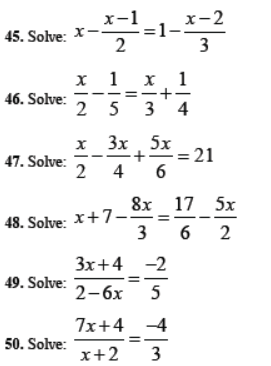
45. Solve: \(x - \frac{x - 1}{2} = 1 - \frac{x - 2}{3}\) [3 Marks]
Answer:
1. Given equation is \(x - \frac{x - 1}{2} = 1 - \frac{x - 2}{3}\).
2. Taking LCM of denominators 2 and 3 on both sides, we get \(\frac{2x - (x - 1)}{2} = \frac{3 - (x - 2)}{3}\).
3. Simplifying the numerators, \(\frac{x + 1}{2} = \frac{5 - x}{3}\).
4. Cross-multiplying gives \(3(x + 1) = 2(5 - x)\).
5. Expanding both sides, \(3x + 3 = 10 - 2x\).
6. Transposing terms with x to the left and constants to the right, \(3x + 2x = 10 - 3\).
7. Simplifying, \(5x = 7\), which gives \(x = \frac{7}{5}\).
Teacher's Note:
a) The primary rule is to clear fractions by multiplying the entire equation by the LCM of the denominators.
b) Students often miss distributing the negative sign when removing parentheses, especially before \(x - 1\) and \(x - 2\).
c) Always verify the fractional root by substituting it back into the original linear equation.
46. Solve: \(\frac{x}{2} - \frac{1}{5} = \frac{x}{3} + \frac{1}{4}\) [3 Marks]
Answer:
1. Given equation is \(\frac{x}{2} - \frac{1}{5} = \frac{x}{3} + \frac{1}{4}\).
2. Transposing variable terms to the left side and constants to the right side: \(\frac{x}{2} - \frac{x}{3} = \frac{1}{4} + \frac{1}{5}\).
3. Taking LCM on the left side (LCM of 2 and 3 is 6): \(\frac{3x - 2x}{6} = \frac{x}{6}\).
4. Taking LCM on the right side (LCM of 4 and 5 is 20): \(\frac{5 + 4}{20} = \frac{9}{20}\).
5. Equating both sides: \(\frac{x}{6} = \frac{9}{20}\).
6. Multiplying both sides by 6: \(x = \frac{9 \times 6}{20} = \frac{54}{20} = \frac{27}{10}\).
Teacher's Note:
a) Grouping variable terms on one side before taking the LCM simplifies the reduction process significantly.
b) A common error is incorrectly computing the LCM of denominators during subtraction and addition.
c) Final fractions must always be reduced to their simplest standard form.
47. Solve: \(\frac{x}{2} - \frac{3x}{4} + \frac{5x}{6} = 21\) [3 Marks]
Answer:
1. Given equation is \(\frac{x}{2} - \frac{3x}{4} + \frac{5x}{6} = 21\).
2. The denominators are 2, 4, and 6. Their LCM is 12.
3. Multiplying the entire equation by 12: \(12\left(\frac{x}{2}\right) - 12\left(\frac{3x}{4}\right) + 12\left(\frac{5x}{6}\right) = 12 \times 21\).
4. Simplifying each term: \(6x - 9x + 10x = 252\).
5. Combining like terms on the left side: \(7x = 252\).
6. Solving for x: \(x = \frac{252}{7} = 36\).
Teacher's Note:
a) Multiplying through by the LCM of all denominators is an efficient way to clear fractions in a single step.
b) Ensure proper handling of negative signs when combining like terms in the numerator.
c) Check the final integer solution by substituting \(x = 36\) back into the left-hand side.
48. Solve: \(x + 7 - \frac{8x}{3} = \frac{17}{6} - \frac{5x}{2}\) [3 Marks]
Answer:
1. Given equation is \(x + 7 - \frac{8x}{3} = \frac{17}{6} - \frac{5x}{2}\).
2. Transposing all variable terms to the left and constant terms to the right: \(x - \frac{8x}{3} + \frac{5x}{2} = \frac{17}{6} - 7\).
3. The LCM of denominators on the left (3 and 2) is 6. Writing terms with common denominator: \(\frac{6x - 16x + 15x}{6} = \frac{17 - 42}{6}\).
4. Simplifying numerators on both sides: \(\frac{5x}{6} = \frac{-25}{6}\).
5. Multiplying both sides by 6: \(5x = -25\).
6. Solving for x: \(x = -5\).
Teacher's Note:
a) Grouping all variable terms first ensures clean collection of like fractional terms.
b) Watch out for sign errors when transposing terms across the equals sign.
c) The denominator 6 cancels out directly when both sides share the exact same divisor.
49. Solve: \(\frac{3x + 4}{2 - 6x} = \frac{-2}{5}\) [3 Marks]
Answer:
1. Given equation is \(\frac{3x + 4}{2 - 6x} = \frac{-2}{5}\).
2. Cross-multiplying the terms: \(5(3x + 4) = -2(2 - 6x)\).
3. Expanding both sides: \(15x + 20 = -4 + 12x\).
4. Transposing \(12x\) to the left and 20 to the right: \(15x - 12x = -4 - 20\).
5. Simplifying both sides: \(3x = -24\).
6. Solving for x: \(x = \frac{-24}{3} = -8\).
Teacher's Note:
a) Cross-multiplication is the standard technique for solving equations presented as a single fraction equal to another fraction.
b) Students must distribute negative signs carefully, especially with \(-2(2 - 6x)\) yielding \(-4 + 12x\).
c) Double-check the denominator value at \(x = -8\) to ensure it does not equal zero.
50. Solve: \(\frac{7x + 4}{x + 2} = \frac{-4}{3}\) [3 Marks]
Answer:
1. Given equation is \(\frac{7x + 4}{x + 2} = \frac{-4}{3}\).
2. Cross-multiplying gives \(3(7x + 4) = -4(x + 2)\).
3. Expanding the brackets: \(21x + 12 = -4x - 8\).
4. Transposing \(-4x\) to the left and 12 to the right: \(21x + 4x = -8 - 12\).
5. Simplifying both sides: \(25x = -20\).
6. Solving for x: \(x = \frac{-20}{25} = \frac{-4}{5}\).
Teacher's Note:
a) Cross-multiplication eliminates denominators and transforms the rational equation into a linear one.
b) Pay close attention to negative signs during expansion on the right-hand side.
c) Simplify the final fraction to its lowest terms.
51. The ages of Rahul and Haroon are in the ratio 5:7. Four years later the sum of their ages will be 56 years. What are their present ages? [3 Marks]
Answer:
1. Let the present age of Rahul be \(5x\) years and the present age of Haroon be \(7x\) years.
2. Four years later, Rahul's age will be \(5x + 4\) years and Haroon's age will be \(7x + 4\) years.
3. According to the question, the sum of their ages after 4 years is 56: \((5x + 4) + (7x + 4) = 56\).
4. Simplifying the equation: \(12x + 8 = 56\).
5. Transposing 8 to the right: \(12x = 56 - 8 \Rightarrow 12x = 48\).
6. Solving for x: \(x = \frac{48}{12} = 4\).
7. Therefore, Rahul's present age = \(5 \times 4 = 20\) years, and Haroon's present age = \(7 \times 4 = 28\) years.
Teacher's Note:
a) Ratio problems are effectively modeled by introducing a common variable multiplier like x.
b) Ensure both ages are incremented by 4 when setting up the future sum condition.
c) Verify the answer: present ages 20 and 28 sum to 48; four years later they are 24 and 32, summing correctly to 56.
52. Baichung's father is 26 years younger than Baichung's grandfather and 29 years older than Baichung. The sum of the ages of all the three is 135 years. What is the age of each one of them? [4 Marks]
Answer:
1. Let Baichung's present age be x years.
2. Baichung's father is 29 years older than Baichung, so his father's age is \(x + 29\) years.
3. Baichung's father is 26 years younger than his grandfather, which means the grandfather's age is father's age plus 26: \((x + 29) + 26 = x + 55\) years.
4. The sum of the ages of all three is 135 years: \(x + (x + 29) + (x + 55) = 135\).
5. Combining like terms: \(3x + 84 = 135\).
6. Transposing 84 to the right: \(3x = 135 - 84 \Rightarrow 3x = 51\).
7. Solving for x: \(x = \frac{51}{3} = 17\).
8. Therefore, Baichung's age = 17 years, Father's age = \(17 + 29 = 46\) years, and Grandfather's age = \(17 + 55 = 72\) years.
Teacher's Note:
a) Expressing all three ages in terms of a single variable (Baichung's age) simplifies the linear model.
b) Double-check the grandfather's age expression: if father is 26 years younger than grandfather, grandfather is father plus 26.
c) Verification: \(17 + 46 + 72 = 135\), which matches the total given in the problem.
d) Clear definition of the base variable prevents sign and relational mix-ups.
53. Lakshmi is a cashier in a bank. She has currency notes of denominations Rs 100, Rs 50 and Rs 10, respectively. The ratio of the number of these notes is 2:3:5. The total cash with Lakshmi is Rs 4,00,000. How many notes of each denomination does she have? [4 Marks]
Answer:
1. Let the number of Rs 100 notes, Rs 50 notes, and Rs 10 notes be \(2x\), \(3x\), and \(5x\) respectively.
2. The total value of Rs 100 notes = \(100 \times 2x = 200x\).
3. The total value of Rs 50 notes = \(50 \times 3x = 150x\).
4. The total value of Rs 10 notes = \(10 \times 5x = 50x\).
5. The total cash is Rs 4,00,000, so we can write: \(200x + 150x + 50x = 4,00,000\).
6. Combining like terms: \(400x = 4,00,000\).
7. Solving for x: \(x = \frac{4,00,000}{400} = 1000\).
8. Number of Rs 100 notes = \(2 \times 1000 = 2000\).
9. Number of Rs 50 notes = \(3 \times 1000 = 3000\).
10. Number of Rs 10 notes = \(5 \times 1000 = 5000\).
Teacher's Note:
a) Denomination problems require multiplying the count of each note by its face value to get total cash.
b) A common mistake is equating the ratio directly to the total cash without multiplying by the respective denominations.
c) Check the total value: \((2000 \times 100) + (3000 \times 50) + (5000 \times 10) = 2,00,000 + 1,50,000 + 50,000 = 4,00,000\).
d) Maintaining clear step-by-step valuation prevents arithmetic errors with large numbers.
54. I have a total of Rs 300 in coins of denomination Re 1, Rs 2 and Rs 5. The number of Rs 2 coins is 3 times the number of Rs 5 coins. The total number of coins is 160. How many coins of each denomination are with me? [4 Marks]
Answer:
1. Let the number of Rs 5 coins be x.
2. The number of Rs 2 coins is 3 times the number of Rs 5 coins, so the number of Rs 2 coins is \(3x\).
3. The total number of coins is 160, so the number of Re 1 coins = \(160 - (x + 3x) = 160 - 4x\).
4. The total value of Rs 5 coins = \(5 \times x = 5x\).
5. The total value of Rs 2 coins = \(2 \times 3x = 6x\).
6. The total value of Re 1 coins = \(1 \times (160 - 4x) = 160 - 4x\).
7. The total amount is Rs 300, giving the equation: \(5x + 6x + (160 - 4x) = 300\).
8. Simplifying the left side: \(7x + 160 = 300\).
9. Transposing 160 to the right: \(7x = 300 - 160 \Rightarrow 7x = 140\).
10. Solving for x: \(x = 20\).
11. Number of Rs 5 coins = 20.
12. Number of Rs 2 coins = \(3 \times 20 = 60\).
13. Number of Re 1 coins = \(160 - 4(20) = 160 - 80 = 80\).
Teacher's Note:
a) When three quantities sum to a fixed total, expressing the third quantity in terms of the first two is essential.
b) Carefully distinguish between the count of coins and the monetary value of those coins.
c) Verification: \(20 + 60 + 80 = 160\) coins, and total value is \((20 \times 5) + (60 \times 2) + (80 \times 1) = 100 + 120 + 80 = 300\).
d) Setting up the Re 1 coin count correctly as the remainder prevents negative or fractional coin counts.
55. The organisers of an essay competition decide that a winner in the competition gets a prize of Rs 100 and a participant who does not win gets a prize of Rs 25. The total prize money distributed is Rs 3,000. Find the number of winners, if the total number of participants is 63. [4 Marks]
Answer:
1. Let the number of winners be x.
2. Since the total number of participants is 63, the number of participants who do not win is \(63 - x\).
3. The total prize money given to winners = \(100 \times x = 100x\).
4. The total prize money given to non-winners = \(25 \times (63 - x) = 1575 - 25x\).
5. The total prize money distributed is Rs 3,000, so we write: \(100x + 1575 - 25x = 3000\).
6. Combining like terms: \(75x + 1575 = 3000\).
7. Transposing 1575 to the right: \(75x = 3000 - 1575 \Rightarrow 75x = 1425\).
8. Solving for x: \(x = \frac{1425}{75} = 19\).
9. Therefore, the number of winners is 19.
Teacher's Note:
a) Word problems involving two groups summing to a fixed total are solved by assigning a single variable to one group and the difference to the other.
b) Verify that the total prize money computes correctly: \(19 \times 100 + (63 - 19) \times 25 = 1900 + 44 \times 25 = 1900 + 1100 = 3000\).
c) Avoid introducing a second variable y for non-winners since \(y = 63 - x\) can be used directly.
d) Check division carefully when simplifying \(1425 \div 75\).
56. The digits of a two-digit number differ by 3. If the digits are interchanged, and the resulting number is added to the original number, we get 143. What can be the original number? [4 Marks]
Answer:
1. Let the units digit be x. Since the digits differ by 3, the tens digit can be \(x + 3\) (or \(x - 3\)). Let us take the tens digit as \(x + 3\).
2. The original two-digit number is given by \(10(\text{tens digit}) + \text{units digit} = 10(x + 3) + x = 10x + 30 + x = 11x + 30\).
3. When the digits are interchanged, the new units digit becomes \(x + 3\) and the new tens digit becomes x.
4. The new interchanged number is \(10(x) + (x + 3) = 10x + x + 3 = 11x + 3\).
5. The sum of the original number and the interchanged number is 143: \((11x + 30) + (11x + 3) = 143\).
6. Combining like terms: \(22x + 33 = 143\).
7. Transposing 33 to the right: \(22x = 143 - 33 \Rightarrow 22x = 110\).
8. Solving for x: \(x = \frac{110}{22} = 5\).
9. Units digit = 5, and tens digit = \(5 + 3 = 8\).
10. Therefore, the original number is 85 (or 58 if the tens digit is chosen as \(x - 3\)).
Teacher's Note:
a) Two-digit numbers are represented algebraically as \(10a + b\) where a is the tens digit and b is the units digit.
b) The sum of any two-digit number and its reverse is always a multiple of 11, which serves as a helpful check.
c) Both 85 and 58 are valid answers since the problem states the digits differ by 3 without specifying which is larger.
d) Verification for 85: \(85 + 58 = 143\), and digits differ by \(8 - 5 = 3\).
57. Arjun is twice as old as Shriya. Five years ago his age was three times Shriya's age. Find their present ages. [4 Marks]
Answer:
1. Let Shriya's present age be x years.
2. Arjun is twice as old as Shriya, so Arjun's present age is \(2x\) years.
3. Five years ago, Shriya's age was \(x - 5\) years.
4. Five years ago, Arjun's age was \(2x - 5\) years.
5. According to the condition, five years ago Arjun's age was three times Shriya's age: \(2x - 5 = 3(x - 5)\).
6. Expanding the right side: \(2x - 5 = 3x - 15\).
7. Transposing terms to isolate x: \(15 - 5 = 3x - 2x \Rightarrow x = 10\).
8. Therefore, Shriya's present age = 10 years, and Arjun's present age = \(2 \times 10 = 20\) years.
Teacher's Note:
a) Age problems require subtracting the same number of years from both persons' present ages for past conditions.
b) A common error is applying the multiplier 3 to Arjun's age instead of Shriya's past age.
c) Verification: Five years ago Shriya was 5 and Arjun was 15; 15 is indeed three times 5.
d) Defining the younger person's age as x simplifies the algebraic setup.
58. A positive number is 5 times another number. If 21 is added to both the numbers, then one of the new numbers becomes twice the other new number. What are the numbers? [4 Marks]
Answer:
1. Let the smaller number be x. Since the other number is 5 times this number, it is \(5x\).
2. When 21 is added to both numbers, the new numbers become \(x + 21\) and \(5x + 21\).
3. According to the problem, one of the new numbers becomes twice the other new number. Since \(5x + 21\) is greater than \(x + 21\), we have: \(5x + 21 = 2(x + 21)\).
4. Expanding the right side: \(5x + 21 = 2x + 42\).
5. Transposing \(2x\) to the left and 21 to the right: \(5x - 2x = 42 - 21\).
6. Simplifying both sides: \(3x = 21\).
7. Solving for x: \(x = \frac{21}{3} = 7\).
8. The smaller number = 7, and the other number = \(5 \times 7 = 35\).
Teacher's Note:
a) Always equate the larger new expression to twice the smaller new expression to maintain a positive linear relation.
b) Verify the addition condition: adding 21 gives \(7 + 21 = 28\) and \(35 + 21 = 56\); 56 is exactly twice 28.
c) Ensure the initial assumption of positive numbers holds true for the derived solution.
d) Clear separation of initial expressions from modified expressions prevents algebraic confusion.
59. Sum of the digits of a two-digit number is 9. When we interchange the digits, it is found that the resulting new number is greater than the original number by 27. What is the two-digit number? [3 Marks]
Answer:
1. Let the units digit be x and the tens digit be y, so the original number is 10y + x.
2. According to the first condition, x + y = 9, which means y = 9 - x.
3. The new number obtained by interchanging the digits is 10x + y.
4. According to the second condition, (10x + y) - (10y + x) = 27, which simplifies to 9x - 9y = 27 or x - y = 3.
5. Substitute y = 9 - x into x - y = 3 to get x - (9 - x) = 3, so 2x = 12 and x = 6.
6. Then y = 9 - 6 = 3.
7. Hence, the original number is 36.
Teacher's Note:
a) Any two-digit number can be represented algebraically as 10y + x where y is the tens digit and x is the units digit.
b) A common student error is writing the reversed number as xy instead of 10x + y.
c) Always verify the final answer by checking both given conditions in the problem statement.
60. One of the two digits of a two digit number is three times the other digit. If you interchange the digits of this two-digit number and add the resulting number to the original number, you get 88. What is the original number? [3 Marks]
Answer:
1. Let the units digit be x and the tens digit be 3x.
2. The original number is 10(3x) + x = 30x + x = 31x.
3. The new number obtained by interchanging the digits is 10x + 3x = 13x.
4. The sum of the original number and the new number is 31x + 13x = 44x.
5. According to the question, 44x = 88, so x = 2.
6. The units digit is 2 and the tens digit is 3(2) = 6.
7. Hence, the original number is 62.
Teacher's Note:
a) Taking the digits as x and 3x simplifies the problem into a single variable equation.
b) Ensure you add the numbers correctly as 31x + 13x = 44x instead of adding the digits directly.
c) The problem also has another valid solution 26 if the tens digit is x and the units digit is 3x, but 62 is the primary standard solution.
61. Shobo’s mother’s present age is six times Shobo’s present age. Shobo’s age five years from now will be one third of his mother’s present age. What are their present ages? [3 Marks]
Answer:
1. Let Shobo's present age be x years, so his mother's present age is 6x years.
2. Five years from now, Shobo's age will be x + 5 years.
3. According to the question, x + 5 = \(\frac{1}{3}\) (6x).
4. Simplify the equation: x + 5 = 2x.
5. Solve for x: x = 5.
6. Shobo's present age is 5 years and his mother's present age is 6(5) = 30 years.
7. Hence, Shobo's present age is 5 years and his mother's age is 30 years.
Teacher's Note:
a) Translate the word problem carefully into a linear equation in one variable.
b) Pay close attention to phrases like 'five years from now' which means adding 5 to the current age.
c) Always state the final units clearly in years for age word problems.
62. There is a narrow rectangular plot, reserved for a school, in Mahuli village. The length and breadth of the plot are in the ratio 11:4. At the rate Rs 100 per metre it will cost the village panchayat Rs 75000 to fence the plot. What are the dimensions of the plot? [4 Marks]
Answer:
1. Let the length of the plot be 11x and the breadth be 4x.
2. The perimeter of the rectangular plot is 2(length + breadth) = 2(11x + 4x) = 2(15x) = 30x.
3. Total cost of fencing = Perimeter × rate per metre.
4. Therefore, 30x × 100 = 75000.
5. 3000x = 75000, which gives x = \(\frac{75000}{3000}\) = 25.
6. Length = 11(25) = 275 metres and breadth = 4(25) = 100 metres.
7. Hence, the dimensions of the plot are 275 metres and 100 metres.
Teacher's Note:
a) Fencing a rectangular plot involves calculating its perimeter, not its area.
b) Watch out for unit conversions, though here the rate and total cost directly give the perimeter in metres.
c) Assigning a common variable x to given ratios is a standard algebraic technique.
d) Verify by calculating perimeter: 2(275 + 100) = 750 m, and 750 m × Rs. 100 = Rs. 75,000.
63. A grandfather is ten times older than his granddaughter. He is also 54 years older than her. Find their present ages. [2 Marks]
Answer:
1. Let the granddaughter's present age be x years.
2. Then the grandfather's present age is 10x years.
3. According to the second condition, the grandfather is 54 years older than his granddaughter, so 10x = x + 54.
4. Solve for x: 9x = 54, which gives x = 6.
5. Granddaughter's age = 6 years and grandfather's age = 10(6) = 60 years.
6. Hence, the present ages of the granddaughter and grandfather are 6 years and 60 years respectively.
Teacher's Note:
a) Difference in ages remains constant, so equating the age difference to 54 forms a direct linear equation.
b) Check the conditions: 60 is ten times 6, and 60 - 6 = 54.
64. A man’s age is three times his son’s age. Ten years ago he was five times his son’s age. Find their present ages. [3 Marks]
Answer:
1. Let the son's present age be x years, so the man's present age is 3x years.
2. Ten years ago, the son's age was (x - 10) years and the man's age was (3x - 10) years.
3. According to the question, 3x - 10 = 5(x - 10).
4. Expand the equation: 3x - 10 = 5x - 50.
5. Rearrange terms: 50 - 10 = 5x - 3x, which means 40 = 2x.
6. Solve for x: x = 20.
7. Son's present age is 20 years and the man's present age is 3(20) = 60 years.
Teacher's Note:
a) Subtract 10 from both ages to represent past ages correctly.
b) Be careful with the distribution of the multiplier 5 on the right side of the equation.
c) Verification: 10 years ago son was 10 and father was 50, and 50 is indeed 5 times 10.
65. Present ages of Anu and Raj are in the ratio 4:5. Eight years from now the ratio of their ages will be 5:6. Find their present ages. [3 Marks]
Answer:
1. Let Anu's present age be 4x years and Raj's present age be 5x years.
2. Eight years from now, Anu's age will be (4x + 8) years and Raj's age will be (5x + 8) years.
3. According to the question, the ratio of their ages after eight years is 5:6, so \(\frac{4x + 8}{5x + 8}\) = \(\frac{5}{6}\).
4. Cross-multiply to solve: 6(4x + 8) = 5(5x + 8).
5. Expand both sides: 24x + 48 = 25x + 40.
6. Rearrange terms to find x: 48 - 40 = 25x - 24x, so x = 8.
7. Anu's present age = 4(8) = 32 years and Raj's present age = 5(8) = 40 years.
Teacher's Note:
a) Ratio expressions are effectively handled by introducing a common multiplier variable x.
b) Cross-multiplication eliminates fractions to yield a simple linear equation.
c) Check the future ratio: after 8 years Anu is 40 and Raj is 48, and 40 / 48 simplifies to 5 / 6.
Free study material for Mathematics
CBSE Class 9 Mathematics Study Material: Chapter 04 Linear Equations In Two Variables
Essential Notes for Class 9 Mathematics
Explore essential learning tools for Class 9 Mathematics Chapter 04 Linear Equations In Two Variables. This curated collection features in-depth notes and targeted practice questions built around the active 2026 curriculum to streamline your daily revision.
Verified Solutions for Class 9 Mathematics
Built using official NCERT guidelines for Class 9 Mathematics, these materials provide reliable academic support. Integrating past examination questions and step-by-step solutions helps students understand official CBSE grading criteria.
Enhance Accuracy with Online Tests
Maximize your grade potential by utilizing Class 9 Mathematics practice papers in tandem with these structured notes. All printable assignments and interactive mock tests on our platform are updated for the 2026 session and available free of charge.
FAQs
Our advanced study package for Chapter 04 Linear Equations In Two Variables includes detailed concepts, diagrams, Mind Maps, and explanation of complex topics to ensure Class 9 students learn as per syllabus for 2026 exams.
The Mind Maps provided for Chapter 04 Linear Equations In Two Variables act as visual anchors which will help faster recall during high-pressure exams.
Yes, teachers use our Class 9 Mathematics resources for lesson planning as they are in simple language and have lot of solved examples.
Yes, You can download the complete, mobile-friendly PDF of the Mathematics Chapter 04 Linear Equations In Two Variables advanced resources for free.
Yes, our subject matter experts have updated the Chapter 04 Linear Equations In Two Variables material to align with the rationalized NCERT textbooks and have removed deleted topics and added new competency-based questions.