

Official CBSE Study Materials for Class 9 Mathematics
Review targeted academic resources with the CBSE Class 9 Coordinate Geometry Sure Shot Questions. Built according to official CBSE standards for the 2026-27 term, these downloadable Class 9 Mathematics study materials support effective daily practice and deeper conceptual understanding for Chapter 03 Coordinate Geometry.
Advanced Resources for Mathematics
View or download the dedicated CBSE Class 9 Coordinate Geometry Sure Shot Questions resource below. Engaging with these advanced study guides under focused conditions ensures continuous academic progress and mastery of the 2026-27 curriculum for Chapter 03 Coordinate Geometry.
CBSE Class 9 Coordinate Geometry Sure Shot Questions. There are many more useful educational material which the students can download in pdf format and use them for studies. Study material like concept maps, important and sure shot question banks, quick to learn flash cards, flow charts, mind maps, teacher notes, important formulas, past examinations question bank, important concepts taught by teachers. Students can download these useful educational material free and use them to get better marks in examinations. Also refer to other worksheets for the same chapter and other subjects too. Use them for better understanding of the subjects.
PRACTICE QUESTIONS
CLASS IX : CHAPTER - 3
COORDINATE GEOMETRY
1. Which of the following points lie in I and II quadrants?
(1, 1), (2, -3), (-2, 3), (-1, 1), (-3, -2), (4, 3)
Answer:
1. Quadrant I: (1, 1) and (4, 3), since both coordinates are positive.
2. Quadrant II: (-2, 3) and (-1, 1), since x is negative and y is positive.
3. Points (2, -3) and (-3, -2) lie in quadrant IV and quadrant III respectively.
Teacher's Note:
a) Quadrant I has both coordinates positive, and quadrant II has x negative with y positive.
b) Check the sign of x first, because a common mistake is to read the point as if the signs did not matter.
2. Which of the following points lie on (a) x-axis (b) y-axis?
(5, 1), (8, 0), (0, 4), (-3, 0), (0, -3), (0, 5), (0, 0)
Answer:
1. (a) Points on the x-axis have y = 0: (8, 0) and (-3, 0).
2. (b) Points on the y-axis have x = 0: (0, 4), (0, -3), (0, 5) and (0, 0).
Teacher's Note:
a) The origin (0, 0) lies on both axes, so it belongs in both lists.
b) A point like (5, 1) lies on neither axis because neither coordinate is zero.
3. If the x-coordinate of a point is negative, it can lie in which quadrants?
Answer: A point with negative x-coordinate lies in quadrant II (if y is positive) or quadrant III (if y is negative). It can also lie on the negative x-axis.
Teacher's Note:
a) Quadrants II and III are the two quadrants to the left of the y-axis.
b) The sign of y decides which of the two left quadrants the point lies in.
4. From the figure, write the coordinates of the point P, Q, R and S. Does the line joining P and Q pass through origin?
[Figure: Coordinate plane with x-axis marked from -5 to 5 and y-axis marked from -4 to 4. Point P is at (1, 4), point Q at (3, 2), point R at (-4, -2) and point S at (-2, -4).]
Answer:
1. P = (1, 4), Q = (3, 2), R = (-4, -2) and S = (-2, -4).
2. Line PQ: slope = (2 - 4)/(3 - 1) = -1, so its equation is y = -x + 5.
3. At the origin, x = 0 gives y = 5, not 0. So the line PQ does not pass through the origin.
Teacher's Note:
a) Read the x-coordinate first, then the y-coordinate, when writing a point.
b) A line passes through the origin only if it satisfies x = 0 and y = 0 together.
5. Write the coordinates of the following points:
(i) lying on both axes
(ii) lying on x-axis and with x-coordinate 4
(iii) lying on y-axis with y-coordinate -3.
Answer:
1. (i) The origin (0, 0).
2. (ii) (4, 0).
3. (iii) (0, -3).
Teacher's Note:
a) Only the origin lies on both axes at the same time.
b) A point on the x-axis has y = 0, and a point on the y-axis has x = 0.
6. The coordinates of the three vertices of a rectangle ABCD are A(3, 2), B(-4, 2), C(-4, 5). Plot these points and write the coordinates of D.
Answer:
1. AB is horizontal and BC is vertical, so the opposite side DC must be horizontal at y = 5, and AD must be vertical at x = 3.
2. D = (3, 5).
Teacher's Note:
a) In a rectangle, the fourth vertex completes the shape with the same x as A and the same y as C.
b) Check that the opposite sides are equal, here 7 units and 3 units.
7. ABC is an equilateral triangle as shown in the figure. Find the coordinates of its vertices.
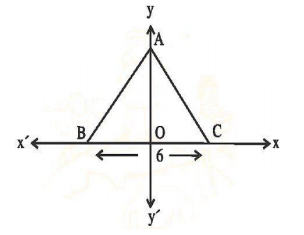
[Figure: Equilateral triangle ABC with base BC on the x-axis, B on the negative side and C on the positive side of the origin O, with the base marked as 6 units. Vertex A lies on the positive y-axis above O.]
Answer:
1. Side BC = 6 units, and O is the midpoint of BC, so B = (-3, 0) and C = (3, 0).
2. Height of an equilateral triangle of side 6 is (√3/2) × 6 = 3√3 ≈ 5.2 units.
3. A lies on the y-axis at the height 3√3, so A = (0, 3√3).
Teacher's Note:
a) Use the midpoint of the base to place the vertices symmetrically about the y-axis.
b) The height formula (√3/2) × side is a quick check for the y-coordinate of A.
8. Plot the following points on a graph paper:

| x | 1 | 2 | 3 | 4 | 5 |
|---|---|---|---|---|---|
| y | 5 | 8 | 11 | 14 | 17 |
Join these points. What do you observe?
Answer:
1. Points: (1, 5), (2, 8), (3, 11), (4, 14) and (5, 17).
2. Each y-value is 3 more than three times the x-value, that is, y = 3x + 2.
3. Observation: all the points lie on a straight line.
Teacher's Note:
a) The difference between successive y-values is constant, 3, when x increases by 1.
b) Joining the points gives a straight line, which is the graph of y = 3x + 2.
9. What is the name of horizontal and the vertical lines drawn to determine the position of any point in the Cartesian plane?
Answer: The horizontal line is the x-axis and the vertical line is the y-axis. Together they are called the coordinate axes.
Teacher's Note:
a) The x-axis is horizontal and the y-axis is vertical.
b) Both lines are called coordinate axes, and they are used as the reference lines for every point.
10. What is the name of each part of the plane formed by these two lines?
Answer: Each part of the plane is called a quadrant. There are four quadrants, named I, II, III and IV in anticlockwise order.
Teacher's Note:
a) Quadrant numbering starts at the upper right part and runs anticlockwise.
b) Points on the axes do not belong to any quadrant.
11. Write the name of the point where these two lines intersect.
Answer: The point of intersection of the x-axis and the y-axis is the origin, O, with coordinates (0, 0).
Teacher's Note:
a) Both coordinates of the origin are zero.
b) Every point on the axes is measured from the origin.
12. Locate the points (5, 0), (0, 5), (2, 5), (5, 2), (-3, 5), (-3, -5), (5, -3) and (6, 1) in the Cartesian plane.
Answer:
1. (5, 0) lies on the x-axis, and (0, 5) lies on the y-axis.
2. (2, 5) and (5, 2) lie in quadrant I, and (6, 1) lies in quadrant I.
3. (-3, 5) lies in quadrant II, (-3, -5) lies in quadrant III, and (5, -3) lies in quadrant IV.
Teacher's Note:
a) Move along x first and then along y, and do not swap the two numbers.
b) The point (5, 2) and (2, 5) are different points.
13. Draw the line passing through (2, 3) and (3, 2). Find the coordinates of the points at which this line meets the x-axis and y-axis.
Answer:
1. Slope of the line = (2 - 3)/(3 - 2) = -1, so the equation is x + y = 5.
2. On the x-axis, y = 0, so x = 5. The line meets the x-axis at (5, 0).
3. On the y-axis, x = 0, so y = 5. The line meets the y-axis at (0, 5).
Teacher's Note:
a) Both points satisfy x + y = 5, so the line can be checked against them.
b) On the x-axis put y = 0, and on the y-axis put x = 0.
14. Locate the coordinates of labelled points A, B, C, D, E, F, G and H in the following diagram:
[Figure: Coordinate diagram with labelled points. A is on the y-axis at 2. B is at (3, 3). C is on the x-axis at 3. D is at (4, -3). E is on the y-axis at -3. F is at (-4, -2). G is on the x-axis at -3. H is at (-4, 3). The segments AB, BC, CD, DE, EF, FG, GH and HA are drawn.]
Answer:
1. A = (0, 2), B = (3, 3), C = (3, 0), D = (4, -3).
2. E = (0, -3), F = (-4, -2), G = (-3, 0), H = (-4, 3).
Teacher's Note:
a) Points on an axis have one coordinate zero, which helps to check A, C, E and G.
b) Read the scale carefully, since the x-axis and y-axis are marked in units of 1.
15. Plot the following ordered pairs of number (x, y) as points in the Cartesian plane. Use the scale 1cm = 1 unit on the axes.

| x | -3 | 0 | -1 | 4 | 2 |
|---|---|---|---|---|---|
| y | 7 | -3.5 | -3 | 4 | -3 |
Answer:
1. Points are (-3, 7), (0, -3.5), (-1, -3), (4, 4) and (2, -3).
2. (-3, 7) lies in quadrant II, (-1, -3) lies in quadrant III, (4, 4) lies in quadrant I and (2, -3) lies in quadrant IV.
3. (0, -3.5) lies on the negative y-axis.
Teacher's Note:
a) A decimal y-value such as -3.5 lies halfway between -3 and -4.
b) Use the scale of 1 cm for each unit so the points stay accurate.
c) Negative values go down on the y-axis and to the left on the x-axis.
16. In which quadrant or on which axis do each of the points (-2, 4), (3, -1), (-1, 0), (1, 2) and (-3, -5) lie? Verify your answer by locating them on the Cartesian plane.
Answer:
1. (-2, 4): quadrant II.
2. (3, -1): quadrant IV.
3. (-1, 0): on the negative x-axis.
4. (1, 2): quadrant I.
5. (-3, -5): quadrant III.
Teacher's Note:
a) The point (-1, 0) has y = 0, so it lies on the x-axis and not in any quadrant.
b) Signs of (x, y) decide the quadrant directly.
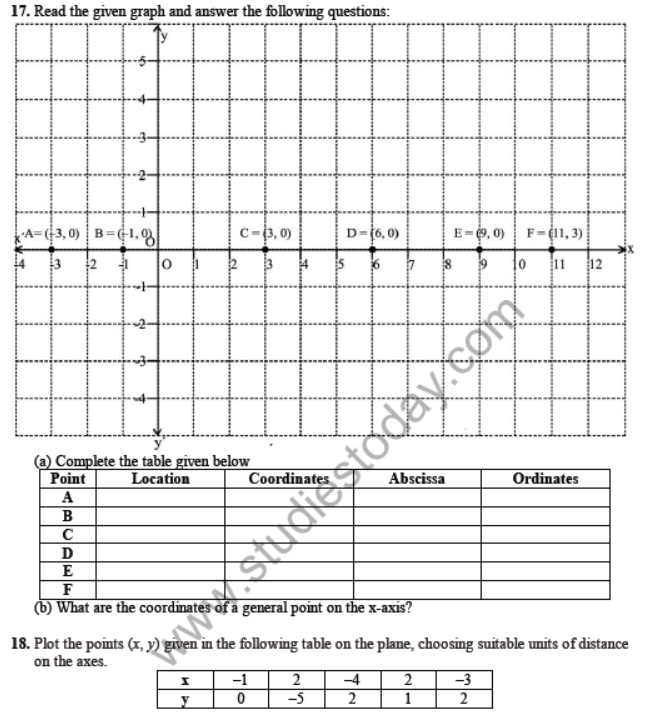
17. Read the given graph and answer the following questions:
(a) Complete the table given below
| Point | Location | Coordinates | Abscissa | Ordinates |
|---|---|---|---|---|
| A | ||||
| B | ||||
| C | ||||
| D | ||||
| E | ||||
| F |
(b) What are the coordinates of a general point on the x-axis?
[Figure: Graph with x-axis marked from -4 to 12 and y-axis marked from -4 to 6. Points A = (-3, 0), B = (-1, 0), C = (3, 0), D = (6, 0), E = (9, 0) and F = (11, 3) are labelled.]
Answer:
| Point | Location | Coordinates | Abscissa | Ordinates |
|---|---|---|---|---|
| A | On x-axis | (-3, 0) | -3 | 0 |
| B | On x-axis | (-1, 0) | -1 | 0 |
| C | On x-axis | (3, 0) | 3 | 0 |
| D | On x-axis | (6, 0) | 6 | 0 |
| E | On x-axis | (9, 0) | 9 | 0 |
| F | In quadrant I | (11, 3) | 11 | 3 |
(b) A general point on the x-axis is (x, 0), where x can be any real number.
Teacher's Note:
a) Abscissa is the x-coordinate and ordinate is the y-coordinate.
b) Points on the x-axis always have ordinate 0.
18. Plot the points (x, y) given in the following table on the plane, choosing suitable units of distance on the axes.
| x | -1 | 2 | -4 | 2 | -3 |
|---|---|---|---|---|---|
| y | 0 | -5 | 2 | 1 | 2 |
Answer:
1. Points: (-1, 0), (2, -5), (-4, 2), (2, 1) and (-3, 2).
2. Suitable scale: 1 unit on each axis, with x from -5 to 3 and y from -6 to 3.
Teacher's Note:
a) Choose a scale that fits the largest and smallest values in both tables.
b) The point (-1, 0) lies on the x-axis.
19. Plot the following points and verify if they lie on a line. If they lie on a line, name it.
(i) (0, 2), (0, 5), (0, 6), (0, 3.5)
(ii) A (1, 1), B (1, 2), C (1, 3), D (1, 4)
(iii) K (1, 3), L (2, 3), M (3, 3), N (4, 3)
(iv) W (2, 6), X (3, 5), Y (5, 3), Z (6, 2)
Answer:
1. (i) All points have x = 0, so they lie on the y-axis.
2. (ii) All points have x = 1, so they lie on the line x = 1, parallel to the y-axis.
3. (iii) All points have y = 3, so they lie on the line y = 3, parallel to the x-axis.
4. (iv) Slopes: (5 - 6)/(3 - 2) = -1, (3 - 5)/(5 - 3) = -1 and (2 - 3)/(6 - 5) = -1, so they lie on the line x + y = 8.
Teacher's Note:
a) Points with the same x-coordinate lie on a vertical line.
b) Points with the same y-coordinate lie on a horizontal line.
c) Equal slopes between successive points confirm that the points are collinear.
20. Plot the following points on a graph sheet. Verify if they lie on a line
(a) A(4, 0), B(4, 2), C(4, 6), D(4, 2.5)
(b) P(1, 1), Q(2, 2), R(3, 3), S(4, 4)
(c) K(2, 3), L(5, 3), M(5, 5), N(2, 5)
Answer:
1. (a) All points have x = 4, so they lie on the line x = 4, which is parallel to the y-axis.
2. (b) The points lie on the line y = x, since each y-value equals its x-value.
3. (c) K, L, M and N do not lie on a line. They are the corners of a rectangle with sides 3 units and 2 units.
Teacher's Note:
a) Points on a line x = constant are all at the same horizontal distance from the y-axis.
b) Check the slope between two points before concluding that the points are collinear.
c) Four points that form a closed figure cannot all lie on one straight line.
21. In which quadrant or on which axis do each of the points (5, 0), (0, 5), (2, 5), (5, 2), (-3, 5), (-3, -5), (5, -3) and (6, 1) in the Cartesian plane.
Answer:
1. (5, 0): on the x-axis.
2. (0, 5): on the y-axis.
3. (2, 5), (5, 2) and (6, 1): quadrant I.
4. (-3, 5): quadrant II.
5. (-3, -5): quadrant III.
6. (5, -3): quadrant IV.
Teacher's Note:
a) A zero coordinate places the point on an axis.
b) Both positive coordinates place the point in quadrant I.
22. Plot the points A (4, 4) and (-4, 4) on a graph sheet. Join the lines OA, OB and BA. What figure do you obtain.
Answer:
1. Here B = (-4, 4), the second point named in the question, and O is the origin.
2. OA = √(4² + 4²) = 4√2 and OB = √((-4)² + 4²) = 4√2, so OA = OB.
3. AB = 8 units, horizontal.
4. The figure is an isosceles right-angled triangle, with the right angle at O.
Teacher's Note:
a) The second point is printed without a label, so it is taken as B.
b) Check the right angle with the dot product of OA and OB, which is zero.
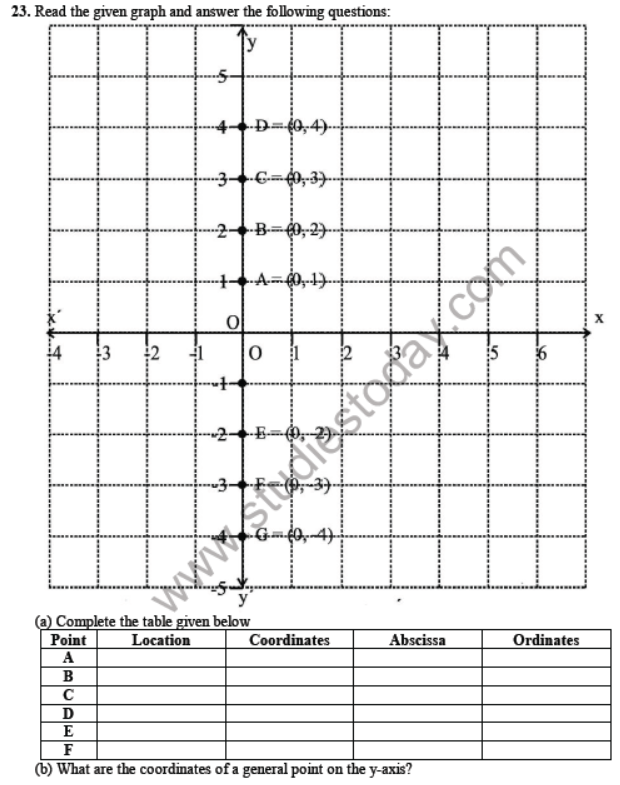
23. Read the given graph and answer the following questions:
(a) Complete the table given below
| Point | Location | Coordinates | Abscissa | Ordinates |
|---|---|---|---|---|
| A | ||||
| B | ||||
| C | ||||
| D | ||||
| E | ||||
| F |
(b) What are the coordinates of a general point on the y-axis?
[Figure: Graph with y-axis marked from -5 to 5 and x-axis marked from -4 to 6. Points A = (0, 1), B = (0, 2), C = (0, 3), D = (0, 4), E = (0, -2), F = (0, -3) and G = (0, -4) are labelled on the y-axis.]
Answer:
| Point | Location | Coordinates | Abscissa | Ordinates |
|---|---|---|---|---|
| A | On y-axis | (0, 1) | 0 | 1 |
| B | On y-axis | (0, 2) | 0 | 2 |
| C | On y-axis | (0, 3) | 0 | 3 |
| D | On y-axis | (0, 4) | 0 | 4 |
| E | On y-axis | (0, -2) | 0 | -2 |
| F | On y-axis | (0, -3) | 0 | -3 |
(b) A general point on the y-axis is (0, y), where y can be any real number.
Teacher's Note:
a) The abscissa of every point on the y-axis is 0.
b) Point G = (0, -4) is also on the y-axis, although the table asks only for A to F.
24. Plot the point P (-6, 2) and from it draw PM and PN as perpendiculars to x-axis and y-axis, respectively. Write the coordinates of the points M and N.
Answer:
1. PM is perpendicular to the x-axis, so M is the foot of the perpendicular on the x-axis: M = (-6, 0).
2. PN is perpendicular to the y-axis, so N is the foot of the perpendicular on the y-axis: N = (0, 2).
Teacher's Note:
a) M keeps the x-coordinate of P and takes y = 0.
b) N keeps the y-coordinate of P and takes x = 0.
25. Plot the following points and write the name of the figure thus obtained : P(-3, 2), Q (-7, -3), R (6, -3), S (2, 2)
Answer:
1. PS is horizontal with length 5 units, and QR is horizontal with length 13 units, so PS is parallel to QR.
2. PQ and SR are not parallel, since their slopes are 5/4 and -5/4.
3. The figure PQRS has exactly one pair of parallel sides, so it is a trapezium.
Teacher's Note:
a) A trapezium has exactly one pair of parallel sides.
b) Two sides of equal slope would make the figure a parallelogram, which is not the case here.
26. Plot the following points and check whether they are collinear or not :
(i) (1, 3), (-1, -1), (-2, -3)
(ii) (1, 1), (2, -3), (-1, -2)
(iii) (0, 0), (2, 2), (5, 5)
Answer:
1. (i) Slope from (1, 3) to (-1, -1) is 2, and slope from (-1, -1) to (-2, -3) is 2. The points are collinear.
2. (ii) Slope from (1, 1) to (2, -3) is -4, and slope from (2, -3) to (-1, -2) is -1/3. The points are not collinear.
3. (iii) Slope from (0, 0) to (2, 2) is 1, and slope from (2, 2) to (5, 5) is 1. The points are collinear.
Teacher's Note:
a) Equal slopes between successive points are the test for collinearity.
b) Check at least two slopes, because one pair of equal values is not enough.
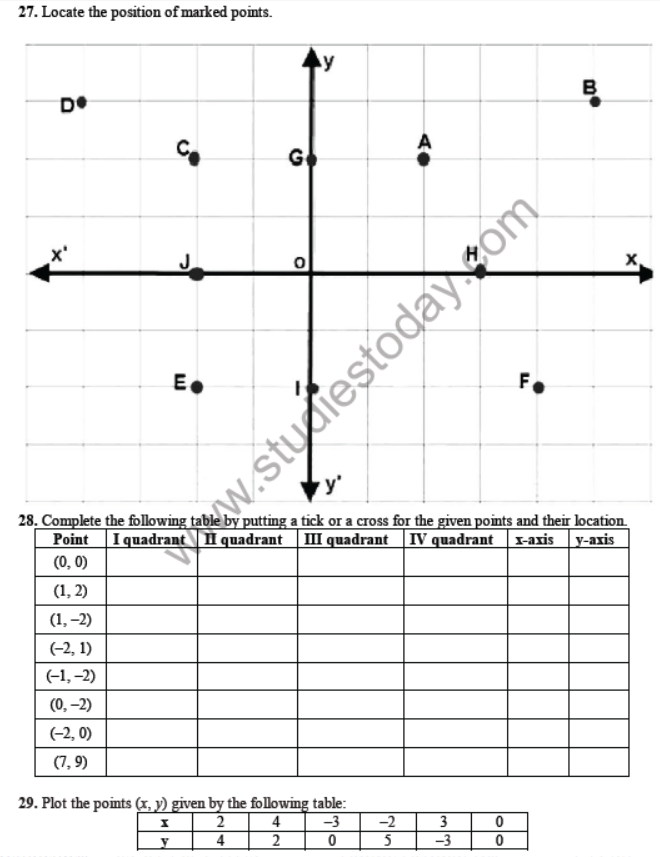
27. Locate the position of marked points.
[Figure: Coordinate plane with x-axis marked from -4 to 5 and y-axis marked from -2 to 3. Points marked: A near (2, 2), B near (5, 3), C near (-2, 2), D near (-4, 3), E near (-2, -2), F near (4, -2), G on the y-axis at (0, 2), H on the x-axis at (3, 0), I on the y-axis at (0, -2) and J on the x-axis at (-2, 0).]
Answer:
1. A = (2, 2), B = (5, 3), C = (-2, 2), D = (-4, 3), E = (-2, -2).
2. F = (4, -2), G = (0, 2), H = (3, 0), I = (0, -2), J = (-2, 0).
Teacher's Note:
a) Points G, H, I and J each have one coordinate zero, so they lie on an axis.
b) Count grid lines from the origin along x first, then along y.
28. Complete the following table by putting a tick or a cross for the given points and their location.
| Point | I quadrant | II quadrant | III quadrant | IV quadrant | x-axis | y-axis |
|---|---|---|---|---|---|---|
| (0, 0) | ||||||
| (1, 2) | ||||||
| (1, -2) | ||||||
| (-2, 1) | ||||||
| (-1, -2) | ||||||
| (0, -2) | ||||||
| (-2, 0) | ||||||
| (7, 9) |
Answer:
| Point | I quadrant | II quadrant | III quadrant | IV quadrant | x-axis | y-axis |
|---|---|---|---|---|---|---|
| (0, 0) | ✗ | ✗ | ✗ | ✗ | ✓ | ✓ |
| (1, 2) | ✓ | ✗ | ✗ | ✗ | ✗ | ✗ |
| (1, -2) | ✗ | ✗ | ✗ | ✓ | ✗ | ✗ |
| (-2, 1) | ✗ | ✓ | ✗ | ✗ | ✗ | ✗ |
| (-1, -2) | ✗ | ✗ | ✓ | ✗ | ✗ | ✗ |
| (0, -2) | ✗ | ✗ | ✗ | ✗ | ✗ | ✓ |
| (-2, 0) | ✗ | ✗ | ✗ | ✗ | ✓ | ✗ |
| (7, 9) | ✓ | ✗ | ✗ | ✗ | ✗ | ✗ |
Teacher's Note:
a) The origin lies on both axes and in no quadrant.
b) A point on the x-axis has y = 0, so (-2, 0) is a tick under x-axis only.
29. Plot the points (x, y) given by the following table:
| x | 2 | 4 | -3 | -2 | 3 | 0 |
|---|---|---|---|---|---|---|
| y | 4 | 2 | 0 | 5 | -3 | 0 |
Answer:
1. Points: (2, 4), (4, 2), (-3, 0), (-2, 5), (3, -3) and (0, 0).
2. (-3, 0) lies on the negative x-axis, and (0, 0) is the origin.
Teacher's Note:
a) Plot each row as one pair, reading x from the top row and y from the bottom row.
b) Two points with a zero coordinate lie on an axis.
30. Without plotting the points indicate the quadrant in which they will lie, if
(i) ordinate is 5 and abscissa is -3
(ii) abscissa is -5 and ordinate is -3
(iii) abscissa is -5 and ordinate is 3
(iv) ordinate is 5 and abscissa is 3
Answer:
1. (i) (-3, 5) lies in quadrant II.
2. (ii) (-5, -3) lies in quadrant III.
3. (iii) (-5, 3) lies in quadrant II.
4. (iv) (3, 5) lies in quadrant I.
Teacher's Note:
a) Abscissa is the x-coordinate and ordinate is the y-coordinate, so write the pair in that order.
b) Both signs decide the quadrant, so check x and y separately.
31. In which quadrant or on which axis each of the following points lie?
(-3, 5), (4, -1), (2, 0), (2, 2), (-3, -6)
Answer:
1. (-3, 5): quadrant II.
2. (4, -1): quadrant IV.
3. (2, 0): on the positive x-axis.
4. (2, 2): quadrant I.
5. (-3, -6): quadrant III.
Teacher's Note:
a) A zero y-coordinate puts the point on the x-axis.
b) Two negative coordinates always give quadrant III.
32. In the below Figure, LM is a line parallel to the y-axis at a distance of 3 units.
(i) What are the coordinates of the points P, R and Q?
(ii) What is the difference between the abscissa of the points L and M?
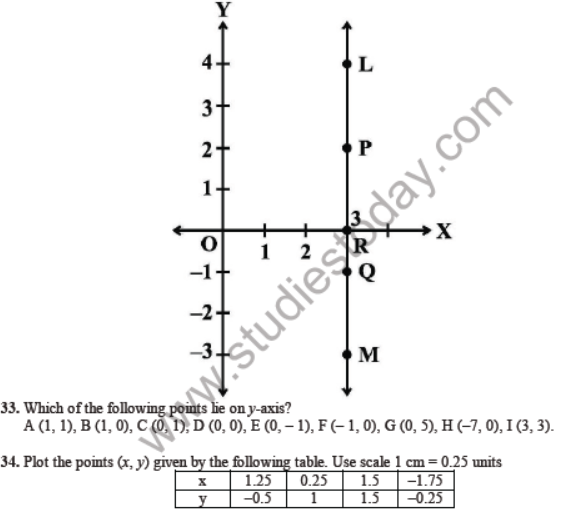
[Figure: Coordinate plane with line LM parallel to the y-axis at x = 3. Points on the line are L at height 4, P at height 2, R at height 0 on the x-axis, Q at height -1 and M at height -3.]
Answer:
1. (i) P = (3, 2), R = (3, 0), Q = (3, -1).
2. (ii) L = (3, 4) and M = (3, -3), both have abscissa 3.
3. The difference between their abscissas is 3 - 3 = 0.
Teacher's Note:
a) Points on a line parallel to the y-axis all share the same abscissa.
b) A difference of 0 is the expected result, not a mistake.
33. Which of the following points lie on y-axis?
A (1, 1), B (1, 0), C (0, 1), D (0, 0), E (0, -1), F (-1, 0), G (0, 5), H (-7, 0), I (3, 3).
Answer: C (0, 1), D (0, 0), E (0, -1) and G (0, 5) lie on the y-axis.
Teacher's Note:
a) A point lies on the y-axis when its x-coordinate is 0.
b) The origin D (0, 0) also lies on the y-axis, although it is also on the x-axis.
34. Plot the points (x, y) given by the following table. Use scale 1 cm = 0.25 units
| x | 1.25 | 0.25 | 1.5 | -1.75 |
|---|---|---|---|---|
| y | -0.5 | 1 | 1.5 | -0.25 |
Answer:
1. Points: (1.25, -0.5), (0.25, 1), (1.5, 1.5) and (-1.75, -0.25).
2. With 1 cm = 0.25 units, each point is placed 5 cm per unit along the axes, so 1.25 units lies 5 cm from the origin.
Teacher's Note:
a) Divide each coordinate by 0.25 to find the distance in centimetres.
b) Decimal values need a careful reading of the scale.
35. A point lies on the x-axis at a distance of 7 units from the y-axis. What are its coordinates? What will be the coordinates if it lies on y-axis at a distance of -7 units from x-axis?
Answer:
1. On the x-axis at a distance of 7 units from the y-axis: (7, 0) or (-7, 0).
2. On the y-axis at a distance of -7 units from the x-axis: (0, -7).
Teacher's Note:
a) A point on the x-axis is at distance 7 from the y-axis on either side, so both signs are valid.
b) The distance from the x-axis is measured by the y-coordinate, which is -7 here.
36. Find the coordinates of the point
(i) which lies on x and y axes both.
(ii) whose ordinate is -4 and which lies on y-axis.
(iii) whose abscissa is 5 and which lies on x-axis.
Answer:
1. (i) (0, 0), the origin.
2. (ii) (0, -4).
3. (iii) (5, 0).
Teacher's Note:
a) The origin is the only point common to both axes.
b) On the y-axis the abscissa is 0, and on the x-axis the ordinate is 0.
37. Taking 0.5 cm as 1 unit, plot the following points on the graph paper : A (1, 3), B (-3, -1), C (1, -4), D (-2, 3), E (0, -8), F (1, 0)
Answer:
1. Each unit is 0.5 cm, so a point such as A (1, 3) is 0.5 cm right and 1.5 cm up from O.
2. Points: A (1, 3), B (-3, -1), C (1, -4), D (-2, 3), E (0, -8) and F (1, 0).
Teacher's Note:
a) Multiply each coordinate by 0.5 cm to get the distance on paper.
b) E lies on the y-axis, and F lies on the x-axis.
38. Plot the points P (1, 0), Q (4, 0) and S (1, 3). Find the coordinates of the point R such that PQRS is a square.
Answer:
1. PQ = 3 units along the x-axis, so the square has side 3.
2. R is vertically above Q at the same height as S, so R = (4, 3).
Teacher's Note:
a) In a square, adjacent sides are equal and perpendicular, so the side from Q must be 3 units upward.
b) The point R must be opposite to P, so check that PS = QR = 3.
39. Three vertices of a rectangle are (3, 2), (-4, 2) and (-4, 5). Plot these points and find the coordinates of the fourth vertex.
Answer:
1. The side from (-4, 2) to (-4, 5) is vertical, so the opposite side is also vertical at x = 3.
2. The side from (3, 2) to (-4, 2) is horizontal, so the opposite side is horizontal at y = 5.
3. Fourth vertex = (3, 5).
Teacher's Note:
a) The fourth vertex has the x-coordinate of one given vertex and the y-coordinate of the other.
b) Check that the opposite sides are equal, 7 units and 3 units.
40. Three vertices of a rectangle are (4, 2), (-3, 2) and (-3, 7). Plot these points and find the coordinates of the fourth vertex.
Answer:
1. The side from (-3, 2) to (-3, 7) is vertical at x = -3, so the opposite side is at x = 4.
2. The side from (4, 2) to (-3, 2) is horizontal at y = 2, so the opposite side is at y = 7.
3. Fourth vertex = (4, 7).
Teacher's Note:
a) Use the x-value that is not shared by the two vertices already on the same vertical side.
b) The sides are 7 units and 5 units, so the figure is a rectangle.
41. Points A (5, 3), B (-2, 3) and D (5, -4) are three vertices of a square ABCD. Plot these points on a graph paper and hence find the coordinates of the vertex C.
Answer:
1. AB = 7 units, so each side of the square is 7 units.
2. AD is vertical from (5, 3) to (5, -4), of length 7 units.
3. C is opposite A, so C = B + (D - A) = (-2, 3) + (0, -7) = (-2, -4).
Teacher's Note:
a) In a square ABCD, the vertices go around in order, so C lies next to both B and D.
b) Check that BC = 7 and CD = 7 after finding C.
42. Write the coordinates of the vertices of a rectangle whose length and breadth are 5 and 3 units respectively, one vertex at the origin, the longer side lies on the x-axis and one of the vertices lies in the third quadrant.
Answer:
1. Longer side of 5 units lies on the x-axis, from O to (-5, 0), so the rectangle extends into the third quadrant.
2. Breadth of 3 units is taken downward, so the vertices are (0, 0), (-5, 0), (-5, -3) and (0, -3).
Teacher's Note:
a) The vertex (-5, -3) is the only one in the third quadrant.
b) If the breadth were taken upward, no vertex would lie in the third quadrant.
43. Plot the points A (1, -1) and B (4, 5) (i) Draw a line segment joining these points. Write the coordinates of a point on this line segment between the points A and B. (ii) Extend this line segment and write the coordinates of a point on this line which lies outside the line segment AB.
Answer:
1. Slope of AB = (5 + 1)/(4 - 1) = 2, so the line is y = 2x - 3.
2. (i) A point between A and B is (2, 1), since 2 × 2 - 3 = 1.
3. (ii) A point beyond A on the extended line is (0, -3), since 2 × 0 - 3 = -3.
Teacher's Note:
a) Any point with x between 1 and 4 lies on segment AB.
b) Points beyond A or B have x less than 1 or greater than 4.
44. Plot the points P (0, -3), Q (0, 3) and R (6, 3). Find the coordinates of the point S such that PQRS is a square.
Answer:
1. PQ is vertical with length 6 units, and QR is horizontal with length 6 units.
2. S is directly below R at the same distance from P, so S = (6, -3).
Teacher's Note:
a) In square PQRS, the vertices are taken in order around the figure.
b) S must be at the same height as P and the same x as R.
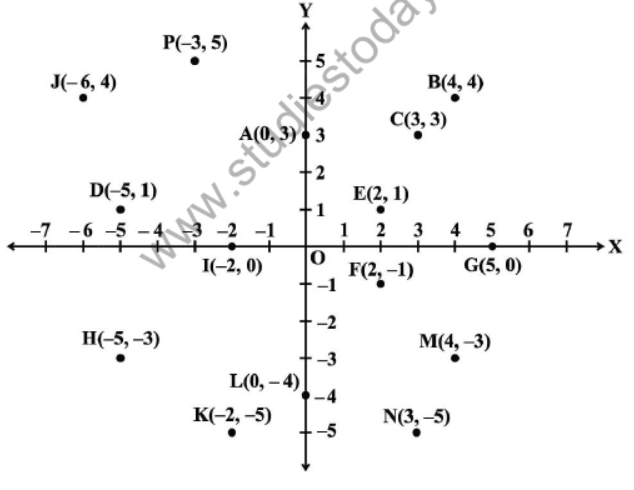
45. From the below graph, answer the following : (i) Write the points whose abscissa is 0. (ii) Write the points whose ordinate is 0. (iii) Write the points whose abscissa is -5.
[Figure: Coordinate graph labelled with points P(-3, 5), J(-6, 4), B(4, 4), A(0, 3), C(3, 3), D(-5, 1), E(2, 1), I(-2, 0), G(5, 0), F(2, -1), H(-5, -3), M(4, -3), L(0, -4), K(-2, -5) and N(3, -5).]
Answer:
1. (i) Abscissa 0: A (0, 3) and L (0, -4).
2. (ii) Ordinate 0: I (-2, 0) and G (5, 0).
3. (iii) Abscissa -5: D (-5, 1) and H (-5, -3).
Teacher's Note:
a) Points with abscissa 0 lie on the y-axis, and points with ordinate 0 lie on the x-axis.
b) Read the labelled coordinates and check the sign of each one.
Free study material for Mathematics
CBSE Class 9 Mathematics Study Material: Chapter 03 Coordinate Geometry
Comprehensive Study Resources for Chapter 03 Coordinate Geometry
Access comprehensive study material for Chapter 03 Coordinate Geometry, including revision notes, concept maps, and high-probability questions. These resources are designed in alignment with the latest 2026 CBSE syllabus for Class 9 Mathematics to support effective exam preparation.
Understanding Marking Schemes
Built using official NCERT guidelines for Class 9 Mathematics, these materials provide reliable academic support. Integrating past examination questions and step-by-step solutions helps students understand official CBSE grading criteria.
Complete Revision for Mathematics
Maximize your grade potential by utilizing Class 9 Mathematics practice papers in tandem with these structured notes. All printable assignments and interactive mock tests on our platform are updated for the 2026 session and available free of charge.
FAQs
Our advanced study package for Chapter 03 Coordinate Geometry includes detailed concepts, diagrams, Mind Maps, and explanation of complex topics to ensure Class 9 students learn as per syllabus for 2026 exams.
The Mind Maps provided for Chapter 03 Coordinate Geometry act as visual anchors which will help faster recall during high-pressure exams.
Yes, teachers use our Class 9 Mathematics resources for lesson planning as they are in simple language and have lot of solved examples.
Yes, You can download the complete, mobile-friendly PDF of the Mathematics Chapter 03 Coordinate Geometry advanced resources for free.
Yes, our subject matter experts have updated the Chapter 03 Coordinate Geometry material to align with the rationalized NCERT textbooks and have removed deleted topics and added new competency-based questions.