

Class 9 Mathematics Study Guide: CBSE Class 9 Surface Areas and Volumes Sure Shot Questions
Explore structured advanced study materials through the CBSE Class 9 Surface Areas and Volumes Sure Shot Questions. Tailored for Class 9 learners, utilizing these Mathematics resources ensures thorough preparation and strengthens foundational knowledge before final CBSE evaluations.
Download Chapter 13 Surface Areas and Volumes Study Material PDF
Navigate directly to the advanced Mathematics study materials using the digital viewer below. Each resource pack includes detailed conceptual summaries and solved practice questions, allowing students to instantly reinforce their learning.
CBSE Class 9 Surface Areas and Volumes Sure Shot Questions. There are many more useful educational material which the students can download in pdf format and use them for studies. Study material like concept maps, important and sure shot question banks, quick to learn flash cards, flow charts, mind maps, teacher notes, important formulas, past examinations question bank, important concepts taught by teachers. Students can download these useful educational material free and use them to get better marks in examinations. Also refer to other worksheets for the same chapter and other subjects too. Use them for better understanding of the subjects.
PRACTICE QUESTIONS
CLASS IX: CHAPTER - 13
SURFACE AREAS AND VOLUMES
11. The dimensions of a prayer Hall are 20m x 15m x 8m. Find the cost of painting its walls at Rs. 10 per m².
Answer:
1. Length l = 20 m, breadth b = 15 m, height h = 8 m.
2. Area of the four walls = 2 (l + b) × h = 2 (20 + 15) × 8 = 560 m²
3. Cost of painting = 560 × 10 = Rs. 5,600
Teacher's Note:
a) Walls mean the lateral surface area; the floor and ceiling are not painted.
b) Area of four walls = 2h (l + b).
12. Find the curved surface area of a right circular cylinder whose height is 13.5 cm and radius of tis base is 7 cm. Find also its surface area.
Answer:
1. Radius r = 7 cm and height h = 13.5 cm.
2. Curved surface area = 2πrh = 2 × \( \frac{22}{7} \) × 7 × 13.5 = 594 cm²
3. Total surface area = 2πr (r + h) = 2 × \( \frac{22}{7} \) × 7 × (7 + 13.5) = 44 × 20.5 = 902 cm²
Teacher's Note:
a) "Surface area" here means total surface area, which includes the two circular ends.
b) Curved surface area is only 2πrh.
13. The exterior diameter of an iron pipe is 25cm and it is one cm thick. Find the whole surface are of the pipe it is 21cm long.
Answer:
1. Outer radius R = 12.5 cm; inner radius r = 12.5 - 1 = 11.5 cm; length h = 21 cm.
2. Outer curved surface area = 2πRh = 2 × \( \frac{22}{7} \) × 12.5 × 21 = 1650 cm²
3. Inner curved surface area = 2πrh = 2 × \( \frac{22}{7} \) × 11.5 × 21 = 1518 cm²
4. Area of the two circular rings at the ends = 2π (R² - r²) = 2 × \( \frac{22}{7} \) × (156.25 - 132.25) = \( \frac{1056}{7} \) ≈ 150.86 cm²
5. Whole surface area = 1650 + 1518 + 150.86 = 3318.86 cm² (approximately).
Teacher's Note:
a) A hollow pipe has an outer surface, an inner surface and two ring-shaped ends.
b) The ring area is π (R² - r²), not πR².
c) Check using the shortcut 2π (R + r) (h + R - r) = \( \frac{23232}{7} \) ≈ 3318.86 cm².
14. A roller 150 cm long has a diameter of 70 cm. To level a playground it takes 750 complete revolutions. Determine the cost of leveling the playground at the rate of 75 paise per m².
Answer:
1. Radius r = 35 cm and length h = 150 cm.
2. Area covered in one revolution = curved surface area = 2πrh = 2 × \( \frac{22}{7} \) × 35 × 150 = 33000 cm²
3. Area of the playground = 750 × 33000 = 24750000 cm² = 2475 m²
4. Cost of leveling = 2475 × 0.75 = Rs. 1,856.25
Teacher's Note:
a) Convert cm² to m² by dividing by 10000.
b) 75 paise = Rs. 0.75.
15. Find the total surface area of a cone, if its slant height is 21 cm and the diameter of its base is 24 cm.
Answer:
1. Slant height l = 21 cm and radius r = 12 cm.
2. Total surface area = πr (l + r) = \( \frac{22}{7} \) × 12 × (21 + 12)
3. = \( \frac{22 × 12 × 33}{7} \) = \( \frac{8712}{7} \) ≈ 1244.57 cm²
Teacher's Note:
a) Radius is half of the given diameter.
b) Total surface area includes the base: πrl + πr².
16. The volume of a sphere is 4851 cm³. How much should its radius be reduced so that it volume becomes \( \frac{4312}{3} \) cm³.
Answer:
1. Volume of the sphere = \( \frac{4}{3} \) πr³ = 4851
2. r³ = 4851 × \( \frac{3 × 7}{4 × 22} \) = 1157.625, so r = 10.5 cm.
3. New volume = \( \frac{4}{3} \) πR³ = \( \frac{4312}{3} \)
4. R³ = \( \frac{4312 × 3 × 7}{3 × 4 × 22} \) = 343, so R = 7 cm.
5. Reduction in radius = 10.5 - 7 = 3.5 cm
Teacher's Note:
a) Use V = \( \frac{4}{3} \) πr³ both times and take the cube root.
b) Check: 10.5³ = 1157.625 and 7³ = 343.
17. A river, 3 m deep and 40m wide, is flowing at the rate of 2km/hr. How much water will fall into the sea in a minute?
Answer:
1. Rate of flow = 2 km/hr = 2000 m per 60 minutes = \( \frac{100}{3} \) m per minute.
2. Water flowing in 1 minute is a cuboid of length \( \frac{100}{3} \) m, breadth 40 m and depth 3 m.
3. Volume = \( \frac{100}{3} \) × 40 × 3 = 4000 m³
Teacher's Note:
a) Treat flowing water as a cuboid whose length is the distance covered in the given time.
b) Convert km/hr to m/min before multiplying.
18. Find the capacity in litres of a conical vessel whose diameter is 14 cm and slant height is 25 cm.
Answer:
1. Radius r = 7 cm and slant height l = 25 cm.
2. Height h = √(l² - r²) = √(625 - 49) = √576 = 24 cm
3. Volume = \( \frac{1}{3} \) πr²h = \( \frac{1}{3} \) × \( \frac{22}{7} \) × 49 × 24 = 1232 cm³
4. 1 litre = 1000 cm³, so capacity = \( \frac{1232}{1000} \) = 1.232 litres.
Teacher's Note:
a) Slant height is not the height; find h using Pythagoras theorem first.
b) 1000 cm³ = 1 litre.
19. What is the total surface area of a hemisphere of base radius 7cm?
Answer:
1. Total surface area of a solid hemisphere = 3πr²
2. = 3 × \( \frac{22}{7} \) × 7 × 7 = 462 cm²
Teacher's Note:
a) Total surface area = curved surface 2πr² + flat base πr².
b) A hollow hemisphere would have only 2πr².
20. A village having a population of 4000, requires 150 litres of water per head per day. It has a tank measuring 20m x 15m x 6m. For how many days, the water of the tank will be sufficient for the village?
Answer:
1. Water needed per day = 4000 × 150 = 600000 litres
2. Capacity of the tank = 20 × 15 × 6 = 1800 m³ = 1800 × 1000 = 1800000 litres
3. Number of days = \( \frac{1800000}{600000} \) = 3
Teacher's Note:
a) 1 m³ = 1000 litres.
b) Keep both quantities in litres before dividing.
21. Mary wants to decorate her Christmas tree. She wants to place the tree on a wooden box covered with coloured paper with picture of Santa Claus on it. She must know the exact quantity of paper to buy for this purpose. If the box has length, breadth and height as 80 cm, 40 cm and 20 cm respectively how many square sheets of paper of side 40 cm would she require?
Answer:
1. Length l = 80 cm, breadth b = 40 cm and height h = 20 cm.
2. Surface area of the box = 2 (lb + bh + hl) = 2 (3200 + 800 + 1600) = 11200 cm²
3. Area of one square sheet = 40 × 40 = 1600 cm²
4. Number of sheets = \( \frac{11200}{1600} \) = 7
Teacher's Note:
a) The box is covered on all six faces, so use the total surface area.
b) The count came out whole (7), so no rounding is needed.
22. Hameed has built a cubical water tank with lid for his house, with each outer edge 1.5 m long. He gets the outer surface of the tank excluding the base, covered with square tiles of side 25 cm. Find how much he would spend for the tiles, if the cost of the tiles is Rs 360 per dozen.
Answer:
1. Edge = 1.5 m = 150 cm. Faces to be tiled = 6 - 1 (base) = 5.
2. Area to be covered = 5 × 150 × 150 = 112500 cm²
3. Area of one tile = 25 × 25 = 625 cm²
4. Number of tiles = \( \frac{112500}{625} \) = 180 = 15 dozen
5. Cost = 15 × 360 = Rs. 5,400
Teacher's Note:
a) Count the faces first: the lid is covered but the base is not.
b) Tiles are priced per dozen, so convert 180 tiles to 15 dozen.
c) Convert 1.5 m to 150 cm to match the tile size.
23. A small indoor greenhouse (herbarium) is made entirely of glass panes (including base) held together with tape. It is 30 cm long, 25 cm wide and 25 cm high. (i) What is the area of the glass? (ii) How much of tape is needed for all the 12 edges?
Answer:
1. Length l = 30 cm, breadth b = 25 cm and height h = 25 cm.
2. (i) Area of glass = total surface area = 2 (lb + bh + hl) = 2 (750 + 625 + 750) = 4250 cm²
3. (ii) Tape needed = sum of all 12 edges = 4 (l + b + h) = 4 (30 + 25 + 25) = 320 cm
Teacher's Note:
a) Glass covers all six faces because the base is included.
b) A cuboid has 4 edges each of length, breadth and height.
24. Shanti Sweets Stall was placing an order for making cardboard boxes for packing their sweets. Two sizes of boxes were required. The bigger of dimensions 25 cm × 20 cm × 5 cm and the smaller of dimensions 15 cm × 12 cm × 5 cm. For all the overlaps, 5% of the total surface area is required extra. If the cost of the cardboard is Rs 4 for 1000 cm², find the cost of cardboard required for supplying 250 boxes of each kind.
Answer:
1. Surface area of the bigger box = 2 (25 × 20 + 20 × 5 + 5 × 25) = 2 (500 + 100 + 125) = 1450 cm²
2. Surface area of the smaller box = 2 (15 × 12 + 12 × 5 + 5 × 15) = 2 (180 + 60 + 75) = 630 cm²
3. Total for one box of each kind = 1450 + 630 = 2080 cm²
4. Extra for overlaps = 5% of 2080 = 104 cm², so cardboard for one pair = 2184 cm².
5. For 250 boxes of each kind = 250 × 2184 = 546000 cm²
6. Cost = \( \frac{546000}{1000} \) × 4 = Rs. 2,184
Teacher's Note:
a) Add 5% to the surface area before multiplying by the number of boxes.
b) Total area times cost per 1000 cm² gives the final cost.
c) Check: 546 × 4 = 2184.
25. Parveen wanted to make a temporary shelter for her car, by making a box-like structure with tarpaulin that covers all the four sides and the top of the car (with the front face as a flap which can be rolled up). Assuming that the stitching margins are very small, and therefore negligible, how much tarpaulin would be required to make the shelter of height 2.5 m, with base dimensions 4 m × 3 m?
Answer:
1. Length l = 4 m, breadth b = 3 m and height h = 2.5 m.
2. Area of the four sides = 2 (l + b) h = 2 (4 + 3) × 2.5 = 35 m²
3. Area of the top = l × b = 4 × 3 = 12 m²
4. Tarpaulin required = 35 + 12 = 47 m²
Teacher's Note:
a) The floor is not covered, so it is not counted.
b) The flap is part of the front side and is included in the four sides.
26. Savitri had to make a model of a cylindrical kaleidoscope for her science project. She wanted to use chart paper to make the curved surface of the kaleidoscope. What would be the area of chart paper required by her, if she wanted to make a kaleidoscope of length 25 cm with a 3.5 cm radius?
[Figure: A vertical cylinder (kaleidoscope) with circular top and bottom]
Answer:
1. Radius r = 3.5 cm and length (height) h = 25 cm.
2. Curved surface area = 2πrh = 2 × \( \frac{22}{7} \) × 3.5 × 25 = 550 cm²
3. Hence, 550 cm² of chart paper is required.
Teacher's Note:
a) Only the curved surface is needed, so the circular ends are not included.
27. A metal pipe is 77 cm long. The inner diameter of a cross section is 4 cm, the outer diameter being 4.4 cm. Find its
(i) inner curved surface area,
(ii) outer curved surface area,
(iii) total surface area.
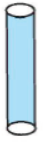
[Figure: A hollow cylindrical metal pipe]
Answer:
1. Length h = 77 cm, inner radius r = 2 cm and outer radius R = 2.2 cm.
2. (i) Inner curved surface area = 2πrh = 2 × \( \frac{22}{7} \) × 2 × 77 = 968 cm²
3. (ii) Outer curved surface area = 2πRh = 2 × \( \frac{22}{7} \) × 2.2 × 77 = 1064.8 cm²
4. (iii) Area of the two circular rings at the ends = 2π (R² - r²) = 2 × \( \frac{22}{7} \) × (4.84 - 4) = 5.28 cm²
5. Total surface area = 968 + 1064.8 + 5.28 = 2038.08 cm²
Teacher's Note:
a) The total surface area of a hollow pipe has four parts: inner, outer and two end rings.
b) Part (iii) is often written as only 968 + 1064.8, which misses the end rings.
c) Each ring has area π (R² - r²).
28. Find (i) the lateral or curved surface area of a closed cylindrical petrol storage tank that is 4.2 m in diameter and 4.5 m high. (ii) how much steel was actually used, if \( \frac{1}{12} \) of the steel actually used was wasted in making the tank.
Answer:
1. Radius r = 2.1 m and height h = 4.5 m.
2. (i) Curved surface area = 2πrh = 2 × \( \frac{22}{7} \) × 2.1 × 4.5 = 59.4 m²
3. (ii) Total surface area of the closed tank = 2πr (r + h) = 2 × \( \frac{22}{7} \) × 2.1 × 6.6 = 87.12 m²
4. Let the steel actually used be x m². Then \( \frac{1}{12} \) of x is wasted, so \( \frac{11}{12} \) x = 87.12.
5. x = 87.12 × \( \frac{12}{11} \) = 95.04 m²
6. Hence, 95.04 m² of steel was actually used.
Teacher's Note:
a) The tank is closed, so the total surface area includes both circular ends.
b) The wasted part is a fraction of the steel used, not of the tank area.
c) Check: 95.04 - \( \frac{95.04}{12} \) = 95.04 - 7.92 = 87.12.
29. Find the curved surface area of a right circular cone whose slant height is 10 cm and base radius is 7 cm.
Answer:
1. Slant height l = 10 cm and radius r = 7 cm.
2. Curved surface area = πrl = \( \frac{22}{7} \) × 7 × 10 = 220 cm²
Teacher's Note:
a) Curved surface area of a cone = πrl.
30. The height of a cone is 16 cm and its base radius is 12 cm. Find the curved surface area and the total surface area of the cone (Use π = 3.14).
Answer:
1. Height h = 16 cm and radius r = 12 cm.
2. Slant height l = √(r² + h²) = √(144 + 256) = √400 = 20 cm
3. Curved surface area = πrl = 3.14 × 12 × 20 = 753.6 cm²
4. Total surface area = πr (l + r) = 3.14 × 12 × 32 = 1205.76 cm²
Teacher's Note:
a) Find the slant height first; the height cannot be used in πrl.
b) Total surface area = curved surface area + base area = 753.6 + 452.16.
31. A corn cob shaped somewhat like a cone, has the radius of its broadest end as 2.1 cm and length (height) as 20 cm. If each 1 cm² of the surface of the cob carries an average of four grains, find how many grains you would find on the entire cob.
Answer:
1. Radius r = 2.1 cm and height h = 20 cm.
2. Slant height l = √(2.1² + 20²) = √404.41 ≈ 20.11 cm
3. Curved surface area = πrl = \( \frac{22}{7} \) × 2.1 × 20.11 ≈ 132.73 cm²
4. Number of grains = 4 × 132.73 ≈ 530.9, that is about 531 grains.
Teacher's Note:
a) Only the curved surface of the cob carries grains, not the flat end.
b) Round the final count to a whole number of grains.
32. In the adjoining figure you see the frame of a lampshade. It is to be covered with a decorative cloth. The frame has a base diameter of 20 cm and height of 30 cm. A margin of 2.5 cm is to be given for folding it over the top and bottom of the frame. Find how much cloth is required for covering the lampshade.
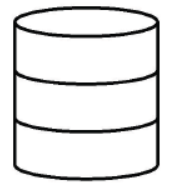
[Figure: Frame of a lampshade in the shape of a cylinder with two circular rings drawn across its height]
Answer:
1. Radius r = 10 cm and height of the frame = 30 cm.
2. Height of the cloth = 30 + 2.5 + 2.5 = 35 cm
3. Area of cloth = curved surface area of a cylinder of height 35 cm = 2πrh = 2 × \( \frac{22}{7} \) × 10 × 35 = 2200 cm²
Teacher's Note:
a) The cloth covers only the curved surface, with margins added at both ends.
b) Add the margin twice, once at the top and once at the bottom.
33. A conical tent is 10 m high and the radius of its base is 24 m. Find (i) slant height of the tent. (ii) cost of the canvas required to make the tent, if the cost of 1 m² canvas is Rs 70.
Answer:
1. Height h = 10 m and radius r = 24 m.
2. (i) Slant height l = √(r² + h²) = √(576 + 100) = √676 = 26 m
3. (ii) Canvas required = πrl = \( \frac{22}{7} \) × 24 × 26 = \( \frac{13728}{7} \) m²
4. Cost = \( \frac{13728}{7} \) × 70 = 13728 × 10 = Rs. 1,37,280
Teacher's Note:
a) Canvas is needed only for the curved surface of the tent.
b) 70 ÷ 7 = 10 makes the calculation easy.
34. What length of tarpaulin 3 m wide will be required to make conical tent of height 8 m and base radius 6 m? Assume that the extra length of material that will be required for stitching margins and wastage in cutting is approximately 20 cm (Use π = 3.14).
Answer:
1. Height h = 8 m and radius r = 6 m.
2. Slant height l = √(36 + 64) = 10 m
3. Area of tarpaulin needed = πrl = 3.14 × 6 × 10 = 188.4 m²
4. Length of the tarpaulin = \( \frac{Area}{Width} \) = \( \frac{188.4}{3} \) = 62.8 m
5. Adding 20 cm = 0.2 m for margins and wastage: 62.8 + 0.2 = 63 m
Teacher's Note:
a) Area = length × width, so length = area ÷ width.
b) Convert 20 cm to 0.2 m before adding.
35. The slant height and base diameter of a conical tomb are 25 m and 14 m respectively. Find the cost of white-washing its curved surface at the rate of Rs 210 per 100 m².
Answer:
1. Slant height l = 25 m and radius r = 7 m.
2. Curved surface area = πrl = \( \frac{22}{7} \) × 7 × 25 = 550 m²
3. Cost = \( \frac{550}{100} \) × 210 = Rs. 1,155
Teacher's Note:
a) The rate is per 100 m², so divide the area by 100 first.
b) Radius is half of the diameter 14 m.
36. A joker’s cap is in the form of a right circular cone of base radius 7 cm and height 24 cm. Find the area of the sheet required to make 10 such caps.
Answer:
1. Radius r = 7 cm and height h = 24 cm.
2. Slant height l = √(49 + 576) = √625 = 25 cm
3. Sheet for one cap = curved surface area = πrl = \( \frac{22}{7} \) × 7 × 25 = 550 cm²
4. Sheet for 10 caps = 10 × 550 = 5500 cm²
Teacher's Note:
a) A cap is open at the base, so only the curved surface is needed.
b) Multiply by 10 only at the end.
37. A hemispherical dome of a building needs to be painted. If the circumference of the base of the dome is 17.6 m, find the cost of painting it, given the cost of painting is Rs 5 per 100 cm².
Answer:
1. Circumference of the base = 2πr = 17.6 m, so r = \( \frac{17.6 × 7}{2 × 22} \) = 2.8 m.
2. Curved surface area of the dome = 2πr² = 2 × \( \frac{22}{7} \) × 2.8 × 2.8 = 49.28 m²
3. 49.28 m² = 49.28 × 10000 = 492800 cm²
4. Cost = \( \frac{492800}{100} \) × 5 = Rs. 24,640
Teacher's Note:
a) Only the curved surface of the dome is painted.
b) The rate is per cm², so convert m² to cm² (1 m² = 10000 cm²).
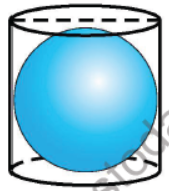
38. A right circular cylinder just encloses a sphere of radius r. Find (i) surface area of the sphere, (ii) curved surface area of the cylinder, (iii) ratio of the areas obtained in (i) and (ii).
[Figure: A sphere of radius r placed inside a right circular cylinder, touching the curved surface and the top and bottom circles]
Answer:
1. The cylinder just encloses the sphere, so its radius is r and its height is the diameter of the sphere, h = 2r.
2. (i) Surface area of the sphere = 4πr²
3. (ii) Curved surface area of the cylinder = 2πrh = 2πr × 2r = 4πr²
4. (iii) Ratio = 4πr² : 4πr² = 1 : 1
Teacher's Note:
a) The height of the cylinder equals the diameter of the sphere.
b) This is Archimedes’ result: the sphere has the same surface area as its enclosing cylinder (curved part).
39. A hemispherical bowl is made of steel, 0.25 cm thick. The inner radius of the bowl is 5 cm. Find the outer curved surface area of the bowl.
Answer:
1. Inner radius = 5 cm, thickness = 0.25 cm.
2. Outer radius R = 5 + 0.25 = 5.25 cm
3. Outer curved surface area = 2πR² = 2 × \( \frac{22}{7} \) × 5.25 × 5.25 = 173.25 cm²
Teacher's Note:
a) Use the outer radius, not the inner radius, for the outer surface.
b) Curved surface area of a hemisphere = 2πr².
40. A wall of length 10 m was to be built across an open ground. The height of the wall is 4 m and thickness of the wall is 24 cm. If this wall is to be built up with bricks whose dimensions are 24 cm × 12 cm × 8 cm, how many bricks would be required?
Answer:
1. Volume of the wall = 1000 cm × 400 cm × 24 cm = 9600000 cm³
2. Volume of one brick = 24 × 12 × 8 = 2304 cm³
3. Number of bricks = \( \frac{9600000}{2304} \) = 4166.67
4. Bricks cannot be used in parts, so 4167 bricks are required.
Teacher's Note:
a) Convert all lengths to cm before finding the volumes.
b) The division does not give a whole number; round up to the next whole brick.
41. A village, having a population of 4000, requires 150 litres of water per head per day. It has a tank measuring 20 m × 15 m × 6 m. For how many days will the water of this tank last?
Answer:
1. Water needed per day = 4000 × 150 = 600000 litres
2. Capacity of the tank = 20 × 15 × 6 = 1800 m³ = 1800000 litres
3. Number of days = \( \frac{1800000}{600000} \) = 3
Teacher's Note:
a) 1 m³ = 1000 litres.
b) This is the same data as question 20, so the answer must match.
42. A godown measures 40 m × 25 m × 10 m. Find the maximum number of wooden crates each measuring 1.5 m × 1.25 m × 0.5 m that can be stored in the godown.
Answer:
1. Volume of the godown = 40 × 25 × 10 = 10000 m³
2. Volume of one crate = 1.5 × 1.25 × 0.5 = 0.9375 m³
3. Maximum number of crates = \( \frac{10000}{0.9375} \) = 10666.67
4. Hence, the maximum number of crates is 10666.
Teacher's Note:
a) The volume method gives the upper limit on the number of crates, as expected in this chapter.
b) Always round down, because a fraction of a crate cannot be stored.
43. A solid cube of side 12 cm is cut into eight cubes of equal volume. What will be the side of the new cube? Also, find the ratio between their surface areas.
Answer:
1. Volume of the big cube = 12³ = 1728 cm³
2. Volume of each small cube = \( \frac{1728}{8} \) = 216 cm³
3. Side of the new cube = ∛216 = 6 cm
4. Surface area of the big cube = 6 × 12² = 864 cm²; surface area of a small cube = 6 × 6² = 216 cm²
5. Ratio of the surface areas (big : small) = 864 : 216 = 4 : 1
Teacher's Note:
a) Volume is conserved when the cube is cut.
b) The side is halved but the surface area becomes one-fourth, since area depends on the square of the side.
44. A river 3 m deep and 40 m wide is flowing at the rate of 2 km per hour. How much water will fall into the sea in a minute?
Answer:
1. Rate of flow = 2 km/hr = 2000 m per 60 minutes = \( \frac{100}{3} \) m per minute.
2. Volume of water in one minute = \( \frac{100}{3} \) × 40 × 3 = 4000 m³
Teacher's Note:
a) This is the same problem as question 17, so the answer is 4000 m³.
b) Think of the water that passes in one minute as a cuboid.
45. The capacity of a closed cylindrical vessel of height 1 m is 15.4 litres. How many square metres of metal sheet would be needed to make it?
Answer:
1. Capacity = 15.4 litres = 15400 cm³ and height h = 1 m = 100 cm.
2. πr²h = 15400, so r² = \( \frac{15400 × 7}{22 × 100} \) = 49 and r = 7 cm = 0.07 m.
3. Total surface area = 2πr (r + h) = 2 × \( \frac{22}{7} \) × 0.07 × (0.07 + 1) = 0.44 × 1.07 = 0.4708 m²
4. Hence, 0.4708 m² of metal sheet is needed.
Teacher's Note:
a) The vessel is closed, so both circular ends are included.
b) Convert litres to cm³ (1 litre = 1000 cm³) and then to metres.
46. A lead pencil consists of a cylinder of wood with a solid cylinder of graphite filled in the interior. The diameter of the pencil is 7 mm and the diameter of the graphite is 1 mm. If the length of the pencil is 14 cm, find the volume of the wood and that of the graphite.
Answer:
1. Length h = 14 cm = 140 mm; radius of the pencil = 3.5 mm; radius of the graphite = 0.5 mm.
2. Volume of the graphite = π × 0.5 × 0.5 × 140 = \( \frac{22}{7} \) × 35 = 110 mm³
3. Volume of the whole pencil = π × 3.5 × 3.5 × 140 = \( \frac{22}{7} \) × 1715 = 5390 mm³
4. Volume of the wood = 5390 - 110 = 5280 mm³
Teacher's Note:
a) Wood volume = volume of the whole pencil - volume of the graphite.
b) Use the same unit (mm) for the length and the radii.
47. The pillars of a temple are cylindrically shaped. If each pillar has a circular base of radius 20 cm and height 10 m, how much concrete mixture would be required to build 14 such pillars?
Answer:
1. Radius r = 20 cm = 0.2 m and height h = 10 m.
2. Volume of one pillar = πr²h = \( \frac{22}{7} \) × 0.2 × 0.2 × 10 = \( \frac{8.8}{7} \) m³
3. Volume for 14 pillars = 14 × \( \frac{8.8}{7} \) = 17.6 m³
Teacher's Note:
a) The printed question ends at "14 such", so "pillars" is supplied to complete the sense.
b) Change the radius to metres, since the height is in metres.
48. Monica has a piece of canvas whose area is 551 m². She uses it to have a conical tent made, with a base radius of 7 m. Assuming that all the stitching margins and the wastage incurred while cutting, amounts to approximately 1 m², find the volume of the tent that can be made with it.
Answer:
1. Area of canvas actually used for the tent = 551 - 1 = 550 m²
2. Curved surface area πrl = 550, so \( \frac{22}{7} \) × 7 × l = 550 and l = 25 m.
3. Height h = √(l² - r²) = √(625 - 49) = √576 = 24 m
4. Volume of the tent = \( \frac{1}{3} \) πr²h = \( \frac{1}{3} \) × \( \frac{22}{7} \) × 49 × 24 = 1232 m³
Teacher's Note:
a) The printed "m-" is read as m², the unit of area.
b) Subtract the wastage before using the area for the curved surface.
49. A right triangle ABC with sides 5 cm, 12 cm and 13 cm is revolved about the side 12 cm. Find the volume of the solid so obtained.
Answer:
1. When the triangle is revolved about the side 12 cm, a cone is formed with height h = 12 cm and base radius r = 5 cm (the slant height is 13 cm).
2. Volume = \( \frac{1}{3} \) πr²h = \( \frac{1}{3} \) × \( \frac{22}{7} \) × 25 × 12 = \( \frac{2200}{7} \) ≈ 314.29 cm³
Teacher's Note:
a) The side about which the triangle is revolved becomes the height.
b) The hypotenuse 13 cm becomes the slant height.
50. A heap of wheat is in the form of a cone whose diameter is 10.5 m and height is 3 m. Find its volume. The heap is to be covered by canvas to protect it from rain. Find the area of the canvas required.
Answer:
1. Radius r = 5.25 m and height h = 3 m.
2. Volume = \( \frac{1}{3} \) πr²h = \( \frac{1}{3} \) × \( \frac{22}{7} \) × 5.25 × 5.25 × 3 = 86.625 m³
3. Slant height l = √(r² + h²) = √(27.5625 + 9) = √36.5625 ≈ 6.05 m
4. Area of canvas = πrl = \( \frac{22}{7} \) × 5.25 × 6.05 ≈ 99.77 m²
Teacher's Note:
a) Canvas covers only the curved surface of the heap.
b) Compute l with more decimals (6.0467) to get 99.77 m².
51. A dome of a building is in the form of a hemisphere. From inside, it was white-washed at the cost of Rs 498.96. If the cost of white-washing is Rs 2.00 per square metre, find the (i) inside surface area of the dome, (ii) volume of the air inside the dome.
Answer:
1. (i) Inside surface area = \( \frac{498.96}{2} \) = 249.48 m²
2. (ii) 2πr² = 249.48, so r² = \( \frac{249.48 × 7}{2 × 22} \) = 39.69 and r = 6.3 m.
3. Volume of air = \( \frac{2}{3} \) πr³ = \( \frac{2}{3} \) × \( \frac{22}{7} \) × 6.3 × 6.3 × 6.3 ≈ 523.9 m³
Teacher's Note:
a) The inside surface of the dome is the curved surface 2πr², with no base.
b) Volume of air = volume of the hemisphere, \( \frac{2}{3} \) πr³.
52. Twenty seven solid iron spheres, each of radius r and surface area S are melted to form a sphere with surface area S'. Find the (i) radius r'of the new sphere, (ii) ratio of S and S'.
Answer:
1. (i) Volume of the new sphere = volume of 27 small spheres: \( \frac{4}{3} \) πr'³ = 27 × \( \frac{4}{3} \) πr³
2. r'³ = 27 r³, so r' = 3r.
3. (ii) S = 4πr² and S' = 4π (3r)² = 36πr²
4. S : S' = 4πr² : 36πr² = 1 : 9
Teacher's Note:
a) Melting keeps the volume the same, not the surface area.
b) Surface area changes as the square of the radius ratio, here 3² = 9.
53. A capsule of medicine is in the shape of a sphere of diameter 3.5 mm. How much medicine (in mm³) is needed to fill this capsule?
Answer:
1. Radius r = 1.75 mm
2. Volume = \( \frac{4}{3} \) πr³ = \( \frac{4}{3} \) × \( \frac{22}{7} \) × 1.75 × 1.75 × 1.75
3. = \( \frac{539}{24} \) ≈ 22.46 mm³
Teacher's Note:
a) Take the radius as half of the given diameter.
b) The medicine needed equals the volume of the sphere.
54. The surface area of a sphere of radius 5 cm is five times the area of the curved surface of a cone of radius 4 cm. Find the height and the volume of the cone (taking π = \( \frac{22}{7} \))
Answer:
1. Surface area of the sphere = 4π × 5² = 100π cm²
2. Curved surface area of the cone = πrl = 4πl
3. Given 100π = 5 × 4πl, so l = 5 cm.
4. Height h = √(l² - r²) = √(25 - 16) = 3 cm
5. Volume = \( \frac{1}{3} \) πr²h = \( \frac{1}{3} \) × \( \frac{22}{7} \) × 16 × 3 = \( \frac{352}{7} \) ≈ 50.29 cm³
Teacher's Note:
a) Form the equation 100π = 5 × (πrl) and solve for the slant height.
b) The 3, 4, 5 triple gives the height without a calculator.
55. The radius of a sphere is increased by 10%. Prove that the volume will be increased by 33.1% approximately.
Answer:
1. Let the original radius be r. Original volume V = \( \frac{4}{3} \) πr³.
2. New radius = r + 10% of r = 1.1 r
3. New volume V' = \( \frac{4}{3} \) π (1.1 r)³ = 1.331 × \( \frac{4}{3} \) πr³ = 1.331 V
4. Increase in volume = 1.331 V - V = 0.331 V
5. Percentage increase = \( \frac{0.331 V}{V} \) × 100 = 33.1%
6. Hence, the volume increases by 33.1% (exactly, as 1.1³ = 1.331).
Teacher's Note:
a) Volume depends on the cube of the radius, so the percentage change is not 10%.
b) 1.1 × 1.1 × 1.1 = 1.331.
56. Metal spheres, each of radius 2 cm, are packed into a rectangular box of internal dimensions 16 cm × 8 cm × 8 cm. When 16 spheres are packed the box is filled with preservative liquid. Find the volume of this liquid. Give your answer to the nearest integer. [Use π = 3.14]
Answer:
1. Volume of the box = 16 × 8 × 8 = 1024 cm³
2. Volume of one sphere = \( \frac{4}{3} \) × 3.14 × 2³ = 33.4933 cm³
3. Volume of 16 spheres = 16 × 33.4933 = 535.893 cm³
4. Volume of the liquid = 1024 - 535.893 = 488.107 ≈ 488 cm³
Teacher's Note:
a) The liquid fills the space left between the spheres and the box.
b) Round only at the last step.
57. A storage tank is in the form of a cube. When it is full of water, the volume of water is 15.625 m³. If the present depth of water is 1.3 m, find the volume of water already used from the tank.
Answer:
1. Volume of the full tank = side³ = 15.625 m³, so the side = 2.5 m.
2. Volume of water present = 2.5 × 2.5 × 1.3 = 8.125 m³
3. Water already used = 15.625 - 8.125 = 7.5 m³
Teacher's Note:
a) The depth of the water is the height of the water cuboid; the base is the same 2.5 m × 2.5 m.
b) Check: the water level has fallen by 1.2 m, and 6.25 × 1.2 = 7.5.
58. Find the amount of water displaced by a solid spherical ball of diameter 4.2 cm, when it is completely immersed in water.
Answer:
1. Radius r = 2.1 cm
2. Water displaced = volume of the ball = \( \frac{4}{3} \) πr³ = \( \frac{4}{3} \) × \( \frac{22}{7} \) × 2.1 × 2.1 × 2.1 = 38.808 cm³
Teacher's Note:
a) A fully immersed solid displaces water equal to its own volume.
59. How many square metres of canvas is required for a conical tent whose height is 3.5 m and the radius of the base is 12 m?
Answer:
1. Height h = 3.5 m and radius r = 12 m.
2. Slant height l = √(12² + 3.5²) = √(144 + 12.25) = √156.25 = 12.5 m
3. Canvas required = πrl = \( \frac{22}{7} \) × 12 × 12.5 = \( \frac{3300}{7} \) ≈ 471.43 m²
Teacher's Note:
a) Canvas covers the curved surface only.
b) 156.25 is a perfect square: 12.5².
60. Two solid spheres made of the same metal have weights 5920 g and 740 g, respectively. Determine the radius of the larger sphere, if the diameter of the smaller one is 5 cm.
Answer:
1. For the same metal, weight is proportional to volume, so \( \frac{V1}{V2} \) = \( \frac{5920}{740} \) = 8.
2. Radius of the smaller sphere r2 = 2.5 cm.
3. (\( \frac{R}{r2} \))³ = 8, so \( \frac{R}{r2} \) = 2.
4. Radius of the larger sphere R = 2 × 2.5 = 5 cm
Teacher's Note:
a) Same material means the same density, so weights are in the ratio of volumes.
b) Volumes of spheres are in the ratio of the cubes of their radii.
61. A school provides milk to the students daily in a cylindrical glasses of diameter 7 cm. If the glass is filled with milk upto an height of 12 cm, find how many litres of milk is needed to serve 1600 students.
Answer:
1. Radius r = 3.5 cm and height h = 12 cm.
2. Volume of milk in one glass = πr²h = \( \frac{22}{7} \) × 3.5 × 3.5 × 12 = 462 cm³
3. Milk for 1600 students = 1600 × 462 = 739200 cm³
4. In litres = \( \frac{739200}{1000} \) = 739.2 litres
Teacher's Note:
a) Divide cm³ by 1000 to get litres.
b) Multiply by the number of students only after finding one glass.
62. A cylindrical roller 2.5 m in length, 1.75 m in radius when rolled on a road was found to cover the area of 5500 m². How many revolutions did it make?
Answer:
1. Length h = 2.5 m and radius r = 1.75 m.
2. Area covered in one revolution = 2πrh = 2 × \( \frac{22}{7} \) × 1.75 × 2.5 = 27.5 m²
3. Number of revolutions = \( \frac{5500}{27.5} \) = 200
Teacher's Note:
a) In one revolution the roller covers its curved surface area.
b) Total area ÷ area per revolution gives the revolutions.
63. A small village, having a population of 5000, requires 75 litres of water per head per day. The village has got an overhead tank of measurement 40 m × 25 m × 15 m. For how many days will the water of this tank last?
Answer:
1. Water needed per day = 5000 × 75 = 375000 litres
2. Capacity of the tank = 40 × 25 × 15 = 15000 m³ = 15000000 litres
3. Number of days = \( \frac{15000000}{375000} \) = 40
Teacher's Note:
a) Keep both quantities in litres.
b) 1 m³ = 1000 litres.
64. A shopkeeper has one spherical laddoo of radius 5cm. With the same amount of material, how many laddoos of radius 2.5 cm can be made?
Answer:
1. Volume of the big laddoo = \( \frac{4}{3} \) π × 5³ = \( \frac{500}{3} \) π cm³
2. Volume of one small laddoo = \( \frac{4}{3} \) π × 2.5³ = \( \frac{62.5}{3} \) π cm³
3. Number of laddoos = \( \frac{500}{62.5} \) = 8
Teacher's Note:
a) The radius is halved, so the volume becomes \( \frac{1}{8} \); therefore 8 laddoos are made.
b) Volume depends on the cube of the radius.
65. A right triangle with sides 6 cm, 8 cm and 10 cm is revolved about the side 8 cm. Find the volume and the curved surface of the solid so formed.
Answer:
1. Revolving about the side 8 cm gives a cone with height h = 8 cm, radius r = 6 cm and slant height l = 10 cm.
2. Volume = \( \frac{1}{3} \) πr²h = \( \frac{1}{3} \) × \( \frac{22}{7} \) × 36 × 8 = \( \frac{2112}{7} \) ≈ 301.71 cm³
3. Curved surface area = πrl = \( \frac{22}{7} \) × 6 × 10 = \( \frac{1320}{7} \) ≈ 188.57 cm²
Teacher's Note:
a) The fixed side is the height; the other leg is the radius.
b) Check the right angle: 6² + 8² = 10².
66. Rain water which falls on a flat rectangular surface of length 6 m and breadth 4 m is transferred into a cylindrical vessel of internal radius 20 cm. What will be the height of water in the cylindrical vessel if the rain fall is 1 cm. Give your answer to the nearest integer. (Take π = 3.14)
Answer:
1. Volume of rain water = 600 cm × 400 cm × 1 cm = 240000 cm³
2. Volume of water in the vessel = πr²h = 3.14 × 20 × 20 × h = 1256 h
3. 1256 h = 240000, so h = \( \frac{240000}{1256} \) = 191.08 cm
4. Height of water ≈ 191 cm
Teacher's Note:
a) Rain of 1 cm depth forms a cuboid with the area of the surface.
b) Convert all lengths to cm before calculating.
67. A cylindrical tube opened at both the ends is made of iron sheet which is 2 cm thick. If the outer diameter is 16 cm and its length is 100 cm, find how many cubic centimeters of iron has been used in making the tube ?
Answer:
1. Outer radius R = 8 cm and inner radius r = 8 - 2 = 6 cm; length h = 100 cm.
2. Volume of iron = π (R² - r²) h = \( \frac{22}{7} \) × (64 - 36) × 100
3. = \( \frac{22}{7} \) × 2800 = 8800 cm³
Teacher's Note:
a) Thickness is subtracted from the outer radius once, not twice, to get the inner radius.
b) Iron volume = outer cylinder minus inner cylinder.
68. A semi-circular sheet of metal of diameter 28cm is bent to form an open conical cup. Find the capacity of the cup.
Answer:
1. The radius of the semi-circle = 14 cm, which becomes the slant height of the cone: l = 14 cm.
2. The arc length of the semi-circle = π × 14 = the base circumference of the cone = 2πr, so r = 7 cm.
3. Height h = √(l² - r²) = √(196 - 49) = √147 = 7√3 ≈ 12.12 cm
4. Capacity = \( \frac{1}{3} \) πr²h = \( \frac{1}{3} \) × \( \frac{22}{7} \) × 49 × 12.12 ≈ 622.4 cm³
Teacher's Note:
a) The radius of the sheet becomes the slant height of the cone.
b) The curved edge (arc) of the sheet becomes the circumference of the base.
c) Exact value: \( \frac{1078√3}{3} \) cm³ ≈ 622.4 cm³.
69. A cloth having an area of 165 m² is shaped into the form of a conical tent of radius 5 m
(i) How many students can sit in the tent if a student, on an average, occupies \( \frac{5}{7} \) m² on the ground?
(ii) Find the volume of the cone.
Answer:
1. Curved surface area πrl = 165, so \( \frac{22}{7} \) × 5 × l = 165 and l = 10.5 m.
2. (i) Area of the base = πr² = \( \frac{22}{7} \) × 25 = \( \frac{550}{7} \) m²
3. Number of students = \( \frac{550/7}{5/7} \) = 110
4. (ii) Height h = √(l² - r²) = √(110.25 - 25) = √85.25 ≈ 9.23 m
5. Volume = \( \frac{1}{3} \) πr²h = \( \frac{1}{3} \) × \( \frac{22}{7} \) × 25 × 9.23 ≈ 241.8 m³
Teacher's Note:
a) The cloth area is the curved surface area, so use it to find the slant height first.
b) The number of students comes from the base area ÷ area per student.
70. The water for a factory is stored in a hemispherical tank whose internal diameter is 14 m. The tank contains 50 kilolitres of water. Water is pumped into the tank to fill to its capacity. Calculate the volume of water pumped into the tank.
Answer:
1. Radius r = 7 m.
2. Capacity of the tank = \( \frac{2}{3} \) πr³ = \( \frac{2}{3} \) × \( \frac{22}{7} \) × 343 = \( \frac{2156}{3} \) ≈ 718.67 m³
3. Water already in the tank = 50 kilolitres = 50 m³
4. Water pumped in = 718.67 - 50 = 668.67 m³
Teacher's Note:
a) 1 kilolitre = 1 m³.
b) Volume pumped = capacity - volume already present.
71. The volumes of the two spheres are in the ratio 64 : 27. Find the ratio of their surface areas.
Answer:
1. Let the radii be r1 and r2. Then \( \frac{r1³}{r2³} \) = \( \frac{64}{27} \), so \( \frac{r1}{r2} \) = \( \frac{4}{3} \).
2. Ratio of the surface areas = r1² : r2² = 4² : 3² = 16 : 9
Teacher's Note:
a) Volume ratio is the cube of the radius ratio and area ratio is the square.
b) Take the cube root of 64 and 27 first.
72. A cube of side 4 cm contains a sphere touching its sides. Find the volume of the gap in between.
Answer:
1. The sphere touches the sides of the cube, so its diameter = 4 cm and radius = 2 cm.
2. Volume of the cube = 4³ = 64 cm³
3. Volume of the sphere = \( \frac{4}{3} \) × \( \frac{22}{7} \) × 2³ = \( \frac{704}{21} \) ≈ 33.52 cm³
4. Volume of the gap = 64 - 33.52 = \( \frac{640}{21} \) ≈ 30.48 cm³
Teacher's Note:
a) The diameter of the sphere equals the side of the cube.
b) Gap = volume of the cube - volume of the sphere.
73. A sphere and a right circular cylinder of the same radius have equal volumes. By what percentage does the diameter of the cylinder exceed its height ?
Answer:
1. Let the common radius be r and the height of the cylinder be h.
2. Equal volumes: \( \frac{4}{3} \) πr³ = πr²h, so h = \( \frac{4r}{3} \).
3. Diameter of the cylinder = 2r. Excess of the diameter over the height = 2r - \( \frac{4r}{3} \) = \( \frac{2r}{3} \).
4. Percentage = \( \frac{2r/3}{4r/3} \) × 100 = 50%
Teacher's Note:
a) The percentage is taken on the height, since the question asks how much the diameter exceeds the height.
b) Check with r = 3: h = 4, diameter = 6, and 2 is 50% of 4.
74. 30 circular plates, each of radius 14 cm and thickness 3cm are placed one above the another to form a cylindrical solid. Find : (i) the total surface area (ii) volume of the cylinder so formed.
Answer:
1. Radius r = 14 cm and height h = 30 × 3 = 90 cm.
2. (i) Total surface area = 2πr (r + h) = 2 × \( \frac{22}{7} \) × 14 × (14 + 90) = 88 × 104 = 9152 cm²
3. (ii) Volume = πr²h = \( \frac{22}{7} \) × 14 × 14 × 90 = 55440 cm³
Teacher's Note:
a) The height of the stack is the number of plates times the thickness.
b) Total surface area includes the top and bottom circles.
75. A hemispherical tank is made up of an iron sheet 1 cm thick. If the inner radius is 1 m, then find the volume of the iron used to make the tank.
Answer:
1. Inner radius r = 1 m and thickness = 1 cm = 0.01 m, so outer radius R = 1.01 m.
2. Volume of iron = \( \frac{2}{3} \) π (R³ - r³) = \( \frac{2}{3} \) × \( \frac{22}{7} \) × (1.030301 - 1)
3. = \( \frac{44}{21} \) × 0.030301 ≈ 0.0635 m³
Teacher's Note:
a) Convert 1 cm to 0.01 m so that all lengths are in metres.
b) Volume of iron = outer hemisphere - inner hemisphere.
Free study material for Mathematics
Useful Resources and Notes for Class 9 Mathematics Chapter 13 Surface Areas and Volumes
Comprehensive Study Resources for Chapter 13 Surface Areas and Volumes
Access comprehensive study material for Chapter 13 Surface Areas and Volumes, including revision notes, concept maps, and high-probability questions. These resources are designed in alignment with the latest 2026 CBSE syllabus for Class 9 Mathematics to support effective exam preparation.
Understanding Marking Schemes
Built using official NCERT guidelines for Class 9 Mathematics, these materials provide reliable academic support. Integrating past examination questions and step-by-step solutions helps students understand official CBSE grading criteria.
Complete Revision for Mathematics
Wrap up your chapter revision by testing your knowledge against standard objective question formats. Explore our full library of free, up-to-date sample papers and online assessments to secure top grades in your CBSE examinations.
FAQs
Our advanced study package for Chapter 13 Surface Areas and Volumes includes detailed concepts, diagrams, Mind Maps, and explanation of complex topics to ensure Class 9 students learn as per syllabus for 2026 exams.
The Mind Maps provided for Chapter 13 Surface Areas and Volumes act as visual anchors which will help faster recall during high-pressure exams.
Yes, teachers use our Class 9 Mathematics resources for lesson planning as they are in simple language and have lot of solved examples.
Yes, You can download the complete, mobile-friendly PDF of the Mathematics Chapter 13 Surface Areas and Volumes advanced resources for free.
Yes, our subject matter experts have updated the Chapter 13 Surface Areas and Volumes material to align with the rationalized NCERT textbooks and have removed deleted topics and added new competency-based questions.