

Download CBSE Class 9 Mathematics Useful Resources
Review targeted academic resources with the CBSE Class 9 Circles Sure Shot Questions. Built according to official CBSE standards for the 2026-27 term, these downloadable Class 9 Mathematics study materials support effective daily practice and deeper conceptual understanding for Chapter 10 Circles.
Access CBSE Study Guides and Summaries
Access the complete useful resource PDF for Class 9 Mathematics below. Regular practice with these targeted academic notes builds familiarity with complex topics and helps secure higher marks in final school evaluations.
CBSE Class 9 Circles Sure Shot Questions. There are many more useful educational material which the students can download in pdf format and use them for studies. Study material like concept maps, important and sure shot question banks, quick to learn flash cards, flow charts, mind maps, teacher notes, important formulas, past examinations question bank, important concepts taught by teachers. Students can download these useful educational material free and use them to get better marks in examinations. Also refer to other worksheets for the same chapter and other subjects too. Use them for better understanding of the subjects.
PRACTICE QUESTIONS
CHAPTER - 10: CIRCLES
1. Prove that “Equal chords of a circle subtend equal angles at the centre”.
Answer:
Given: A circle with centre O and chords AB = CD.
To prove: ∠AOB = ∠COD.
1. In △AOB and △COD, OA = OC (radii of the same circle).
2. OB = OD (radii of the same circle).
3. AB = CD (given).
4. So, △AOB ≅ △COD (SSS congruence rule).
5. Hence, ∠AOB = ∠COD (corresponding parts of congruent triangles).
Teacher's Note:
a) Join the ends of the chords to the centre; the radii give two equal sides in each triangle.
b) Quote the congruence rule (SSS) and CPCT; both are asked for in the proof.
2. Prove that “Chords of a circle which subtends equal angles at the centre are equal”.
Answer:
Given: A circle with centre O and chords AB, CD such that ∠AOB = ∠COD.
To prove: AB = CD.
1. In △AOB and △COD, OA = OC and OB = OD (radii of the same circle).
2. ∠AOB = ∠COD (given).
3. So, △AOB ≅ △COD (SAS congruence rule).
4. Hence, AB = CD (corresponding parts of congruent triangles).
Teacher's Note:
a) This is the converse of the previous theorem; this time the included angle is given, so SAS is used.
b) Do not use SSS here, because AB = CD is what has to be proved.
c) Both proofs depend only on the equal radii OA, OB, OC, OD.
3. Prove that “The perpendicular from the centre of a circle to a chord bisects the chord.”
Answer:
Given: A circle with centre O, chord AB and OM ⊥ AB, M on AB.
To prove: AM = MB.
Construction: Join OA and OB.
1. In right triangles OMA and OMB, ∠OMA = ∠OMB = 90°.
2. OA = OB (radii of the same circle).
3. OM = OM (common side).
4. So, △OMA ≅ △OMB (RHS congruence rule).
5. Hence, AM = MB (corresponding parts of congruent triangles).
Teacher's Note:
a) Hypotenuse and one side of a right triangle give RHS congruence.
b) Remember to join OA and OB first; without the construction the triangles do not exist.
4. Prove that “The line drawn through the centre of a circle to bisect a chord is perpendicular to the chord”.
Answer:
Given: A circle with centre O, chord AB and M the mid-point of AB.
To prove: OM ⊥ AB.
Construction: Join OA and OB.
1. In △OAM and △OBM, OA = OB (radii).
2. AM = BM (M is the mid-point of AB).
3. OM = OM (common side).
4. So, △OAM ≅ △OBM (SSS congruence rule).
5. ∠OMA = ∠OMB (corresponding parts of congruent triangles).
6. ∠OMA + ∠OMB = 180° (linear pair), so 2∠OMA = 180°.
7. Hence, ∠OMA = ∠OMB = 90°, that is, OM ⊥ AB.
Teacher's Note:
a) Equal angles on a straight line form a linear pair, so each must be 90°.
b) This theorem and the previous one are converses of each other.
5. Prove that “Chords equidistant from the centre of a circle are equal in length”
Answer:
Given: A circle with centre O, chords AB and CD, OM ⊥ AB, ON ⊥ CD and OM = ON.
To prove: AB = CD.
Construction: Join OA and OC.
1. In right triangles OMA and ONC, ∠OMA = ∠ONC = 90°.
2. OA = OC (radii) and OM = ON (given).
3. So, △OMA ≅ △ONC (RHS congruence rule), hence AM = CN.
4. M and N are the mid-points of AB and CD (perpendicular from the centre bisects the chord).
5. AB = 2AM = 2CN = CD.
6. Hence, AB = CD.
Teacher's Note:
a) The distance of a chord from the centre means the length of the perpendicular from the centre.
b) Do not forget the last step: halves are equal, so the whole chords are equal.
6. Prove that “Chords of a circle which are equidistant from the centre are equal”
Answer:
Given: A circle with centre O, chords AB and CD with OM ⊥ AB, ON ⊥ CD and OM = ON.
To prove: AB = CD.
Construction: Join OA and OC.
1. In right △OMA, AM² = OA² - OM² (Pythagoras theorem).
2. In right △ONC, CN² = OC² - ON² (Pythagoras theorem).
3. OA = OC (radii) and OM = ON (given), so AM² = CN² and AM = CN.
4. The perpendicular from the centre bisects the chord, so AB = 2AM and CD = 2CN.
5. Hence, AB = CD.
Teacher's Note:
a) This statement is the same as the previous theorem; it can be proved by RHS congruence or by Pythagoras theorem.
b) Use the fact that a perpendicular from the centre bisects the chord.
7. Prove that “Of any two chords of a circle then the one which is larger is nearer to the centre.”
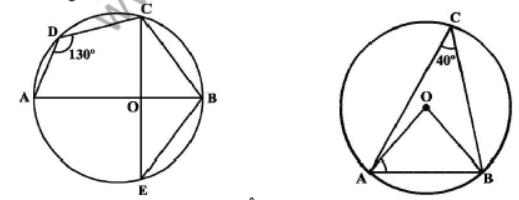
Answer:
Given: A circle with centre O and radius r, chords AB and CD with AB > CD, OM ⊥ AB and ON ⊥ CD.
To prove: OM < ON.
Construction: Join OA and OC.
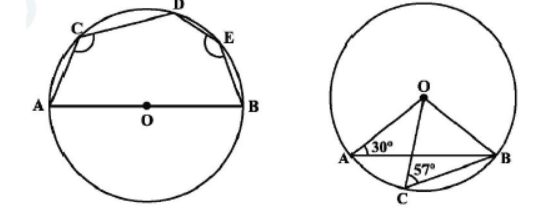
1. AM = \( \frac{1}{2} \)AB and CN = \( \frac{1}{2} \)CD (perpendicular from the centre bisects the chord).
2. AB > CD, so AM > CN and AM² > CN².
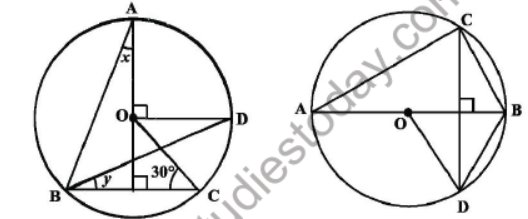
3. OM² = r² - AM² and ON² = r² - CN² (Pythagoras theorem in △OMA and △ONC).
4. Since AM² > CN², r² - AM² < r² - CN², so OM² < ON².
5. Hence, OM < ON, that is, the larger chord is nearer to the centre.
Teacher's Note:
a) Both right triangles have the same hypotenuse r, so a longer half-chord means a shorter distance from the centre.
b) A diameter, the longest chord, is at distance 0.
8. Prove that “Of any two chords of a circle then the one which is nearer to the centre is larger.”
Answer:
Given: A circle with centre O and radius r, chords AB and CD, OM ⊥ AB, ON ⊥ CD and OM < ON.
To prove: AB > CD.
Construction: Join OA and OC.
1. AM² = r² - OM² and CN² = r² - ON² (Pythagoras theorem).
2. OM < ON, so OM² < ON² and r² - OM² > r² - ON².
3. Hence, AM² > CN², so AM > CN.
4. AB = 2AM and CD = 2CN, therefore AB > CD.
Teacher's Note:
a) This is the converse of the previous theorem; the same Pythagoras relation is used in the reverse order.
b) Take care with the inequality sign when subtracting from r².
9. Prove that “line joining the midpoints of two equal chords of circle subtends equal angles with the chord.”
Answer:
Given: A circle with centre O, equal chords AB and CD with mid-points M and N.
To prove: The line MN makes equal angles with the chords AB and CD.
Construction: Join OM, ON and MN.
1. OM ⊥ AB and ON ⊥ CD (the line joining the centre to the mid-point of a chord is perpendicular to the chord).
2. AB = CD, so OM = ON (equal chords are equidistant from the centre).
3. In △OMN, OM = ON, so ∠OMN = ∠ONM (angles opposite equal sides).
4. The angle between MN and AB on the side of O is 90° - ∠OMN.
5. The angle between NM and CD on the side of O is 90° - ∠ONM.
6. Since ∠OMN = ∠ONM, the two angles are equal.
7. Hence, MN makes equal angles with the two equal chords.
Teacher's Note:
a) The key idea is that equal chords are equidistant from the centre, which makes △OMN isosceles.
b) Subtract the base angles from 90° because OM and ON are perpendicular to the chords.
10. Prove that “if two chords of a circle bisect each other they must be diameters.
Answer:
Given: A circle with centre O and chords AB and CD bisecting each other at P, so AP = PB and CP = PD.
To prove: AB and CD are diameters.
1. Suppose P is not the centre and join OP.
2. P is the mid-point of AB, so OP ⊥ AB (line from the centre to the mid-point of a chord).
3. P is the mid-point of CD, so OP ⊥ CD in the same way.
4. Then AB and CD are both perpendicular to OP at the same point P, so they would lie along the same line, which is not possible for two different chords.
5. Hence, P must be the centre O.
6. Both chords pass through the centre, so AB and CD are diameters.
Teacher's Note:
a) This is a proof by contradiction: assume the point is not the centre and show an impossible situation.
b) Through one point only one line can be perpendicular to OP.
11. If two chords of a circle are equally inclined to the diameter through their point of intersection, prove that the chords are equal.
Answer:
Given: Chords AB and CD of a circle with centre O intersect at E. The diameter through E makes equal angles with AB and CD.
To prove: AB = CD.
Construction: Draw OM ⊥ AB and ON ⊥ CD, and join OE.
1. In right triangles OME and ONE, ∠OME = ∠ONE = 90°.
2. ∠OEM = ∠OEN (the chords are equally inclined to the diameter, which passes through O and E).
3. OE = OE (common side).
4. So, △OME ≅ △ONE (AAS congruence rule), hence OM = ON.
5. Chords which are equidistant from the centre are equal.
6. Hence, AB = CD.
Teacher's Note:
a) The diameter through E is the line OE, so the equal inclinations are the equal angles at E.
b) Finish by quoting the theorem on equidistant chords.
12. Prove that “The angle subtended by an arc at the centre is double the angle subtended by it at any point on the remaining part of the circle.”
Answer:
Given: An arc PQ of a circle with centre O, and a point R on the remaining part of the circle.
To prove: ∠POQ = 2∠PRQ.
Construction: Join RO and extend it to a point M on the circle.
1. Case 1 (PQ is a minor arc): In △OPR, OP = OR (radii), so ∠OPR = ∠ORP.
2. The exterior angle ∠POM = ∠OPR + ∠ORP = 2∠ORP.
3. Similarly, in △OQR, ∠QOM = 2∠ORQ.
4. Adding, ∠POM + ∠QOM = 2(∠ORP + ∠ORQ), that is, ∠POQ = 2∠PRQ.
5. Case 2 (PQ is a major arc): the same steps give the reflex angle POQ = 2∠PRQ.
6. Case 3 (PQ is a diameter): ∠POQ = 180° and ∠PRQ = 90°, so again ∠POQ = 2∠PRQ.
7. Hence, the angle at the centre is double the angle at the circumference.
Teacher's Note:
a) Extend RO to M so that two exterior angles of isosceles triangles can be used.
b) Mention all three cases (minor arc, major arc and semicircle) to earn full credit.
c) This theorem is the base of the next four results.
13. Prove that “Angles in the same segment of a circle are equal.”
Answer:
Given: A circle with centre O and points A, B in the same segment of chord PQ.
To prove: ∠PAQ = ∠PBQ.
Construction: Join OP and OQ.
1. The angle subtended by arc PQ at the centre is ∠POQ.
2. ∠POQ = 2∠PAQ (angle at the centre is double the angle at the circumference).
3. ∠POQ = 2∠PBQ for the same reason.
4. So, 2∠PAQ = 2∠PBQ.
5. Hence, ∠PAQ = ∠PBQ.
Teacher's Note:
a) Both inscribed angles stand on the same arc PQ, so each is half the central angle.
b) The points must lie in the same segment; angles in opposite segments add up to 180°.
14. Prove that “Angle in a semicircle is a right angle.”
Answer:
Given: A circle with centre O, diameter AB and a point C on the circle.
To prove: ∠ACB = 90°.
Construction: Join OC.
1. The angle subtended by the arc AB at the centre is ∠AOB = 180° (AB is a straight line through O).
2. The angle at the centre is double the angle at the remaining part of the circle, so ∠AOB = 2∠ACB.
3. ∠ACB = \( \frac{1}{2} \) × 180° = 90°.
4. Hence, the angle in a semicircle is a right angle.
Teacher's Note:
a) Use the theorem that the angle at the centre is double the angle at the circumference.
b) The same result also follows from isosceles triangles OAC and OBC whose base angles add to 90°.
15. Prove that “Arc of a circle subtending a right angle at any point of the circle in its alternate segment is a semicircle.”
Answer:
Given: An arc AXB of a circle with centre O and a point C in the alternate segment such that ∠ACB = 90°.
To prove: Arc AXB is a semicircle.
1. The angle subtended by arc AXB at the centre is ∠AOB = 2∠ACB (angle at the centre is double the angle at the circumference).
2. ∠AOB = 2 × 90° = 180°.
3. So A, O and B lie on a straight line, that is, AB is a diameter.
4. Hence, arc AXB is a semicircle.
Teacher's Note:
a) This is the converse of the theorem on the angle in a semicircle.
b) A central angle of 180° means the chord passes through the centre.
16. Prove that “Any angle subtended by a minor arc in the alternate segment is acute and any angle subtended by a major arc in the alternate segment is obtuse.”
Answer:
Given: A circle with centre O and a chord AB. Let C be a point on the major arc and D a point on the minor arc.
To prove: The angle subtended by the minor arc AB at C is acute, and the angle subtended by the major arc AB at D is obtuse.
1. The minor arc AB subtends ∠AOB at the centre, where ∠AOB is less than 180°.
2. ∠ACB = \( \frac{1}{2} \)∠AOB, which is less than 90°. So the angle subtended by the minor arc in the alternate segment is acute.
3. The major arc AB subtends the reflex angle AOB at the centre, which is greater than 180° and less than 360°.
4. ∠ADB = \( \frac{1}{2} \) × (reflex ∠AOB), which is greater than 90° and less than 180°.
5. Hence, the angle subtended by the major arc in the alternate segment is obtuse.
Teacher's Note:
a) Use the theorem that the angle at the centre is double the angle at the circumference.
b) A minor arc gives a central angle below 180°; a major arc gives a reflex central angle.
17. Prove that “If a line segment joining two points subtends equal angles at two other points lying on the same side of the line segment, the four points are concyclic.”
Answer:
Given: A line segment AB and points C, D on the same side of AB such that ∠ACB = ∠ADB.
To prove: A, B, C, D lie on a circle.
1. Draw the circle through A, B and C. Suppose D does not lie on it.
2. Let BD (extended if needed) meet the circle at E and join AE.
3. ∠AEB = ∠ACB (angles in the same segment).
4. But ∠ACB = ∠ADB (given), so ∠AEB = ∠ADB.
5. If D is outside the circle, ∠AEB is an exterior angle of △AED, so ∠AEB is greater than ∠ADB. If D is inside the circle, ∠ADB is an exterior angle of △AED, so ∠ADB is greater than ∠AEB.
6. Both cases contradict ∠AEB = ∠ADB.
7. Hence, D lies on the circle, that is, A, B, C, D are concyclic.
Teacher's Note:
a) Proof by contradiction: assume D is off the circle and compare an exterior angle with an interior opposite angle.
b) Both points must be on the same side of AB; otherwise the angles would add up to 180° instead.
18. Prove that “Circle drawn on any one side of the equal sides of an isosceles trainlge as diameter bisects the side.”
Answer:
Given: △ABC with AB = AC. The circle drawn on AB as diameter meets BC at D.
To prove: D is the mid-point of BC, that is, BD = DC.
Construction: Join AD.
1. ∠ADB = 90° (angle in a semicircle).
2. So AD ⊥ BC and ∠ADC = 90°.
3. In △ABD and △ACD, ∠ADB = ∠ADC = 90°.
4. AB = AC (given) and AD = AD (common).
5. So, △ABD ≅ △ACD (RHS congruence rule).
6. Hence, BD = DC, that is, the circle bisects the third side BC.
Teacher's Note:
a) The side that is bisected is the base BC, the side that is not equal to the others.
b) Angle in a semicircle gives the right angle needed for RHS.
19. Prove that “The sum of either pair of opposite angles of a cyclic quadrilateral is 180º.”
Answer:
Given: A cyclic quadrilateral ABCD in a circle with centre O.
To prove: ∠A + ∠C = 180° and ∠B + ∠D = 180°.
Construction: Join OB and OD.
1. The arc BCD subtends ∠BAD at A, so ∠BAD = \( \frac{1}{2} \)∠BOD (angle at the centre is double the angle at the circumference).
2. The arc BAD subtends ∠BCD at C, so ∠BCD = \( \frac{1}{2} \) × (reflex ∠BOD).
3. ∠BAD + ∠BCD = \( \frac{1}{2} \)(∠BOD + reflex ∠BOD) = \( \frac{1}{2} \) × 360° = 180°.
4. Hence, ∠A + ∠C = 180°.
5. Similarly, by joining OA and OC, ∠B + ∠D = 180°.
Teacher's Note:
a) Angle at the centre plus the reflex angle make a full turn of 360°.
b) The result is used to find unknown angles in many cyclic quadrilateral problems.
20. Prove that “If the sum of a pair of opposite angles of a quadrilateral is 180º, the quadrilateral is cyclic.”
Answer:
Given: A quadrilateral ABCD in which ∠B + ∠D = 180°.
To prove: ABCD is cyclic.
1. Draw the circle through A, B and C. Suppose D does not lie on it.
2. Let CD (extended if needed) meet the circle at E and join AE.
3. ABCE is cyclic, so ∠ABC + ∠AEC = 180°.
4. ∠ABC + ∠ADC = 180° (given), so ∠AEC = ∠ADC.
5. If D is outside the circle, ∠AEC is an exterior angle of △AED and is greater than ∠ADE. If D is inside the circle, ∠ADC is an exterior angle of △AED and is greater than ∠AED.
6. Both cases contradict ∠AEC = ∠ADC.
7. Hence, D lies on the circle and ABCD is cyclic.
Teacher's Note:
a) This is the converse of the cyclic quadrilateral theorem and is proved by contradiction.
b) State the exterior angle property clearly; it produces the contradiction.
21. Prove that “If one side of the cyclic quadrilateral is produced then the exterior angle is equal to the interior opposite angle.”
Answer:
Given: A cyclic quadrilateral ABCD with side BC produced to E.
To prove: Exterior ∠DCE = interior opposite ∠BAD.
1. ∠BAD + ∠BCD = 180° (opposite angles of a cyclic quadrilateral).
2. ∠BCD + ∠DCE = 180° (linear pair).
3. So, ∠BAD + ∠BCD = ∠BCD + ∠DCE.
4. Hence, ∠DCE = ∠BAD.
Teacher's Note:
a) The interior opposite angle is the angle at the vertex that is not on the produced side.
b) Compare the two sums equal to 180° and cancel the common angle.
22. Prove that “If two sides of a cyclic quadrilateral are parallel, then the remaining two sides are equal and the diagonals are also equal.”
Answer:
Given: A cyclic quadrilateral ABCD with AB ∥ CD.
To prove: AD = BC and AC = BD.
1. AB ∥ CD, so ∠ABC + ∠BCD = 180° (co-interior angles).
2. ABCD is cyclic, so ∠ABC + ∠ADC = 180°.
3. Hence, ∠BCD = ∠ADC.
4. In △ADC and △BCD, ∠ADC = ∠BCD (shown above).
5. ∠DAC = ∠CBD (angles in the same segment DC).
6. DC = CD (common side).
7. So, △ADC ≅ △BCD (AAS congruence rule).
8. Hence, AD = BC and AC = BD (corresponding parts of congruent triangles).
Teacher's Note:
a) Co-interior angles between parallel lines are supplementary.
b) Choose the triangles that share the parallel side DC.
23. Prove that “If two opposite sides of cyclic quadrilateral are equal, then the other two sides are parallel.”
Answer:
Given: A cyclic quadrilateral ABCD with AD = BC.
To prove: AB ∥ CD.
1. Equal chords subtend equal angles at the circumference, so ∠ABD = ∠BAC (chord AD = chord BC).
2. ∠ABD = ∠ACD (angles in the same segment AD).
3. So, ∠BAC = ∠ACD.
4. These are alternate interior angles for the lines AB and CD with transversal AC.
5. Hence, AB ∥ CD.
Teacher's Note:
a) Equal chords give equal inscribed angles; then use angles in the same segment.
b) Alternate angles equal is the test for parallel lines.
24. Prove that “If two non parallel sides of a trapezium are equal, it is cyclic.”
Answer:
Given: A trapezium ABCD with AB ∥ CD and AD = BC.
To prove: ABCD is cyclic.
Construction: Draw AE ⊥ CD and BF ⊥ CD.
1. AE = BF (distance between the parallel lines AB and CD).
2. In right triangles AED and BFC, AD = BC (given) and AE = BF.
3. So, △AED ≅ △BFC (RHS congruence rule), hence ∠D = ∠C.
4. AB ∥ CD, so ∠A + ∠D = 180° and ∠B + ∠C = 180°.
5. Hence, ∠B + ∠D = ∠B + ∠C = 180°.
6. A quadrilateral whose opposite angles are supplementary is cyclic, so ABCD is cyclic.
Teacher's Note:
a) Show first that the base angles are equal; then use the converse of the cyclic quadrilateral theorem.
b) A trapezium with equal non-parallel sides is called an isosceles trapezium.
25. Prove that “The sum of the angles in the four segments exterior to a cyclic quadrilateral is equal to 6 right angles.”
Answer:
Given: A cyclic quadrilateral ABCD. The four segments exterior to it are the segments cut off by AB, BC, CD and DA.
To prove: The sum of the angles in these four segments = 6 × 90° = 540°.
1. An angle in the exterior segment on AB and ∠ACB together are opposite angles of a cyclic quadrilateral, so the angle in that segment = 180° - ∠ACB.
2. In the same way, the angle in the segment on BC = 180° - ∠BDC, on CD = 180° - ∠CAD, and on DA = 180° - ∠DBA.
3. Sum = 720° - (∠ACB + ∠BDC + ∠CAD + ∠DBA).
4. ∠ACB = ∠ADB (same segment AB) and ∠CAD = ∠CBD (same segment CD).
5. ∠ACB + ∠BDC = ∠ADB + ∠BDC = ∠ADC and ∠CAD + ∠DBA = ∠CBD + ∠DBA = ∠ABC.
6. ∠ADC + ∠ABC = 180° (opposite angles of a cyclic quadrilateral).
7. Sum = 720° - 180° = 540° = 6 right angles.
Teacher's Note:
a) An angle in an exterior segment is supplementary to the angle that the same side makes on the quadrilateral's opposite side.
b) Group the four subtracted angles into two opposite angles of the quadrilateral.
26. Two circles with centres A and B intersect at C and D. Prove that ∠ACB = ∠ADB.
Answer:
Given: Two circles with centres A and B intersecting at C and D.
To prove: ∠ACB = ∠ADB.
Construction: Join AC, AD, BC, BD and AB.
1. In △ACB and △ADB, AC = AD (radii of the circle with centre A).
2. BC = BD (radii of the circle with centre B).
3. AB = AB (common side).
4. So, △ACB ≅ △ADB (SSS congruence rule).
5. Hence, ∠ACB = ∠ADB (corresponding parts of congruent triangles).
Teacher's Note:
a) The line joining the centres is the common side of both triangles.
b) Radii of the same circle are always equal.
27. Bisector AD of AC of △ABC passes through the centre of the circumcircle of △ABC. Prove that AB = AC.
Answer:
Given: The bisector AD of the angle at A of △ABC passes through the centre O of the circumcircle.
To prove: AB = AC.
Construction: Produce AD to meet the circumcircle at E and join BE and CE.
1. AE passes through the centre O, so AE is a diameter.
2. ∠ABE = 90° and ∠ACE = 90° (angles in a semicircle).
3. In △ABE and △ACE, ∠ABE = ∠ACE = 90°.
4. ∠BAE = ∠CAE (AE bisects the angle at A).
5. AE = AE (common side).
6. So, △ABE ≅ △ACE (AAS congruence rule).
7. Hence, AB = AC (corresponding parts of congruent triangles).
Teacher's Note:
a) The question prints the bisector as 'AD of AC'; it is read as the bisector of the angle at A.
b) A line through the centre meeting the circle at A and E gives a diameter and two right angles.
28. In the below figure A, B and C are three points on a circle such that angles subtended by the chords AB and AC at the centre O are 80° and 120° respectively. Determine ∠BAC.
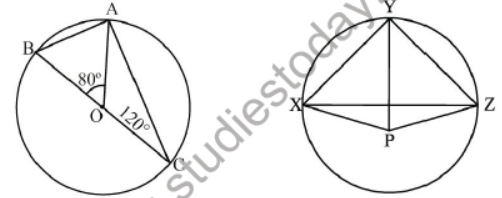
Answer:
1. ∠AOB = 80° and ∠AOC = 120°, so ∠BOC = 360° - 80° - 120° = 160°.
2. The angle at the centre is double the angle at the remaining part of the circle.
3. ∠BAC = \( \frac{1}{2} \)∠BOC = \( \frac{1}{2} \) × 160° = 80°.
4. Hence, ∠BAC = 80°.
Teacher's Note:
a) Find the central angle on the arc BC first; the three central angles around O add up to 360°.
b) Check: ∠ACB = 40° and ∠ABC = 60°, which together with 80° make 180°.
29. In the above right-sided figure, P is the centre of the circle. Prove that ∠XPZ = 2 (∠XZY + ∠YXZ).
Answer:
Given: P is the centre of the circle through X, Y and Z.
To prove: ∠XPZ = 2(∠XZY + ∠YXZ).
1. In △XYZ, ∠XYZ + ∠XZY + ∠YXZ = 180°, so ∠XYZ = 180° - (∠XZY + ∠YXZ).
2. The arc XZ that does not contain Y subtends the reflex angle XPZ at the centre P.
3. The reflex angle XPZ = 2∠XYZ (angle at the centre is double the angle at the circumference).
4. The reflex angle XPZ = 360° - ∠XPZ, so 360° - ∠XPZ = 2∠XYZ.
5. ∠XPZ = 360° - 2∠XYZ = 360° - 2[180° - (∠XZY + ∠YXZ)].
6. Hence, ∠XPZ = 2(∠XZY + ∠YXZ).
Teacher's Note:
a) In the figure the centre P lies on the opposite side of XZ from Y, so the central angle that is doubled is the reflex angle.
b) Do not equate the non-reflex angle XPZ to 2∠XYZ.
30. Prove that the midpoint of the hypotenuse of a right triangle is equidistant from its vertices.
Answer:
Given: A right triangle ABC with the right angle at B. M is the mid-point of the hypotenuse AC.
To prove: MA = MB = MC.
1. Draw the circle through A, B and C.
2. ∠ABC = 90°, so AC subtends a right angle at B; hence AC is a diameter of this circle (converse of the angle in a semicircle).
3. The mid-point of a diameter is the centre, so M is the centre of the circle.
4. MA, MB and MC are radii of this circle.
5. Hence, MA = MB = MC.
Teacher's Note:
a) The circle through the three vertices of a right triangle has the hypotenuse as its diameter.
b) The same result can be proved by completing the rectangle ABCD and using equal diagonals.
31. In the below figure ABCD is a cyclic quadrilateral, O is the centre of the circle. If ∠BOD = 160°, find ∠BPD.
Answer:
1. ∠BOD = 160° is the angle at the centre on the minor arc BD.
2. ∠BAD = \( \frac{1}{2} \)∠BOD = \( \frac{1}{2} \) × 160° = 80° (angle at the centre is double the angle at the circumference).
3. ABPD is a cyclic quadrilateral, so ∠BAD + ∠BPD = 180°.
4. ∠BPD = 180° - 80° = 100°.
5. Hence, ∠BPD = 100°.
Teacher's Note:
a) P is on the minor arc BD, so the angle there is obtuse; A is on the major arc.
b) Cross-check: the angle on the minor arc is 360° - 160° = 200° divided by 2 = 100°.
32. Prove that in a triangle if the bisector of any angle and the perpendicular bisector of its opposite side intersect, they will intersect on the circumcircle of the triangle.
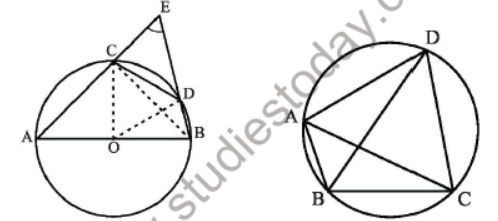
Answer:
Given: △ABC with circumcircle. The bisector of ∠A meets the circumcircle at D.
To prove: D lies on the perpendicular bisector of BC, so the two lines meet on the circumcircle.
Construction: Join BD and CD.
1. ∠BAD = ∠CAD (AD bisects ∠A).
2. Equal angles at the circumference stand on equal chords, so BD = CD.
3. D is equidistant from B and C, so D lies on the perpendicular bisector of BC.
4. The bisector of ∠A and the perpendicular bisector of BC are two different lines (when AB ≠ AC) and meet at only one point.
5. D lies on both lines and on the circumcircle.
6. Hence, the two lines intersect on the circumcircle.
Teacher's Note:
a) A point equidistant from two points lies on the perpendicular bisector of the segment joining them.
b) If AB = AC the two lines coincide and the statement is trivial.
33. The diagonals of a cyclic quadrilateral are at right angles. Prove that perpendiculars from the point of their intersection on any side when produced backward bisect the opposite side.
Answer:
Given: A cyclic quadrilateral ABCD whose diagonals AC and BD meet at P with ∠APB = 90°. PE ⊥ AB at E, and EP produced meets CD at M.
To prove: M is the mid-point of CD.
1. ∠MPC = ∠APE (vertically opposite angles).
2. In right △APE, ∠APE = 90° - ∠PAE = 90° - ∠CAB.
3. ∠CAB = ∠CDB (angles in the same segment BC), so ∠MPC = 90° - ∠CDP.
4. In right △CPD, ∠PCD = 90° - ∠CDP.
5. So, ∠MPC = ∠PCD = ∠PCM, hence MC = MP.
6. ∠MPD = 90° - ∠MPC = 90° - ∠MCP = ∠MDP, hence MP = MD.
7. Therefore, MC = MD.
8. Hence, M is the mid-point of CD.
Teacher's Note:
a) Prove MP = MC and MP = MD separately, then join the two results.
b) This is a standard result called Brahmagupta's theorem.
34. If two circles intersect at two points, prove that their centres lie on the perpendicular bisector of the common chord.
Answer:
Given: Two circles with centres O and O' intersecting at A and B. AB is the common chord.
To prove: O and O' lie on the perpendicular bisector of AB.
Construction: Join OA, OB, O'A and O'B.
1. OA = OB (radii of the first circle), so O is equidistant from A and B.
2. Hence, O lies on the perpendicular bisector of AB.
3. O'A = O'B (radii of the second circle), so O' also lies on the perpendicular bisector of AB.
4. Hence, the line OO' is the perpendicular bisector of the common chord AB.
Teacher's Note:
a) Every point equidistant from A and B lies on the perpendicular bisector of AB.
b) So the line of centres is perpendicular to the common chord and bisects it.
35. If two intersecting chords of a circle make equal angles with the diameter passing through their point of intersection, prove that the chords are equal.
Answer:
Given: Chords AB and CD of a circle with centre O intersect at E. The diameter through E makes ∠AEO = ∠DEO with the chords.
To prove: AB = CD.
Construction: Draw OM ⊥ AB and ON ⊥ CD.
1. In right triangles OME and ONE, ∠OME = ∠ONE = 90°.
2. ∠OEM = ∠OEN (equal inclinations given).
3. OE = OE (common side).
4. So, △OME ≅ △ONE (AAS congruence rule), hence OM = ON.
5. Chords which are at equal distances from the centre are equal.
6. Hence, AB = CD.
Teacher's Note:
a) This is the same theorem as question 11; the perpendiculars from the centre are the key construction.
b) Name the equal angles at the point of intersection carefully.
36. Two circles of radii 5 cm and 3 cm intersect at two points and the distance between their centres is 4 cm. Find the length of the common chord.
Answer:
Given: Circles with centres O (radius 5 cm) and O' (radius 3 cm) intersect at A and B, and OO' = 4 cm.
Construction: Join OA, O'A and O'B.
1. In △OAO', OA² = 5² = 25.
2. O'A² + OO'² = 3² + 4² = 9 + 16 = 25.
3. So, OA² = O'A² + OO'², hence ∠AO'O = 90° (converse of Pythagoras theorem).
4. Similarly, ∠BO'O = 90°.
5. ∠AO'O + ∠BO'O = 180°, so A, O' and B are collinear.
6. So the common chord AB passes through the centre O' of the smaller circle and is its diameter.
7. AB = 2 × 3 = 6 cm.
8. Hence, the length of the common chord is 6 cm.
Teacher's Note:
a) The sides 3, 4 and 5 form a right triangle; spot this before doing any long calculation.
b) Here the line of centres is perpendicular to the common chord at the centre of the smaller circle, so the chord is a diameter.
c) Check: OO' ⊥ AB at O', so OA² = OO'² + O'A² = 16 + 9 = 25.
37. If two equal chords of a circle intersect within the circle, prove that the segments of one chord are equal to corresponding segments of the other chord.
Answer:
Given: Equal chords AB and CD of a circle with centre O intersect at P inside the circle.
To prove: AP = CP and PB = PD (taking AP and CP as the longer segments).
Construction: Draw OM ⊥ AB and ON ⊥ CD, and join OP.
1. AB = CD, so OM = ON (equal chords are equidistant from the centre).
2. In right triangles OMP and ONP, OM = ON and OP = OP, so △OMP ≅ △ONP (RHS), hence MP = NP.
3. AM = \( \frac{1}{2} \)AB = \( \frac{1}{2} \)CD = CN (perpendicular from the centre bisects the chord).
4. AP = AM + MP = CN + NP = CP.
5. PB = AB - AP = CD - CP = PD.
6. Hence, the segments of one chord are equal to the corresponding segments of the other chord.
Teacher's Note:
a) Label the segments so that M and N lie on the longer segments AP and CP.
b) Perpendiculars from the centre bisect the chords, which gives AM = CN.
38. If two equal chords of a circle intersect within the circle, prove that the line joining the point of intersection to the centre makes equal angles with the chords.
Answer:
Given: Equal chords AB and CD of a circle with centre O intersect at P.
To prove: ∠OPA = ∠OPC (OP makes equal angles with the chords).
Construction: Draw OM ⊥ AB and ON ⊥ CD.
1. AB = CD, so OM = ON (equal chords are equidistant from the centre).
2. In right triangles OMP and ONP, OM = ON and OP = OP.
3. So, △OMP ≅ △ONP (RHS congruence rule).
4. Hence, ∠OPM = ∠OPN (corresponding parts of congruent triangles).
5. Since M lies on PA and N lies on PC, ∠OPA = ∠OPC.
6. Hence, OP makes equal angles with the chords.
Teacher's Note:
a) The same congruence as in the previous question is used again.
b) State clearly which segments M and N lie on when naming the equal angles.
39. In the below figure, AB is a diameter of the circle, CD is a chord equal to the radius of the circle. AC and BD when extended intersect at a point E. Prove that ∠AEB = 60°.
Answer:
Construction: Join OC, OD and AD.
1. OC = OD = CD (radii and the given chord), so △OCD is equilateral and ∠COD = 60°.
2. ∠CAD = \( \frac{1}{2} \)∠COD = 30° (angle at the centre is double the angle at the circumference).
3. ∠ADB = 90° (angle in a semicircle), so ∠ADE = 90°.
4. In right △ADE, ∠AEB = ∠AED = 90° - ∠DAE = 90° - 30°.
5. Hence, ∠AEB = 60°.
Teacher's Note:
a) Note that ∠DAE is the same as ∠CAD because E lies on AC extended.
b) Another route: ∠AEB = \( \frac{1}{2} \)(arc AB - arc CD) = \( \frac{1}{2} \)(180° - 60°) = 60°.
40. In the above right-sided figure, ABCD is a cyclic quadrilateral in which AC and BD are its diagonals. If ∠DBC = 55° and ∠BAC = 45°, find ∠BCD.
Answer:
1. ∠BDC = ∠BAC = 45° (angles in the same segment BC).
2. In △BCD, ∠BCD = 180° - ∠DBC - ∠BDC.
3. ∠BCD = 180° - 55° - 45° = 80°.
4. Hence, ∠BCD = 80°.
Teacher's Note:
a) Identify the chord on which the two equal angles stand (here BC).
b) Verify using the cyclic quadrilateral: ∠BAD = 180° - 80° = 100°.
41. Prove that the quadrilateral formed (if possible) by the internal angle bisectors of any quadrilateral is cyclic.
Answer:
Given: A quadrilateral ABCD. The bisectors of ∠A and ∠B meet at P, those of ∠B and ∠C at Q, those of ∠C and ∠D at R, and those of ∠D and ∠A at S, forming the quadrilateral PQRS.
To prove: PQRS is cyclic.
1. In △APB, ∠APB = 180° - (\( \frac{1}{2} \)∠A + \( \frac{1}{2} \)∠B).
2. In △CRD, ∠CRD = 180° - (\( \frac{1}{2} \)∠C + \( \frac{1}{2} \)∠D).
3. ∠APB + ∠CRD = 360° - \( \frac{1}{2} \)(∠A + ∠B + ∠C + ∠D) = 360° - \( \frac{1}{2} \) × 360° = 180°.
4. ∠SPQ = ∠APB and ∠QRS = ∠CRD (the same pairs of lines meet at P and R).
5. So, ∠SPQ + ∠QRS = 180°.
6. Hence, the opposite angles of PQRS are supplementary and PQRS is cyclic.
Teacher's Note:
a) The angle sum of a quadrilateral is 360°, so half of it is 180°.
b) Use the converse of the cyclic quadrilateral theorem at the end.
42. ABCD is a cyclic quadrilateral whose diagonals intersect at a point E. If ∠DBC = 70°, ∠BAC is 30°, find ∠BCD. Further, if AB = BC, find ∠ECD.
Answer:
1. ∠BDC = ∠BAC = 30° (angles in the same segment BC).
2. In △BCD, ∠BCD = 180° - 70° - 30° = 80°.
3. AB = BC, so in △ABC, ∠BCA = ∠BAC = 30° (angles opposite equal sides).
4. ∠ECD = ∠ACD = ∠BCD - ∠BCA = 80° - 30° = 50°.
5. Hence, ∠BCD = 80° and ∠ECD = 50°.
Teacher's Note:
a) Use the same-segment property first, then the isosceles triangle ABC.
b) E lies on AC, so ∠ECD and ∠ACD are the same angle.
43. If diagonals of a cyclic quadrilateral are diameters of the circle through the vertices of the quadrilateral, prove that it is a rectangle.
Answer:
Given: A cyclic quadrilateral ABCD whose diagonals AC and BD are diameters of the circle.
To prove: ABCD is a rectangle.
1. AC is a diameter, so ∠ABC = 90° and ∠ADC = 90° (angles in a semicircle).
2. BD is a diameter, so ∠BAD = 90° and ∠BCD = 90° (angles in a semicircle).
3. All four angles of ABCD are right angles.
4. Hence, ABCD is a rectangle.
Teacher's Note:
a) A quadrilateral with four right angles is a rectangle.
b) The diagonals are diameters, so they also bisect each other at the centre.
44. Two circles intersect at two points A and B. AD and AC are diameters to the two circles. Prove that B lies on the line segment DC.
Answer:
Given: Two circles intersect at A and B. AD is a diameter of the first circle and AC is a diameter of the second circle.
To prove: D, B and C are collinear.
Construction: Join AB, BD and BC.
1. ∠ABD = 90° (angle in a semicircle of the first circle).
2. ∠ABC = 90° (angle in a semicircle of the second circle).
3. ∠ABD + ∠ABC = 90° + 90° = 180°.
4. So DBC is a straight line.
5. Hence, B lies on the line segment DC.
Teacher's Note:
a) Two adjacent angles adding to 180° form a straight line.
b) Two right angles at B on the same side of AB give a straight line.
45. Prove that the quadrilateral formed (if possible) by the internal angle bisectors of any quadrilateral is cyclic.
Answer:
Given: A quadrilateral ABCD. The bisectors of its angles A, B, C, D form a quadrilateral PQRS, where P is the meeting point of the bisectors of ∠A and ∠B, Q of ∠B and ∠C, R of ∠C and ∠D and S of ∠D and ∠A.
To prove: PQRS is cyclic.
1. In △BQC, ∠BQC = 180° - (\( \frac{1}{2} \)∠B + \( \frac{1}{2} \)∠C).
2. In △DSA, ∠DSA = 180° - (\( \frac{1}{2} \)∠D + \( \frac{1}{2} \)∠A).
3. ∠BQC + ∠DSA = 360° - \( \frac{1}{2} \)(∠A + ∠B + ∠C + ∠D) = 360° - 180° = 180°.
4. ∠PQR = ∠BQC and ∠RSP = ∠DSA (vertically opposite pairs of the same lines).
5. So, ∠PQR + ∠RSP = 180°.
6. Hence, PQRS is a cyclic quadrilateral.
Teacher's Note:
a) This is the same theorem as question 41, proved here using the other pair of opposite vertices.
b) Always write the angle sum of the quadrilateral as 360° before halving.
46. If the non-parallel sides of a trapezium are equal, prove that it is cyclic.
Answer:
Given: A trapezium ABCD with AB ∥ CD and AD = BC.
To prove: ABCD is cyclic.
Construction: Draw BE ∥ AD meeting CD at E.
1. AB ∥ DE and AD ∥ BE, so ABED is a parallelogram and BE = AD.
2. BE = AD = BC, so in △BEC, ∠BEC = ∠BCE.
3. ∠D = ∠BEC (corresponding angles, BE ∥ AD), so ∠D = ∠C.
4. ∠A + ∠D = 180° and ∠B + ∠C = 180° (co-interior angles).
5. So, ∠B + ∠D = ∠B + ∠C = 180°.
6. Hence, ABCD is cyclic.
Teacher's Note:
a) Drawing a line parallel to a leg creates a parallelogram and an isosceles triangle.
b) This is the same result as question 24 with a different construction.
47. Two circles intersect at two points B and C. Through B, two line segments ABD and PBQ are drawn to intersect the circles at A, D and P, Q respectively. Prove that ∠ACP = ∠QCD.
Answer:
Given: Two circles intersect at B and C. The lines ABD and PBQ pass through B, with A, P on the first circle and D, Q on the second circle.
To prove: ∠ACP = ∠QCD.
Construction: Join AC, PC, QC and DC.
1. In the first circle, ∠ACP = ∠ABP (angles in the same segment AP).
2. ∠ABP = ∠DBQ (vertically opposite angles).
3. In the second circle, ∠DBQ = ∠DCQ (angles in the same segment DQ).
4. Hence, ∠ACP = ∠ABP = ∠DBQ = ∠DCQ.
5. So, ∠ACP = ∠QCD.
Teacher's Note:
a) Move the angle from one circle to the other through the vertically opposite angles at B.
b) Name the chord (AP or DQ) each time you use the same-segment property.
48. If circles are drawn taking two sides of a triangle as diameters, prove that the point of intersection of these circles lie on the third side.
Answer:
Given: △ABC. Circles are drawn on AB and AC as diameters and they meet again at D.
To prove: D lies on BC.
Construction: Join AD.
1. ∠ADB = 90° (angle in the semicircle of the circle on AB).
2. ∠ADC = 90° (angle in the semicircle of the circle on AC).
3. ∠ADB + ∠ADC = 180°, so B, D and C are collinear.
4. Hence, D lies on the third side BC (and AD ⊥ BC).
Teacher's Note:
a) The common point D is also the foot of the perpendicular from A to BC.
b) Two right angles sharing the arm DA on opposite sides form a straight line.
49. Prove that the circle drawn with any side of a rhombus as diameter, passes through the point of intersection of its diagonals.
Answer:
Given: A rhombus ABCD whose diagonals AC and BD meet at O.
To prove: The circle with AB as diameter passes through O.
1. The diagonals of a rhombus bisect each other at right angles, so ∠AOB = 90°.
2. The segment AB subtends a right angle at O.
3. By the converse of the angle in a semicircle, O lies on the circle with AB as diameter.
4. Hence, the circle drawn on a side of the rhombus as diameter passes through the point of intersection of the diagonals.
Teacher's Note:
a) Perpendicular diagonals are a special property of the rhombus.
b) A point that sees a segment at 90° lies on the circle having that segment as diameter.
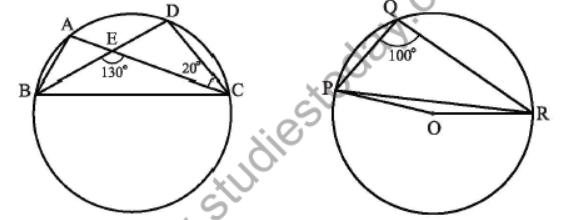
50. In the adjoining figure, A, B, C and D are four points on a circle. AC and BD intersect at a point E such that ∠BEC = 130° and ∠ECD = 20°. Find ∠BAC.
Answer:
1. ∠BEC is an exterior angle of △CED, so ∠BEC = ∠EDC + ∠ECD.
2. 130° = ∠EDC + 20°, so ∠EDC = 110°.
3. ∠BDC = ∠EDC = 110° (E lies on BD).
4. ∠BAC = ∠BDC (angles in the same segment BC).
5. Hence, ∠BAC = 110°.
Teacher's Note:
a) An exterior angle equals the sum of the two interior opposite angles.
b) Check that A and D lie on the same side of BC before using the same-segment property.
51. In the above right-sided figure, ∠PQR = 100°, where P, Q and R are points on a circle with centre O. Find ∠OPR.
Answer:
1. Q is on the minor arc PR, so the reflex angle POR = 2∠PQR = 2 × 100° = 200°.
2. ∠POR = 360° - 200° = 160°.
3. OP = OR (radii), so ∠OPR = ∠ORP.
4. ∠OPR = (180° - 160°) ÷ 2 = 10°.
5. Hence, ∠OPR = 10°.
Teacher's Note:
a) The angle at the circumference is obtuse, so the doubled angle at the centre is a reflex angle.
b) Use the isosceles triangle OPR to finish.
52. ABCD is a parallelogram. The circle through A, B and C intersect CD (produced if necessary) at E. Prove that AE = AD.
Answer:
Given: A parallelogram ABCD. The circle through A, B, C meets CD produced at E.
To prove: AE = AD.
Construction: Join AE.
1. AB ∥ DC, so AB ∥ CE and ∠ABC + ∠BCE = 180° (co-interior angles).
2. ABCE is cyclic, so ∠ABC + ∠AEC = 180°.
3. Hence, ∠BCE = ∠AEC.
4. In △BCE and △AEC, ∠BCE = ∠AEC, CE = EC and ∠CBE = ∠CAE (angles in the same segment CE).
5. So, △BCE ≅ △AEC (AAS), hence BC = AE.
6. BC = AD (opposite sides of a parallelogram).
7. Hence, AE = AD.
Teacher's Note:
a) ABCE is an isosceles trapezium, so its non-parallel sides AE and BC are equal.
b) Use the parallelogram property BC = AD at the end.
53. AC and BD are chords of a circle which bisect each other. Prove that (i) AC and BD are diameters, (ii) ABCD is a rectangle.
Answer:
Given: Chords AC and BD of a circle bisect each other at P.
To prove: (i) AC and BD are diameters; (ii) ABCD is a rectangle.
1. (i) If P were not the centre O, OP would be perpendicular to both AC and BD (line from the centre to the mid-point of a chord), which is impossible for two different chords through P.
2. So P is the centre and AC and BD pass through the centre, that is, AC and BD are diameters.
3. (ii) AC is a diameter, so ∠ABC = ∠ADC = 90° (angles in a semicircle).
4. BD is a diameter, so ∠BAD = ∠BCD = 90° (angles in a semicircle).
5. All four angles are right angles.
6. Hence, ABCD is a rectangle.
Teacher's Note:
a) Part (i) is the same as the theorem in question 10.
b) In part (ii) the diagonals of ABCD are diameters, so all four angles are in semicircles.
54. A chord of a circle is equal to the radius of the circle. Find the angle subtended by the chord at a point on the minor arc and also at a point on the major arc.
Answer:
Given: A circle with centre O and chord AB = radius.
Construction: Join OA and OB. Take C on the major arc and D on the minor arc.
1. OA = OB = AB, so △OAB is equilateral and ∠AOB = 60°.
2. The angle on the major arc: ∠ACB = \( \frac{1}{2} \)∠AOB = 30°.
3. ACBD is a cyclic quadrilateral, so ∠ADB = 180° - 30° = 150°.
4. Hence, the chord subtends 150° at a point on the minor arc and 30° at a point on the major arc.
Teacher's Note:
a) A chord equal to the radius makes an equilateral triangle with the centre.
b) The angle on the minor arc is obtuse; the angle on the major arc is acute.
55. Prove that the circle drawn with any side of a rhombus as a diameter, passes through the point of its diagonals.
Answer:
Given: A rhombus ABCD with diagonals AC and BD intersecting at O.
To prove: The circle drawn on side BC as diameter passes through O.
1. The diagonals of a rhombus are perpendicular, so ∠BOC = 90°.
2. BC subtends a right angle at O.
3. Therefore, O lies on the circle with BC as diameter (converse of the angle in a semicircle).
4. Hence, the circle drawn on any side of the rhombus as diameter passes through the intersection of its diagonals.
Teacher's Note:
a) The question means the point of intersection of the diagonals.
b) The same argument works for each of the four sides.
56. Bisectors of angles A, B and C of a triangles ABC intersect its circumcircle at D, E and F respectively. Prove that the angles of △DEF are 90° - \( \frac{A}{2} \), 90° - \( \frac{B}{2} \) and 90° - \( \frac{C}{2} \).
Answer:
Given: △ABC with circumcircle. The bisectors of ∠A, ∠B and ∠C meet the circle at D, E and F.
To prove: ∠D = 90° - \( \frac{1}{2} \)∠A, ∠E = 90° - \( \frac{1}{2} \)∠B, ∠F = 90° - \( \frac{1}{2} \)∠C.
Construction: Join DE, EF, FD.
1. ∠EDA = ∠EBA (angles in the same segment EA) = \( \frac{1}{2} \)∠B.
2. ∠ADF = ∠ACF (angles in the same segment AF) = \( \frac{1}{2} \)∠C.
3. ∠EDF = ∠EDA + ∠ADF = \( \frac{1}{2} \)∠B + \( \frac{1}{2} \)∠C = \( \frac{1}{2} \)(∠B + ∠C).
4. ∠A + ∠B + ∠C = 180°, so ∠B + ∠C = 180° - ∠A.
5. ∠EDF = \( \frac{1}{2} \)(180° - ∠A) = 90° - \( \frac{1}{2} \)∠A.
6. In the same way, ∠DEF = 90° - \( \frac{1}{2} \)∠B and ∠DFE = 90° - \( \frac{1}{2} \)∠C.
Teacher's Note:
a) The question prints the triangle as DDEF; it means △DEF.
b) Check: the three angles add up to 270° - 90° = 180°.
57. Prove that the line of centres of two intersecting circles subtends equal angles at the two points of intersection.
Answer:
Given: Two circles with centres O and O' intersecting at A and B.
To prove: ∠OAO' = ∠OBO'.
Construction: Join OA, OB, O'A, O'B and OO'.
1. In △OAO' and △OBO', OA = OB (radii of the first circle).
2. O'A = O'B (radii of the second circle).
3. OO' = OO' (common side).
4. So, △OAO' ≅ △OBO' (SSS congruence rule).
5. Hence, ∠OAO' = ∠OBO' (corresponding parts of congruent triangles).
Teacher's Note:
a) The line of centres is the common side of the two triangles.
b) This is the same idea as question 26.
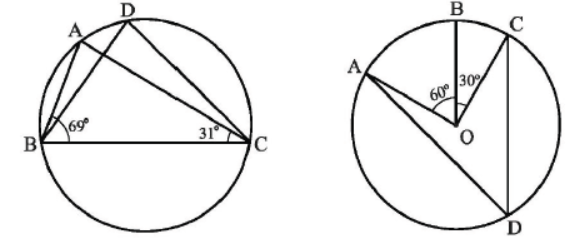
58. In the adjoining Fig., ∠ABC = 69°, ∠ACB = 31°, find ∠BDC.
Answer:
1. In △ABC, ∠BAC = 180° - 69° - 31° = 80°.
2. ∠BDC = ∠BAC (angles in the same segment BC).
3. Hence, ∠BDC = 80°.
Teacher's Note:
a) Find the third angle of the triangle first.
b) A and D lie on the same side of BC, so the angles are equal.
59. In the above right-sided figure, A,B and C are three points on a circle with centre O such that ∠BOC = 30° and ∠AOB = 60°. If D is a point on the circle other than the arc ABC, find ∠ADC.
Answer:
1. ∠AOC = ∠AOB + ∠BOC = 60° + 30° = 90°.
2. D lies on the remaining part of the circle, so ∠ADC = \( \frac{1}{2} \)∠AOC.
3. ∠ADC = \( \frac{1}{2} \) × 90° = 45°.
4. Hence, ∠ADC = 45°.
Teacher's Note:
a) Add the two central angles to get the angle subtended by the arc ABC.
b) The angle at the circumference is half the angle at the centre.
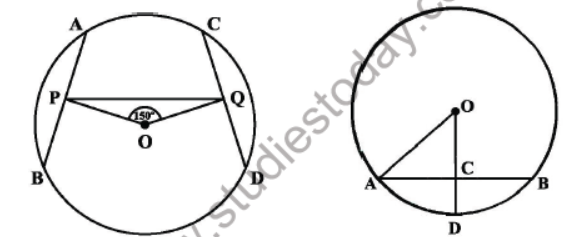
60. In the below figure, AB and CD are two equal chords of a circle with centre O. OP and OQ are perpendiculars on chords AB and CD, respectively. If ∠POQ = 150°, then find ∠APQ.
Answer:
1. AB = CD, so OP = OQ (equal chords are equidistant from the centre).
2. In △OPQ, ∠OPQ = ∠OQP (angles opposite equal sides).
3. ∠OPQ = (180° - 150°) ÷ 2 = 15°.
4. OP ⊥ AB, so ∠APO = 90°.
5. ∠APQ = ∠APO - ∠OPQ = 90° - 15° = 75°.
6. Hence, ∠APQ = 75°.
Teacher's Note:
a) Equal chords give equal distances from the centre, which makes △OPQ isosceles.
b) Subtract the angle OPQ from the right angle APO.
61. In the above right sided figure, if OA = 5 cm, AB = 8 cm and OD is perpendicular to AB, then find CD.
Answer:
1. OD ⊥ AB, so C is the mid-point of AB and AC = 8 ÷ 2 = 4 cm.
2. In right △OCA, OC² = OA² - AC² = 5² - 4² = 25 - 16 = 9, so OC = 3 cm.
3. OD = OA = 5 cm (radii).
4. CD = OD - OC = 5 - 3 = 2 cm.
5. Hence, CD = 2 cm.
Teacher's Note:
a) The perpendicular from the centre bisects the chord.
b) Remember that OD is a radius, so OD = 5 cm; do not stop at OC.
62. Two chords AB and CD of lengths 5 cm and 11 cm respectively of a circle are parallel to each other and are on opposite sides of its centre. If the distance between AB and CD is 6 cm, find the radius of the circle.
Answer:
1. Let O be the centre, r the radius and x the distance of AB from O. Then the distance of CD from O is 6 - x.
2. The perpendicular from the centre bisects a chord, so half of AB = 2.5 cm and half of CD = 5.5 cm.
3. r² = x² + (2.5)² = x² + 6.25 (Pythagoras theorem for AB).
4. r² = (6 - x)² + (5.5)² = 36 - 12x + x² + 30.25 (Pythagoras theorem for CD).
5. x² + 6.25 = x² - 12x + 66.25, so 12x = 60 and x = 5.
6. r² = 25 + 6.25 = 31.25.
7. r = √31.25 = \( \frac{5\sqrt{5}}{2} \) cm (about 5.59 cm).
8. Hence, the radius of the circle is \( \frac{5\sqrt{5}}{2} \) cm.
Teacher's Note:
a) Take the distance of one chord as x and the other as 6 - x because the chords are on opposite sides of the centre.
b) Check with CD: (6 - 5)² + 5.5² = 1 + 30.25 = 31.25, the same r².
c) Leave the radius as a surd or as 5.59 cm approximately.
63. Two congruent circles intersect each other at points A and B. Through A any line segment PAQ is drawn so that P, Q lie on the two circles. Prove that BP = BQ.
Answer:
Given: Two congruent circles intersect at A and B. The line PAQ passes through A with P on one circle and Q on the other.
To prove: BP = BQ.
Construction: Join BP and BQ.
1. AB is a common chord of two congruent circles, so it subtends equal angles in the two circles.
2. P and Q lie on opposite sides of AB, so both are on the major arcs or both are on the minor arcs of their circles.
3. Hence, ∠APB = ∠AQB, that is, ∠BPQ = ∠BQP.
4. In △BPQ, the angles opposite BQ and BP are equal, so BP = BQ.
5. Hence, BP = BQ.
Teacher's Note:
a) Equal chords of congruent circles subtend equal angles at the circumference.
b) Equal angles in a triangle mean equal opposite sides.
64. In any triangle ABC, if the angle bisector of ∠A and perpendicular bisector of BC intersect, prove that they intersect on the circumcircle of the triangle ABC.
Answer:
Given: △ABC with circumcircle. The bisector of ∠A meets the circumcircle at D.
To prove: D lies on the perpendicular bisector of BC.
Construction: Join BD and CD.
1. ∠BAD = ∠CAD (AD bisects ∠A).
2. Equal angles at the circumference stand on equal chords, so BD = CD.
3. D is equidistant from B and C, so D lies on the perpendicular bisector of BC.
4. The two lines meet at only one point, so that point is D, which lies on the circumcircle.
5. Hence, the angle bisector of ∠A and the perpendicular bisector of BC intersect on the circumcircle.
Teacher's Note:
a) This is the same theorem as question 32.
b) A point equidistant from B and C lies on the perpendicular bisector of BC.
65. If arcs AXB and CYD of a circle are congruent, find the ratio of AB and CD.
Answer:
1. Congruent arcs of a circle subtend equal angles at the centre, so ∠AOB = ∠COD.
2. In △AOB and △COD, OA = OC and OB = OD (radii).
3. So, △AOB ≅ △COD (SAS), hence AB = CD.
4. AB : CD = 1 : 1.
5. Hence, the ratio of AB and CD is 1 : 1.
Teacher's Note:
a) Equal arcs give equal chords and the ratio is 1 : 1.
b) This is the arc form of the theorem that equal chords subtend equal angles at the centre.
66. If the perpendicular bisector of a chord AB of a circle PXAQBY intersects the circle at P and Q, prove that arc PXA ≅ Arc PYB.
Answer:
Given: A circle with the points P, X, A, Q, B, Y in order. The perpendicular bisector of chord AB meets the circle at P and Q.
To prove: arc PXA ≅ arc PYB.
Construction: Join PA and PB.
1. P lies on the perpendicular bisector of AB, so PA = PB.
2. Equal chords cut off equal arcs, so arc PXA ≅ arc PYB.
3. Hence, arc PXA ≅ arc PYB.
Teacher's Note:
a) Any point on the perpendicular bisector of a chord is equidistant from its ends.
b) Equal chords of the same circle cut off congruent arcs.
67. A, B and C are three points on a circle. Prove that the perpendicular bisectors of AB, BC and CA are concurrent.
Answer:
Given: A circle with centre O and three points A, B, C on it.
To prove: The perpendicular bisectors of AB, BC and CA pass through one point.
1. AB is a chord of the circle, so its perpendicular bisector passes through the centre O (OA = OB).
2. BC is a chord, so its perpendicular bisector passes through O (OB = OC).
3. CA is a chord, so its perpendicular bisector passes through O (OC = OA).
4. Hence, the three perpendicular bisectors meet at the centre O, that is, they are concurrent.
Teacher's Note:
a) The perpendicular bisector of every chord passes through the centre.
b) The common point is the centre of the circle through A, B and C.
68. AB and AC are two equal chords of a circle. Prove that the bisector of the angle BAC passes through the centre of the circle.
Answer:
Given: A circle with centre O, equal chords AB = AC. The bisector of ∠BAC meets BC at D.
To prove: The bisector of ∠BAC passes through O.
1. In △ABD and △ACD, AB = AC (given).
2. ∠BAD = ∠CAD (AD bisects ∠BAC) and AD = AD (common).
3. So, △ABD ≅ △ACD (SAS), hence BD = DC and ∠ADB = ∠ADC.
4. ∠ADB + ∠ADC = 180°, so ∠ADB = ∠ADC = 90°.
5. So AD is the perpendicular bisector of the chord BC.
6. The perpendicular bisector of a chord passes through the centre.
7. Hence, the bisector of ∠BAC passes through the centre O.
Teacher's Note:
a) Show AD is both the bisector of the angle and the perpendicular bisector of BC.
b) Every perpendicular bisector of a chord passes through the centre.
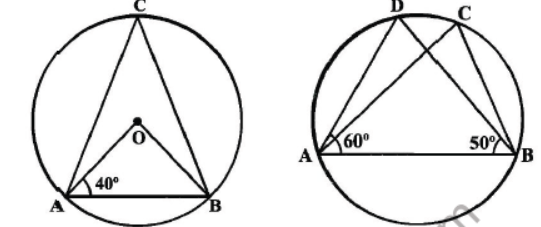
69. In the below figure, if ∠OAB = 40°, then find ∠ACB
Answer:
1. OA = OB (radii), so ∠OBA = ∠OAB = 40°.
2. ∠AOB = 180° - 40° - 40° = 100°.
3. ∠ACB = \( \frac{1}{2} \)∠AOB = \( \frac{1}{2} \) × 100° = 50°.
4. Hence, ∠ACB = 50°.
Teacher's Note:
a) Find the central angle using the isosceles triangle OAB.
b) Then halve it to get the angle on the major arc.
70. In the above right sided figure, if ∠DAB = 60°, ∠ABD = 50° then find ∠ACB.
Answer:
1. In △ABD, ∠ADB = 180° - 60° - 50° = 70°.
2. ∠ACB = ∠ADB (angles in the same segment AB).
3. Hence, ∠ACB = 70°.
Teacher's Note:
a) C and D are on the same side of AB, so their angles on AB are equal.
b) The third angle of the triangle gives ∠ADB.
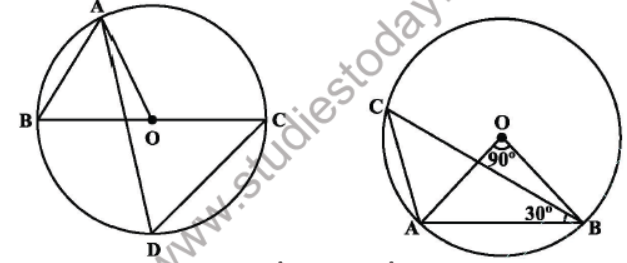
71. In the below figure, BC is a diameter of the circle and ∠BAO = 60° then find ∠ADC
Answer:
1. OA = OB (radii), so ∠OBA = ∠BAO = 60°.
2. ∠ABC = ∠OBA = 60° (O lies on BC).
3. ∠ADC = ∠ABC (angles in the same segment AC).
4. Hence, ∠ADC = 60°.
Teacher's Note:
a) O lies on the diameter BC, so ∠ABO is the same as ∠ABC.
b) Angles on the same arc AC are equal.
72. In above right sided figure, ∠AOB = 90° and ∠ABC = 30°, then find ∠CAO
Answer:
1. ∠ABC = 30° is the angle at the circumference on arc AC, so ∠AOC = 2 × 30° = 60°.
2. OA = OC (radii), so ∠OAC = ∠OCA.
3. ∠OAC = (180° - 60°) ÷ 2 = 60°.
4. Hence, ∠CAO = 60°.
Teacher's Note:
a) The triangle AOC has two equal sides and a 60° angle, so it is equilateral.
b) The angle ∠AOB = 90° is given for other parts of the figure and is not needed here.
73. The lengths of two parallel chords of a circle are 6 cm and 8 cm. If the smaller chord is at distance 4 cm from the centre, what is the distance of the other chord from the centre?
Answer:
1. Half of the smaller chord = 3 cm and its distance from the centre = 4 cm.
2. Radius r = √(3² + 4²) = √25 = 5 cm.
3. Half of the other chord = 8 ÷ 2 = 4 cm.
4. Distance of the other chord from the centre = √(5² - 4²) = √9 = 3 cm.
5. Hence, the distance of the 8 cm chord from the centre is 3 cm.
Teacher's Note:
a) The longer chord is nearer to the centre, so the answer must be less than 4 cm.
b) Find the radius first; it is the link between the two chords.
74. A, B, C D are four consecutive points on a circle such that AB = CD. Prove that AC = BD.
Answer:
Given: Four consecutive points A, B, C, D on a circle with AB = CD.
To prove: AC = BD.
1. Equal chords cut off equal arcs, so arc AB = arc CD.
2. Adding arc BC to both sides, arc AB + arc BC = arc BC + arc CD.
3. That is, arc ABC = arc BCD.
4. Equal arcs belong to equal chords, so AC = BD.
5. Hence, AC = BD.
Teacher's Note:
a) The arcs AC and BD overlap in arc BC; adding BC to equal arcs keeps them equal.
b) The converse (equal arcs give equal chords) is the final step.
75. If a line segment joining mid-points of two chords of a circle passes through the centre of the circle, prove that the two chords are parallel.
Answer:
Given: A circle with centre O, chords AB and CD with mid-points M and N, and the line MN passes through O.
To prove: AB ∥ CD.
1. M is the mid-point of AB, so OM ⊥ AB (the line from the centre to the mid-point of a chord).
2. N is the mid-point of CD, so ON ⊥ CD.
3. M, O and N lie on one line, so AB and CD are both perpendicular to the line MN.
4. Two lines perpendicular to the same line are parallel.
5. Hence, AB ∥ CD.
Teacher's Note:
a) If one chord is a diameter, its mid-point is the centre, and the same argument still works with ON ⊥ CD and AB ⊥ MN.
b) The perpendicular from the centre to a chord goes through its mid-point.
76. ABCD is such a quadrilateral that A is the centre of the circle passing through B, C and D. Prove that ∠CBD + ∠CDB = \( \frac{1}{2} \)∠BAD
Answer:
Given: A is the centre of the circle through B, C and D, so AB = AC = AD.
To prove: ∠CBD + ∠CDB = \( \frac{1}{2} \)∠BAD.
1. ABCD is a convex quadrilateral, so A and C lie on opposite sides of BD. The centre A lies on the side of the major arc BD, so C lies on the minor arc BD.
2. Take a point E on the major arc BD. The minor arc BD subtends ∠BAD at the centre, so ∠BED = \( \frac{1}{2} \)∠BAD.
3. BEDC is a cyclic quadrilateral, so ∠BCD = 180° - ∠BED = 180° - \( \frac{1}{2} \)∠BAD.
4. In △BCD, ∠CBD + ∠CDB = 180° - ∠BCD.
5. So, ∠CBD + ∠CDB = 180° - (180° - \( \frac{1}{2} \)∠BAD) = \( \frac{1}{2} \)∠BAD.
6. Hence, the result is proved.
Teacher's Note:
a) The centre and the arc through C lie on opposite sides of the chord BD.
b) The sum of the angles of △BCD gives the final relation.
77. O is the circumcentre of the triangle ABC and D is the mid-point of the base BC. Prove that ∠BOD = ∠A.
Answer:
Given: O is the circumcentre of △ABC and D is the mid-point of BC.
To prove: ∠BOD = ∠A.
Construction: Join OB, OC and OD.
1. ∠BOC = 2∠A (angle at the centre is double the angle at the circumference).
2. In △OBD and △OCD, OB = OC (radii).
3. BD = CD (D is the mid-point of BC) and OD = OD (common).
4. So, △OBD ≅ △OCD (SSS), hence ∠BOD = ∠COD.
5. ∠BOD = \( \frac{1}{2} \)∠BOC = \( \frac{1}{2} \) × 2∠A.
6. Hence, ∠BOD = ∠A.
Teacher's Note:
a) The line OD bisects the angle BOC because the two small triangles are congruent.
b) This result is written for the case when ∠A is acute and O lies inside the triangle.
78. On a common hypotenuse AB, two right triangles ACB and ADB are situated on opposite sides. Prove that ∠BAC = ∠BDC.
Answer:
Given: Right triangles ACB and ADB with right angles at C and D on the common hypotenuse AB, on opposite sides of AB.
To prove: ∠BAC = ∠BDC.
Construction: Join CD.
1. ∠ACB = ∠ADB = 90°.
2. A circle with AB as diameter passes through C and D (the converse of the angle in a semicircle).
3. So A, C, B, D are concyclic.
4. ∠BAC and ∠BDC are angles in the same segment on the chord BC.
5. Hence, ∠BAC = ∠BDC.
Teacher's Note:
a) Two points that see a segment at 90° lie on the circle with that segment as diameter.
b) Check that A and D are on the same side of BC before using the same-segment property.
79. In the below figure, AOC is a diameter of the circle and arc(AXB) = \( \frac{1}{2} \)arc(BYC). Find ∠BOC.
Answer:
1. Let arc(BYC) = x°. Then arc(AXB) = \( \frac{1}{2} \)x°.
2. AOC is a diameter, so arc(AXB) + arc(BYC) = 180°.
3. \( \frac{1}{2} \)x + x = 180°, so \( \frac{3}{2} \)x = 180° and x = 120°.
4. The angle at the centre equals the arc it stands on, so ∠BOC = arc(BYC) = 120°.
5. Hence, ∠BOC = 120°.
Teacher's Note:
a) The two arcs together form a semicircle of 180°.
b) Check: ∠AOB = 60°, which is half of 120°, as required.
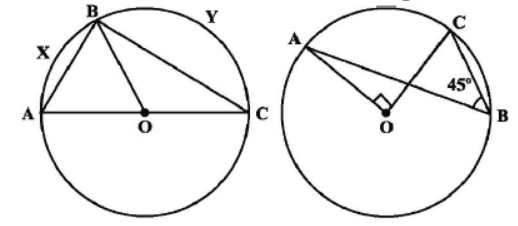
80. In the above right sided figure, ∠ABC = 45°, prove that OA ⊥ OC.
Answer:
Construction: Join OA and OC.
1. ∠ABC = 45° is the angle subtended by arc AC at the circumference.
2. ∠AOC = 2∠ABC = 2 × 45° = 90° (angle at the centre is double the angle at the circumference).
3. So, OA ⊥ OC.
4. Hence, proved.
Teacher's Note:
a) The right angle mark at O in the figure agrees with the result.
b) Double the inscribed angle to find the central angle.
81. Two chords AB and AC of a circle subtends angles equal to 90° and 150°, respectively at the centre. Find ∠BAC, if AB and AC lie on the opposite sides of the centre.
Answer:
1. ∠AOB = 90° and ∠AOC = 150°, where AB and AC lie on opposite sides of the centre.
2. ∠BOC (on the side not containing A) = 360° - 90° - 150° = 120°.
3. The angle at the circumference is half the angle at the centre on the same arc BC.
4. ∠BAC = \( \frac{1}{2} \) × 120° = 60°.
5. Hence, ∠BAC = 60°.
Teacher's Note:
a) The three central angles around O add up to 360°.
b) The arc BC that does not contain A is the one doubled by ∠BAC.
82. If BM and CN are the perpendiculars drawn on the sides AC and AB of the triangle ABC, prove that the points B, C, M and N are concyclic.
Answer:
Given: △ABC with BM ⊥ AC and CN ⊥ AB.
To prove: B, C, M, N are concyclic.
1. ∠BMC = 90° and ∠BNC = 90°.
2. So BC subtends a right angle at both M and N.
3. M and N lie on the circle having BC as diameter (converse of the angle in a semicircle).
4. Hence, B, C, M and N are concyclic.
Teacher's Note:
a) Equal angles on the same segment BC also prove that the four points are concyclic.
b) The circle on BC as diameter passes through the feet of both altitudes.
83. If a line is drawn parallel to the base of an isosceles triangle to intersect its equal sides, prove that the quadrilateral so formed is cyclic.
Answer:
Given: △ABC with AB = AC. DE ∥ BC with D on AB and E on AC.
To prove: BCED is cyclic.
1. AB = AC, so ∠ABC = ∠ACB.
2. DE ∥ BC, so ∠ADE = ∠ABC (corresponding angles).
3. ∠BDE + ∠ADE = 180° (linear pair).
4. ∠BCE = ∠ACB = ∠ABC = ∠ADE.
5. So, ∠BDE + ∠BCE = ∠BDE + ∠ADE = 180°.
6. The opposite angles of BCED are supplementary.
7. Hence, BCED is cyclic.
Teacher's Note:
a) Equal base angles of the isosceles triangle and corresponding angles from the parallel lines are both used.
b) Finish with the converse of the cyclic quadrilateral theorem.
84. If a pair of opposite sides of a cyclic quadrilateral are equal, prove that its diagonals are also equal.
Answer:
Given: A cyclic quadrilateral ABCD with AB = CD.
To prove: AC = BD.
1. In △ABC and △DCB, ∠ACB = ∠DBC (equal chords AB and CD subtend equal angles at the circumference).
2. ∠BAC = ∠BDC (angles in the same segment BC).
3. AB = DC (given).
4. So, △ABC ≅ △DCB (AAS congruence rule).
5. Hence, AC = DB (corresponding parts of congruent triangles).
Teacher's Note:
a) Match the vertices carefully: A corresponds to D, B to C and C to B.
b) The same proof works if the other pair of opposite sides is equal.
85. The circumcentre of the triangle ABC is O. Prove that ∠OBC + ∠BAC = 90°.
Answer:
Given: O is the circumcentre of △ABC.
To prove: ∠OBC + ∠BAC = 90°.
Construction: Join OB and OC.
1. ∠BOC = 2∠BAC (angle at the centre is double the angle at the circumference).
2. OB = OC (radii), so ∠OBC = ∠OCB.
3. ∠OBC + ∠OCB + ∠BOC = 180°, so 2∠OBC = 180° - 2∠BAC.
4. ∠OBC = 90° - ∠BAC.
5. Hence, ∠OBC + ∠BAC = 90°.
Teacher's Note:
a) The result holds when ∠A is acute so that O lies inside the triangle.
b) Use the isosceles triangle OBC to split the angle sum.
86. A chord of a circle is equal to its radius. Find the angle subtended by this chord at a point in major segment.
Answer:
Construction: Let AB be the chord with AB = radius and O the centre. Join OA and OB.
1. OA = OB = AB, so △OAB is equilateral and ∠AOB = 60°.
2. The angle at a point C in the major segment = \( \frac{1}{2} \)∠AOB.
3. ∠ACB = \( \frac{1}{2} \) × 60° = 30°.
4. Hence, the chord subtends 30° at a point in the major segment.
Teacher's Note:
a) A chord equal to the radius forms an equilateral triangle with the centre.
b) The angle in the minor segment would be 180° - 30° = 150°.
87. In the below figure, ∠ADC = 130° and chord BC = chord BE. Find ∠CBE.
Answer:
1. AB is a diameter and ABCD is a cyclic quadrilateral, so ∠ABC = 180° - ∠ADC = 180° - 130° = 50°.
2. ∠ACB = 90° (angle in a semicircle), so ∠BAC = 180° - 90° - 50° = 40°.
3. Chord BC = chord BE, so they subtend equal angles at the centre: ∠BOE = ∠BOC = 2∠BAC = 80°.
4. The diameter AB is the axis of symmetry of the chords BC and BE, so ∠ABE = ∠ABC = 50°.
5. ∠CBE = ∠ABC + ∠ABE = 50° + 50° = 100°.
6. Hence, ∠CBE = 100°.
Teacher's Note:
a) Equal chords BC and BE are mirror images in the diameter AB, so each makes the same angle with AB.
b) Cross-check: the arc CE not containing B is 200°, and half of 200° is 100°.
88. In the above right sided figure, ∠ACB = 40°. Find ∠OAB.
Answer:
1. ∠AOB = 2∠ACB = 2 × 40° = 80° (angle at the centre is double the angle at the circumference).
2. OA = OB (radii), so ∠OAB = ∠OBA.
3. ∠OAB = (180° - 80°) ÷ 2 = 50°.
4. Hence, ∠OAB = 50°.
Teacher's Note:
a) First find the central angle, then use the isosceles triangle OAB.
b) The angles ∠OAB and ∠ACB add up to 90°, which is a useful shortcut.
89. A quadrilateral ABCD is inscribed in a circle such that AB is a diameter and ∠ADC = 130°. Find ∠BAC.
Answer:
1. ABCD is cyclic, so ∠ABC = 180° - ∠ADC = 180° - 130° = 50°.
2. AB is a diameter, so ∠ACB = 90° (angle in a semicircle).
3. In △ABC, ∠BAC = 180° - 90° - 50° = 40°.
4. Hence, ∠BAC = 40°.
Teacher's Note:
a) Use the opposite angles of the cyclic quadrilateral, then the angle in a semicircle.
b) Check that the three angles of △ABC add up to 180°.
90. Two circles with centres O and O’ intersect at two points A and B. A line PQ is drawn parallel to OO’ through A(or B) intersecting the circles at P and Q. Prove that PQ = 2 OO’
Answer:
Given: Circles with centres O and O' meeting at A and B. PQ ∥ OO' passes through A and meets the circles at P and Q.
To prove: PQ = 2OO'.
Construction: Draw OM ⊥ PQ and O'N ⊥ PQ.
1. OM ⊥ PA, so M is the mid-point of the chord PA, that is, PA = 2MA.
2. O'N ⊥ AQ, so N is the mid-point of the chord AQ, that is, AQ = 2AN.
3. OM ∥ O'N (both perpendicular to PQ) and OO' ∥ MN (given), so OMNO' is a rectangle and MN = OO'.
4. PQ = PA + AQ = 2MA + 2AN = 2(MA + AN) = 2MN.
5. Hence, PQ = 2OO'.
Teacher's Note:
a) Perpendiculars from the centres bisect the chords PA and AQ.
b) The rectangle OMNO' gives the equality MN = OO'.
91. In the below figure, AOB is a diameter of the circle and C, D, E are any three points on the semi-circle. Find the value of ∠ACD + ∠BED.
Answer:
Construction: Join AD and BD.
1. ACDB is a cyclic quadrilateral, so ∠ACD + ∠ABD = 180°.
2. ADEB is a cyclic quadrilateral, so ∠BED + ∠BAD = 180°.
3. Adding, ∠ACD + ∠BED + ∠ABD + ∠BAD = 360°.
4. ∠ADB = 90° (angle in a semicircle), so ∠ABD + ∠BAD = 90°.
5. ∠ACD + ∠BED = 360° - 90° = 270°.
6. Hence, ∠ACD + ∠BED = 270°.
Teacher's Note:
a) Two cyclic quadrilaterals share the diameter AB, so two pairs of opposite angles can be added.
b) The angle sum of △ABD gives the 90° that is subtracted.
92. In the above right sided figure, ∠OAB = 30° and ∠OCB = 57°. Find ∠BOC and ∠AOC.
Answer:
1. OA = OB (radii), so ∠OBA = ∠OAB = 30°.
2. ∠AOB = 180° - 30° - 30° = 120°.
3. OB = OC (radii), so ∠OBC = ∠OCB = 57°.
4. ∠BOC = 180° - 57° - 57° = 66°.
5. C lies on the minor arc AB, so OC lies inside ∠AOB.
6. ∠AOC = ∠AOB - ∠BOC = 120° - 66° = 54°.
7. Hence, ∠BOC = 66° and ∠AOC = 54°.
Teacher's Note:
a) Both triangles OAB and OBC are isosceles because two sides are radii.
b) Check: ∠OCA = (180° - 54°) ÷ 2 = 63° and ∠ACB = 63° + 57° = 120°, which equals 180° - 60° for a point on the minor arc.
93. In the below figure, O is the centre of the circle, ∠BCO = 30°, find x and y.
Answer:
1. OB = OC (radii), so ∠OBC = ∠BCO = 30°.
2. AO ⊥ BC, so in the right triangle formed by O, B and the foot of the perpendicular on BC, the angle at O is 90° - 30° = 60°.
3. ∠AOB = 180° - 60° = 120° (A, O and the foot of the perpendicular are collinear).
4. OA = OB (radii), so x = ∠OAB = (180° - 120°) ÷ 2 = 30°.
5. ∠DOC = 90° - 60° = 30° (OD ⊥ OA and ∠COM = 60° with M on BC).
6. y = ∠DBC = \( \frac{1}{2} \)∠DOC = 15° (angle at the circumference is half the angle at the centre).
7. Hence, x = 30° and y = 15°.
Teacher's Note:
a) The perpendicular from the centre to the chord BC bisects the angle at the centre.
b) The arc DC subtends 30° at the centre, so only 15° at B.
94. In the above right sided figure, O is the centre of the circle, BD = OD and CD ⊥ AB. Find ∠CAB.
Answer:
1. OB = OD (radii) and BD = OD (given), so OB = OD = BD.
2. △OBD is equilateral, so ∠BOD = 60°.
3. The diameter AB is perpendicular to the chord CD, so it bisects the chord and the angle COD.
4. ∠BOC = ∠BOD = 60°.
5. ∠CAB = \( \frac{1}{2} \)∠BOC = \( \frac{1}{2} \) × 60° = 30°.
6. Hence, ∠CAB = 30°.
Teacher's Note:
a) Look for an equilateral triangle whenever a segment equals the radius.
b) The diameter perpendicular to a chord bisects it, which makes ∠BOC equal to ∠BOD.
95. Let the vertex of an angle ABC be located outside a circle and let the sides of the angle intersect equal chords AD and CE with the circle. Prove that ∠ABC is equal to half the difference of the angles subtended by the chords AC and DE at the centre.
Answer:
Given: A point B outside a circle with centre O. The sides of ∠ABC meet the circle at A, D and at C, E, where A and C are the points nearer to B.
To prove: ∠ABC = \( \frac{1}{2} \)(∠DOE - ∠AOC).
Construction: Join AE.
1. In △ABE, ∠DAE is an exterior angle, so ∠DAE = ∠ABE + ∠AEB.
2. ∠ABE = ∠ABC (C lies on BE), so ∠ABC = ∠DAE - ∠AEB.
3. ∠DAE = \( \frac{1}{2} \)∠DOE (angle at the circumference is half the angle at the centre on arc DE).
4. ∠AEB = ∠AEC = \( \frac{1}{2} \)∠AOC (angle at the circumference is half the angle at the centre on arc AC).
5. ∠ABC = \( \frac{1}{2} \)∠DOE - \( \frac{1}{2} \)∠AOC.
6. Hence, ∠ABC = \( \frac{1}{2} \)(∠DOE - ∠AOC), that is, half the difference of the angles subtended by DE and AC at the centre.
Teacher's Note:
a) Draw the line AE; it creates a triangle whose exterior angle connects the two arcs.
b) The farther arc DE gives the bigger angle, so the difference is taken as DE minus AC.
Free study material for Mathematics
Useful Resources and Notes for Class 9 Mathematics Chapter 10 Circles
Comprehensive Study Resources for Chapter 10 Circles
Review targeted study resources for Chapter 10 Circles tailored for Class 9 learners. Utilizing these structured notes and quick-revision tools ensures complete alignment with current CBSE evaluation standards.
Understanding Marking Schemes
Each resource draws directly from authorized textbooks to maintain academic accuracy. Evaluating solved examples allows Class 9 students to master the formal presentation and answer-writing standards expected in upcoming school exams.
Complete Revision for Mathematics
Wrap up your chapter revision by testing your knowledge against standard objective question formats. Explore our full library of free, up-to-date sample papers and online assessments to secure top grades in your CBSE examinations.
FAQs
Our advanced study package for Chapter 10 Circles includes detailed concepts, diagrams, Mind Maps, and explanation of complex topics to ensure Class 9 students learn as per syllabus for 2026 exams.
The Mind Maps provided for Chapter 10 Circles act as visual anchors which will help faster recall during high-pressure exams.
Yes, teachers use our Class 9 Mathematics resources for lesson planning as they are in simple language and have lot of solved examples.
Yes, You can download the complete, mobile-friendly PDF of the Mathematics Chapter 10 Circles advanced resources for free.
Yes, our subject matter experts have updated the Chapter 10 Circles material to align with the rationalized NCERT textbooks and have removed deleted topics and added new competency-based questions.