
CBSE Class 9 Polynomials Sure Shot Questions

Read and download the CBSE Class 9 Polynomials Sure Shot Questions. Designed for 2025-26, this advanced study material provides Class 9 Mathematics students with detailed revision notes, sure-shot questions, and detailed answers. Prepared by expert teachers and they follow the latest CBSE, NCERT, and KVS guidelines to ensure you get best scores.

Advanced Study Material for Class 9 Mathematics Chapter 2 Polynomials

To achieve a high score in Mathematics, students must go beyond standard textbooks. This Class 9 Chapter 2 Polynomials study material includes conceptual summaries and solved practice questions to improve you understanding.

Class 9 Mathematics Chapter 2 Polynomials Notes and Questions


CBSE Class 9 Polynomials Sure Shot Questions. There are many more useful educational material which the students can download in pdf format and use them for studies. Study material like concept maps, important and sure shot question banks, quick to learn flash cards, flow charts, mind maps, teacher notes, important formulas, past examinations question bank, important concepts taught by teachers. Students can download these useful educational material free and use them to get better marks in examinations.  Also refer to other worksheets for the same chapter and other subjects too. Use them for better understanding of the subjects.

1. Factorize the following: 9x2 + 6x + 1 – 25y2.

2. Factorize the following: a2 + b2 + 2ab + 2bc + 2ca

3. Show that p(x) = x3 – 3x2 + 2x – 6 has only one real zero.

4. Find the value of a if x + 6 is a factor of x3 + 3x2 + 4x + a.

5. If polynomials ax3 + 3x2 – 3 and 2x3 – 5x + a leaves the same remainder when each is divided byx – 4, find the value of a..

6. The polynomial f(x)= x4 – 2x3 +3x2 – ax + b when divided by (x – 1) and (x + 1) leaves the remainders 5 and 19 respective ly. Find the values of a and b. Hence, find the remainder when

f(x) is divided by (x – 2).

7. If the polynomials 2x3 +ax2 + 3x – 5 and x3 + x2 – 2x + a leave the same remainder when divided by (x – 2), find the value of a. Also, find the remainder in each case.

8. If the polynomials az3 + 4z2 + 3z – 4 and z3 – 4z + a leave the same remainder when divided by z – 3, find the value of a.

9. The polynomial p(x) = x4 – 2x3 + 3x2 – ax + 3a – 7 when divided by x + 1 leaves the remainder 19. Find the values of a. Also find the remainder when p(x) is divided by x + 2.

10. If both x – 2 and x – 1/ 2 are factors of px2 + 5x + r, show that p = r.

11. Without actual division, prove that 2x4 – 5x3 + 2x2 – x + 2 is divisible by x2 – 3x + 2.

12. Simplify (2x – 5y)3 – (2x + 5y)3.

13. Multiply x2 + 4y2 + z2 + 2xy + xz – 2yz by (– z + x – 2y).

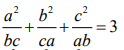
14. If a, b, c are all non-zero and a + b + c = 0, prove that 
useful-resources-polynomials-cbse-class-9-polynomials

15. If a + b + c = 5 and ab + bc + ca = 10, then prove that a3 + b3 + c3 –3abc = – 25.

16. Without actual division, prove that 2x4 – 6x3 +3x2 +3x – 2 is exactly divisible by x2 – 3x + 2.

17. Without actual division, prove that x3 – 3x2 – 13x + 15 is exactly divisible by x2 + 2x – 3.

18. Find the values of a and b so that the polynomial x3 – 10x2 +ax + b is exactly divisible by (x – 1) as well as (x – 2).

19. Find the integral zeroes of the polynomial 2x3 + 5x2 – 5x – 2.
20. If (x – 3) and x -1/3 are both factors of ax2 + 5x + b, then show that a = b.
 
21. Find the values of a and b so that the polynomial x4 + ax3 – 7x2 +8x + b is exactly divisible by (x + 2) as well as (x + 3).
 
22. If x3 + ax2 + bx + 6 has (x – 2) as a factor and leaves a remainder 3 when divided by (x – 3), find the values of a and b.
 
23. Find the value of x3 + y3 + 15xy – 125 if x + y = 5.
 
24. Without actually calculating, find the value of (25)3 – (75)3 + (50)3.
 
25. Factorise each of the following cubic expressions:
 
(i) 8x3 – y3 – 12x2y + 6xy2
 
(ii) 27q3 – 125p3 – 135q2p + 225qp2
 
(iii) 8x3 + 729 + 108x2 + 486x
 
(iv) 27x3 - 1/216-9/2x2 + 1/4x
 
26. Factorise:
 
(i) x3 + 216y3 + 8z3 – 36xyz
 
(ii) a3 – 64b3 – 27c3 – 36abc
 
28. Give one example each of a binomial of degree 35, and of a monomial of degree 100.
 
29. Find a zero of the polynomial p(x) = 2x + 1.
 
30. Verify whether 2 and 0 are zeroes of the polynomial x2 – 2x.
 
31. Find the zero of the polynomial in each of the following cases:
 
(i) p(x) = x + 5 (ii) p(x) = x – 5 (iii) p(x) = 2x + 5
 
(iv) p(x) = 3x – 2 (v) p(x) = 3x (vi) p(x) = ax, a ≠ 0
 
32. Find the value of each of the following polynomials at the indicated value of variables:
 
(i) p(x) = 5x2 – 3x + 7 at x = 1.
 
(ii) q(y) = 3y3 – 4y + 11 at y = 2.
 
(iii) p(t) = 4t4 + 5t3 – t2 + 6 at t = a.
 
33. Divide p(x) by g(x), where p(x) = x + 3x2 – 1 and g(x) = 1 + x.
 
34. Divide the polynomial 3x4 – 4x3 – 3x –1 by x – 1.
 
35. Find the remainder obtained on dividing p(x) = x3 + 1 by x + 1.
 
36. Find the remainder when x4 + x3 – 2x2 + x + 1 is divided by x – 1.
 
37. Check whether the polynomial q(t) = 4t3 + 4t2 – t – 1 is a multiple of 2t + 1.
 
38. Check whether p(x) is a multiple of g(x) or not, where p(x) = x3 – x + 1, g(x) = 2 – 3x.
 
39. Check whether g(x) is a factor of p(x) or not, where p(x) = 8x3 – 6x2 – 4x + 3, g(x) = x/3-1/4
 
40. Find the remainder when x3 – ax2 + 6x – a is divided by x – a.
 
41. Examine whether x + 2 is a factor of x3 + 3x2 + 5x + 6 and of 2x + 4.
 
42. Find the value of k, if x – 1 is a factor of 4x3 + 3x2 – 4x + k.
 
43. Find the value of a, if x – a is a factor of x3– ax2 + 2x + a – 1.
 
44. Factorise 6x2 + 17x + 5
 
45. Factorise y2 – 5y + 6
 
46. Factorise x3 – 23x2 + 142x – 120.
 
47. Factorise :
(i) x3– 2x2 – x + 2 (ii) x3 – 3x2 – 9x – 5
 
(iii) x3+ 13x2 + 32x + 20 (iv) 2y3 + y2 – 2y – 1
 
48. Factorise : 4x2 + 9y2 + 16z2 + 12xy – 24yz – 16xz
 
49. Expand (4a – 2b – 3c)2.
 
50. Factorise 4x2 + y2 + z2 – 4xy – 2yz + 4xz.
 
51. If x + 1 is a factor of ax3 + x2 – 2x + 4a – 9, find the value of a.
 
52. By actual division, find the quotient and the remainder when the first polynomial is divided by the second polynomial : x4 + 1; x –1
 
53. Find the zeroes of the polynomial : p(x) = (x – 2)2 – (x + 2)2
 
54. Factorise :
(i) x2 + 9x + 18 (ii) 6x2 + 7x – 3
 
(iii) 2x2 – 7x – 15 (iv) 84 – 2r – 2r2
 
55. Factorise :
 
(i) 2x3 – 3x2 – 17x + 30 (ii) x3 – 6x2 + 11x – 6
 
(iii) x3 + x2 – 4x – 4 (iv) 3x3 – x2 – 3x + 1
 
56. Using suitable identity, evaluate the following:
 
(i) 1033 (ii) 101 × 102 (iii) 9992
 
57. Factorise the following:
 
(i) 4x2 + 20x + 25
 
(ii) 9y2 – 66yz + 121z2
 
(iii) (2x+1/3)2 - (x-1/2)2
 
58. Factorise the following :
 
(i) 9x2 – 12x + 3 (ii) 9x2 – 12x + 4
 
59. If a + b + c = 9 and ab + bc + ca = 26, find a2 + b2 + c2.
 
60. Expand the following :
 
(i) (4a – b + 2c)2
 
(ii) (3a – 5b – c)2
 
(iii) (– x + 2y – 3z)2
 
61. Find the value of
 
(i) x3 + y3 – 12xy + 64, when x + y = – 4
 
(ii) x3 – 8y3 – 36xy – 216, when x = 2y + 6
 
62. Factorise the following :
 
(i) 9x2 + 4y2 + 16z2 + 12xy – 16yz – 24xz
 
(ii) 25x2 + 16y2 + 4z2 – 40xy + 16yz – 20xz
 
(iii) 16x2 + 4y2 + 9z2 – 16xy – 12yz + 24 xz
CBSE Class 9 Polynomials Sure Shot Questions
 
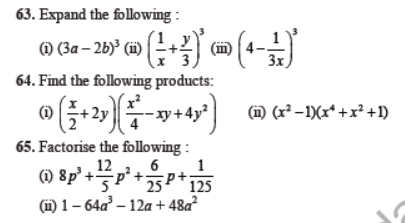
66. Without finding the cubes, factorise (x – 2y)3 + (2y – 3z)3 + (3z – x)3
 
67. Give possible expressions for the length and breadth of the rectangle whose area is given by 4a2 + 4a –3.
 
68. Factorise: (i) 1+ 64x3 (ii) a3 + 2 2b3
 
69. Evaluate each of the following using suitable identities:
(i) (104)3         (ii) (999)3
 
70. Factorise : 8x3 + 27y3 + 36x2y + 54xy2
 
71. Factorise : 8x3 + y3 + 27z3 – 18xyz
 
72. Verify : (i) x3 + y3 = (x + y) (x2 – xy + y2) (ii) x3 – y3 = (x – y) (x2 + xy + y2)
 
73. Factorise each of the following:
 
(i) 27y3 + 125z3 (ii) 64m3 – 343n3
 
74. Factorise : 27x3 + y3 + z3 – 9xyz
 
75. Without actually calculating the cubes, find the value of each of the following:
 
(i) (–12)3 + (7)3 + (5)3
 
(ii) (28)3 + (–15)3 + (–13)3
 
76. Find the following product :(2x – y + 3z) (4x2 + y2 + 9z2 + 2xy + 3yz – 6xz) 77. Factorise :
 
(i) a3 – 8b3 – 64c3 – 24abc (ii) 2 2 a3 + 8b3 – 27c3 + 18 2 abc.
 
78. Give possible expressions for the length and breadth of rectangles, in which its areas is given by 35y2 + 13y –12
 
79. Without actually calculating the cubes, find the value of :
 
(i) (1/2)3 +(1/3)3 - (5/6)
 
(ii) (0.2)3 - (0.3)3 + (0.1)3
 
80. By Remainder Theorem find the remainder, when p(x) is divided by g(x), where
(i) p(x) = x3 – 2x2 – 4x – 1, g(x) = x + 1
 
(ii) p(x) = x3 – 3x2 + 4x + 50, g(x) = x – 3
 
(iii) p(x) = 4x3 – 12x2 + 14x – 3, g(x) = 2x – 1
 
(iv) p(x) = x3 – 6x2 + 2x – 4, g(x) = 1 3/2x
 
81. Check whether p(x) is a multiple of g(x) or not :
 
(i) p(x) = x3 – 5x2 + 4x – 3, g(x) = x – 2
 
(ii) p(x) = 2x3 – 11x2 – 4x + 5, g(x) = 2x + 1
 
82. Show that p – 1 is a factor of p10 – 1 and also of p11 – 1.
 
83. For what value of m is x3 – 2mx2+ 16 divisible by x + 2 ?
 
84. If x + 2a is a factor of x5 – 4a2x3 + 2x + 2a + 3, find a.
 
85. Find the value of m so that 2x – 1 be a factor of 8x4 + 4x3 – 16x2 + 10x + m.
 
86. Show that :
 
(i) x + 3 is a factor of 69 + 11x – x2 + x3 .
 
(ii) 2x – 3 is a factor of x + 2x3 – 9x2 + 12 .
 
87. If x + y = 12 and xy = 27, find the value of x3 + y3
 
88. Without actually calculating the cubes, find the value of 483 – 303 – 183.
 
89. Without finding the cubes, factorise (2x – 5y)3 + (5y – 3z)3 + (3z – 2x)3.
 
90. Without finding the cubes, factorise (x – y)3 + (y – z)3 + (z – x)3.
 

Please click the link below to download CBSE Class 9 Polynomials Sure Shot Questions.

CBSE Class 9 Mathematics Chapter 2 Polynomials Study Material

Students can find all the important study material for Chapter 2 Polynomials on this page. This collection includes detailed notes, Mind Maps for quick revision, and Sure Shot Questions that will come in your CBSE exams. This material has been strictly prepared on the latest 2026 syllabus for Class 9 Mathematics. Our expert teachers always suggest you to use these tools daily to make your learning easier and faster.

Chapter 2 Polynomials Expert Notes & Solved Exam Questions

Our teachers have used the latest official NCERT book for Class 9 Mathematics to prepare these study material. We have included previous year examination questions and also step-by-step solutions to help you understand the marking scheme too. After reading the above chapter notes and solved questions also solve the practice problems and then compare your work with our NCERT solutions for Class 9 Mathematics.

Complete Revision for Mathematics

To get the best marks in your Class 9 exams you should use Mathematics Sample Papers along with these chapter notes. Daily practicing with our online MCQ Tests for Chapter 2 Polynomials will also help you improve your speed and accuracy. All the study material provided on studiestoday.com is free and updated regularly to help Class 9 students stay ahead in their studies and feel confident during their school tests.

What is included in the advanced study material for Class 9 Mathematics Chapter Chapter 2 Polynomials?

Our advanced study package for Chapter Chapter 2 Polynomials includes detailed concepts, diagrams, Mind Maps, and explanation of complex topics to ensure Class 9 students learn as per syllabus for 2026 exams.

How do Mind Maps for Mathematics Chapter Chapter 2 Polynomials help in revision?

The Mind Maps provided for Chapter Chapter 2 Polynomials act as visual anchors which will help faster recall during high-pressure exams.

Are these Mathematics resources suitable for both classroom teaching and self-study?

Yes, teachers use our Class 9 Mathematics resources for lesson planning as they are in simple language and have lot of solved examples.

Is this advanced study material for Chapter Chapter 2 Polynomials free to download in PDF?

Yes, You can download the complete, mobile-friendly PDF of the Mathematics Chapter Chapter 2 Polynomials advanced resources for free.

Does this material cover rationalized content for the 2025-26 CBSE session?

Yes, our subject matter experts have updated the Chapter Chapter 2 Polynomials material to align with the rationalized NCERT textbooks and have removed deleted topics and added new competency-based questions.