

Download CBSE Class 9 Mathematics Useful Resources
Access comprehensive study materials and useful resources for Chapter 15 Probability using the CBSE Class 9 Probability Sure Shot Questions. Designed to align with the 2026-27 CBSE academic guidelines, these advanced resources help Class 9 Mathematics students reinforce core concepts beyond standard textbooks.
Access CBSE Study Guides and Summaries
Navigate directly to the advanced Mathematics study materials using the digital viewer below. Each resource pack includes detailed conceptual summaries and solved practice questions, allowing students to instantly reinforce their learning.
CBSE Class 9 Probability Sure Shot Questions. There are many more useful educational material which the students can download in pdf format and use them for studies. Study material like concept maps, important and sure shot question banks, quick to learn flash cards, flow charts, mind maps, teacher notes, important formulas, past examinations question bank, important concepts taught by teachers. Students can download these useful educational material free and use them to get better marks in examinations. Also refer to other worksheets for the same chapter and other subjects too. Use them for better understanding of the subjects.
1. Write all possible outcomes when
(i) one coin is tossed.
(ii) two coins are tossed.
(iii) one die is rolled. [3 Marks]
Answer:
1. (i) When one coin is tossed, the possible outcomes are Head (H) and Tail (T), i.e., {H, T}.
2. (ii) When two coins are tossed, the possible outcomes are {HH, HT, TH, TT}.
3. (iii) When one die is rolled, the possible outcomes are {1, 2, 3, 4, 5, 6}.
Teacher's Note:
a) Sample space represents the set of all possible outcomes of a random experiment.
b) The number of outcomes doubles with each additional coin tossed (2n rule).
c) A standard die has six faces numbered 1 through 6.
2. Three coins are tossed simultaneously 100 times. The following outcomes are recorded.
Outcome: 3 tails | 2 tails | 1 tail | No tail
Frequency: 23 | 28 | 23 | 26
Find the probability of coming up more than one tail. [3 Marks]

| Outcome | 3 tails | 2 tails | 1 tail | No tail |
|---|---|---|---|---|
| Frequency | 23 | 28 | 23 | 26 |
Answer:
1. Total number of trials = 100.
2. Outcomes of getting more than one tail means getting either 2 tails or 3 tails.
3. Frequency of getting 2 tails = 28, and frequency of getting 3 tails = 23.
4. Number of favorable trials = 28 + 23 = 51.
5. Probability = \(\frac{51}{100}\) = 0.51.
Teacher's Note:
a) "More than one tail" strictly means 2 or 3 tails, excluding 1 tail and 0 tails.
b) Always sum the individual frequencies corresponding to the favorable condition correctly.
c) Empirical probability is based on actual observations and experiments.
3. A die is thrown 300 times with the frequencies for the outcomes 1, 2, 3, 4, 5 and 6 as given in the following table :
Find the probability of getting (i) an even number (ii) a prime number and (iii) a number more than 4. [3 Marks]

| Outcome | 1 | 2 | 3 | 4 | 5 | 6 |
|---|---|---|---|---|---|---|
| Frequency | 42 | 60 | 55 | 53 | 60 | 30 |
Answer:
1. Total number of trials = 300.
2. (i) Even numbers are 2, 4, 6. Sum of frequencies = 60 + 53 + 30 = 143. Probability = \(\frac{143}{300}\).
3. (ii) Prime numbers on a die are 2, 3, 5. Sum of frequencies = 60 + 55 + 60 = 175. Probability = \(\frac{175}{300}\) = \(\frac{7}{12}\).
4. (iii) Numbers more than 4 are 5, 6. Sum of frequencies = 60 + 30 = 90. Probability = \(\frac{90}{300}\) = \(\frac{3}{10}\).
Teacher's Note:
a) Note that 1 is neither prime nor composite.
b) Simplify fractional probabilities to their lowest terms whenever possible.
c) Double check the addition of frequencies for each sub-part.
4. A box contains 3 blue, 2 white, and 4 red marbles. If a marble is drawn at random from the box, what is the probability that it will be (i) white? (ii) blue? (iii) red? [3 Marks]
Answer:
1. Total number of marbles = 3 + 2 + 4 = 9.
2. (i) Number of white marbles = 2. Probability of white marble = \(\frac{2}{9}\).
3. (ii) Number of blue marbles = 3. Probability of blue marble = \(\frac{3}{9}\) = \(\frac{1}{3}\).
4. (iii) Number of red marbles = 4. Probability of red marble = \(\frac{4}{9}\).
Teacher's Note:
a) Total probability of all mutually exclusive outcomes in an experiment always equals 1.
b) Always write the total number of favorable outcomes over the total number of possible outcomes.
c) Reduce fractions completely.
5. A coin is tossed 1000 times with the following frequencies: Head : 455, Tail : 545 Compute the probability for getting head. [2 Marks]
Answer:
1. Total number of trials = 1000.
2. Number of times head comes up = 455.
3. Probability of getting head = \(\frac{455}{1000}\) = 0.455.
Teacher's Note:
a) Empirical probability can be expressed as a decimal or a simplified fraction.
b) Ensure proper division by powers of ten.
6. Two coins are tossed simultaneously 500 times, and we get Two heads : 105 times, One head : 275 times and No head : 120 times. Find the probability of occurrence of two heads. [2 Marks]
Answer:
1. Total number of trials = 500.
2. Number of times two heads occur = 105.
3. Probability of occurrence of two heads = \(\frac{105}{500}\) = \(\frac{21}{100}\) = 0.21.
Teacher's Note:
a) Verify total frequency: 105 + 275 + 120 = 500.
b) Focus only on the specific frequency demanded by the question.
7. A die is thrown 1000 times with the frequencies for the outcomes 1, 2, 3, 4, 5 and 6 as given in the following table :
Find the probability of getting (i) an odd number (ii) a prime number and (iii) a number greater than 4. [3 Marks]

| Outcome | 1 | 2 | 3 | 4 | 5 | 6 |
|---|---|---|---|---|---|---|
| Frequency | 179 | 150 | 157 | 149 | 175 | 190 |
Answer:
1. Total number of trials = 1000.
2. (i) Odd numbers are 1, 3, 5. Sum of frequencies = 179 + 157 + 175 = 511. Probability = \(\frac{511}{1000}\) = 0.511.
3. (ii) Prime numbers are 2, 3, 5. Sum of frequencies = 150 + 157 + 175 = 482. Probability = \(\frac{482}{1000}\) = 0.482.
4. (iii) Numbers greater than 4 are 5, 6. Sum of frequencies = 175 + 190 = 365. Probability = \(\frac{365}{1000}\) = 0.365.
Teacher's Note:
a) Carefully identify odd numbers versus prime numbers to avoid overlapping counting errors.
b) Expressing answers in decimals is standard when the denominator is 1000.
c) Check that the sum of all frequencies matches the total given trials.
8. 12 defective pens are accidentally mixed with 132 good ones. It is not possible to just look at a pen and tell whether or not it is defective. One pen is taken out at random from this lot. Determine the probability that the pen taken out is a good one. [2 Marks]
Answer:
1. Number of defective pens = 12.
2. Number of good pens = 132.
3. Total number of pens = 12 + 132 = 144.
4. Probability of getting a good pen = \(\frac{132}{144}\) = \(\frac{11}{12}\).
Teacher's Note:
a) Total pens equal the sum of defective and good pens.
b) Always simplify the fraction by dividing numerator and denominator by their HCF.
9. On one page of a telephone directory, there were 200 telephone numbers. The frequency distribution of their unit place digit (for example, in the number 25828573, the unit place digit is 3) is given in Table 15.7 :
Without looking at the page, the pencil is placed on one of these numbers, i.e., the number is chosen at random. What is the probability that the digit in its unit place is (i) an odd number (ii) a prime number and (iii) a number greater than 4.? [3 Marks]

| Digit | 0 | 1 | 2 | 3 | 4 | 5 | 6 | 7 | 8 | 9 |
|---|---|---|---|---|---|---|---|---|---|---|
| Frequency | 22 | 1, 26 | 22 | 22 | 20 | 10 | 14 | 28 | 16 | 20 |
Answer:
1. Total number of telephone numbers = 200.
2. (i) Odd digits are 1, 3, 5, 7, 9. Sum of frequencies = 26 + 22 + 10 + 28 + 20 = 106. Probability = \(\frac{106}{200}\) = \(\frac{53}{100}\) = 0.53.
3. (ii) Prime single-digit numbers are 2, 3, 5, 7. Sum of frequencies = 22 + 22 + 10 + 28 = 82. Probability = \(\frac{82}{200}\) = \(\frac{41}{100}\) = 0.41.
4. (iii) Numbers greater than 4 are 5, 6, 7, 8, 9. Sum of frequencies = 10 + 14 + 28 + 16 + 20 = 88. Probability = \(\frac{88}{200}\) = \(\frac{22}{50}\) = \(\frac{11}{25}\).
Teacher's Note:
a) Remember that 0 and 1 are neither prime nor composite numbers.
b) Grouping single-digit frequencies correctly prevents calculation errors.
c) Final fractions must be reduced to their simplest forms.
10. A box contains 90 discs which are numbered from 1 to 90. If one disc is drawn at random from the box, find the probability that it bears (i) a two-digit number (ii) a perfect square number (iii) a number divisible by 5. [3 Marks]
Answer:
1. Total possible outcomes = 90
2. (i) Two-digit numbers from 1 to 90 are from 10 to 90, which are 81 in number. Probability = \(\frac{81}{90}\) = \(\frac{9}{10}\)
3. (ii) Perfect square numbers from 1 to 90 are 1, 4, 9, 16, 25, 36, 49, 64, 81, which are 9 in number. Probability = \(\frac{9}{90}\) = \(\frac{1}{10}\)
4. (iii) Numbers divisible by 5 from 1 to 90 are 5, 10, 15, ..., 90, which are 18 in number. Probability = \(\frac{18}{90}\) = \(\frac{1}{5}\)
Teacher's Note:
a) The total number of outcomes is the count of all discs, which is 90.
b) Be careful when counting two-digit numbers; do not forget to include 10 and 90.
c) Perfect squares are numbers of the form \(n^2\) where n is a natural number.
11. A lot consists of 144 ball pens of which 20 are defective and the others are good. Nuri will buy a pen if it is good, but will not buy if it is defective. The shopkeeper draws one pen at random and gives it to her. What is the probability that (i) She will buy it ? (ii) She will not buy it ? [2 Marks]
Answer:
1. Total number of pens = 144, Defective pens = 20, Good pens = 144 - 20 = 124
2. (i) Probability that she will buy it (i.e., pen is good) = \(\frac{124}{144}\) = \(\frac{31}{36}\)
3. (ii) Probability that she will not buy it (i.e., pen is defective) = \(\frac{20}{144}\) = \(\frac{5}{36}\)
Teacher's Note:
a) Subtract defective pens from total pens to find the number of good pens.
b) The sum of probabilities of complementary events is 1.
12. A bag contains 3 red balls and 5 black balls. A ball is drawn at random from the bag. What is the probability that the ball drawn is (i) red ? (ii) not red? [2 Marks]
Answer:
1. Total number of balls = 3 + 5 = 8
2. (i) Number of red balls = 3. Probability of getting a red ball = \(\frac{3}{8}\)
3. (ii) Probability of not getting a red ball = 1 - \(\frac{3}{8}\) = \(\frac{5}{8}\)
Teacher's Note:
a) Total outcomes equal the sum of red and black balls.
b) The probability of 'not red' can also be found by counting the non-red (black) balls directly.
13. A box contains 5 red marbles, 8 white marbles and 4 green marbles. One marble is taken out of the box at random. What is the probability that the marble taken out will be (i) red ? (ii) white ? (iii) not green? [3 Marks]
Answer:
1. Total number of marbles = 5 + 8 + 4 = 17
2. (i) Probability of getting a red marble = \(\frac{5}{17}\)
3. (ii) Probability of getting a white marble = \(\frac{8}{17}\)
4. (iii) Number of non-green marbles = 5 + 8 = 13. Probability of not getting a green marble = \(\frac{13}{17}\)
Teacher's Note:
a) Total outcomes are obtained by adding all colored marbles together.
b) 'Not green' means we consider all marbles except the green ones.
c) Always simplify fractions if possible, though 17 is a prime number here.
14. A die is thrown once. Find the probability of getting (i) a prime number; (ii) a number lying between 2 and 6; (iii) an odd number. [3 Marks]
Answer:
1. Total possible outcomes when a die is thrown = {1, 2, 3, 4, 5, 6}, total = 6
2. (i) Prime numbers on a die are 2, 3, 5 (total 3). Probability = \(\frac{3}{6}\) = \(\frac{1}{2}\)
3. (ii) Numbers lying between 2 and 6 are 3, 4, 5 (total 3). Probability = \(\frac{3}{6}\) = \(\frac{1}{2}\)
4. (iii) Odd numbers on a die are 1, 3, 5 (total 3). Probability = \(\frac{3}{6}\) = \(\frac{1}{2}\)
Teacher's Note:
a) Note that 1 is neither prime nor composite.
b) 'Lying between 2 and 6' strictly excludes 2 and 6.
c) Sample space for a single throw of a die has 6 outcomes.
15. A bag contains 5 red, 8 green and 7 white balls. One ball is drawn at random from the bag, find the probability of getting (i) a white ball or a green ball and (ii) neither green ball nor red ball. [2 Marks]
Answer:
1. Total number of balls = 5 + 8 + 7 = 20
2. (i) Number of white or green balls = 7 + 8 = 15. Probability = \(\frac{15}{20}\) = \(\frac{3}{4}\)
3. (ii) 'Neither green nor red' means a white ball. Number of white balls = 7. Probability = \(\frac{7}{20}\)
Teacher's Note:
a) 'Or' implies the sum of favorable outcomes for both categories.
b) Negative conditions ('neither... nor...') simplify to counting the remaining valid category.
16. Harpreet tosses two different coins simultaneously. What is the probability that she gets at least one head? [2 Marks]
Answer:
1. Possible outcomes when two coins are tossed = {HH, HT, TH, TT}, total = 4
2. Outcomes with at least one head = {HH, HT, TH}, total = 3
3. Probability of getting at least one head = \(\frac{3}{4}\)
Teacher's Note:
a) 'At least one head' means one head or two heads.
b) Alternatively, use the complement rule: 1 - P(no head) = 1 - \(\frac{1}{4}\) = \(\frac{3}{4}\).
17. A company selected 4000 households at random and surveyed them to find out a relationship between income level and the number of television sets in a home. The information so obtained is listed in the following table: [3 Marks]
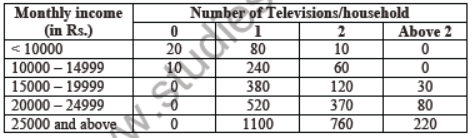
| Monthly income (in Rs.) | 0 | 1 | 2 | Above 2 |
|---|---|---|---|---|
| < 10000 | 20 | 80 | 10 | 0 |
| 10000 - 14999 | 10 | 240 | 60 | 0 |
| 15000 - 19999 | 0 | 380 | 120 | 30 |
| 20000 - 24999 | 0 | 520 | 370 | 80 |
| 25000 and above | 0 | 1100 | 760 | 220 |
Find the probability:
(i) of a household earning Rs 10000 - Rs 14999 per year and having exactly one television.
(ii) of a household earning Rs 25000 and more per year and owning 2 televisions.
(iii) of a household not having any television.
Answer:
1. Total number of households surveyed = 4000
2. (i) Households earning Rs 10000 - Rs 14999 and having 1 television = 240. Probability = \(\frac{240}{4000}\) = \(\frac{3}{50}\)
3. (ii) Households earning Rs 25000 and above and owning 2 televisions = 760. Probability = \(\frac{760}{4000}\) = \(\frac{19}{100}\)
4. (iii) Total households not having any television = 20 + 10 + 0 + 0 + 0 = 30. Probability = \(\frac{30}{4000}\) = \(\frac{3}{400}\)
Teacher's Note:
a) Read data carefully from the intersection of the respective row and column.
b) For part (iii), sum all values in the column corresponding to 0 televisions.
18. Cards are marked with numbers 4, 5, 6, ......50 are placed in the box and mixed thoroughly. One card is drawn at random from the box. What is the probability of getting (i) an even prime number (ii) a number divisible by 5 and (iii) multiple of 7? [3 Marks]

Answer:
1. Numbers marked on cards are 4, 5, 6, ..., 50. Total number of cards = 50 - 4 + 1 = 47
2. (i) Even prime number in this range is only 2 (which is not in the box). Favorable outcomes = 0. Probability = \(\frac{0}{47}\) = 0
3. (ii) Numbers divisible by 5 from 4 to 50 are 5, 10, 15, 20, 25, 30, 35, 40, 45, 50 (total 10). Probability = \(\frac{10}{47}\)
4. (iii) Multiples of 7 from 4 to 50 are 7, 14, 21, 28, 35, 42, 49 (total 7). Probability = \(\frac{7}{47}\)
Teacher's Note:
a) Total number of cards is calculated using (Last - First + 1), giving 47, not 50.
b) 2 is the only even prime number, but it is not present in the given range starting from 4.
19. The record of a weather station shows that out of the past 250 consecutive days, its weather forecasts were correct 175 times. (i) What is the probability that on a given day it was correct? (ii) What is the probability that it was not correct on a given day? [2 Marks]
Answer:
1. Total number of days recorded = 250
2. (i) Number of times forecasts were correct = 175. Probability = \(\frac{175}{250}\) = \(\frac{7}{10}\)
3. (ii) Number of times forecasts were not correct = 250 - 175 = 75. Probability = \(\frac{75}{250}\) = \(\frac{3}{10}\)
Teacher's Note:
a) Based on experimental or empirical probability.
b) Always reduce fractions to their lowest terms.
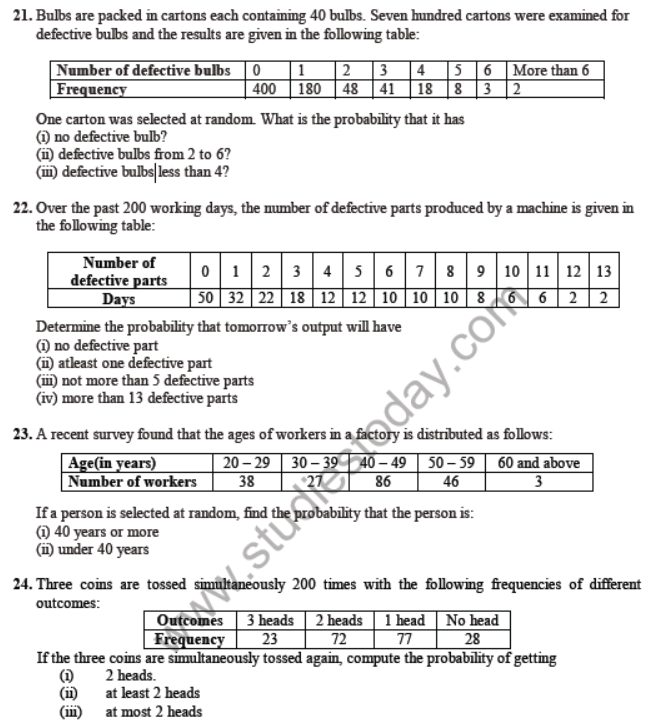
20. Two dice are thrown simultaneously 500 times. Each time the sum of two numbers appearing on their tops is noted and recorded as given in the following table: [4 Marks]
| Sum | 2 | 3 | 4 | 5 | 6 | 7 | 8 | 9 | 10 | 11 | 12 |
|---|---|---|---|---|---|---|---|---|---|---|---|
| Frequency | 14 | 30 | 42 | 55 | 72 | 75 | 70 | 53 | 46 | 28 | 15 |
If the dice are thrown once more, what is the probability of getting a sum (i) 3? (ii) more than 10? (iii) less than or equal to 5? (iv) between 8 and 12?
Answer:
1. Total trials = 500
2. (i) Frequency of sum 3 = 30. Probability = \(\frac{30}{500}\) = \(\frac{3}{50}\)
3. (ii) Sum more than 10 means sum 11 or 12. Frequency = 28 + 15 = 43. Probability = \(\frac{43}{500}\)
4. (iii) Sum less than or equal to 5 means sum 2, 3, 4 or 5. Frequency = 14 + 30 + 42 + 55 = 141. Probability = \(\frac{141}{500}\)
5. (iv) Sum between 8 and 12 (exclusive) means sum 9, 10 or 11. Frequency = 53 + 46 + 28 = 127. Probability = \(\frac{127}{500}\)
Teacher's Note:
a) Empirical probability is calculated using the given frequency table totals.
b) Pay close attention to inequalities like 'more than', 'less than or equal to', and 'between'.
c) Sum of all frequencies in the table equals 500.
21. Bulbs are packed in cartons each containing 40 bulbs. Seven hundred cartons were examined for defective bulbs and the results are given in the following table:
| Number of defective bulbs | 0 | 1 | 2 | 3 | 4 | 5 | 6 | More than 6 |
|---|---|---|---|---|---|---|---|---|
| Frequency | 400 | 180 | 48 | 41 | 18 | 8 | 3 | 2 |
(i) no defective bulb?
(ii) defective bulbs from 2 to 6?
(iii) defective bulbs less than 4? [3 Marks]
Answer:
1. Total number of cartons examined = 700.
(i) Number of cartons with no defective bulb = 400.
Probability = \(\frac{400}{700}\) = \(\frac{4}{7}\).
(ii) Number of cartons with defective bulbs from 2 to 6 = 48 + 41 + 18 + 8 + 3 = 118.
Probability = \(\frac{118}{700}\) = \(\frac{59}{350}\).
(iii) Number of cartons with defective bulbs less than 4 = 400 + 180 + 48 + 41 = 669.
Probability = \(\frac{669}{700}\).
Teacher's Note:
a) Empirical probability is the ratio of favorable trials to the total number of trials.
b) Ensure all frequency values for the given range are correctly added.
c) Always reduce fractions to their simplest form where possible.
22. Over the past 200 working days, the number of defective parts produced by a machine is given in the following table:
| Number of defective parts | 0 | 1 | 2 | 3 | 4 | 5 | 6 | 7 | 8 | 9 | 10 | 11 | 12 | 13 |
|---|---|---|---|---|---|---|---|---|---|---|---|---|---|---|
| Days | 50 | 32 | 22 | 18 | 12 | 12 | 10 | 10 | 10 | 8 | 6 | 6 | 2 | 2 |
(i) no defective part
(ii) atleast one defective part
(iii) not more than 5 defective parts
(iv) more than 13 defective parts [4 Marks]
Answer:
1. Total number of working days = 200.
(i) Number of days with no defective part = 50. Probability = \(\frac{50}{200}\) = \(\frac{1}{4}\).
(ii) Number of days with at least one defective part = 200 - 50 = 150. Probability = \(\frac{150}{200}\) = \(\frac{3}{4}\).
(iii) Number of days with not more than 5 defective parts = 50 + 32 + 22 + 18 + 12 + 12 = 146. Probability = \(\frac{146}{200}\) = \(\frac{73}{100}\).
(iv) Number of days with more than 13 defective parts = 0. Probability = \(\frac{0}{200}\) = 0.
Teacher's Note:
a) Utilize complementary probability for at least one case to save calculation time.
b) Pay careful attention to inequalities like not more than and more than.
c) An impossible event always has a probability of zero.
d) Cross-verify the sum of all frequencies equals the total number of days.
23. A recent survey found that the ages of workers in a factory is distributed as follows:
| Age (in years) | 20 - 29 | 30 - 39 | 40 - 49 | 50 - 59 | 60 and above |
|---|---|---|---|---|---|
| Number of workers | 38 | 27 | 86 | 46 | 3 |
(i) 40 years or more
(ii) under 40 years [2 Marks]
Answer:
1. Total number of workers = 38 + 27 + 86 + 46 + 3 = 200.
(i) Number of workers 40 years or more = 86 + 46 + 3 = 135. Probability = \(\frac{135}{200}\) = \(\frac{27}{40}\).
(ii) Number of workers under 40 years = 38 + 27 = 65. Probability = \(\frac{65}{200}\) = \(\frac{13}{40}\).
Teacher's Note:
a) Total frequency is obtained by summing workers across all age groups.
b) Group categories correctly according to the specified age boundaries.
24. Three coins are tossed simultaneously 200 times with the following frequencies of different outcomes:
| Outcomes | 3 heads | 2 heads | 1 head | No head |
|---|---|---|---|---|
| Frequency | 23 | 72 | 77 | 28 |
(i) 2 heads.
(ii) at least 2 heads
(iii) at most 2 heads [3 Marks]
Answer:
1. Total number of trials = 200.
(i) Frequency of getting 2 heads = 72. Probability = \(\frac{72}{200}\) = \(\frac{9}{25}\).
(ii) Frequency of getting at least 2 heads (2 heads or 3 heads) = 72 + 23 = 95. Probability = \(\frac{95}{200}\) = \(\frac{19}{40}\).
(iii) Frequency of getting at most 2 heads (2 heads, 1 head, or no head) = 72 + 77 + 28 = 177. Probability = \(\frac{177}{200}\).
Teacher's Note:
a) At least means the specified number or more.
b) At most means the specified number or less.
c) Check that the sum of frequencies equals the total trials given in the problem.
Free study material for Mathematics
Useful Resources and Notes for Class 9 Mathematics Chapter 15 Probability
Comprehensive Study Resources for Chapter 15 Probability
Explore essential learning tools for Class 9 Mathematics Chapter 15 Probability. This curated collection features in-depth notes and targeted practice questions built around the active 2026 curriculum to streamline your daily revision.
Understanding Marking Schemes
Built using official NCERT guidelines for Class 9 Mathematics, these materials provide reliable academic support. Integrating past examination questions and step-by-step solutions helps students understand official CBSE grading criteria.
Complete Revision for Mathematics
Maximize your grade potential by utilizing Class 9 Mathematics practice papers in tandem with these structured notes. All printable assignments and interactive mock tests on our platform are updated for the 2026 session and available free of charge.
FAQs
Our advanced study package for Chapter 15 Probability includes detailed concepts, diagrams, Mind Maps, and explanation of complex topics to ensure Class 9 students learn as per syllabus for 2026 exams.
The Mind Maps provided for Chapter 15 Probability act as visual anchors which will help faster recall during high-pressure exams.
Yes, teachers use our Class 9 Mathematics resources for lesson planning as they are in simple language and have lot of solved examples.
Yes, You can download the complete, mobile-friendly PDF of the Mathematics Chapter 15 Probability advanced resources for free.
Yes, our subject matter experts have updated the Chapter 15 Probability material to align with the rationalized NCERT textbooks and have removed deleted topics and added new competency-based questions.