

Official CBSE Study Materials for Class 12 Economics
Explore structured advanced study materials through the CBSE Class 12 Economics Introduction Revision Notes. Tailored for Class 12 learners, utilizing these Economics resources ensures thorough preparation and strengthens foundational knowledge before final CBSE evaluations.
Advanced Resources for Economics
Navigate directly to the advanced Economics study materials using the digital viewer below. Each resource pack includes detailed conceptual summaries and solved practice questions, allowing students to instantly reinforce their learning.
Meaning of economics: Economics is the science which studies human behavior as a relationship between ends and scarce means which have alternative uses.
Meaning of an economy:-Economy is the system which provides people the means to work and earn a living. Or it is a frame work within which economic activities like production, consumption, and capital formation are undertaken.
Meaning of scarcity:-It is defined as excess of demand over available supply, i.e., demand of resources greater than supply of resources.
Economic problem:-The problem of making a choice is called economic problem.
Causes of economic problem: - It arises due to Scarcity of resources unlimited human wants Resources can be put to alternative uses
Scarcity and Choice go together:-Scarcity and choice are not separable because resources are limited or scarce and the problem of choice arises due to it.
Economizing of resources:-Our wants are unlimited and resources are limited, so we have to use the resources fully and efficiently. It means that resources should be best utilized. This is called economizing of resources.
Central Problems of an Economy:-Central problem of an economy is Allocation of resources. The three central problems relating to allocation of resources are:-
What to produce:-The problem of what to produce and in what quantity is the first basic or central problem. It is related to the selection of goods. Our resources are limited. So first problem that we have to face is which goods and services are to be produced e.g. consumer goods or capital goods, war time or peace time goods. After the decision has been taken the quantities of these goods should also be decided.
How to produce:- The second important problem is the problem of choice of technique of production. That means we have to decide whether to use labour intensive technique (it uses more of labour than capital) or capital intensive technique (it uses more of capital than labour).However the choice of technique depends on the objective of the producer. The producer can use labour intensive, capital intensive or both technique of production. The main aim is to use the efficient technique of production.
For whom to produce:-This is also called the problem of distribution of National Income among the factor of production. For whom to produce is actually the problem of determining wage rate for the use of labour, rent for the use of land, interest for the use of capital and profits for the producer to ensure equitable distribution of income and welfare in the society?
Production possibility curve or frontier:
A production possibility curve/ frontier show different combinations of two commodities that can be produced by an economy with the full use and efficient utilization of given resources and technology.
(i) Normally, the production possibility curve is concave to the origin. It is because of increasing marginal opportunity cost.
(ii) A production possibility curve shifts out due to technological progress or increase in the supply of resources available to an economy or both.
Assumptions of PPC-
1) Resources are constant.
2) Technology is given.
3) Resources are fully and efficiently used.
4) Production of only two goods can be shown in a PPC.
Features of PPC-
1) It is downward sloping.
2) It is concave to the origin.
Shifting/Rotation of PPC
(I) Change of Resources
(II) Change in technology
Efficient technology for the production of Commodity – X: Efficient technology for the production of Commodity – X would mean more production of commodity – X with the same resources. Accordingly, PPC would rotate (NOT SHIFT) as shown in Fig
Efficient technology for the production of Commodity – Y : Efficient technology for the production of commodity – Y would mean more production of Y with the same resources. Accordingly, PPC would rotate (NOT SHIFT) as shown in Fig
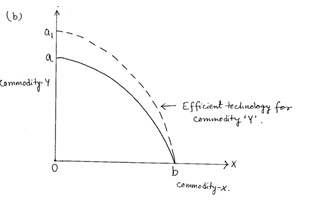
Efficient technology for the production of both X and Y:
Efficient technology for the production of both X and Y would mean much greater production of both X and Y with the same resources. Accordingly, PPC would shift to the right as shown in Fig.

Opportunity Cost (Transformation cost)-
The opportunity cost of a factor is equal to the value of a factor in its next best alternative use, eg-A plot of land can be used for wheat and rice production. Production of wheat provides earning of Rs. 1 lakh and Production of rice provides earning of Rs. 90000.If we produce wheat then its opportunity cost is Rs. 90000, which is the value of rice sacrificed.
Marginal opportunity cost (or Marginal Rate of Transformation)-
The marginal opportunity cost of good X is the rate of sacrifice of the other good, say, Y, per unit increase in the production of good X.
OR
The marginal opportunity cost of good X is defined as the amount / quantity sacrificed of good Y per unit increase in production of good X.
Marginal opportunity cost along a PPC.

Note: The above table shows the case of increasing marginal opportunity cost. To produce one more unit of Good X, increasing units of Good Y have to be sacrificed. For example, to produce the first, second, third, fourth and fifth unit of Good X, 1, 2,3,4 and 5 units of Good Y have been sacrificed respectively.
The shape of PPC depends on MOC :
1. If MOC is increasing PPC is concave.
2. If MOC is decreasing, PPC is convex.
3.If MOC is constant, PPC is a straight line.
The Fig Illustrates the concept of marginal opportunity cost.
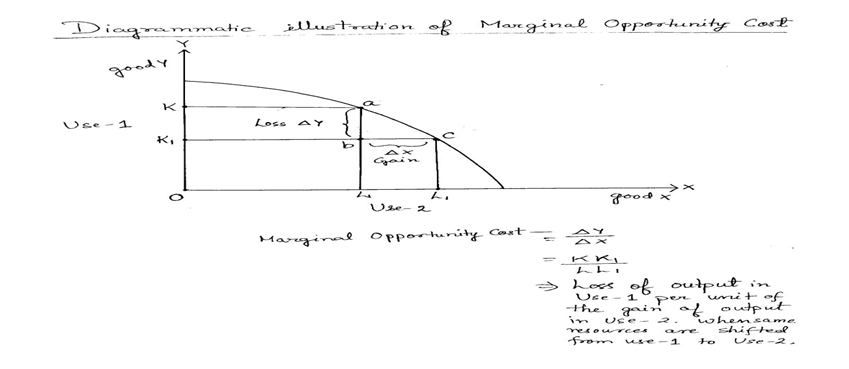
It is assumed that initially resources are employed such that, output in Use-1 = OK and output in Use-2=OL
M.O.C = Loss of Output of Good Y/Gain of Output of Good X
= KK1 / LL1
= ab / bc
= Slope of production possibility curve
Micro and Macro Economics:
Micro economics studies the behavior of individual economic units of an economy like a consumer, a producer for different goods and services.
Macroeconomics studies aggregates at the level of the economy as a whole like aggregate demand, aggregate supply, problem of full employment, total saving, total investment, aggregate price level, etc.
Free study material for Economics
Economics Class 12 Exam Resources: Introduction
Comprehensive Study Resources for Introduction
Explore essential learning tools for Class 12 Economics Introduction. This curated collection features in-depth notes and targeted practice questions built around the active 2026 curriculum to streamline your daily revision.
Understanding Marking Schemes
Each resource draws directly from authorized textbooks to maintain academic accuracy. Evaluating solved examples allows Class 12 students to master the formal presentation and answer-writing standards expected in upcoming school exams.
Complete Revision for Economics
Maximize your grade potential by utilizing Class 12 Economics practice papers in tandem with these structured notes. All printable assignments and interactive mock tests on our platform are updated for the 2026 session and available free of charge.
FAQs
Our advanced study package for Introduction includes detailed concepts, diagrams, Mind Maps, and explanation of complex topics to ensure Class 12 students learn as per syllabus for 2026 exams.
The Mind Maps provided for Introduction act as visual anchors which will help faster recall during high-pressure exams.
Yes, teachers use our Class 12 Economics resources for lesson planning as they are in simple language and have lot of solved examples.
Yes, You can download the complete, mobile-friendly PDF of the Economics Introduction advanced resources for free.
Yes, our subject matter experts have updated the Introduction material to align with the rationalized NCERT textbooks and have removed deleted topics and added new competency-based questions.