Class 11 Chemistry Structure of Atom Exam Questions

Read and download the Class 11 Chemistry Structure of Atom Exam Questions. Designed for 2025-26, this advanced study material provides Class 11 Chemistry students with detailed revision notes, sure-shot questions, and detailed answers. Prepared by expert teachers and they follow the latest CBSE, NCERT, and KVS guidelines to ensure you get best scores.

Advanced Study Material for Class 11 Chemistry Chapter 2 Structure of Atom

To achieve a high score in Chemistry, students must go beyond standard textbooks. This Class 11 Chapter 2 Structure of Atom study material includes conceptual summaries and solved practice questions to improve you understanding.

Class 11 Chemistry Chapter 2 Structure of Atom Notes and Questions


LEVEL – I

1. The atomic number of an element is 5 and mass number is 11. Find the number of electrons, protons and neutrons present in an atom of it. How can this element be represented?
Ans : Number of electrons (Z=5)=5
Number of protons (Z=5)=5
Number of neutrons (A=Z)=11-5=6
Since the atomic number is 5 , the element is boron and is represented as : 5B11
 
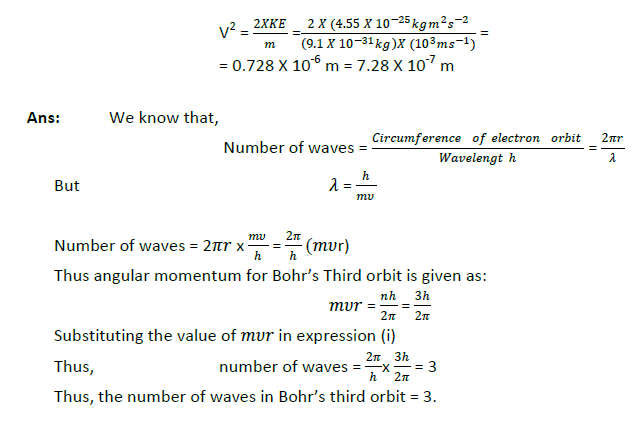
2. The Kinetic energy of an electron is 4.55 X 10⁻²⁵ J. The mass of electron is 9.1X10⁻³¹ kg. Calculate velocity, momentum and the wavelength of the electron.
Ans : Setp-1 Calculation of the velocity of electron.
Kinetic energy = ½ mv2 = 4.55 X 10⁻²⁵ J = 4.55 X 10⁻²⁵ kg m2 s-2
Class 11 Chemistry Structure of Atom Exam Questions-Q-1
 
3. Which has higher energy, 3d or 4s? Explain?
Ans: 3d because n+l for 3d is 3+2=5, but for 4s it is 4+0=5
 
4. State and explain Hund’s rule of maximum multiplicity?
Ans : It states that pairing of e in the degenerate orbital is not possible until there is one e in each orbital
 
5. Define (i) work function (ii) Threshold frequency.
Ans: (i) Work function is the minimum energy of light radiations required to remove an electron from the metal surface. (ii) Frequency related to work function is threshold frequency.
 
6. Half filled and full filled orbitals have extra stability. Why?
Ans: Due to exchange energy
 
7. What are isoelectronic series?
Ans : Species having same no of electrons.
 
LEVEL – 2


1. The uncertainty in the position of a moving bullet of mass 10g is 10-5m.Calculate the uncertainty in the velocity.
Ans: Uncertainty Principle
 
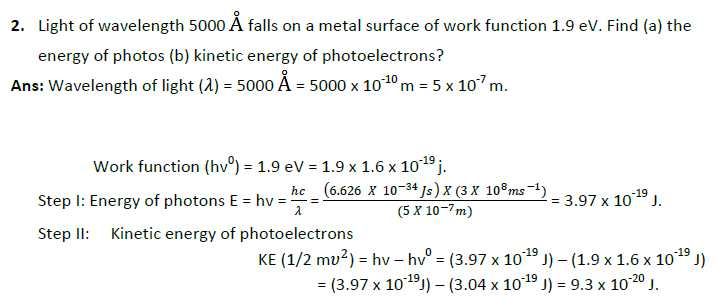
Class 11 Chemistry Structure of Atom Exam Questions-Q-Level-2
 
Class 11 Chemistry Structure of Atom Exam Questions-Q-Level-2-1
 
3. Which of the following are iso-electronic species?
Na+,, K+, Mg2+, Ca2+, S2-, Ar.
Ans: Na+ and Mg2+ are iso- electrons species (have 10 electrons) K+, Ca2+, S2- are iso-electronic species (have 18 electrons).
 
4. (i) Write the electronic configuration of the following ions? (a) H- (b) Na+ (c) O2- (d) F-.
(ii) What are the atomic numbers of the elements whose outermost electronic configurations are represented by:
(a) 3s1 (b) 2p3 and (c) 3d6 ?
(iii) Which atoms are indicated by the following configurations? (a) [He] 2s1 (b) [Ne] 3s2 3p3 (c) [Ar] 4s2 3d1.
Ans: (i) (a) 1s2 (b) 1s2 2s2 2p6 (c) 1s2 2s22p6. (d) 1s2 2s22p6.
(ii) (a) Na (Z=11) has outermost electronic Configuration = 3s1
(b) N (Z=7) has outermost electronic Configuration = 2p3
(c) Fe (Z=26) has outermost electronic Configuration = 3d6
(iii) (a) Li (b) P (c) Sc
 
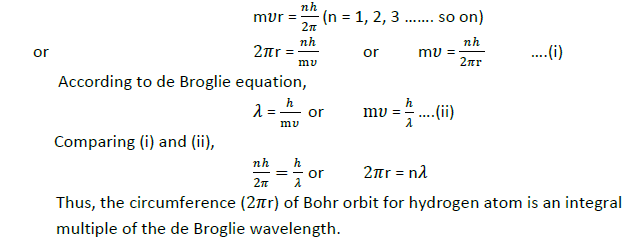
5. Show that the circumference of Bohr orbit for the hydrogen atom is an integral multiple of the de Broglie wavelength associated with the electron revolving around the orbit.
Ans: According to Bohr’s theory,
 
Class 11 Chemistry Structure of Atom Exam Questions-Q-Level-2-2
 
6. The unpaired electrons in Al and Si are present in 3p orbital. Which electrons will experience more effective nuclear charge from the nucleus?
Ans: Configuration of the two elements are:
Al (Z=13) : [Ne]103s23p1 ; Si (Z=14) :[Ne]103s23p2 
The unpaired electrons in silicon (Si) will experience more effective nuclear charge because the atomic number of the element Si is more than that of Al.
 
7. The electronic energy is negative. How will you account for that?
Ans: Electron just out of atom has zero energy. It enters in the atom due to attraction of atom so it loses energy.
 
8. How many unpaired electrons are present in Pd (Z=46)?
Ans: Zero
 
9. Write electronic configuration of Ca(z=24) and Cu(z=22).
Ans: Ca= 1s2 2s2 2p6 3s2 3p6 4s2
Cu=1s2 2s2 2p6 3s2 3p6 3d10 4s1


 LEVEL – 3


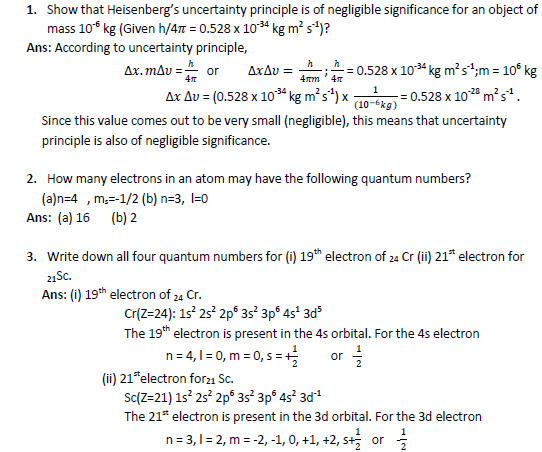
 Class 11 Chemistry Structure of Atom Exam Questions-Q-Level-2-8
4. Draw the shape of all d orbitals.
Ans:

Class 11 Chemistry Structure of Atom Exam Questions-Q-Level-2-5


 5. Consider an element Z that has two naturally occurring isotopes with the following percent abundances: the isotope with a mass number of 19.0 is 55.0% abundant; the isotope with a mass number of 21.0 is 45.0% abundant. Calculate the average ATOMIC MASS for element Z.
Class 11 Chemistry Structure of Atom Exam Questions-Q-Level-2-6

 
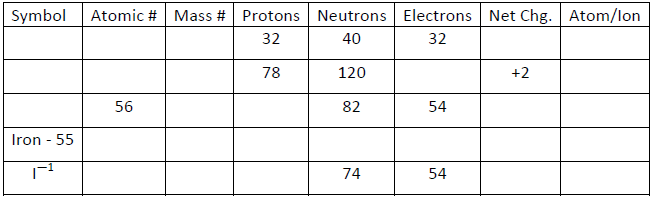
6. Complete the following table.

Class 11 Chemistry Structure of Atom Exam Questions-Q-Level-2-7

Chapter 04 Chemical Bonding and Molecular Structure
Class 11 Chemistry Chemical Bonding and Molecular Structure Exam Questions

CBSE Class 11 Chemistry Chapter 2 Structure of Atom Study Material

Students can find all the important study material for Chapter 2 Structure of Atom on this page. This collection includes detailed notes, Mind Maps for quick revision, and Sure Shot Questions that will come in your CBSE exams. This material has been strictly prepared on the latest 2026 syllabus for Class 11 Chemistry. Our expert teachers always suggest you to use these tools daily to make your learning easier and faster.

Chapter 2 Structure of Atom Expert Notes & Solved Exam Questions

Our teachers have used the latest official NCERT book for Class 11 Chemistry to prepare these study material. We have included previous year examination questions and also step-by-step solutions to help you understand the marking scheme too. After reading the above chapter notes and solved questions also solve the practice problems and then compare your work with our NCERT solutions for Class 11 Chemistry.

Complete Revision for Chemistry

To get the best marks in your Class 11 exams you should use Chemistry Sample Papers along with these chapter notes. Daily practicing with our online MCQ Tests for Chapter 2 Structure of Atom will also help you improve your speed and accuracy. All the study material provided on studiestoday.com is free and updated regularly to help Class 11 students stay ahead in their studies and feel confident during their school tests.

What is included in the advanced study material for Class 11 Chemistry Chapter Chapter 2 Structure of Atom?

Our advanced study package for Chapter Chapter 2 Structure of Atom includes detailed concepts, diagrams, Mind Maps, and explanation of complex topics to ensure Class 11 students learn as per syllabus for 2026 exams.

How do Mind Maps for Chemistry Chapter Chapter 2 Structure of Atom help in revision?

The Mind Maps provided for Chapter Chapter 2 Structure of Atom act as visual anchors which will help faster recall during high-pressure exams.

Are these Chemistry resources suitable for both classroom teaching and self-study?

Yes, teachers use our Class 11 Chemistry resources for lesson planning as they are in simple language and have lot of solved examples.

Is this advanced study material for Chapter Chapter 2 Structure of Atom free to download in PDF?

Yes, You can download the complete, mobile-friendly PDF of the Chemistry Chapter Chapter 2 Structure of Atom advanced resources for free.

Does this material cover rationalized content for the 2025-26 CBSE session?

Yes, our subject matter experts have updated the Chapter Chapter 2 Structure of Atom material to align with the rationalized NCERT textbooks and have removed deleted topics and added new competency-based questions.