

Advanced Study Material for Class 11 Chemistry: Chapter 08 Organic Chemistry Some Basic Principles and Techniques
Review targeted academic resources with the CBSE Class 11 Chemistry Organic Chemistry Flash Cards. Built according to official CBSE standards for the 2026-27 term, these downloadable Class 11 Chemistry study materials support effective daily practice and deeper conceptual understanding for Chapter 08 Organic Chemistry Some Basic Principles and Techniques.
Practice Class 11 Chemistry Resources: Chapter 08 Organic Chemistry Some Basic Principles and Techniques
Access the complete useful resource PDF for Class 11 Chemistry below. Regular practice with these targeted academic notes builds familiarity with complex topics and helps secure higher marks in final school evaluations.
CBSE Class 11 Chemistry Organic Chemistry Flash Cards. There are many more useful educational material which the students can download in pdf format and use them for studies. Study material like concept maps, important and sure shot question banks, quick to learn flash cards, flow charts, mind maps, teacher notes, important formulas, past examinations question bank, important concepts taught by teachers. Students can download these useful educational material free and use them to get better marks in examinations. Also refer to other worksheets for the same chapter and other subjects too. Use them for better understanding of the subjects.
Class 11 Chemistry: Organic Chemistry Flash Cards
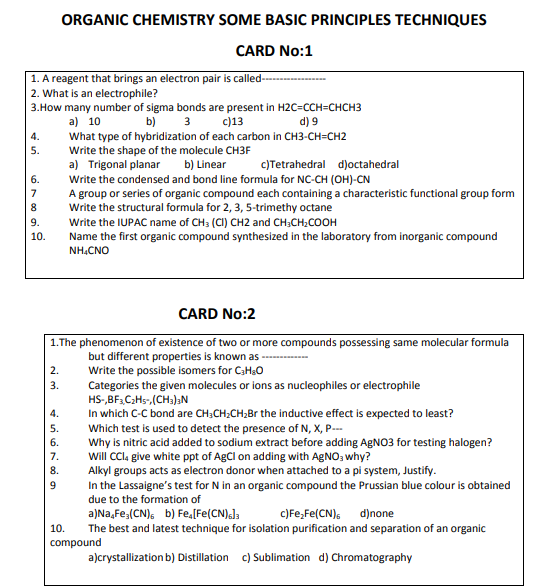
Organic Chemistry: Some Basic Principles and Techniques – Card 1
A reagent that brings an electron pair is called ______.
Answer: a nucleophile (nucleus-loving; an electron-rich species that donates a pair of electrons).
What is an electrophile?
Answer: An electrophile is an electron-deficient species (a reagent that is short of electrons) which accepts a pair of electrons from an electron-rich centre, e.g. H\(^+\), NO\(_2^+\), BF\(_3\), carbocations.
How many sigma bonds are present in H\(_2\)C=CCH=CHCH\(_3\)?
- 10
- 3
- 13
- 9
The formula is printed incompletely (one H is missing on the second carbon). Read as CH\(_2\)=CH–CH=CH–CH\(_3\): C–C sigma bonds = 4 and C–H sigma bonds = 8, so there are 12 sigma bonds, which is not one of the options. If the compound is isoprene, CH\(_2\)=C(CH\(_3\))–CH=CH\(_2\), it has 4 C–C and 9 C–H sigma bonds, i.e. 13 sigma bonds, so the intended key is most likely option (c) 13.
What type of hybridization does each carbon show in CH\(_3\)–CH=CH\(_2\)?
Answer: The CH\(_3\) carbon (four single bonds) is sp\(^3\). The two double-bonded carbons (one double bond + two other bonds, 3 sigma bonds each) are sp\(^2\).
Write the shape of the molecule CH\(_3\)F.
- Trigonal planar
- Linear
- Tetrahedral
- Octahedral
Answer: (c) Tetrahedral. Carbon is sp\(^3\) hybridised with four bond pairs.
Write the condensed and bond line formula for NC–CH(OH)–CN.
Answer: Condensed formula: CH(OH)(CN)\(_2\), or (NC)\(_2\)CHOH. In the bond-line formula, a single zig-zag vertex carbon carries the OH group and two lines ending in a triple bond to N (each C≡N is drawn as a straight line with a triple bond, with N at the end).
A group or series of organic compounds each containing a characteristic functional group form ______.
Answer: a homologous series (successive members differ by a CH\(_2\) unit).
Write the structural formula for 2,3,5-trimethyloctane.
Answer: CH\(_3\)–CH(CH\(_3\))–CH(CH\(_3\))–CH\(_2\)–CH(CH\(_3\))–CH\(_2\)–CH\(_2\)–CH\(_3\)
Write the IUPAC name of CH\(_3\)–CH(Cl)–CH\(_3\) and CH\(_3\)CH\(_2\)COOH.
Answer: The first formula is printed as 'CH\(_3\)(Cl)CH\(_2\)' (incomplete); read as CH\(_3\)CH(Cl)CH\(_3\), it is 2-chloropropane. CH\(_3\)CH\(_2\)COOH is propanoic acid.
Name the first organic compound synthesised in the laboratory from the inorganic compound NH\(_4\)CNO.
Answer: Urea (by F. Wöhler, 1828, on heating ammonium cyanate: NH\(_4\)CNO \(\rightarrow\) NH\(_2\)CONH\(_2\)).
Card 2
The phenomenon of existence of two or more compounds possessing the same molecular formula but different properties is known as ______.
Answer: isomerism.
Write the possible isomers for C\(_3\)H\(_8\)O.
Answer: Three isomers: propan-1-ol (CH\(_3\)CH\(_2\)CH\(_2\)OH), propan-2-ol (CH\(_3\)CH(OH)CH\(_3\)) and methoxyethane (CH\(_3\)OCH\(_2\)CH\(_3\)).
Categorise the given molecules or ions as nucleophiles or electrophiles: HS\(^-\), BF\(_3\), C\(_2\)H\(_5^-\), (CH\(_3\))\(_3\)N.
Answer: Nucleophiles (have a lone pair or negative charge): HS\(^-\), C\(_2\)H\(_5^-\), (CH\(_3\))\(_3\)N. Electrophile (electron-deficient, incomplete octet): BF\(_3\).
In which C–C bond of CH\(_3\)CH\(_2\)CH\(_2\)Br is the inductive effect expected to be the least?
Answer: In the C–C bond between CH\(_3\) and the middle CH\(_2\) (C\(_3\)–C\(_2\)), since it is farthest from the electronegative Br and the inductive effect weakens rapidly with distance.
Which test is used to detect the presence of N, X (halogens), S and P?
Answer: Lassaigne's test (sodium fusion test): the organic compound is fused with sodium and the extract is tested.
Why is nitric acid added to the sodium extract before adding AgNO\(_3\) for testing halogens?
Answer: Nitric acid decomposes any NaCN and Na\(_2\)S present (as HCN and H\(_2\)S, which are boiled off). Otherwise they would also form precipitates (AgCN and Ag\(_2\)S) with AgNO\(_3\) and interfere with the test for halides.
Will CCl\(_4\) give a white precipitate of AgCl on adding AgNO\(_3\)? Why?
Answer: No. CCl\(_4\) is a covalent compound and does not ionise in water to give Cl\(^-\) ions, so no AgCl is formed unless it is first converted to ionic chloride (by sodium fusion).
Alkyl groups act as electron donors when attached to a \(\pi\) system. Justify.
Answer: Alkyl groups release electrons through the +I effect and by hyperconjugation: the \(\sigma\) electrons of the C–H bonds next to the \(\pi\) system get delocalised into it, increasing its electron density.
In Lassaigne's test for nitrogen in an organic compound, the Prussian blue colour is obtained due to the formation of
- Na\(_4\)Fe\(_3\)(CN)\(_6\)
- Fe\(_4\)[Fe(CN)\(_6\)]\(_3\)
- Fe\(_2\)Fe(CN)\(_6\)
- None of these
Answer: (b) Fe\(_4\)[Fe(CN)\(_6\)]\(_3\) (ferric ferrocyanide).
The best and latest technique for isolation, purification and separation of organic compounds is
- Crystallization
- Distillation
- Sublimation
- Chromatography
Answer: (d) Chromatography.
Card 3
The reaction CH\(_3\)CH\(_2\)I + KOH \(\rightarrow\) CH\(_3\)CH\(_2\)OH + KI is classified as
- Electrophilic substitution
- Nucleophilic substitution
- Elimination
- Addition
Answer: (b) Nucleophilic substitution: OH\(^-\) (a nucleophile) replaces I\(^-\).
We use acetic acid but not sulphuric acid for acidification of the sodium extract for testing sulphur by the lead acetate test. Justify.
Answer: Sulphuric acid would react with lead acetate to give a white precipitate of lead sulphate, which would hide or be confused with the black PbS precipitate. Acetic acid gives soluble lead acetate only, so only the black PbS (if sulphur is present) is seen. (The source says 'bead acetate'; this is the lead acetate test.)
Why is a solution of KOH used to absorb CO\(_2\) evolved during the estimation of carbon present in an organic compound?
Answer: CO\(_2\) is an acidic oxide and is absorbed by the strong base KOH, forming potassium carbonate: 2KOH + CO\(_2\) \(\rightarrow\) K\(_2\)CO\(_3\) + H\(_2\)O. The increase in the mass of the KOH tube gives the mass of CO\(_2\), from which the percentage of carbon is found.
Write the state of hybridization of carbon in HCHO.
Answer: sp\(^2\) (the carbon forms three sigma bonds and one pi bond; the shape is trigonal planar).
According to Berzelius, what type of force was responsible for the formation of organic compounds?
Answer: The 'vital force', which he believed existed only in living organisms.
Which unique property of carbon is responsible for forming covalent bonds with other carbon atoms?
Answer: Catenation: the ability of carbon atoms to link with each other to form long chains and rings.
What is the maximum valency of carbon in carbon compounds?
Answer: 4 (tetravalency).
Match the following: Glucose and fructose; Propanol and 2-propanol; Butane and isobutane; cis-2-butene and trans-2-butene, with: geometrical isomerism, chain isomerism, position isomerism, functional group isomerism.
Glucose and fructose: functional group isomerism (aldehyde and ketone).
Propan-1-ol and propan-2-ol: position isomerism.
Butane and isobutane: chain isomerism.
cis-2-Butene and trans-2-butene: geometrical isomerism.
What is the full form of IUPAC?
Answer: International Union of Pure and Applied Chemistry.
Write the IUPAC names of the following: (1) CH\(_3\)CH(NH\(_2\))CH\(_2\)CHO, (2) CH\(_3\)CH(C\(_2\)H\(_5\))CH\(_2\)CH(CH\(_3\))CH\(_2\)CH\(_3\), (3) CH\(_2\)CH=CH\(_2\)
(1) 3-Aminobutanal.
(2) 3,5-Dimethylheptane (the longest chain has 7 carbons, running through the ethyl group).
(3) As printed, the formula has a missing H; read as CH\(_3\)CH=CH\(_2\) it is propene (prop-1-ene). The group CH\(_2\)–CH=CH\(_2\) is allyl (prop-2-en-1-yl).
Hydrocarbons – Card 1 (Write true or false)
Hydrocarbons are made up of carbon and hydrogen.
Answer: True
C\(_2\)H\(_6\) is formed by replacing one hydrogen of methane by carbon and the required number of hydrogens to satisfy the tetravalency of carbon.
Answer: True (replace one H of CH\(_4\) by a CH\(_3\) group).
Alkanes are inert under normal conditions, so they are called paraffins.
Answer: True
The compounds having different properties due to different structures are functional isomers.
Answer: False. They are called structural isomers; functional isomers are only one type of structural isomers.
Terminal carbons are always tertiary.
Answer: False. Terminal carbons are primary.
Alkanes are prepared by the Wurtz reaction in the presence of moisture.
Answer: False. The Wurtz reaction needs dry ether and no moisture.
Due to a very small difference in electronegativity between carbon and hydrogen, alkanes are non-polar.
Answer: True
The first four members of alkanes exist in the gaseous state.
Answer: True
Hydrocarbons – Card 2 (Fill in the blanks)
The term ______ is self-explanatory, which means compounds of carbon and hydrogen.
Answer: hydrocarbon
______ is the full form of CNG.
Answer: Compressed natural gas
______ is the full form of LPG.
Answer: Liquefied petroleum gas
C\(_n\)H\(_{2n+2}\) is the general formula of ______.
Answer: alkanes
C\(_n\)H\(_{2n-2}\) is the general formula of ______.
Answer: alkynes (the source key says 'alkene', which is wrong; alkenes are C\(_n\)H\(_{2n}\)).
Hybridization of carbon in alkanes is ______.
Answer: sp\(^3\)
______ is the first alkane which shows isomers.
Answer: Butane (n-butane and isobutane)
The process of eliminating CO\(_2\) from the salt of a carboxylic acid is known as ______.
Answer: decarboxylation
The IUPAC name of CH\(_2\)=CH–C≡C–CH\(_3\) is ______.
Answer: pent-1-en-3-yne
The complete combustion of methane gives ______ and ______.
Answer: carbon dioxide and water (CH\(_4\) + 2O\(_2\) \(\rightarrow\) CO\(_2\) + 2H\(_2\)O)
Hydrocarbons – Card 3 (Write the product/products)
Wurtz reaction
Answer: 2R–X + 2Na \(\xrightarrow{\text{dry ether}}\) R–R + 2NaX, e.g. 2CH\(_3\)Br + 2Na \(\rightarrow\) CH\(_3\)–CH\(_3\) + 2NaBr.
Wurtz–Fittig reaction
Answer: Ar–X + R–X + 2Na \(\xrightarrow{\text{dry ether}}\) Ar–R + 2NaX, e.g. C\(_6\)H\(_5\)Br + CH\(_3\)Br + 2Na \(\rightarrow\) C\(_6\)H\(_5\)CH\(_3\) + 2NaBr.
Fittig reaction
Answer: 2Ar–X + 2Na \(\xrightarrow{\text{dry ether}}\) Ar–Ar + 2NaX, e.g. 2C\(_6\)H\(_5\)Br + 2Na \(\rightarrow\) C\(_6\)H\(_5\)–C\(_6\)H\(_5\) + 2NaBr.
Ozonolysis giving aldehydes
Answer: An alkene such as RCH=CHR reacts with O\(_3\) to give an ozonide, which on treatment with Zn/H\(_2\)O gives aldehydes: RCH=CHR \(\rightarrow\) 2RCHO. For example, but-2-ene gives 2 CH\(_3\)CHO.
Ozonolysis giving ketones (symmetrical and unsymmetrical)
Answer: Symmetrical ketones: R\(_2\)C=CR\(_2\) \(\rightarrow\) 2R\(_2\)C=O, e.g. 2,3-dimethylbut-2-ene gives 2 acetone. Unsymmetrical ketones: R\(_2\)C=CR'\(_2\) \(\rightarrow\) R\(_2\)C=O + R'\(_2\)C=O, e.g. 2-methylbut-2-ene gives acetone + ethanal (an aldehyde and a ketone).
Friedel–Crafts alkylation and acylation
Answer: Alkylation: C\(_6\)H\(_6\) + RCl \(\xrightarrow{\text{anhyd. AlCl}_3}\) C\(_6\)H\(_5\)R + HCl. Acylation: C\(_6\)H\(_6\) + RCOCl \(\xrightarrow{\text{anhyd. AlCl}_3}\) C\(_6\)H\(_5\)COR + HCl.
Addition of HX to an unsymmetrical alkene: Markovnikov and anti-Markovnikov rule
Answer: Markovnikov rule: the negative part goes to the carbon having fewer hydrogens: CH\(_3\)CH=CH\(_2\) + HBr \(\rightarrow\) CH\(_3\)CHBrCH\(_3\) (2-bromopropane). Anti-Markovnikov (peroxide effect, only for HBr): CH\(_3\)CH=CH\(_2\) + HBr \(\xrightarrow{\text{peroxide}}\) CH\(_3\)CH\(_2\)CH\(_2\)Br (1-bromopropane).
Hydrocarbons – Card 4 (Complete the following reactions)
CH\(_3\)Br + Na (dry ether)
Answer: \(2\text{CH}_3\text{Br}+2\text{Na}\rightarrow \text{CH}_3\text{CH}_3+2\text{NaBr}\) (ethane)
CH\(_3\)COONa + NaOH (soda lime)
Answer: \(\text{CH}_3\text{COONa}+\text{NaOH}\rightarrow \text{CH}_4+\text{Na}_2\text{CO}_3\) (methane)
CH\(_2\)=CH\(_2\) + H\(_2\) (Pd)
Answer: \(\text{CH}_2=\text{CH}_2+\text{H}_2\rightarrow \text{CH}_3\text{CH}_3\) (ethane)
CH\(_3\)CH=CH\(_2\) + HBr
Answer: \(\text{CH}_3\text{CH}=\text{CH}_2+\text{HBr}\rightarrow \text{CH}_3\text{CHBrCH}_3\) (2-bromopropane, Markovnikov addition)
Hydrocarbons – Card 5
How do you account for the formation of ethane during chlorination of methane?
Answer: Chlorination is a free-radical chain reaction. In the termination step two methyl free radicals combine: CH\(_3^{\bullet}\) + \({}^{\bullet}\)CH\(_3\) \(\rightarrow\) CH\(_3\)–CH\(_3\), giving ethane as a by-product.
Write the IUPAC names of the products obtained by the ozonolysis of: (i) pent-2-ene, (ii) 3,4-dimethylhept-3-ene, (iii) 2-ethylbut-1-ene, (iv) 1-phenylbut-1-ene.
(i) Ethanal and propanal.
(ii) Butan-2-one and pentan-2-one.
(iii) Methanal and pentan-3-one.
(iv) Benzaldehyde (benzenecarbaldehyde) and propanal.
An alkene 'A' contains three C–C and eight C–H \(\sigma\) bonds and one C–C \(\pi\) bond. 'A' on ozonolysis gives two moles of an aldehyde of molar mass 44 u. Write the IUPAC name of 'A'.
Three C–C sigma bonds mean 4 carbons, and eight C–H bonds mean 8 hydrogens, so A is C\(_4\)H\(_8\). An aldehyde of molar mass 44 u is ethanal (CH\(_3\)CHO). Two moles of it are formed only from a symmetrical alkene, so A is CH\(_3\)CH=CHCH\(_3\), but-2-ene.
Why is benzene extraordinarily stable though it contains three double bonds? What are the necessary conditions for any system to be aromatic?
Answer: Benzene is stable because its six \(\pi\) electrons are delocalised over the whole ring (resonance), which lowers its energy (resonance energy about 150 kJ/mol). A system is aromatic if it is (i) planar, (ii) cyclic, (iii) completely conjugated (every ring atom has a p orbital, with delocalised \(\pi\) electrons), and (iv) has \((4n+2)\) \(\pi\) electrons, where n = 0, 1, 2, … (Hückel rule).
Arrange benzene, n-hexane and ethyne in decreasing order of acidic behaviour. Also give reason for this behaviour.
Answer: Ethyne > benzene > n-hexane. The acidity depends on the s-character of the carbon bearing the H: ethyne is sp (50% s), benzene is sp\(^2\) (33% s) and hexane is sp\(^3\) (25% s). The more s-character, the more electronegative the carbon, so the C–H bond is more polar and the anion left behind is more stable.
Please click the link below to download CBSE Class 11 Chemistry Organic Chemistry Flash Cards.
Free study material for Chemistry
Useful Resources and Notes for Class 11 Chemistry Chapter 08 Organic Chemistry Some Basic Principles and Techniques
Core Study Kit: Class 11 Chemistry Chapter 08 Organic Chemistry Some Basic Principles and Techniques
Explore essential learning tools for Class 11 Chemistry Chapter 08 Organic Chemistry Some Basic Principles and Techniques. This curated collection features in-depth notes and targeted practice questions built around the active 2026 curriculum to streamline your daily revision.
NCERT-Aligned Solutions for Chapter 08 Organic Chemistry Some Basic Principles and Techniques
Designed around the official curriculum, these study guides guarantee standard compliance. Reviewing step-by-step solutions clarifies complex sub-topics within Chapter 08 Organic Chemistry Some Basic Principles and Techniques and demystifies standard marking schemes for Chemistry evaluations.
Next Steps in Your Exam Preparation
For peak performance in upcoming evaluations, integrate official Chemistry sample papers directly into your study schedule. Follow up your revision by attempting online MCQ tests for Chapter 08 Organic Chemistry Some Basic Principles and Techniques to refine calculation speed and precision.
FAQs
Our advanced study package for Chapter 08 Organic Chemistry Some Basic Principles and Techniques includes detailed concepts, diagrams, Mind Maps, and explanation of complex topics to ensure Class 11 students learn as per syllabus for 2026 exams.
The Mind Maps provided for Chapter 08 Organic Chemistry Some Basic Principles and Techniques act as visual anchors which will help faster recall during high-pressure exams.
Yes, teachers use our Class 11 Chemistry resources for lesson planning as they are in simple language and have lot of solved examples.
Yes, You can download the complete, mobile-friendly PDF of the Chemistry Chapter 08 Organic Chemistry Some Basic Principles and Techniques advanced resources for free.
Yes, our subject matter experts have updated the Chapter 08 Organic Chemistry Some Basic Principles and Techniques material to align with the rationalized NCERT textbooks and have removed deleted topics and added new competency-based questions.