

Official CBSE Study Materials for Class 11 Chemistry
Access comprehensive study materials and useful resources for Chapter 08 Organic Chemistry Some Basic Principles and Techniques using the Class 11 Chemistry Organic Chemistry Some Basic Principles and Techniques Exam Questions. Designed to align with the 2026-27 CBSE academic guidelines, these advanced resources help Class 11 Chemistry students reinforce core concepts beyond standard textbooks.
Advanced Resources for Chemistry
View or download the dedicated Class 11 Chemistry Organic Chemistry Some Basic Principles and Techniques Exam Questions resource below. Engaging with these advanced study guides under focused conditions ensures continuous academic progress and mastery of the 2026-27 curriculum for Chapter 08 Organic Chemistry Some Basic Principles and Techniques.
LEVEL – 1
1. Suggest a method to purify a liquid which decomposes at its boiling point?
Ans: The process Distillation Under reduced pressure is used to purify aliquid which decomposes at its boiling point.
2. How will you separate a mixture of O-nitrophenol and P-nitrophenol?
Ans: O-nitrophenol is steam volatile therefore it can be separated by Steam distillation.
3. Lassaigne's test is not shown by diazonium salt .Why?
Ans: On heating diazoniumsalt , loses Nitrogen and could not fuse with the Sodium metal therefore diazonium salt does not show Positive Lassaigne's test for Nitrogen .
4. Why alcohols are weaker acids than Water?
Ans: The alkyl group in alcohol is has +I effect due to which electron density increases on oxygen atom which makes the release of H⁺ ion more difficult from alcohol R→ O – H
5. Why is nitric acid is added to Sodium Extract before adding Silvernitrate for testing halogens?
Ans: Nitric acid is added to decompose NaCN& Na₂ S .
NaCN + HNO₃ → NaNO₃ + HCN
Na₂ S + HNO₃ → 2NaNO₃ + H₂ S
6. Write the hybridized state of C atoms in the following

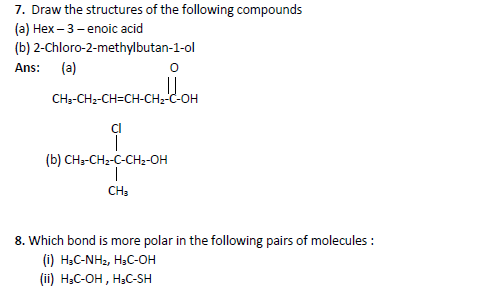
Ans: (i) C-O is more polar because O is more electronegative than N
(ii) C-O is more polar because O is more electronegative than S
9. In which C-C bond of CH₃CH₂CH₂Br , the inductive effect is expected to be the least.
Ans: Magnitude of inductive effect diminishes as the intervening bonds increases. Hence, the effect is least in the bond between C-3 and C-2.
10. Why (CH₃)₃C⁺ carbocation is more easily formed than ( CH₃)₂C⁺H carbocation ?
Ans: Tertiary butyl carbocation is more stable than isopropyl carbocation.
11. Diphenylketone ( C₆H₅-CO-C₆H₅ ) shows tautomerism. Explain.
Ans: It contains two alpha H atoms.
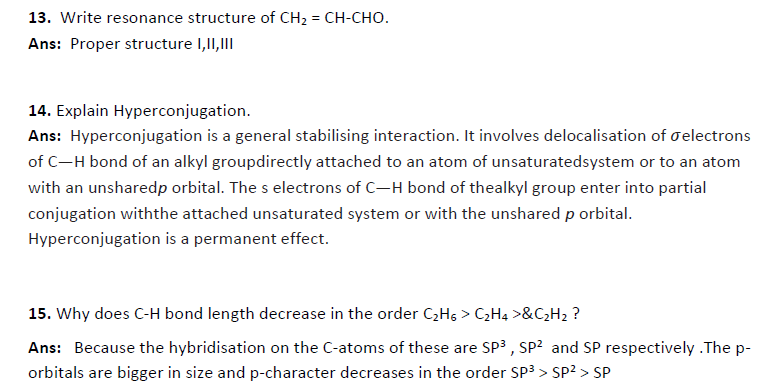
12. What are Electrophiles and Nucleophiles?
Ans: Electrophiles: The species which have one atom the octet of which is incomplete they attract nucleophiles are called Electrophiles e.g. BF₃ ,Cl⁺ etc
Nucleophiles: The species which carry negative charge or a loan pair of electrons on an atom for donation are called Nucleophiles e.g. HS⁻ , (CH₃)₃N: etc
LEVEL – 2
1. Write the IUPAC name of the following compound
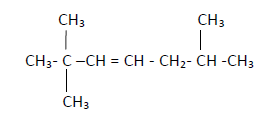
Ans: The IUPAC name is 2,2,6-trimethylhept-3-ene.

4. How Sodium fusion extract is prepared ?
Ans: A small piece of dry Sodium metal is heated with an organic compound in a fusion tube for 2-3 minutes and the red hot tube is plunged in to distilled water contained in achina dish The contained of the china dish is boiled ,cooled and filtered . The filtrate is known as Sodium fusion extract.
5. Explain the principle of Paper Chromatography.
Ans: Paper Chromatography is based on the difference in the rates at which the components of a mixture are adsorbed. The material on which different components are adsorbed is called Stationary phase which is generally made up of Alumina, Silica gel or Activated Charcoal.The mixture to be separated is dissolved in asuitable medium and it is called Moving phase. The moving phase is run on the stationary phase, the different compounds are adsorbed on stationary phase at different rates.
LEVEL – 3
1. Write a short note on RESONANCE EFFECT.
Ans: The polarity produced in the molecule by the interaction of two pi bonds or between a pi bond and loan pair of electron present on an adjacent atom is known as RESONANCE EFFECT There are two types of resonance effect:
(1) Positive resonance effect (Transfer of electron is away from an atom or substituent group attached to the conjugated system ) +R effect
e.g. –OH , -OR , -NH₂
(2) Negative resonance (Transfer of electron is towards the atom or substituent group attached to the conjugated system ) –R effect
e.g. –COOH , -CHO , -CN
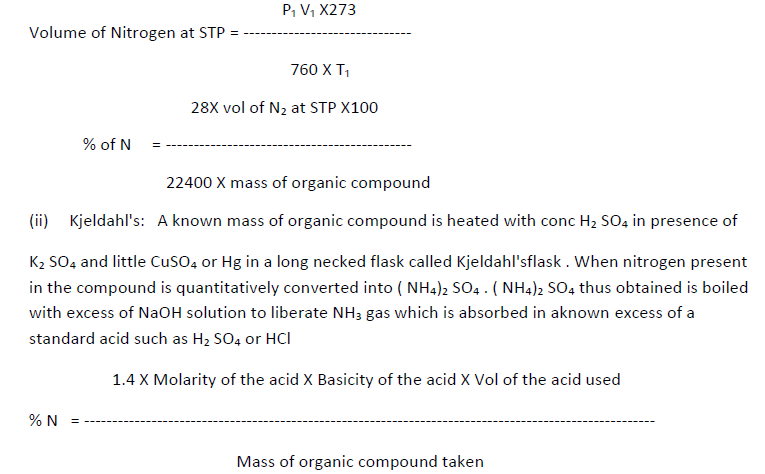
2. Differentiate between the principles of estimation of nitrogen in an organic compound by
(i) DUMAS method
(ii) KJELDAHL'S method
Ans: (i) Dumas method : A known mass of organic compound is heated with excess of CuO in an atmosphere of CO₂, when nitrogen of the organic compound is converted into N₂ gas The volume of N₂ gas thus obtained is converted into STP and the percentage of nitrogen is determined by the formula.
Free study material for Chemistry
Free CBSE Study Guides: Class 11 Chemistry Chapter 08 Organic Chemistry Some Basic Principles and Techniques
Core Study Kit: Class 11 Chemistry Chapter 08 Organic Chemistry Some Basic Principles and Techniques
Review targeted study resources for Chapter 08 Organic Chemistry Some Basic Principles and Techniques tailored for Class 11 learners. Utilizing these structured notes and quick-revision tools ensures complete alignment with current CBSE evaluation standards.
NCERT-Aligned Solutions for Chapter 08 Organic Chemistry Some Basic Principles and Techniques
Designed around the official curriculum, these study guides guarantee standard compliance. Reviewing step-by-step solutions clarifies complex sub-topics within Chapter 08 Organic Chemistry Some Basic Principles and Techniques and demystifies standard marking schemes for Chemistry evaluations.
Next Steps in Your Exam Preparation
For peak performance in upcoming evaluations, integrate official Chemistry sample papers directly into your study schedule. Follow up your revision by attempting online MCQ tests for Chapter 08 Organic Chemistry Some Basic Principles and Techniques to refine calculation speed and precision.
FAQs
Our advanced study package for Chapter 08 Organic Chemistry Some Basic Principles and Techniques includes detailed concepts, diagrams, Mind Maps, and explanation of complex topics to ensure Class 11 students learn as per syllabus for 2026 exams.
The Mind Maps provided for Chapter 08 Organic Chemistry Some Basic Principles and Techniques act as visual anchors which will help faster recall during high-pressure exams.
Yes, teachers use our Class 11 Chemistry resources for lesson planning as they are in simple language and have lot of solved examples.
Yes, You can download the complete, mobile-friendly PDF of the Chemistry Chapter 08 Organic Chemistry Some Basic Principles and Techniques advanced resources for free.
Yes, our subject matter experts have updated the Chapter 08 Organic Chemistry Some Basic Principles and Techniques material to align with the rationalized NCERT textbooks and have removed deleted topics and added new competency-based questions.