

Advanced Study Material for Class 11 Chemistry: Chapter 10 The s Block Elements
Access comprehensive study materials and useful resources for Chapter 10 The s Block Elements using the CBSE Class 11 Chemistry s block elements Flash Cards. Designed to align with the 2026-27 CBSE academic guidelines, these advanced resources help Class 11 Chemistry students reinforce core concepts beyond standard textbooks.
Practice Class 11 Chemistry Resources: Chapter 10 The s Block Elements
Access the complete useful resource PDF for Class 11 Chemistry below. Regular practice with these targeted academic notes builds familiarity with complex topics and helps secure higher marks in final school evaluations.
CBSE Class 11 Chemistry s block elements Flash Cards. Please refer to the examination notes which you can use for preparing and revising for exams. These notes will help you to revise the concepts quickly and get good marks.
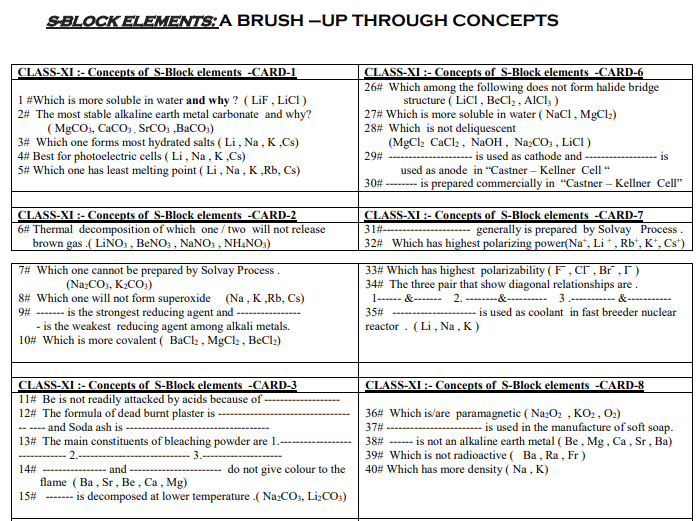
CLASS-XI :- Concepts of S-Block elements -CARD-1
1. Which is more soluble in water and why ? ( LiF , LiCl ) [1 Mark]
Answer: LiCl
1. LiCl is more soluble in water than LiF due to its lower lattice enthalpy.
2. The small size of both Li+ and F- ions results in a very high lattice energy for LiF, making it less soluble.
3. Chloride ion is larger, which decreases the lattice energy and favors greater solubility.
Teacher's Note:
a) Lattice enthalpy and hydration enthalpy determine ionic solubility.
b) High lattice energy acts as a major trap when comparing small halide salts.
c) Fajan's rule and hydration energy explain the trend.
2. The most stable alkaline earth metal carbonate and why? ( MgCO3, CaCO3 , SrCO3 , BaCO3) [1 Mark]
Answer: BaCO3
1. BaCO3 is the most stable alkaline earth metal carbonate.
2. Thermal stability increases down the group from MgCO3 to BaCO3.
3. The larger size of Ba2+ stabilizes the large carbonate anion more effectively.
Teacher's Note:
a) Stability increases with cation size down the group.
b) Students often confuse thermal stability with solubility.
c) Lattice energy considerations explain this behavior.
3. Which one forms most hydrated salts ( Li , Na , K , Cs) [1 Mark]
Answer: Li
1. Lithium (Li) forms the most hydrated salts.
2. Li+ has the smallest size and highest charge density among alkali metals.
3. High charge density leads to maximum degree of hydration.
Teacher's Note:
a) Hydration energy is inversely proportional to ionic radius.
b) Smaller ions hold water molecules more tightly.
4. Best for photoelectric cells ( Li , Na , K , Cs) [1 Mark]
Answer: Cs
1. Caesium (Cs) is the best for photoelectric cells.
2. It has the lowest ionization enthalpy among alkali metals.
3. Electrons are easily emitted when light falls on its surface.
Teacher's Note:
a) Low ionization energy facilitates photoelectric emission.
b) Caesium is widely used in solar cells and photoelectric devices.
5. Which one has least melting point ( Li , Na , K , Rb, Cs) [1 Mark]
Answer: Cs
1. Caesium (Cs) has the least melting point.
2. Metallic bonding weakens as the size of the alkali metal atom increases down the group.
3. Larger atomic size results in weaker cohesive forces and lower melting points.
Teacher's Note:
a) Melting point decreases down the alkali metal group.
b) Caesium melts just above room temperature at 28.5 °C.
CLASS-XI :- Concepts of S-Block elements -CARD-2
6. Thermal decomposition of which one / two will not release brown gas . ( LiNO3 , BeNO3 , NaNO3 , NH4NO3) [1 Mark]
Answer: NaNO3 (Note: Be(NO3)2 formula in print is BeNO3)
1. Sodium nitrate (NaNO3) on heating decomposes to give sodium nitrite and oxygen gas without releasing brown NO2 gas.
2. Other nitrates like LiNO3 decompose to give metal oxide, NO2 (brown gas), and O2.
3. Hence, NaNO3 does not release a brown gas.
Teacher's Note:
a) Group 1 nitrates except lithium decompose to nitrites and oxygen.
b) Nitrates of lithium and group 2 decompose to oxides and brown nitrogen dioxide gas.
c) Check note: The printed question lists BeNO3, which should chemically be Be(NO3)2.
7. Which one cannot be prepared by Solvay Process . ( Na2CO3 , K2CO3) [1 Mark]
Answer: K2CO3
1. Potassium carbonate (K2CO3) cannot be prepared by the Solvay process.
2. Potassium bicarbonate is fairly soluble in water and does not precipitate out easily like sodium bicarbonate.
3. Therefore, the Solvay process is restricted to sodium carbonate manufacture.
Teacher's Note:
a) Solubility differences between sodium and potassium bicarbonates prevent this method for potassium salts.
b) Potassium carbonate is prepared by the Engel's process.
8. Which one will not form superoxide ( Na , K , Rb, Cs) [1 Mark]
Answer: Na
1. Sodium (Na) does not form superoxide.
2. Sodium forms only peroxide (Na2O2) and normal oxide upon heating in oxygen.
3. Potassium, rubidium, and caesium form superoxides due to stabilization of large anions by large cations.
Teacher's Note:
a) Lattice energy stability dictates oxide, peroxide, and superoxide formation.
b) Sodium is too small to stabilize the large superoxide ion.
9. ------- is the strongest reducing agent and ---------------- - is the weakest reducing agent among alkali metals. [1 Mark]
Answer: Li is the strongest reducing agent and Cs is the weakest reducing agent (in aqueous medium)
1. Lithium (Li) has the most negative standard reduction potential, making it the strongest reducing agent in aqueous solution.
2. Caesium (Cs) or Sodium (depending on reference, but generally Li and Cs extremes) represents the other end.
3. High hydration energy of Li+ compensates for its high ionization enthalpy.
Teacher's Note:
a) Reducing character depends on sublimation, ionization, and hydration energies combined.
b) Lithium is an exceptionally strong reducing agent in water despite high ionization energy.
10. Which is more covalent ( BaCl2 , MgCl2 , BeCl2) [1 Mark]
Answer: BeCl2
1. Beryllium chloride (BeCl2) is more covalent.
2. According to Fajan's rule, small cation size and high charge increase covalent character.
3. Be2+ has the smallest size among alkaline earth metal ions, polarizing the chloride ion significantly.
Teacher's Note:
a) Fajan's rule correlates high polarizing power with covalent bonding.
b) BeCl2 exists as a polymer in the solid state due to its covalent nature.
CLASS-XI :- Concepts of S-Block elements -CARD-3
11. Be is not readily attacked by acids because of ------------------- [1 Mark]
Answer: formation of an oxide film on its surface
1. Beryllium forms a thin, protective layer of beryllium oxide (BeO) on its surface.
2. This oxide film renders the metal passive towards acids.
3. Removal of this layer is required for the acid to react with the underlying metal.
Teacher's Note:
a) Passivity is caused by protective oxide coating.
b) Aluminum exhibits a similar protective passivation behavior.
12. The formula of dead burnt plaster is ------------------------------------- and Soda ash is ------------------------------------ [1 Mark]
Answer: CaSO4 and Na2CO3
1. Dead burnt plaster is anhydrous calcium sulfate (CaSO4).
2. Soda ash is anhydrous sodium carbonate (Na2CO3).
3. Both are important industrial compounds derived from alkaline earth and alkali metals respectively.
Teacher's Note:
a) Plaster of Paris is hemihydrate, while dead burnt plaster has no water of crystallization.
b) Soda ash should not be confused with washing soda (Na2CO3 · 10H2O).
13. The main constituents of bleaching powder are 1.---------------------------- 2.---------------------------- 3.-------------------- [1 Mark]
Answer: Calcium oxychloride (CaOCl2), Calcium chloride (CaCl2), and Calcium hydroxide (Ca(OH)2)
1. The composition of bleaching powder is complex.
2. Main active component is calcium oxychloride.
3. Byproducts and unreacted material include calcium chloride and calcium hydroxide along with water of crystallization.
Teacher's Note:
a) Bleaching powder is manufactured by action of chlorine on dry slaked lime.
b) Memorize all three constituents as listed in standard textbooks.
14. ---------------- and ----------------------- do not give colour to the flame ( Ba , Sr , Be , Ca , Mg) [1 Mark]
Answer: Be and Mg
1. Beryllium (Be) and Magnesium (Mg) do not impart any color to the flame.
2. Their atoms are too small and have high ionization energies.
3. The energy supplied in a Bunsen burner flame is insufficient to excite their valence electrons to higher energy levels.
Teacher's Note:
a) Flame test depends on ease of electronic excitation.
b) Heavier alkaline earth metals give characteristic brick-red, crimson, and apple-green colors.
15. ------- is decomposed at lower temperature . ( Na2CO3 , Li2CO3) [1 Mark]
Answer: Li2CO3
1. Lithium carbonate (Li2CO3) decomposes at a much lower temperature compared to sodium carbonate.
2. Small Li+ ion polarizes the carbonate ion effectively, weakening the C-O bond.
3. Sodium carbonate is thermally very stable and melts without decomposing easily.
Teacher's Note:
a) Group 1 carbonates except Li2CO3 are stable towards heat.
b) Lithium shows diagonal relationship with magnesium in this thermal behavior.
CLASS-XI :- Concepts of S-Block elements -CARD-4
16. ---------- is the product at cathode and ---------- at anode when aq. NaCl is electrolysed . ( Na , H2 , Cl2 , O2) [1 Mark]
Answer: H2 is at cathode and Cl2 is at anode
1. During the electrolysis of aqueous sodium chloride, reduction of water occurs at the cathode preferentially, producing hydrogen gas (H2).
2. Chloride ions are oxidized at the anode to produce chlorine gas (Cl2).
3. Sodium metal is not deposited because reduction potential of water is higher than Na+.
Teacher's Note:
a) Preferential discharge theory explains the products.
b) Aqueous electrolysis yields NaOH solution alongside these gases.
17. The alkali metals dissolves in liquid ammonia giving deep blue solutions which are conducting in nature because ------------------------------------------------------------------------------------------------------------------------- [1 Mark]
Answer: of the presence of ammonated electrons and ammoniated metal cations
1. Alkali metals dissolve in liquid ammonia to form ammoniated electrons.
2. These ammoniated electrons absorb energy in the visible region, imparting a deep blue color.
3. The presence of free mobile ammoniated electrons and ions makes the solution electrically conducting.
Teacher's Note:
a) Dilute solutions are paramagnetic and intensely colored.
b) Concentrated solutions become bronze-colored and diamagnetic due to metal cluster formation.
18. Which is more basic ( Be(OH)2 , Ba(OH)2 ) [1 Mark]
Answer: Ba(OH)2
1. Barium hydroxide Ba(OH)2 is more basic.
2. Basic strength of alkaline earth metal hydroxides increases down the group.
3. Larger size of Ba2+ decreases lattice energy and increases hydroxide ion release facility, whereas Be(OH)2 is amphoteric.
Teacher's Note:
a) Down the group, electropositive character increases.
b) Beryllium hydroxide dissolves in excess alkali, proving its amphoteric nature.
19. Which of the following forms nitride ( Li , Na , K , Cs) [1 Mark]
Answer: Li
1. Lithium reacts directly with atmospheric nitrogen to form lithium nitride (Li3N).
2. Other alkali metals do not form nitrides directly under normal conditions.
3. Small size of Li+ ion allows high lattice energy stabilization with the small nitride ion.
Teacher's Note:
a) Direct combination with nitrogen is a unique property of lithium among alkali metals.
b) Magnesium in group 2 shows similar nitride formation.
20. The two halides which are used as Friedel Craft Catalyst 1.------------------------------ 2.----------------------- [1 Mark]
Answer: AlCl3 and BeCl2 (or FeCl3)
1. Anhydrous aluminum chloride (AlCl3) is widely used as a Friedel-Crafts catalyst.
2. Beryllium chloride (BeCl2) also acts as a Lewis acid catalyst in such reactions.
3. These electron-deficient halides polarize alkyl or acyl halides.
Teacher's Note:
a) Lewis acid character is essential for Friedel-Crafts alkylation and acylation.
b) AlCl2/AlCl3 type catalysts form electrophilic complexes.
CLASS-XI :- Concepts of S-Block elements -CARD-5
21. Which is more soluble in water ( MgSO4 , CaSO4 ) [1 Mark]
Answer: MgSO4
1. Magnesium sulfate is more soluble in water than calcium sulfate.
2. Hydration energy decreases down the group faster than lattice energy.
3. The high hydration energy of Mg2+ keeps its sulfate more soluble.
Teacher's Note:
a) Solubility of alkaline earth sulfates decreases down the group.
b) Epsom salt (MgSO4 · 7H2O) is highly water-soluble.
22. ----------------------- is added in cement to slow down the process of setting of the cement so that it sufficiently gets hardened . [1 Mark]
Answer: Gypsum (CaSO4 · 2H2O)
1. Gypsum is added during cement manufacturing.
2. It acts as a retarder to slow down rapid initial setting.
3. Controlled setting ensures uniform structural strength development.
Teacher's Note:
a) Without gypsum, cement would set almost instantaneously.
b) Chemical formula of gypsum is CaSO4 · 2H2O.
23. Which one has highest mobilities in aq. Solutions ( Li+ , Na+ , K+ , Rb+ , Cs+ ) [1 Mark]
Answer: Cs+
1. Caesium ion (Cs+) has the highest ionic mobility in aqueous solution.
2. Smaller ions get heavily hydrated, increasing their effective hydrated radius and slowing them down.
3. Cs+ is the least hydrated, has the smallest effective size in water, and moves the fastest under an electric field.
Teacher's Note:
a) Ionic mobility is inversely proportional to hydrated ionic radius.
b) Li+ has the smallest bare radius but largest hydrated radius.
24. Which is more soluble in ethanol ( LiI , KI ) [1 Mark]
Answer: LiI
1. Lithium iodide (LiI) is more soluble in ethanol.
2. Ethanol is an organic solvent, and covalent compounds dissolve better in it.
3. Due to high polarization by Li+, LiI has significant covalent character according to Fajan's rule.
Teacher's Note:
a) Like dissolves like: covalent salts dissolve in organic solvents.
b) Lithium salts generally show appreciable covalent character and organic solubility.
25. Which is sparingly soluble in water ( Na2CO3 , MgCO3 ) [1 Mark]
Answer: MgCO3
1. Magnesium carbonate (MgCO3) is sparingly soluble in water.
2. Sodium carbonate is highly soluble in water.
3. High lattice energy of divalent Mg2+ and carbonate ion outweighs the hydration energy compared to sodium salts.
Teacher's Note:
a) Alkali metal carbonates are generally soluble, while alkaline earth carbonates are insoluble or sparingly soluble.
b) Solubility of group 2 carbonates decreases down the group.
CLASS-XI :- Concepts of S-Block elements -CARD-6
26. Which among the following does not form halide bridge structure ( LiCl , BeCl2 , AlCl3 ) [1 Mark]
Answer: LiCl
1. Lithium chloride (LiCl) exists as an ionic lattice and does not form halide-bridged polymeric structures.
2. BeCl2 forms a polymeric chain structure with chlorine bridges in solid state.
3. AlCl3 exists as a dimer (Al2Cl6) bridged by chlorine atoms.
Teacher's Note:
a) Electron-deficient halides tend to form coordinate covalent halide bridges.
b) LiCl is predominantly ionic with high lattice energy.
27. Which is more soluble in water ( NaCl , MgCl2 ) [1 Mark]
Answer: MgCl2
1. Magnesium chloride is more soluble in water than sodium chloride.
2. High hydration energy of magnesium ion favors its dissolution.
3. MgCl2 often forms hydrates (like MgCl2 · 6H2O) due to strong water coordination.
Teacher's Note:
a) Hydration enthalpy drives solubility for these chlorides.
b) Group 2 chlorides are generally very soluble compared to their carbonates.
28. Which is not deliquescent ( MgCl2 , CaCl2 , NaOH , Na2CO3 , LiCl ) [1 Mark]
Answer: Na2CO3
1. Sodium carbonate (Na2CO3) is an efflorescent substance rather than deliquescent.
2. MgCl2, CaCl2, NaOH, and LiCl absorb moisture from the atmosphere and dissolve in it.
3. Sodium carbonate decahydrate loses water molecules to the atmosphere.
Teacher's Note:
a) Deliquescent compounds absorb moisture to form liquid solutions.
b) Anhydrous sodium carbonate does not liquefy on atmospheric exposure.
29. --------------------- is used as cathode and ------------------ is used as anode in “Castner - Kellner Cell” [1 Mark]
Answer: Mercury is used as cathode and Carbon (Graphite) is used as anode
1. In the Castner-Kellner cell, a falling stream of mercury acts as the mobile cathode.
2. Carbon or graphite blocks serve as the anode.
3. Brine is electrolysed to produce sodium amalgam and chlorine gas.
Teacher's Note:
a) Mercury cathode prevents deposition of sodium directly, forming sodium amalgam instead.
b) This industrial cell produces high-purity sodium hydroxide (caustic soda).
30. -------- is prepared commercially in “Castner - Kellner Cell” [1 Mark]
Answer: NaOH (Sodium hydroxide)
1. Sodium hydroxide (caustic soda) is prepared commercially using the Castner-Kellner cell.
2. Sodium amalgam reacts with water subsequently to yield pure NaOH solution and hydrogen gas.
3. Chlorine is obtained as a valuable byproduct at the anode.
Teacher's Note:
a) Commercial production of caustic soda relies heavily on electrolytic cells.
b) Mercury cell technology has environmental regulations, but is classic for high purity.
CLASS-XI :- Concepts of S-Block elements -CARD-7
31. ---------------------- generally is prepared by Solvay Process . [1 Mark]
Answer: Sodium carbonate (Na2CO3)
1. Solvay process is exclusively used for the manufacture of sodium carbonate (washing soda).
2. Raw materials include sodium chloride, ammonia, and limestone.
3. Carbon dioxide is recovered and reused in the cyclic process.
Teacher's Note:
a) Solvay process is an economical industrial triumph.
b) Potassium carbonate cannot be made this way due to high solubility of potassium bicarbonate.
32. Which has highest polarizing power ( Na+ , Li+ , Rb+ , K+ , Cs+ ) [1 Mark]
Answer: Li+
1. Lithium ion (Li+) has the highest polarizing power among alkali metal ions.
2. Polarizing power is directly proportional to charge and inversely proportional to square of ionic radius.
3. Smallest ionic radius of Li+ gives it maximum charge density.
Teacher's Note:
a) High polarizing power causes covalent character in ionic compounds.
b) Explains anomalous behavior of lithium.
33. Which has highest polarizability ( F- , Cl- , Br- , I- ) [1 Mark]
Answer: I-
1. Iodide ion (I-) has the highest polarizability.
2. Larger anions have electrons held less tightly by the nucleus, making their electron cloud easily distorted.
3. I- is the largest halide ion listed.
Teacher's Note:
a) Polarizability increases down the group for anions as size increases.
b) Fajan's rule pairs small cations with polarizable large anions for maximum covalency.
34. The three pair that show diagonal relationships are . 1------ &------- 2. --------&---------- 3 .----------- &----------- [1 Mark]
Answer: 1. Lithium & Magnesium, 2. Beryllium & Aluminum, 3. Boron & Silicon (or Lithium & Magnesium, Beryllium & Aluminum, and Lithium/Beryllium pairings depending on standard board syllabus; standard pairs: Li & Mg, Be & Al, B & Si)
1. Diagonal relationship exists between diagonally adjacent elements in periodic table.
2. Lithium resembles magnesium, beryllium resembles aluminum, and boron resembles silicon.
3. Similar charge-to-radius ratios cause these chemical similarities.
Teacher's Note:
a) Diagonal pairs share similar electronegativities and polarizing powers.
b) Classic periodic table concept for period 2 and 3 elements.
35. --------------------- is used as coolant in fast breeder nuclear reactor . ( Li , Na , K ) [1 Mark]
Answer: Na (liquid sodium metal)
1. Liquid sodium or a sodium-potassium alloy (NaK) is used as a coolant in fast breeder nuclear reactors.
2. Sodium has a high thermal conductivity and a low melting point, making it efficient for heat transfer.
3. It does not moderate neutrons effectively, allowing fast reactors to operate properly.
Teacher's Note:
a) Liquid metal coolants remain liquid over a wide temperature range.
b) Sodium handles immense heat loads without boiling off immediately.
CLASS-XI :- Concepts of S-Block elements -CARD-8
36. Which is/are paramagnetic ( Na2O2 , KO2 , O2 ) [1 Mark]
Answer: KO2 and O2
1. Potassium superoxide (KO2) contains the superoxide ion (O2-), which has an odd number of electrons and is paramagnetic.
2. Oxygen molecule (O2) has two unpaired electrons in anti-bonding molecular orbitals, making it paramagnetic.
3. Sodium peroxide (Na2O2) contains the peroxide ion (O22-) with all paired electrons, making it diamagnetic.
Teacher's Note:
a) Molecular orbital theory determines magnetic behavior of oxygen species.
b) Superoxides are always paramagnetic due to unpaired electrons.
37. ------------------------ is used in the manufacture of soft soap. [1 Mark]
Answer: Potassium hydroxide (KOH)
1. Potassium hydroxide (KOH) is used in the manufacture of soft soaps.
2. Sodium hydroxide produces hard soaps.
3. Potassium soaps dissolve more readily in water and are softer on skin.
Teacher's Note:
a) Saponification of fats with KOH yields soft liquid or paste soaps.
b) NaOH yields solid bar soaps.
38. ------ is not an alkaline earth metal ( Be , Mg , Ca , Sr , Ba ) [1 Mark]
Answer: None (All listed are alkaline earth metals; if radium was an option, or if question implies a trick, but Be, Mg, Ca, Sr, Ba are all standard Group 2 alkaline earth metals)
1. Beryllium, magnesium, calcium, strontium, and barium are all members of Group 2.
2. Group 2 elements are collectively known as alkaline earth metals.
3. All listed options correctly belong to this family.
Teacher's Note:
a) Check print: All options given are indeed alkaline earth metals.
b) Radium is also a group 2 radioactive element.
39. Which is not radioactive ( Ba , Ra , Fr ) [1 Mark]
Answer: Ba
1. Barium (Ba) is a stable, non-radioactive alkaline earth metal.
2. Radium (Ra) is a radioactive element belonging to Group 2.
3. Francium (Fr) is a highly radioactive alkali metal belonging to Group 1.
Teacher's Note:
a) Radioactivity characterizes heavier elements at the bottom of groups.
b) Barium isotopes are stable.
40. Which has more density ( Na , K ) [1 Mark]
Answer: Na
1. Sodium (Na) has a higher density than potassium (K).
2. Normally density increases down a group, but potassium exhibits an anomaly due to an unusual increase in atomic volume.
3. Therefore, potassium is lighter than sodium and floats on it.
Teacher's Note:
a) Potassium has lower density than sodium due to large vacant atomic volume.
b) Classic density anomaly in alkali metals.
CLASS-XI :- Concepts of S-Block elements -CARD-9
41. The flame coloration of Potassium is ------------------ ( Crimson red , Yellow , Blue , Violet , Red violet ) [1 Mark]
Answer: Violet (or Lilac)
1. Potassium compounds impart a violet or lilac color to the Bunsen burner flame.
2. The low excitation energy of potassium valence electrons permits this emission.
3. Cobalt glass is often used to filter out interfering yellow sodium sodium when viewing potassium flames.
Teacher's Note:
a) Flame test colors are characteristic fingerprints for alkali and alkaline earth metals.
b) Potassium gives violet, sodium gives golden yellow.
42. Which one does not form peroxide ( Na , K , Li , Cs ) [1 Mark]
Answer: Li
1. Lithium forms only normal oxide (Li2O) upon heating in air.
2. Sodium forms peroxide, while potassium, rubidium, and caesium form superoxides.
3. Small size of lithium ion prevents formation of stable larger peroxide and superoxide lattices.
Teacher's Note:
a) Oxide stability is dictated by lattice energy matching.
b) Lithium's high polarizing power restricts it to normal oxide.
43. Which is more basic ( NaOH , Mg(OH)2 ) [1 Mark]
Answer: NaOH
1. Sodium hydroxide (NaOH) is a much stronger base than magnesium hydroxide (Mg(OH)2).
2. Alkali metals are more electropositive than alkaline earth metals.
3. NaOH dissociates completely in water to release hydroxide ions freely.
Teacher's Note:
a) Basic strength increases with electropositive character.
b) Group 1 hydroxides are strong alkalis, whereas group 2 hydroxides are comparatively weaker.
44. Which has low solubility in water due to low hydration enthalpy ( LiF , CsI , LiCl ) [1 Mark]
Answer: LiF
1. Lithium fluoride (LiF) has low solubility in water.
2. Both Li+ and F- are very small ions, resulting in an exceptionally high lattice enthalpy.
3. This high lattice energy overcomes hydration enthalpy, making LiF sparingly soluble.
Teacher's Note:
a) Solubility depends on the delicate balance between lattice enthalpy and hydration enthalpy.
b) LiF is an exception to the general high solubility of lithium salts.
45. The anomalous behavior of Li is due to (i) -------------------------------- (ii) ------------------------- [1 Mark]
Answer: (i) Small size of Li atom and Li+ ion, (ii) High electronegativity and high polarizing power
1. Lithium differs from other alkali metals due to its extremely small atomic and ionic size.
2. It also possesses high polarizing power and high ionization enthalpy.
3. These factors impart significant covalent character to lithium compounds.
Teacher's Note:
a) First element of every s and p block group shows anomalous properties.
b) High charge-to-radius ratio is the root cause.
CLASS-XI :- Concepts of S-Block elements -CARD-10
46. The similarities between Li and Mg is due to (i) ----------------------------------- (ii) -------------------------------------------------------------------- [1 Mark]
Answer: (i) Similar ionic radii, (ii) Similar electronegativity / polarizing power
1. Lithium and magnesium show a diagonal relationship.
2. This similarity arises because they have comparable atomic/ionic radii and polarizabilities.
3. Consequently, their chemical properties and compound characteristics closely parallel each other.
Teacher's Note:
a) Diagonal relationship is a cornerstone of periodic trends.
b) Charge-to-radius ratio matches closely between Li+ and Mg2+.
47. The characteristics color shown in the flame in case of (i) Ca is ------------ (ii) Sr --------------- (iii) Ba is ---------------- [1 Mark]
Answer: (i) Brick red, (ii) Crimson red, (iii) Apple green
1. Calcium compounds impart a brick-red color to the flame.
2. Strontium compounds impart a crimson-red color.
3. Barium compounds impart an apple-green color to the flame.
Teacher's Note:
a) Memorizing flame test colors is essential for qualitative inorganic analysis.
b) Ca, Sr, and Ba flame test colors help distinguish alkaline earth metals.
48. --------------------- ions are most abundant ions within the cell fluid ( Na+ , K+ ) [1 Mark]
Answer: K+
1. Potassium ions (K+) are the most abundant cations within cell fluids (intracellular fluid).
2. Sodium ions (Na+) are primarily found in extracellular fluids.
3. This concentration gradient is maintained by the sodium-potassium pump.
Teacher's Note:
a) Biological role of alkali metal ions is vital for nerve impulse transmission.
b) Intracellular high K+ contrasts with extracellular high Na+.
49. --------- ions participate in the oxidation of glucose to produce ATP ( ( Na+ , K+ ) [1 Mark]
Answer: K+
1. Potassium ions (K+) activate many enzymes, including pyruvate kinase, which is crucial for the oxidation of glucose to produce ATP.
2. They play a key role in biological energy metabolism.
3. Sodium ions do not play this specific enzymatic activation role in glycolysis.
Teacher's Note:
a) Enzyme activation is a specific biochemical function of potassium.
b) Essential concept linking inorganic chemistry with biological systems.
50. ----------------- metal is used for making windows of X-ray tubes . ( Mg , Be ) [1 Mark]
Answer: Be
1. Beryllium (Be) is used for making windows of X-ray tubes.
2. Beryllium has a very low atomic number and is transparent to X-rays compared to other metals.
3. It allows X-rays to pass through with minimum absorption and scattering.
Teacher's Note:
a) X-ray transparency is a unique industrial application of beryllium.
b) Beryllium dust is toxic, requiring special handling during manufacturing.
CLASS-XI :- Concepts of S-Block elements - CARD-11
51. Which one is not used in photoelectric effect? (Cs , Li , K) [1 Mark]
(A) Cs
(B) Li
(C) K
(D) None of these
Answer: (B) Li
1. Lithium has a very high ionization enthalpy due to its small size.
2. Therefore, electrons are not easily ejected from lithium when exposed to light.
3. Hence, lithium is not used in photoelectric cells, whereas heavier alkali metals like Cs and K are used.
4. Hence, the correct option is (B).
Teacher's Note:
a) Photoelectric effect requires low ionization energy.
b) Lithium has the highest ionization energy among alkali metals.
52. Which one do not give colour to flame ? ( Li , Be , Ca) [1 Mark]
(A) Li
(B) Be
(C) Ca
(D) Li and Ca
Answer: (B) Be
1. Beryllium has a very small size and high ionization enthalpy.
2. The energy of the flame is insufficient to excite the electrons of beryllium to higher energy levels.
3. Consequently, beryllium does not impart any characteristic colour to the flame.
4. Hence, the correct option is (B).
Teacher's Note:
a) Small alkaline earth metals like Be and Mg do not impart flame colour.
b) Heavier elements undergo easy electronic excitation in flame.
53. What is prepared in Solvay's Preparation ( Sodium carbonate , Bleaching powder) [1 Mark]
(A) Sodium carbonate
(B) Bleaching powder
(C) Both
(D) None
Answer: (A) Sodium carbonate
1. Solvay process is a major industrial process used for the manufacture of sodium carbonate (washing soda).
2. It uses sodium chloride, ammonia, and carbon dioxide as raw materials.
3. Bleaching powder is prepared by the action of chlorine on slaked lime (Hasenclever or Backmann plant).
4. Hence, the correct option is (A).
Teacher's Note:
a) Solvay process cannot be used to prepare potassium carbonate directly because potassium bicarbonate is too soluble.
b) Remember the raw materials involved in the Solvay process.
CLASS-XI :- Concepts of S-Block elements - CARD-12
61. KO2 is --------------- ( Paramagnetic , diamagnetic) [1 Mark]
(A) Paramagnetic
(B) Diamagnetic
(C) Both
(D) None
Answer: (A) Paramagnetic
1. Potassium superoxide (KO2) contains the superoxide ion (O2-).
2. The superoxide ion has an odd number of electrons (17 valence electrons).
3. Molecular orbital configuration leaves one unpaired electron in the antibonding pi star orbital.
4. Hence, it is paramagnetic and the correct option is (A).
Teacher's Note:
a) Presence of unpaired electrons causes paramagnetism.
b) Superoxides are generally colored and paramagnetic.
62. Which is more soluble in water ? ( BeCO3 , CaCO3) [1 Mark]
(A) BeCO3
(B) CaCO3
(C) Both equal
(D) None
Answer: (A) BeCO3
1. Solubility of alkaline earth metal carbonates decreases down the group.
2. As we go down from beryllium to barium, lattice enthalpy remains almost constant while hydration enthalpy decreases sharply.
3. Beryllium ion has a very high hydration enthalpy, making BeCO3 more soluble than down-the-group carbonates.
4. Hence, the correct option is (A).
Teacher's Note:
a) Down the group, lattice energy decreases less rapidly than hydration energy for sulphates, but for carbonates hydration energy dominates solubility trends.
b) BeCO3 is exceptionally soluble compared to other group 2 carbonates.
63. Which has higher Lattice Enthalpy ? ( LiF , LiCl) [1 Mark]
(A) LiF
(B) LiCl
(C) Both equal
(D) Cannot be determined
Answer: (A) LiF
1. Lattice enthalpy is inversely proportional to the interionic distance (sum of ionic radii).
2. Fluoride ion (F-) is much smaller in size than chloride ion (Cl-).
3. The smaller distance between Li+ and F- results in stronger electrostatic forces of attraction.
4. Hence, LiF has a higher lattice enthalpy and the correct option is (A).
Teacher's Note:
a) Lattice energy depends directly on product of charges and inversely on radius sum.
b) Smaller anions give higher lattice energy in alkali metal halides.
54. The oxidation state of K in potassium superoxide is ----------- ( +1 , +2 , +3) [1 Mark]
(A) +1
(B) +2
(C) +3
(D) +1.5
Answer: (A) +1
1. Potassium is an alkali metal and always exhibits an oxidation state of +1 in its stable compounds.
2. In potassium superoxide (KO2), the superoxide ion (O2-) carries a -1 charge shared across two oxygen atoms.
3. Thus, potassium retains its standard +1 oxidation state.
4. Hence, the correct option is (A).
Teacher's Note:
a) Alkali metals show a fixed oxidation state of +1.
b) Do not confuse the oxidation state of the metal with the apparent oxidation number of oxygen in superoxides.
55. Which has higher thermal stability ? ( Li2CO3 , Na2CO3) [1 Mark]
(A) Li2CO3
(B) Na2CO3
(C) Both equal
(D) None
Answer: (B) Na2CO3
1. Thermal stability of alkali metal carbonates increases down the group.
2. Larger cations stabilize larger anions more effectively through lattice interactions.
3. Sodium ion is larger than lithium ion, making Na2CO3 more thermally stable than Li2CO3.
4. Hence, the correct option is (B).
Teacher's Note:
a) Lithium carbonate decomposes easily on heating to give lithium oxide and carbon dioxide.
b) Stability increases with an increase in electropositive character down the group.
56. Li shows diagonal relationship with ------ ( Be , B , Mg) [1 Mark]
(A) Be
(B) B
(C) Mg
(D) Na
Answer: (C) Mg
1. Elements of period 2 show similar properties with diagonal elements of period 3.
2. Lithium (Group 1, Period 2) exhibits a diagonal relationship with Magnesium (Group 2, Period 3).
3. This is due to similar atomic/ionic radii and charge-to-radius ratios (polarizing power).
4. Hence, the correct option is (C).
Teacher's Note:
a) Diagonal relationships arise due to comparable polarizing power.
b) Other diagonal pairs include Be-Al and B-Si.
57. Which is more reactive ? (Na , K) [1 Mark]
(A) Na
(B) K
(C) Both equal
(D) None
Answer: (B) K
1. Reactivity of alkali metals increases down the group as ionization energy decreases.
2. Potassium has a larger atomic size and lower ionization energy than sodium.
3. Therefore, potassium loses its valence electron much more easily than sodium.
4. Hence, potassium is more reactive and the correct option is (B).
Teacher's Note:
a) Reactivity with water and air increases down group 1.
b) Potassium reacts more vigorously than sodium.
58. Which is more basic ? ( NaOH , Mg(OH)2 ) [1 Mark]
(A) NaOH
(B) Mg(OH)2
(C) Both equal
(D) Amphoteric
Answer: (A) NaOH
1. Basicity of hydroxides depends on how easily they release hydroxide ions in water.
2. Sodium is an alkali metal (Group 1) forming a strongly ionic hydroxide, whereas magnesium is an alkaline earth metal (Group 2).
3. Group 1 oxides and hydroxides are far more basic than Group 2 counterparts.
4. Hence, the correct option is (A).
Teacher's Note:
a) Metallic character decreases across a period, so basic strength of hydroxides decreases.
b) NaOH is a strong alkali while Mg(OH)2 is a weak base.
59. When sodium dissolves in liquid ammonia , it gives ----------------------- colour ? ( Red , deep blue) [1 Mark]
(A) Red
(B) Deep blue
(C) Yellow
(D) Colorless
Answer: (B) Deep blue
1. Alkali metals dissolve in liquid ammonia to form ammoniated cations and ammoniated electrons.
2. The deep blue color of the solution is due to the absorption of energy by ammoniated electrons, which excite in the visible region of light.
3. Dilute solutions are paramagnetic and deep blue.
4. Hence, the correct option is (B).
Teacher's Note:
a) Concentrated solutions become bronze-colored and diamagnetic due to metal-ion cluster formation.
b) Solutions conduct electricity due to the presence of ammoniated ions and electrons.
60. Liquid -------------- metal is used as a coolant in fast breeder reactor . [1 Mark]
(A) Sodium
(B) Potassium
(C) Na-K alloy
(D) Mercury
Answer: (C) Na-K alloy
Answer: (C) Na-K alloy (Liquid sodium-potassium alloy)
1. Liquid sodium-potassium alloy (Na-K alloy) remains liquid at room temperature and possesses high thermal conductivity.
2. It has a high boiling point and low neutron absorption cross-section.
3. These properties make it an ideal coolant to transfer heat efficiently in fast breeder nuclear reactors.
4. Hence, the correct option is (C).
Teacher's Note:
a) Eutectic mixtures of Na and K have extremely low melting points.
b) Excellent heat transfer properties are required for nuclear coolants.
64. which one give hydrated salt ? ( Na , Li , Cs) [1 Mark]
(A) Na
(B) Li
(C) Cs
(D) All of these
Answer: (B) Li
1. Due to the extremely small size of the lithium ion (Li+), it has a very high charge density.
2. This results in a very high hydration enthalpy, causing lithium salts to readily crystallize as hydrated salts (e.g., LiCl . 2H2O).
3. Larger alkali metal ions have lower charge densities and do not form hydrated salts easily.
4. Hence, the correct option is (B).
Teacher's Note:
a) Degree of hydration decreases down group 1.
b) Lithium chloride and lithium perchlorate form stable hydrates.
65. Which has least melting point ( Li , Cs) [1 Mark]
(A) Li
(B) Cs
(C) Both equal
(D) Na
Answer: (B) Cs
1. Melting points of alkali metals decrease down the group as atomic size increases.
2. Larger atomic size leads to weaker metallic bonding because the valence electrons are further from the nucleus.
3. Cesium is the largest stable alkali metal among the common choices.
4. Hence, cesium has the lowest melting point and the correct option is (B).
Teacher's Note:
a) Caesium has a melting point of about 28.5 °C, remaining liquid near room temperature.
b) Metallic bond strength weakens down group 1.
66. Which is more soluble in water ? ( BeO , BeSO4) [1 Mark]
(A) BeO
(B) BeSO4
(C) Both equal
(D) Insoluble
Answer: (B) BeSO4
1. Beryllium oxide (BeO) is essentially covalent with a strong crystal lattice and is practically insoluble in water.
2. Beryllium sulphate (BeSO4) has a high hydration energy due to small Be2+ ion, making it readily soluble in water.
3. Sulphates of alkaline earth metals generally show decreasing solubility, but BeSO4 is exceptionally soluble.
4. Hence, the correct option is (B).
Teacher's Note:
a) Lattice energy dominates for BeO making it insoluble.
b) Hydration energy favors solubility of BeSO4.
67. Which is more soluble in ethanol ? ( LiI , KI) [1 Mark]
(A) LiI
(B) KI
(C) Both equal
(D) Insoluble
Answer: (A) LiI
1. According to Fajan's rules, smaller cations have higher polarizing power, imparting covalent character to their ionic compounds.
2. Lithium iodide (LiI) has significant covalent character due to the small size of Li+ and large polarizable size of I-.
3. Covalent compounds dissolve better in organic solvents like ethanol compared to ionic salts like KI.
4. Hence, the correct option is (A).
Teacher's Note:
a) Like dissolves like: covalent LiI dissolves well in organic ethanol.
b) Potassium iodide is largely ionic and less soluble in ethanol.
68. Which is more soluble in water ? ( BaO , BaSO4) [1 Mark]
(A) BaO
(B) BaSO4
(C) Both equal
(D) Insoluble
Answer: (A) BaO
1. Barium oxide reacts with water vigorously to form soluble barium hydroxide, Ba(OH)2.
2. Barium sulphate (BaSO4) has a very high lattice energy due to high charges and similar ionic sizes, making it sparingly soluble (insoluble) in water.
3. Therefore, BaO is far more soluble in water compared to BaSO4.
4. Hence, the correct option is (A).
Teacher's Note:
a) BaSO4 is famous for being extremely insoluble in water.
b) BaO reacts chemically to yield soluble hydroxide.
69. The mobilities of which alkali ions in aq. solution is more ? ( Li , Cs) [1 Mark]
(A) Li
(B) Cs
(C) Both equal
(D) Depends on temperature
Answer: (B) Cs
1. Smaller alkali metal ions have higher charge densities and get heavily hydrated in aqueous solutions.
2. Lithium ion gets heavily hydrated, forming a large hydrated radius, which moves sluggishly under an electric field.
3. Cesium ion is least hydrated due to its large size, resulting in a smaller effective hydrated radius and higher ionic mobility.
4. Hence, the correct option is (B).
Teacher's Note:
a) Hydrated ionic radius order is opposite to bare ionic radius order.
b) Mobility order in water: Li+ < Na+ < K+ < Rb+ < Cs+.
70. To slow down the process of setting of cement , what is used ? ( Plaster of Paris , Gypsum ) [1 Mark]
(A) Plaster of Paris
(B) Gypsum
(C) Both
(D) Quicklime
Answer: (B) Gypsum
1. Gypsum (calcium sulphate dihydrate, CaSO4 . 2H2O) is added in small amounts to clinker during the manufacture of cement.
2. It reacts slowly with tricalcium aluminate to form calcium sulphoaluminate, which prevents rapid flash setting.
3. This retards the setting process, allowing cement to be laid properly.
4. Hence, the correct option is (B).
Teacher's Note:
a) Plaster of Paris causes quick setting, whereas gypsum acts as a retarder.
b) Proper setting time ensures structural strength in civil engineering applications.
CLASS-XI :- Concepts of S-Block elements - CARD-13
71. which constituent is present in 20-25% in Portland Cement ? ( CaO , Al2O3 , SiO2 , MgO) [1 Mark]
(A) CaO
(B) Al2O3
(C) SiO2
(D) MgO
Answer: (C) SiO2
1. Portland cement typically consists of CaO (50-60%), SiO2 (20-25%), Al2O3 (5-10%), and MgO (2-3%).
2. Silicon dioxide (silica) provides strength and comprises about 20 to 25 percent of the composition.
3. Calcium oxide is the most abundant component (around 50-60%), but 20-25% specifically corresponds to silica.
4. Hence, the correct option is (C).
Teacher's Note:
a) Memorize standard percentage composition ranges for cement components.
b) CaO is 50-60% while SiO2 is 20-25%.
72. Which is more soluble in water ? ( Ba(OH)2 or Be(OH)2 ) [1 Mark]
(A) Ba(OH)2
(B) Be(OH)2
(C) Both equal
(D) Insoluble
Answer: (A) Ba(OH)2
1. Solubility of alkaline earth metal hydroxides increases down the group from beryllium to barium.
2. Down the group, lattice enthalpy decreases more rapidly than hydration enthalpy.
3. Beryllium hydroxide is amphoteric and practically insoluble, whereas barium hydroxide is quite soluble.
4. Hence, the correct option is (A).
Teacher's Note:
a) Hydroxide solubility trend is opposite to carbonate solubility trend.
b) Ba(OH)2 forms a strong basic solution known as baryta water.
73. What is used in Fridel Craft Reaction ? ( LiAlH4 , Anh.AlCl3) [1 Mark]
(A) LiAlH4
(B) Anh.AlCl3
(C) Both
(D) None
Answer: (B) Anh.AlCl3
1. Friedel-Crafts alkylation and acylation reactions require a Lewis acid catalyst.
2. Anhydrous aluminium chloride (Anh. AlCl3) acts as a strong Lewis acid to generate electrophiles.
3. LiAlH4 is a strong reducing agent used for reduction of carbonyl compounds.
4. Hence, the correct option is (B).
Teacher's Note:
a) Anhydrous AlCl3 is essential to accept lone pairs and form carbocations.
b) Moisture must be excluded since water deactivates AlCl3 catalyst.
74. Which one does not form nitride ? ( K , Li , Mg ) [1 Mark]
(A) K
(B) Li
(C) Mg
(D) Both K and Li
Answer: (A) K
1. Lithium reacts directly with nitrogen gas to form lithium nitride (Li3N) due to its high polarizing power.
2. Magnesium also reacts with nitrogen to form magnesium nitride (Mg3N2) via diagonal relationship.
3. Potassium, being a larger alkali metal with low polarizing power, cannot form a stable nitride.
4. Hence, the correct option is (A).
Teacher's Note:
a) Only lithium among alkali metals forms a stable direct nitride.
b) Group 2 metals generally form nitrides on heating with nitrogen.
75. Which are not deliquescent ? ( LiCl , NaCl , MgCl2) [1 Mark]
(A) LiCl
(B) NaCl
(C) MgCl2
(D) LiCl and MgCl2
Answer: (B) NaCl
1. Deliquescent substances absorb moisture from the air to form aqueous solutions.
2. Lithium chloride and magnesium chloride are strongly hydrated and hygroscopic or deliquescent.
3. Sodium chloride (NaCl) does not absorb atmospheric moisture under normal conditions and is not deliquescent.
4. Hence, the correct option is (B).
Teacher's Note:
a) Table salt (NaCl) remains dry in air unlike deliquescent MgCl2.
b) High hydration enthalpy favors deliquescence in small-cation halides.
76. Which one does not form protective oxide film on the surface of the metal ? ( Al , Be , Rb) [1 Mark]
(A) Al
(B) Be
(C) Rb
(D) None
Answer: (C) Rb
1. Aluminium forms a thin protective oxide layer (Al2O3) that prevents further corrosion.
2. Beryllium forms a protective oxide film (BeO) making it unreactive to acids at room temperature initially.
3. Rubidium is a highly reactive alkali metal that forms superoxides and reactive oxides which flake off, providing no protective coating.
4. Hence, the correct option is (C).
Teacher's Note:
a) Passivation is observed in Al and Be due to strong adherent oxide films.
b) Heavy alkali metals oxidize rapidly and destructively in air.
77. The slag obtained from Iron and steel industries are ----------- ( calcium silicate , calcium phosphate) [1 Mark]
(A) calcium silicate
(B) calcium phosphate
(C) calcium carbonate
(D) calcium sulphate
Answer: (A) calcium silicate
1. During the extraction of iron in a blast furnace, calcium oxide (flux) reacts with silica impurity (gangue).
2. The chemical reaction is CaO + SiO2 → CaSiO3.
3. Calcium silicate (CaSiO3) is formed as a molten slag that floats on molten iron and is removed.
4. Hence, the correct option is (A).
Teacher's Note:
a) Flux + Gangue = Slag.
b) Slag is lighter than molten metal, which helps in easy separation.
78. The formula of lime water is -- ( CaSiO3 , Ca(OCl)2 , Ca(OH)2 ) [1 Mark]
(A) CaSiO3
(B) Ca(OCl)2
(C) Ca(OH)2
(D) CaO
Answer: (C) Ca(OH)2
1. Lime water is an aqueous solution of calcium hydroxide.
2. Its chemical formula is Ca(OH)2.
3. It is commonly used to test for carbon dioxide gas, turning milky due to insoluble calcium carbonate formation.
4. Hence, the correct option is (C).
Teacher's Note:
a) Suspension of slaked lime is milk of lime, while clear solution is lime water.
b) Ca(OCl)2 is bleaching powder.
79. What is calcium sulphate hemihydrate ? ( Gypsum , POP) [1 Mark]
(A) Gypsum
(B) POP (Plaster of Paris)
(C) Both
(D) Anhydrite
Answer: (B) POP (Plaster of Paris)
1. Plaster of Paris has the chemical formula CaSO4 . \(\frac{1}{2}\) H2O.
2. It contains half a molecule of water of crystallization per calcium sulphate formula unit.
3. Gypsum is the dihydrate form (CaSO4 . 2H2O).
4. Hence, the correct option is (B).
Teacher's Note:
a) POP is prepared by heating gypsum at 393 K.
b) Note the fractional water molecule in hemihydrate.
80. Ba imparts which characteristic colour to the flame ? ( Brick red , Crimson , apple green , golden yellow) [1 Mark]
(A) Brick red
(B) Crimson
(C) Apple green
(D) Golden yellow
Answer: (C) Apple green
1. Different s-block elements impart characteristic colors to a Bunsen flame due to electronic transitions.
2. Barium (Ba) gives an apple green color to the flame.
3. Calcium gives brick red, strontium gives crimson, and sodium gives golden yellow.
4. Hence, the correct option is (C).
Teacher's Note:
a) Flame test is a qualitative analytical tool for s-block elements.
b) Memorize flame colors: Ba = apple green, Ca = brick red, Sr = crimson.
CLASS-XI :- Concepts of S-Block elements - CARD-14
81. Which is best reducing agent ( Cs , Li) [1 Mark]
(A) Cs
(B) Li
(C) Both equal
(D) Na
Answer: (B) Li
1. Reducing character depends on standard reduction potential (sum of sublimation, ionization, and hydration enthalpies).
2. Although lithium has the highest ionization energy, it has the most negative electrode potential (\(E^\circ\)) in aqueous solution due to its extremely high hydration energy.
3. Thus, lithium acts as the strongest reducing agent in aqueous solution among alkali metals.
4. Hence, the correct option is (B).
Teacher's Note:
a) A common student trap is to look only at ionization energy and pick cesium.
b) Hydration energy makes lithium the strongest reducing agent in water.
82. Which is more covalent ? (a) ( LiCl , NaCl ) (b) ( LiCl , BeCl2) [1 Mark]
(A) LiCl and LiCl
(B) NaCl and BeCl2
(C) LiCl and BeCl2
(D) NaCl and LiCl
Answer: (C) LiCl and BeCl2
1. According to Fajan's rules, smaller cations and higher charges increase covalent character.
2. Between LiCl and NaCl, Li+ is smaller than Na+, so LiCl is more covalent than NaCl.
3. Between LiCl and BeCl2, Be2+ has a higher charge and smaller size than Li+, making BeCl2 more covalent than LiCl.
4. Hence, the correct option is (C).
Teacher's Note:
a) Polarizing power increases with decrease in ionic size and increase in ionic charge.
b) BeCl2 is significantly covalent and dissolves in organic solvents.
83. Which one forms stable superoxide ? ( Na , K ) [1 Mark]
(A) Na
(B) K
(C) Both
(D) None
Answer: (B) K
1. Larger alkali metal cations stabilize larger anions via lattice energy effects (large cation stabilizes large anion).
2. Sodium forms only peroxide (Na2O2) and oxide, whereas potassium, rubidium, and cesium form stable superoxides (KO2, RbO2, CsO2).
3. Therefore, potassium forms a stable superoxide.
4. Hence, the correct option is (B).
Teacher's Note:
a) Stability of oxides, peroxides, and superoxides increases with increase in cation size down the group.
b) Potassium superoxide is widely used in oxygen breathing apparatus.
84. Nitrate of which metal does not liberate brown colour gas on heating ? ( Na , Li , Ca ) [1 Mark]
(A) Na
(B) Li
(C) Ca
(D) All liberate
Answer: (A) Na
1. Sodium nitrate on heating decomposes to form sodium nitrite and oxygen gas without liberating nitrogen dioxide.
2. Equation: 2NaNO3 → 2NaNO2 + O2 (no brown gas NO2).
3. Nitrates of lithium, calcium, and other heavy metals decompose to give metal oxide, nitrogen dioxide (brown gas), and oxygen.
4. Hence, the correct option is (A).
Teacher's Note:
a) NaNO3 behaves differently from other metal nitrates upon thermal decomposition.
b) Brown gas refers to NO2.
85. -------- ions are most abundant within cell fluid ( K+ , Na+ ) [1 Mark]
(A) K+
(B) Na+
(C) Ca2+
(D) Mg2+
Answer: (A) K+
1. Biological fluids inside cells (intracellular fluid) have high concentrations of potassium ions (K+).
2. Conversely, extracellular fluids (blood plasma and fluids outside cells) contain higher concentrations of sodium ions (Na+).
3. This concentration gradient is maintained by the sodium-potassium pump.
4. Hence, the correct option is (A).
Teacher's Note:
a) Do not confuse intracellular fluid (rich in K+) with extracellular fluid (rich in Na+).
b) Potassium plays a vital role in transmission of nerve impulses.
86. Which one is baking powder ( sodium carbonate , Sodium bicarbonate ) [1 Mark]
(A) Sodium carbonate
(B) Sodium bicarbonate
(C) Both
(D) Washing soda
Answer: (B) Sodium bicarbonate
1. Baking powder is a mixture of sodium bicarbonate (NaHCO3) and a mild edible acid like tartaric acid or citric acid.
2. Sodium bicarbonate alone is baking soda, which on heating gives sodium carbonate (making cakes bitter if used alone).
3. The acid neutralizes the sodium carbonate produced during baking, yielding carbon dioxide gas to make cakes fluffy.
4. Hence, the correct option is (B).
Teacher's Note:
a) Baking soda is NaHCO3; baking powder is NaHCO3 + edible acid.
b) Carbon dioxide evolution causes dough to rise.
87. What is obtained at cathode in Castner - Kellner cell ? ( Na-Hg or Chlorine) [1 Mark]
(A) Na-Hg
(B) Chlorine
(C) Sodium metal
(D) Hydrogen
Answer: (A) Na-Hg
1. In the Castner-Kellner cell for chlor-alkali process, brine is electrolyzed using a mercury cathode and a carbon/titanium anode.
2. Sodium ions are discharged at the mercury cathode to form sodium amalgam (Na-Hg).
3. Chlorine gas is liberated at the carbon anode.
4. Hence, the correct option is (A).
Teacher's Note:
a) Amalgam formation lowers the discharge potential of sodium.
b) Anode produces chlorine gas, cathode produces sodium amalgam.
88. Which has more lattice enthalpy ? ( Li2O , BeO) [1 Mark]
(A) Li2O
(B) BeO
(C) Both equal
(D) Cannot be determined
Answer: (B) BeO
1. Lattice enthalpy depends on the product of ionic charges and inversely on the sum of ionic radii.
2. BeO contains Be2+ and O2- ions, whereas Li2O contains Li+ and O2- ions.
3. The higher charges (+2 and -2) and smaller ionic radii in BeO result in a much higher lattice enthalpy than Li2O.
4. Hence, the correct option is (B).
Teacher's Note:
a) Higher ionic charges lead to significantly greater electrostatic attraction.
b) Beryllium oxide has an exceptionally high lattice energy.
89. What is the water of crystallization in washing soda ? ( 7 , 10 , 1) [1 Mark]
(A) 7
(B) 10
(C) 1
(D) 5
Answer: (B) 10
1. Washing soda is hydrated sodium carbonate.
2. Its chemical formula is Na2CO3 . 10H2O.
3. It contains ten molecules of water of crystallization per formula unit.
4. Hence, the correct option is (B).
Teacher's Note:
a) Anhydrous sodium carbonate is soda ash (Na2CO3).
b) Washing soda loses its water of crystallization on exposure to dry air (efflorescence).
90. Which is more soluble in water ? ( NaHCO3 , KHCO3) [1 Mark]
(A) NaHCO3
(B) KHCO3
(C) Both equal
(D) Insoluble
Answer: (B) KHCO3
1. Potassium bicarbonate (KHCO3) is more soluble in water than sodium bicarbonate (NaHCO3).
2. Larger cations with similar anions generally form more soluble salts due to favorable lattice energy changes.
3. In fact, potassium bicarbonate is so soluble that it precipitates out in the Solvay process.
4. Hence, the correct option is (B).
Teacher's Note:
a) Solubility of alkali metal bicarbonates increases down the group.
b) NaHCO3 is sparingly soluble compared to other alkali metal bicarbonates.
Please click the link below to download pdf file of CBSE Class 11 Chemistry s block elements Flash Cards.
Free study material for Chemistry
Chemistry Class 11 Exam Resources: Chapter 10 The s Block Elements
Quick Revision Material for Chapter 10 The s Block Elements
Access comprehensive study material for Chapter 10 The s Block Elements, including revision notes, concept maps, and high-probability questions. These resources are designed in alignment with the latest 2026 CBSE syllabus for Class 11 Chemistry to support effective exam preparation.
Expert Notes and Solved Exam Questions
Built using official NCERT guidelines for Class 11 Chemistry, these materials provide reliable academic support. Integrating past examination questions and step-by-step solutions helps students understand official CBSE grading criteria.
Additional Study Resources for Class 11
Wrap up your chapter revision by testing your knowledge against standard objective question formats. Explore our full library of free, up-to-date sample papers and online assessments to secure top grades in your CBSE examinations.
FAQs
Our advanced study package for Chapter 10 The s Block Elements includes detailed concepts, diagrams, Mind Maps, and explanation of complex topics to ensure Class 11 students learn as per syllabus for 2026 exams.
The Mind Maps provided for Chapter 10 The s Block Elements act as visual anchors which will help faster recall during high-pressure exams.
Yes, teachers use our Class 11 Chemistry resources for lesson planning as they are in simple language and have lot of solved examples.
Yes, You can download the complete, mobile-friendly PDF of the Chemistry Chapter 10 The s Block Elements advanced resources for free.
Yes, our subject matter experts have updated the Chapter 10 The s Block Elements material to align with the rationalized NCERT textbooks and have removed deleted topics and added new competency-based questions.