

Class 11 Chemistry Study Guide: CBSE Class 11 Chemistry p block elements Flash Cards
Explore structured advanced study materials through the CBSE Class 11 Chemistry p block elements Flash Cards. Tailored for Class 11 learners, utilizing these Chemistry resources ensures thorough preparation and strengthens foundational knowledge before final CBSE evaluations.
Download Chapter 11 The p Block Elements Study Material PDF
Navigate directly to the advanced Chemistry study materials using the digital viewer below. Each resource pack includes detailed conceptual summaries and solved practice questions, allowing students to instantly reinforce their learning.
CBSE Class 11 Chemistry p block elements Flash Cards. Please refer to the examination notes which you can use for preparing and revising for exams. These notes will help you to revise the concepts quickly and get good marks.
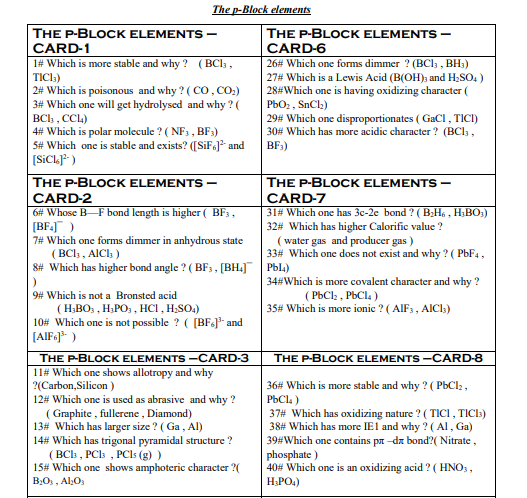
The p-Block elements - CARD-1
1. Which is more stable and why ? ( BCl3 , TlCl3) [1 Mark]
Answer: BCl3
1. BCl3 is more stable because the smaller size of boron allows effective \(p\pi - p\pi\) back bonding.
2. Thallium shows inert pair effect, making TlCl3 a strong oxidizing agent as Tl(I) is more stable than Tl(III).
Teacher's Note:
a) The stability of lower oxidation states increases down group 13 due to the inert pair effect.
b) Boron compounds readily form stable monomers by utilizing back bonding from chlorine.
2. Which is poisonous and why ? ( CO , CO2) [1 Mark]
Answer: CO
1. Carbon monoxide (CO) is poisonous because it binds strongly with hemoglobin to form carboxyhemoglobin.
2. This stable complex prevents hemoglobin from carrying oxygen to body tissues.
Teacher's Note:
a) Carbon dioxide is a normal metabolic waste product and is not toxic in moderate amounts.
b) CO has a much higher affinity for hemoglobin compared to oxygen.
3. Which one will get hydrolysed and why ? ( BCl3 , CCl4) [1 Mark]
Answer: BCl3
1. BCl3 gets hydrolysed because boron has vacant d-orbitals to accept lone pairs of electrons from water molecules.
2. CCl4 does not undergo hydrolysis due to the absence of vacant d-orbitals on the carbon atom.
Teacher's Note:
a) Hydrolysis of halides requires the central atom to coordinate with water molecules.
b) Carbon cannot expand its octet because it belongs to the second period.
4. Which is polar molecule ? ( NF3 , BF3) [1 Mark]
Answer: NF3
1. NF3 is a polar molecule with a pyramidal shape where bond dipoles and the lone pair dipole reinforce each other.
2. BF3 is symmetrical and planar, resulting in a net dipole moment of zero.
Teacher's Note:
a) Although fluorine is more electronegative than nitrogen, molecular geometry determines the net dipole moment.
b) BF3 has a regular trigonal planar structure.
5. Which one is stable and exists? ([SiF6]2- and [SiCl6]2-) [1 Mark]
Answer: [SiF6]2-
1. [SiF6]2- exists and is stable due to the small size of fluorine atoms.
2. Six large chlorine atoms cannot coordinate around a silicon atom due to severe steric crowding.
Teacher's Note:
a) Silicon can extend its coordination number to six by using vacant d-orbitals.
b) Steric hindrance prevents the formation of hexachlorosilicate ion.
The p-Block elements - CARD-2
6. Whose B - F bond length is higher ( BF3 , [BF4]¯ ) [1 Mark]
Answer: [BF4]¯
1. In BF3, partial double bond character arises due to \(p\pi - p\pi\) back bonding, shortening the bond length.
2. In [BF4]¯, boron is \(sp^3\) hybridized with only single bonds, resulting in a higher bond length.
Teacher's Note:
a) Single bonds are longer than bonds with partial double bond character.
b) Back bonding in BF3 increases bond strength and decreases bond length.
7. Which one forms dimmer in anhydrous state ( BCl3 , AlCl3 ) [1 Mark]
Answer: AlCl3
1. Aluminum trichloride exists as a dimer (Al2Cl6) to achieve an octet configuration around aluminum.
2. BCl3 does not form a dimer because boron is too small to coordinate four large chlorine atoms simultaneously.
Teacher's Note:
a) Chlorine bridges are formed through coordinate covalent bonds.
b) Monomeric AlCl3 is electron deficient.
8. Which has higher bond angle ? ( BF3 , [BH4]¯ ) [1 Mark]
Answer: BF3
1. BF3 has a trigonal planar geometry with a bond angle of 120°.
2. [BH4]¯ has a tetrahedral geometry with a bond angle of 109°28'.
Teacher's Note:
a) Planar structures have larger bond angles than tetrahedral structures.
b) Hybridization changes from \(sp^2\) in BF3 to \(sp^3\) in [BH4]¯.
9. Which is not a Bronsted acid ( H3BO3 , H3PO3 , HCl , H2SO4) [1 Mark]
Answer: H3BO3
1. Boric acid (H3BO3) acts as a Lewis acid by accepting a hydroxyl ion from water rather than donating a proton.
2. The other three substances dissociate to release hydrogen ions in aqueous solution.
Teacher's Note:
a) Bronsted acids are proton donors.
b) H3BO3 is a monobasic Lewis acid.
10. Which one is not possible ? ( [BF6]3- and [AlF6]3- ) [1 Mark]
Answer: [BF6]3-
1. [BF6]3- is not possible because boron lacks vacant d-orbitals to expand its coordination number beyond four.
2. Aluminum has vacant d-orbitals and readily forms the stable [AlF6]3- complex.
Teacher's Note:
a) Maximum covalency of boron is four.
b) Elements of the third period and beyond can extend their coordination number.
The p-Block elements - CARD-3
11. Which one shows allotropy and why ? (Carbon, Silicon ) [1 Mark]
Answer: Carbon
1. Carbon shows extensive allotropy due to its strong catenation property and multiple bonding ability.
2. Silicon has a much lower tendency for catenation and does not form stable multiple bonds easily.
Teacher's Note:
a) Allotropy is the existence of an element in two or more different physical forms.
b) Carbon exists as diamond, graphite, and fullerenes.
12. Which one is used as abrasive and why ? ( Graphite , fullerene , Diamond) [1 Mark]
Answer: Diamond
1. Diamond has a rigid three-dimensional network structure with strong covalent bonds in all directions.
2. This extreme structural rigidity makes diamond exceptionally hard and useful as an abrasive.
Teacher's Note:
a) Graphite is soft and used as a lubricant due to its layered structure.
b) Hardness in covalent crystals depends on directional bonding networks.
13. Which has larger size ? ( Ga , Al) [1 Mark]
Answer: Al
1. Gallium has a smaller atomic size than aluminum due to the poor shielding effect of intervening d-electrons.
2. This d-block contraction compensates for the addition of a new shell in gallium.
Teacher's Note:
a) Atomic radius normally increases down a group.
b) Transition contraction leads to anomalous size trends in group 13.
14. Which has trigonal pyramidal structure ? ( BCl3 , PCl3 , PCl5 (g) ) [1 Mark]
Answer: PCl3
1. PCl3 has three bond pairs and one lone pair, resulting in a trigonal pyramidal shape according to VSEPR theory.
2. BCl3 is trigonal planar and PCl5 is trigonal bipyramidal.
Teacher's Note:
a) Lone pair-bond pair repulsion distorts tetrahedral geometry into trigonal pyramidal.
b) Phosphorus undergoes \(sp^3\) hybridization in PCl3.
15. Which one shows amphoteric character ? ( B2O3 , Al2O3 ) [1 Mark]
Answer: Al2O3
1. Al2O3 reacts with both acids and bases, displaying amphoteric character.
2. B2O3 is acidic in nature and reacts only with bases.
Teacher's Note:
a) Amphoteric oxides dissolve in both acidic and alkaline media.
b) Metallic character increases down group 13, changing oxide nature from acidic to amphoteric.
The p-Block elements - CARD-4
16. Which has Polymeric structure is solid state ? ( B(OH)3 and H2SO4 ) [1 Mark]
Answer: B(OH)3
1. Solid boric acid consists of a two-dimensional sheet structure held together by hydrogen bonds.
2. This extensive hydrogen bonding gives it a layered polymeric structure in the solid state.
Teacher's Note:
a) Molecules are linked via intermolecular hydrogen bonds.
b) Sulfuric acid exists as discrete molecular units linked differently.
17. Which has network structure ? ( CO2 , SiO2 ) [1 Mark]
Answer: SiO2
1. Silicon dioxide exists as a giant three-dimensional network solid where each silicon is tetrahedrally bonded to four oxygens.
2. Carbon dioxide consists of discrete, linear molecules held by weak intermolecular forces.
Teacher's Note:
a) Silicon forms single bonds with oxygen to create a continuous network.
b) Carbon forms stable \(p\pi - p\pi\) multiple bonds with oxygen, forming small molecules.
18. Which one will get hydrolysed and why ? ( CCl4 , SiCl4) [1 Mark]
Answer: SiCl4
1. SiCl4 undergoes rapid hydrolysis because silicon has vacant d-orbitals to coordinate water molecules.
2. CCl4 is resistant to hydrolysis due to the absence of d-orbitals on carbon and steric hindrance.
Teacher's Note:
a) Hydrolysis proceeds via nucleophilic attack of water on the central atom.
b) Carbon cannot expand its coordination number.
19. Which one is electron deficient species ? ( BCl3 , SiCl4 ) [1 Mark]
Answer: BCl3
1. BCl3 has only six electrons in the valence shell of boron, making it electron deficient.
2. SiCl4 has a complete octet of eight electrons around the central silicon atom.
Teacher's Note:
a) Electron deficient compounds readily act as Lewis acids.
b) Group 13 halides are typically Lewis acids due to incomplete octets.
20. Which one is acidic oxide ? ( CO , CO2) [1 Mark]
Answer: CO2
1. CO2 dissolves in water to form carbonic acid, showing clear acidic properties.
2. Carbon monoxide (CO) is neutral in nature.
Teacher's Note:
a) Non-metal oxides are generally acidic.
b) CO and NO are examples of neutral oxides.
The p-Block elements - CARD-6
26. Which one forms dimmer ? (BCl3 , BH3) [1 Mark]
Answer: BH3
1. BH3 exists as a dimer (B2H6, diborane) to complete the octet of boron through three-center two-electron bonds.
2. BCl3 does not form a dimer due to steric crowding and chlorine back bonding.
Teacher's Note:
a) Borane is highly unstable as a monomer.
b) Bridging hydrogen atoms stabilize the diborane structure.
27. Which is a Lewis Acid (B(OH)3 and H2SO4 ) [1 Mark]
Answer: B(OH)3
1. Boric acid accepts a hydroxyl ion from water, functioning as a Lewis acid.
2. H2SO4 acts as a Bronsted-Lowry acid by donating protons.
Teacher's Note:
a) Lewis acids are electron pair acceptors.
b) B(OH)3 does not dissociate to release protons directly.
28. Which one is having oxidizing character ( PbO2 , SnCl2) [1 Mark]
Answer: PbO2
1. PbO2 acts as a strong oxidizing agent because the +2 oxidation state of lead is more stable than +4 due to the inert pair effect.
2. SnCl2 acts as a reducing agent as tin prefers the +4 oxidation state.
Teacher's Note:
a) Higher oxidation states of heavier group elements show strong oxidizing power.
b) Inert pair effect dictates the stability of lower oxidation states.
29. Which one disproportionates ( GaCl , TlCl) [1 Mark]
Answer: GaCl
1. GaCl disproportionates into Ga and GaCl3 because the +3 oxidation state of gallium is more stable than +1.
2. TlCl does not disproportionate because Tl(I) is extremely stable due to the inert pair effect.
Teacher's Note:
a) Disproportionation involves simultaneous oxidation and reduction of an element.
b) Stability of the +1 state increases down group 13.
30. Which has more acidic character ? (BCl3 , BF3) [1 Mark]
Answer: BCl3
1. BCl3 is a stronger Lewis acid than BF3 because effective \(p\pi - p\pi\) back bonding is strongest in BF3, reducing its electron deficiency.
2. Chlorine has larger atoms with diffuse orbitals, making back bonding in BCl3 much weaker.
Teacher's Note:
a) Lewis acidity order in boron halides is \(BF_3 \lt BCl_3 \lt BBr_3 \lt BI_3\).
b) Back bonding decreases the tendency to accept electron pairs.
The p-Block elements - CARD-7
31. Which one has 3c-2e bond ? ( B2H6 , H3BO3) [1 Mark]
Answer: B2H6
1. Diborane (B2H6) contains banana bonds, which are three-center two-electron (\(3c - 2e\)) bonds.
2. H3BO3 has normal two-center two-electron covalent bonds and hydrogen bonds.
Teacher's Note:
a) Electron deficient hydrides form multi-center bonds.
b) Each bridging hydrogen shares electrons with two boron atoms.
32. Which has higher Calorific value ? ( water gas and producer gas ) [1 Mark]
Answer: water gas
1. Water gas is a mixture of carbon monoxide and hydrogen (\(CO + H_2\)), both of which are excellent combustible gases.
2. Producer gas contains non-combustible nitrogen gas (\(CO + N_2\)), which lowers its calorific value.
Teacher's Note:
a) Calorific value measures heat produced per unit mass or volume.
b) Presence of diluents like nitrogen decreases fuel efficiency.
33. Which one does not exist and why ? ( PbF4 , PbI4) [1 Mark]
Answer: PbI4
1. PbI4 does not exist because lead in the +4 state is a strong oxidizing agent and iodide is a strong reducing agent.
2. The oxidizing power of Pb(IV) readily oxidizes iodide to iodine, yielding PbI2 and \(I_2\).
Teacher's Note:
a) Redox stability limits the existence of certain high oxidation state halides.
b) Fluorine can stabilize Pb(IV) due to its high electronegativity.
34. Which is more covalent character and why ? ( PbCl2 , PbCl4 ) [1 Mark]
Answer: PbCl4
1. According to Fajans' rules, higher positive charge on the cation increases polarizing power and covalent character.
2. Pb4+ has a higher charge and smaller size than Pb2+, making PbCl4 more covalent.
Teacher's Note:
a) Higher oxidation states favor covalent bonding.
b) Cation polarization distorts the electron cloud of the anion.
35. Which is more ionic ? ( AlF3 , AlCl3) [1 Mark]
Answer: AlF3
1. Fluoride ion is much smaller and less polarizable than chloride ion.
2. Consequently, AlF3 has significantly more ionic character compared to the more covalent AlCl3.
Teacher's Note:
a) Smaller anions reduce polarization and increase ionic character.
b) Fajans' rules explain the gradation in halide bond types.
The p-Block elements - CARD-8
36. Which is more stable and why ? ( PbCl2 , PbCl4 ) [1 Mark]
Answer: PbCl2
1. PbCl2 is more stable due to the inert pair effect, which makes the +2 oxidation state of lead thermodynamically favored.
2. PbCl4 readily decomposes into PbCl2 and chlorine gas.
Teacher's Note:
a) Relativistic stabilization of s-electrons increases down group 14.
b) Lower oxidation states dominate heavier p-block elements.
37. Which has oxidizing nature ? ( TlCl , TlCl3) [1 Mark]
Answer: TlCl3
1. TlCl3 acts as an oxidizing agent because thallium prefers the lower +1 oxidation state due to the inert pair effect.
2. Reduction to TlCl releases energy and stabilizes the thallium(I) ion.
Teacher's Note:
a) Higher oxidation states of heavier elements are unstable and oxidizing.
b) Inert pair effect dictates redox behavior in group 13.
38. Which has more IE1 and why ? ( Al , Ga) [1 Mark]
Answer: Ga
1. Gallium has a higher first ionization enthalpy than aluminum due to poor shielding by intervening d-electrons.
2. This results in a higher effective nuclear charge acting on the outermost electrons in gallium.
Teacher's Note:
a) Ionization energy normally decreases down a group.
b) d-Block contraction causes anomalies in ionization energy trends.
39. Which one contains \(p\pi - d\pi\) bond ? ( Nitrate , phosphate ) [1 Mark]
Answer: phosphate
1. Phosphate ion contains phosphorus with vacant d-orbitals, allowing participation in \(p\pi - d\pi\) bonding with oxygen.
2. Nitrogen in nitrate lacks d-orbitals and forms only \(p\pi - p\pi\) bonds.
Teacher's Note:
a) Third period elements can utilize d-orbitals for multiple bonding.
b) Nitrogen is restricted to a maximum coordination number of four.
40. Which one is an oxidizing acid ? ( HNO3 , H3PO4) [1 Mark]
Answer: HNO3
1. Nitric acid (HNO3) is a powerful oxidizing agent due to the presence of nitrogen in its highest +5 oxidation state.
2. H3PO4 does not exhibit strong oxidizing properties under normal conditions.
Teacher's Note:
a) Concentrated HNO3 reacts with metals to release nitrogen oxides.
b) Oxidizing acids undergo reduction of the central atom easily.
The p-Block elements - CARD-9
41. Which has more basic character ? ( Trisilyl amine , Trimethyl amine ) [1 Mark]
Answer: Trimethyl amine
1. Trimethyl amine (\(N(CH_3)_3\)) is a strong Lewis base because its lone pair on nitrogen is readily available for donation.
2. In trisilyl amine (\(N(SiH_3)_3\)), the lone pair is donated into vacant d-orbitals of silicon via \(p\pi - d\pi\) back bonding, making it planar and weakly basic.
Teacher's Note:
a) Back bonding decreases electron availability on nitrogen.
b) Trimethyl amine has a pyramidal geometry.
42. Which has more IE1 and why ? ( In , Tl ) [1 Mark]
Answer: Tl
1. Thallium has a higher first ionization enthalpy than indium due to the poor shielding of nuclear charge by intervening f and d electrons.
2. This relativistic contraction results in a higher effective nuclear charge on the valence electrons of thallium.
Teacher's Note:
a) Lanthanide and d-block contractions disrupt periodic trends.
b) Thallium shows unusually high ionization energy compared to indium.
43. Which one is used as piezoelectric materials . ( Quartz , silical gel , Orthoboric acid ) [1 Mark]
Answer: Quartz
1. Quartz is a crystalline form of silica that exhibits piezoelectric properties, generating electric potential under mechanical stress.
2. Silica gel and orthoboric acid do not exhibit piezoelectricity.
Teacher's Note:
a) Piezoelectric materials are widely used in electronic devices and oscillators.
b) Quartz crystals have a well-defined chiral lattice structure.
44. Which acid has the ability to dissolve glass ? ( HCl , HF , Conc . HNO3 ) [1 Mark]
Answer: HF
1. Hydrofluoric acid (HF) reacts readily with silica and silicates present in glass to form soluble fluorosilicic acid.
2. Other mineral acids like HCl and HNO3 do not react with glass.
Teacher's Note:
a) HF is stored in plastic or wax-coated containers.
b) The reaction dissolves silicon dioxide to form \(H_2SiF_6\).
45. Which one is used in the manufacture of heat resistant glass ( Borax , Silicone , Zeolite ) [1 Mark]
Answer: Borax
1. Borax is fused with silica to manufacture borosilicate glass, which is known for its high resistance to thermal shock.
2. Silicones and zeolites have different industrial applications.
Teacher's Note:
a) Borosilicate glass has a very low coefficient of thermal expansion.
b) Addition of boric oxide improves durability against temperature changes.
THE p-BLOCK ELEMENTS - CARD-5
21. Which one causes global warming ? ( CO , CO2 ) [1 Mark]
Answer: CO2
Teacher's Note:
a) Carbon dioxide absorbs infrared radiation from the Earth's surface.
b) Carbon monoxide is toxic but does not directly cause global warming.
22. White fumes appear around the bottle of ----------- ( Anhydrous AlCl3 , Hydrated AlCl3 ) [1 Mark]
Answer: Anhydrous AlCl3
Teacher's Note:
a) Anhydrous aluminium chloride hydrolyses in moist air to release dense white fumes of HCl gas.
b) Hydrated aluminium chloride is stable in air.
23. The catenation property of which one has more and why ? ( Carbon , silicon ) [1 Mark]
Answer: Carbon; because of its small size and high C-C bond enthalpy.
Teacher's Note:
a) Catenation decreases down the group as atomic size increases.
b) Silicon has a lower bond enthalpy than carbon.
24. An aqueous solution of borax is ------------ ( neutral , basic , amphoteric , acidic ) [1 Mark]
Answer: basic
Teacher's Note:
a) Borax is a salt of a strong base (NaOH) and a weak acid (H3BO3).
b) Hydrolysis produces a basic solution.
25. In borax bead test the blue colour bead is formed due to formation of metaborate of which metal ? ( Co , Cu ) [1 Mark]
Answer: Co
Teacher's Note:
a) Cobalt metaborate imparts a characteristic blue colour to the bead.
b) Copper gives a green or red bead depending on the flame conditions.
THE p-BLOCK ELEMENTS - CARD-10
46. Which is aromatic ? ( Diamond , fullerene ) [1 Mark]
Answer: fullerene
Teacher's Note:
a) Fullerenes have conjugated double bonds satisfying Huckel's rule of aromaticity.
b) Diamond consists of sp3 hybridized carbon atoms in a 3D network.
47. Which is the purest form of carbon ? ( Diamond , fullerene ) [1 Mark]
Answer: fullerene
Teacher's Note:
a) Fullerenes are considered the purest allotrope of carbon as they have smooth structures without dangling bonds.
b) Diamond contains surface impurities.
48. Which one is used as a refrigerant for ice-cream and frozen food ? ( Solid CO2 , Solid CO ) [1 Mark]
Answer: Solid CO2
Teacher's Note:
a) Solid carbon dioxide is also known as dry ice.
b) It sublimes directly to gas without leaving any liquid residue.
49. Which one does not form passive oxide layer ? ( Be , Al , K ) [1 Mark]
Answer: K
Teacher's Note:
a) Potassium is an alkali metal that reacts vigorously and does not form a protective oxide layer.
b) Both Be and Al form protective oxide layers on their surfaces.
50. Which has more I.E ( Sn , Pb ) [1 Mark]
Answer: Pb
Teacher's Note:
a) Due to poor shielding of nuclear charge by intervening d and f electrons in lead (lanthanide contraction effect), ionization enthalpy increases unexpectedly at Pb.
b) Down the group, IE generally decreases.
51. Fullerene contains ------------------- six-membered rings and --------------------- five-membered rings [1 Mark]
Answer: 20, 12
Teacher's Note:
a) Buckminsterfullerene (C60) has a football-like structure.
b) It contains 20 hexagons and 12 pentagons.
52. The basic structural unit of silicate is ----------------------- [1 Mark]
Answer: [SiO4]4-
Teacher's Note:
a) It has a tetrahedral geometry.
b) Silicon is at the center bonded to four oxygen atoms.
53. The formula of Inorganic Benzene is ------------------------- [1 Mark]
Answer: B3N3H6
Teacher's Note:
a) Its chemical name is borazine.
b) It is isoelectronic and structurally similar to benzene.
54. The elements of Gr-14 used in semiconductor are-------------------- and --------------------------- [1 Mark]
Answer: Silicon, Germanium
Teacher's Note:
a) Both are metalloids.
b) They possess moderate electrical conductivity.
55. The Shape of H3BO3 is ----------- and H3PO3 is ------------- [1 Mark]
Answer: planar, pyramidal
Teacher's Note:
a) Boric acid has a layered planar structure held by hydrogen bonding.
b) Phosphorous acid has a tetrahedral/pyramidal geometry around the central phosphorus atom.
56. Boron is unable to form [BF6]3- because ----------------------- [1 Mark]
Answer: absence of vacant d-orbitals
Teacher's Note:
a) Boron has a maximum covalency of 4 due to lack of d-orbitals.
b) It cannot expand its octet.
57. --------------- and -------------------- are used as reducing agent [1 Mark]
Answer: CO, Carbon (or SnCl2, etc.)
Teacher's Note:
a) Carbon monoxide reduces metal oxides to metals in metallurgy.
b) Carbon is commonly used in blast furnaces.
58. Graphite conducts electricity because --------------------------------- [1 Mark]
Answer: presence of free electrons
Teacher's Note:
a) Each carbon atom in graphite is sp2 hybridized.
b) The fourth valence electron is free to move in the layers.
59. Graphite is used as lubricants because ------------------------------- [1 Mark]
Answer: layered structure held by weak van der Waals forces
Teacher's Note:
a) The layers can easily slide over one another.
b) This imparts softness and lubricating properties.
60. ---------------------- is biocompatible and used in surgical and cosmetic implants [1 Mark]
Answer: Carbon (or vitreous carbon)
Teacher's Note:
Teacher's Note:
a) Vitreous carbon is non-toxic and inert.
b) It is widely accepted by human body tissues.
THE p-BLOCK ELEMENTS - CARD-13
61. --------------- is used to convert alcohols directly into gasoline [1 Mark]
Answer: ZSM-5 (zeolite)
Teacher's Note:
a) Shape-selective catalysis is exhibited by zeolites.
b) ZSM-5 dehydrates alcohols to form a mixture of hydrocarbons.
62. Hydrated zeolites are used as ----------------------------------------- [1 Mark]
Answer: water softeners
Teacher's Note:
a) They exchange sodium ions with calcium and magnesium ions in hard water.
b) This process is called ion exchange.
63. The type of hybridization of boron in diborane is ------------------- [1 Mark]
Answer: sp3
Teacher's Note:
a) Each boron atom forms four hybrid orbitals.
b) Boron achieves tetrahedral spatial arrangement in the bridge units.
64. Thermodynamically the most stable form of carbon is -------- [1 Mark]
Answer: graphite
Teacher's Note:
a) Standard enthalpy of formation of graphite is taken as zero.
b) It is more stable than diamond under standard conditions.
65. It is the property of an element which exists in different form through their different structural arrangement . This phenomenon is known as ------------- [1 Mark]
Answer: allotropy
Teacher's Note:
a) Allotropes have the same chemical properties but different physical properties.
b) Carbon exhibits extensive allotropy.
THE p-BLOCK ELEMENTS - CARD-14
66. The state of hybridization of carbon in (a) Carbonate is ------------- ( b) diamond is ------------- (c) graphite is ------------- (d) fullerene is ------------- [1 Mark]
Answer: (a) sp2 (b) sp3 (c) sp2 (d) sp2
Teacher's Note:
a) Carbonate ion has three sigma bonds around carbon giving sp2 hybridization.
b) Diamond has four single bonds (sp3), while graphite and fullerenes have three sigma bonds per carbon (sp2).
67. Boric acid is polymeric due to -------------------------------------- [1 Mark]
Answer: hydrogen bonding
Teacher's Note:
a) Molecules of boric acid are linked together by hydrogen bonds.
b) This creates a two-dimensional sheet structure.
68. The hybridized state of ------------- is ----------- [1 Mark]
Answer: Boron in BF3 is sp2 (or equivalent standard molecule)
Teacher's Note:
a) Trigonal planar molecules involve sp2 hybridization.
b) Bond angle is 120°.
69. In Diborane --------------- 2c-2e bonds and ---------- 3c-2e bonds are present [1 Mark]
Answer: 4, 2
Teacher's Note:
a) Four terminal B-H bonds are normal 2-center 2-electron bonds.
b) Two bridging B-H-B bonds are 3-center 2-electron (banana) bonds.
70. SiCl4 is hydrolyzed due to presence of -------------------------- [1 Mark]
Answer: vacant d-orbitals on silicon
Teacher's Note:
a) Water molecules coordinate to the vacant d-orbitals of silicon.
b) This initiates rapid hydrolysis to form silicic acid and HCl.
THE P-BLOCK ELEMENTS - CARD-15
71. Write balanced equations for: [5 Marks]
(i) BF3 + LiH
(ii) B2H6 + H2O
(iii) NaH + B2H6
(iv) H3BO3 + Heat
(v) Al + NaOH
Answer:
1. (i) 2BF3 + 6LiH → B2H6 + 6LiF
2. (ii) B2H6 + 6H2O → 2H3BO3 + 3H2
3. (iii) 2NaH + B2H6 → 2NaBH4
4. (iv) H3BO3 \(\xrightarrow{\Delta}\) HBO2 \(\xrightarrow{\Delta}\) B2O3 (or complete decomposition to B2O3 + 3H2O)
5. (v) 2Al + 2NaOH + 2H2O → 2NaAlO2 + 3H2 (or Na[Al(OH)4] + 3H2)
Teacher's Note:
a) These reactions involve preparation and chemical properties of boron hydrides, boric acid, and aluminium.
b) Ensure all stoichiometry coefficients are properly balanced.
c) Reaction (iii) shows the formation of metal tetrahydroborate.
d) Reaction (v) demonstrates the amphoteric nature of aluminium reacting with strong bases.
THE P-BLOCK ELEMENTS - CARD-16
72. Write balanced equations for: [5 Marks]
(vi) B2H6 + NH3
(vii) CH3Cl + Si + Cu powder at 570K → A
A + H2O → B
(viii) NaBH4 + I2 →
(ix) BCl3 + H2O →
(x) SiCl4 + H2O →
Answer:
1. (vi) B2H6 + 2NH3 → [BH2(NH3)2]+[BH4]- \(\xrightarrow{\text{heat}}\) B3N3H6 (Inorganic benzene) + 6H2
2. (vii) CH3Cl + Si \(\xrightarrow{\text{Cu, 570K}}\) (CH3)2SiCl2 (A); (CH3)2SiCl2 + 2H2O → (CH3)2Si(OH)2 + 2HCl (B)
3. (viii) 2NaBH4 + I2 → B2H6 + 2NaI + H2
4. (ix) BCl3 + 3H2O → H3BO3 + 3HCl
5. (x) SiCl4 + 4H2O → H4SiO4 (or Si(OH)4) + 4HCl
Teacher's Note:
a) Reaction (vi) forms borazine at elevated temperatures.
b) Reactions (vii) describe the direct synthesis and hydrolysis steps for silicone polymers.
c) Halide hydrolysis reactions (ix) and (x) yield boric acid and silicic acid respectively.
d) Check reaction conditions and balance oxidation states carefully.
THE P-BLOCK ELEMENTS - CARD-17
73. What happens when (Also Explain the following reactions) [5 Marks]
(a) Borax is heated strongly
(b) Boric acid is added to water,
(c) Aluminium is treated with dilute NaOH,
(d) BF3 is reacted with ammonia ?
(e) Boric acid is heated .
Answer:
1. (a) Borax swells up first due to loss of water of crystallization, then melts to form a transparent liquid bead consisting of sodium metaborate and boric anhydride: Na2B4O7·10H2O \(\xrightarrow{\Delta}\) Na2B4O7 \(\xrightarrow{\Delta}\) 2NaBO2 + B2O3.
2. (b) Boric acid behaves as a weak Lewis acid by accepting a hydroxyl ion from water rather than acting as a proton donor: H3BO3 + 2H2O ⇌ [B(OH)4]- + H3O+.
3. (c) Aluminium dissolves in dilute sodium hydroxide evolving hydrogen gas and forming sodium tetrahydroxoaluminate(III): 2Al + 2NaOH + 6H2O → 2Na[Al(OH)4] + 3H2.
4. (d) Boron trifluoride reacts with ammonia to form an adduct as BF3 acts as an electron-pair acceptor (Lewis acid) and NH3 as an electron-pair donor: F3B + :NH3 → F3B←NH3.
5. (e) Boric acid on heating gives metaboric acid at 373K, boric oxide at higher temperatures: H3BO3 \(\xrightarrow{\Delta}\) HBO2 + H2O, and further heating gives B2O3.
Teacher's Note:
a) Each sub-part requires the balanced chemical equation along with a brief explanation.
b) Focus on Lewis acid character of boron compounds.
c) Borax bead test relies on formation of colored metaborates with transition metal ions.
d) Ensure state symbols and reaction conditions are mentioned.
THE P-BLOCK ELEMENTS - CARD-18
74. What happens when (Also Explain the following reactions) [5 Marks]
(a) CO is heated with ZnO;
(b) Hydrated alumina is treated with aqueous NaOH solution.
(c) Methyl chloride reacts with silicon in the presence of copper as a catalyst at a temperature 573K.
(d) Dimethyl chlorosilane is hydrolysed and followed by condensation polymerization .
(e) Silicon dioxide is treated with (i) Sodium hydroxide (ii) hydrogen fluoride
Answer:
1. (a) Carbon monoxide reduces zinc oxide to zinc metal upon heating: ZnO + CO \(\xrightarrow{\Delta}\) Zn + CO2.
2. (b) Hydrated alumina dissolves in aqueous NaOH solution to form soluble sodium meta-aluminate: Al2O3·xH2O + 2NaOH → 2NaAlO2 + (x + 1)H2O.
3. (c) Methyl chloride reacts with silicon at 573K in the presence of copper catalyst to form dimethyldichlorosilane: 2CH3Cl + Si \(\xrightarrow{\text{Cu, 573K}}\) (CH3)2SiCl2.
4. (d) Hydrolysis of dimethyldichlorosilane yields dimethyldisilanol, which undergoes condensation polymerization to form straight chain silicones: n(CH3)2Si(OH)2 → - [ - O - Si(CH3)2 - ]n - + nH2O.
5. (e) (i) Silicon dioxide reacts with sodium hydroxide to form sodium silicate and water: SiO2 + 2NaOH → Na2SiO3 + H2O; (ii) Silicon dioxide reacts with hydrogen fluoride to form silicon tetrafluoride and water: SiO2 + 4HF → SiF4 + 2H2O.
Teacher's Note:
a) Emphasize the reducing nature of CO in metallurgy.
b) Highlight the amphoteric nature of aluminium oxide.
c) Silicone polymerization steps are important for organosilicon chemistry.
d) Silica reacts with HF to form volatile SiF4, which is used in glass etching.
THE P-BLOCK ELEMENTS - CARD-19
75. What happens when (Also Explain the following reactions) [6 Marks]
(a) Formic acid and sucrose are treated with conc.H2SO4 individually at 373K.
(b) (i) SiCl4 is hydrolysed . (ii) BCl3 is hydrolysed
(c) Steam is passed through the tin.
(d) Aqueous solution of borax is acidified .
(e) Boron trifluoride is treated with lithium aluminium hydride in presence of diethyl ether.
(f) Sodium hydride is treated with diborane .
Answer:
1. (a) Formic acid is dehydrated to carbon monoxide: HCOOH \(\xrightarrow{\text{conc. H}_2\text{SO}_4}\) CO + H2O; Sucrose is charred to carbon: C12H22O11 \(\xrightarrow{\text{conc. H}_2\text{SO}_4}\) 12C + 11H2O.
2. (b) (i) Silicon tetrachloride undergoes hydrolysis to form silicic acid and HCl: SiCl4 + 4H2O → H4SiO4 + 4HCl; (ii) Boron trichloride undergoes hydrolysis to form boric acid and HCl: BCl3 + 3H2O → H3BO3 + 3HCl.
3. (c) Steam passed through red-hot tin produces tin(IV) oxide and hydrogen gas: Sn + 2H2O(g) \(\xrightarrow{\Delta}\) SnO2 + 2H2.
4. (d) Aqueous solution of borax on acidification gives orthoboric acid: Na2B4O7 + 2HCl + 5H2O → 4H3BO3 + 2NaCl.
5. (e) Boron trifluoride reacts with lithium aluminium hydride to form diborane: 4BF3 + 3LiAlH4 \(\xrightarrow{\text{ether}}\) 2B2H6 + 3LiF + 3AlF3.
6. (f) Sodium hydride reacts with diborane to form sodium tetrahydroborate: 2NaH + B2H6 → 2NaBH4.
Teacher's Note:
a) Concentrated sulfuric acid acts as a powerful dehydrating agent in part (a).
b) Hydrolysis mechanisms differ slightly based on vacant d-orbitals availability in Si vs B.
c) Diborane preparation methods are frequently asked in board exams.
d) Ensure all individual sub-reactions are balanced correctly.
THE P-BLOCK ELEMENTS - CARD-20
76. What do you understand by [6 Marks]
(a) inert pair effect
(b) allotropy and
(c) catenation
(d) Anomalous properties
(e) Multiple bond formation ability
(f) electron deficient molecules
Answer:
1. (a) Inert pair effect: The reluctance of s-electrons of the valence shell to participate in bonding due to poor shielding by intervening d and f electrons, becoming more prominent down the heavier groups (e.g., in groups 13 to 15).
2. (b) Alllotropy: The existence of an element in two or more different physical forms in the same physical state, possessing different physical properties but similar chemical properties (e.g., diamond and graphite in carbon).
3. (c) Catenation: The self-linking property of atoms of an element to form long chains, branched chains, or rings through covalent bonds, most prominently exhibited by carbon.
4. (d) Anomalous properties: The distinct, exceptional behavior of the first element of a group (like lithium, boron, carbon, nitrogen) compared to the rest of the group members, caused by small size, high electronegativity, high ionization enthalpy, and absence of vacant d-orbitals.
5. (e) Multiple bond formation ability: The capacity of smaller p-block elements to form multiple pi-pi bonds (such as C=C, C≡C, C=O, N≡N) with themselves and other elements, aided by small size and effective lateral overlap of p-orbitals.
6. (f) Electron deficient molecules: Molecules in which the central atom possesses fewer than eight electrons in its valence shell and thus has an incomplete octet (e.g., BF3, BCl3, AlCl3).
Teacher's Note:
a) These definitions form the theoretical foundation of p-block periodicity and bonding characteristics.
b) Give clear examples for each term to score full marks in descriptive questions.
c) Note that inert pair effect explains the stability of lower oxidation states in heavier p-block elements.
d) Electron deficient species often act as Lewis acids by accepting electron pairs.
Please click the link below to download pdf file of CBSE Class 11 Chemistry p block elements Flash Cards.
Free study material for Chemistry
Free CBSE Study Guides: Class 11 Chemistry Chapter 11 The p Block Elements
Quick Revision Material for Chapter 11 The p Block Elements
Review targeted study resources for Chapter 11 The p Block Elements tailored for Class 11 learners. Utilizing these structured notes and quick-revision tools ensures complete alignment with current CBSE evaluation standards.
Expert Notes and Solved Exam Questions
Each resource draws directly from authorized textbooks to maintain academic accuracy. Evaluating solved examples allows Class 11 students to master the formal presentation and answer-writing standards expected in upcoming school exams.
Additional Study Resources for Class 11
Maximize your grade potential by utilizing Class 11 Chemistry practice papers in tandem with these structured notes. All printable assignments and interactive mock tests on our platform are updated for the 2026 session and available free of charge.
FAQs
Our advanced study package for Chapter 11 The p Block Elements includes detailed concepts, diagrams, Mind Maps, and explanation of complex topics to ensure Class 11 students learn as per syllabus for 2026 exams.
The Mind Maps provided for Chapter 11 The p Block Elements act as visual anchors which will help faster recall during high-pressure exams.
Yes, teachers use our Class 11 Chemistry resources for lesson planning as they are in simple language and have lot of solved examples.
Yes, You can download the complete, mobile-friendly PDF of the Chemistry Chapter 11 The p Block Elements advanced resources for free.
Yes, our subject matter experts have updated the Chapter 11 The p Block Elements material to align with the rationalized NCERT textbooks and have removed deleted topics and added new competency-based questions.