

Advanced Study Material for Class 11 Chemistry: Chapter 02 Structure of Atom
Access comprehensive study materials and useful resources for Chapter 02 Structure of Atom using the CBSE Class 11 Chemistry Atomic Structure Flash Cards. Designed to align with the 2026-27 CBSE academic guidelines, these advanced resources help Class 11 Chemistry students reinforce core concepts beyond standard textbooks.
Practice Class 11 Chemistry Resources: Chapter 02 Structure of Atom
Access the complete useful resource PDF for Class 11 Chemistry below. Regular practice with these targeted academic notes builds familiarity with complex topics and helps secure higher marks in final school evaluations.
Question. If the atom 100Fm257 follows the Bohr model and the radius of 100Fm257 is n times the Bohr radius, then find n:
a. 100
b. 200
c. 4
d. 1/4
Answer : D
Question. An energy of 24.6 eV is required to remove one of the electrons from a neutral helium atom. The energy (in eV) required to remove both the electrons from a neutral helium atom is:
a. 79.0
b. 51.8
c. 49.2
d. 38.2
Answer : A
Question. Which one of the following is/are true for the cathode rays?
a. they have kinetic energy
b. they cause certain substances to fluoresce
c. they travel in straight line
d. they are electromagnetic waves
Answer : A, B, C
Question. The specific charge of the cathode rays is:
a. a universal constant
b. independent of the place of earth
c. independent of the nature of gas in discharge tube
d. independent of the material of discharge tube
Answer : ALL
Question. In Thomson’s experiment, if the velocity of electron is greater than E/B, then:
a. the electron will not reach the underflected spot
b. the electron will move to a spot below the underflected spot
c. the electron will move to a spot above the underflected spot
d. the electron will move to the underflected spot
Answer : A, B
Question. Which of the following statements are true for the cathode rays?
a. They travel along straight line
b. They emit X-rays when strike a metal
c. They are electromagnetic waves
d. They are not deflected by magnetic field
Answer : A, B
Question. The potential difference applied to an X-ray tube is increased. As a result, in the emitted radiation:
a. the intensity increases
b. the minimum wave length increases
c. the intensity remains unchanged
d. the minimum wave length decreases
Answer : C, D
Question. The shortest wave length produced in an X-ray tube operated at 0.5 million volt is:
a. dependent on the target material
b. 0.025 Å approximately
c. half of the shortest wave length produced which the tube operating at 1 million volts
d. dependent only on the target material and not on the operating voltage
Answer : B, C
Question. When α– particle are sent through a thin metal foil, most of them go straight through the foil because:
a. α– particles are much heavier than electrons
b. α– particles are positively charged
c. most part of the atom is empty space
d. α– particles move with high velocity
Answer : A, C
Question. Which of the following statements about X-rays is/are an accepted fact(s)?
a. They are generated when fast moving electrons strike a metal target
b. They can penetrate through a thin sheet of Al.
c. When they traverse a space across which there is a magnetic field and electric field perpendicular to one another, they are undeviated
d. When they traverse a space across which there is a magnetic field and electric field parallel to one another they describe a circular path
Answer : A, B, C
Question. Which of the following statement (s) is / are correct?
a. An atom with a vacancy has smaller energy than a neutral atom
b. K X-ray is emitted when a hole makes a jump from the K shell to some other shell
c. The wavelength of K X-ray is smaller than the wavelength of L X-ray of the same material
d. The wavelength of Kα X-ray is smaller than the wavelength of Kβ X-ray of the same material
Answer : B, C
Question. An X-ray is operating at 50 kV and 20 mA. The target material of the tube has a mass of 1.0 kg and specific heat 495J kg–1ºC–1. One percent of the supplied electric power is converted into X-ray and entire remaining energy goes into heating the target. Then,
a. the average rate of rise of temperature of the target would be 2ºC/s
b. the minimum wavelength of the X-rays emitted is about 0.25×10⁻¹⁸m
c. a suitable target material must have a high melting temperature
d. a suitable target material must have low thermal conductivity
Answer : A, B
Question. When an electron strikes the target in a Coolidge tube, its entire kinetic energy:
a. is converted into a photon
b. may be converted into a photon
c. is converted into heat
d. may be converted into heat
Answer : B, D
Question. For harder X-rays:
a. the wavelength is higher
b. the intensity is higher
c. the frequency is higher
d. the photon energy is higher
Answer : C, D
Question. In Bohr model of hydrogen atom:
a. the radius of nth orbit is proportional to n²
b. the total energy of electron in nth orbit is proportional to n
c. the angular momentum of the electron in an orbit is an integral multiple of h/2π
d. the magnitude of the potential energy of an electron in any orbit is greater than its kinetic energy
Answer : A, B, C
Question. For which of the following sets of four quantum numbers, an electron will have the highest energy?
n l m s
a. 3 2 1 +1/2
b. 4 2 1 +1/2
c. 4 1 0 –1/2
d. 5 0 0 –1/2
Answer : B
Question. What is the maximum number of electrons which can be accommodated in an atom in which the highest principal quantum number value is 4?
a. 10
b. 18
c. 32
d. 54
Answer : C
Question. The four quantum numbers of the valence electron of potassium are:
a. 4, 1, 0 and 1/2
b. 4, 0, 1 and 1/2
c. 4, 0, 0 and + 1/2
d. 4, 1, 1 and 1/2
Answer : C
Question. Orbital angular momentum for a d-electron is:
a. 6h/2π
b. √6h/2π
c. 12h/2π
d. √12h/2π
Answer : B
Question. The maximum number of electrons present in an orbit l = 3 , is:
a. 6
b. 8
c. 10
d. 14
Answer : D
Question. When photons of energy 4.25 eV strike the surface of a metal A, the ejected photo electrons have maximum kinetic energy TA (expressed in eV) and de Broglie wavelength λA .The maximum kinetic energy of the photo electrons liberated from another metal ‘B’ by photons of energy 4.20 eV is TB =TA – 1.5 (expressed in eV). If the de Broglie wavelength of these photo electrons is λB = 2λA , then
a. work function of A is 2.25 eV
b. work function of B is 4.20 eV
c. A T = 2 eV
d. B T = 2.50 eV
Answer : A, C
Question. Which of the following pairs have identical values of magnetic moment?
a. Zn2+ , Cu+
b. Co2+ , Ni2+
c. Mn2+ , Co2+
d. Mg4+ , Sc+
Answer : A, C
Question. If there were three possible values ( - 1/2, 0, + 1/2) for the spin magnetic quantum number s (m ), which of the following statement (s) is/are correct regarding a hypothetical Periodic
Table based on this conditions?
a. The first period would have only 2 vertical columns
b. The second period would have 12 elements
c. The Periodic Table would contain 27 group
d. The third period would have 12 elements
Answer : A, C, D
Question. Choose the correct statement among the following
a. Radial distribution function 2 2 (ψ 4π r ) gives the probability at a particular distance along one chosen direction:
b. ‘xz’ plane acts as a nodal plane for x 3p orbital
c. For ‘s’ orbital’s wave function is independent of θ and φ
d. ‘2p’ orbital with quantum number n = 2, l =1, m = 0, also shows the angular dependence.
Answer : C, D
Question. Choose the correct statement(s) regarding the photoelectric effect:
a. No electrons are ejected, regardless of the intensity of the radiation, unless the frequency equals or exceeds a threshold value characteristic of the metal
b. The kinetic energy of the ejected electrons varies linearly with the frequency of the incident radiation and its intensity
c. Even at low intensities, electrons are ejected immediately if the frequency is above the threshold value
d. An intense and a weak beam of monochromatic radiations differ in having number of photons and not in the energy of photons
Answer : A, C, D
Question. Mark out the correct statement (s)
a. Electrons within a subshell for which l > 0 mean that the relatively greater electrostatics repulsion between two electrons in the same orbital within a sub shell as compared with occupancy of two orbitals having different m1 values
b. Electrons in singly occupied orbitals tend to have their spins in the same direction so as to maximize the net magnetic moment
c. In the ground state, an atom adopts a configuration with the greatest number of unpaired electrons
d. Electrons in different orbitals with parallel spins show mutual attraction, so the electron-nucleus interaction is improved
Answer : A, B, C
Question. Which one of the following is/are true for the cathode rays?
a. they have kinetic energy
b. they cause certain substances to fluoresce
c. they travel in straight line
d. they are electromagnetic waves
Answer : A, B, C
Question. The specific charge of the cathode rays is:
a. a universal constant
b. independent of the place of earth
c. independent of the nature of gas in discharge tube
d. independent of the material of discharge tube
Answer : ALL
Question. The potential difference applied to an X-ray tube is increased.
As a result, in the emitted radiation:
a. the intensity increases
b. the minimum wave length increases
c. the intensity remains unchanged
d. the minimum wave length decreases
Answer : C, D
Question. In Bohr model of hydrogen atom:
a. the radius of nth orbit is proportional to n²
b. the total energy of electron in nth orbit is proportional to n
c. the angular momentum of the electron in an orbit is an integral multiple of h / 2π
d. the magnitude of the potential energy of an electron in any orbit is greater than its kinetic energy
Answer : A, C, D
Question. Which of the following are in the ascending order of wavelength?
a. Hα ,Hβ ,Hγ ... lines in Balmer series of hydrogen atom
b. Lyman limit, Balmer limit, Paschen limit in the hydrogen spectrum
c. Violet, blue, yellow, red colours in solar spectrum
d. None of these
Answer : B, C
Question. Continuous spectrum is produced by:
a. Incandescent electric bulb
b. sun
c. Hydrogen molecules
d. Na-vapour lamp
Answer : A, B
Question. A gas of monoatomic hydrogen is bombarded with a stream of electrons that have been accelerated from rest through a potential difference of 12.75 volt. In emission spectrum one can observe lines of:
a. Lyman series
b. Balmer series
c. Paschen series
d. Pfund series
Answer : A, B, C
Question. If the potential energy of the electron in the first allowed orbit in hydrogen atom is E, its:
a. Ionisation potential is –E/2
b. Kinetic energy is –E/2
c. Total energy is E/2
d. None of these true
Answer : A, B, C
Question. According to Bohr’s theory of the hydrogen atom, for the electron in the nth allowed orbit, the:
a. Linear momentum is proportional to (1/n)
b. the radius is proportional to n
c. The kinetic energy is proportional to (1/n2)
d. The angular momentum is proportional to n
Answer : A, C, D
Question. In an atom, the two electrons move round the nucleus in circular orbits of radii R and 4R. The ratio of the time taken by them to complete one revolution is:
a. 1/4
b. 4/1
c. 8/1
d. 1/8
Answer : D
Question. An energy of 24.6 eV is required to remove one of the electrons from a neutral helium atom. The energy (in eV) required to remove both the electrons from a neutral helium atom is:
a. 79.0
b. 51.8
c. 49.2
d. 38.2
Answer : A
Assertion and Reason
Note: Read the Assertion (A) and Reason (R) carefully to mark the correct option out of the options given below:
a. If both assertion and reason are true and the reason is the correct explanation of the assertion.
b. If both assertion and reason are true but reason is not the correct explanation of the assertion.
c. If assertion is true but reason is false.
d. If the assertion and reason both are false.
e. If assertion is false but reason is true.
Question. Assertion: The cation energy of an electron is largely determined by its principal quantum number.
Reason: The principal quantum number n is a measure of the most probable distance of finding the electron around the nucleus.
Answer : A
Question. Assertion: Nuclide 30Al13 is less stable than 40Ca20 Reason: Nuclides having odd number of protons and neutrons are generally unstable
Answer : A
Question. Assertion: The atoms of different elements having same mass number but different atomic number are known as isobars
Reason: The sum of protons and neutrons, in the isobars is always different
Answer : C
Question. Assertion: Two electrons in an atom can have the same values of four quantum numbers.
Reason: Two electrons in an atom can be present in the same shell, sub-shell and orbital and have the same spin
Answer : D
Question. Assertion: The value of n for a line in Balmer series of hydrogen spectrum having the highest wave length is 4 and 6.
Reason: For Balmer series of hydrogen spectrum, the value n1 = 2 and n2 = 3, 4,5.
Answer : C
Question. Assertion: Absorption spectrum conists of some bright lines separated by dark spaces.
Reason: Emission spectrum consists of dark lines.
Answer : D
Question. Assertion: A resonance hybrid is always more stable than any of its canonical structures.
Reason: This stability is due to delocalization of electrons.
Answer : A
Question. Assertion: Cathode rays do not travel in straight lines.
Reason: Cathode rays penetrate through thick sheets
Answer : C
Question. Assertion: Electrons revolving around the nucleus do not fall into the nucleus because of centrifugal force.
Reason: Revolving electrons are planetary electrons.
Answer : B
Question. Assertion: The transition of electrons n3 → n2 in H atom will emit greater energy than n4 → n3 .
Reason: n3 and n2 are closer to nucleus tan n4 .
Answer : B
Comprehension Based
Paragraph –I
The letters n, l, m proposed by Bohr, Sommerfeld and Zeeman respectively for quantization of angular momentum in classical physics were later on obtained as the results of solution of Schrodinger wave equation based on quantum mechanics. The term n, l, m were named as principal quantum number, azimuthal quantum number and magnetic quantum number respectively. The fourth quantum number s was given the name spin quantum number on the basis of two spins of electrons.
The first two quantum numbers also decides the nodes of an orbital.
Question. The numerical value 4,3, 0 ψ denotes:
a. 3d-orbitals
b. 4f-orbitals
c. 2s-orbitals
d. 4d-orbitals
Answer : B
Question. The angular momentum of 3p-orbitals in terms of h(h = h/2π) is:
a. √2ℏ
b. 2ℏ
c. ℏ/√2
d. ℏ/2π
Answer : A
Question. Number of radial and angular nodes in 3p-orbitals respectively are:
a. 1, 1
b. 2, 1
c. 1, 2
d. 2, 2
Answer : A
Question. Which statement about energy level in H-atom is correct?
a. Only n and l decide energy level
b. Only ‘l’ decides energy level
c. Only n decides energy level
d. n, l and m decide energy level
Answer : C
Question. The quantum numbers of +½ and –½ for the electron spin represents:
a. rotation of electron in clockwise and anticlockwise direction respectively
b. rotation of electron in anticlockwise and clockwise direction respectively
c. two quantum mechanical states having classical analogue
d. two quantum mechanical states having no classical analogue
Answer : D
Paragraph –II
The hydrogen-like species Li2+ is in a spherically symmetric state S1 with one radial node. Upon absorbing light the ion undergoes transition to a state S2 . The state S2 has one radial node and its energy is equal to the ground state energy of the hydrogen atom.
Question. The state S1 is:
a. 1s
b. 2s
c. 2p
d. 3s
Answer : B
Question. Energy of the state S1 in units of the hydrogen atom ground state energy is:
a. 0.75
b. 1.50
c. 2.25
d. 4.50
Answer : C
Question. The orbital angular momentum quantum number of the state S2 is:
a. 0
b. 1
c. 2
d. 3
Answer : B
Integer
Question. The angular momentum of electron in 2nd orbit of hydrogen atom is L. The angular momentum of electron in 4th orbit of hydrogen atom is n L where n =?
Answer : 2
Question. For an atom of an ion having single electron, the wavelength observed λ1 = 2 are units and λ3 = 2 units figure. The value of missing wavelength λ2 is
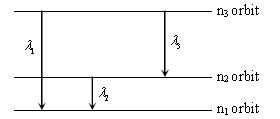
Answer : 6
Question. How many different wave-length may be observed in the spectrum from a hydrogen sample if the atoms are excited to 3rd excited state?
Answer : 6
Question. The maximum number of electrons can have principal quantum number n=3 and spin quantum number s m = 1/ 2 is
Answer : 9
Question. The work function (φ ) of some metals is listed below. The number of metals which will show photoelectric effect when light of 300 nm wavelength falls on the metal is
Metal Li Na K Mg Cu Ag Fe Pt W
φ (eV) 2.4 2.3 2.2 3.7 4.8 4.3 4.7 6.3 4.75
Answer : 4
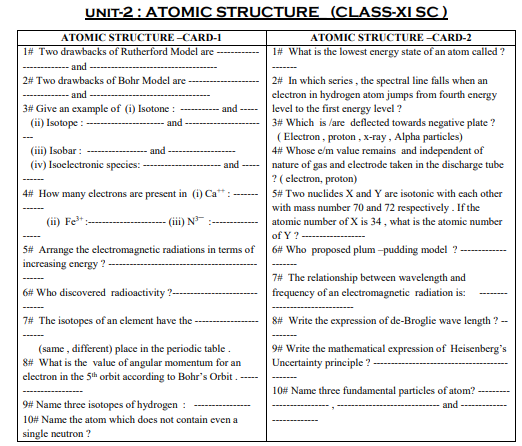
Please click the link below to download pdf file of CBSE Class 11 Chemistry Atomic Structure Flash Cards.
Free study material for Chemistry
Chemistry Class 11 Exam Resources: Chapter 02 Structure of Atom
Quick Revision Material for Chapter 02 Structure of Atom
Review targeted study resources for Chapter 02 Structure of Atom tailored for Class 11 learners. Utilizing these structured notes and quick-revision tools ensures complete alignment with current CBSE evaluation standards.
Expert Notes and Solved Exam Questions
Each resource draws directly from authorized textbooks to maintain academic accuracy. Evaluating solved examples allows Class 11 students to master the formal presentation and answer-writing standards expected in upcoming school exams.
Additional Study Resources for Class 11
Wrap up your chapter revision by testing your knowledge against standard objective question formats. Explore our full library of free, up-to-date sample papers and online assessments to secure top grades in your CBSE examinations.
FAQs
Our advanced study package for Chapter 02 Structure of Atom includes detailed concepts, diagrams, Mind Maps, and explanation of complex topics to ensure Class 11 students learn as per syllabus for 2026 exams.
The Mind Maps provided for Chapter 02 Structure of Atom act as visual anchors which will help faster recall during high-pressure exams.
Yes, teachers use our Class 11 Chemistry resources for lesson planning as they are in simple language and have lot of solved examples.
Yes, You can download the complete, mobile-friendly PDF of the Chemistry Chapter 02 Structure of Atom advanced resources for free.
Yes, our subject matter experts have updated the Chapter 02 Structure of Atom material to align with the rationalized NCERT textbooks and have removed deleted topics and added new competency-based questions.