

Download CBSE Class 11 Chemistry Useful Resources
Review targeted academic resources with the Class 11 Chemistry Equilibrium Exam Questions. Built according to official CBSE standards for the 2026-27 term, these downloadable Class 11 Chemistry study materials support effective daily practice and deeper conceptual understanding for Chapter 06 Equilibrium.
Access CBSE Study Guides and Summaries
View or download the dedicated Class 11 Chemistry Equilibrium Exam Questions resource below. Engaging with these advanced study guides under focused conditions ensures continuous academic progress and mastery of the 2026-27 curriculum for Chapter 06 Equilibrium.
LEVEL – I
1. Mention the factors that affect equilibrium constant.
Ans: Temperature, pressure, catalyst and molar concentration of reactants and products.
2. What is ionic products of water?
Ans:

3. Write conjugates acids of H2O & NH3.
Ans:

4. Define Arrhenius acids.
Ans: Arrhenius acids are the substances that ionize in water to form H+.
5. Define the term degree of ionization.
Ans: Extent up to which an acid/base/salt ionize to form ions.
6. What are Buffer solutions?
Ans: The solutions which resist change in pH on dilution or with the addition of small amounts of acid or alkali are called Buffer Solutions.
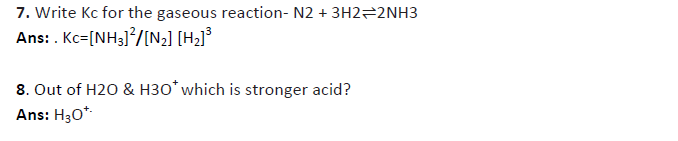
9. What is common ion effect?
Ans: Shift in equilibrium on adding a substance that provides more of an ionicspecies already present in the dissociation equilibrium.
10. Write relationship between Kp and Kc for the gaseous reaction :

Ans: Kp = Kc as Δn is zero for the above said reaction.
LEVEL – 2
1. What is effect of catalyst on equilibrium constant “Kc”?
Ans: A catalyst does not affect equilibrium constant because it speeds upboth forward and backward reactions to the same extent.
2. State Le Chatelier’s principle.
Ans: It states that a change in any of the factors that determine the equilibriumconditions of a system will cause the system to change in such a manner so as to reduce or to counteract the effect of the change.
3. What is meant by conjugate acid –base pairs? Explain.

4. Classify the following bases as strong and weak bases: NaHCO3, NaOH,KOH, Ca(OH)2, Mg(OH)2.
Ans: Strong bases: NaOH, KOH ; Weak bases: NaHCO3,Ca(OH)2, Mg(OH)2.
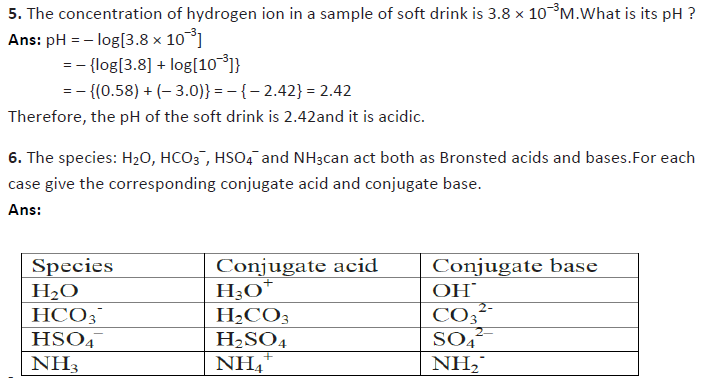
7. Explain Lewis acids and bases with suitable examples.
Ans: Lewis acids are lone pair (of e-) accepters while Lewis bases are lone pair donators.AlCl3 is a Lewis acid while NH3 is a Lewis base.
8. What is difference between alkali and bases? Give examples.
Ans: An alkali is a water soluble base. All the alkalis are bases but all the bases are not alkali. Ex- NaOH is an alkali/base.Ca(OH)2 is a base but not an alkali.
9. Explain homogeneous and heterogeneous equilibrium giving examples.
Ans: If all the reactants and products present in an equilibrium mixture are insame

LEVEL – 3
1. The pH of some common substances is given bellow. Classify the substances as acidic/basic Name of fluid pH
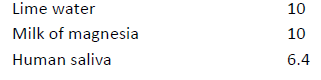
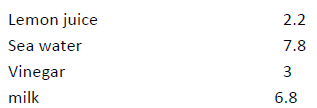
Ans: acidic-Human saliva, Lemon juice, milk, vinegar Basic- Lime water, sea water, milk of magnesia.
2. Explain general characteristics of acids and bases.
Ans: Most of the acids taste sour. Acids are known to turn blue litmus paper into red and liberate dihydrogen on reacting with some metals. Bases are known to turn red litmus paper blue, taste bitter and feel soapy.
3. Water is amphoteric in nature. Explain.
Ans: Water can react with acid as well as base
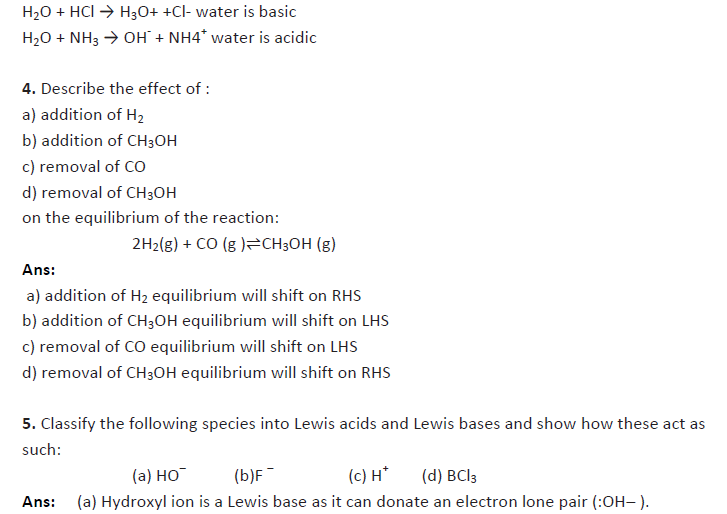
(b) Fluoride ion acts as a Lewis base as it can donate any one of its four electronlone pairs.
(c) A proton is a Lewis acid as it can accept a lone pair of electrons from baseslike hydroxyl ion and fluoride ion.
(d) BCl3 acts as a Lewis acid as it can accept a lone pair of electrons from species like ammonia or amine molecules.
8.Explain the following :
(i) Common ion effect
(ii) solubility products
(iii) pH
Ans: (i) Suppression of ionization of weak electrolyte by adding a strong electrolyte having an ion common.
(ii) Product of the molar concentrations of the ions in a saturated solution,each concentration term raised to the power equal to the no. of ions produced.
(iii) Negative logarithm of hydrogen ion concentration.
FIVE MARKS QUESTIONS

Free study material for Chemistry
Chemistry Class 11 Exam Resources: Chapter 06 Equilibrium
Essential Notes for Class 11 Chemistry
Access comprehensive study material for Chapter 06 Equilibrium, including revision notes, concept maps, and high-probability questions. These resources are designed in alignment with the latest 2026 CBSE syllabus for Class 11 Chemistry to support effective exam preparation.
Verified Solutions for Class 11 Chemistry
Designed around the official curriculum, these study guides guarantee standard compliance. Reviewing step-by-step solutions clarifies complex sub-topics within Chapter 06 Equilibrium and demystifies standard marking schemes for Chemistry evaluations.
Enhance Accuracy with Online Tests
Maximize your grade potential by utilizing Class 11 Chemistry practice papers in tandem with these structured notes. All printable assignments and interactive mock tests on our platform are updated for the 2026 session and available free of charge.
FAQs
Our advanced study package for Chapter 06 Equilibrium includes detailed concepts, diagrams, Mind Maps, and explanation of complex topics to ensure Class 11 students learn as per syllabus for 2026 exams.
The Mind Maps provided for Chapter 06 Equilibrium act as visual anchors which will help faster recall during high-pressure exams.
Yes, teachers use our Class 11 Chemistry resources for lesson planning as they are in simple language and have lot of solved examples.
Yes, You can download the complete, mobile-friendly PDF of the Chemistry Chapter 06 Equilibrium advanced resources for free.
Yes, our subject matter experts have updated the Chapter 06 Equilibrium material to align with the rationalized NCERT textbooks and have removed deleted topics and added new competency-based questions.