

Class 11 Chemistry Study Guide: CBSE Class 11 Chemistry The Gas Laws Flash Cards
Review targeted academic resources with the CBSE Class 11 Chemistry The Gas Laws Flash Cards. Built according to official CBSE standards for the 2026-27 term, these downloadable Class 11 Chemistry study materials support effective daily practice and deeper conceptual understanding for Chapter 05 States of Matter.
Download Chapter 05 States of Matter Study Material PDF
Navigate directly to the advanced Chemistry study materials using the digital viewer below. Each resource pack includes detailed conceptual summaries and solved practice questions, allowing students to instantly reinforce their learning.
CBSE Class 11 Chemistry The Gas Laws Flash Cards. Please refer to the examination notes which you can use for preparing and revising for exams. These notes will help you to revise the concepts quickly and get good marks.
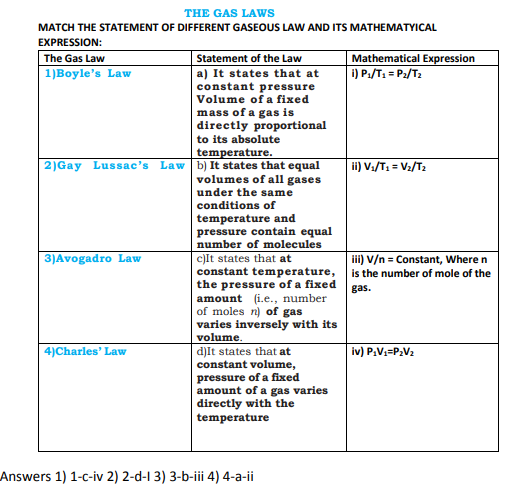
Please click the link below to download pdf file of CBSE Class 11 Chemistry The Gas Laws Flash Cards.
Question. 1. The correct equation for Boyle's law is :-
(a) \( \frac{d^2P}{P} = - \frac{dV}{dT} \)
(b) \( \frac{d^2P}{P} = + \frac{d^2V}{dT} \)
(c) \( \frac{dP}{P} = - \frac{dV}{V} \)
(d) \( \frac{dP}{P} = + \frac{dV}{V} \)
Answer: C
Question. 2. Under which of the following conditions, Van der Waal's gas approaches ideal behaviour ?
(a) Extremely low pressure
(b) High pressure
(c) Low product of PV
(d) Low temperature
Answer: A
Question. 3. A gas behaves like an ideal gas under conditions of
(a) High pressure and low temperature
(b) High temperature and high pressure
(c) Low pressure and high temperature
(d) Low pressure and low temperature
Answer: C
Question. 4. When the temperature is raised, the viscosity of the liquid decreases. This is because
(a) Attraction between the molecules increases
(b) Covalent and hydrogen bond forces decrease
(c) Volume of the solution decreases
(d) Increase in temperature increases the average kinetic energy of the molecules which over-comes the attractive force between them
Answer: D
Question. 5. Which of the following gases has the lowest average speed at 25°C ?
(a) NH3
(b) O2
(c) CH4
(d) H2S
Answer: D
Question. 6. If the four tubes of a car are filled to the same pressure with N2, O2, H2 and Ne separately, then which one will be filled first ?
(a) O2
(b) H2
(c) Ne
(d) N2
Answer: B
Question. 7. An ideal gas expands according to PV = constant. On expansion, the temperature of gas
(a) will rise
(b) will drop
(c) will remain constant
(d) cannot be determined because the external pressure is not known
Answer: C
Question. 8. Some assumptions from the kinetic molecular theory are listed below. Which one is most frequently cited to explain Charle's law ?
(a) Collisions of gas particle are elastic and total kinetic energy of the gas is constant
(b) A gas consists of tiny particles moving in random straight line motion
(c) The volume of the particle is negligible compared to the volume of the gas
(d) The average kinetic energy of gas particles is proportional to the Kelvin temperature
Answer: D
Question. 9. Universal gas constant (R) is divided by Avogadro's number (N0) then the value is equivalent to
(a) van der Waal's constant
(b) Rydberg's constant
(c) Planck's constant
(d) Boltzmann's constant
Answer: B
Question. 10. The term that accounts for intermolecular force in van der Waal's equation for non ideal gas is
(a) RT
(b) V – b
(c) (P + \( \alpha/V^2 \))
(d) (RT)–1
Question. 11. According to the kinetic energy of gases, in an ideal gas, between two successive collisions a gas molecules travels
(a) in a circular path
(b) in a wavy path
(c) in a straight line path
(d) with an accelerated velocity
Answer: C
Question. 12. The temperature at which real gases obey the ideal gas laws over a wide range of pressure is called
(a) Critical temperature
(b) Boyle temperature
(c) Inversion temperature
(d) Reduced temperature
Answer: B
Question. 13. A real gas at a very high pressure occupies
(a) Less volume then that of an ideal gas under identical condition
(b) More volume than that of an ideal gas under identical conditions
(c) Same volume than that of an ideal gas under identical conditions
(d) Cannot be predicted
Answer: B
Question. 14. Temperature according to kinetic theory, is a measure of
(a) Average translational kinetic energy of gas molecules
(b) Intermolecular attraction
(c) Intermolecular distances
(d) Volume of gas
Answer: A
Question. 15. A gas deviates from ideal behaviour at a high pressure because its molecules
(a) Show the Tyndall effect
(b) Have kinetic energy
(c) Attract one another
(d) Are bound by covalent bonds
Answer: C
Question. 16. Which statement about real gases is true ?
(a) Forces of attraction and repulsion exist between gas particles as close range
(b) The behaviour of real gases can be exactly predicted using the ideal gas law
(c) The volume of the gas particle is zero
(d) The mass of the gas particles is zero
Answer: A
Question. 17. It is easier to liquefy oxygen than hydrogen because
(a) Oxygen has a higher critical temperature and a higher inversion temperature than hydrogen
(b) The critical temperature and inversion temperature of oxygen is very low
(c) Oxygen has a higher critical temperature and lower inversion temperature than hydrogen
(d) Oxygen has a lower critical temperature and higher inversion temperature than hydrogen
Answer: A
Free study material for Chemistry
Useful Resources and Notes for Class 11 Chemistry Chapter 05 States of Matter
Quick Revision Material for Chapter 05 States of Matter
Access comprehensive study material for Chapter 05 States of Matter, including revision notes, concept maps, and high-probability questions. These resources are designed in alignment with the latest 2026 CBSE syllabus for Class 11 Chemistry to support effective exam preparation.
Expert Notes and Solved Exam Questions
Built using official NCERT guidelines for Class 11 Chemistry, these materials provide reliable academic support. Integrating past examination questions and step-by-step solutions helps students understand official CBSE grading criteria.
Additional Study Resources for Class 11
Maximize your grade potential by utilizing Class 11 Chemistry practice papers in tandem with these structured notes. All printable assignments and interactive mock tests on our platform are updated for the 2026 session and available free of charge.
FAQs
Our advanced study package for Chapter 05 States of Matter includes detailed concepts, diagrams, Mind Maps, and explanation of complex topics to ensure Class 11 students learn as per syllabus for 2026 exams.
The Mind Maps provided for Chapter 05 States of Matter act as visual anchors which will help faster recall during high-pressure exams.
Yes, teachers use our Class 11 Chemistry resources for lesson planning as they are in simple language and have lot of solved examples.
Yes, You can download the complete, mobile-friendly PDF of the Chemistry Chapter 05 States of Matter advanced resources for free.
Yes, our subject matter experts have updated the Chapter 05 States of Matter material to align with the rationalized NCERT textbooks and have removed deleted topics and added new competency-based questions.