

Download CBSE Class 11 Chemistry Useful Resources
Explore structured advanced study materials through the CBSE Class 11 Chemistry Periodic Classification Flash Cards. Tailored for Class 11 learners, utilizing these Chemistry resources ensures thorough preparation and strengthens foundational knowledge before final CBSE evaluations.
Access CBSE Study Guides and Summaries
View or download the dedicated CBSE Class 11 Chemistry Periodic Classification Flash Cards resource below. Engaging with these advanced study guides under focused conditions ensures continuous academic progress and mastery of the 2026-27 curriculum for Chapter 03 Classification of Elements and Periodicity in Properties.
CBSE Class 11 Chemistry Periodic Classification Flash Cards. There are many more useful educational material which the students can download in pdf format and use them for studies. Study material like concept maps, important and sure shot question banks, quick to learn flash cards, flow charts, mind maps, teacher notes, important formulas, past examinations question bank, important concepts taught by teachers. Students can download these useful educational material free and use them to get better marks in examinations. Also refer to other worksheets for the same chapter and other subjects too. Use them for better understanding of the subjects.
PERIODIC CLASSIFICATION –
A BRUSH –UP THROUGH CONCEPTS
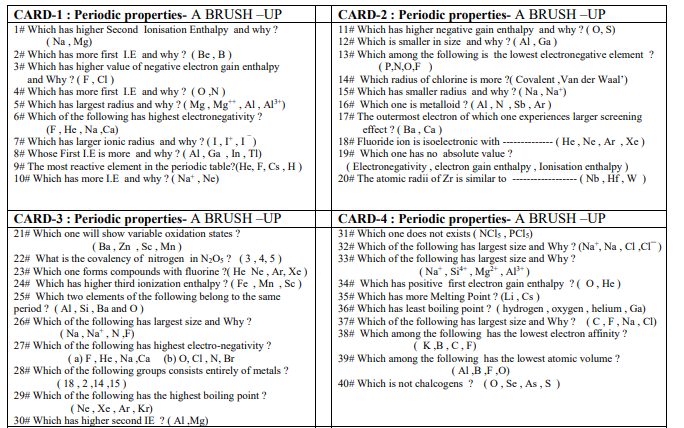
CARD-1 : Periodic properties- A BRUSH –UP
1# Which has higher Second Ionisation Enthalpy and why ? ( Na , Mg)
2# Which has more first I.E and why ? ( Be , B )
3# Which has higher value of negative electron gain enthalpy and Why ? ( F , Cl )
4# Which has more first I.E and why ? ( O ,N )
5# Which has largest radius and why ? ( Mg , Mg++ , Al , Al3+)
6# Which of the following has highest electronegativity ? (F , He , Na ,Ca)
7# Which has larger ionic radius and why ? ( I , I+, I ¯ )
8# Whose First I.E is more and why ? ( Al , Ga , In , Tl)
9# The most reactive element in the periodic table?(He, F, Cs , H )
10# Which has more I.E and why ? ( Na+, Ne)
CARD-2 : Periodic properties- A BRUSH –UP
11# Which has higher negative gain enthalpy and why ? ( O, S)
12# Which is smaller in size and why ? ( Al , Ga )
13# Which among the following is the lowest electronegative element ? ( P,N,O,F )
14# Which radius of chlorine is more ?( Covalent ,Van der Waal’)
15# Which has smaller radius and why ? ( Na , Na+)
16# Which one is metalloid ? ( Al , N , Sb , Ar )
17# The outermost electron of which one experiences larger screening effect ? ( Ba , Ca )
18# Fluoride ion is isoelectronic with -------------- ( He , Ne , Ar , Xe )
19# Which one has no absolute value ? ( Electronegativity , electron gain enthalpy , Ionisation enthalpy )
20# The atomic radii of Zr is similar to ------------------ ( Nb , Hf , W )
CARD-3 : Periodic properties- A BRUSH –UP
21# Which one will show variable oxidation states ? ( Ba , Zn , Sc , Mn )
22# What is the covalency of nitrogen in N2O5 ? ( 3 , 4, 5 )
23# Which one forms compounds with fluorine ?( He Ne , Ar, Xe )
24# Which has higher third ionization enthalpy ? ( Fe , Mn , Sc )
25# Which two elements of the following belong to the same period ? ( Al , Si , Ba and O )
26# Which of the following has largest size and Why ? ( Na , Na+, N ,F)
27# Which of the following has highest electro-negativity ? ( a) F , He , Na ,Ca (b) O, Cl , N, Br
28# Which of the following groups consists entirely of metals ? ( 18 , 2 ,14 ,15 )
29# Which of the following has the highest boiling point ? ( Ne , Xe , Ar , Kr)
30# Which has higher second IE ? ( Al ,Mg)
CARD-4 : Periodic properties- A BRUSH –UP
31# Which one does not exists ( NCl5 , PCl5)
32# Which of the following has largest size and Why ? (Na+, Na , Cl ,Cl¯ )
33# Which of the following has largest size and Why ? ( Na+, Si4+ , Mg2+ , Al3+ )
34# Which has positive first electron gain enthalpy ? ( O , He )
35# Which has more Melting Point ? (Li , Cs )
36# Which has least boiling point ? ( hydrogen , oxygen , helium , Ga)
37# Which of the following has largest size and Why ? ( C , F , Na , Cl)
38# Which among the following has the lowest electron affinity ? ( K ,B , C , F)
39# Which among the following has the lowest atomic volume ? ( Al ,B ,F ,O)
40# Which is not chalcogens ? ( O , Se , As , S )
CARD-5 : Periodic properties- A BRUSH –UP
41# Which of the following has smallest size and Why ? (a ) Na+, Si4+ , Mg2+ , Al3+ (b) C, F ,Na , Cl
42# Which of the following is a p-block element in the periodic table ? (a) Na ,Mg . Ni , N (b) Na , O ,Mg , Fe (c) K, Na , Cr , Ca
43# The IUPAC Name of the element having atomic number 119 is ---------------------
44# What is the oxidation state and covalency of Al in [Al Cl (H2O)5] is ------------ and ----------- respectively .
45# Lanthanoids starts from at . no. ---------------------- to ----------
46# The elements of d- block covers group no ---------------- to ---
47# The elements of p- block covers group no----------- to------
48# The outer electronic configuration of element belongs to gr-14 and period 6th is ---------------------------
49# ---------- number of gases ar present in the periodic table .
50# -------------- is the metal and ---------------- is the non-metal , exists in liquid state at room temperature .
FILL IN THE BLANKS
51# Among halogens , the negative electron gain enthalpy is highest for --------------------- .
52# The element with highest value of first iisation enthalpy is ------------
53# The ionization enthalpy of nitrogen is ---------------------- (smaller , greater ) than that of oxygen .
54# The element of smallest size in 3rd period is ------------------------
55# The d-block elements are known as ---------------------- metals .
56# Valence shell electronic configuration of elements of group 16 is ----
57# Be shows diagonal relationship with -----------------------------.
58# The oxidation state of He , Ne , Ar is ---------------------------- .
59# Which has larger size among each pair ? (a) ( Cl ,Ar ) (b) (Na , Ar ) (c) (Na , Cl ) (d) (Li , Cs)
60# The number of elements in the 5th period of the periodic table is ------
61# The element with atomic number 35 belongs to -------------- block .
62# The most electronegative element of the periodic table is --------------
Free study material for Chemistry
Useful Resources and Notes for Class 11 Chemistry Chapter 03 Classification of Elements and Periodicity in Properties
Quick Revision Material for Chapter 03 Classification of Elements and Periodicity in Properties
Explore essential learning tools for Class 11 Chemistry Chapter 03 Classification of Elements and Periodicity in Properties. This curated collection features in-depth notes and targeted practice questions built around the active 2026 curriculum to streamline your daily revision.
Expert Notes and Solved Exam Questions
Built using official NCERT guidelines for Class 11 Chemistry, these materials provide reliable academic support. Integrating past examination questions and step-by-step solutions helps students understand official CBSE grading criteria.
Additional Study Resources for Class 11
Wrap up your chapter revision by testing your knowledge against standard objective question formats. Explore our full library of free, up-to-date sample papers and online assessments to secure top grades in your CBSE examinations.
FAQs
Our advanced study package for Chapter 03 Classification of Elements and Periodicity in Properties includes detailed concepts, diagrams, Mind Maps, and explanation of complex topics to ensure Class 11 students learn as per syllabus for 2026 exams.
The Mind Maps provided for Chapter 03 Classification of Elements and Periodicity in Properties act as visual anchors which will help faster recall during high-pressure exams.
Yes, teachers use our Class 11 Chemistry resources for lesson planning as they are in simple language and have lot of solved examples.
Yes, You can download the complete, mobile-friendly PDF of the Chemistry Chapter 03 Classification of Elements and Periodicity in Properties advanced resources for free.
Yes, our subject matter experts have updated the Chapter 03 Classification of Elements and Periodicity in Properties material to align with the rationalized NCERT textbooks and have removed deleted topics and added new competency-based questions.