

Download CBSE Class 11 Chemistry Useful Resources
Access comprehensive study materials and useful resources for Chapter 06 Equilibrium using the CBSE Class 11 Chemistry Equilibrium Flash Cards. Designed to align with the 2026-27 CBSE academic guidelines, these advanced resources help Class 11 Chemistry students reinforce core concepts beyond standard textbooks.
Access CBSE Study Guides and Summaries
Access the complete useful resource PDF for Class 11 Chemistry below. Regular practice with these targeted academic notes builds familiarity with complex topics and helps secure higher marks in final school evaluations.
CBSE Class 11 Chemistry Equilibrium Flash Cards. Please refer to the examination notes which you can use for preparing and revising for exams. These notes will help you to revise the concepts quickly and get good marks.
EQUILIBRIUM
UNIT - 7
EQUILIBRIUM
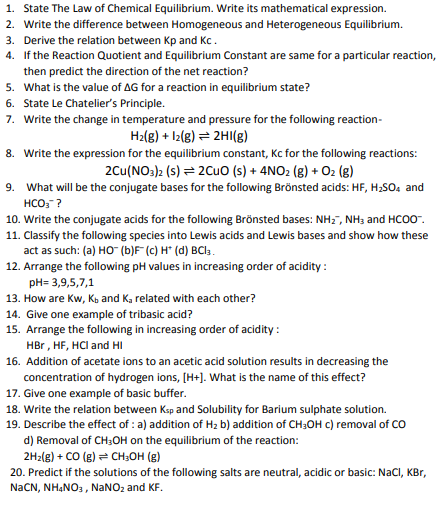
TOP 20 QUESTIONS:
1. State The Law of Chemical Equilibrium. Write its mathematical expression. [1 Mark]
Answer:
1. At a given temperature, the rate of a chemical reaction is directly proportional to the product of the molar concentrations of the reactants.
2. For a reversible reaction \(aA + bB \rightleftharpoons cC + dD\), the equilibrium constant expression is given as \(K_c = \frac{[C]^c [D]^d}{[A]^a [B]^b}\).
Teacher's Note:
a) The law states that the product of molar concentrations of products raised to their stoichiometric coefficients divided by reactants is a constant at constant temperature.
b) Pure solids and liquids are taken as having unit activity and are omitted from the expression.
2. Write the difference between Homogeneous and Heterogeneous Equilibrium. [2 Marks]
Answer:
1. In a homogeneous equilibrium, all the reactants and products are in the same phase (e.g., all gases or all liquids).
2. In a heterogeneous equilibrium, the reactants and products are present in more than one phase (e.g., solid and gas, or liquid and solid).
Teacher's Note:
a) Phase refers to a homogeneous and physically distinct part of a system.
b) Concentration of pure solids and pure liquids is constant, hence they do not appear in heterogeneous equilibrium expressions.
3. Derive the relation between Kp and Kc. [3 Marks]
Answer:
1. Consider a general gaseous reaction: \(aA + bB \rightleftharpoons cC + dD\).
2. The equilibrium constant in terms of concentration is \(K_c = \frac{[C]^c [D]^d}{[A]^a [B]^b}\) and in terms of partial pressure is \(K_p = \frac{(P_C)^c (P_D)^d}{(P_A)^a (P_B)^b}\).
3. Using the ideal gas equation \(PV = nRT\), partial pressure \(P = \frac{n}{RT} = C RT\), where C is concentration.
4. Substituting partial pressures into \(K_p\) gives \(K_p = K_c(RT)^{\Delta n}\), where \(\Delta n = (c + d) - (a + b)\).
Teacher's Note:
a) \(\Delta n\) represents the change in the number of moles of gases between products and reactants.
b) Ensure proper units of R and T are used during calculations.
c) When \(\Delta n = 0\), \(K_p = K_c\).
4. If the Reaction Quotient and Equilibrium Constant are same for a particular reaction, then predict the direction of the net reaction? [1 Mark]
Answer:
1. The reaction is in a state of chemical equilibrium.
2. There is no net reaction in either forward or backward direction.
Teacher's Note:
a) When reaction quotient \(Q_c\) equals equilibrium constant \(K_c\), the system has already reached equilibrium.
5. What is the value of \(\Delta G\) for a reaction in equilibrium state? [1 Mark]
Answer:
1. The value of Gibbs free energy change (\(\Delta G\)) for a reaction in equilibrium state is zero.
Teacher's Note:
a) At equilibrium, the system has minimum free energy and maximum entropy, making \(\Delta G = 0\).
6. State Le Chatelier’s Principle. [1 Mark]
Answer:
1. If a stress (such as change in concentration, pressure, or temperature) is applied to a system at equilibrium, the system shifts in a direction that tends to relieve or nullify the effect of that stress.
Teacher's Note:
a) This principle helps qualitatively predict the shift in equilibrium position due to external disturbances.
7. Write the change in temperature and pressure for the following reaction - \(H_2(g) + I_2(g) \rightleftharpoons 2HI(g)\) [2 Marks]
Answer:
1. Pressure change: Since the number of moles of gaseous reactants and products are equal (\(\Delta n = 0\)), change in pressure has no effect on the equilibrium.
2. Temperature change: Formation of HI is exothermic, so increase in temperature shifts the equilibrium in the backward direction, while decrease in temperature shifts it in the forward direction.
Teacher's Note:
a) Reactions with equal moles of gas on both sides are pressure-independent.
b) Exothermic reactions are favored by low temperatures.
8. Write the expression for the equilibrium constant, \(K_c\) for the following reactions: \(2Cu(NO_3)_2(s) \rightleftharpoons 2CuO(s) + 4NO_2(g) + O_2(g)\) [1 Mark]
Answer:
1. \(K_c = [NO_2]^4 [O_2]\)
Teacher's Note:
a) Concentration of pure solids like \(Cu(NO_3)_2\) and \(CuO\) are taken as unity and excluded from the expression.
9. What will be the conjugate bases for the following Brönsted acids: \(HF\), \(H_2SO_4\) and \(HCO_3^-\)? [1 Mark]
Answer:
1. Conjugate base of \(HF\) is \(F^-\).
2. Conjugate base of \(H_2SO_4\) is \(HSO_4^-\).
3. Conjugate base of \(HCO_3^-\) is \(CO_3^{2-}\).
Teacher's Note:
a) A conjugate base is formed by the removal of a proton (\(H^+\)) from the given acid.
10. Write the conjugate acids for the following Brönsted bases: \(NH_2^-\), \(NH_3\) and \(HCOO^-\). [1 Mark]
Answer:
1. Conjugate acid of \(NH_2^-\) is \(NH_3\).
2. Conjugate acid of \(NH_3\) is \(NH_4^+\).
3. Conjugate acid of \(HCOO^-\) is \(HCOOH\).
Teacher's Note:
a) A conjugate acid is formed by the addition of a proton (\(H^+\)) to the given base.
11. Classify the following species into Lewis acids and Lewis bases and show how these act as such: (a) \(HO^-\) (b) \(F^-\) (c) \(H^+\) (d) \(BCl_3\). [2 Marks]
Answer:
1. Lewis Bases: (a) \(HO^-\) and (b) \(F^-\) act as Lewis bases because they are electron-rich species capable of donating a lone pair of electrons.
2. Lewis Acids: (c) \(H^+\) and (d) \(BCl_3\) act as Lewis acids because they are electron-deficient species capable of accepting a lone pair of electrons.
Teacher's Note:
a) Lewis acids are electron-pair acceptors, while Lewis bases are electron-pair donors.
b) Molecules with incomplete octets like \(BCl_3\) or cations like \(H^+\) act as Lewis acids.
12. Arrange the following pH values in increasing order of acidity : pH = 3, 9, 5, 7, 1 [1 Mark]
Answer:
1. 9 < 7 < 5 < 3 < 1
Teacher's Note:
a) Acidity is inversely proportional to pH value; lower pH means higher hydrogen ion concentration and higher acidity.
13. How are \(K_w\), \(K_b\) and \(K_a\) related with each other? [1 Mark]
Answer:
1. \(K_w = K_a \times K_b\)
Teacher's Note:
a) This relation holds true for a conjugate acid-base pair in aqueous solution at a given temperature.
14. Give one example of tribasic acid? [1 Mark]
Answer:
1. Phosphoric acid (\(H_3PO_4\))
Teacher's Note:
a) Tribasic acids are acids that contain three ionizable hydrogen atoms per molecule.
15. Arrange the following in increasing order of acidity : \(HBr\), \(HF\), \(HCl\) and \(HI\) [1 Mark]
Answer:
1. \(HF < HCl < HBr < HI\)
Teacher's Note:
a) Acid strength increases down the group as bond dissociation enthalpy decreases due to increasing atomic size.
16. Addition of acetate ions to an acetic acid solution results in decreasing the concentration of hydrogen ions, \([H^+]\). What is the name of this effect? [1 Mark]
Answer:
1. Common ion effect
Teacher's Note:
a) The addition of acetate ions suppresses the dissociation of weak acetic acid by shifting the equilibrium backward.
17. Give one example of basic buffer. [1 Mark]
Answer:
1. A mixture of ammonium hydroxide (\(NH_4OH\)) and ammonium chloride (\(NH_4Cl\))
Teacher's Note:
a) A basic buffer consists of a weak base and its salt with a strong acid.
18. Write the relation between \(K_{sp}\) and Solubility for Barium sulphate solution. [1 Mark]
Answer:
1. \(K_{sp} = s^2\)
Teacher's Note:
a) Barium sulphate (\(BaSO_4\)) dissociates into one \(Ba^{2+}\) ion and one \(SO_4^{2-}\) ion, so \(K_{sp} = [Ba^{2+}][SO_4^{2-}] = s \times s = s^2\).
19. Describe the effect of : a) addition of \(H_2\) b) addition of \(CH_3OH\) c) removal of \(CO\) d) Removal of \(CH_3OH\) on the equilibrium of the reaction: \(2H_2(g) + CO(g) \rightleftharpoons CH_3OH(g)\) [2 Marks]
Answer:
1. (a) Addition of \(H_2\): Shifts equilibrium in the forward direction.
2. (b) Addition of \(CH_3OH\): Shifts equilibrium in the backward direction.
3. (c) Removal of \(CO\): Shifts equilibrium in the backward direction.
4. (d) Removal of \(CH_3OH\): Shifts equilibrium in the forward direction.
Teacher's Note:
a) According to Le Chatelier's principle, increasing reactant concentration favors the forward reaction.
b) Removing a product also drives the reaction forward to replace what was lost.
20. Predict if the solutions of the following salts are neutral, acidic or basic: \(NaCl\), \(KBr\), \(NaCN\), \(NH_4NO_3\), \(NaNO_2\) and \(KF\). [2 Marks]
Answer:
1. Neutral salts: \(NaCl\), \(KBr\) (derived from strong acid and strong base).
2. Basic salts: \(NaCN\), \(NaNO_2\), \(KF\) (derived from weak acid and strong base).
3. Acidic salt: \(NH_4NO_3\) (derived from weak base and strong acid).
Teacher's Note:
a) Salts of strong acids and strong bases do not undergo hydrolysis and remain neutral.
b) Salts containing anions of weak acids undergo anionic hydrolysis, making the solution basic.
1. The mass of a gas dissolved in a given mass of a solvent at any temperature is proportional to the pressure of the gas above the solvent - this Law is known as- [1 Mark]
(a) Charle's Law,
(b) Raoult's Law,
(c) Henry's Law,
(d) Boyle's Law
Answer: (c) Henry's Law
1. Henry's law states that the solubility of a gas in a liquid is directly proportional to the partial pressure of the gas present above the surface of liquid or solution.
2. Hence, the correct option is (c).
Teacher's Note:
a) Henry's law relates gas solubility to partial pressure.
b) Watch out for confusion with Raoult's law which deals with vapor pressures of volatile liquid solutions.
2. Equilibrium is possible only in a ______ system at a given temperature. [1 Mark]
(a) Open
(b) Closed
(c) Isothermal
(d) Isolated.
Answer: (b) Closed
1. Chemical equilibrium can only be attained in a closed system so that no matter can escape or enter from the surroundings.
2. Hence, the correct option is (b).
Teacher's Note:
a) A closed system prevents exchange of matter while allowing energy transfer.
b) Open systems allow reactants or products to escape, preventing a constant state of concentrations.
3. In dynamic equilibrium, the rate of forward reaction is_____the backward reaction. [1 Mark]
(a) Greater than
(b) less than
(c) Equal to
(d) constant with.
Answer: (c) Equal to
1. At dynamic equilibrium, the rate of the forward reaction becomes equal to the rate of the backward reaction.
2. Hence, the correct option is (c).
Teacher's Note:
a) Dynamic equilibrium means reactions continue to happen at equal opposing rates.
b) Do not confuse equal rates with equal concentrations of reactants and products.
4. Equilibrium constant for the reverse reaction is ________of the equilibrium constant for the reaction in the forward direction. [1 Mark]
(a) Greater
(b) Less
(c) Equal
(d) Inverse.
Answer: (d) Inverse
1. The equilibrium constant for a reverse reaction is the reciprocal or inverse of the equilibrium constant for the forward reaction.
2. Hence, the correct option is (d).
Teacher's Note:
a) If forward constant is \(K\), the reverse constant is \(\frac{1}{K}\).
b) Remember that reversing a chemical equation inverts its equilibrium expression.
5. Equilibrium in a system having more than ______ phase is called heterogeneous equilibrium. [1 Mark]
(a) One
(b) Two
(c) Three
(d) four
Answer: (a) One
1. When reactants and products are present in more than one phase, the system exhibits heterogeneous equilibrium.
2. Hence, the correct option is (a).
Teacher's Note:
a) Homogeneous equilibrium involves all species in the same phase.
b) Heterogeneous systems involve multiple phases like solid and gas or liquid and solid.
6. The value of equilibrium constant is_______ of initial concentrations of the reactants and products. [1 Mark]
(a) Independent
(b) Dependent.
Answer: (a) Independent
1. The equilibrium constant is independent of the initial concentrations of reactants and products at a constant temperature.
2. Hence, the correct option is (a).
Teacher's Note:
a) Equilibrium constant depends only on temperature.
b) Initial concentrations affect equilibrium positions, not the equilibrium constant value.
7. No net reaction occurs when - [1 Mark]
(a) Qc > Kc
(b) Qc < Kc
(c) Qc = Kc
Answer: (c) Qc = Kc
1. When the reaction quotient \(Q_c\) equals the equilibrium constant \(K_c\), the system is at equilibrium.
2. Therefore, no net reaction occurs.
3. Hence, the correct option is (c).
Teacher's Note:
a) \(Q_c\) compares instantaneous concentrations to equilibrium constants.
b) If \(Q_c \gt K_c\), the reaction proceeds backwards; if \(Q_c \lt K_c\), it proceeds forwards.
8. When the reaction is spontaneous and proceeds in the forward direction, then ΔG is ------ [1 Mark]
(a) +ve
(b) -ve
(c) Zero.
Answer: (b) -ve
1. For a spontaneous process at constant temperature and pressure, the change in Gibbs free energy (ΔG) is negative.
2. Hence, the correct option is (b).
Teacher's Note:
a) Negative ΔG indicates spontaneity in the forward direction.
b) A positive ΔG means the reverse reaction is spontaneous.
9. Which of the following is acted as Lewis acid: [1 Mark]
(a) HO-
(b) F-
(c) NH3
(d) BCl3
Answer: (d) BCl3
1. A Lewis acid is an electron-pair acceptor.
2. Boron trichloride has an incomplete octet on the central boron atom, allowing it to accept an electron pair.
3. Hence, the correct option is (d).
Teacher's Note:
a) Electron-deficient molecules act as Lewis acids.
b) Species like HO-, F- and NH3 are Lewis bases because they donate electron pairs.
10. Which of the following is the example of polyprotic acid --- [1 Mark]
(a) HCl
(b) HNO3
(c) HCOOH
(d) H3PO4
Answer: (d) H3PO4
1. A polyprotic acid is an acid that can donate more than one proton per molecule.
2. Phosphoric acid (H3PO4) can donate three protons, making it triprotic, a type of polyprotic acid.
3. Hence, the correct option is (d).
Teacher's Note:
a) HCl, HNO3, and HCOOH are monoprotic acids as they release only one hydrogen ion.
b) Polyprotic acids ionize in multiple steps.
REDOX REACTION
1. Loss of electron is ............ (oxidation/reduction) [1 Mark]
Answer: oxidation
1. Oxidation is defined as the loss of electrons by an atom, ion, or molecule.
2. Conversely, gain of electrons is termed as reduction.
3. Therefore, loss of electron is oxidation.
Teacher's Note:
a) Remember the mnemonic OIL RIG - Oxidation Is Loss, Reduction Is Gain of electrons.
b) Oxidation results in an increase in oxidation number.
2. H2S + Cl2 → 2HCl + S. The oxidizing agent is (H2S/Cl2) [1 Mark]
Answer: Cl2
1. In the reaction, chlorine (Cl2) accepts hydrogen to form HCl, undergoing reduction.
2. An oxidizing agent is the species that oxidizes another substance and gets reduced itself.
3. Hence, Cl2 acts as the oxidizing agent.
Teacher's Note:
a) Oxidizing agents are themselves reduced during a redox reaction.
b) Non-metals in elemental form often act as good oxidizing agents.
3. Which of the following has zero oxidation state in oxygen ......... (O2/H2O) [1 Mark]
Answer: O2
1. Elements in their elemental or uncombined state always possess an oxidation state of zero.
2. In water (H2O), oxygen has an oxidation state of -2.
3. Therefore, O2 has zero oxidation state.
Teacher's Note:
a) Any atom in its standard elemental form has a zero oxidation number.
b) Compounds always have assigned non-zero oxidation states based on electronegativity rules.
4. N2H4 + 2H2O2 → N2 + 4H2O. .......... Acts as a reductant. [1 Mark]
Answer: N2H4
1. In N2H4, the oxidation number of nitrogen is -2, which increases to 0 in N2.
2. An increase in oxidation number corresponds to oxidation, making the substance a reducing agent.
3. Thus, hydrazine (N2H4) acts as the reductant.
Teacher's Note:
a) Reductants donate electrons and undergo oxidation during reactions.
b) Identify the element whose oxidation number increases from reactant to product side.
5. Among halogens .......... Is the best oxidant. [1 Mark]
Answer: F2 (Fluorine)
1. Fluorine has the highest electronegativity and standard reduction potential among all halogens.
2. It readily accepts electrons to form fluoride ions.
3. Therefore, fluorine is the strongest oxidizing agent among halogens.
Teacher's Note:
a) Oxidizing power decreases down the group from fluorine to iodine.
b) Fluorine's high hydration enthalpy and low bond dissociation enthalpy contribute to its strong oxidizing nature.
6. Which of the following is not a redox process
(i) CaCO3 → CaO + CO2
(ii) H2 + Cl2 → 2HCl [1 Mark]
Answer: (i) CaCO3 → CaO + CO2
1. In reaction (i), the oxidation states of calcium (+2), carbon (+4), and oxygen (-2) remain unchanged throughout.
2. Reaction (ii) involves changes in oxidation states of hydrogen and chlorine, making it a redox reaction.
3. Hence, thermal decomposition of calcium carbonate is not a redox process.
Teacher's Note:
a) Thermal decompositions without elemental changes are typically non-redox reactions.
b) Always assign oxidation numbers to all atoms to verify if a reaction is redox.
7. Identify the element that exhibits only -ve oxidation state .... (I, F) [1 Mark]
Answer: F
1. Fluorine is the most electronegative element in the periodic table.
2. It cannot show positive oxidation states because it has no vacant d-orbitals and higher electronegativity than all other elements.
3. Thus, fluorine exhibits only -1 oxidation state in its compounds.
Teacher's Note:
a) Fluorine is exceptionally consistent in showing only -0 and -1 oxidation states.
b) Other halogens like iodine show positive oxidation states like +1, +3, +5, and +7 due to vacant d-orbitals.
8. Identify the element that exhibits only +ve oxidation state ................ (Cs, Cl) [1 Mark]
Answer: Cs
1. Caesium is an alkali metal with very low electronegativity and ionization enthalpy.
2. It readily loses its single valence electron to form a +1 ion.
3. It never exhibits a negative oxidation state, hence showing only positive oxidation states.
Teacher's Note:
a) Alkali metals exclusively exhibit a +1 oxidation state in all their combined states.
b) Chlorine can exhibit both positive and negative oxidation states.
9. Identify the element that exhibits both +ve and -ve oxidation state .............. (F, Br, Ba) [1 Mark]
Answer: Br
1. Bromine is a halogen that can show a negative oxidation state (-1) when bonded to less electronegative elements.
2. It can also show positive oxidation states (+1, +3, +5, +7) due to the presence of vacant d-orbitals.
3. Thus, bromine exhibits both positive and negative oxidation states.
Teacher's Note:
a) Elements with both vacant orbitals and intermediate electronegativities show dual oxidation states.
b) Fluorine shows only negative, and barium shows only positive oxidation states.
10. Identify the element that exhibits neither +ve nor -ve oxidation state .......... (O, Ne) [1 Mark]
Answer: Ne
1. Neon is a noble gas with a completely filled valence shell configuration (\(s^2 p^6\)).
2. It is chemically inert under normal conditions and does not form stable chemical bonds.
3. Therefore, neon exhibits a zero oxidation state and shows neither positive nor negative oxidation states.
Teacher's Note:
a) Noble gases generally have zero oxidation states in their elemental form.
b) He, Ne, and Ar do not form compounds easily, hence keeping a zero oxidation state.
11. In cell notation the double bar represents ..................... [1 Mark]
Answer: Salt bridge
1. In electrochemical cell representation, a single vertical line represents a phase boundary.
2. A double vertical line represents the salt bridge connecting the two half-cells.
3. It accounts for the elimination of liquid junction potential.
Teacher's Note:
a) The salt bridge maintains electrical neutrality in the two half-cells.
b) Standard IUPAC convention uses \(\parallel\) for salt bridge separation.
12. The potential associated with each electrode is called as ................ [1 Mark]
Answer: Electrode potential
1. When an electrode is in contact with its electrolyte, a potential difference is set up.
2. This potential associated with a single electrode is termed electrode potential.
3. It can be expressed as oxidation potential or reduction potential.
Teacher's Note:
a) Individual electrode potentials cannot be measured in isolation absolutely.
b) They are measured relative to the Standard Hydrogen Electrode (SHE).
13. The cell in which chemical energy is converted into electrical energy is called ............. [1 Mark]
Answer: Electrochemical cell (Galvanic cell or Voltaic cell)
1. A galvanic cell harnesses spontaneous chemical redox reactions to generate electrical energy.
2. Electrolytic cells perform the reverse function by using electrical energy for non-spontaneous reactions.
3. Daniel cell is a standard example of a galvanic cell.
Teacher's Note:
a) Galvanic cells have a positive cell potential (\(E^\circ_{cell}\)).
b) Gibbs free energy change (\(\Delta G\)) is negative for such cells.
14. In galvanic cell the electrons flow from .......... to .............. [1 Mark]
Answer: Anode to cathode
1. Oxidation takes place at the anode, releasing electrons.
2. These electrons flow through the external circuit to the cathode where reduction occurs.
3. Thus, electron flow is from anode to cathode.
Teacher's Note:
a) Current flow is conventionally taken from cathode to anode, opposite to electron flow.
b) Anode is negatively charged and cathode is positively charged in a galvanic cell.
15. In galvanic cell the two electrolytic solutions are connected through ................ [1 Mark]
Answer: Salt bridge
1. A salt bridge is an inverted U-tube filled with an electrolyte like KCl or \(NH_4NO_3\) in agar-agar gel.
2. It completes the electrical circuit by connecting the two half-cell solutions.
3. It prevents accumulation of charges in the half-cells.
Teacher's Note:
a) The ions chosen in the salt bridge should have nearly equal transport numbers.
b) It stops direct mixing of the two electrolytic solutions.
16. In Daniel cell .......... acts as cathode and .........acts as anode? [1 Mark]
Answer: Copper (Cu) rod acts as cathode and Zinc (Zn) rod acts as anode
1. In a Daniel cell, oxidation occurs at the zinc electrode, making it the anode.
2. Reduction occurs at the copper electrode, making it the cathode.
3. Therefore, copper is the cathode and zinc is the anode.
Teacher's Note:
a) Remember the rule: ANODIC oxidation and CATHODIC reduction (AN-OX, RED-CAT).
b) Zinc loses mass while copper gains mass during the operation of a Daniel cell.
17. Match the following [1 Mark]
| Types of reaction | Example |
|---|---|
| Combination reaction | 2H2O → 2H2 + O2 |
| Displacement reaction | 2H2O2 → 2H2O + O2 |
| Decomposition reaction | H2 + Cl2 → 2HCl |
| Disproportionation reaction | CuSO4 + Zn → ZnSO4 + Cu |
Answer:
1. Combination reaction matches with H2 + Cl2 → 2HCl (Note: The options in the question need re-matching as the original table contains incorrect pairings).
2. Displacement reaction matches with CuSO4 + Zn → ZnSO4 + Cu.
3. Decomposition reaction matches with 2H2O2 → 2H2O + O2 and also with 2H2O → 2H2 + O2.
4. Disproportionation reaction matches with 2H2O2 → 2H2O + O2.
Teacher's Note:
a) The official worksheet contains mismatched examples which have been correctly re-paired in the solution.
b) Combination involves forming a single product from multiple reactants.
18. Zn + 2Ag+ → Zn2+ + 2Ag
(i) ............. acts as -ve electrode? [1 Mark]
(ii) Write the cell notation [1 Mark]
Answer:
1. (i) Zn acts as the negative electrode (anode) since oxidation takes place on zinc.
2. (ii) Cell notation: Zn(s) | Zn2+(aq) || Ag+(aq) | Ag(s)
Teacher's Note:
a) Oxidation occurs at the anode, which is assigned a negative polarity in a galvanic cell.
b) Anode is written on the left and cathode on the right in cell representation.
19. E0 K+/K = -2.93V and E0 Ag+/Ag = 0.80V. .............. has higher reducing power? [1 Mark]
Answer:
1. More negative standard reduction potential implies a stronger reducing agent.
2. Potassium (K) has a more negative reduction potential (-2.93V) compared to silver.
3. Therefore, K has higher reducing power.
Teacher's Note:
a) Reducing power is inversely proportional to standard reduction potential.
20. The standard reduction potential of Zn2+, Mg2+, Na+ are -0.76V, -2.37V and -2.71V respectively. Which of them is the strongest oxidizing agent? [1 Mark]
Answer:
1. Strongest oxidizing agent has the highest (least negative) standard reduction potential.
2. Comparing the given values, -0.76V for Zn2+ is the highest.
3. Hence, Zn2+ is the strongest oxidizing agent.
Answer:
1. Metals placed higher in the electrochemical series have more negative reduction potentials.
2. Hence, metal "A" acts as a stronger reducing agent.
Teacher's Note:
a) Position higher in the series corresponds to a greater tendency to lose electrons.
22. A metal with .............. E0 displace another metal with .............. E0 value. (higher, lower) [1 Mark]
Answer:
1. A metal with a lower standard reduction potential can displace a metal with a higher standard reduction potential from its salt solution.
Teacher's Note:
a) A more reactive metal with a negative reduction potential displaces less reactive metals.
23. Match the column [1 Mark]
| A (Oxidation state of underlined elements) | B (Oxidation state) |
|---|---|
| KMnO4 | +6 |
| Na H2PO4 | +3 |
| H2S2O7 | +7 |
| NaBH4 | +5 |
Answer:
1. KMnO4 (Mn is +7) matches with +7.
2. NaH2PO4 (P is +5) matches with +5.
3. H2S2O7 (S is +6) matches with +6.
4. NaBH4 (B is +3) matches with +3.
Teacher's Note:
a) Oxidation states are calculated by assigning standard oxidation numbers to oxygen (-2), hydrogen (+1), and alkali metals (+1).
24. The reaction in which the same element is oxidized and reduced is called as.............. [1 Mark]
Answer:
1. Disproportionation reaction.
Teacher's Note:
a) A disproportionation reaction is a special type of redox reaction where a single reactant undergoes both oxidation and reduction simultaneously.
25. Which of the following does not show disproportionation reaction. (ClO-, ClO2-, ClO3-, ClO4-) [1 Mark]
Answer:
1. ClO4- does not show disproportionation reaction.
2. In ClO4-, chlorine is already in its maximum possible oxidation state of +7.
Teacher's Note:
a) An element must be in an intermediate oxidation state to undergo disproportionation.
26. Which of the following species undergo disproportionation reaction.............. (H3PO4, P4, H3PO3) [1 Mark]
Answer:
1. P4 and H3PO3 undergo disproportionation reaction.
Teacher's Note:
a) Elemental phosphorus (P4 in oxidation state 0) and H3PO3 (P in oxidation state +3) can both increase and decrease their oxidation states.
27. I2 is insoluble in ....................but soluble in ..................... due to the formation of ............. [1 Mark]
Answer:
1. I2 is insoluble in water.
2. It is soluble in potassium iodide (KI) solution.
3. This solubility is due to the formation of a soluble complex, potassium triiodide (KI3).
Teacher's Note:
a) Iodine is a non-polar molecule, making it hydrophobic in nature.
b) The formation of KI3 increases solubility through ion-dipole interactions.
c) This is a classic example of like dissolving like through chemical complexation.
28. In KMnO4 titration ............ Act as an indicator. [1 Mark]
Answer:
1. Potassium permanganate (KMnO4) acts as a self-indicator in acid-base or redox titrations.
2. At the equivalence point, the addition of a single drop of excess KMnO4 imparts a permanent pink color to the solution.
Teacher's Note:
a) KMnO4 serves as an oxidizing agent and its own indicator.
b) The intense purple color of the permanganate ion fades upon reduction to colorless Mn2+.
29. Write the cell reaction at anode and cathode for the following cell:- Zn/Zn2+(1M) // Cd2+/(1M)/Cd [2 Marks]
Answer:
1. Anode reaction (oxidation): Zn(s) → Zn2+(aq) + 2e-
2. Cathode reaction (reduction): Cd2+(aq) + 2e- → Cd(s)
Teacher's Note:
a) Oxidation always takes place at the anode, which is written on the left side of the cell diagram.
b) Reduction occurs at the cathode, located on the right side of the salt bridge denoted by '//'.
30. Balance the following reaction by ion-electron method.
(i) MnO4- + I- → MnO2 + I2 (basic medium)
(ii) Cr2O72- + SO32- → Cr3+ + SO42- (acidic) [3 Marks]
Answer:
1. For reaction (i) in basic medium: 2MnO4- + 6I- + 4H2O → 3I2 + 2MnO2 + 8OH-.
2. For reaction (ii) in acidic medium: Cr2O72- + 3SO32- + 8H+ → 2Cr3+ + 3SO42- + 4H2O.
3. All atoms and charges are balanced on both sides for each respective ionic equation.
Teacher's Note:
a) Split the given skeleton equation into oxidation and reduction half-reactions.
b) Balance atoms other than H and O first, then balance O using H2O and H using H+ ions (or OH- for basic medium).
c) Equalize the number of electrons lost and gained before adding the half-reactions together.
Please click the link below to download pdf file of CBSE Class 11 Chemistry Equilibrium Flash Cards.
Free study material for Chemistry
Useful Resources and Notes for Class 11 Chemistry Chapter 06 Equilibrium
Quick Revision Material for Chapter 06 Equilibrium
Explore essential learning tools for Class 11 Chemistry Chapter 06 Equilibrium. This curated collection features in-depth notes and targeted practice questions built around the active 2026 curriculum to streamline your daily revision.
Expert Notes and Solved Exam Questions
Built using official NCERT guidelines for Class 11 Chemistry, these materials provide reliable academic support. Integrating past examination questions and step-by-step solutions helps students understand official CBSE grading criteria.
Additional Study Resources for Class 11
For peak performance in upcoming evaluations, integrate official Chemistry sample papers directly into your study schedule. Follow up your revision by attempting online MCQ tests for Chapter 06 Equilibrium to refine calculation speed and precision.
FAQs
Our advanced study package for Chapter 06 Equilibrium includes detailed concepts, diagrams, Mind Maps, and explanation of complex topics to ensure Class 11 students learn as per syllabus for 2026 exams.
The Mind Maps provided for Chapter 06 Equilibrium act as visual anchors which will help faster recall during high-pressure exams.
Yes, teachers use our Class 11 Chemistry resources for lesson planning as they are in simple language and have lot of solved examples.
Yes, You can download the complete, mobile-friendly PDF of the Chemistry Chapter 06 Equilibrium advanced resources for free.
Yes, our subject matter experts have updated the Chapter 06 Equilibrium material to align with the rationalized NCERT textbooks and have removed deleted topics and added new competency-based questions.