

Official CBSE Study Materials for Class 11 Chemistry
Explore structured advanced study materials through the CBSE Class 11 Chemistry Minds Map All Chapters. Tailored for Class 11 learners, utilizing these Chemistry resources ensures thorough preparation and strengthens foundational knowledge before final CBSE evaluations.
Advanced Resources for Chemistry
Access the complete useful resource PDF for Class 11 Chemistry below. Regular practice with these targeted academic notes builds familiarity with complex topics and helps secure higher marks in final school evaluations.
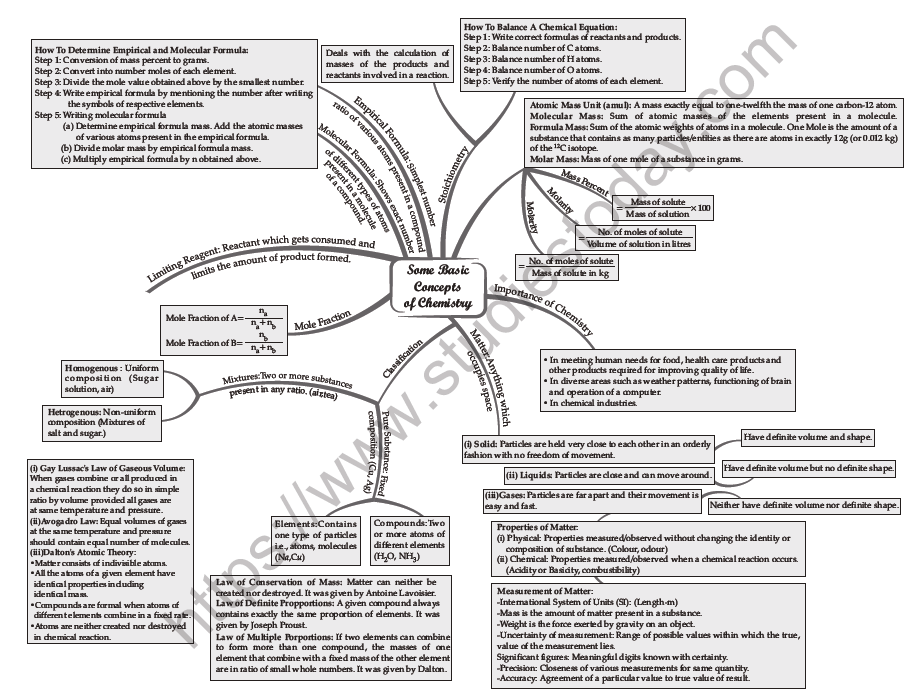
These Class 11 Chemistry mind maps give a quick chapter-wise revision of all the chapters of the syllabus, from Some Basic Concepts of Chemistry and Structure of Atom through classification of elements, chemical bonding, thermodynamics, equilibrium and redox reactions to organic chemistry and hydrocarbons. Each mind map is written out below as notes, with definitions, laws, formulas and key points in the order they appear.
SOME BASIC CONCEPTS OF CHEMISTRY
Importance of Chemistry:
- In meeting human needs for food, health care products and other products required for improving quality of life.
- In diverse areas such as weather patterns, functioning of brain and operation of a computer.
- In chemical industries.
Matter: Anything which occupies space.
(i) Solid: Particles are held very close to each other in an orderly fashion with no freedom of movement. Have definite volume and shape.
(ii) Liquids: Particles are close and can move around. Have definite volume but no definite shape.
(iii) Gases: Particles are far apart and their movement is easy and fast. Neither have definite volume nor definite shape.
Properties of Matter:
(i) Physical: Properties measured/observed without changing the identity or composition of substance. (Colour, odour)
(ii) Chemical: Properties measured/observed when a chemical reaction occurs. (Acidity or Basicity, combustibility)
Measurement of Matter:
- International System of Units (SI): (Length-m)
- Mass is the amount of matter present in a substance.
- Weight is the force exerted by gravity on an object.
- Uncertainty of measurement: Range of possible values within which the true value of the measurement lies.
- Significant figures: Meaningful digits known with certainty.
- Precision: Closeness of various measurements for same quantity.
- Accuracy: Agreement of a particular value to true value of result.
Classification:
Mixtures: Two or more substances present in any ratio. (air, tea)
Homogenous: Uniform composition (Sugar solution, air)
Hetrogenous: Non-uniform composition (Mixtures of salt and sugar.)
Pure Substance: Fixed composition (Cu, Ag)
Elements: Contains one type of particles i.e., atoms, molecules (Na, Cu)
Compounds: Two or more atoms of different elements (H2O, NH3)
Laws of chemical combination:
Law of Conservation of Mass: Matter can neither be created nor destroyed. It was given by Antoine Lavoisier.
Law of Definite Propportions: A given compound always contains exactly the same proportion of elements. It was given by Joseph Proust.
Law of Multiple Porportions: If two elements can combine to form more than one compound, the masses of one element that combine with a fixed mass of the other element are in ratio of small whole numbers. It was given by Dalton.
(i) Gay Lussac's Law of Gaseous Volume: When gases combine or all produced in a chemical reaction they do so in simple ratio by volume provided all gases are at same temperature and pressure.
(ii) Avogadro Law: Equal volumes of gases at the same temperature and pressure should contain equal number of molecules.
(iii) Dalton's Atomic Theory:
- Matter consists of indivisible atoms.
- All the atoms of a given element have identical properties including identical mass.
- Compounds are formal when atoms of different elements combine in a fixed rate.
- Atoms are neither created nor destroyed in chemical reaction.
Mole Fraction:
Mole Fraction of A = na / (na + nb)
Mole Fraction of B = nb / (na + nb)
Limiting Reagent: Reactant which gets consumed and limits the amount of product formed.
Atomic and molecular masses:
Atomic Mass Unit (amul): A mass exactly equal to one-twelfth the mass of one carbon-12 atom.
Molecular Mass: Sum of atomic masses of the elements present in a molecule.
Formula Mass: Sum of the atomic weights of atoms in a molecule. One Mole is the amount of a substance that contains as many particles/entities as there are atoms in exactly 12g (or 0.012 kg) of the 12C isotope.
Molar Mass: Mass of one mole of a substance in grams.
Concentration terms:
Mass Percent = \( \frac{\text{Mass of solute}}{\text{Mass of solution}} \) × 100
Molarity = \( \frac{\text{No. of moles of solute}}{\text{Volume of solution in litres}} \)
Molality = \( \frac{\text{No. of moles of solute}}{\text{Mass of solute in kg}} \)
Stoichiometry: Deals with the calculation of masses of the products and reactants involved in a reaction.
How To Balance A Chemical Equation:
Step 1: Write correct formulas of reactants and products.
Step 2: Balance number of C atoms.
Step 3: Balance number of H atoms.
Step 4: Balance number of O atoms.
Step 5: Verify the number of atoms of each element.
Empirical Formula: Simplest ratio of various atoms present in a compound.
Molecular Formula: Shows exact number of different types of atoms present in a molecule of a compound.
How To Determine Empirical and Molecular Formula:
Step 1: Conversion of mass percent to grams.
Step 2: Convert into number moles of each element.
Step 3: Divide the mole value obtained above by the smallest number.
Step 4: Write empirical formula by mentioning the number after writing the symbols of respective elements.
Step 5: Writing molecular formula
(a) Determine empirical formula mass. Add the atomic masses of various atoms present in the empirical formula.
(b) Divide molar mass by empirical formula mass.
(c) Multiply empirical formula by n obtained above.
STRUCTURE OF ATOM
Atomic Number (Z): Number of protons in nucleus of an atom or number of electrons in a neutral atom.
Mass Number (A): Number of protons (Z) + number of neutrons (n).
Isotopes: Atoms of same element having same atomic number but different mass number. (Isotopes of hydrogen) Protium 1H1, Deuterium 2D1 and Tritium 3T1.
Isobars: Atoms of different elements with different atomic number but same mass number. (Ca and Ar)
Discovery of Electron: By J.J. Thomson. Charge to mass ratio of electron = 1.758820 × 10¹¹ C kg-1. Charge on electron = 1.6022 × 10⁻¹⁹ C. Mass of electron = 9.1094 × 10⁻³¹ kg.
Discovery of Proton: By Ernest Rutherford. Charge on proton = +1.6022 × 10⁻¹⁹ C. Mass of proton = 1.672 × 10⁻²⁷ kg.
Discovery of Neutron: By James Chadwick. Charge on neutron = 0. Mass of neutron = 1.675 × 10⁻²⁷ kg.
Thomson Model of Atom (Watermelon Model): Atom possesses a spherical shape in which the positive charge is uniformly distributed.
[Figure: Circle representing the atom, labelled "Positive space", with five small dots inside labelled "Electron"]
Rutherford's Nuclear Model of Atom:
Postulates:
- Positive charge and most of the mass of atoms was densely concentrated in extremely small region (ie) nucleus.
- Nucleus is surrounded by electrons that move around the nucleus with high speed in circular path called orbits.
- Electrons and nucleus are held together by electrostatic forces of attraction.
Drawbacks:
- It cannot explain the stability of an atom.
- It does not say anything about the electronic structure of atoms.
Developments Leading To Bohr's Model of Atom:
Dual nature ie wave like and particle like of the electromagnetic radiation.
- Experimental results regarding atomic spectra.
- Wave nature of electromagnetic radiation: It was given by James Maxwell.
Frequency (ν): Number of waves that pass a given point in one second. Unit - Hertz (Hz). Velocity of light = Frequency × Wave length
Wave number (ν̄): Number of wavelengths per unit length. Unit - m-1
- Particle nature of electromagnetic radiation: Planck's quantum theory: E = hν. Planck's constant (h) = 6.626 × 10⁻³⁴ Js
Photoelectric Effect (found by H. Hertz): It is the phenomenon of ejection of electrons from the surface of a metal when light of suitable frequency strikes on it.
KE of ejected electron: hν = hν0 + ½ mev²
Atomic Spectra - Types:
- Emission Spectra: Spectrum of radiation emitted by a substance that has absorbed energy.
- Absorption Spectra: It is like photographic negative of an emission spectra.
- Line / Atomic Spectra: Emission Spectra which do not show a continuous spread of wavelength from red to violet, rather they emit light only at specific wavelength with dark space between them.
ν̄ = 109677 ( \( \frac{1}{n_1^2} - \frac{1}{n_2^2} \) ) cm-1 where n1 = 1, 2, ... and n2 = n1 + 1, n1 + 2, ...
| Series | n1 | n2 | Spectral Region |
|---|---|---|---|
| Lyman | 1 | 2, 3, ... | Ultraviolet |
| Balmer | 2 | 3, 4, ... | Visible |
| Paschen | 3 | 4, 5, ... | Infrared |
| Brackett | 4 | 5, 6, ... | Infrared |
| Pfund | 5 | 6, 7, ... | Infrared |
Bohr's Model for Hydrogen Atom:
Postulates:
- Electron in H atom can move around the nucleus in a circular path of fixed radius and energy called as orbits. These orbits are arranged concentrically around the nucleus.
- Each of these orbits has a definite energy known as energy levels or stationary states.
- When an electron jumps from a lower energy level to higher one, some energy is absorbed.
- ν = \( \frac{E}{h} \) = \( \frac{E_2 - E_1}{h} \) Bohr's frequency rule.
Angular momentum of electron: mevr = n \( \frac{h}{2\pi} \), n = 1, 2, 3, ...
Limitations:
- Unable to account for finer details of H atom. Spectrum observed by sophisticated spectroscopic techniques.
- Could not explain the ability of atoms to form molecules by chemical bonds.
Quantum Mechanical Model of Atom:
- Dual behaviour of atom i.e., particle and wavelike. De Broglie equation: λ = \( \frac{h}{mv} \) = \( \frac{h}{p} \)
- Heisenberg's Uncertainty Principle: It is impossible to determine simultaneously, the exact position and momentum of an electron.
Δx · Δpx ≥ \( \frac{h}{4\pi} \)
⇒ Δv · Δx ≥ \( \frac{h}{4\pi m} \)
Schrodinger Equation: Fundamental Equation was developed by Schrodinger as Ĥψ = Eψ where Ĥ = Hamiltonian
Quantum Numbers:
(i) Principal quantum number (n): n = 1, 2, 3, 4, ... Shell = K, L, M, N, ...
(ii) Azimuthal Quantum number: For given value of n, l = 0 to n-1
(iii) Magnetic Quantum number (m): for subshell with 'l' value ml = 2l + 1
(iv) Spin Quantum Number (ms): +1/2 (↑), -1/2 (↓)
Electronic Configuration of atoms:
(i) sa pb dc ... notation
(ii) Orbital diagram
Filling of orbitals in atom:
- Aufbau Principle: In the ground state of atoms, the orbital's are filled according to increasing energies.
- Pauli Exclusion Principle: No 2 electrons in an atom can have same set of four quantum numbers.
- Hund's rule: Pairing of electrons in the orbitals belonging to same subshell does not take place until each electron belonging to the subshell is singly occupied.
Energy of orbitals: Lower the value of (n + l) for an orbital, lower is its energy.
Shapes of orbitals:
s Orbitals: Spherically symmetric. Size increases with increase in size in n, ie, 4s > 3s > 2s > 1s
p Orbitals: Each p Orbitals consists of two sections called lobes on either side of plane passing through the nucleus. Size: 4p > 3p > 2p
d Orbitals: "Clover leaf" distribution. Two angular nodes.
[Figure: Orbital shapes - 1s and 2s spheres on x, y, z axes; 2px, 2py and 2pz dumbbell lobes along their axes; dxy, dxz, dyz and dx2-y2 clover-leaf shapes with four lobes; dz2 with two lobes along the z axis and a ring around the centre]
CLASSIFICATION OF ELEMENTS AND PERIODICITY IN PROPERTIES
Purpose: To ease out difficulty in studying individually the chemistry of all the elements and their compounds.
Genesis of Periodic Classification:
- Law of Triads: Johann Dobereiner (1829)
- Law of Octaves: John Alexander Newlands (1865)
- Periodic Law: Dimitri Mendeleev and Lothar Meyer. It states that the properties of the elements are periodic function of their atomic weights.
- Modern Periodic Law: Henry Moseley (1913). It states that the physical and chemical properties of the elements are periodic functions of their atomic numbers. Horizontal rows - Periods, Vertical columns - Groups - are numbered from 1 to 18.
IUPAC Nomenclature of Elements with Atomic numbers > 100: Derived from the atomic number of element using numerical roots for 0 and numbers 1-9 and "ium" is added at the end.
Properties of Elements based on Electronic Configuration:
- Electronic Configuration is the distribution of electrons into orbitals of an atom.
- In periods: Number of elements in each period is twice the number of atomic orbitals available in the energy level that is being filled.
- Group wise: Elements in same group have similar valence shell electronic configurations. Same number of electrons in outer orbitals and similar properties. These are classified into four blocks i.e., s-block, p-block, d-block and f-block.
Periodic Table Classification based on Types of Elements:
s-Block Elements:
- Group 1 (alkali metals) and Group 2 (alkaline earth metals)
- Outermost configuration is ns1 or ns2
- Reactive with low IE.
- Metallic character and reactivity increases down the group.
p-Block elements:
- Group 13 to 18.
- Also called as representatives or main group elements
- Outermost configuration varies from ns2 np1 to ns2 np6
- At the end of period are low reactive noble gases.
- Halogens and Chalcogens have high negative electron gain enthalpies.
- Metallic character increases down the group.
d-Block Elements:
- Group 3-12
- Outer configuration is (n-1) d1-10 ns0-2
- Forms coloured ions.
- Exhibit variable valence, paramagnetism.
- Also called as Transition elements.
- Some are used as catalysts.
f-Block Elements:
- Also called as Inner Transition Elements.
- Contains Lanthanoids and Actinoids.
- Outer configuration ie (n-2) f1-14 (n-1) d0-10 ns2
- All are metals.
- Actinoids are radioactive.
Periodic Trends in Properties of Elements:
| Properties | Group | Period |
|---|---|---|
| (a) Atomic Radius: Distance from the centre of the nucleus to the outermost shell containing electrons. | Increases | Decreases |
| (b) Electron Gain Enthalpy: Energy released when a neutral isolated gaseous atom accepts an electron to form an anion. | Becomes less negative | Becomes more negative |
| (c) Ionization Energy: The minimum amount of energy required to remove the electron from the outmost orbit of an isolated atom in gaseous state. | Decreases | Increases |
| (d) Electronegativity: Tendency of an atom to attract the shared pair of electrons towards itself. | Decreases | Increases |
| (e) Electron Affinity | Decreases | Increases |
| (f) Valency: Number of univalent atoms which combine with an atom of given element. | No Change | Increase from 1 to 4 and then decrease from 4 to 0. |
| (g) Metallic Character: | Increases | Decreases |
| (h) Non-Metallic Character: | Decreases | Increases |
CHEMICAL BONDING AND MOLECULAR STRUCTURE
Chemical Bond: Attractive forces which hold the various chemical constituents together in different chemical species.
Types:
(i) Covalent Bond: A chemical bond formed between two atoms by mutual sharing of electrons between them to complete their octet.
(ii) Ionic Bond: A chemical bond formed by complete transference of electrons from one atom to another acquire the stable nearest noble gas configuration.
Lattice Enthalpy: Energy required to completely separate one mole of a solid ionic compound into gaseous constituent ions.
Kossel Lewis approach to chemical bonding:
- Lewis pictured the atom as a positively charged 'kernel' and the outer shell accommodates a maximum of eight electrons.
- Lewis postulated that atoms achieve the stable octet when linked by chemical bonds.
- Kossel gave following facts:
- In the periodic table, highly electronegative halogens and highly electropositive alkali separated by noble gases.
- Formation of a negative ion from a halogen atom and a positive ion from an alkali metal atom is associated with gain and loss of electron by respective atoms.
- Negative and positive ions formed attain noble gas electronic configurations.
- Negative and positive ions are stabilized by electrostatic attraction.
Octet Rule: Atoms can combine either by transfer of valence electrons from one atom to another or by sharing of valence electrons to complete octet in their valence shells.
Lewis Dot Structure provides a picture of bonding in molecules and ions in terms of the shared pairs of electrons and the octet rule.
How To Write A Lewis Dot Structure:
Step 1: Add the valence electrons of the combining atoms to obtain total number of electrons.
Step 2: For anions, each negative charge means addition of one electron. For cations, each positive charge means subtraction of one electron from total number of valence electrons.
Step 3: Write chemical symbols of combining atoms.
Step 4: Least electronegative atom occupies central position.
Step 5: After accounting for shared pairs of electrons remaining are either utilized for multiple bonding or remain as lone pairs.
Formal Charge = (Total number of valence electrons in free atom) - (Total number of non-bonding electrons) - ½ (Total number of bonding electrons)
Limitations Of Octet Rule:
- Shows three types of exceptions (ie) incomplete octet of central atom, odd-electron molecules and expanded octet.
- Does not account for the shape of molecules.
- Fails to explain stability of molecules.
Hydrogen Bond: Formed when the negative end of one molecule attracts the positive end of other.
Types:
(i) Intermolecular: Between two different molecules of same or different compounds.
(ii) Intramolecular: H atom is between two highly electronegative atoms.
Molecular orbital theory - Postulates:
- Electrons in a molecule are present in various molecular orbitals as electrons are present in atomic orbitals.
- Atomic orbitals of comparable energies and proper symmetry combine.
- Atomic orbitals is monocentric while a molecular orbital is polycentric.
- Number of molecular orbital formed is equal to number of combining molecular orbitals.
- Bonding molecular orbitals has low energy and high stability.
Types of MO: σ (Sigma), π (Pi), δ (Delta)
Valence Shell Electron Pair Repulsion (VSEPR):
Postulates:
- Shape of molecule depends upon the number of valence shell electron pairs around central atom.
- Pairs of electrons in the valence shell repel one another.
- These pairs of electrons tend to occupy such positions in space that minimize repulsion.
- The valence shell is taken as a sphere with electron pairs localising on spherical surface at maximum distance from one another.
- A multiple bond is treated as if it is a single electron pair and the two or three electron pairs of a multiple bond are treated as a single super pair.
- When one or more resonance structures can represent a molecule, VSEPR model is applicable.
- Decreasing order of repulsive interaction: lp - lp > lp - bp > bp - bp
Hybridization:
Valence Bond Theory: Given by L Pauling. It explains that a covalent bond is formed between two atoms by overlap of their half-filled valance orbitals, each of which contains one unpaired electron.
Orbital Overlap Concept: Formation of a covalent bond results by pairing of electrons in valence shell with opposite spins.
Types of Overlapping: (i) Sigma (σ) bond - end to end. (ii) Pi (π) bond - axis remain parallel to each other.
Hybridisation: Process of intermixing of orbitals of different energies resulting in formation of new set of orbitals of equivalent energies and shape.
Types of Hybridisation - (i) sp (ii) sp² (iii) sp³
Bonding Molecular Orbitals: Addition of atomic orbitals.
Antibonding Molecular Orbitals: Substraction of atomic orbitals.
Bond Parameters:
(i) Bond Length: Equilibrium distance between the nuclei of two bonded atoms in molecule.
(ii) Bond Angle: Angle between the orbitals containing bonding electron pairs around central atom in a molecule complex ion.
(iii) Bond Enthalpy: Amount of energy required to break one mole of bonds of particular type between 2 atoms.
(iv) Bond Order: Number of bonds between the two atoms of a molecule.
(v) Resonance Structures: Are a set of two or more Lewis structures that collectively describe the electronic bonding a single polyatomic species.
(vi) Dipole Moment: Product of the magnitude of the charge and distance between centres of positive and negative charge. μ = Q × r
Geometry of molecules (VSEPR shapes):
| Type | Shape | Bond angle | Examples |
|---|---|---|---|
| AB2 | Linear | 180° | BeCl2, HgCl2 |
| AB3 | Trigonal planar | 120° | BF3 |
| AB4 | Tetrahedral | 109°5' | CH4, NH4+ |
| AB5 | Trigonal Bipyramidal | 90° and 120° | PCl5 |
| AB6 | Octahedral | 90° | SF6 |
| AB2E | Bent | SO2, O3 | |
| AB3E | Trigonal pyramidal (Tetrahedral) | NH3 | |
| AB4E | See saw (Trigonal-bi-pyramidal) | SF4 | |
| AB5E | Square pyramid (Octahedral) | BrF5 | |
| AB2E2 | Bent (Tetrahedral) | H2O | |
| AB3E2 | T-shape (Trigonal-bi-pyramidal) | ClF3 | |
| AB4E2 | Square planar (Octahedral) | XeF4 |
STATES OF MATTER: GASES, LIQUIDS AND SOLIDS
Intermolecular Forces are the forces of attraction and repulsion between interacting particles.
- London dispersion forces are the weakest intermolecular forces present among non-polar atoms and molecules.
- Dipole - dipole forces act between the molecules possessing permanent dipole.
- Dipole - induced dipole forces are the attractive forces operate between polar molecules having permanent dipole.
- Hydrogen bond is found in the molecules in which highly polar N-H, H-O and H-F bonds are present.
Thermal Energy is the energy of body arising from motion of its atoms or molecules.
Intermolecular forces vs thermal interaction:
Gas → Liquid → Solid: Predominance of intermolecular interactions
Gas ← Liquid ← Solid: Predominance of thermal energy
Gaseous State - Physical Properties:
- Gases are highly compressible.
- Gases exert pressure equally in all directions.
- Gases have much lower density than solids and liquids.
- Volume and shape of gases are not fixed.
- They mix evenly and completely in all proportions.
Gas Laws:
- Boyle's Law (Pressure - Volume relationship): At constant temperature, the pressure of a fixed amount of gas varies inversely with its volume. P1V1 = P2V2 = Constant ⇒ \( \frac{P_1}{P_2} \) = \( \frac{V_2}{V_1} \)
- Charles' Law (Temperature - Volume relationship): At constant pressure, the volume of a fixed mass of a gas is directly proportional to the absolute temperature. \( \frac{V_1}{T_1} \) = \( \frac{V_2}{T_2} \) ⇒ \( \frac{V}{T} \) = Constant
- Gay Lussac's Law (Pressure - Temperature relationship): At constant volume, pressure of a fixed amount of a gas varies directly with temperature. \( \frac{P}{T} \) = constant
- Avogadro Law (Volume - Amount relationship): Equal volume of all gases under the same conditions of temperature and pressure contain equal number of molecules. V = kn; n = \( \frac{\text{Mass of gas}}{\text{Molar Mass}} \)
Ideal Gas Equation:
R = \( \frac{pV}{nT} \), R is gas constant / universal gas constant
R = 8.314 JK-1 mol-1
Postulates of Kinetic-Molecular Theory of gases:
- A gas contains a large number of small particles called molecules. Size and mass of all molecules of each gas are identical.
- There is no force of attraction between the particles of a gas at ordinary temperature and pressure.
- Particles of a gas are always in constant and random motion.
- Particles of a gas move in all possible directions in straight lines.
- Collisions of gas molecules are perfectly elastic.
- At any particular time, different particles in the gas have different speeds and hence different kinetic energies.
- If a molecule has variable speed, then it must have variable kinetic energy.
Dalton's Law of Partial Pressure: Total pressure exerted by the mixture of non-reactive gases is equal to sum of the partial pressures of individual gases. Ptotal = p1 + p2 + p3 ... (At constant T, V)
Density and molar mass at a gaseous substance: M = \( \frac{dRT}{p} \)
Deviation from ideal gas behaviour:
- Real gases show deviations from ideal gas law because molecules interact with each other.
- Pressure exerted by the gas is lower than the pressure exerted by the ideal gas.
Pideal = Preal + \( \frac{an^2}{V^2} \) (Preal is the observed pressure; the term \( \frac{an^2}{V^2} \) is the correction term)
- Compressibility factor Z = \( \frac{PV}{nRT} \)
Liquefaction of Gases: Volume of one mole of gas at critical temperature is called critical volume (Vc) and pressure at this temperature is called critical pressure (Pc).
Liquid State:
Intermolecular forces are stronger than gaseous state.
- Boiling is the condition of free vapourisation throughout the liquid.
- Normal b.p. is boiling point at 1 atm.
- Standard b.p. is boiling point at 1 bar.
Surface Tension: Denoted by Gamma (γ). Unit: Nm-1. It is the force acting per unit length perpendicular to the line drawn on the surface of liquid.
Viscosity: F = ηA \( \frac{dx}{dz} \)
- Viscosity coefficient (η) is the force when velocity gradient is unity and the area of contact is unit area.
- SI unit of viscosity coefficient is Newton second per square metre (N s m-2) = Pa s (Pascal second).
CHEMICAL THERMODYNAMICS
Terms:
- Systems and surroundings: A system refers to that part of universe in which observations are made and remaining universe constitutes the surroundings.
- Types of System:
1. Open System: There is exchange of energy and matter between system and surroundings.
2. Closed System: There is no exchange of matter but exchange of energy is possible.
3. Isolated System: There is no exchange of energy or matter between the system and the surroundings.
4. State of system: is described by its measurable or macroscopic properties.
5. Internal Energy: as a state function: It is the sum of chemical, electrical, mechanical or any other type of energy.
6. (a) Work: Adiabatic process is in which there is no transfer of heat between system and surroundings. ΔU = U2 - U1 = Wad
(b) Heat is change in internal energy of a system by transfer of heat from the surroundings to the system or vice-versa without expenditure of work. q is positive: Heat is transferred from surroundings to system. q is negative: Heat is transferred from system to surroundings.
(c) General Case: First law of Thermodynamics: ΔU = q + w, the energy of an isolated system is constant.
Extensive Property: property whose value depends in the quantity or size of matter present.
Intensive property: property which does not depend on the quantity or size of matter present in the system. Temperature, density, pressure.
Relationship Between Cp And Cv For An Ideal Gas: Cp - Cv = R
Measurement of ΔU and ΔH: In calorimetry, the process is carried out in a vessel called calorimeter, immersed in a known volume of a liquid.
(a) ΔU measurements: The energy changes are measured at constant volume. No work is done.
(b) ΔH measurements: In exothermic reaction, heat is evolved, so qp and ΔrH will be negative. In endothermic reaction, heat is absorbed, so qp and ΔrH will be positive.
Enthalpy Change, ΔrH - Reaction Enthalpy:
ΔrH = Σ ai Hproducts - Σ bi Hreactants
(a) Standard Enthalpy of reactions is the enthalpy change for a reaction when all the participating substances are in their standard states.
(b) Enthalpy changes during phase transformations: Standard enthalpy of fusion / molar enthalpy of fusion, ΔfusHθ is the enthalpy change that accompanies melting of one mole of a solid substance in standard state. Standard enthalpy of vaporization or molar enthalpy of vaporization, ΔvapHθ is the amount of heat required to vaporize one mole of a liquid at constant temperature and under standard pressure.
(c) Standard molar enthalpy of formation ΔfHθ is the standard enthalpy change for the formation of one mole of a compound from its elements in their most stable state of aggregation.
Standard Enthalpy of combustion: ΔcHθ is the enthalpy change per mole of a substance when it undergoes combustion and all reactants and products are in standard state.
Enthalpy of atomization: ΔaHθ is the enthalpy change on breaking one mole of bonds completely to obtain atoms in gas phase.
ΔrHθ: Σ bond enthalpies reactants - Σ bond enthalpies products
Hess's Law of Constant Heat Summation: If a reaction takes place in several steps then its standard reaction enthalpy is the sum of standard enthalpies of the intermediate reactions into which the overall reaction may be divided at the same temperature.
ΔrH = ΔrH1 + ΔrH2 + ΔrH3 ...
[Figure: Hess's law cycle - A goes to C with ΔrH1 on the top arrow; A goes down to B with ΔrH1 on the left arrow; B goes to D with ΔrH2 on the bottom arrow; D goes up to C with ΔrH3 on the right arrow]
Enthalpy of Solutions: ΔsolHθ is the enthalpy change when one mole of a substance dissolves in a specified amount of solvent.
Gibbs Energy: ΔrGθ = -RT ln K
ΔG = ΔH - TΔS
ΔG is less than 0, process is spontaneous.
ΔG is greater than 0, process is non-spontaneous.
Lattice Enthalpy: is the enthalpy change when one mole of an ionic compound dissociates into its ions in gaseous state.
A spontaneous process is an irreversible process which may be reversed by some external agency.
Applications:
Work = PexΔV = -Pex (Vf - Vi) = -∫ Pex dV (limits Vi to Vf)
Reversible Process: The process which can be reversed at any moment by an infinitesimal change.
Irreversible Process: Processes other than reversible process.
At constant temperature Wrev = -2.303 nRT log \( \frac{V_f}{V_i} \)
For adiabatic change, q = 0, ΔU = Wad
Enthalpy, H:
ΔH is negative: Exothermic reactions.
ΔH is positive: Endothermic reactions.
Heat Capacity: q = C × m × ΔT = CΔT
Entropy:
ΔSTotal = ΔSsystems + ΔSsurroundings
ΔS = \( \frac{q_{rev}}{T} \)
EQUILIBRIUM
Equilibrium In Chemical Processes - Under given set of conditions: If a chemical reaction is carried out in a closed container, a constancy in some observable properties like colour, pressure is observed. Such a state is referred as equilibrium state.
Dynamic Equilibrium: Chemical reactions reach a state of dynamic equilibrium in which the rate of forward and reverse reactions are equal and there is no net change in composition.
Types:
Homogeneous Equilibria: Reactants and products are in same phase.
Hetrogeneous Equilibria: Reactants and products are present in two or more phases.
Physical Equilibrium: Equilibrium set up in physical processes like evaporation of water, etc.
- Solid ⇌ Liquid
- Liquid ⇌ Gas
- Solid ⇌ Gas
Characteristics:
- Possible only in a closed system at a given temperature.
- Both the reactions occur at same rate.
- All measurable property remains constant.
- When equilibrium is attained one of its parameter remains constant at given temperature.
- Magnitude of such quantities at any stage indicates the extent to which process has proceeded before reaching equilibrium.
Chemical Equilibrium: Speed of forward reaction equals that of backward reaction.
Characteristics:
- Can be achieved from either side.
- Dynamic in nature.
- There is no change in concentration of various species.
- Observable physical properties become constant.
- Equilibrium is attained rapidly by the presence of catalyst.
Equilibrium Law or Law of Chemical Equilibrium: At a given temperature, the product of concentrations of the reaction products raised to the respective stoichiometric coefficient in the balanced chemical equation divided by the product of concentration of the reactions raised to their individual stoichiometric coefficients has a constant value: aA + bB ⇌ cC + dD
Kc = \( \frac{[C]^c [D]^d}{[A]^a [B]^b} \)
Equilibrium Constant: The equilibrium constant for the reverse reaction is the inverse of the equilibrium constant for reaction in the forward direction.
Applications of Equilibrium Constants:
- Applicable only when concentrations of the reactants and products have attained constant value at equilibrium state.
- Value of Kc is independent of initial concentrations of the reactants and products.
- Equilibrium constant is temperature dependent.
- Kc reverse = \( \frac{1}{K_c} \)
- Equilibrium constant for a reaction is related to equilibrium constant of corresponding reaction.
Predicting the Extent of a Reaction:
- Kc less than 10-3: reaction proceeds rarely.
- Kc greater than 103: reaction proceeds nearly to completion.
- Kc between 10-3 to 103: reaction is at equilibrium.
Predicting the Direction of a Reaction:
- If Qc is less than Kc, net reaction goes from left to right.
- If Qc is greater than Kc, net reaction goes from right to left.
- If Qc = Kc, no net reaction occurs.
Calculating Equilibrium Concentrations:
Step 1: Write the balanced equation for the reaction.
Step 2: Make a table that lists for each substance involved in reaction; Initial concentration, change in concentration, equilibrium concentration.
Step 3: Substitute the equilibrium concentrations into the equilibrium equation for the reaction and solve.
Step 4: Calculate equilibrium concentrations from the calculated value of concentration of substances.
Step 5: Check results by substituting them into the equilibrium equation.
Buffer Solutions are the solutions which resist change in pH on dilution or addition of acid or alkali.
Solubility Product (Ksp): For a sparingly soluble salt, it is the product of molar concentration of ions raised to power equal to numbers of times each ion.
Relationship Between Equilibrium Constant K, Reaction Quotient Q And Gibbs Energy G:
ΔG is negative, reaction is spontaneous and proceeds in forward reaction.
ΔG is positive, reaction is non-spontaneous and proceeds in reserve reaction.
ΔG is 0, reaction has achieved equilibrium.
K = e-ΔG°/RT
Acids and Bases: Acids turn blue litmus into red and liberate dihydrogen on reacting with some metals. Bases turn red litmus into blue, taste bitter and feel soapy. Salts are formed when acids and bases are mixed in right proportion. Lewis Acid accepts an electron pair. Lewis Base donates an electron pair.
Acidic: [H3O+] > [OH-]
Neutral: [H3O+] = [OH-]
Basic: [H3O+] < [OH-]
Arrhenius Concept of Acids and Bases: Arrhenius theory states that acids are substances that dissociates in water give hydrogen ions and bases are substances that produce hydroxyl ions.
Bronsted Lowry Theory states that acid is a substance that is capable of donating hydrogen ion and bases are substances capable of accepting a hydrogen ion.
- Weak acids have very strong conjugate bases.
pH of a solution is negative logarithm to base 10 of the activity of hydrogen ion.
Acidic strength of hydrogen halides: HF << HCl << HBr << HI (size increases, acidic strength increases)
Factors Affecting Equilibria:
- Le Chatelier's principle: A change in any of the factors that determine the equilibrium conditions of a system will cause the system to change in such a manner so as to counteract the effect of the change.
- Effect of Concentration Change: If concentration of reactants is increased, equilibrium will shift in forward direction and vice-versa.
- Effect of Pressure Change: No effect if moles of reactants and products are same. If there is change in number of moles, equilibrium will shift in the direction having smaller number of moles when the pressure is increased and vice-versa.
- Effect of Inert Gas Addition: If volume is constant, ie addition does not change partial pressure or molar concentrations, equilibrium is not affected.
- Effect of Temperature change: For exothermic, low temperature favours formation of reactants; for endothermic, high temperature favours formation of products.
REDOX REACTIONS
Oxidation: Addition of oxygen to an element/compound or removal of hydrogen from a substance. Loss of electrons.
Reducing agent: Donor of electron(s) → Increases O.N.
Reduction: Removal of oxygen from a substance or addition of hydrogen to a substance. Gain of electrons.
Oxidising agent: Acceptor of electron(s) → Lowers O.N.
Types of Redox Reactions:
1. Combination reactions: A + B → C; Either A and B or both A and B must be in elemental form.
2. Decomposition reactions: Leads to the breakdown of a compound into two or more components at least one of which must be in the elemental state. CaCO3(s) → (Δ) CaO(s) + CO2(g)
3. Displacement reactions: An ion/atom in a compound, is replaced by an ion/atom of another element, X + YZ → XZ + Y
(a) Metal displacement: CuSO4(aq) + Zn(s) → Cu(s) + ZnSO4(aq)
(b) Non-Metal displacement: Includes hydrogen displacement.
4. Disproportionation reaction: An element in one oxidation state is simultaneously oxidised and reduced.
Oxidation Number: Oxidation state of an element in a compound ascertained according to a set of rules formulated on the basis that pair in a covalent bond belongs to electronegative element.
Rules for O.N.:
1. In elements, each atom bears an oxidation number of zero.
2. For ions with only one atom, O.N. is equal to the charge on ion.
3. O.N. of oxygen in most compounds is -2.
4. O.N. of hydrogen is +1, except when it is bonded to metals in binary compound.
5. Halogens have O.N. of -1, when they occur as halide ions in their compound.
6. Algebraic sum of O.N. of all the atoms in a compound must be zero.
Competitive Electron Transfer Reactions:
Zn(s) + Cu2+(aq) → Zn2+(aq) + Cu(s)
Zn releases 2e- and Cu2+ gains 2e-.
Balancing of Redox Reactions - Two Methods:
O.N. Method:
Step 1: Write the correct formula for each reactant and product.
Step 2: Identify atoms undergoing change in O.N.
Step 3: Calculate increase / decrease in O.N. per atom and for entire ion or molecule. If unequal, multiply by suitable number to make equal.
Step 4: Add H+/OH- ion to make total ionic charges of reactants and product equal.
Step 5: Equalize H+ on two sides by adding water.
Half-Reaction Method:
Step 1: Produce, unbalanced equation for the reaction in ionic form.
Step 2: Separate equation into two half-reactions.
Step 3: Individually balance atoms other than O and H.
Step 4: For reactions occurring in acidic medium, add H2O to balance O atoms and H+ to balance H atoms.
Step 5: Balance charges by adding electrons to one side of the half reaction.
Step 6: Add two half reactions and cancel the electrons on each side.
Step 7: Verify if equation has same type and number of atoms and same charges on both sides of the equation.
Redox Reactions and Electrode Processes:
- Redox Couple: Having together oxidised and reduced forms of a substance involved in oxidation/reduction half reaction.
- Electrode Potential: Potential associated with each electrode.
- Standard Electrode Potential: Electrode potential of concentration of each species is unity and carried out at 298K.
Negative E°: Stronger reducing agent than H+/H2 couple.
Positive E°: Weaker reducing agent than H+/H2 couple.
Application: Study of electrode processes and cells.
HYDROGEN
Electronic Configuration: 1s1
Properties:
- Resembles alkali metals (lose one e- to form unipositive ions).
- Resembles halogens (gain one e- to form uninegative ion).
- Forms oxides, halides and sulphides.
- Very high ionization enthalpy.
- Does not possess metallic characters under normal conditions.
- Forms diatomic molecules.
Isotopes:
Protium: Predominant form. (11H)
Deuterium: (21H)
Tritium: Radioactive (31H)
Dihydrogen (H2):
Occurrence: Most abundant in universe.
Preparation:
Laboratory Method:
- Zn + 2H+ → Zn2+ + H2
- Zn + 2NaOH → Na2ZnO2 + H2
Commercial Method:
- 2H2O(l) → (Electrolysis, traces of acid/base) 2H2(g) + O2(g)
- By electrolysing warm aqueous barium hydroxide solution between Ni electrodes.
- CnH2n+2 + nH2O → (1270 K, Ni) nCO + (2n+1)H2
- CO + H2 is called water gas
- Cool Gasification: C(s) + H2O(g) → (1270 K) CO(g) + H2(g)
- Water-gas shift reaction: CO(g) + H2O(g) → (673 K, Catalyst) CO2(g) + H2(g)
Physical Properties:
- Colourless, odourless, tasteless and combustible.
- Lighter than air, insoluble in water.
Chemical Properties:
- H2(g) + X2(g) → 2HX(g) (X = F, Cl, Br, I)
- 2H2(g) + O2(g) → (Catalyst or Heating) 2H2O(l), ΔH° = -285.9 kJ mol-1
- 3H2(g) + N2(g) → (673 K, 200 atm, Fe) 2NH3(g), ΔH° = -92.6 kJ mol-1
- H2(g) + 2M(g) → 2MH(s), where M = alkali metal
- H2(g) + Pd2+(aq) → Pd(s) + 2H+(aq)
- H2 + CO + RCH=CH2 → RCH2CH2CHO
- H2 + RCH2CH2CHO → RCH2CH2CH2OH
Uses:
- Synthesis of ammonia.
- In manufacture of vanaspati fat.
- In manufacture of bulk organic chemicals.
- For manufacture of metal hydrides
- Preparation of HCl.
- In metallurgical processes.
- As a rocket fuel
- In fuel cells
Hydrides - Types:
(i) Ionic/saline/saltlike: Stoichiometric compounds of dihydrogen formed with s-block elements.
(ii) Covalent/molecular: Formation of molecular compounds from dihydrogen and p-block elements.
(iii) Metallic/non-stoichiometric/interstitial: Formed by d-block and f-block elements.
Water: (Human body: 65%, Plants: 95%)
Physical Properties:
- Colourless and tasteless
- Presence of extensive H bonding.
- High freezing point, high B.P., high heat of vaporization, high heat of fusion
Structure: Bent molecule with H-O-H bond angle 104.5° and O-H bond length 95.7 pm.
[Figure: Water molecule with oxygen at the top and two hydrogen atoms below, H-O-H angle 104.5 degrees, O-H bond length 95.7 pm; beside it a hydrogen-bonded network of water molecules in ice showing vacant spaces]
Chemical Properties:
- H2O(l) + NH3(aq) ⇌ OH-(aq) + NH4+(aq)
- 2H2O(l) + 2Na(s) → 2NaOH(aq) + H2(g)
- 6CO2(g) + 12H2O(l) → C6H12O6(aq) + 6H2O(l) + 6O2(g)
- P4O10(s) + 6H2O(l) → 4H3PO4(aq)
Difference: Hard water does not give lather with soap whereas soft water gives lather easily.
Temporary hardness: Removed by boiling, Clark's method. (Due to presence of magnesium and calcium hydrogen carbonates)
Permanent hardness: Removed by treatment with washing soda, Calgon's method, Ion exchange method, synthetic resins methods. (Due to presence of soluble salts of Mg and Ca in the form of chlorides and sulphate)
Heavy Water (D2O):
Preparation: By exhaustive electrolysis of water.
Uses:
- As a moderator in nuclear reactors.
- In exchange reactions for the study of reaction mechanisms.
Hydrogen Peroxide (H2O2):
Preparation:
- BaO2.8H2O(s) + H2SO4(aq) → BaSO4(s) + H2O2(aq) + 8H2O(l)
- 2HSO4-(aq) → (Electrolysis) HO3SOOSO3H(aq) → 2HSO4-(aq) + 2H+(aq) + H2O2(aq)
- 2-ethylanthraquinol ⇌ H2O2 + Oxidised Product (forward with O2 (air), reverse with H2/Pd)
Physical Properties:
- Colourless, miscible with water.
Structure: Non-Planar
Chemical Properties:
- PbS(s) + 4H2O2(aq) → PbSO4(s) + 4H2O(l)
- HOCl + H2O2 → H3O+ + Cl- + O2
- Mn2+ + H2O2 → Mn4+ + 2OH-
- I2 + H2O2 + 2OH- → 2I- + 2H2O + O2
- Decomposes on exposure
Uses:
- As hair bleach, disinfectant.
- Manufacture chemicals used in detergents.
- In industries as bleaching agent.
- In environmental chemistry.
s-BLOCK ELEMENTS
Electronic Configuration: ns1: Alkali metals; ns2: Alkaline earth metals
Group 1 Elements (Alkali Metals):
- Atomic and Ionic Radii: Increases with increase in atomic number.
- I.E.: Decreases down the group.
- Hydration Enthalpy: Decreases with increase in ionic sizes.
- Physical properties:
- Silvery white, soft and light metals.
- Low m.p. and b.p.
- Alkali metals and their salts impart colour to an oxidizing flame.
Chemical Properties:
4Li + O2 → 2Li2O; 2Na + O2 → Na2O2; M + O2 → MO2 (M = K, Rb, Cs)
2M + 2H2O → 2M+ + 2OH- + H2
2M + H2 → 2M+H-
React vigorously with halogens to form ionic halides
M + (x + y) NH3 → [M(NH3)x]+ + [e(NH3)y]-
Uses:
- Li is used to make useful alloys.
- Li is used in thermonuclear reactions and making electrochemical cells.
- Na is used to make Na/Pb alloy.
- Liquid Na metal is used as coolant in nuclear reactors.
- KCl is used as fertilizer.
- Cs is used in devising photoelectric cells.
Characteristics Of Compounds Of Alkali Metals:
Oxide and Hydroxides: Combustion in excess of air: +Li → Li2O; +Na → Na2O2; +K/Rb/Cs → MO2
Halides:
- Alkali metal halides (MX) have high melting, colourless crystalline solids.
- Preparation: Reaction of oxide, hydroxide or carbonate with aq HX.
- High negative enthalpies of formation.
- Melting and boiling points: F > Cl > Br > I
- Soluble in water.
Salts of Oxo-Acids:
- Alkali metals form salts with all oxo-acids.
- Soluble in water and thermally stable.
- Stability of carbonates and hydrogencarbonates increases
Anomalies properties of Li: Due to
(i) exceptionally small size of its atom and ion.
(ii) High polarising power.
Biological Importance of Na and K: Na ions participate in nuclear signals transmission, regulator of flow of water across cell membranes. K ions activate many enzymes and oxidation of glucose to produce ATP.
Group 2 Elements (Alkaline Earth Metals):
- Atomic and Ionic Radii: Smaller than corresponding alkali in group, increases with increase in atomic number.
- I.E: IE1 higher than corresponding Group 1 metals. IE2 smaller than corresponding alkali metals.
- Hydration Enthalpies: Decreases with increase in ionic size down the group.
Physical properties:
- Slivery white, lustrous and relatively soft but harder than alkali metals.
- M.p. and b.p. higher than corresponding alkali metals.
- Electropositive character increases down the group.
Chemical properties:
- Be and Mg are kinetically inert to O and H2O
- Mg is more electropositive and burns in air.
- Ca, Sr and Ba with air forms oxide and nitride.
M + X2 → MX2 (X = F, Cl, Br, I)
2BeCl2 + LiAlH4 → 2BeH2 + LiCl + AlCl3
M + 2HCl → MCl2 + H2
M + (x + y)NH3 → [M(NH3)x]2+ + 2[e(NH3)y]-
Uses:
- Be is used in the manufacture of alloys.
- Metallic Be is used for making windows of X-rays tubes.
- Mg-Al alloys are used in air craft construction.
- Ca in extraction of metals.
- Ra is used in radiotherapy.
Characteristics Of Compounds Of Alkaline Earth Metals:
Oxides and Hydroxides
- Alkaline earth metals burn oxygen to form MO.
- All oxides except BeO are basic in nature
MO + H2O → M(OH)2
Be(OH)2 is amphoteric in nature
Halides:
- Except for Be halides, all other halides are ionic.
- Tendency to form halide hydrates decreases gradually.
- Salts of oxoacids: Forms carbonates, sulphates and nitrates.
- Anomalous behavior of Be: Small atomic and ionic sizes, does not exhibit C.N. more than four, its oxide and hydroxide are amphoteric.
- Be shows diagonal relationship with Al.
Biological Importance Of Mg And Ca:
- All enzymes that utilise ATP in PO4 transfer requires Mg as cofactor. Chlorophyll contains Mg. Ca is present in bones and teeth. Important in neuromuscular function, intraneuronal transmission and blood coagulation.
Important Compounds of Calcium:
(i) CaO, Quick Lime
Preparations: CaCO3 ⇌ (heat) CaO + CO2
Properties: White amorphous solid with m.p. 2870 K. CaO + H2O → Ca(OH)2, CaO + CO2 → CaCO3
(ii) Ca(OH)2 Calcium hydroxide
Preparations: Additional of water to CaO.
Properties: white amorphous powder. Ca(OH)2 + CO2 → CaCO3 + H2O
(iii) CaSO4.½H2O (Plaster of Paris)
2(CaSO4.2H2O) → 2(CaSO4).H2O + 3H2O
Important Compounds of Sodium:
(i) Sodium Carbonate (Washing Soda)
Preparation: By Solvay process
2NH3 + H2O + CO2 → (NH4)2CO3
(NH4)2CO3 + H2O + CO2 → 2NH4HCO3
NH4HCO3 + NaCl → NH4Cl + NaHCO3
2NaHCO3 → Na2CO3 + CO2 + H2O
2NH4Cl + Ca(OH)2 → 2NH3 + CaCl2 + H2O
Properties: (a) White, crystalline solid. (b) Readily soluble in water
Na2CO3.10H2O → (375 K) Na2CO3.H2O + 9H2O
Na2CO3.H2O → (above 373 K) Na2CO3 + H2O
Uses: Water softening, laundering, cleaning, manufacture, as laboratory reagent.
(ii) Sodium Chloride (NaCl)
Preparation: Crude NaCl by crystallization of brine solution. Pure NaCl is obtained by dissolving crude salt in minimum water and filtered to remove insoluble impurities. Solution is saturated with HCl gas. Uses: As common salt.
(iii) Sodium Hydroxide (NaOH)
Preparation: By electrolysis of NaCl in Castner-Kellner cell.
Uses: In manufacture of soap, paper, petroleum refining.
(iv) Sodium Hydrogencarbonate (NaHCO3)
Preparation: Na2CO3 + H2O + CO2 → 2NaHCO3
p-BLOCK ELEMENTS
Group 13 Elements [B, Al, Ga, In, Tl]:
Electronic configuration: ns2np1
Atomic Radii: Atomic radius of Ga is less than Al.
I.E.: Decrease from B to Al is associated with increase in size. ΔiH1 < ΔiH2 < ΔiH3
Electronegativity: Down the group, decreases from B to Al and then increases marginally.
Physical Properties:
- Non-metallic, hard and black coloured solid.
- Exists in many allotropic forms.
- B has high m.p. while others have low m.p.
- Density increases down the group.
Chemical Properties:
- Oxidation State: +1, +3
2E(s) + 3O2(g) → (Δ) 2E2O3(s)
2E(s) + N2(g) → (Δ) 2EN(s)
2Al(s) + 6HCl(aq) → 2Al3+(aq) + 6Cl-(aq) + 3H2(g)
2E(s) + 3X2(g) → 2EX3(s) (X = F, Cl, Br, I)
Trends and Anomalous Properties of Boron:
- Except in boron, [M(OH)4]- and [M(H2O)6]3+ exist in aqueous medium.
- Boron trifluoride reacts with Lewis bases.
- Maximum covalence of B is 4.
Important Compounds of Boron:
(i) Borax (Na2B4O7.10H2O): White crystalline solid
Na2B4O7 + 7H2O → 2NaOH + 4H3BO3
Na2B4O7.10H2O → (Δ) Na2B4O7 → (Δ) 2NaBO2 + B2O3
Borax bead test is used for identification.
(ii) Orthoboric acid (H3BO3): White crystalline solid, soapy touch
Preparation Properties: Na2B4O7 + 2HCl + 5H2O → 2NaCl + 4B(OH)3
B(OH)3 + 2HOH → [B(OH)4]- + H3O+
H3BO3 → (Δ) HBO2 → (Δ) B2O3
(iii) Diborane (B2H6)
Preparation: 4BF3 + 3LiAlH4 → 2B2H6 + 3LiF + 3AlF3
2NaBH4 + I2 → B2H6 + 2NaI + H2
2BF3 + 6NaH → (450 K) B2H6 + 6NaF
Properties: Colourless, toxic, b.p.: 180K, catches fire
B2H6 + 3O2 → B2O3 + 3H2O, ΔcHθ = -1976 kJ mol-1
B2H6(g) + 6H2O(l) → 2B(OH)3(aq) + 6H2(g)
B2H6 + 2NMe3 → 2BH3.NMe3
B2H6 + 2CO → 2BH3CO
3B2H6 + 6NH3 → 3[BH2(NH3)2]+ [BH4]- → (Δ) 2B3N3H6 + 12H2
Uses of Boron and Aluminium and their Compounds:
- Boron fibers are used in making bullet-proof vest and light material for aircraft.
- Borax is used in manufacturing heat resistant glasses.
- Al is used in packing, utensil making, construction and transportation industry.
Group 14 Elements [C, Si, Ge, Sn, Pb]:
Electronic configuration: ns2 np2
Covalent Radius: Increase from C to Si and from Si to Pb a small increase is observed.
I.E.: Decreases down the group.
Electro negativity: More than group 13 elements. From Si to Pb same.
Physical Properties:
- Solid.
- C and Si are non-metals, Ge metalloid, Sn and Pb are soft metals.
- M.p. and b.p. higher than group 13 elements.
Chemical Properties:
- Oxidation State: +4, +2
- Forms oxides on heating in oxygen.
- C, Si, Ge, and Pb are not affected by water.
Sn + 2H2O → (Δ) SnO2 + 2H2
- Form halides of formula MX2 and MX4
Important Trends and Anomalous Behavior of Carbon:
- C differs from rest due to smaller size, higher electronegativity, high ionisation enthalpy and unavailability of d orbitals.
- C forms pπ-pπ multiple bonds
- Shows Catenation
Allotropes of Carbon:
- Diamond
- Graphite
- Fullerenes
Uses of Carbon:
- Graphite composites are used in tennis rackets, fishing rods, aircrafts and canoes.
- Graphite is used for electrodes in batteries and industrial electrolysis.
- C black is used in black ink and as filter in automobile tyres.
- Diamond is used in jewellery.
Important Compounds of C and Si:
Carbon monoxide: 2C + O2 → (Δ, limited air) 2CO; HCOOH → (373 K, conc. H2SO4) H2O + CO
Silicones: Group of organosilicon polymers with (R2SiO) repeating unit.
Carbon Dioxide: C + O2 → (Δ) CO2; CH4 + 2O2 → CO2 + 2H2O
Silicates: Structural unit is SiO44-
Silicon Dioxide: Si is covalently bonded to 4 oxygen atoms.
Zeolites: used as catalyst in petrochemical industries.
Water Gas or Synthesis Gas: Mixture of CO + H2
Producer Gas: Mixture of CO + N2
Group 18 Elements - Electronic configuration: ns2np1-6 (except He)
ORGANIC CHEMISTRY - SOME BASIC PRINCIPLES AND TECHNIQUES
Isomerism: Compounds with same molecular formula but different structures.
Structural: same molecular formula but different structures. Types:
- Chain: same molecular formula, different skeleton
- Position: different position of substituent atom/functional group
- Functional: group different functional groups
- Metamerism: different alkyl chain on either side of functional group
Stereoisomerism: similar constitution, different in relative position of atoms/groups. Types:
- Optical
- Geometrical
Nomenclature:
(i) Identify longest carbon chain in the molecule.
(ii) Numbering is done so that branched C atoms get the lowest possible numbers.
(iii) Name of alkyl, group is prefixed to parent followed by position of substituent
(iv) Lowest number is given to one coming first alphabetically.
(v) C atom attached to root is numbered first.
Functional Group: atom/group of atoms responsible for chemical properties of organic compounds.
Homologous Series: group/series containing a characteristic functional group.
Structural Formulas: 3D Representation: using solid and dashed wedge bonds
(i) Complete: H2C=CH2 drawn with all four C-H bonds shown (ethene)
(ii) Condensed: H2C=CH2 ethene
(iii) Bond-line: 2-bromo butane
Shape of C Compounds - Hybridisation: Influences bond length and bond enthalpy
Electron movement shown by curved-arrow notation - Organic Reaction Mechanism:
Organic molecule → (Attacking reagent) [Intermediate] → Product(s) + Byproducts
Attacking reagent: Electrophile (Electron seeking) or Nucleophile (Nucleus seeking)
Fission Of Covalent Bond: Heterolytic Cleavage, Homolytic Cleavage
Resonance Structure: Same Positions of nuclei. Same number of unpaired electrons. Example: Benzene
Inductive Effect: Polarisation of σ bond caused by polarisation of adjacent σ bond.
Hyperconjugation: Delocalisation of electrons of C-H bond of an alkyl group directly attached an atom of unsaturated system.
Resonance Effect: Polarity produced in the molecule by interaction of 2 π bonds or between a π bond and lone pair of electrons of adjacent atom.
Electromeric Effect: Complete transfer of a shared pair of π electrons to one of atoms joined by a multiple bond on the demand of an attacking agent.
Characteristics of Bonds:
- Electron charge cloud is located above and below plane of bonding atoms.
- Provide most reactive centres.
Types Of Organic Reactions: Substitution, Addition, Elimination, Rearrangement
Classification Of Organic Compounds:
- Acyclic/Open Chain: Consist of straight or branched chain
- Cyclic/Closed Chain/ring: Carbon atoms in a ring
- Heterocyclic: Atoms other than C are also present
- Homocyclic/carbocyclic: Only C atoms are present
- Alicyclic: Both aliphatic and cyclic
- Aromatic: Contains conjugated planar ring system
- Benzenoid. Example: Benzene, Aniline, Naphthalene
- Non-benzenoid. Example: Tropolone
Qualitative Detection of Elements:
(i) C and H: By heating with copper (II) oxide.
(ii) Nitrogen: Sodium fusion extract is boiled with iron (II) sulphate, then acidified with conc. H2SO4.
(iii) Sulphur: Sodium fusion extract is acidified with acetic acid and lead acetate is added.
(iv) Halogens: Sodium fusion extract is acidified with silver nitrate.
(v) Phosphorus: Compound is heated with an oxidising agent.
Quantitative Analysis:
(i) C and H: H2O and CO2 formed on oxidation are absorbed in anhydrous CaCl2 and KOH solutions respectively contained in U tubes.
(ii) Nitrogen: Dumas method and Kjeldahl's method
(iii) Halogen: Carius method
(iv) Sulphur: Carius method
(v) Phosphorus: Known mass is heated with fuming HNO3 and oxidised to phosphoric acid.
Methods of Purification Of Organic Compounds:
(i) Sublimation:
- Principle: On heating, some solid substances change from solid to vapour directly.
- Used to separate sublimable compounds from non-sublimable impurities.
(ii) Crystallisation:
- Principle: Based on the difference in solubilities of the compound and impurities in a suitable solvent.
(iii) Distillation:
- Principle: Liquids having different boiling points vaporise at different temperatures.
- Used to separate (a) Volatile liquids from non-volatile impurities. (b) Liquids having sufficient difference in their boiling points.
Types: Fractional distillation and steam distillation
(iv) Differential Extraction:
Principle: Organic compound is shaken with an organic solvent in which it is more soluble than water. Organic solvent and aqueous solution should be immiscible with each other forms two distinct layers which can be separated by separatory funnel.
(v) Chromatography:
(a) Adsorption Chromatography. Different compounds are adsorbed on an adsorbent to different degrees.
- Column Chromatography: Separation of a mixture over a column of adsorbent packed in a glass tube.
- Thin Layer Chromatography: Separation of substances of a mixture over a thin layer of an adsorbent coated on a glass tube.
(b) Partition Chromatography: Principle: Based on continuous differential partitioning of components of a mixture between stationary and mobile phases.
HYDROCARBONS
Hydrocarbons are compounds of Carbon and Hydrogen.
Classification:
- Saturated: Contain C-C and C-H single bonds. (alkanes)
- Unsaturated: Contain C-C multiple bonds.
- Aromatic: Contain cyclic compounds
Alkanes (CnH2n+2):
- H-C-H bond angles are 109.5°, C-C and C-H bond lengths are 154 pm and 112 pm respectively.
- Shows structural and chain isomerism.
Preparation:
CH2=CH2 + H2 → (Pt/Pd/Ni) CH3-CH3
CH3Cl + H2 → (Zn, H+) CH4 + HCl
Wurtz reaction: CH3Br + 2Na + BrCH3 → (Dry ether) CH3-CH3 + 2NaBr
CH3COO-Na+ + NaOH → (CaO, Δ) CH4 + Na2CO3
2CH3COONa + 2H2O → C2H6 + 2CO2 + H2 + 2NaOH
Physical Properties: Non-polar, weak van der Waals forces, colourless, odourless. B.P. increases with increases in molecular size.
Chemical Properties:
CH4 → (+Cl2, hv / -HCl) CH3Cl → (+Cl2, hv / -HCl) CH2Cl2 → (+Cl2, hv / -HCl) CHCl3 → (+Cl2, hv / -HCl)
CnH2n+2 + \( \left(\frac{3n+1}{2}\right) \) O2 → nCO2 + (n+1)H2O
2CH4 + O2 → (Cu/523 K/100 atm) 2CH3OH
CH4 + O2 → (Mo2O3, Δ) HCHO + H2O
Isomerisation: CH3(CH2)4CH3 → (Anhyd. AlCl3/HCl) CH3-CH(CH3)-(CH2)2-CH3 + CH3-CH2-CH(CH3)-CH2-CH3
CH4 + H2O → (Ni, Δ) CO + 3H2
Pyrolysis: C6H14 → (773 K) C6H12 + H2; or C4H8 + C2H6; or C3H6 + C2H4 + CH4
[Figure: Methane shown as a carbon atom at the centre with four hydrogen atoms at the corners of a tetrahedron, each joined by an overlapping orbital lobe]
[Figure: Conformations of ethane - Sawhorse projections (Eclipsed and Staggered) and Newman projections (Eclipsed and Staggered), each showing six hydrogen atoms]
Alkenes (CnH2n):
- Shows structural and geometrical isomerism.
- Bond data: C=C bond length 134 pm, C-H bond length 110 pm, H-C-H angle 116.6° and H-C=C angle 121.7°.
Preparation:
RC≡CR' + H2 → (Pd/C) cis-Alkene
RC≡CR' + H2 → (Na/Liquid NH3) trans-Alkene
H3C-CH2X → (Alc. KOH, Δ) H2C=CH2
CH2Br-CH2Br + Zn → CH2=CH2 + ZnBr2
H3CCH2OH → (conc. H2SO4, Δ) CH2=CH2 + H2O
Physical Properties:
- Ethene is a colourless gas with faint sweet smell.
- All other are colourless and odourless, insoluble in water but fairly soluble in non-polar solvents.
- Increase in b.p. with increased molecular size.
Chemical Properties:
CH2=CH2 + Br2 → (CCl4) BrCH2-CH2Br
CH2=CH2 + HBr → CH3CH2Br
CH3-CH=CH2 + HBr → (Markovnikov rule) CH3-CHBr-CH3 (major) and CH3-CH2-CH2Br (minor)
(CH3)2C=CH2 + H2O → (H+) (CH3)3C-OH
CH3-CH=CH-CH3 → (KMnO4/H+) 2CH3COOH
n(CH2=CH2) → (High Temp/Pressure, Catalyst) -(CH2-CH2)n
n(CH3-CH=CH2) → (High Temp/Pressure, Catalyst) -(CH(CH3)-CH2)n
Alkynes (CnH2n-2):
- IUPAC name: replacing 'ane' by the suffix 'yne'.
- Shows position and chain isomerism
- Structure of ethyne: H-C≡C-H with C-H bond length 106 pm and C≡C bond length 120 pm.
Preparation:
CaCO3 → (Δ) CaO + CO2
CaO + 3C → CaC2 + CO
CaC2 + 2H2O → Ca(OH)2 + C2H2
CH2Br-CH2Br + KOH → (alcohol, -KBr, -H2O) H2C=CHBr → (NaNH2, -NaBr, -NH3) CH≡CH
Physical Properties:
- First three members are gases, next eight are liquids and higher ones are solids.
- Colourless, ethyne has characteristic odour and other are odourless.
- Lighter than water, immiscible with water but soluble in organic solvents.
- m.p, b.p. and density increase with increase in molar mass.
Chemical Properties:
HC≡CH + Na → HC≡CNa + ½H2
HC≡CH + H2 → (Pt/Pd/Ni) [H2C=CH2] → (H2) CH3-CH3
CH3-C≡CH + Br2 → [CH3CBr=CHBr] → (Br2) CH3-CBr2-CHBr2
HC≡C-H + HBr → [CH2=CH-Br] → CH3CHBr2
HC≡CH + H2O → (Hg2+/H+, 333 K) [CH2=CH-OH] → (Isomerisation) CH3-CHO
Polymerisation: three molecules of ethyne (HC≡CH) → (Red hot iron tube, 873 K) Benzene
Aromatic Hydrocarbon:
- Types: Benzenoids - contain benzene ring, Non-benzenoids - does not contain benzene ring.
- Isomerism: Ortho (o-), Meta (m-), Para (p-)
- Resonance and Structure: Benzene is a six-membered ring of carbon atoms, each bonded to one hydrogen, drawn with alternating double bonds and shown as a resonance hybrid.
- Aromaticity: Planarity, complete delocalisation of the π electrons in the ring, presence of (4n + 2) π electrons in the ring where n is an integer (n = 0, 1, 2, ...) (Huckel rule)
Preparation:
- Cyclic polymerisation of ethyne
C6H5COONa + NaOH → (CaO, Δ) C6H6 + Na2CO3
C6H5OH + Zn → (Δ) C6H6 + ZnO
Physical Properties:
- Non-polar, usually colourless liquids or solids with characteristic aroma.
- Immiscible with water but miscible with organic solvents.
- Burns with sooty flame.
Chemical Properties:
Benzene + conc. HNO3 + conc. H2SO4 → (323-333 K) Nitrobenzene (C6H5NO2) + H2O
Benzene + Cl2 → (Anhyd. AlCl3) Chlorobenzene (C6H5Cl) + HCl
Benzene + H2SO4 → (Δ) Benzenesulphonic acid (C6H5SO3H) + H2O
Benzene + CH3Cl → (Anhyd. AlCl3) Toluene (C6H5CH3) + HCl
Benzene + CH3COCl → (Anhyd. AlCl3) Acetophenone (C6H5COCH3) + HCl
Mechanism of Electrophilic substitution reactions:
(i) Generation of Electrophile
(ii) Formation of carbocation intermediate
(iii) Removal of proton
ENVIRONMENTAL CHEMISTRY
Environmental Chemistry: Deals with the study of origin, transport, reactions, effects and fates of chemical species in the environment.
Environmental Pollution: Effect of undesirable changes in our surroundings that have harmful effects on plants, animals and human beings.
Acid Rain (when pH of the rain water drops below 5.6.)
Greenhouse Effect: It is a naturally occurring phenomenon responsible for heating of earth's surface and atmosphere due to presence of certain gases in the atmosphere.
Global warming is the gradual and continuous increase in average temperature of surface of the earth due to increase in concentrations of greenhouse gases (CO2, CFCs, CH4).
Biochemical Oxygen Demand (BOD): Amount of oxygen required by bacteria to break down the organic matter present in a certain volume of a sample of water.
Strategies to Control Environmental Pollution:
(i) Waste Management
(ii) Collection and Disposal
Green Chemistry: It is a way of thinking and utilizing the existing knowledge and principles of chemistry and other sciences to reduces the adverse impact in environment.
In Daily life:
(i) Dry cleaning of clothes.
(ii) Bleaching of paper
(iii) Synthesis of chemicals
Soil Pollution:
- Pesticides (DDT)
- Herbicidies
- Industrial Waste:
(i) Biodegradable wastes are generated by cotton mills, food processing units, paper mills and textile factories.
(ii) Non-biodegradable wastes are generated by thermal power plants, integrated iron and steel plants, fertilizer industries, etc.
(iii) Control:
(i) Use of manures
(ii) Use of bio-fertilizers
(iii) Proper sewage system
(iv) Salvage and recycling
Water Pollution:
Causes of water pollution:
(i) Pathogens which cause diseases. (Escherichia coli, Streptococcus faecalis)
(ii) Organic Wastes: (Leaves, grass, trash)
(iii) Chemical Pollutants: Heavy metals, acids from mine drainage, salts from different sources, petroleum products, fertilizers and industrial chemicals.
Eutrophication: Process in which nutrient enriched water bodies support a dense plant population which kills animals life and loss of biodiversity.
International standards for Drinking water:
(i) Fluoride: Excess fluoride (over 10 ppm) causes harmful effects to bones and teeth.
(ii) Lead: Prescribed upper limit in drinking Water is about 50 ppm.
(iii) Sulphate: more than 500 ppm causes laxative effect.
(iv) Nitrate: Maximum limit in water is 50 ppm.
(v) Other metals: Fe, Mn, Al, Cu, Zn, Cd.
Atmospheric Pollution:
Troposphere: about 10 km from sea level
Stratosphere: Between 10 and 50 km above sea level
Stratospheric Pollution: Ozone present in upper stratosphere protects us from cancer causing harmful uv radiations.
Depletion of Ozone layer:
ClO•(g) + NO2(g) → ClONO2(g)
Cl•(g) + CH4(g) → •CH3(g) + HCl(g)
ClONO2(g) + H2O(g) → HOCl(g) + HNO3(g)
ClONO2(g) + HCl(g) → Cl2(g) + HNO3(g)
HOCl(g) → (hv) •OH(g) + Cl•(g)
Cl2(g) → (hv) 2Cl•(g)
Tropospheric Pollution: Occurs due to the presence of undesirable solid or gaseous particles in the air.
Pollutants presents in Troposphere:
(1) Gaseous air pollutants
(a) Oxides of sulphur produced when sulphur containing fossil fuel is burnt. It causes respiratory diseases.
(b) Oxides of Nitrogen: At high altitudes when lightning strikes, dinitrogen and dioxygen combine to form oxides of nitrogen. In an automobile engine, when fossil fuel is burnt, dinitrogen and dioxygen combine to form NO and NO2
(c) Hydrocarbons: Formed by incomplete combustion of fuel used in automobiles. They are carcinogenic and harm plants also.
(d) Oxides of Carbon: CO, CO2
(2) Particulate pollutants: (Minute solid particles or liquid droplets in air present in vehicle emissions, smoke particles from fires, dust particles and ash from industries).
(a) Smog: Smoke + Fog
Types of smog:
(1) Classical smog occurs in cool humid climate. It is a mixture of smoke, fog and sulphur dioxide.
(2) Photochemical smog occurs in warm, dry and sunny climate. It has high concentration of oxidising agents. It contains ozone, nitric oxide, acrolein, formaldehyde and PAN. It causes serious health problems.
Please click on below link to download CBSE Class 11 Chemistry Minds Map All Chapters
Free study material for Chemistry
Chemistry Class 11 Exam Resources: Minds Map
Quick Revision Material for Minds Map
Review targeted study resources for Minds Map tailored for Class 11 learners. Utilizing these structured notes and quick-revision tools ensures complete alignment with current CBSE evaluation standards.
Expert Notes and Solved Exam Questions
Designed around the official curriculum, these study guides guarantee standard compliance. Reviewing step-by-step solutions clarifies complex sub-topics within Minds Map and demystifies standard marking schemes for Chemistry evaluations.
Additional Study Resources for Class 11
For peak performance in upcoming evaluations, integrate official Chemistry sample papers directly into your study schedule. Follow up your revision by attempting online MCQ tests for Minds Map to refine calculation speed and precision.
FAQs
Our advanced study package for Minds Map includes detailed concepts, diagrams, Mind Maps, and explanation of complex topics to ensure Class 11 students learn as per syllabus for 2026 exams.
The Mind Maps provided for Minds Map act as visual anchors which will help faster recall during high-pressure exams.
Yes, teachers use our Class 11 Chemistry resources for lesson planning as they are in simple language and have lot of solved examples.
Yes, You can download the complete, mobile-friendly PDF of the Chemistry Minds Map advanced resources for free.
Yes, our subject matter experts have updated the Minds Map material to align with the rationalized NCERT textbooks and have removed deleted topics and added new competency-based questions.