

Class 11 Chemistry Study Guide: CBSE Class 11 Chemistry Important Concepts used in Class 12
Access comprehensive study materials and useful resources for Important Concepts using the CBSE Class 11 Chemistry Important Concepts used in Class 12. Designed to align with the 2026-27 CBSE academic guidelines, these advanced resources help Class 11 Chemistry students reinforce core concepts beyond standard textbooks.
Download Important Concepts Study Material PDF
Access the complete useful resource PDF for Class 11 Chemistry below. Regular practice with these targeted academic notes builds familiarity with complex topics and helps secure higher marks in final school evaluations.
This Class 11 Chemistry revision page lists the concepts of Class XI that are very often used in Class XII and need to be mastered for better performance in Class XII. It covers organic chemistry basics (inductive effect, resonance effect, reaction intermediates), hydrocarbons, some basic concepts of chemistry, structure of atom, chemical bonding, classification of elements and p-block elements, ionisation enthalpy, electronegativity, thermodynamics, states of matter, equilibrium, redox reactions and the electrochemical series.
Concepts of Class-XI which are very often used in Class-XII (which needs to be mastered for better performance in Class-XII)
ORGANIC CHEMISTRY - Some Basic Principles
IUPAC Naming and structure - including all functional group, (some common names)
Isomerism - geometrical, Structural
Classification of Organic compounds
Fundamental concept of Organic reaction mechanism
Homolytic and Heterolytic cleavage, Nucleophiles and electrophiles
Electron movement in organic reactions
Electron Displacement Effect In Covalent Bond -
(i) Inductive effect (+I and -I effect)
(ii) Resonance Structure - Rules while resonance Structure, Predicting the stable resonating structure, Hybrid Structure, Resonance Effect (+R and -R effect)
Hyperconjugation
Reactive Intermediates
Stability of carbocation, Carboanion, free radicals, alkenes
Types of Organic Reaction and its Mechanism
[Substitution - SN1 and SN2, Addition Reaction - AdE, Elimination Reaction - alpha and beta, Rearrangement, Polymerisation and Condensation Reaction]
INDUCTIVE EFFECT
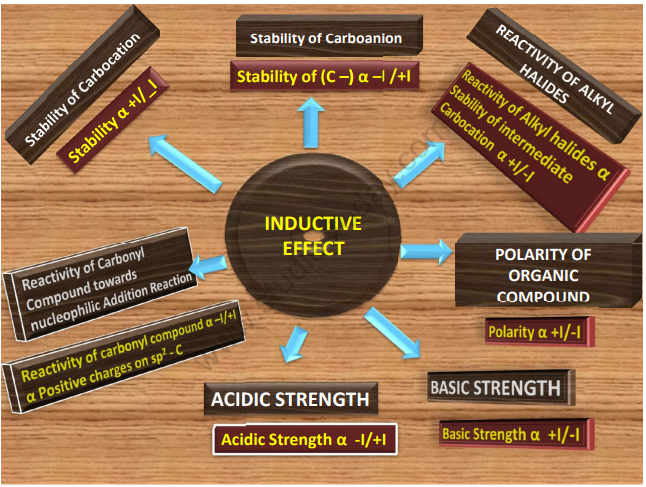
The Inductive Effect is applied to the following (each with its rule):
Stability of Carbocation: Stability α +I / -I
Stability of Carboanion: Stability of (C -) α -I / +I
Reactivity of Alkyl halides: Reactivity of Alkyl halides α Stability of intermediate Carbocation α +I / -I
Polarity of organic compound: Polarity α +I / -I
Basic Strength: Basic Strength α +I / -I
Acidic Strength: Acidic Strength α -I / +I
Reactivity of Carbonyl Compound towards nucleophilic Addition Reaction: Reactivity of carbonyl compound α -I / +I α Positive charges on sp² - C
RESONANCE EFFECT
The Resonance Effect is applied to the following (each with its rule):
Stability of Carbocation: Stability α No of resonating St
Stability of Carboanion: Stability α No of resonating St
Reactivity of Halides: More resonance in Carbocation than corresponding halide is more stable
Reactivity of Carbonyl compound: More positive on sp² C carbon so more reactivity
Reactivity of Benzene towards electrophilic substitution: Electron density is more in Benzene; First attack will be Electrophilic
Acidic nature: Acidic nature α -R, -I / +R, +I. More stable conjugate base by resonance - More Acidic
Basic nature: Basic nature α +R, +I / -R, -I. Electron density increases by resonance H + attraction capacity. More basic and vice-versa
REACTION INTERMEDIATE
CARBON FREE RADICALS →
1. Substitution reaction in alkane
2. Wurtz reaction
3. Kolbe's electrolysis
4. Allylic or benzylic substitution by NBS
5. Side chain halogenation of arenes
CARBOCATION OR CARBONIUM ION →
1. Electrophilic addition of alkene and alkyne
2. Electrophilic substitution of benzene
3. Nucleophilic substitution of halides (SN1)
4. Elimination of halides (E1)
5. Acid catalysed dehydration of alcohol
CARBANIONS →
1. Nucleophilic addition reaction of alkyne
2. Decarboxylation of acid
3. Reduction of halides by Zn/HCl
4. Aldol condensation
CARBENES →
1. Carbyl amine reaction
2. Reimer-Tiemann reaction
HYDROCARBON
Wurtz Reaction, Duma's Decarboxylation Reaction, Markovnikov Rule, Kharash Effect (Peroxide effect)
Ozonolysis, Polymerization and cyclic Polymerization, Aromatization, Isomerization, bayer's reagent, lindlar's catalyst, dehydrohalogenation Reaction - β-elimination of haloalkanes (Saytzeff Rule)
Aromaticity, Resonance and stability of Benzene
Electrophilic substitution Reactions - Friedel Craft Reaction - alkylation and Acylation, Nitration and halogenations, Sulphonation
Electrophilic addition Reactions - Markovnikov Rule
Free Radical addition Reactions - Kharash Effect (Peroxide effect)
Directive influence of a functional group in monosubstituted benzene, ring activating and Deactivating group towards electrophile
Mechanism of Markovnikov Rule and Kharash Effect
Preparation and Properties of Alkane, alkene, Alkyne, Benzene
Acidic Character of Alkynes, alkenes and alkanes
Effect of branching on the boiling point of isomeric compounds (alkanes, alcohols, haloalkanes)
Effect of H-bonding on BP of alcohols, Carboxylic acids, Amines etc.
Understanding acidic and basic character using resonance and Inductive effect
SOME BASIC CONCEPTS OF CHEMISTRY
(A) Calculation based on Molarity, Molality, Mass Percentage, Mole Fraction, ppm, Mole concepts and Molar masses →
Use in Solution Chapter for solving Numericals
Understanding the concept easily
Preparation of standard solution in Lab.
(B) Calculation based on stoichiometry equations →
Used in Titration (Quantitative Analysis) to determine the molarity
Equation: M1V1/a1 = M2V2/a2
STRUCTURE OF ATOM
Idea of writing electronic configuration → Use in p-block, d-block and f-block elements to determine stability, I.E., E.G.E, magnetic properties, colour compound, determination of structure by VBT in coordination compound
Shape of orbitals and Degenerate orbitals → Use in CFT (coordination compound)
Effective Nuclear Charge, screening effect, Penetrating power of different orbitals → Use in variation of size of p-block, d-block and f-block element, concept of lanthanoid contraction
Stability of completely filled and half filled subshell → stability of different oxidation state in p and d block element
CHEMICAL BONDING
VSEPR Theory → Predicting shape and geometry of various molecule. Used in p-block element to determine structure of oxo acid, inter halogen compound and compound of noble gas
Hybridisation → VBT in coordination compound
Resonance and Resonating structures → Understanding the conditions of stability of resonating structure (various application questions)
CLASSIFICATION OF ELEMENTS AND p-BLOCK ELEMENTS
This topic connects to the following ideas:
Structure of oxo acid
Vacant d-orbital
Inert pair effect
Pπ-Pπ bonding
B.D.E
Thermal stability
Reduction capacity of hydride and oxide
Catenation
Fajan's rule
Electron gain enthalpy
Electronegativity
Metallic property
Acidic nature of oxide and oxoacid
Basic nature of hydride
Bond polarity
IONISATION ENTHALPY
Metallic and non metallic character: IE α 1/Metallic property
Ionic nature α 1/IE
Reactivity α 1/IE
Reducing character α 1/IE
Basic nature α 1/IE (Na2O > Li2O)
Stability of oxidation state
APPLICATION OF ELECTRONEGATIVITY
Metallic and non metallic nature
Bond enthalpy: ΔEN α 1/Bond length
Bond energy α Electronegativity difference
Acidic strength of hydride: Bond energy α Stability of molecule
Reactivity: Difference in electronegativity α Stability α 1/Reactivity
Nature of bond and percentage of ionic character
Nature of hydroxide
Acidic nature of the oxide α Electronegativity
Nomenclature of inorganic compounds: OF2 oxygen difluoride
THERMODYNAMICS
Enthalpies of different types of reactions - Std enthalpy of combustion, Std. enthalpy of formation, Std. enthalpy of reaction
Enthalpy of atomization, Bond Enthalpy, Lattice enthalpy, Hydration Enthalpy, Enthalpy of solution
Spontaneity - Enthalpy and entropy, Gibb's Free Energy of reaction
STATES OF MATTER
Intermolecular forces
Isotherm, isobar, isochore
Vapour pressure - Boiling point, std. and normal BP
Evaporation and vaporization
Critical Temperature
Vapour pressure Vs Temperature Curve
Ideal Gas Equation
EQUILIBRIUM
Idea about dynamic equilibrium, Rate law expression, Law of mass action,
Relation between Kc and Qc, Kp and Kc
Le Chatelier's Principle and its application
Different concepts of Acids and Bases - Lewis, Bronsted, Arrhenius
Conjugate Acid - Base pair
pH calculation
Knowledge about Ka, Kb, Kw, pKa, pKb, pKw, Ksp (Solubility Product), common ion effect
REDOX REACTIONS
Understanding the concept of Redox Reactions (both oxidation and Reduction half cell reaction)
Calculation of Oxidation number (deal some special cases H2O2, NaH, Cr2O5, H2S2O5, CaOCl2)
Identification of oxidizing and reducing agent in a given reaction
Types of redox reactions - Combination, Decomposition, Displacement, Disproportionation Reactions
Competitive electron transfer reactions - Metal activity or electrochemical series
Balancing of redox reactions - half reaction method (Ion-electron method) in acidic and basic medium
Redox reactions as the basis for Titrations
Redox reactions and electrode processes - Feasibility of Redox couple, Standard Hydrogen electrode, Standard electrode potential
Cell Representation, carriers of current, Sign of electrode, Half cell reaction.
ELECTROCHEMICAL SERIES
The electrochemical series is used:
To compare the relative activities of metals
To compare the relative oxidising and reducing power
To calculate standard EMF of any electrochemical cell
To predict whether a metal react with acid to give hydrogen gas
To predict the spontaneity of redox reaction
For predicting product of electrolysis
3 lessons to be learn from a Pencil
Pain always sharpens you!
Everything you do leaves a mark!
What's inside you is useful, not what's outside!
Please click the link below to download pdf file of CBSE Class 11 Chemistry Important Concepts used in Class 12.
Free study material for Chemistry
Free CBSE Study Guides: Class 11 Chemistry Important Concepts
Quick Revision Material for Important Concepts
Review targeted study resources for Important Concepts tailored for Class 11 learners. Utilizing these structured notes and quick-revision tools ensures complete alignment with current CBSE evaluation standards.
Expert Notes and Solved Exam Questions
Designed around the official curriculum, these study guides guarantee standard compliance. Reviewing step-by-step solutions clarifies complex sub-topics within Important Concepts and demystifies standard marking schemes for Chemistry evaluations.
Additional Study Resources for Class 11
Maximize your grade potential by utilizing Class 11 Chemistry practice papers in tandem with these structured notes. All printable assignments and interactive mock tests on our platform are updated for the 2026 session and available free of charge.
FAQs
Our advanced study package for Important Concepts includes detailed concepts, diagrams, Mind Maps, and explanation of complex topics to ensure Class 11 students learn as per syllabus for 2026 exams.
The Mind Maps provided for Important Concepts act as visual anchors which will help faster recall during high-pressure exams.
Yes, teachers use our Class 11 Chemistry resources for lesson planning as they are in simple language and have lot of solved examples.
Yes, You can download the complete, mobile-friendly PDF of the Chemistry Important Concepts advanced resources for free.
Yes, our subject matter experts have updated the Important Concepts material to align with the rationalized NCERT textbooks and have removed deleted topics and added new competency-based questions.