

Download CBSE Class 11 Chemistry Useful Resources
Review targeted academic resources with the CBSE Class 11 Chemistry Thermodynamics Flash Cards. Built according to official CBSE standards for the 2026-27 term, these downloadable Class 11 Chemistry study materials support effective daily practice and deeper conceptual understanding for Chapter 05 Thermodynamics.
Access CBSE Study Guides and Summaries
View or download the dedicated CBSE Class 11 Chemistry Thermodynamics Flash Cards resource below. Engaging with these advanced study guides under focused conditions ensures continuous academic progress and mastery of the 2026-27 curriculum for Chapter 05 Thermodynamics.
CBSE Class 11 Chemistry Thermodynamics Flash Cards. Please refer to the examination notes which you can use for preparing and revising for exams. These notes will help you to revise the concepts quickly and get good marks.
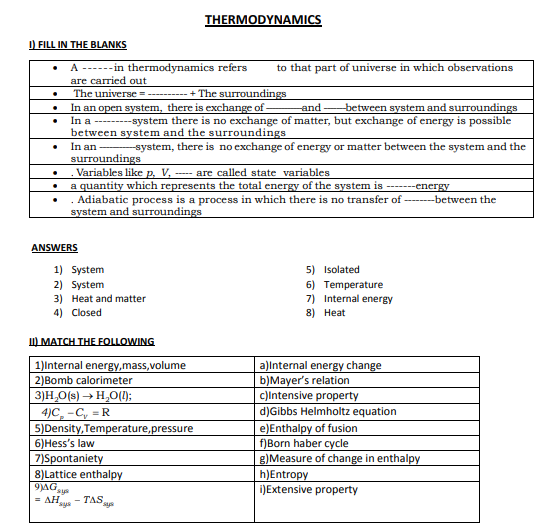
THERMODYNAMICS
I) FILL IN THE BLANKS
1. A ------in thermodynamics refers to that part of universe in which observations are carried out [1 Mark]
Answer:
1. System
Teacher's Note:
a) The specific portion of the universe chosen for thermodynamic study is defined as the system.
b) Everything outside the system constitutes the surroundings.
2. The universe = ---------- + The surroundings [1 Mark]
Answer:
1. System
Teacher's Note:
a) The universe is broadly classified into the system and its surroundings.
b) Universe = System + Surroundings.
3. In an open system, there is exchange of ------------and -------between system and surroundings [1 Mark]
Answer:
1. Heat and matter
Teacher's Note:
a) An open system allows both energy (heat/work) and matter to transfer across its boundary.
b) A beaker with boiling water left uncovered is an example of an open system.
4. In a ---------system there is no exchange of matter, but exchange of energy is possible between system and the surroundings [1 Mark]
Answer:
1. Closed
Teacher's Note:
a) A closed system permits energy transfer but strictly restricts mass transfer.
b) Sealed containers made of conducting materials represent closed systems.
5. In an -----------system, there is no exchange of energy or matter between the system and the surroundings [1 Mark]
Answer:
1. Isolated
Teacher's Note:
a) An isolated system is completely insulated from its surroundings.
b) Neither mass nor energy can cross the boundaries of an isolated system.
6. Variables like p, V, ----- are called state variables [1 Mark]
Answer:
1. Temperature
Teacher's Note:
a) State functions depend only on the state of the system, not on the path.
b) Common state variables include pressure (p), volume (V), and temperature (T).
7. a quantity which represents the total energy of the system is -------energy [1 Mark]
Answer:
1. Internal
Teacher's Note:
a) Internal energy is the sum of all forms of kinetic and potential energies of the entities inside the system.
b) It is denoted by the symbol U.
8. Adiabatic process is a process in which there is no transfer of --------between the system and surroundings [1 Mark]
Answer:
1. Heat
Teacher's Note:
a) In an adiabatic process, the boundary is thermally insulated so that q = 0.
b) Temperature changes occur purely due to work done on or by the system.
II) MATCH THE FOLLOWING [9 Marks]
Answer:
| Column I | Column II |
|---|---|
| 1) Internal energy, mass, volume | i) Extensive property |
| 2) Bomb calorimeter | a) Internal energy change |
| 3) \(H_2O(s) \rightarrow H_2O(l)\) | e) Enthalpy of fusion |
| 4) \(C_p - C_v = R\) | b) Mayer's relation |
| 5) Density, Temperature, pressure | c) Intensive property |
| 6) Hess's law | g) Measure of change in enthalpy |
| 7) Spontaneity | h) Entropy |
| 8) Lattice enthalpy | f) Born-Haber cycle |
| 9) \(\Delta G_{sys} = \Delta H_{sys} - T\Delta S_{sys}\) | d) Gibbs-Helmholtz equation |
Teacher's Note:
a) Extensive properties depend on the quantity of matter, whereas intensive properties do not.
b) Bomb calorimeter is specifically used to measure internal energy change at constant volume.
c) Mayer's relation connects molar heat capacities for an ideal gas.
d) The Gibbs-Helmholtz equation determines spontaneity based on enthalpy and entropy factors.
III) TRUE OR FALSE
1) Density is an intensive property [1 Mark]
Answer: True
1. Density is mass divided by volume, both of which are extensive properties.
2. The ratio of two extensive properties is always an intensive property.
3. Therefore, density does not depend on the amount of matter present.
4. Hence, the statement is True.
Teacher's Note:
a) Intensive properties are independent of the quantity of matter.
b) Always check property ratios to determine intensive nature.
2) Working of an electric motor is a spontaneous process [1 Mark]
Answer: False
1. An electric motor requires a continuous external supply of electrical energy to function.
2. Spontaneous processes occur on their own without needing outside intervention.
3. Non-spontaneous processes need external work to proceed.
4. Hence, the statement is False.
Teacher's Note:
a) Spontaneous processes are thermodynamically favored in a given direction.
b) Do not confuse driven non-spontaneous systems with natural processes.
3) Hot tea in a thermos flask is an example of an isolated system [1 Mark]
Answer: True
1. An isolated system allows neither the exchange of energy nor matter with the surroundings.
2. An ideal thermos flask prevents heat transfer and mass transfer across its boundaries.
3. Thus, tea inside it remains isolated for a practical duration.
4. Hence, the statement is True.
Teacher's Note:
a) Perfect isolation is theoretical, but a thermos approximates an isolated system.
b) Distinguish between closed, open, and isolated thermodynamic systems.
4) Universe is an example of an isolated system [1 Mark]
Answer: True
1. The universe comprises the system and its surroundings.
2. There is nothing outside the universe to exchange energy or matter with it.
3. Therefore, total energy and mass of the universe remain constant.
4. Hence, the statement is True.
Teacher's Note:
a) The universe is the ultimate definition of an isolated system in thermodynamics.
b) The first law applies directly to this universal isolation.
5) Thermodynamically most stable form of carbon is diamond [1 Mark]
Answer: False
1. Carbon exists in multiple allotropic forms including graphite and diamond.
2. Graphite is assigned a standard enthalpy of formation of zero as the reference state.
3. Graphite is thermodynamically more stable than diamond under standard conditions.
4. Hence, the statement is False.
Teacher's Note:
a) Standard reference states have zero enthalpy of formation.
b) Graphite has lower standard Gibbs energy than diamond.
6) Born-Haber cycle is used to measure lattice enthalpy [1 Mark]
Answer: True
1. Lattice enthalpy cannot be measured directly by a single experiment.
2. The Born-Haber cycle applies Hess's law to related thermochemical data.
3. It connects enthalpy of formation, sublimation, ionization, and electron gain.
4. Hence, the statement is True.
Teacher's Note:
a) Born-Haber cycles illustrate the application of Hess's Law.
b) Understand each individual energy step in the cycle.
7) \(\Delta G\) represents entropy for a process [1 Mark]
Answer: False
1. \(\Delta G\) represents the change in Gibbs free energy for a process.
2. Entropy is represented by the symbol \(\Delta S\).
3. Gibbs energy combines enthalpy and entropy factors.
4. Hence, the statement is False.
Teacher's Note:
a) Learn standard thermodynamic symbols and their meanings.
b) \(\Delta G\) determines spontaneity at constant temperature and pressure.
8) For a spontaneous process the \(\Delta S\) will be positive [1 Mark]
Answer: True
1. According to the second law of thermodynamics, \(\Delta S_{\text{total}}\) must be positive for any spontaneous process.
2. Here \(\Delta S_{\text{total}} = \Delta S_{\text{sys}} + \Delta S_{\text{surr}}\).
3. Spontaneous changes naturally increase the entropy of the universe.
4. Hence, the statement is True.
Teacher's Note:
a) Total entropy change is the definitive criterion for spontaneity.
b) System entropy alone can sometimes decrease during a spontaneous process.
IV) Cross word Puzzle
Thermodynamics cross word puzzle.htm
Answer:
1. Interactive or external HTML crossword puzzle file reference as presented in study material.
Teacher's Note:
a) Digital resource link for student practice.
V) SELECT THE ODD ONE AMONG THE GROUP
1) MASS, VOLUME, ENTHALPY, PRESSURE [1 Mark]
(A) MASS
(B) VOLUME
(C) ENTHALPY
(D) PRESSURE
Answer: (D) PRESSURE
1. Mass, volume, and enthalpy depend on the amount of substance, making them extensive properties.
2. Pressure is independent of the amount of substance, making it an intensive property.
3. Therefore, pressure does not belong to the group of extensive properties.
4. Hence, the correct option is (D).
Teacher's Note:
a) Differentiate between extensive and intensive properties.
b) Extensive properties scale with system size.
2) BOND ENTHALPY, LATTICE ENTHALPY, ENTHALPY OF ATOMISATION, ENTHALPY OF SOLUTION [1 Mark]
(A) BOND ENTHALPY
(B) LATTICE ENTHALPY
(C) ENTHALPY OF ATOMISATION
(D) ENTHALPY OF SOLUTION
Answer: (B) LATTICE ENTHALPY
1. Lattice enthalpy is determined or calculated using the Born-Haber cycle.
2. The other listed enthalpies are typically measured or defined through direct reaction or calorimetric methods.
3. Lattice energy specifically relates to ionic crystal lattices.
4. Hence, the correct option is (B).
Teacher's Note:
a) Born-Haber cycle specifically targets lattice enthalpy calculations.
b) Understand the distinct types of reaction enthalpies.
3) REACTION ENTHALPY, FUSION ENTHALPY, ENTHALPY OF SUBLIMATION, BOND ENTHALPY [1 Mark]
(A) REACTION ENTHALPY
(B) FUSION ENTHALPY
(C) ENTHALPY OF SUBLIMATION
(D) BOND ENTHALPY
Answer: (D) BOND ENTHALPY
1. Bond enthalpy is calculated as the difference between reactant bond energies and product bond energies.
2. Fusion, sublimation, and reaction enthalpies are standard state enthalpy changes.
3. Bond enthalpy is averaged across various molecules.
4. Hence, the correct option is (D).
Teacher's Note:
a) Bond enthalpies depend on average bond dissociation energies.
b) Contrast phase transition enthalpies with bond breaking values.
4) PRESSURE, VOLUME, TEMPERATURE, HEAT [1 Mark]
(A) PRESSURE
(B) VOLUME
(C) TEMPERATURE
(D) HEAT
Answer: (D) HEAT
1. Pressure, volume, and temperature are state functions that describe the state of a system.
2. Heat is a path function that depends on the specific path taken during a process.
3. State functions depend only on initial and final states.
4. Hence, the correct option is (D).
Teacher's Note:
a) Distinguish clearly between state functions and path functions.
b) Heat and work are boundary phenomena, not state properties.
VI) DIAGRAM BASED QUESTIONS
What do the following represent? [2 Marks]
[Figure: Labeled diagram of a Bomb Calorimeter showing a thermometer, firing leads, oxygen inlet, sample container, bomb vessel, and surrounding water bath.]
Answer:
1. The diagram represents a Bomb Calorimeter.
2. It is used experimentally to measure the enthalpy of combustion at constant volume (\(\Delta U\)).
Teacher's Note:
a) Bomb calorimeters operate at constant volume in a sealed steel container.
b) Heat measured is related to internal energy change rather than enthalpy change directly.
2) [2 Marks]
[Figure: Enthalpy diagram for an exothermic reaction showing total enthalpy of reactants Hr higher than total enthalpy of products Hp, with downward arrow labeled ΔrH as net heat evolved in the reaction against reaction coordinate]
Answer:
1. Exothermic reactions.
2. The total enthalpy of reactants is greater than the total enthalpy of products.
Teacher's Note:
a) Heat is released to the surroundings during this process.
b) The enthalpy change (\(\Delta_r H\)) has a negative sign.
3) [2 Marks]
[Figure: Enthalpy diagram for an endothermic reaction showing total enthalpy of reactants Hr lower than total enthalpy of products Hp, with upward arrow labeled ΔrH as net heat absorbed from the surroundings in the reaction against reaction coordinates]
Answer:
1. Endothermic reactions.
2. The total enthalpy of reactants is less than the total enthalpy of products.
Teacher's Note:
a) Heat is absorbed from the surroundings during this process.
b) The enthalpy change (\(\Delta_r H\)) has a positive sign.
Please click the link below to download pdf file of CBSE Class 11 Chemistry Thermodynamics Flash Cards.
Free study material for Chemistry
Free CBSE Study Guides: Class 11 Chemistry Chapter 05 Thermodynamics
Quick Revision Material for Chapter 05 Thermodynamics
Explore essential learning tools for Class 11 Chemistry Chapter 05 Thermodynamics. This curated collection features in-depth notes and targeted practice questions built around the active 2026 curriculum to streamline your daily revision.
Expert Notes and Solved Exam Questions
Each resource draws directly from authorized textbooks to maintain academic accuracy. Evaluating solved examples allows Class 11 students to master the formal presentation and answer-writing standards expected in upcoming school exams.
Additional Study Resources for Class 11
Wrap up your chapter revision by testing your knowledge against standard objective question formats. Explore our full library of free, up-to-date sample papers and online assessments to secure top grades in your CBSE examinations.
FAQs
Our advanced study package for Chapter 05 Thermodynamics includes detailed concepts, diagrams, Mind Maps, and explanation of complex topics to ensure Class 11 students learn as per syllabus for 2026 exams.
The Mind Maps provided for Chapter 05 Thermodynamics act as visual anchors which will help faster recall during high-pressure exams.
Yes, teachers use our Class 11 Chemistry resources for lesson planning as they are in simple language and have lot of solved examples.
Yes, You can download the complete, mobile-friendly PDF of the Chemistry Chapter 05 Thermodynamics advanced resources for free.
Yes, our subject matter experts have updated the Chapter 05 Thermodynamics material to align with the rationalized NCERT textbooks and have removed deleted topics and added new competency-based questions.