

Class 11 Chemistry Study Guide: Class 11 Chemistry Redox Reactions Exam Questions
Review targeted academic resources with the Class 11 Chemistry Redox Reactions Exam Questions. Built according to official CBSE standards for the 2026-27 term, these downloadable Class 11 Chemistry study materials support effective daily practice and deeper conceptual understanding for Chapter 07 Redox Reactions.
Download Chapter 07 Redox Reactions Study Material PDF
Access the complete useful resource PDF for Class 11 Chemistry below. Regular practice with these targeted academic notes builds familiarity with complex topics and helps secure higher marks in final school evaluations.
Redox Reactions MCQ Questions with Answers Class 11 Chemistry
Question. Which element undergoes disproportionation in water?
(1) Cl2
(2) F2
(3) K
(4) Cs
Answer (1)
Question. Which of the following processes does not involve oxidation of iron?
(1) Liberation of H2 from steam by iron at high temperature
(2) Rusting of iron sheets
(3) Decolourization of blue CuSO4 solution by iron
(4) Formation of Fe(CO)5 from Fe
Answer (4)
Question. In which of the following compounds, nitrogen exhibits highest oxidation state?
(1) N3H
(2) NH2OH
(3) N2H4
(4) NH3
Answer (1)
Question. Standard electrode potential for Sn4+ / Sn2+ couple is +0.15 V and that for the Cr3+ / Cr couple is–0.74 V. These two couples in their standard state are connected to make a cell. The cell potential will be
(1) +1.83 V
(2) +1.19 V
(3) +0.89 V
(4) +0.18 V
Answer (3)
Question. Standard reduction electrode potential of three metals X, Y and Z are –1.2 V, +0.5 V and –3.0 V respectively.The reducing power of these metals will be
(1) X > Y > Z
(2) Y > Z > X
(3) Y > X > Z
(4) Z > X > Y
Answer (4)
Question. A : Oxidation number of carbon in HCN is +4.
R : Oxidation state and valency is same for carbon.
Answer (4)
Question. The oxide, which cannot act as a reducing agent, is
(1) CO2
(2) ClO2
(3) NO2
(4) SO2
Answer (1)
Question. A : Fluorine acts as a stronger oxidising agent than chlorine.
R : Standard reduction potential of fluorine is higher than Cl2.
Answer (1)
Question. Oxidation states of P in H4P2O5, H4P2O6, H4P2O7 are respectively
(1) +3, +5, +4
(2) +5, +3, +4
(3) +5, +4, +3
(4) +3, +4, +5
Answer (4)
LEVEL – 1
1. Define oxidation and reduction in terms of oxidation number.
Ans: Increase in Oxidation Number is Oxidation and decrease in Oxidation Number is called reduction.
2. What is meant by disproportionation? Give one example.
Ans: In a disproportionation reaction an element simultaneously oxidized and reduced.

3. What is O.N. of sulphur in H2SO4?
Ans: +6
4. Identify the central atom in the following and predict their O.S. HNO3
Ans: central atom:- N; O.S. +5
5. Out of Zn and Cu which is more reactive?
Ans: Zn.
6. What is galvanization?
Ans: Coating of a less reactive metal with a more reactive metal e.g.- coatingof iron surface with Zn to prevent rusting of iron.
7. How is standard cell potential calculated using standard electrode potential?

9. The formation of sodium chloride from gaseous sodium and gaseous chlorideis a redox process justify.
Ans: Na atom get oxidize and Cl is reduced.
LEVEL – 2
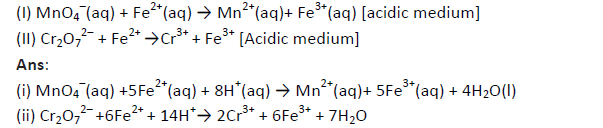
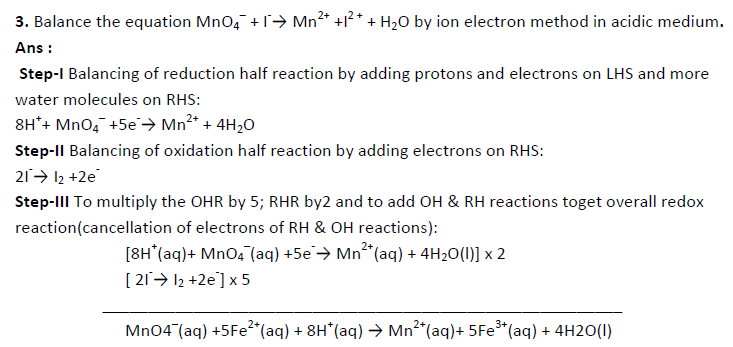
1. Write the balanced redox reaction .
2. Identify the strongest & weakest reducing agent from the following metals:
Zn, Cu, Na, Ag, Sn
Ans: Strongest reducing agent: Na, weakest reducing agent: Ag.
3. Determine the oxidation no. of all the atoms in the following oxidants:KMnO4, K2Cr2O7 and KClO4
Ans :
In KMnO4 K = +1, Mn = +7, O = -2
In K2Cr2O7K = +1, Cr = +6, O = -2
In KClO4K = +1, Cl = =+7, O = -2
4. Determine the oxidation no. of all the atoms in the following species:Na2O2and OF2.
Ans:
In Na2O2Na = +1, O = -1
InOF2, F = -1, O = +2
5. Is it possible to store:
(i) H2SO4 in Al container?
(ii) CuSO4 solution in Zn vessel?
Ans : (i) yes. (ii) No.

8. Predict all the possible oxidation states of Cl in its compounds.
Ans: 0, -1, +1, +3, +5, +7
9. Formulate possible compounds of ‘Cl ‘in its O.S.is: 0, -1, +1, +3, +5, +7
Ans: Cl2, HCl, HOCl, HOClO, HOClO2, HOClO3 respectively.
10. List three measures used to prevent rusting of iron.
Ans:
(i) galvanization(coating iron by a more reactive metal)
(ii) greasing/oiling
(iii) painting.
LEVEL – 3
1. Write short notes on :
(a) Electrochemical series
(b) redox reactions
(c) oxidizing agents
Ans : (a) Electrochemical series :- arrangement of metals(non-metals also)in increasing order of their reducing power or vice versa. (b) Reactions in which both Oxidation and reduction take place simultaneously are REDOX reactions. (c) Oxidizing agents : chemical specie which can oxidize the other one or can reduce itself.
2. Calculate O. S. of sulphur in the following oxoacids of S : H2SO4, H2SO3 , H2S2O8 and H2S2O7
Ans : +6, +4, +6 and +6 respectively.
3. Explain role of salt bridge in Daniel cell.
Ans :
(a) it completes the electric circuit in the cell.
(b) It maintains the electric neutrality in the cell.
4. Account for the followings :
(i) sulphur exhibits variable oxidation states.
(ii) Fluorine exhibits only -1 O.S.
(iii) Oxygen can’t extend its valency from 2.
Ans.
(i) Due to the presence of vacant d orbitals in sulphur.
(ii) It is most electronegative element
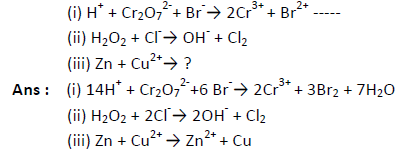
(iii) Small size/unavailability of vacant d orbitals in O 5. Complete and balance the following equations:
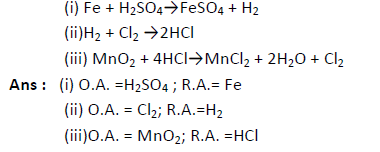
6. Identify the oxidizing and reducing agents in the following equations:
7 . Arrange the following in increasing order of their reducing power: Cu, Ag, Au, Zn, Fe, Al, Na, Mg, Pt(SHE), Hg, Ca, K
Ans : Au, Hg, Ag, Cu, Pt(SHE), Fe, Zn, Al, Mg, Na, Ca, K
LEVEL – 4
1.What is SHE? What is its use?Draw its diagram.
Ans : Standard Hydrogen Electrode (SHE) has been selected to have zero standard potential at all temperatures. It consists of a platinum foilcoated with platinum black (finely divided platinum) dipping partially into an aqueous solution in which the activity (approximate concentration 1M) of hydrogen ion is unity and hydrogen gas is bubbled through the solution at 1 bar pressure. The potential of the other half cell is measured by constructing a cell in which reference electrode is standard hydrogen electrode. The potential of the other half cell is equal to the potential of the cell.
2. We spend crore of Rupees and even thousands of lives every year due tocorrosion. How can it be prevented? Explain.
Ans : (i) By Galvanization: Coating of a less reactive metal with a more reactive metal e.g.- coating of iron surface with Zn to prevent rusting of iron.
(ii) By greasing /oiling (to keep away the object from the contact of air&moisture.)
(iii)By painting (to keep away the object from the contact of air &moisture.)
Free study material for Chemistry
CBSE Class 11 Chemistry Study Material: Chapter 07 Redox Reactions
Core Study Kit: Class 11 Chemistry Chapter 07 Redox Reactions
Explore essential learning tools for Class 11 Chemistry Chapter 07 Redox Reactions. This curated collection features in-depth notes and targeted practice questions built around the active 2026 curriculum to streamline your daily revision.
NCERT-Aligned Solutions for Chapter 07 Redox Reactions
Designed around the official curriculum, these study guides guarantee standard compliance. Reviewing step-by-step solutions clarifies complex sub-topics within Chapter 07 Redox Reactions and demystifies standard marking schemes for Chemistry evaluations.
Next Steps in Your Exam Preparation
Wrap up your chapter revision by testing your knowledge against standard objective question formats. Explore our full library of free, up-to-date sample papers and online assessments to secure top grades in your CBSE examinations.
FAQs
Our advanced study package for Chapter 07 Redox Reactions includes detailed concepts, diagrams, Mind Maps, and explanation of complex topics to ensure Class 11 students learn as per syllabus for 2026 exams.
The Mind Maps provided for Chapter 07 Redox Reactions act as visual anchors which will help faster recall during high-pressure exams.
Yes, teachers use our Class 11 Chemistry resources for lesson planning as they are in simple language and have lot of solved examples.
Yes, You can download the complete, mobile-friendly PDF of the Chemistry Chapter 07 Redox Reactions advanced resources for free.
Yes, our subject matter experts have updated the Chapter 07 Redox Reactions material to align with the rationalized NCERT textbooks and have removed deleted topics and added new competency-based questions.