Class 11 Chemistry Basic Concepts of Chemistry Exam Questions

Read and download the Class 11 Chemistry Basic Concepts of Chemistry Exam Questions. Designed for 2025-26, this advanced study material provides Class 11 Chemistry students with detailed revision notes, sure-shot questions, and detailed answers. Prepared by expert teachers and they follow the latest CBSE, NCERT, and KVS guidelines to ensure you get best scores.

Advanced Study Material for Class 11 Chemistry Chapter 1 Some Basic Concepts of Chemistry

To achieve a high score in Chemistry, students must go beyond standard textbooks. This Class 11 Chapter 1 Some Basic Concepts of Chemistry study material includes conceptual summaries and solved practice questions to improve you understanding.

Class 11 Chemistry Chapter 1 Some Basic Concepts of Chemistry Notes and Questions

LEVEL WISE QUESTIONS
 
LEVEL- 1

1. State the number of significant figures in (i) 0.436 and (ii) 802.42
Ans. (i) 0.436 has three significant figures
       (ii) 802.42 has five significant figures
 
2. What do you mean by Mole fraction?
Ans. Mole fraction is the ratio of number of moles of one component to the total number of moles (solute & solvents) present in the solution. It is expressed as ‘x’.
 
3. Calculate the molecular mass of H2SO4.
Ans. Molecular Mass of H2SO4 = 2 × 1 + 32 + 4 × 16 = 2 + 32 + 64 = 98u
 
4. What is the SI unit of mass? How is it defined?
Ans. The S.I. unit of mass is Kilogram.
Mass of a substance is the amount of matter present in it.
 
5. What is limiting reagent?
Ans. The reactant which gets consumed first or limits the amount of product formed is known as limiting reagent.
 
LEVEL- 2

1. What is the value of Avogadro number?
Ans. 6.022 × 10²³
 
2. What is the law called which deals with the ratios of the volumes of the gaseous reactants and products of the volumes of the gaseous reactants and products?
Ans. Gay Lussac’s law of gaseous volumes.
 
3. How are 0.50 mol Na2CO3 and 0.50 M Na2CO3 different?
Ans. Molar mass of Na2CO3 = 2 × 23 + 12 × 3 × 16 = 106 g/mol.
0.50 mol Na2CO3 means 0.50 × 106 = 53 g.
0.50 mol Na2CO3 means 0.50 mol i.e. 53 g of Na2CO3 are present in 1 L of the solution.
 
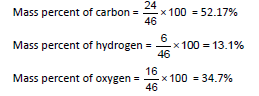
4. What is the percentage of carbon, hydrogen and oxygen in ethanol?
Ans. Molecular formula of ethanol is C2H5OH
Molar mass of ethanol is:
                                            = 2 × 12 + 5 × 1 + 16 + 1
                                           = 24 + 5 + 17 = 46 g
 
Class 11 Chemistry Basic Concepts of Chemistry Exam Questions
 
5. Classify the following as pure substances or mixture.
(a) ethyl alcohol
(b) oxygen
(c) carbon
(d) distilled water
(e) blood
(f) steel
Ans. Pure substance – ethyl alcohol, oxygen, carbon, distilled water mixture – blood, steel
 
 
LEVEL – 3

1. What is the difference between 160 cm and 160.0 cm?
Ans. 160 has three significant figures while 160.0 has four significant figures. Hence160.0 represents greater accuracy.
 
2. In the combustion of methane in air, what is the limiting reagent & why?
Ans. Methane is the limiting reagent because the other reactant is oxygen of air which is always present in excess. Thus the amounts of carbon dioxide & water formed will depend upon the amount of methane burnt.
 
3. Which aqueous solution has higher concentration, 1 molar or 1 molal solution of the same solute? Give reason.
Ans. 1 molar aqueous solution has higher concentration than 1 molal solution.
A molar solution contains one mole of solute in one litre of solution while one molal solution contains one mole of solute in 1000 g of solvent. If density of water is 1, then one mole of solute is present in 1000 mL of water in 1 molal solution while one mole of solute is present in less than 1000mL of water in 1 molar solution (1000 mL sol = amount of solute + amount of solvent). Thus 1 molar solution is more concentrated.
 
4. Calculate the molarity of water if its density is 1000 kg/m3.
Ans. Molarity of water means the number of moles of water in 1 litre of water
 
Class 11 Chemistry Basic Concepts of Chemistry Exam Questions-1
 
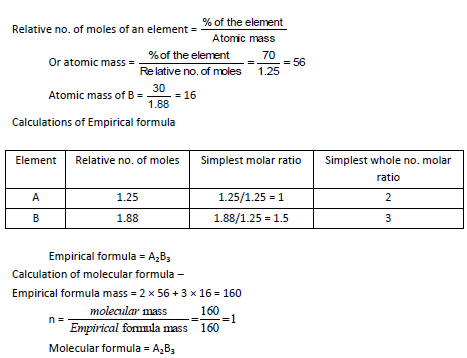
5. A compound made up of two elements A and B has = 70%, B = 30%. Their relative number of moles in the compound is 1.25 and 1.88. Calculate
a. Atomic masses of the elements A and B
b. Molecular formula of the compound, if its molecular mass is found to be 160.
Ans. 
Class 11 Chemistry Basic Concepts of Chemistry Exam Questions-2


Chapter 04 Chemical Bonding and Molecular Structure
Class 11 Chemistry Chemical Bonding and Molecular Structure Exam Questions

CBSE Class 11 Chemistry Chapter 1 Some Basic Concepts of Chemistry Study Material

Students can find all the important study material for Chapter 1 Some Basic Concepts of Chemistry on this page. This collection includes detailed notes, Mind Maps for quick revision, and Sure Shot Questions that will come in your CBSE exams. This material has been strictly prepared on the latest 2026 syllabus for Class 11 Chemistry. Our expert teachers always suggest you to use these tools daily to make your learning easier and faster.

Chapter 1 Some Basic Concepts of Chemistry Expert Notes & Solved Exam Questions

Our teachers have used the latest official NCERT book for Class 11 Chemistry to prepare these study material. We have included previous year examination questions and also step-by-step solutions to help you understand the marking scheme too. After reading the above chapter notes and solved questions also solve the practice problems and then compare your work with our NCERT solutions for Class 11 Chemistry.

Complete Revision for Chemistry

To get the best marks in your Class 11 exams you should use Chemistry Sample Papers along with these chapter notes. Daily practicing with our online MCQ Tests for Chapter 1 Some Basic Concepts of Chemistry will also help you improve your speed and accuracy. All the study material provided on studiestoday.com is free and updated regularly to help Class 11 students stay ahead in their studies and feel confident during their school tests.

What is included in the advanced study material for Class 11 Chemistry Chapter Chapter 1 Some Basic Concepts of Chemistry?

Our advanced study package for Chapter Chapter 1 Some Basic Concepts of Chemistry includes detailed concepts, diagrams, Mind Maps, and explanation of complex topics to ensure Class 11 students learn as per syllabus for 2026 exams.

How do Mind Maps for Chemistry Chapter Chapter 1 Some Basic Concepts of Chemistry help in revision?

The Mind Maps provided for Chapter Chapter 1 Some Basic Concepts of Chemistry act as visual anchors which will help faster recall during high-pressure exams.

Are these Chemistry resources suitable for both classroom teaching and self-study?

Yes, teachers use our Class 11 Chemistry resources for lesson planning as they are in simple language and have lot of solved examples.

Is this advanced study material for Chapter Chapter 1 Some Basic Concepts of Chemistry free to download in PDF?

Yes, You can download the complete, mobile-friendly PDF of the Chemistry Chapter Chapter 1 Some Basic Concepts of Chemistry advanced resources for free.

Does this material cover rationalized content for the 2025-26 CBSE session?

Yes, our subject matter experts have updated the Chapter Chapter 1 Some Basic Concepts of Chemistry material to align with the rationalized NCERT textbooks and have removed deleted topics and added new competency-based questions.