

Sample Question Papers for Class 7 Science
Access comprehensive sample question papers for Class 7 Science using the CBSE Class 7 Science Sample Paper Set 23. Designed to align with the 2026-27 CBSE academic guidelines, these model papers help students assess their exam readiness and understand current marking schemes.
Practice Class 7 Science Exam Papers
View or download the dedicated CBSE Class 7 Science Sample Paper Set 23 resource below. Engaging with these sample papers under timed conditions ensures continuous academic progress and mastery of the 2026-27 exam format.
CBSE Class 7 Science Sample Paper Set W.Sample Papers are the very important for every student. The sample papers should be practiced to gain extra marks in examinations. The sample papers have been prepared based on summative assessment1 and summative assessment 2 pattern. The sample papers have been prepared based on pattern of last year examinations and as per latest changes in the syllabus. Students, teachers and parents can download all CBSE educational material and very well prepared worksheets from this website. All CBSE educational material is developed by our panel of teachers, have also been submitted by CBSE teachers and students.
Q.1 Fill in the blanks with appropriate words.
a) Wool has a __________ tensile strength.
b) A long wire has __________ resistance than a short wire.
c) A magnifying glass is a __________ lens.
d) The dark radiating rows under the head of a mushroom are called __________.
e) A __________ tank allows the water to seep into the soil and recharge ground water.
f) Underground pipes that carry waste water are called __________.
Q.2 Choose the correct option.
a) Quinine is obtained from the bark of -
i) chincona ii) eucalyptus
iii) Tulsi iv) Kikar
b) The smallest particle of soil are called –
i) silt ii) sand
iii) clay iv) gravel
c) Rose and lemon are grown from –
i) tubers ii) bulbs
iii) stem cuttings iv) leaf buds
d) On mixing the light of colours of rainbow, we will get -
i) pink light ii) brown light
iii) colourless light iv) black light
e) To make a battery of 9 volts, how many 1.5V cells are needed ?
i) 6 ii) 3 iii) 5 iv) 4
f) Rusting takes place in -
i) air and moisture ii) air free moisture
iii) moisture free air iv) none of these
Q.3 Name the following.
a) The process of obtaining silk from silk moth.
b) One device that uses the heating effect of electric current.
c) A mirror in which the reflecting surface bulges out.
d) Tiny cells protected by a wall and capable of producing new plants.
e) Soil found in the fertile plains of Punjab and Uttar Pradesh.
f) Process of eating and being eaten.
Q.4 Give reasons for the following. (any three)
a) Rain water should be carried out by underground sewer.
b) A bulb get warmer than the wires that connect it to a battery.
c) Soft iron core is used in an electromagnet.
d) Burning of candle is a physical as well as chemical change.
Q.5 Define the following terms. (any five) (2×5=10)
a) Chemical changes b) Refraction c) Focus of lens
d) Water table e) Extinct f) Secondary sludge
Q.6 Answer the following questions in not more than 20 words. (any six) (2×6=12)
a) How do forests check pollution?
b) How do changes in temperature help in weathering rocks?
c) Why do seeds need to be dispersed?
d) Write two properties of the image formed by a plane mirror.
e) Draw the symbols for the following : cell, bulb, battery, switch (open)
f) What do you mean by throwing of silk?
g) State two uses of a convex lens.
Q.7 Answer the following questions in not more than 40 words. (any six) (3×6=18)
a) Discuss why the dissolving of salt in water is a physical change.
b) What is a circuit diagram? Draw the circuit diagram of a torch working on three cells.
c) What is an electromagnet? Write two properties of an electromagnet.
d) Why is the image formed by a pinhole camera inverted?
e) What are the special features of wind-pollinated flowers?
f) What about the pattern of rainfall in our country that leads to scarcity of water? Which part of country gets rainfall twice a year?
g) Write one way of overcoming the problem of lack of sewage systems in villages.
Q.8 Answer the following questions in not more than 100 words. (any five) (5×5=25)
a) What are the advantages and disadvantages of sandy and clayey soils?
b) Distinguish between self pollination and cross pollination. How is pollen from other flowers prevented from reaching the stigma of a self-pollinated flower?
c) Describe the features of fruits and seed dispersed by animal and wind.
d) What are real and virtual images? What are the differences between them?
e) Explain with the help of a diagram, the construction and working of an electric bell.
f) Discuss moulting in silkworms. What is raw silk and spun silk?
g) What is a fuse? How does it works?
Q.9 Draw well labelled diagram of any two of the following. (3×2=6)
a) Layers of the soil b) Stages of sewage treatment
c) Biogas plant
Q.10 Look at the diagram given below and answer the questions that follow.
a) Label the parts numbered 1-5.
b) What do you mean by pollination?
c) Which parts of flower develops into fruit and seed?
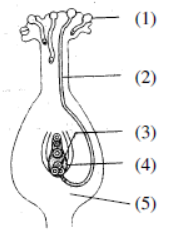
d) Give one example of a complete flower.
Please click the below link to access CBSE Class 7 Science Sample Paper Set W.
Free study material for Science
Exam Preparation Sample Paper for Class 7 Science CBSE Class 7 Science Sample Paper Set 23
Download Sample Paper: CBSE Class 7 Science Sample Paper Set 23 (Class 7 Science)
Review model practice papers for Class 7 Science. Working through the CBSE Class 7 Science Sample Paper Set 23 under simulated test conditions at home ensures complete familiarity with upcoming school evaluations.
Why Practice Class 7 Science Sample Papers?
- Original Practice Material: Access unique questions for Science designed to challenge your understanding.
- Self-Assessment: Evaluate scores per set to pinpoint weak zones in Class 7 Science.
- Exam Completion Skills: Routine problem sets train you to manage test duration efficiently without stress.
How to Analyze Your Performance in CBSE Class 7 Science Sample Paper Set 23
- Self-Evaluation: Score your answers using official guidance to track your academic progress.
- Mistake Correction: Class 7 pupils must re-solve questions answered incorrectly to master the correct method.
- Continuous Practice: Take additional Science sample modules online to maximize preparedness for CBSE evaluations.
FAQs
You can download the complete PDF for CBSE Class 7 Science Sample Paper Set 23 for free from StudiesToday.com. Our resources for Class 7 Science are updated for the latest academic session and follow the official exam pattern.
Yes, CBSE Class 7 Science Sample Paper Set 23 comes with detailed, teacher-verified solutions. We have provided step-by-step answers for Science to help students of Class 7 understand correct methodology and marking scheme.
Practicing this Science paper helps in time management and identifying important topics. For Class 7, solving mock papers is the best way to gain confidence and reduce exam-day anxiety.
Yes, all our study materials for Class 7 Science are provided in a mobile-friendly PDF format. You can easily download CBSE Class 7 Science Sample Paper Set 23 on your mobile device.