

Download CBSE Class 7 Science Sample Papers
Review targeted exam resources with the CBSE Class 7 Science Sample Paper Set 17. Built according to official CBSE standards for the 2026-27 academic year, these downloadable Class 7 Science sample papers support effective revision and performance tracking.
Access CBSE Sample Papers and Solutions
View or download the dedicated CBSE Class 7 Science Sample Paper Set 17 resource below. Engaging with these sample papers under timed conditions ensures continuous academic progress and mastery of the 2026-27 exam format.
CBSE Class 7 Science Sample Paper Set Q.Sample Papers are the very important for every student. The sample papers should be practiced to gain extra marks in examinations. The sample papers have been prepared based on summative assessment1 and summative assessment 2 pattern. The sample papers have been prepared based on pattern of last year examinations and as per latest changes in the syllabus. Students, teachers and parents can download all CBSE educational material and very well prepared worksheets from this website. All CBSE educational material is developed by our panel of teachers, have also been submitted by CBSE teachers and students.
Q1. Fill in the blanks:
a) The coil of wire is called an ____________________
b) White light consists of _________________ colour.
Ans. a) element b) seven
Q.2 Correct the following statement.
a) Convex lens is called diverging lens.
b) Air exerts pressure only in upward direction.
Ans. a) Convex lens is called converging lens.
b) Air exerts pressure in all directions.
Q3. Choose the correct answer.
a) Meera is making a closed electric circuit. What she does not need for it?
i. Battery
ii. Switch
iii. Wire
iv. Test tube
b) What is the other name of cyclone?
i. Typhoon
ii. Storm
iii. Tsunami
iv. Monsoon
Ans. (i) d) Test tube (ii) a) Typhoon
Q.4 What does ‘VIBGYOR’ stand for in spectrum?
Ans. „VIBGYOR‟ stand for seven in spectrum.
V – Violet
I – Indigo
B – Blue
G – Green
Y – yellow
O – Orange
R – Red
Q5. Write one use of convex lens.
Ans. Convex lens is used in making magnifying glasses.
Q6. Draw symbols for following electric component:
a) Battery
b) Open switch
Ans.

Q.7 Name the lens if it is thicker in middle than at it edges.
Ans. Convex lens
Q.8 Give the name of two devices based on heating effect of current.
Ans. The names of two devices based on heating effect of current are:
a) Hot plates b) Electric Iron
Q.9) Draw a ray diagram to show refraction through a concave lens.
ANS. 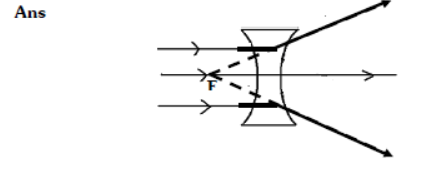
Q.10 When the current is switched on through a wire, a compass needle kept nearby gets deflected from its north-south position. Why?
Ans. When the current is switched on through a wire, a compass needle kept nearby gets deflected from its north-south position because of the magnetic effect of electric current.
Q.11 Write two effective safety measures for the cyclones.
Ans. Two effective safety measures for the cyclones are: -
a) A cyclone forecast and warning service.
b) Rapid communication of warning to the Government agencies, the ports, fishermen, ships and the general public.
Q.12 Why holes are made in hanging banners and hoardings?
Ans. Holes are made in hanging banners and hoardings to allow the wind to move from one side to the other.
Q.13 What is electromagnet? Write one use of electromagnet.
Ans. A current carrying coil of an insulated wire wrapped around a piece of iron is called an electromagnet. It is used to separate magnetic materials from the junk.
Q.14 State three differences between convex and concave lens.
Ans. Three differences between convex and concave lens are –
Convex lens
1. It is thick in middle and thin at edges.
2. It is also called converging lens.
3. Convex lens can forme real and inverted image.
Concave lens
a) It is thin in middle and thick at edges.
b) It is also called diverging lens.
c) Concave lens always forms erect, virtual and smaller image than object.
Q.15 a) What kind of wires are used in making an electric fuse?
b) Name the scientist who first noticed the deflection in compass needle when kept in a closed electric circuit.
Ans. a) Wires used in an electric fuse are made up of special material which melt quickly and break when large electric current are passed through them.
b) Hans Christian Orested was first noticed the deflection in compass needle when kept in a closed electric circuit.
Q.16 a) How does the air move? b) What are tornadoes?
Ans.a) Air moves from the region where the pressure is high to the region where the pressure is low.
b) A tornado is a dark funnel shaped cloud that reaches from the sky to the ground. Most of the tornadoes are weak. A violent tornado can travel at speed of about 300km/hr.
Please click the below link to access CBSE Class 7 Science Sample Paper Set Q.
Free study material for Science
Model Practice Papers & Solutions for Class 7 Science
Download Sample Paper: CBSE Class 7 Science Sample Paper Set 17 (Class 7 Science)
Explore downloadable sample sets for Class 7 Science. Utilizing the CBSE Class 7 Science Sample Paper Set 17 allows learners to gauge exam readiness and master official CBSE assessment structures.
Why Practice Class 7 Science Sample Papers?
- Curriculum Insights: Clarify chapter-wise weightage rules and question trends across Class 7.
- Gap Analysis: Check performance drops across sets to isolate specific Class 7 Science topics needing extra attention.
- Time Efficiency: Working through objective and descriptive problems builds critical pacing to finish exams comfortably.
Post-Practice Strategy for Class 7 Science
- Self-Evaluation: Score your answers using official guidance to track your academic progress.
- Mistake Correction: Class 7 pupils must re-solve questions answered incorrectly to master the correct method.
- Continuous Practice: Take additional Science sample modules online to maximize preparedness for CBSE evaluations.
FAQs
You can download the complete PDF for CBSE Class 7 Science Sample Paper Set 17 for free from StudiesToday.com. Our resources for Class 7 Science are updated for the latest academic session and follow the official exam pattern.
Yes, CBSE Class 7 Science Sample Paper Set 17 comes with detailed, teacher-verified solutions. We have provided step-by-step answers for Science to help students of Class 7 understand correct methodology and marking scheme.
Practicing this Science paper helps in time management and identifying important topics. For Class 7, solving mock papers is the best way to gain confidence and reduce exam-day anxiety.
Yes, all our study materials for Class 7 Science are provided in a mobile-friendly PDF format. You can easily download CBSE Class 7 Science Sample Paper Set 17 on your mobile device.