

Sample Question Papers for Class 7 Science
Access comprehensive sample question papers for Class 7 Science using the CBSE Class 7 Science Sample Paper Set 14. Designed to align with the 2026-27 CBSE academic guidelines, these model papers help students assess their exam readiness and understand current marking schemes.
Practice Class 7 Science Exam Papers
Access the complete sample paper PDF for Class 7 Science below. Regular practice with these targeted mock exams builds familiarity with expected question patterns and chapter weightage to help secure higher marks.
CBSE Class 7 Science Sample Paper Set N. It’s always recommended to practice as many sample papers as possible before the examinations. Students can download the sample papers and also question papers of previous years to practice and score better marks in examinations. Refer to other links too for more sample papers.
1. Answer the following questions.
(i) What type of soil is required for growing Paddy?
(ii) Name an organism which breathes through its skin as well as the lungs.
(iii) What conclusion can be drawn from Newton's Disc?
(iv) Define pollination.
(v) Draw the symbol for the following :
(a) Switch in 'ON' position
(b) An electric Bulb
(vi) What is the function of contact screw in an electric bell?
(vii) Name the process of seeping water into the soil.
(viii) Name any two water borne diseases.
(ix) Name the instrument used to amplify the sound of human heart.
(x) What will happen if there are no platelets in our blood?
2. Explain what would happen if a potted plant is over watered?
3. An electrician is carrying out some repairs in your house. He wants to replace a fuse by a piece of wire. Would you agree? Give reasons for your response.
4. What is the relationship between your heart beat and pulse rate?
5. Calculate the rate of percolation if it takes 45 min for 180..mI water to percolate through the given soil sample.
6. What is the use of pumping air into the clarified water in a waste water treatment plant? Why it is done?
7. Write any two advantages of vegetative propagation in plants.
8. Name the mirror which is :
(a) Used in headlights of a car
(b) Used by dentists to see enlarged image of the tooth
(c) Used as rear view mirror in vehicles
d) Used in dressing table ( + + +'l-2=2)
9. Explain as to why breathing rate of a person increases while doing heavy exercise?
10. What is drip irrigation? (2)
11. Name the red pigment present in our blood. \What is its function?
12. Which layer of soil profile support the growth of plants? Mention any two characteristicsof this layer.
13. \Vrite the word equation for the following :
(a) Anaerobic respiration in human muscle cells
(b) Anaerobic respiration in Yeast
14. Name the vascular tissue which helps in transport of water and nutrients in plants. Explain how water reaches to leaves of tall trees?
15. How are the seeds of following plants dispersed? \Write the characteristic features of these seeds which help in their dispersal respectively. (i+l+1=3) (1) Madar (2) Coconut (3) Xanthium
16. What are electromagnets?Give any two uses of electromagnets in our daily life. (1+2=3)
17. (a) What kind of image is formed by aconvex lens if an object is placed too close to it?
(b) What kind of image is formed by a concave lens? (1Y2+1Yz:::;:3)
18. Name the method of asexual reproduction in Yeast. Represent it .with the help of a well labelled diagram.
19. (a) What are decomposers?
(b) Give examples of any two decomposers. (c) \\-'hat role do they play in a forest?
20. Give three differences between sandy and clayey soil. (1.+1+1=3)
21. Give reason as to why water does not stagnate in forests after a heavy rainfall? (3)
22. (a) What is the importance of the presence of tough protective coat in : (2+1+2=5)
(1) Spores
(2) Pollen Grains •
(b) Give two-examples of organisms which reproduce by spore formation.
(c) Draw a well labelled diagram to show the female reproductive part of a flower.
23. (a) What is a Diaphragm?
(b) What is the position of ribs and diaphragm during inhalation?
(c) Define Exhalation. What happens to the size of chest cavity during exhalation?
24. (a) Observe the diagram given below. Name the various parts labelled as A, B, C and D.· (Do not draw the diagram)
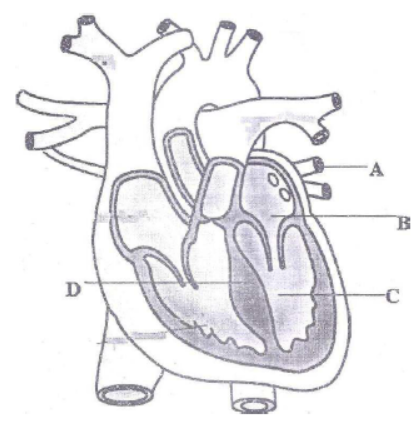
(b) What is the function of the parts labelled as A and D respectively.
(c) Give the location of human heart.
25. Explain how the increased demand for construction of houses, shops, offices, roads and pavements affects the water table.
Please click the link below to download CBSE Class 7 Science Sample Paper Set N.
Free study material for Science
CBSE Class 7 Science Sample Paper Set 14 & Sample Question Papers for Class 7 Science
Class 7 Science CBSE Class 7 Science Sample Paper Set 14 PDF Download Guide
Explore downloadable sample sets for Class 7 Science. Utilizing the CBSE Class 7 Science Sample Paper Set 14 allows learners to gauge exam readiness and master official CBSE assessment structures.
Maximize Your Scores with Model Papers
- Exam Blueprint: Understand mark allocations and structural guidelines relevant to Class 7 evaluations.
- Targeted Improvement: Identify weak areas in Class 7 Science requiring focused revision.
- Pacing & Precision: Practice mixed question formats to build execution speed and ensure timely paper completion.
How to Analyze Your Performance in CBSE Class 7 Science Sample Paper Set 14
- Self-Evaluation: Score your answers using official guidance to track your academic progress.
- Mistake Correction: Class 7 pupils must re-solve questions answered incorrectly to master the correct method.
- Continuous Practice: Take additional Science sample modules online to maximize preparedness for CBSE evaluations.
FAQs
You can download the complete PDF for CBSE Class 7 Science Sample Paper Set 14 for free from StudiesToday.com. Our resources for Class 7 Science are updated for the latest academic session and follow the official exam pattern.
Yes, CBSE Class 7 Science Sample Paper Set 14 comes with detailed, teacher-verified solutions. We have provided step-by-step answers for Science to help students of Class 7 understand correct methodology and marking scheme.
Practicing this Science paper helps in time management and identifying important topics. For Class 7, solving mock papers is the best way to gain confidence and reduce exam-day anxiety.
Yes, all our study materials for Class 7 Science are provided in a mobile-friendly PDF format. You can easily download CBSE Class 7 Science Sample Paper Set 14 on your mobile device.