

Download CBSE Class 7 Science Sample Papers
Explore authentic exam practice materials through the CBSE Class 7 Science Sample Paper Set 16. Tailored for Class 7 learners, utilizing these Science sample papers ensures thorough preparation and strengthens time management skills before final CBSE evaluations.
Access CBSE Sample Papers and Solutions
Access the complete sample paper PDF for Class 7 Science below. Regular practice with these targeted mock exams builds familiarity with expected question patterns and chapter weightage to help secure higher marks.
CBSE Class 7 Science Sample Paper Set P. It’s always recommended to practice as many sample papers as possible before the examinations. Students can download the sample papers and also question papers of previous years to practice and score better marks in examinations. Refer to other links too for more sample papers.
Q.1 Fill in the blanks. (1×6=6)
i) Atoms are neither lost nor _______ in a chemical reaction.
ii) An antacid generally contains a _______.
iii) Heat causes a _______ in temperature.
iv) Digestion begins in the _______.
v) Food is carried from the leaves by pipes formed by _______ tissues.
vi) Lungs have millions of air sacs called _______.
Q.2 Choose the correct option. (1×6=6)
i) Which of the following is the symbol of gold -
a) Gd b) Ag c) Au d) Pb
ii) A soap solution is
a) acidic b) alkaline c) neutral d) none of these
iii) A black body with a rough surface is a good -
a) absorber & good radiator of heat b) reflector & poor absorber of heat
c) absorber & poor radiator of heat d) reflector & poor radiator of heat
iv) Plants store food as -
a) cellulose b) sugar c) glucose d) starch
v) The process by which a plant loses water through the stomata is called -
a) excretion b) respiration c) transpiration d) sweating
vi) Earthworms breathe through their
a) skin b) gills c) lungs d) none of these
Q.3 Name the following : (any six) (1×6=6)
i) An abbreviation of the name of an element.
ii) These are called as soluble bases.
iii) The fingerlike folds in the wall of the small intestine.
iv) These blood cells help to fight infections.
v) The blood vessels that carries blood away from the heart.
vi) The tiny openings on stems and fruits that plants use for breathing.
vii) A weight hung from a fixed point in such a way that it can swing freely.
Q.4 Give reasons for the following. (any three) (2×3=6)
i) An egg without its shell swells when it is placed in a bowl of water.
ii) Sour things (vinegar or pickles) are not kept in metal pots.
iii) While swallowing, the food enters the food pipe but it does not enter the wind pipe.
iv) The water moves up the stem against the force of gravity.
v) Carnivorous plants trap insects.
Q.5 Define the following. (any five) (2×5=10)
i) Valency ii) Convection
iii) Radiation iv) Speed
v) Excretion vi) Anaerobic respiration
vii) Respiration rate
Q.6 Draw well labelled neat diagrams. (any two) (3×2=6)
i) Clinical thermometer
ii) Land breeze & Sea breeze
iii) Different taste areas on the tongue
iv) Villi
Q.7 Answer the following in not more than 20 words. (any six) (2×6=12)
i) What are neutral substances?
ii) How does heat from the sun reaches the earth?
iii) Why is it better to wear lighter shades in summer?
iv) When is a moving body said to be in uniform motion?
v) What are autotrophs? Name an organism other than green plants that is an autotroph.
vi) Why is the heart divided into two halves by a thick wall?
vii) How do leaves of plants exchange gases with the atmosphere?
Q.8 Answer the following in not more than 40 words. Part (vii) is compulsory.
Select any five more.
i) a) What is a balanced chemical equation?
b) Find the valencies of the underlined element.
PCl3, Na2O
ii) Name three mineral acids and give their formula.
iii) Mention three changes that heat causes in substances.
iv) What is the juice secreted by liver called? What does it do?
v) How does sweating helps to maintain our body temperature?
vi) Why do gardeners loosen the soil from time to time ?
vii) During a dental check up in school, Rohan was told that tooth decay had just started at the top of his last large back tooth in the lower jaw. He shared this with his best friend Vikram who had good dental health.
Vikram advised him to prevent further tooth decay by giving some tips on dental health.
a) Name the tooth where decay had started.
b) What is the function of such teeth?
c) What value is displayed by Vikram.
Q.9 Answer the following questions in not more than 100 words. (any five) (5×5=25)
i) a) Name two elements that have variable valency.
b) Give the formulae & names of two compounds formed by each of these elements.
ii) a) What is acid rain?
b) Mention three bad effects of acid rain.
iii) Distinguish between Celsius & Fahrenheit scales.
iv) a) What happens to the radiant heat when it falls on a body?
b) What does the absorption of radiant heat by a body depend on ?
v) a) What are nephrons?
b) How do they help in the excretion of waste?
vi) How do roots absorb water from the soil? Also draw the diagram.
vii) How does oxygen from the air in the lungs reach the cells? Also draw the diagram.
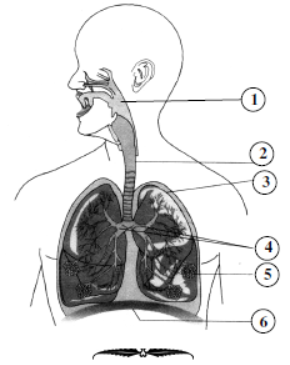
Q.10 Label the diagram. (any five)
Please click the link below to download CBSE Class 7 Science Sample Paper Set P.
Free study material for Science
Exam Preparation Sample Paper for Class 7 Science CBSE Class 7 Science Sample Paper Set 16
Class 7 Science CBSE Class 7 Science Sample Paper Set 16 PDF Download Guide
Explore downloadable sample sets for Class 7 Science. Utilizing the CBSE Class 7 Science Sample Paper Set 16 allows learners to gauge exam readiness and master official CBSE assessment structures.
Why Practice Class 7 Science Sample Papers?
- Curriculum Insights: Clarify chapter-wise weightage rules and question trends across Class 7.
- Gap Analysis: Check performance drops across sets to isolate specific Class 7 Science topics needing extra attention.
- Time Efficiency: Working through objective and descriptive problems builds critical pacing to finish exams comfortably.
Post-Practice Strategy for Class 7 Science
- Verify Answers: Compare your responses against professional teacher solutions provided in the sample paper keys.
- Error Analysis: Class 7 learners must review incorrect answers carefully to understand underlying mistakes.
- Concept Reinforcement: Consult the official NCERT book for Class 7 Science when stuck before re-attempting problems.
FAQs
You can download the complete PDF for CBSE Class 7 Science Sample Paper Set 16 for free from StudiesToday.com. Our resources for Class 7 Science are updated for the latest academic session and follow the official exam pattern.
Yes, CBSE Class 7 Science Sample Paper Set 16 comes with detailed, teacher-verified solutions. We have provided step-by-step answers for Science to help students of Class 7 understand correct methodology and marking scheme.
Practicing this Science paper helps in time management and identifying important topics. For Class 7, solving mock papers is the best way to gain confidence and reduce exam-day anxiety.
Yes, all our study materials for Class 7 Science are provided in a mobile-friendly PDF format. You can easily download CBSE Class 7 Science Sample Paper Set 16 on your mobile device.