

Official CBSE Practice Papers for Class 7 Science
Review targeted exam resources with the CBSE Class 7 Science Sample Paper Set 19. Built according to official CBSE standards for the 2026-27 academic year, these downloadable Class 7 Science sample papers support effective revision and performance tracking.
Solved Model Papers for Science
Navigate directly to the solved Science model papers using the digital viewer below. Each practice set includes detailed solutions, allowing students to instantly cross-check their work and identify areas requiring further revision.
CBSE Class 7 Science Sample Paper Set S.Sample Papers are the very important for every student. The sample papers should be practiced to gain extra marks in examinations. The sample papers have been prepared based on summative assessment1 and summative assessment 2 pattern. The sample papers have been prepared based on pattern of last year examinations and as per latest changes in the syllabus. Students, teachers and parents can download all CBSE educational material and very well prepared worksheets from this website. All CBSE educational material is developed by our panel of teachers, have also been submitted by CBSE teachers and students.
Section- A
(PHYSICS)
Q.1. Fill in the blanks:- (1)
(vii) Moisture laden winds are called _____________.
(viii) The central calm area of a cyclone is known as _____________.
Q.2. A man standing close and in front of a spherical mirror finds image having a small head and a fat body. What is the shape of (1)
(i) top part of the mirror?
(ii) bottom part of the mirror?
Q.3. Which effect of current does the filament in an electric bulb utilize? (1)
Q.4. Complete the analog- (2)
(i) speed of vehicles : speedometer :: speed of wind : _____________.
(ii) length : metre :: current : ____________.
Q.5. Differentiate between converging and diverging mirrors. (Give two points each) (2)
Q.6. Name a safety device based on the heating effect of current. How does it work? (2)
Q.7. How are thunderstorms caused? (2)
Q.8. Draw a circuit diagram of a dry cell connected to a bulb through a switch. Mark the negative and positive terminals of the cell and the direction of flow of current in the diagram. (2)
Q.9. Give reason, why- (3)
(i) When we blow over a paper strip, it blows upwards.
(ii) Concave mirrors are used as shaving mirrors.
Q.10. (i) Observe the diagram and write the aim of the experiment? (1 + 2= 3)
(ii) Why does the balloon inflate when it is kept under hot water?
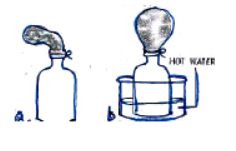
Q.11. Write down three precautions which one must take in advance to tackle with the problems created by a cyclone.
Q.12. (i) What is the underlying principle behind the working of an electric bell?
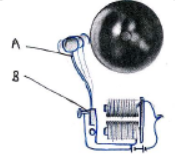
(ii) Identify „A‟ and „B‟ and tell their functions.
(iii) Why do we prefer to use an electromagnet instead of a permanent magnet in an electric bulb?
Section- B (CHEMISTRY)
Q.13 The process of preparing pure crystals of a substance from its concentrated solution is (1)
(i) Galvanization
(ii) Rusting
(iii) Crystallization
(iv) Weathering
Q.14 Clean water fit for drinking is (1)
(i) Potable water
(ii) Clarified water
(iii) Treated water
(iv) None of above
Q.15 The product formed when a zinc piece is introduced in a solution of copper sulphate is (1)
(i) Ammonium sulphate
(ii) Copper sulphate
(iii) Zinc sulphate
(iv) Zinc hydroxide
Q.16 Which of these soil particles are largest in size (1)
(i) Sand
(ii) Clay
(iii) Silt
(iv) Humus
Q.17 (i) State two conditions necessary for rusting. (1 +1= 2)
(ii)Give the word equation for the chemical reaction involved in the process of rusting.
Q.18 Label the diagram given below:
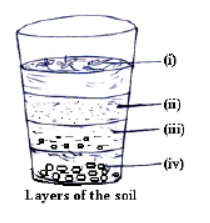
Q.19 Define the following: (2)
(i) Sewerage
(ii) Sewers
Q.20 Calculate the percentage of water absorbed by 90 gm of soil sample when the initial volume of water taken is 60 ml and the final volume of water is 30 ml in the measuring cylinder. (2)
Q.21 (i) Complete the following word equation: (3)
(a) Magnesium + Oxygen →___________
(b) Calcium hydroxide + Carbon dioxide → __________ + __________
(ii)Arrange clayey, sandy and loamy soils in the increasing order of their percentage of water absorbed.
Q.22 (i) What is the function of bar screens? (3)
(ii)Expand STP.
(iii)What is activated sludge?
(iv)Which horizon of soil is the home for soil organisms?
Q.23 (i) Name the following: (1 + 2= 3)
(a) Breaking down of rocks by the climatic changes.
(b) A section of soil showing distinct layers of soil.
(ii)Trees help in making the soil as well as protecting it. How? (2 points)
Q.24 (i) Why oils, fats and paints should not be discharged in the household drains? (5)
(ii)Which gas is produced during anaerobic decomposition of sludge?
(iii)Give the chemical name and formula of the product formed when magnesium
ribbon is burnt in air.
(iv)Classify the following changes into physical and chemical changes:
(a) clothes being ironed
(b) burning of petrol
(v) How can you show that iron is more reactive than copper?
Section- C [27] (BIOLOGY)
Q.25 Name the organ of respiration and the type of excretory waste produced by fish. (1)
Q.26 Which scientist was called the „circulator‟? (1)
Q.27 (i) The cells which prevent blood- loss during injury are called ___________. (1)
(ii)The pulse is observed in _____________.
Q.28 (i) Root : Sweet Potato :: Leaf buds : _________________. (1)
(ii)Yeast : Budding :: ________________ : Fragmentation.
Q.29 Correct the statement: (1)
(i) Sepals, Petals and Ovary fall off after fertilization.
(ii) Each detached part of Rose plant develop into new plant.
Q.30 How is dispersal of seeds beneficial to plants (1 point). (1)
Q.31 Observe this figure and answer the question given (2)
(i) The arrow marks are showing movement of which substance?
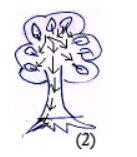
(ii) In which direction is this substance moving?
(iii) Name the tissue in which the substance is moving.
(iv) Vascular tissue is made of the above tissue and __________.
Q.32 On exhaling into a particular solution, it turned milky. (2)
(i) Name the solution and the gas which turned it milky.
(ii) Why do plants die when they are over watered?
Q.33 Explain how forests help to prevent. (2)
(i) Soil erosion
(ii) Global warming
Q.34 (i) Flowers with both stamen or pistil are called _____________. (2)
(ii)Which type(s) of pollination will they show?
(iii)Give one example of such a flower.
Q.35 Observe the following figures:
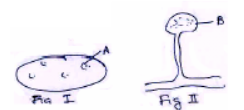
(i) Which type of asexual reproduction is shown by Fig. I and Fig. II?
(ii) What is the name given to part A and part B in above figures.
Q.36 What are decomposers? Give two examples of decomposers. (2)
Q.37 (i) The right ventricle contains ___________ rich blood and sends it out through a blood vessel called ___________. (3)
(ii)What is present between left and right side of the Heart and what is its function?
(iii)Exchange of materials between blood and cells occur through ___________. (veins/ capillaries)
Q.38 Choose the correct option: (3)
(i) Ovary contains ____________.
(a)Male gamete
(b) Female gamete
(c) Pollen grain
(d)Ovule
(ii) A fusion of male and female gamete occurs during
(a) Sexual reproduction
(b) Vegetative propogation
(c) Spore formation
(d) Budding
(iii)The Reproductive part of plant is
(a)Root
(b) Stem
(c) Leaf
(d)Flower
(iv)The part of the stem at which leaf arises is
(a)Leaf axil
(b) Axillary bud
(c) Node
(d) Internode
(v) The branchy part of a tree above the stem is called
(a)Canopy
(b) Crown
(c) Understorey
(d)Roofcover
(vi)The food chain begins with
(e) Herbivores
(f) Carnivores
(g) Green plants
(h)Omnivore
Q.39 (i) Draw schematic diagram of blood circulation in humans. (3)
(ii) Label Lungs and Pulmonary vein in the above diagram.
(iii)Name the following parts of human excretory system.
(a) The part which stores the urine.
(b) The part which contain tiny filtering units called nephrons.
Please click the below link to access CBSE Class 7 Science Sample Paper Set S.
Free study material for Science
Download CBSE Sample Papers: Class 7 Science
Download Sample Paper: CBSE Class 7 Science Sample Paper Set 19 (Class 7 Science)
Explore downloadable sample sets for Class 7 Science. Utilizing the CBSE Class 7 Science Sample Paper Set 19 allows learners to gauge exam readiness and master official CBSE assessment structures.
Maximize Your Scores with Model Papers
- Exam Blueprint: Understand mark allocations and structural guidelines relevant to Class 7 evaluations.
- Targeted Improvement: Identify weak areas in Class 7 Science requiring focused revision.
- Pacing & Precision: Practice mixed question formats to build execution speed and ensure timely paper completion.
How to Analyze Your Performance in CBSE Class 7 Science Sample Paper Set 19
- Review Solutions: Evaluate your completed papers using expert-verified guidance inside our solution sets.
- Target Weaknesses: Class 7 students should analyze missed questions to rectify conceptual misunderstandings.
- Deep Revision: Re-read sections in the NCERT book for Class 7 Science to clear doubts before solving items again.
FAQs
You can download the complete PDF for CBSE Class 7 Science Sample Paper Set 19 for free from StudiesToday.com. Our resources for Class 7 Science are updated for the latest academic session and follow the official exam pattern.
Yes, CBSE Class 7 Science Sample Paper Set 19 comes with detailed, teacher-verified solutions. We have provided step-by-step answers for Science to help students of Class 7 understand correct methodology and marking scheme.
Practicing this Science paper helps in time management and identifying important topics. For Class 7, solving mock papers is the best way to gain confidence and reduce exam-day anxiety.
Yes, all our study materials for Class 7 Science are provided in a mobile-friendly PDF format. You can easily download CBSE Class 7 Science Sample Paper Set 19 on your mobile device.